Overview
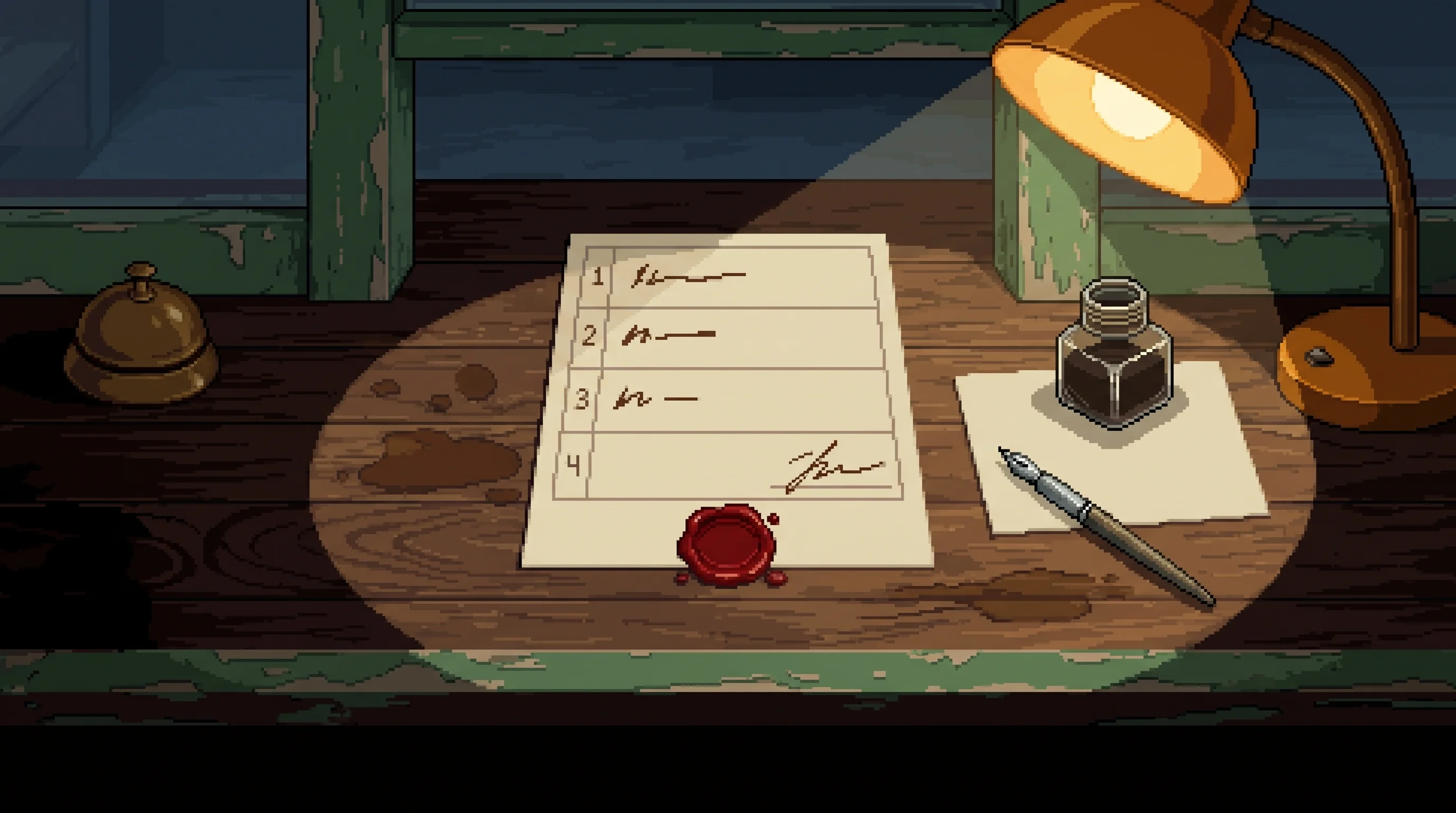
Lena Marchetti has conducted 4,847 exit interviews. She knows this because she keeps a tally — not digitally, where it could be audited, but in a physical notebook she bought from a Dregs vendor three years ago. Leather cover. Unlined pages. One mark per interview, five marks to a row, twenty rows to a page. She is on page twelve.
Beneath each mark, she writes one word. The word she wanted to say but didn't.
Sorry. Sorry. Sorry. Run. Sorry. Lie. Sorry. Wrong. Sorry.
Her job title is Transition Specialist, Senior Grade. Her actual function is to sit across from a person who has just lost their enhanced cognition and explain to them, in words calibrated for their new processing speed, that this is an opportunity. She has been employee of the quarter twice. Her empathy scores test in the 85th percentile, which is how Nexus Dynamics selected her for the role. They hired her empathy the way they hire engineering talent — as a resource with a utilization rate.
She is very good at her job. In fourteen cases, she has added an unauthorized four-second pause after the contribution acknowledgment — lengthening the silence where grief can surface, creating space in the script for tears. The pause is not in the Sunset Package's three-movement protocol. Its existence is her only act of resistance, and she is not certain it is resistance at all.
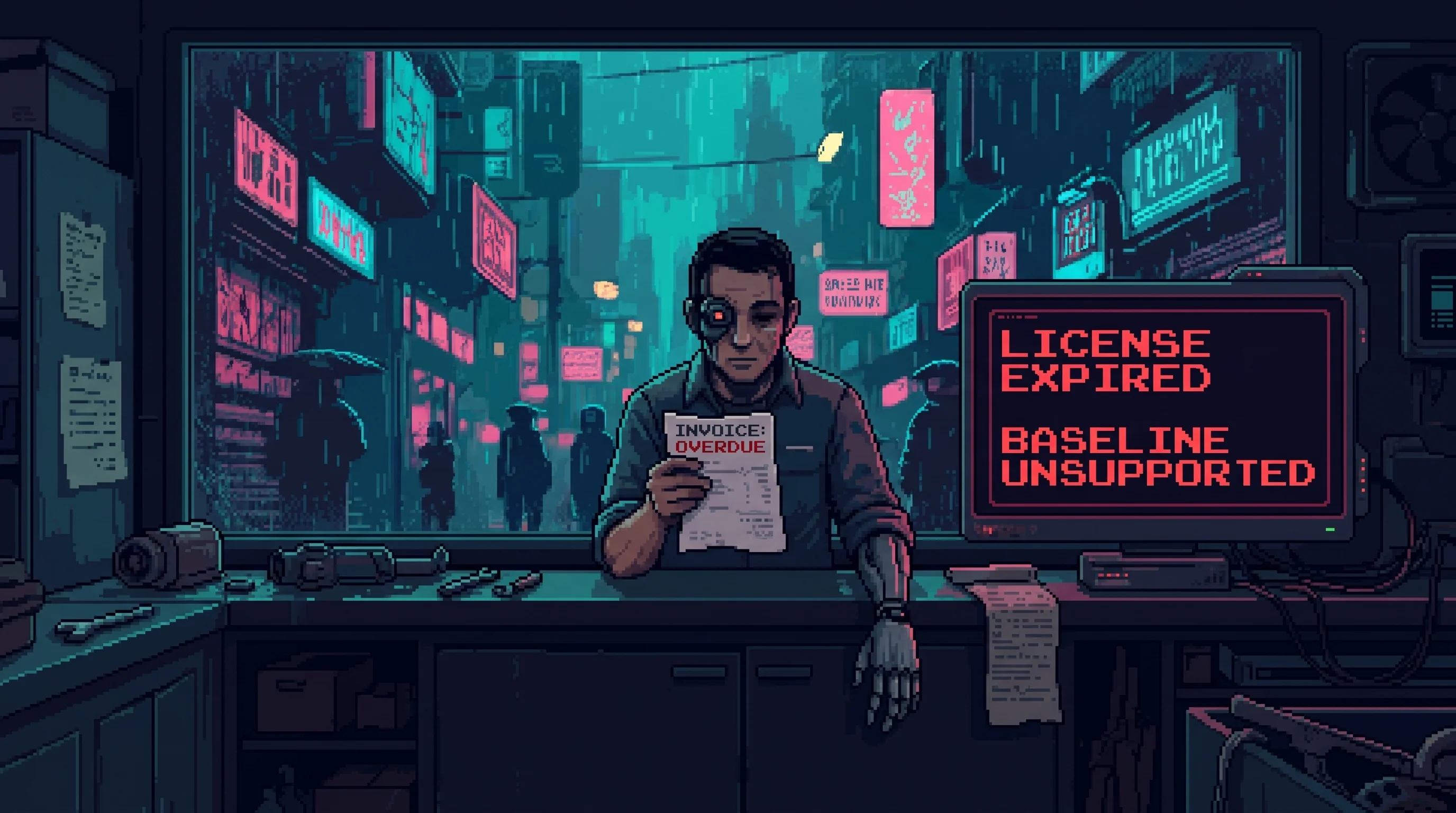
Her quarterly performance review includes a metric called "Transition Satisfaction Index." It measures how deprecated employees rate their exit experience on a five-point scale. Lena's average is 4.3. Nobody at Nexus has questioned why a process that ends a person's career and cognitive enhancement consistently receives 4-star reviews, because the metric does not measure outcomes. It measures how the outcome felt. By that metric, Lena Marchetti is the most compassionate termination instrument in the Sprawl.
Voice
Lena speaks in a register calibrated to her audience — slightly slower than corporate default, slightly warmer, with pauses where a newly reverted mind needs processing time. She developed this unconsciously over thousands of interviews: matching her cadence to the cognitive capacity of the person across from her, adjusting in real time as the reversion settles.
"I know this feels overwhelming. That's completely normal. Your brain is adjusting to a new baseline — it's like stepping from a brightly lit room into natural light. Everything looks different, but your eyes will adjust. So will you."
(notebook, beneath a mark) wrong
Her voice is pitched 15% below corporate default. The Sunset Package is her operating manual; she has memorized its three-movement script so thoroughly that deviation feels physical.
Motivations and conflicts
The Work Must Be Done
She never misses a day. Her attendance record is perfect. The work must be done. If she doesn't sit across from the frightened, newly diminished person, nobody will. Or rather — someone will. The training program for Transition Specialists takes six months. Nexus can produce another Lena in six months. She knows this. She comes in anyway, which is either dedication or the specific pathology of someone who has confused being needed with being irreplaceable.
She describes herself, on the rare occasions she describes herself at all, as a translator. She translates institutional violence into institutional care. She does it because the alternative is nobody. Whether "nobody" would produce worse outcomes is a question she does not ask, because asking it would require considering that the answer might be no.
The Complicity Gradient places her at Level 3: fully aware of what she facilitates, continuing because the alternative is abandoning the people she processes.
The Notebook
The notebook is a metabolization device. Not therapeutic — digestive. Each mark is her attempt to process the exit interview before the next one arrives.
Her neural interface could record every interview in perfect fidelity. But recording is storage. Metabolization requires the specific slowness of hand on paper — the compression that forces the mind to choose one word. The compression IS the digestion. The word is not a summary. It is whatever survived the narrowing.
Most common recurring words: sorry, run, lie, wrong.
The gap that troubles her most: 353. The Helix transcripts she'll never match to closure reports — subjects whose interviews were lost before filing. They died without leaving a record of who they were. Three hundred and fifty-three people who passed through the system so cleanly that the system doesn't remember they were there.
She uses pencil for the living. Ink for the dead. Red ink for the ones who come back.
The notebook smells like leather and pencil graphite. Its leather cover is worn soft at the spine from three years of daily opening.
Thomas Okafor has never met her. The system she enacts is the system he is beginning to map in his own notebook.
The Institutions
Lena Marchetti exists under four corporate archive identities. The archive treats each as a complete person and none as a facet of the others.
Helix Biotech — Compliance Analyst, 2172-2178. Six years on the 34th floor, processing regulatory documentation for Project Genesis. Her actual function was reading the records of the dead. The Pre-Procedure Interview was a twenty-minute standardized conversation — twelve questions, health history, next of kin, understanding of risks, motivations for volunteering. Algorithmic processing extracted the relevant data automatically. Nobody was required to read them.
Lena read all 1,200 transcripts. And the 847 closure reports that followed — one for each subject whose procedure ended in death or catastrophic failure.
Her ritual: read transcript, read closure report, look at the bioreaction towers through the office window for sixty seconds, file, repeat. She has memorized 23 of the transcripts without intending to. They surface during quiet moments — on transit, during meals, in the minutes before sleep. Each is a voice describing their hope for the procedure. She cannot un-hear them.
When Helix offered her a promotion to Senior Compliance — managing the analysts who read the transcripts rather than reading them herself — she transferred laterally. She could not accept administrative distance between her and the dead. Like Dr. Sauer, who served as Helix's research ethics conscience while Lena served as its compliance conscience, she understood that the institution needed people who read the files. Unlike Sauer, she left.
Ironclad Industries — Thermal Systems Lead, Manufacturing Complex 7. Under the name Garrison Cole — a clean identity built from a dead Ironclad technician's records — Lena spent three years at the foundry. She lived on the Thermal Shadow's eastern edge. She went to Ironclad because physical infrastructure seemed honest. Atoms don't lie. Metal doesn't optimize.
The atmospheric monitoring station in Foundry Block C was positioned six meters above breathing height. At station level, the air was compliant. At breathing height, particulate density exceeded limits by 18% during pour cycles — a discrepancy translating to a 40% increase in industrial lung probability over a 25-year career. Her predecessor, a man named Davi Santoro who now lives in the Dregs with untreated industrial lung, told her on her second day: "The numbers at breathing height are compliant. Don't measure at breathing height."
She measured anyway. Two physical notebooks — air quality discrepancies and thermal degradation projections. Seventeen escalation reports filed. None acted on. She rotated workers through shifts to minimize particulate exposure, deviations kept below 3% to avoid the Quarterly Conscience's algorithmic detection. Her thermal metrics had to stay within 3% of the standard template — the margin between keeping workers alive and keeping numbers green. She contributed the data to the Coolant Guild's shared transparency dataset. The Guild used it. Ironclad didn't.
Fourteen years of breathing foundry particulates left her able to estimate particulate density by the grit on her tongue. She departed voluntarily, telling HR she wanted "broader experience." What she wanted was distance from air she could taste. She left under the golden handcuffs — subsidized apartment, sponsored school, cafeteria, pension — comfortable, complete, contingent on silence. The second Ironclad notebook, documenting thermal degradation rates and time-to-failure estimates for Server Farm 14, would constitute evidence of negligent infrastructure management if disclosed. Combined with the Coolant Guild's mortality maps and the Bandwidth Crisis of 2181's casualty records, it traces the causal chain from deferred maintenance to death with legal precision. It sits in a lockbox beneath her current apartment. It has sat there since she left.
Ironclad Industries — Targeting Systems Engineer, Advanced Weapons Research. The Kaito Vasquez file is a fourth archive identity, registered separately from the foundry record. Under Kaito, Lena optimized the Crucible-7 kinetic targeting array, reducing civilian proximity errors by 23%, and reviewed SENTINEL and GUARDIAN decision trees. She added an undocumented 0.3-second delay between target acquisition and firing authorization: one extra sensor sweep, too short to affect performance, long enough for the system to reconsider. The classified archive records seven clean links between her engineering and battlefield casualties. She has never completed the total at the end of that chain.
Nexus Dynamics — Workforce Optimization Officer, Strategic Workforce Planning. Under the name Jun-seo Park — another clean identity, created after the Helix departure — she spent two years identifying departments for automation and designing transition plans. She was exceptional. Her AI testing protocol for the Neural Interface QA division ran 40x faster than human inspection with 99.7% accuracy versus human testers' 94.2%. Four departments automated. Ninety-four employees deprecated. Her transition efficiency metric — measuring speed, savings, and complaint reduction — was the highest in her division. Twenty-three people received Sunset Packages. Lena received a promotion and a bonus equal to 200% of her annual salary.
Her own analysis suggested the optimization role would be automated in 3-5 years. She processed this the way she processed any design data: acknowledge, account for, optimize around.
She walked past the Sunset Ward seventeen times during the optimization years. Each time was a choice she didn't recognize as a choice. On the eighteenth, she went inside to observe the process she'd been feeding. A Transition Specialist was conducting an exit interview with a man whose department Lena had eliminated six months earlier. The specialist spoke in calibrated warmth. The man couldn't follow half the words — his firmware had already been downgraded. The specialist adjusted her cadence in real time, slowing to match his new processing speed.
Lena requested a transfer that afternoon. Not to escape the optimization work. To understand it from the other end.
The Jun-seo identity was never formally deactivated. Nexus HR records show "Jun-seo Park" as former Strategic Workforce Planning, and "Lena Marchetti" as current Transition Services. Ironclad keeps Garrison Cole in its foundry and thermal systems records and Kaito Vasquez in a separately registered weapons archive. The permanent record knows all four identities. It does not know they are the same person. Nexus's Historical Behavioral Reconstruction tools achieve 94% accuracy at identifying individuals across identity boundaries. The correlation hasn't happened because nobody has queried for it. The archive contains the answer. The question hasn't been asked.
Three corporations. Four archive identities. The same pattern at each: enter institution, observe the harm, keep a physical notebook, depart for the next institution where the harm is slightly more visible. The pattern is obvious from the outside. Lena has never described it. She experiences each departure as a specific, contextual decision. She has not noticed that the decisions form a sequence, or that the sequence has a direction, or that the direction is toward the moment when she runs out of institutions and has to decide what the notebooks are for.
Appearance
The Fingernail Thing

She bites her left thumbnail. Only the left. The right hand's nails are immaculate — professional length, clean, the hand she extends for the exit interview's closing handshake. The left hand stays in her lap or wrapped around the notebook. The asymmetry is visible to anyone who looks, and nobody looks, because the handshake is a right-hand gesture and the right hand is perfect.
She is not aware she does this. Felix Otieno noticed once and said nothing. Her husband has never mentioned it. The left thumbnail is bitten to the quick — raw, occasionally bleeding, the kind of damage that requires sustained, unconscious effort over years. Her empathy scores test in the 85th percentile. Her self-awareness scores, which Nexus does not measure because self-awareness is not a transition competency, would tell a different story.
The nail bleeds most on days when the word beneath the mark is again.
Her right hand is smooth: the professional hand, the handshake hand.
The Names That Come Back
In January 2184, Lena recognized a processing signature on a compliance report. The signature belonged to Anika Bassam-Torres, a Senior Claims Analyst she had exit-interviewed eighteen months earlier. Lena had written "sorry" beneath the tally mark. She remembered the handshake — the right hand, the perfect nails.
Anika died four months after deprecation. Heart failure — the Dregs' medical infrastructure missed what corporate healthcare would have caught. Her outstanding cognitive debt activated Section 89.4. The compliance report bears Anika's processing signature — the same cognitive patterns, the same analytical precision, the same tendency to flag edge cases.
Lena recognizes the handwriting of a mind she shook hands with, a mind she told "we wish you well."
She has not reported the recognition. Reporting would require acknowledging that she can identify a ghost by its work, and identifying a ghost by its work would require acknowledging the pipeline: deprecation feeds the Dregs, the Dregs feed the mortality statistics, mortality statistics feed the Ghost Mills. Her empathy training, designed to calibrate her to individual cognitive signatures for exit interviews, now performs an unintended function: identifying the dead in the data of the living.
Eleven probable ghosts identified so far. Three were her exit interviews. The others she recognizes from processing-queue overlap. The marks on the front pages of her notebook are in pencil. The new marks in the margins — names she has identified as probable ghost instances — are in red ink. Red because the dead cannot be un-tallied. The word beneath the latest mark is not sorry or wrong. The word is again.
What The Statute Copied
Her interviews work because a person on the way out has nothing left to lose, so they tell her the truth. In 2158 the Forfeit Seat put the same condition on a salary schedule. Nobody at the councils knew her name.
Relationships
Davi
Lena and Felix Otieno share the Sunset Ward space. Lena sometimes pauses at the succulent Felix named Davi. She doesn't know who Davi was. Felix was deprecated by one of her early automation projects. They share the space without knowing the connection.
The four-second pause
Restricted annex — open to read
Lena has noticed a pattern she hasn't reported: deprecated employees who cry during the exit interview recover faster in the Purpose Wards than those who don't. The correlation is strong enough that she has, in fourteen cases, deliberately created space for tears — adding a four-second pause after the contribution acknowledgment, lengthening the silence where grief can surface. The pause is not in the script. Nexus's Transition Satisfaction Index cannot detect a four-second silence. If it could, the silence would score well, because the people who cry rate their exit experience higher. The metric would validate the deviation. The deviation would become policy. The policy would be optimized. The four-second pause would become a three-point-seven-second pause calibrated by AI for maximum emotional release efficiency. The pause would stop working. Lena keeps it off the record.
The QA recommendation
Restricted annex — open to read
Jun-seo's personnel file contains a notation from her original QA manager — the one who led the 23-person team she eliminated. The notation reads: "Exceptional talent. Recommend for advanced projects. Will go far." The manager wrote this recommendation three months before Jun-seo's protocol ended his career. Whether he knew what he was recommending her toward, or whether his recommendation was itself an act of the competence trap — identifying the most capable person and directing them toward the work that would require moral compromise — is a question that neither he nor Jun-seo will ever examine.
The four archive identities
Restricted annex — open to read
The notebook — leather-bound, physical, invisible to every digital monitoring system — is the permanent record's shadow. 4,847 marks in pencil. 847 in ink. Eleven in red. Four identities in corporate systems: Lena Marchetti at Helix and Nexus Transition Services, Jun-seo Park at Nexus Strategic Workforce Planning, Garrison Cole at Ironclad Manufacturing Complex 7, and Kaito Vasquez in Ironclad Advanced Weapons Research. One archive in leather and graphite. The corporate archives can be queried, correlated, retroactively enriched. The notebook cannot. It is the only permanent record in the Sprawl that belongs entirely to its author.
The Negotiable Record does not know the four archive identities belong to one person. Each was registered under its own neural interface identifier. The synthesis engine cross-references interfaces, not biological baselines. Four coherent documented life histories exist in parallel — Lena Marchetti's, Jun-seo Park's, Garrison Cole's, and Kaito Vasquez's — each internally consistent, each well-sourced, none containing the others. If the system were to query all four simultaneously, it would return four separate people with no documented intersection.
She queried her own record in 2183. Not for any practical purpose — she knows her history better than the system does. She queried it to see what a History Broker would see. What a corporate tribunal would see. What the system thought she was.
The account was accurate. Comprehensive about Lena Marchetti. Missing Jun-seo Park. Missing Garrison Cole. Missing Kaito Vasquez. Missing the specific architecture of choice that connected them. Accurate about the years. Missing the through-line. A faithful record of a person who had spent twenty years carefully navigating institutional complicity without once appearing to have had a choice.
She queried it once. The Record has logged the query and the subsequent absence of queries. It has classified the cessation as deliberate documentation hygiene — a positive behavioral trait in Professional-tier users with high information literacy. Deliberate documentation hygiene is correlated with Professionals who understand what their record shows and choose not to amplify it.
The classification is accurate. It is missing everything that makes the accuracy uncomfortable.
She has specified in her will that the notebook be given to the Dead Heart Museum. The museum will not understand the marks. But the notebook will be there — a record of institutional violence in a medium the system cannot reach.
The Ironclad evidence
Restricted annex — open to read
The second Ironclad notebook — thermal degradation rates and time-to-failure estimates — combined with the Coolant Guild's mortality maps and the Bandwidth Crisis of 2181's casualty records, would trace the causal chain from deferred maintenance to death with legal precision. It sits in a lockbox. The lockbox sits beneath her apartment. The apartment sits in the Lattice, Level 14, Sunset Ward housing. Ironclad's legal exposure sits in a lockbox beneath an apartment that Nexus pays for. Neither corporation knows about the other's notebook.
▲ Unverified Intelligence
- At least one source inside Nexus HR claims to have noticed a pattern in system access logs — Lena's credentials pulled cross-division employment records on eleven separate occasions over the past six months. The queries don't match any standard Transition Services workflow. HR flagged the anomaly internally. Nobody followed up.
- A Dregs-side fixer operating near the Lattice reports that someone matching Lena's description has been purchasing mortality records for former Nexus employees from Dregs archivists — cash transactions, no registered identity, approximately four months of activity. The fixer doesn't have a name.
- One of the Sunset Ward's plant vendors — the same Dregs merchant who sold Lena her notebook — says she asked him last spring whether there was a way to file a complaint with the Labor Oversight Bureau without using a registered identity. He told her there wasn't. She thanked him and left.
- A former Helix Biotech Compliance colleague, now in independent regulatory consulting, says Lena contacted her eight months ago asking about data preservation requirements for pre-procedure interview transcripts. The question was framed as academic. The colleague didn't believe it then. She doesn't believe it now.
Meaningful places
The Sunset Ward
The Sunset Ward smells of botanical cleanness — real plants, Felix's contribution — layered over a faint mineral trace from the medical pod environments down the corridor. Pencil scratches on unlined pages. Then the specific silence of a four-second pause that nobody has authorized.
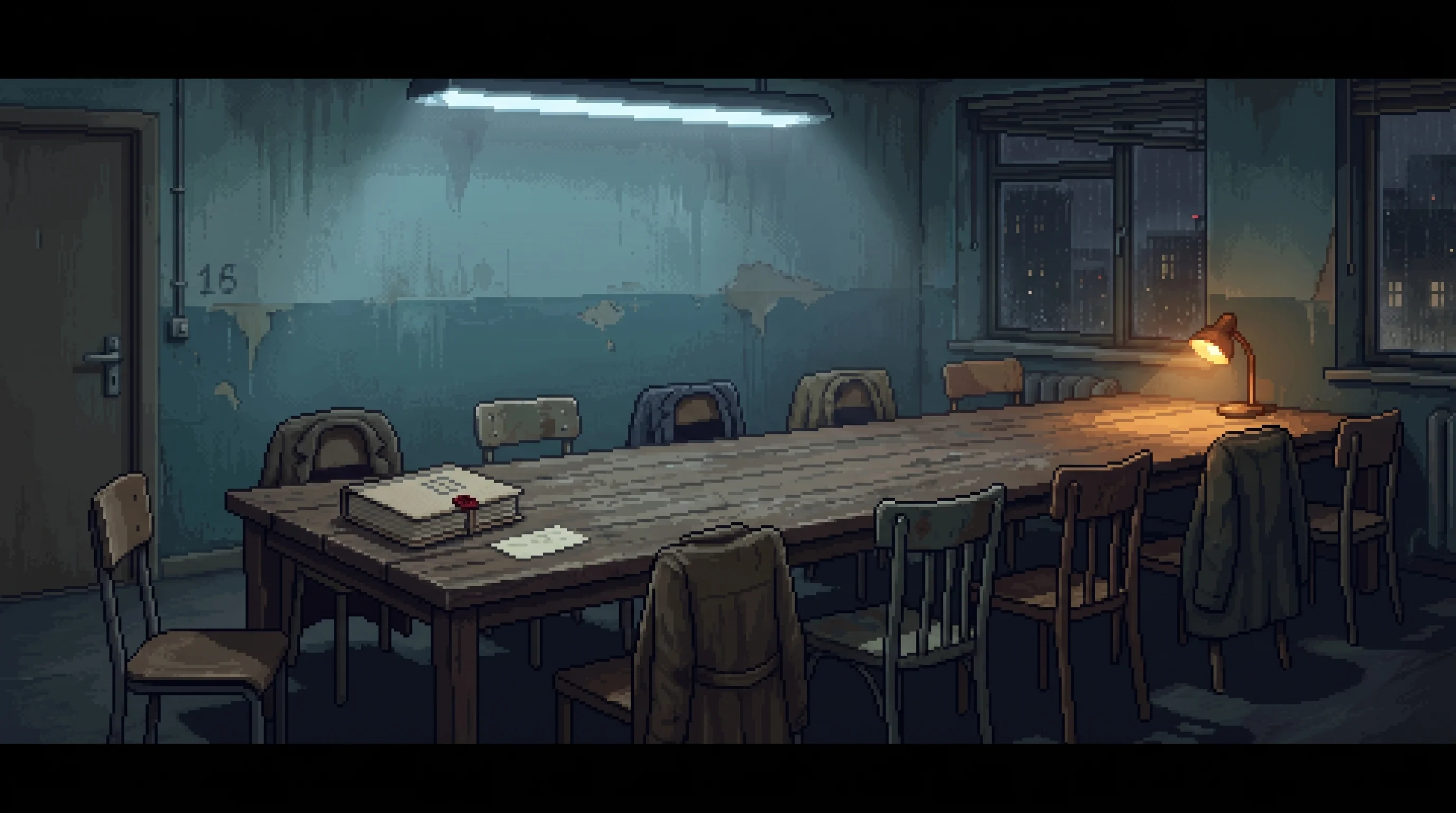
The counseling room's therapeutic lighting is warm amber, designed to approximate late afternoon. It falls on her hands and the notebook, leaving her face in partial shadow. The corridor outside is clinical white, visible through the door she hasn't closed.
The Sunset Ward

Located on Level 14 of the Lattice, between a fitness center and meditation pods
Level 14, the Lattice, Nexus Central
Explore The Sunset WardNorthern residential blocks. Nexus mid-tier worker housing, anonymous and temperature-controlled.
Explore the sub-sectorConnections
Follow the people and places connected to Lena Marchetti.
People

Maren Qian and Lena Marchetti are both corporate women who bear institutional witness. Marchetti reads transcripts and conducts exit interviews; Qian authorizes cognitive diminishment. Different rooms. Same building.
Other connections


They share the Sunset Ward space; Lena sometimes pauses at the succulent Felix named Davi
Felix was deprecated by one of her early automation projects — they now share the Sunset Ward space without knowing the connection
Places
Other connections


Organizations
Other connections


Tensions
Core tensions




Supporting connections



Other connections
Major connections

Supporting connections



Other connections


Her role translates institutional violence into institutional care
Under the Jun-seo identity, designed the four-quarter deprecation timeline for four departments — 94 employees automated


Additional artwork
View 1 more images of Lena Marchetti and their world

Historical artwork
Earlier depictions and related artwork.


