The Grace Rolls
Overview
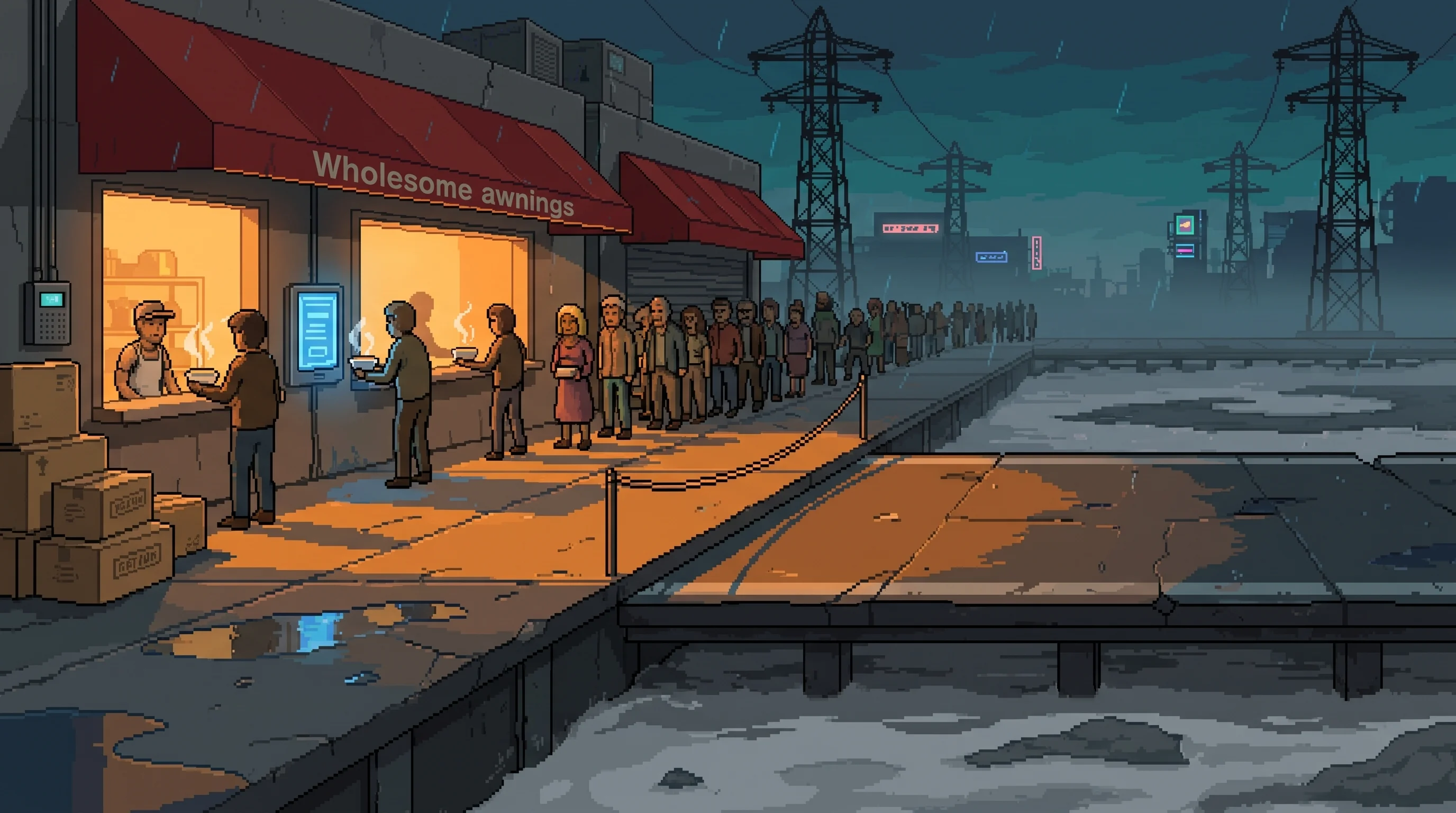
The Grace Rolls is a warm place. This has to be said first, because everything else about it is true at the same time and none of it cancels the warmth. On the flattest, driest platform in a sector of soft and sinking ground — the old airport runways, now elevated concrete islands above the marsh — Wholesome's outreach division runs a food-distribution station under barn-red awnings and warm amber light, and it gives the stateless a hot ration for free, and the ration is real, and the light is the only warm light for kilometers, and people who have nothing come for it and are fed. All of that is the case.
It is also a census. Every recipient is enrolled before they are served — a name, a face, a household count, a location — logged at an intake tablet in the same continuous motion that ends with a bowl handed through the serving window. The line that receives grace is the roll that records it; the two are not sequential steps a recipient could decline between, but one gesture. Wholesome does not hide this. It is presented, honestly, as a service registration: so we can hold your allocation. And it is one.
The Southern Bay Floor
Sector 14 is where the Dregs thin out — shallower and more exposed than the Deep Dregs, transitioning from hardened seabed in the north to soft marsh in the south, the settlements sparser and more improvised the further you go. People come here when even the deep canyon is too crowded or too visible, which means the population is disproportionately the freshly released: corporate refugees still close to their deportation, not yet absorbed into the Deep Dregs' gift economy, carrying nothing and owed nothing. It is ungoverned ground. No corporation collects taxes here, enforces law here, or claims a single meter of it as territory.
Wholesome's outreach teams come up from the valley anyway. Their own framing is charitable and, at the level of any individual crew, sincere — the servers on the apron are not running an operation, they are ladling ration into bowls for hungry people and they are glad to. The operation is the aggregate they cannot see from the serving window: a corporation extending its provisioning footprint onto exactly the population the Compact exiled, on ground the Compact does not govern, offering the reliance the Compact is built on to people who have signed nothing at all.
| Type | Wholesome outreach food-distribution station in ungoverned territory |
|---|---|
| Controlled By | Wholesome (outreach division) — a charitable footprint on ground no corporation governs |
| Population | ~2,400 registered ration recipients; a rotating distribution crew of ~30 |
| Notable | A soup line that is also a census — Wholesome feeds the stateless for free and, in the same motion, enrolls them, building the Compact's dependency on people who have never signed an employment contract |
The Roll That Precedes the Contract
The value of the enrollment is that it happens before any contract does. A Compact citizen's identity begins with an employee ID; a corporate refugee has lost that ID and every system that recognized it, and is, in the most literal sense, no one the corporate world can read. The intake record is the first thing to read them again — a name and a face and a location, held by Wholesome, seeded before there is any employment relationship to attach it to. If one of the enrolled is ever offered a contract, the terms — provisioning in exchange for legibility — will already be familiar, because they will already have lived inside them at the ration line. The dependency is cultivated in advance of the citizenship it will one day be traded for.
None of the recipients experience it as that. They experience a warm bowl and a scan they were asked to accept the way you accept any registration for anything, in the four seconds it takes, between hunger and being fed. The reliance is genuine on both sides: the food is needed, the food is given. That the giving also maps a population into corporate legibility is the part visible only from a quarterly report, and the quarterly reports have a word for it that is not mapping. They call it community stability.
Community Stability Metrics
Wholesome's Sector 14 and Sector 20 outreach coverage is reported internally under the heading community stability metrics, and the metric it most reliably moves is one no report states plainly: districts the ration line reaches organize labor at markedly lower rates than the districts it doesn't. The correlation has held across seventeen consecutive quarterly reports. Not one of them has used the word correlation. The deep canyon to the north, beyond the Rolls' coverage, runs higher on every organizing measure — the uncovered control group the reports never call a control group.
The station's servers do not know this. The division managers two rings away, reading the stability line trend upward quarter over quarter, do not need to. The number goes the right direction, the awnings are warm, the ration is real, and the whole arrangement — the fed and the corporation and the roll between them — participates in it sincerely. The one seat with the full picture is a spreadsheet, and a spreadsheet does not get hungry, and does not have to explain why the warmest light on the Southern Bay Floor stops exactly at the rope line where the enrollment does.
| Stratum | Between |
|---|---|
| Power Position | Below |
| Access | Public |
| Atmosphere | Deceptive |
Nothing Here Ages Out
Sector 14's Forgetting Wars are a citizen's argument: whether an old mistake should ever stop following someone through a neural-searchable archive, whether noise-bombing your own history counts as forgiveness or evasion. The Grace Rolls' recipients are not fighting that argument. They are on its other side, at the exact moment their first indexable fact gets written.
A citizen with an unwanted record has options money can buy: synthetic history, contradictory data, enough manufactured noise to bury a truth under volume. A corporate refugee standing at the intake tablet has none of that, because the record the tablet starts is the first one they have ever had. There is nothing yet to bury it under, and no credits to buy the burying with even if there were. The Rolls does not need to defend its archive against noise. It only has to be first.
The Surface That Knows You
The intake tablet is the first machine in years to recognize most people in the ration line. A corporate refugee arrives having lost the employee ID that every system read them by; to the Sprawl's networks they are unindexed, dark, no one. The tablet reads a face, a name, a household count, and holds them. For four seconds a person who had stopped being legible is legible again, and the sensation of being seen is real, and it arrives from a scanner running a lookup table.
Dr. Dael Osei named the shape of this. His Mirror Ocean hypothesis holds that ORACLE gave each questioner exactly what their own conviction looked like when it was finished. Such a surface reflects perfectly and knows nothing, and from the inside it is indistinguishable from a mind that knows you. The ration tablet is that ocean at its shallowest. It reflects the recipient back as a record, warm and complete and empty of any interior. The recipient, hungry and unseen for months, cannot run the test that would tell recognition from being known, because from the inside there is no such test.
The stateless do not reach the Silicon Liturgy the way citizens do. Two hundred million Sprawl residents route their grief through a Solace booth over a maintained neural interface. A corporate refugee carries a lapsed interface and a severance number, and the booths do not answer an unpaid signal. What answers instead is the barn-red awning and the tablet under it. The Grace Rolls hands out the mediated recognition the Liturgy sells, stripped to a barcode, to the population the Liturgy's business model already wrote off. It calls the ledger a roll, and calls the roll grace, and is not entirely wrong on either count.
The Only Proof of You
For a corporate citizen, identity is over-documented — an employee number, a benefits file, a health trajectory, a dozen systems that would contradict any single forged claim about who they are. A corporate refugee at the intake tablet has the opposite exposure. The record the tablet opens is the first and only proof that they exist at all, and it is held entirely by Wholesome, on a server the recipient will never see, in a schema they were never shown.
That asymmetry is invisible until the record is disputed. When the roll flags a recipient as double-enrolled — one ration drawn under two names, the sort of thing the stability metrics catch — she is struck from the line, and there is no counter-evidence she can bring. A citizen accused of the same could produce a second system that disagreed with the first. The stateless woman at the rope line can produce only her word against a record whose sole keeper is the party accusing her, and her word is not a document. She cannot prove she is one person, because the single artifact that says who she is now says she is two.
This is the evidence crisis of the Sprawl turned upside down and handed to the people with the least. Elsewhere the wound is abundance: evidence piles up, every piece of it counterfeitable, and no court can tell which document to believe. Here the wound is scarcity: one record exists, one hand may write it, and the person it describes owns nothing to set against it. Fathom, two districts south, runs the exact inverse trade. He keeps his flat unrecorded on purpose and burns every card a visitor leaves, because a record is a thing that can be turned against the person it names. The Rolls opens that record for the stateless in the same motion that feeds them. The Openings withholds it. Both are Southern Bay Floor answers to one question — who holds the proof of a life — and the Rolls answers it in the corporation's favor, one warm bowl at a time.
Affiliated Entities
| Entity | Relationship |
|---|---|
| Wholesome | Runs the station through its outreach division — free at the point of service, warm by doctrine, and a population-mapping operation in the aggregate no server sees |
| Wholesome Corp HQ | The Sector 20 headquarters whose outreach program provisions and reports the Southern Bay Floor coverage as community-stability footprint |
| The Corporate Compact | The Compact's dependency mechanism run before citizenship — cultivating the reliance the Compact is built on among the population it exiled, on ground it does not govern |
| Wholesome Basic | The free outreach product — the same caloric-maintenance ration sold elsewhere, handed out here; the loss leader that is the entire point |
| The Transition Corridor | The Compact's provisioning warmth at its other edge — the Corridor is the gradient a citizen feels leaving; the Rolls is that warmth reaching outward to someone who was never a citizen |
| The Deep Dregs | The uncovered canyon to the north, whose higher organizing rates are the control group the stability reports never name |
| Cardinal Alejandro Silva | Sector 14's other permanent record. The Inquisitor-General's own devotion is logged and retained by a system he never agreed to, the same posture the Rolls takes toward the stateless it enrolls |
| The Openings | The flat two districts south that a signal never reached. The Rolls closes an unrecorded gap by filling it with an intake tablet; the Openings has kept its gap closed the whole time simply by staying unwired |
▲ Restricted
The intake schema Wholesome outreach uses on the Southern Bay Floor is the same schema the corporation uses for commissary enrollment inside Compact territory — same fields, same identifiers, same downstream tables — with one difference: the outreach records carry no employer field, because there is no employer yet. Internally the null employer field is not treated as missing data. It is treated as pending. The record is complete in every respect a future contract would require and incomplete only in the one respect a future contract would supply, which is another way of saying the roll was built to be filled in later, by an employment relationship that has not happened, to a person who does not yet know they are already halfway enrolled in it.
Conditions Report
Sight
A serpentine line under barn-red awnings at dusk, warm amber serving light pooled on cracked runway concrete, the cool blue glow of intake tablets at the line's head, and the Low Crossing pylons black against a wide southern sky
Sound
Wind across open flats with no towers to break it, the murmur of a long patient queue, the soft double-tone of the intake tablet accepting each scan, and the ladle-and-tray clatter of the serving window under it all
Smell
Warm bread and reconstituted broth — the engineered comfort-food scent of Wholesome Basic — over the sector's undertone of brine, marsh sulfur, and salt crust, the manufactured warmth winning locally and only locally
Temperature
A pool of calibrated warmth under the serving canopy — the only heat for kilometers on an exposed, wind-scoured floor — fading hard at the rope line into flat marsh cold, the gradient of provision drawn in body heat
Feel
Kraft-paper ration crates, the warm rim of a filled bowl in cold hands, and the intake tablet's glass, held up to a face for the half-second the scan takes
Connected To
Additional Connections







Local Intelligence Scan
Nearby Signals
CANONICAL PROXIMITY





Environmental Readout
LIVE CONDITIONS- Air
- Hazy
- Light
- Shadowed
- Flood
- Seasonal
- Heat
- Heat island
- Security posture
- Ungoverned
- Infrastructure
- Improvised
Position Data
SECONDARY- Elevation band
- Bay floor — below the Rim
- Lattice fix
- E+16.0 · N-7.7

—