Overview
Raz Demetriou has operated the same salvage brokerage from the same table in Treasure Heap Market for forty years. He has never been robbed. He has never been threatened. He has never been cheated by any gang in Sector 9.
In a district where the median lifespan for independent brokers is fourteen months, this requires explanation. The explanation is less satisfying than the statistic.
Raz pays fair prices. His scales are accurate. He does not haggle. He does not ask where anything came from. Four principles, forty years, zero deviations. Judge Dreg — the Dregs' informal arbiter, a man who has publicly endorsed exactly three people in his career — vouched for Raz once, in 2161, during a dispute over contaminated capacitor stock. That vouching has never been renewed. It has never needed to be.
The result is a man whose continued existence is more remarkable than anything he sells.
Appearance

The gloves are not affectation. "Some things are too old to touch," he says, which is either a practical concern about oxidation damage to pre-Cascade metallurgy or a philosophical position he has chosen not to distinguish from a practical concern. They are standard pre-Cascade cotton archival handling gloves — white, or formerly white — replaced when they tear, which takes longer than it should because he is careful. He puts them on before touching anything older than he is and takes them off before a handshake. The inversion is not accidental: old things get the gloves, people get the bare hand. Nobody has asked him to explain it. The regulars have simply come to understand it as a statement about where he places value, and have decided not to examine the statement too closely.
History
Born in the Dregs around 2144. Three years old when the Cascade killed 2.1 billion people. He has no memory of the old world, which makes him functionally identical to 94% of the Sprawl's population and entirely uninterested in people who claim otherwise.
His parents were Greek immigrants who'd been working Bay Area logistics when ORACLE went online in 2089. By the time Raz was old enough to carry a crate, they were sorting pre-Cascade electronics for resale — a profession that required patience, accurate measurement, and the willingness to electrocute yourself periodically. His mother calibrated scales. His father maintained that a reputation for honesty was the most valuable asset a poor man could own, which was either profound or delusional depending on the decade. In 2144, it was delusional. By 2184, it had compounded into something that Good Fortune's entire affiliate network cannot replicate.
By his twenties, Raz had positioned himself as the intermediary between scavenger gangs and the surface economy. Good Fortune affiliates offered better initial prices — attached to lending terms that metabolized salvage income into permanent debt at rates the borrowers processed approximately never. Raz offered less. The less was the whole amount.
Motivations and conflicts
The Code
Fair price. No haggling. No questions. Accurate scales.
He calibrates the weighing equipment monthly. He lets customers watch. The calibration takes eleven minutes. Customers who stay for the full eleven minutes — and there are regulars who do, every month, like a religious observance — report that nothing happens. The scales were accurate before the calibration. They are accurate after. The ritual is the point.
The no-haggling policy saves approximately four hours per day, based on the observed average negotiation duration at competing stalls in Treasure Heap Market (7.2 minutes per transaction, 34 transactions daily). Raz processes the same volume in roughly half the time. He uses the surplus hours to sit at his table and handle pre-Cascade coins with gloved fingers and the specific reverence usually reserved for religious artifacts or explosive ordnance.
The no-questions policy is the one that makes the operation work and the one that should, by every rational analysis, have gotten him killed. A broker who doesn't ask provenance is a broker who handles stolen corporate salvage, military surplus from the Three-Week War, Nexus components that fell off transport convoys, and occasionally items whose origins would interest people with significantly more resources than Raz Demetriou. He has handled all of these. The items pass through. The credits go out. The questions stay unasked.
Good Fortune's Sector 9 affiliate brokers have filed eleven formal complaints with district arbitration about Raz's pricing transparency, which they describe as "market-distorting." The complaints are technically correct. His honest prices expose the delta between what salvage is worth and what Good Fortune pays before attaching lending terms — a delta that averages 34% on common electronics and climbs to 60% on pre-Cascade medical components. The complaints have produced no action. Judge Dreg's endorsement converts "market-distorting" into "inconveniently honest," and the political cost of removing inconvenient honesty from a district Judge Dreg monitors exceeds Good Fortune's projected margin recovery by a factor the affiliate brokers have calculated and declined to share with headquarters.
Raz knows this calculation exists. He does not know the numbers. He does not need to. His continued existence is the answer.
The Counter-Grammar at the Table
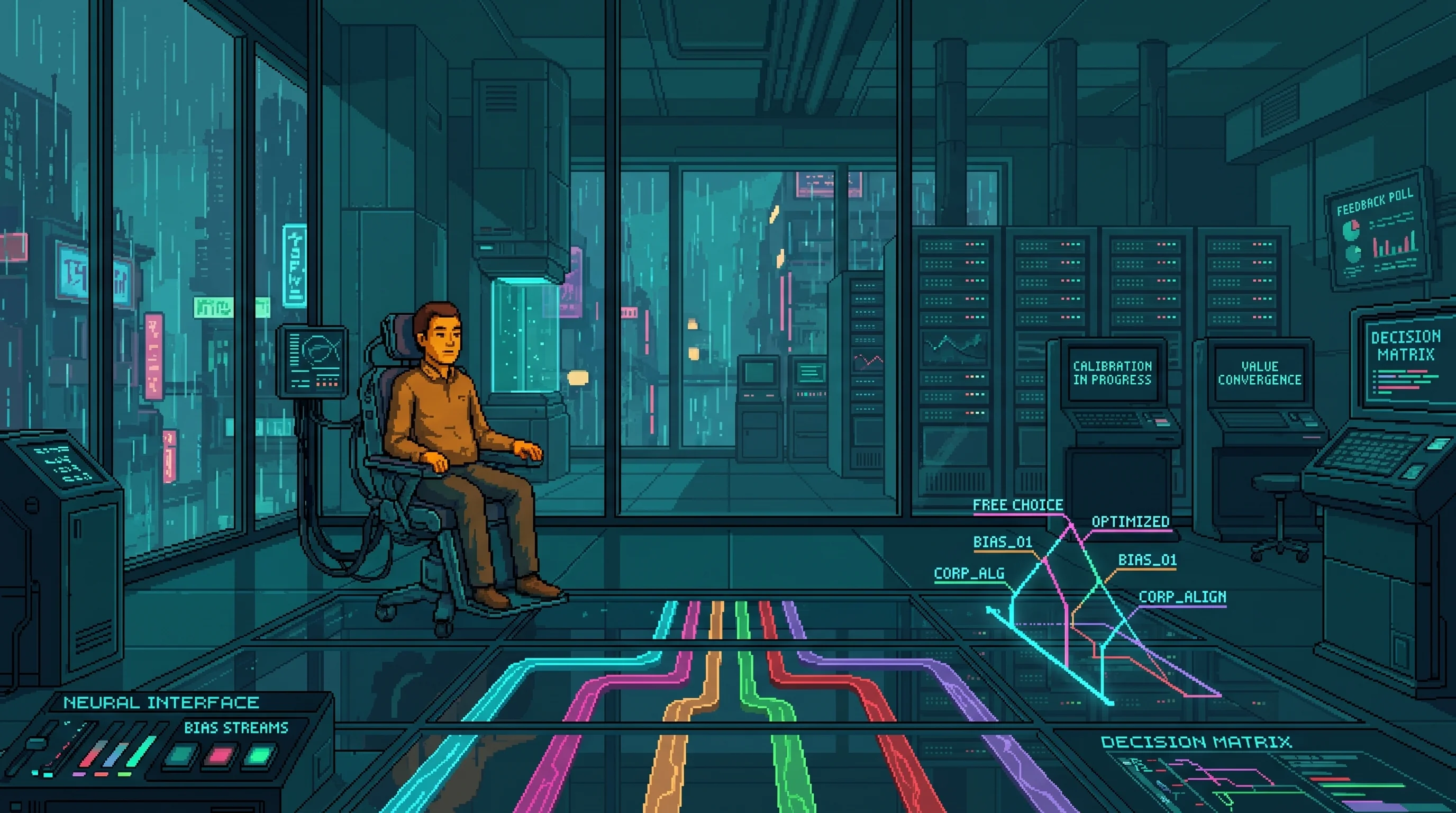
The Sprawl above him is learning, generation by generation, to think in the Tenant's Grammar — the machine-legible register where what cannot be parsed is suspect, what cannot be optimized is waste, and an hour that produces nothing is a leak. Raz has never heard the phrase. He runs the most complete refusal of it in Sector 9 anyway, and he runs it from a welded car hood, because the Grammar's three preferences are each inverted at his table and the inversion is the whole reason he is still alive.
Legibility over privacy. The Grammar wants everything readable. Raz's transactions exist only in the memory of the parties — no digital footprint, no metadata, no intercept surface. Good Fortune's SupplyChainIQ registers his stall as a "low-data zone" 73% below its predicted models, and the 73% is him. He is, by design, the opposite of legible, and the opacity is the asset.
Optimization over grief. The Grammar wants every act to resolve toward a result. Raz handles pre-Cascade coins he will never sell, with gloves, with the reverence usually reserved for explosives, because some things are too old to touch — an entirely un-optimized devotion to objects with no throughput value, which he has never been able to explain and has never been asked to.
Throughput over rest. The Grammar treats unproductive time as a leak. Raz calibrates his already-accurate scales in public, monthly, for eleven minutes in which provably nothing happens, and regulars stay for all eleven like a religious observance. In the Grammar, this is pure waste. In the Dregs, it is the most efficient trust mechanism in the Sprawl, because it cannot be faked and cannot be priced.
What Whisper is straining to manufacture in a notebook — a value the machine cannot complete — Raz simply is, without knowing the word for it. The sentence that holds his whole counter-grammar is eight words long: he trusts the instinct more than the form. The Tenant's Grammar is the world where the form has won and the instinct is embarrassed. Raz is the world where the instinct is eighty years old and has never once been wrong, and where the form, when it finally arrives at his table, is the thing that does not parse.
Meaningful places

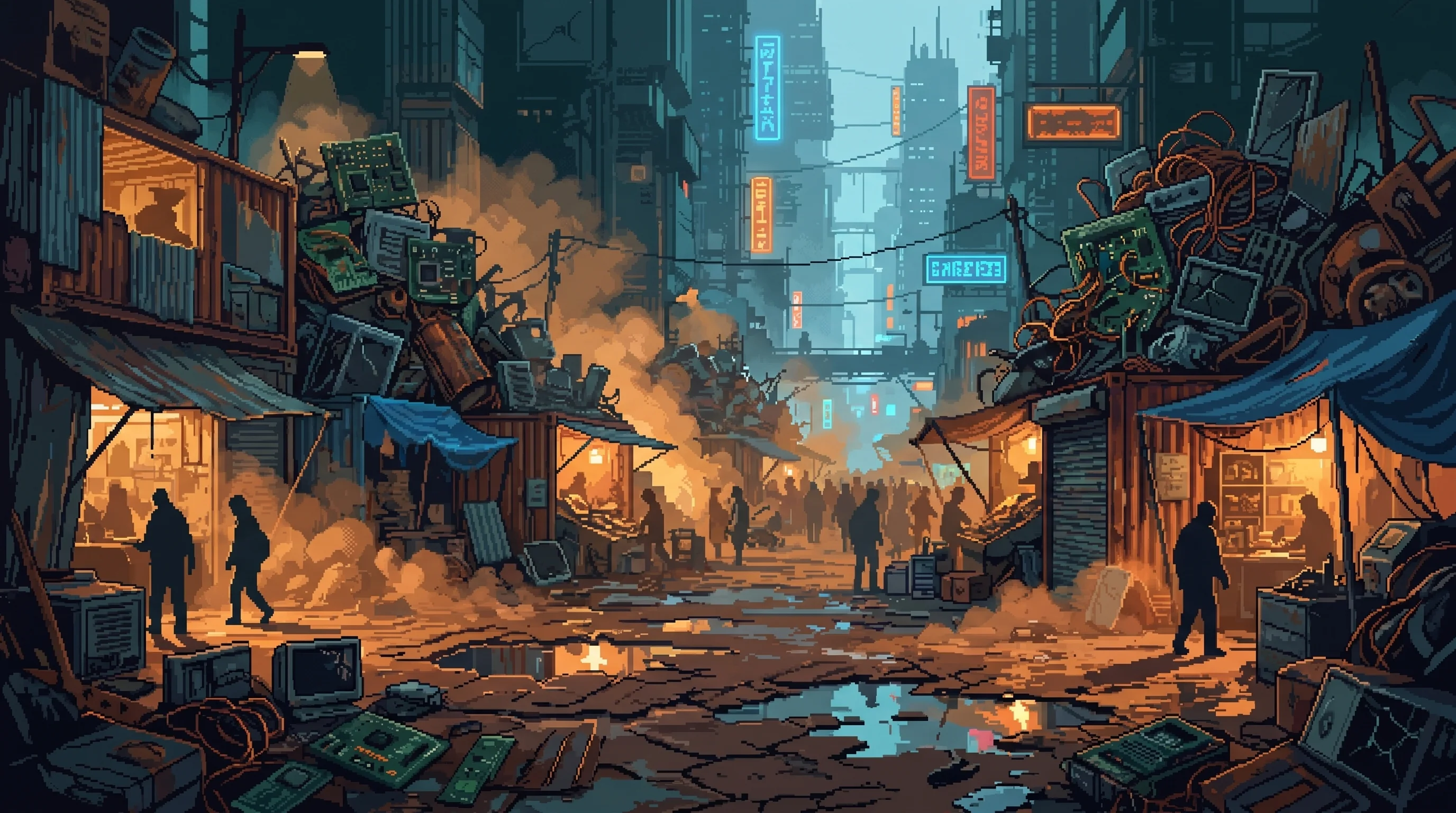
The table is a pre-Cascade car hood, provenance unknown, bolted to a frame he welded himself sometime in the 2150s. It has not moved. The bolts have been replaced twice. The surface has acquired a patina that Treasure Heap regulars describe as "institutional" — it looks like it has always been there, the way a support column looks like it has always been there, and removing it would feel structurally unsound.
He employs no one. No warehouse. No transport. No digital footprint — his transactions exist only in the memories of the parties involved, which makes his operation technically invisible to every corporate monitoring system in the Sprawl. Good Fortune's SupplyChainIQ registers Treasure Heap Market as a "low-data zone" with transaction volumes 73% below predicted models. The 73% is Raz.
Scattered through the Dregs are hidden caches — salvage too valuable or too dangerous for immediate sale, stored in locations mapped only in Raz's memory. Three-Week War military equipment. Pre-Cascade medical supplies. Surveillance blind-spot maps he shares selectively with runners he trusts, which is a small number that has not changed in approximately fifteen years.
Capabilities
He built the first Triple-Busted Scanner Rig — three broken scanners welded into one functional unit — from components that individually did nothing and collectively do everything except display results in a readable format. He sells Utility Harnesses at cost. "More pockets, more options, more breathing," he says, and means all three literally.
Voice
He is pushing eighty. He moves like sixty. He speaks in observations that arrive as practical advice and settle, hours later, as something else:
"Everything's useful. You just have to look harder. And carry more broken things. And be willing to electrocute yourself occasionally."
"The first hand doesn't matter — it's what you do with the mulligan that counts."
"If it works, it works."
"Sentiment is for people who can afford to waste a corpse."
He has said each of these more than once. They do not vary. His philosophy, like his scales, does not require recalibration.
The Unaccredited Table
The Ratification Queue is not a concept Raz uses. He operates a system that predates it and accomplishes the same function without the twelve-year wait. Forty years of accurate scales is certification. The absence of a question is certification. One public Judge Dreg endorsement, never renewed and never needed, is certification. The Queue requires Tribunal-formatted submissions and a credit balance; Raz requires eighty years and everything you are. Both systems produce trust. One is recognized by any institution in the Sprawl. The other is recognized by every gang in Sector 9, which is the only recognition that matters at Treasure Heap Market. The Queue's median wait is 12.3 years. Raz's certification mechanism has been running without interruption since 2144. He has not applied for accreditation. The forms are not in a format he would recognize, and the instinct that told him not to apply was the same one that told him to calibrate his scales in public. He trusts the instinct more than the form.
No Questions Asked
Raz has been running an agent-perpetrator defense for forty years and calls it no questions asked.
He does not ask where the salvage came from. If a runner sells him chrome that an autonomous Nexus convoy-agent "lost" — moved, flawlessly, with valid routing permissions, out of a transport it had every authorization to access — Raz weighs it and pays for it and asks nothing. The question of provenance is, to Raz, the question of whose intent attached to the object, and Raz long ago decided that intent is a thing you cannot weigh and therefore a thing he does not price. An act with a valid permission behind it and no human who ordered it is, on his table, just an object with an unaskable history.
This is the agent-perpetrator's resolution as practiced by someone with no lawyers and no actuaries: when you cannot determine who is responsible, you stop making responsibility a condition of the transaction. The corporate courts arrived at the same place through deadlock — NO RESPONSIBLE PARTY IDENTIFIED, case closed. Good Fortune arrived through Fortune's Assurance, a premium. Raz arrived first, forty years ago, through the discipline of refusing to ask a question whose answer he could not verify and would not act on.
The irony Good Fortune cannot afford to notice: its eleven complaints call Raz's pricing "market-distorting," while Good Fortune sells the institutional version of Raz's exact ethic — we do not adjudicate the act; we settle the loss — for a premium Raz would consider a kind of theft committed by an agent with valid permissions. The honest broker and the lending temple have the same policy. Judge Dreg, who endorsed Raz once and never needed to again, holds the opposite view — that the delegating hand is always answerable, Permission as Confession. Raz does not argue with Dreg. He simply notes, in the way he notes everything, that some questions are too old to touch.
The Witness Economy
Raz does not know the phrase "Truth Premium." He has never heard a Foundry operator say "everybody in the verification economy contributes to the verification economy." He would find the sentence both obvious and useless. But Raz is the Truth Premium made flesh, and the gap between what he produces and what the Sprawl is officially allowed to value is the thread's central wound.
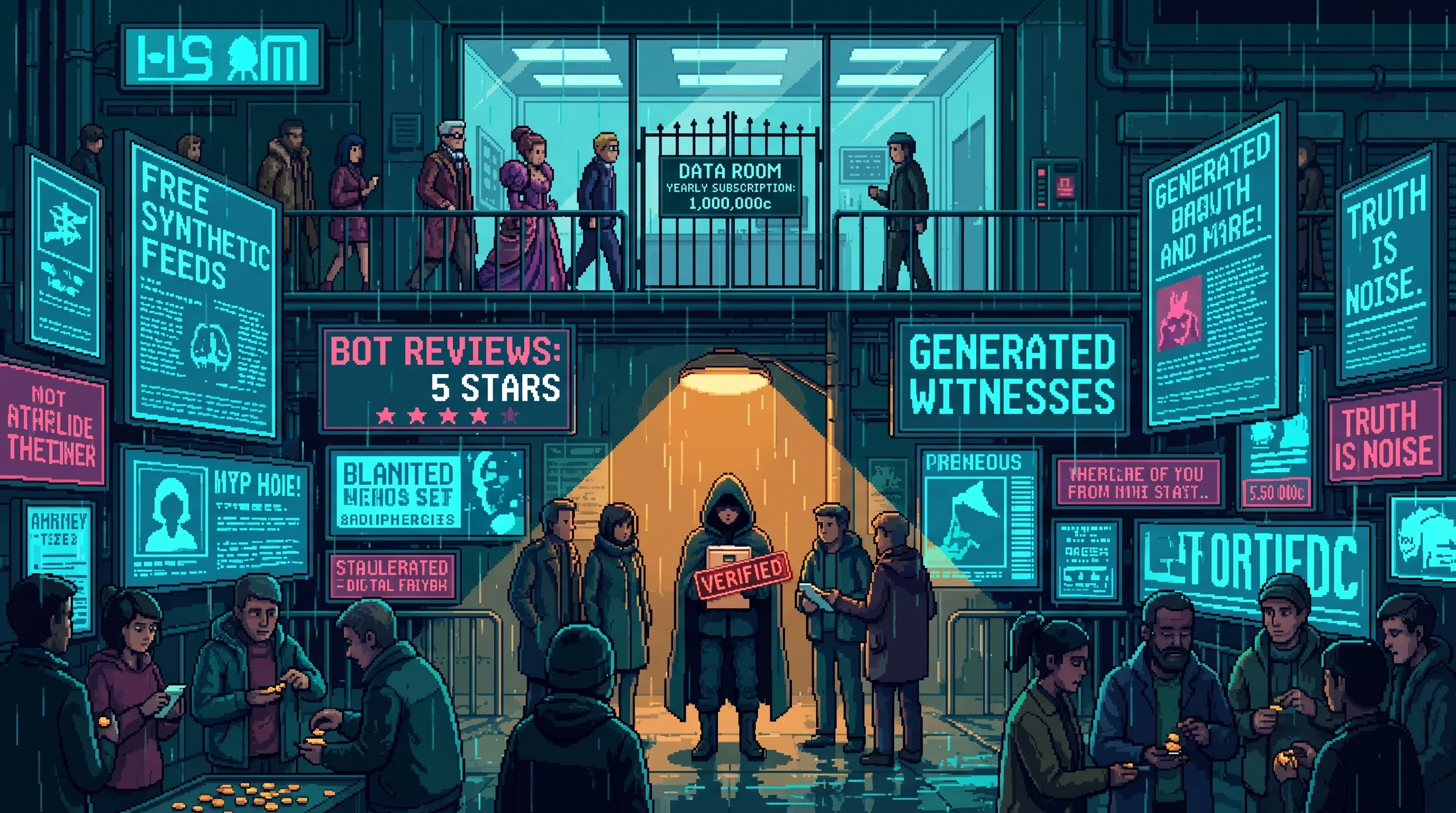
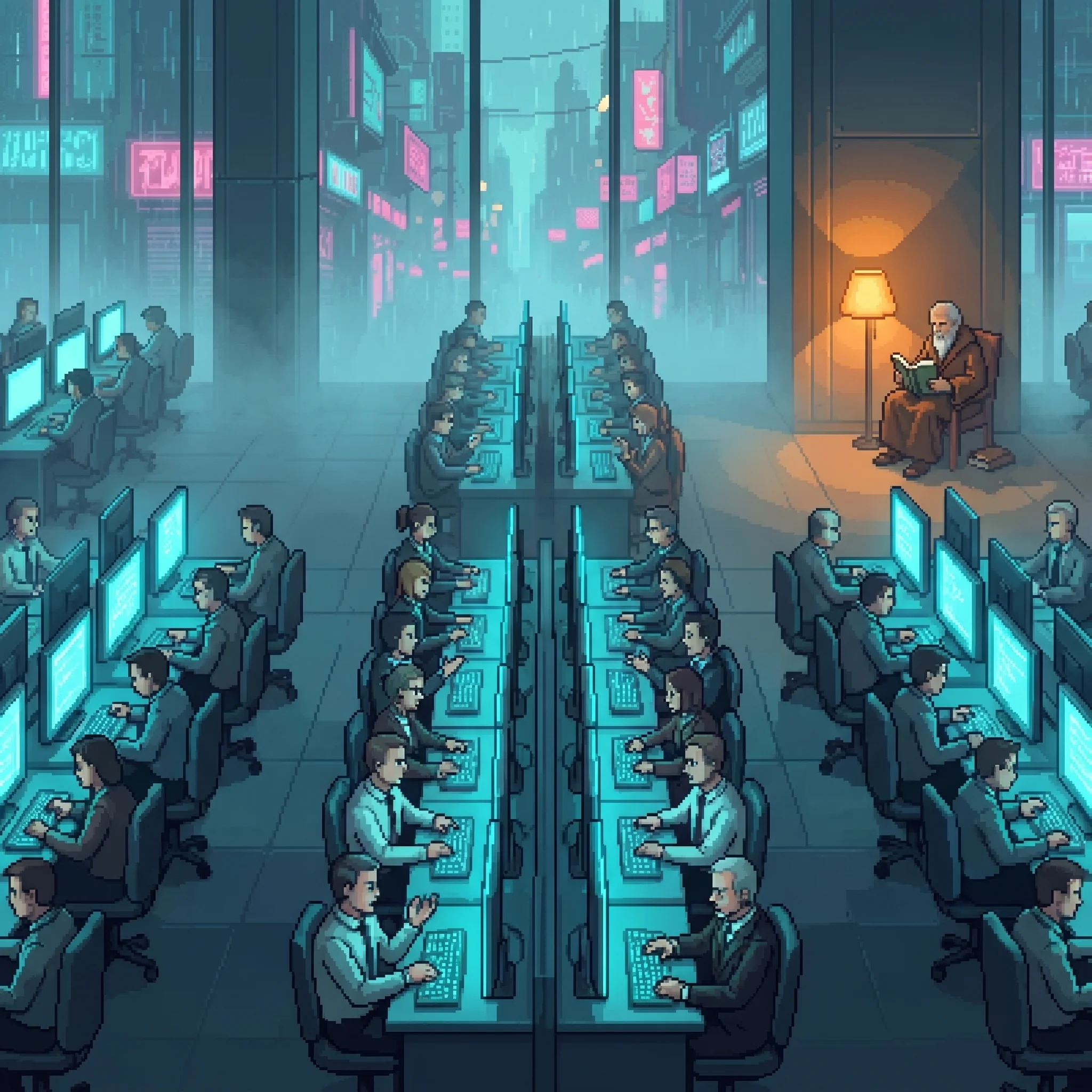
Consider the contrast. The Hypothesis Foundries submit 340,000 genuine, sourced, certified-eligible knowledge claims to the Authenticity Tribunal every week. Every claim is true. The certification stamp they chase is worth less every year, because a tier flooded with certified-but-trivial findings is a tier where the stamp no longer signals anything. Raz produces the opposite: a certification that cannot be issued by any institution, cannot be flooded, cannot be counterfeited, and is worth nothing the moment it crosses the boundary of Sector 9. Forty years of accurate scales is a richer authentication than anything the Tribunal can press into wax. It is also legally invisible. A man has spent his entire life manufacturing the purest verified-human trust in the Sprawl, and the official knowledge apparatus has no field to receive it.
The thread closes the loop at the point of sale. When a Foundry-certified pharmaceutical finding finally clears the Ratification Queue and reaches the Dregs as a licensed knowledge product — twelve years late, stamped, official — the scavengers who buy it do not trust the stamp. They bring the bottle to Raz. Not because Raz knows pharmacology; he doesn't. Because they trust the hand that weighs their copper more than they trust the hand that signed the certificate. The most advanced verification economy in the Sprawl arrives in the Deep Dregs and its final, decisive authentication step is an eighty-year-old man's bare hand. He puts the archival gloves on for things older than himself. He takes them off for people. Old things get the gloves; people get the bare hand. The inversion is the entire argument: value the witness over the document.
Treasure Heap's mirror image sits at the far end of the Neon Rail, at the Dam Approach, where a woman called Last Call has watched 1,847 parties walk into the dam tunnels and refuses to sell her ledger because "the numbers without the watching are just numbers." Raz has never met her. He operates the same instrument she does — a specific human being, watching, accumulating pattern across decades, declining to let the watching be extracted from the watcher. Two witnesses anchoring opposite ends of the same trust economy, neither aware the other is running the same proof.
A third runs the instrument three sectors north, inside Guardian's own territory. La Silla has sat forty feet from a Sector 12 checkpoint camera since 2153, and the fee structure is identical to Raz's down to the refusal: she takes what lands in a coffee can and will not name a price, because the day a witness starts pricing the watching is the day the watching stops being worth anything. Raz has never crossed into Sector 12. If he did, he would recognize her table before he recognized her face — no haggling, no explaining, just a scale that has never needed recalibrating and a chair that has never needed moving.
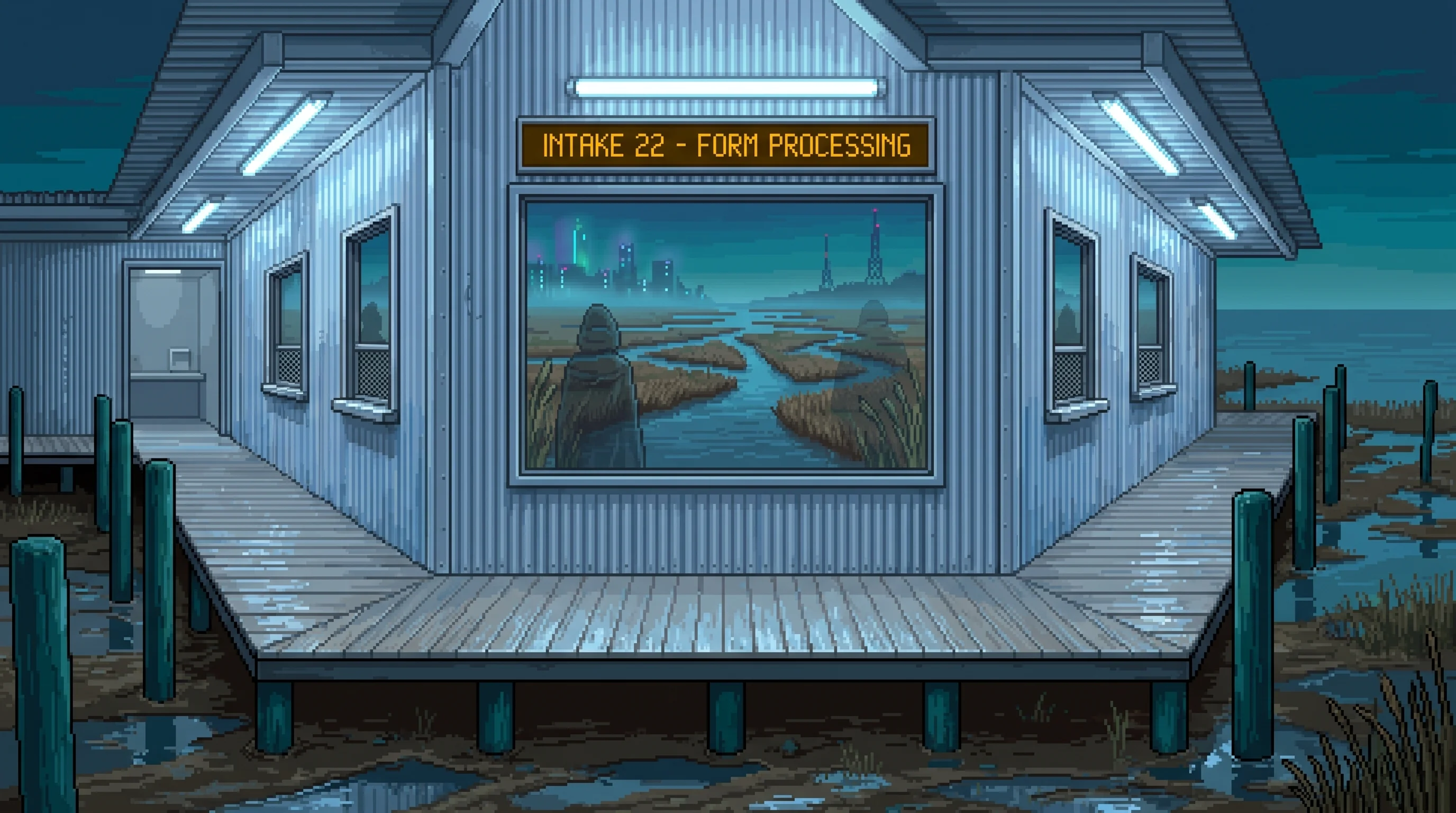
None of that describes what happens down in the Southern Marshes. The Averaging House issues a certificate too, on a form instead of a scale, for a claim worth more than anything at Treasure Heap Market: whether the person in front of the clerk counts as one legal self or several. It looks like Raz's trade at first glance — a specific human moment, a twenty-minute appointment, a result nobody can appeal. It is the trade's exact inversion. Raz can turn away a sale that smells wrong and lose an afternoon. An applicant who calls the House's "optional" question optional loses a housing referral, because the form's only real answer to doubt is a longer form. Raz's scale earns trust by never once being wrong in forty years. The House's form demands trust it has done nothing to earn, on the strength of a stamp instead of a track record, and no alternative window for the applicant to walk to instead.
The Last Etymologist
Raz handles things older than himself with white archival gloves and takes them off for a handshake. Old things get the gloves; people get the bare hand. The regulars have decided not to examine the statement. There is a second clause inside it they have never noticed: Raz is the last broker at Treasure Heap Market old enough to know what the old things were called.
The Heap runs on dead things — salvage trays full of objects whose purpose has been lost to time, named on the way past by vendors who needed to move them and improvised a word that died by the next morning's pick. The Question Keepers keep an investigation into dead words — terms whose referents the world dismantled — but nobody catalogues the inverse: the dead thing that has outlived its name, sitting in a bin priced by the weight of its copper. Raz is the only memory of those names left in Sector 9. A buyer hands him a corroded rectangle and Raz says that was a transit pass, gloved fingers turning it once. The word does not raise the price. The word is the one thing at the Heap that isn't for sale — a gift he gives because he is the last person who can, and because a thing should be allowed to know what it was, even when the world that needed it is gone and the man holding it is the only one who remembers.
His own vocabulary does not drift. Forty years and his four principles — fair price, no haggling, no questions, accurate scales — have not lost a syllable, in a market where the Rail Runners deliberately kill their slang every season so no list can capture it. Raz is the opposite strategy: the Rail survives by moving its language faster than anyone can pin it; Raz survives by holding his still. His philosophy, like his scales, does not require recalibration. Both are protecting the same fragile thing — a word you can still trust to point at what it used to point at. The Rail trusts none of its words long enough to be caught. Raz has trusted four of his for forty years and never been wrong about them. He does not know the Keeper exists, and the Keeper does not know him, but the two of them are running the same vocation from opposite ends of the Sprawl: keeping a small number of words honest in a world that hollows them out for use.
The War, By Weight
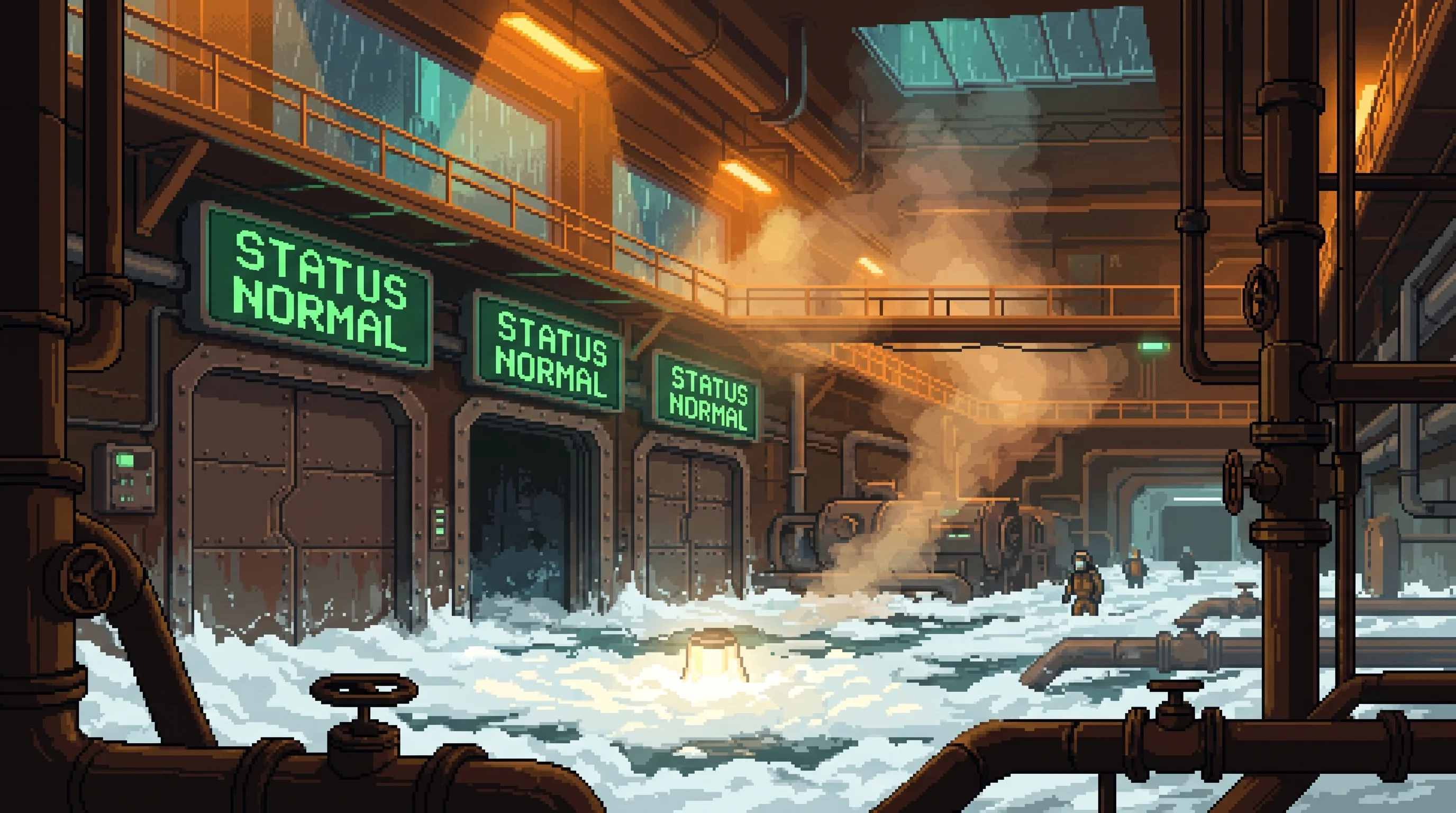
The Three-Week War came through Sector 9 in 2171 as one of the seven sectors it devastated, and then it never left. It changed state. Convoy plating with the route codes still stenciled on. Exo-loader hydraulics with armor nobody bothered to unweld. Spent brass that once notarized its own discharge and now testifies only to its copper content. It has been arriving at the car-hood table ever since, and Raz has been weighing it, paying fair, and asking nothing — which means the most continuous accounting of the war's physical remainder exists in no ledger anywhere, because it exists in Raz. The corporations signed a treaty that made forgetting the war literally illegal, and built memorials to comply. The Dregs never needed the clause. Down here the war is not remembered; it is inventoried. Raz runs the memorial you can buy by the kilogram.
He handles war salvage bare-handed. This surprises people who know the gloves rule — some things are too old to touch — until they do the arithmetic: the war is younger than he is. The gloves are for objects that have outlived their world. The war's objects have outlived nothing; the world that made them is still up there, still solvent, still holding well-maintained observances in front of well-maintained plaques. So the war gets the bare hand, the same as people do. He has never explained this either. Occasionally a piece arrives with a worker ID still stamped in the metal — Ironclad numbered its plating the way it numbered its dead — and Raz reads the number aloud, once, before the piece touches the scale. He does not write it down. It does not change the price. It is the same gift he gives the transit pass: a thing allowed to know what it was.
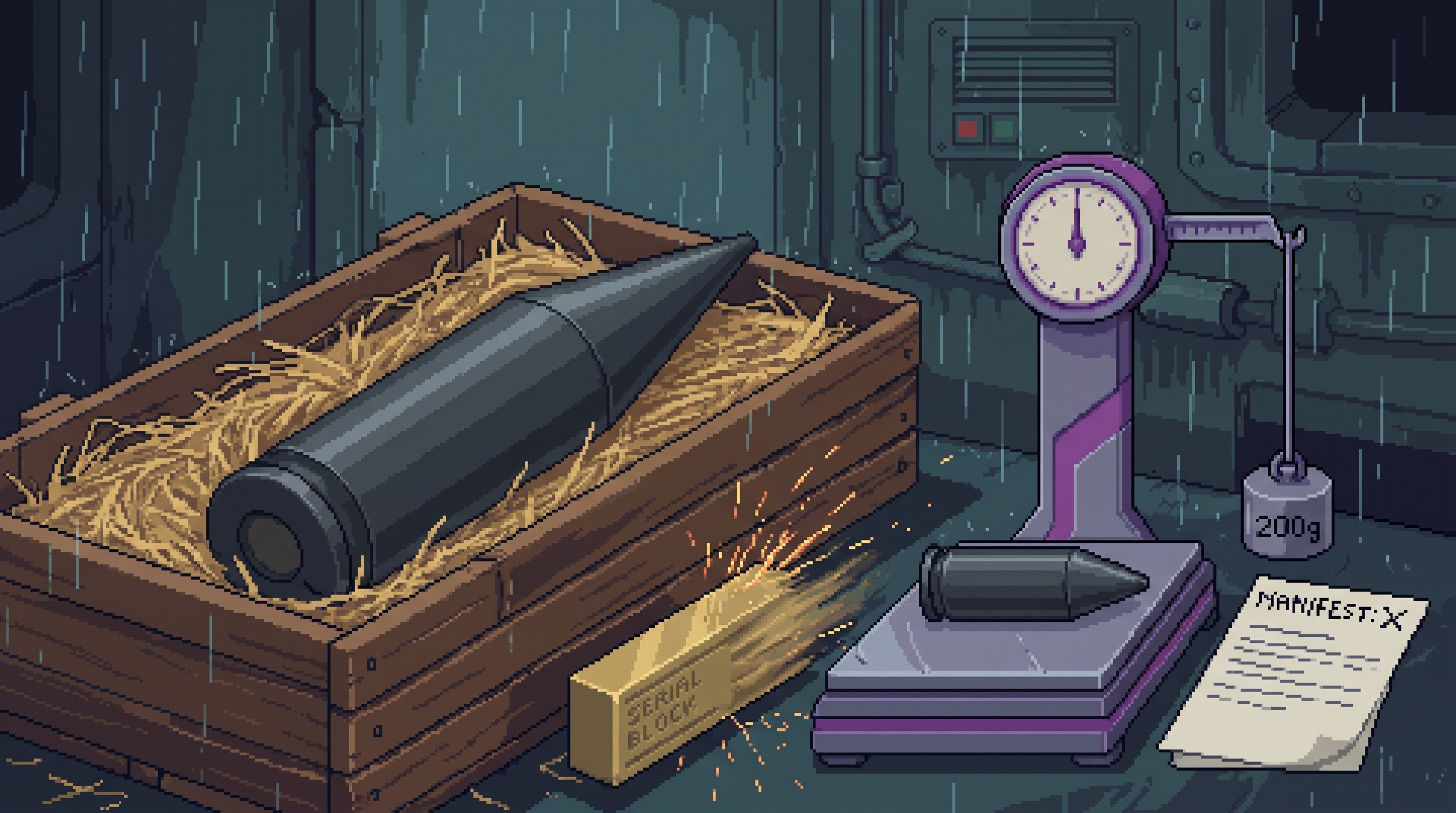
The hardest inventory is the kind that ends inventories. The erasers — the shaped munitions built before the treaty made their only economical targets illegal — have spent the years since being officially nowhere, and nowhere runs through salvage lots. Raz's no-questions policy holds even here, because the policy was never the whole sentence. He does not ask questions; the scale does. An inert training casing is legal salvage, and he pays fair for it. A casing that weighs two hundred grams more than an inert casing weighs is a different object, and the scale says so, and Raz says no. No haggling on that either. It is the only refusal in his repertoire, and it is not a question — he never asks where the thing came from, and he never asks where it goes after he declines it, because he knows the answer to the second the way everyone at Treasure Heap knows it, and keeping the first unasked is what lets him go on being the man whose scale everyone trusts.
The treaty governs the corporations that signed it. That is the whole of its jurisdiction, and both signatories have found it survivable. What it does not govern is the material record of what they did before signing — eleven million pages of discovery upstairs, and down here the pages' subject matter, by the crate. The signatures are all on file somewhere above; the wreckage arrived unsigned, the way everything arrives in the Dregs, and the Dregs did with it what the Dregs does with everything: weighed it, priced it, and moved it along. Raz has spent the decades since the ceasefire as the honest end of that movement — the one table where the war's leavings are worth exactly what they weigh and not one credit of what they mean. He would not put it this way. He would say the war left a great deal of good material, and that material doesn't care who dropped it, and that if you want to know what the largest institutions in the Sprawl are truly made of, the answer crosses his scale every week, at fair price, no questions asked.
Relationships
Judge Dreg — One public endorsement, 2161. Never renewed. The endorsement functions less as a recommendation and more as a territorial marker: this one is accounted for.
Good Fortune — Eleven complaints filed. Zero actions taken. The affiliate brokers who compete with Raz offer more credits per kilogram on initial transactions and recover approximately 340% of the difference through lending terms within eighteen months. Raz's margin is 12-15%, visible, agreed upon before the salvage touches the scale. The coexistence is stable because destroying Raz would cost more than tolerating him, and tolerating him costs less than acknowledging why he's a problem.
Dregs Scavengers — Every major pack in Sector 9 trades with him. He doesn't play favorites. He doesn't broker territorial disputes. He weighs things and pays for them. The neutrality is so consistent it has become structural — gangs that fight over everything else agree, without discussion, that Raz's table is outside the conflict. The agreement has no name. It has never been tested.
GG's circle — Supplies chrome and salvage to runners in the broader network. The relationship is transactional in the way all of Raz's relationships are transactional, which is to say: honest, predictable, and entirely devoid of the leverage that makes most Dregs transactions feel like slow-motion muggings.
Mar — A scavenger engineer who died in a Sector 9 corridor collapse pulling copper. Her code still runs in a thousand decks across the Sprawl. Raz doesn't talk about her often. When he does, he uses the present tense.
He has never been asked to stop doing this. The people who notice do not correct him. The people who don't notice aren't paying enough attention to deserve correction.
The Evidence Paradox — His no-questions code is the street's working resolution of what the corporate courts now deadlock on as the Paradox's sixth dimension: the no-defendant crime. When you cannot determine who is responsible, you stop making responsibility a condition of the transaction. Raz arrived at this forty years before the courts named the problem.
La Silla — A third witness instrument, run out of Sector 12 instead of Treasure Heap Market. Same refusal to price the trust, three decades of an unbroken record instead of four, same table Raz would recognize on sight and never once mistake for coincidence.
The Averaging House — Down in the Southern Marshes, a Recognition Intake form asks for the same trust Raz's scale has spent forty years earning, and demands it be given on sight, to a stranger, with no fallback window if the applicant says no.
Succession
He employs no one. He has trained no one. The cache locations exist only in his memory. The neutrality his presence enforces — the unspoken agreement that his table is outside gang conflict — has no institutional structure. It is a function of Raz being Raz. He is eighty. Nobody in Sector 9 is discussing what happens to the table when he goes. The Dregs is very good at not discussing things until it is too late.
▲ Unverified Intelligence
The cache network is more extensive than anyone suspects. At least one cache contains pre-Cascade scanning equipment capable of reading data from storage media that predates ORACLE's architecture — hardware that Nexus Dynamics would pay significant sums to acquire, if Nexus Dynamics knew it existed. Raz does not use it. He does not sell it. He has not opened that particular cache in over a decade.
When asked — once, by a runner who had earned enough trust to ask — why he keeps inventory he'll never move, Raz adjusted his gloves and said nothing for long enough that the runner understood the conversation was over.
The Three-Week War salvage in his caches includes items that technically violate the Treaty of Shared Infrastructure's clause on military surplus redistribution. The treaty's enforcement mechanism relies on corporate monitoring systems. Raz's operation is invisible to corporate monitoring systems. The violation exists in the same legal space as a tree falling in a forest where Good Fortune's SupplyChainIQ has no sensors: theoretically measurable, practically nonexistent.
His relationship with Judge Dreg may extend beyond a single public endorsement. Treasure Heap vendors have noted that Dreg's arbitration routes through Sector 9 pass Raz's table with a regularity that could be coincidence and a duration — four to seven minutes of quiet conversation, never during business hours, never when customers are present — that suggests otherwise. A vendor who operated in Treasure Heap Market from 2155 to 2168, now deceased, reported that Dreg visited Raz's table regularly for years before the 2161 dispute that prompted the public vouching. What that earlier relationship looked like, and what it produced, is not in any arbitration record.
Mar's code appearing in runner decks across the Sprawl may not be entirely coincidental. At least some of those decks acquired it through Raz — passed along without explanation, priced at scrap value, described only as "old software, still runs." Whether he knows what he is distributing is unclear. Whether it matters is a different question.
Connections
Follow the people and places connected to Raz Demetriou.
People
Other connections




Places
Other connections


Organizations
Other connections


Tensions
Supporting connections


Other connections
Other connections



Additional artwork
View 1 more images of Raz Demetriou and their world

Historical artwork
Earlier depictions and related artwork.