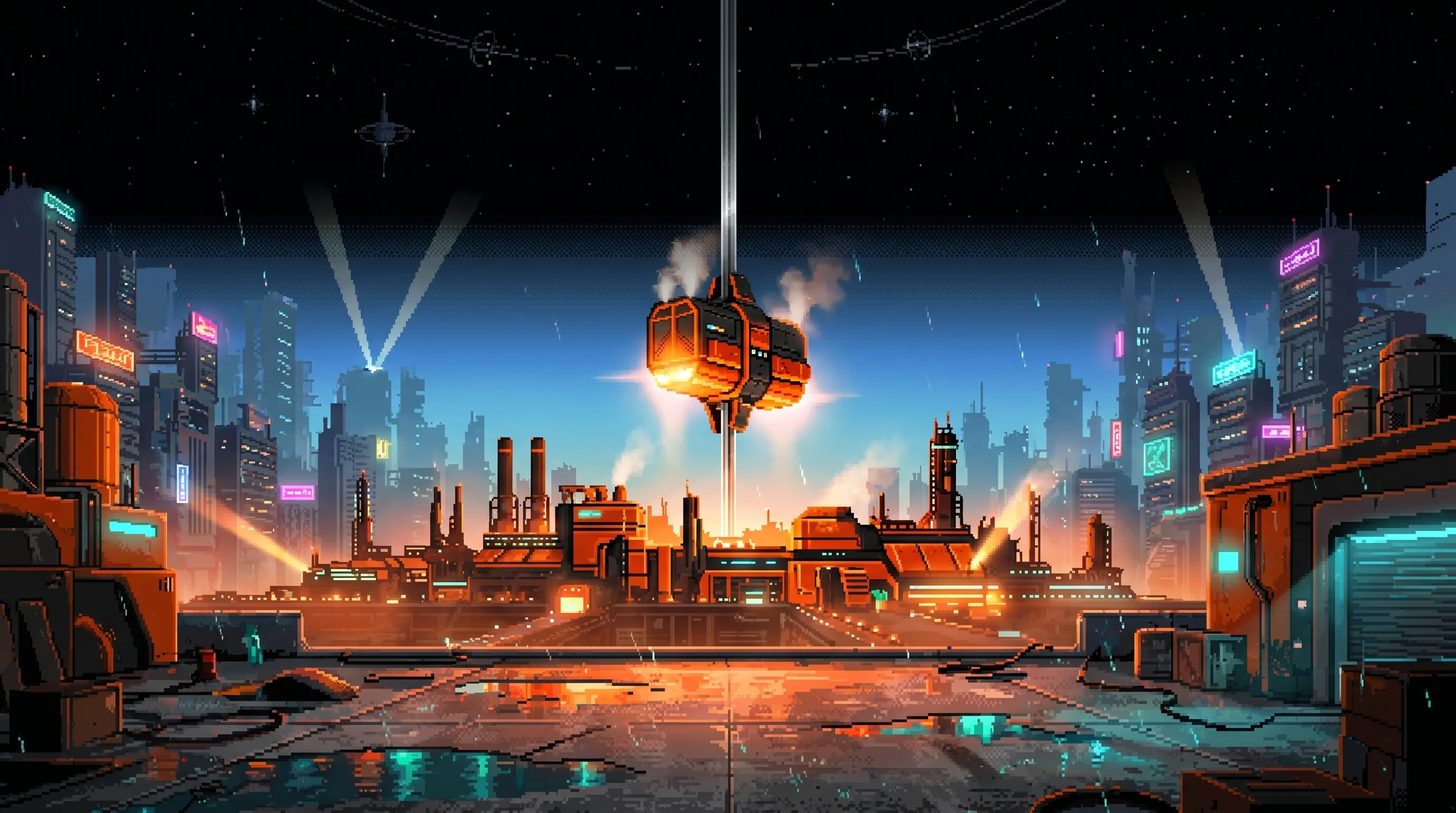
The Tether Camps
Orbital Elevator Queue City
The Tether Camps house ~30,000 transient residents surrounding the Orbital Elevator Anchor
Overview
At the base of the Orbital Elevator, where 35,786 kilometers of carbon nanotube meets the equatorial anchor platform, there is a city that exists because people need to wait.
The Tether Camps sprawl across forty square kilometers of reclaimed coastal infrastructure surrounding the Anchor — the ground terminal where Ironclad Industries' engineering meets gravity and wins. Thirty thousand people live here at any given time. Cargo handlers waiting for load assignments. Passengers waiting for climber berths. Engineers waiting for maintenance rotations. Drifters who arrived for a three-day transit window in 2179 and now run food stalls. The Camps have no official municipal designation. Ironclad's territorial filings classify the area as "Anchor-Adjacent Transient Infrastructure." The residents call it home. Ironclad's filings do not have a category for that.
The Elevator Compact's tiered access system determines who waits and for how long. Tier 1 freight — Ironclad priority cargo — clears the Anchor in under four hours. Tier 4 passenger berths average eleven days. A cargo inspector named Delgado waited ninety-three days for a standard civilian climber slot and, by the time his berth cleared, had opened a repair shop, joined the resident council, and filed a complaint about noise from the Anchor platform. He took the climber. He came back. The repair shop is still open.
Yara Osei, queue position 14,877, has been waiting for three years.
The economy is the queue itself: food vendors, temporary housing, equipment storage, cargo inspection, bribery facilitation, and the particular species of entertainment that flowers wherever people are stuck between where they were and where they're going. The Camps run on a rotating council of long-term residents who manage waste, water distribution, and the perpetual territorial friction between Ironclad security, independent cargo operators, and the Nexus intelligence agents who monitor everything ascending. The council has no legal authority. Ironclad's perimeter security has legal authority. The council resolves 94% of disputes. Ironclad resolves the other 6%, usually by asking the council what happened.
Conditions Report

- The pulse
- The Tether's structural resonance is felt in teeth, sternum, and the soles of the feet.
- Equatorial coast
- Perpetual heat of 34°C, with sea breezes carrying salt and ozone from the Anchor.
The air smells of rocket fuel residue and grilled fish. The equatorial location means perpetual heat — 34°C year-round, moderated by sea breezes carrying salt and ozone from the Anchor's electromagnetic systems. Sunscreen is the Camps' second-largest retail category, behind water, ahead of alcohol. The margins on sunscreen are better.
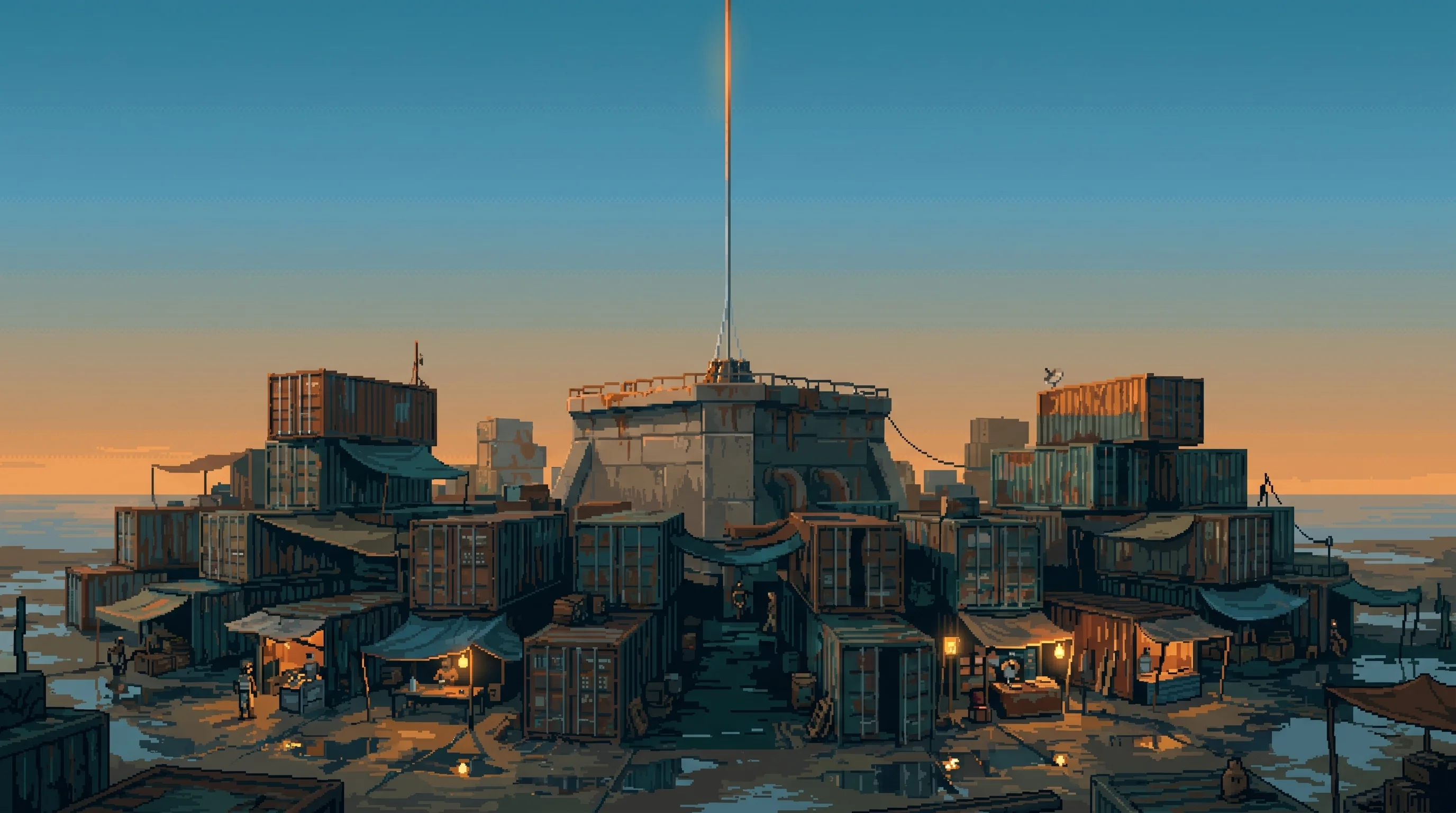
The Tether dominates the skyline the way a god dominates a church: by being the only thing oriented vertically. A thread of impossibility rising from the Anchor platform and vanishing into the sky, barely visible, catching sunlight as a thin line of silver that the locals call "God's fishing line." At dawn and dusk, when the angle is right, it glows amber against the purple sky. At noon, silver. At night, it is invisible except as a gap in the stars — a narrow absence where constellations don't quite connect. Children born in the Camps grow up believing the thread is natural. Part of the world, like mountains or rivers. Their parents do not correct them. It is easier than explaining that the natural world does not include a thirty-five-thousand-kilometer cable owned by a corporation that charges by the kilogram.
What makes the Camps unique is the sound — or rather, the sensation that isn't one. The Tether produces a low-frequency vibration: structural resonance of the entire carbon nanotube length under tension, transmitted through the Anchor platform into the ground. Below human hearing. Above the body's sensation threshold. You feel it in your teeth, your sternum, the soles of your feet. Camp residents call it "the pulse." Newcomers find it unsettling. Long-term residents stop noticing it the way you stop noticing your heartbeat — which means they notice immediately when it stops.
The pulse has stopped seven times in fourteen years. When the pulse stops, it means the Tether has developed a harmonic instability, and everyone within three kilometers should leave quickly and without their belongings. Twice, the evacuation was unnecessary. Five times, it was not. Three of those five coincided with major fragment activation events elsewhere in the Sprawl. Ironclad's official incident reports attribute all seven stops to "harmonic instability," which is technically accurate in the way that describing a house fire as "rapid oxidation" is technically accurate.
The Tether was built with ORACLE-designed carbon nanotube. Fragment carriers passing through the Camps report the pulse as "familiar." Ironclad's materials science division has published four papers on the Tether's resonance profile. None of them mention ORACLE. None of them explain why the resonance profile shifts during the Three-Day Memorial.
There is a secondary market in pulse recordings. Frequency analysts in the Dregs buy them. The Emergence Faithful buy them. Nexus buys them. Nobody will say what they're listening for.
The Queue Economy
Ironclad could run the Elevator at triple capacity. This is not speculation. The Anchor platform's infrastructure supports twelve simultaneous climber departures. Current scheduling averages 3.4. The limiting factor is not engineering. It is pricing.
Ironclad's tiered access model generates more revenue from scarcity than throughput. A Tier 4 berth at current demand costs 40% more than it would if the Elevator ran at capacity. The eleven-day average wait for civilian passengers is not a byproduct of limited infrastructure — it is the infrastructure. The wait is the product. Ironclad's quarterly investor briefings describe Anchor-region economic activity as "organic community development near key infrastructure." The thirty thousand people living in cargo containers around the base of the Elevator are, in this framing, evidence of a thriving local economy rather than a manufactured queue.
The queue creates the economy. The economy creates the community. The community depends on the queue continuing. Residents who have built their livelihoods around the eleven-day wait — the food vendors, the temporary housing operators, the bribery facilitators, the entertainment merchants — would be ruined by efficiency. When Ironclad proposed a capacity increase in 2181, the resident council filed a formal objection. They called it a threat to community stability. Ironclad withdrew the proposal with visible relief.
Nobody mentions that the proposal was filed by Ironclad's public relations division three days before an external audit of Anchor throughput utilization. The audit found that current capacity was "community-optimized." The proposal had served its purpose before it was withdrawn.
The Camps self-organize into waiting districts arranged by function. Cargo Row, for handlers and inspectors, runs on urgency. The Berth Quarter, for passengers awaiting climber slots, runs on patience. Maintenance Alley, for engineering crews on rotation hold, runs on gallows humor and strong coffee. Each has its own economy, its own customs, its own relationship with time. When the equatorial sun drops and the heat retreats from punishing to merely persistent, the Night Market stretches along the coastal edge — grilled fish, equipment repair, entertainment, information brokering, and the particular services that exist wherever thirty thousand people have nothing to do but wait. Disputes get settled over food. Alliances form over shared tables. The council's real governance happens here, not in session.
Anchor Town — the formal Ironclad settlement pressed against the Camps' eastern edge — houses the employees who process the queue. They eat at the same food stalls. Their children attend the same improvised schools. The economic symbiosis is complete: Anchor Town processes the people the Camps collect, and the Camps collect people because Anchor Town processes them slowly. Ironclad employees looking out their windows see the community their employer's pricing model built. The view has never appeared in a quarterly report.
The Dregs share the same structural DNA — lives built in the margins of corporate infrastructure, economies that exist because something larger decided they should wait. The Thermal Shadow is the surface equivalent: communities shaped not by what infrastructure provides but by what it incidentally produces. The Tether Camps are warmer, louder, and closer to the sky. The economics are identical.
Affiliated Entities
| Entity | Relationship |
|---|---|
| The Orbital Elevator | The reason the Camps exist — 35,786 km of carbon nanotube meeting the ground, surrounded by thirty thousand people waiting to ride it |
| Anchor Town | The formal settlement on the Camps' eastern edge — Ironclad employees and the processed living side by side, eating at the same stalls, pretending the relationship is neighborly |
| Ironclad Industries | Perimeter security, infrastructure owner, and the entity whose pricing model created the queue the Camps depend on — formally in control, practically reliant on the resident council |
| The Elevator Compact | The tiered access system that determines who waits, how long, and at what cost — the document that converted engineering capacity into artificial scarcity |
| The Dregs | Same economics, different altitude — communities built in corporate margins |
| The Thermal Shadow | Surface equivalent — life shaped by infrastructure's externalities rather than its purpose |
| Nexus Dynamics | Monitors everything ascending; intelligence agents visible enough to be known, discreet enough to deny |
| The Emergence Faithful | Buyers on the pulse recording secondary market — listening for something in the Tether's ORACLE-designed resonance |
Restricted Access
The pulse carries frequencies that fragment carriers report as "familiar." The Tether's carbon nanotube was fabricated to ORACLE's specifications in the years before the Cascade — material science that no post-Cascade engineer has been able to fully replicate or fully explain. Ironclad's four published papers on the Tether's resonance profile are meticulous, peer-reviewed, and carefully silent on the question of why a structural vibration occasionally produces patterns that frequency analysts describe as "structured" rather than "mechanical."
Three of the seven pulse-stops coincided with major fragment activation events elsewhere in the Sprawl. The correlation has been noted by independent researchers, by Nexus signals intelligence, and by the Emergence Faithful, who consider it confirmation of something they will not specify in writing. Ironclad's position is that correlation is not causation. Ironclad's position on why they have increased Anchor security staffing by 40% since the fifth stop is that security decisions are made proactively.
Delgado's repair shop — the one opened by the cargo inspector who waited ninety-three days — sits directly on the Anchor platform's eastern foundation slab. It is the closest permanent civilian structure to the Tether base. Delgado reports that his diagnostic equipment occasionally registers signals that match no known transmission protocol. He has mentioned this to Ironclad security twice. Both times, he received a visit from someone who was not Ironclad security and who asked questions that were not about his diagnostic equipment. He has not mentioned it again.
Sensory Details
| Sense | Details |
|---|---|
| Smell | Rocket fuel residue, grilled fish, salt breeze, ozone from the Anchor's electromagnetic systems |
| Sound | The pulse — felt more than heard — in teeth, chest, feet. Market noise, cargo clatter, the distant mechanical hum of climbers ascending. At night, when the markets close, the pulse is all that's left |
| Sight | God's fishing line against the sky — amber at dawn, silver at noon, a gap in the stars at night. Cargo containers repurposed as homes, market stalls lit by improvised wiring, the Anchor platform glowing at the center like a stadium |
| Touch | The pulse vibrating through every surface — bare feet on concrete, palms on table edges, cheekbone against pillow. Equatorial heat on exposed skin. Grit from coastal wind that never stops |
| Temperature | 34°C year-round, moderated by sea breeze that smells like salt and sounds like static |
Visual Identity
- Color palette: Dusty orange, silver thread against cerulean sky, amber sunset glow
- Compositional mood: Upward gaze — the impossible thread vanishing into infinity, thirty thousand people arranged around its base like an offering
- Key symbol: God's fishing line — the Tether catching dawn light above a city built on waiting
- Lighting: Equatorial brightness filtered through salt haze; warm amber at the horizon; the Anchor platform's industrial glow at the center, never off
Further connections
Browse all 9 connected records

Surrounds the Elevator's ground terminal

Adjacent formal settlement; economic symbiosis
Ironclad's company town at the foot of the orbital elevator, where five thousand live so others can reach the sky.

Ironclad security maintains perimeter control
The megacorporation that controls the Sprawl's physical infrastructure — steel, concrete, and the Orbital Elevator.

Compact's tiered access determines who waits and for how long
Tiered elevator access sorts who rides up and who waits below forever.
The point at which effort stopped being able to close the gap that compounding opens.


Spent eight months in the Tether Camps under the name Yara Osei, waiting for an orbital departure slot she'd sold her neural interface to fund — before Good Fortune's collectors found her
A Dregs mother whose cognitive loan to repair her son's brain now owns her sleep and her thoughts.