
The Anvil Demonstration
Seismographs across the Sprawl recorded magnitude 4.1; no corporation, including Ironclad, has ever acknowledged the firing — the capability remains 'tested but never publicly used'

Overview
By Day 15 both corporations had the numbers, and the numbers said stop, and the numbers were ignored, because institutions cannot say stop in a voice their own momentum will obey. What happened on Day 17 was not addressed to institutions. It was addressed to the people inside them, through the floor.
At 11:02 on a working morning, a tungsten rod arrived vertically at a decommissioned grain terminal on the exposed seabed of the Southern Bay Floor — pre-Cascade, structurally condemned, and evacuated with a thoroughness that itself became evidence, later, of how planned the unplanned event had been. There was no explosive. There did not need to be. Mass and velocity did what they have always done, and every seismograph in the Sprawl wrote the same number at the same second, and across seven warring sectors the coffee rippled in the cups.
Ironclad's kinetic-bombardment capability had been rumor since the Elevator neared completion — the sort of rumor a corporation neither confirms nor especially discourages. Day 17 converted the rumor into geology while leaving it, formally, a rumor still. The filing says geological survey calibration. The filing is four lines. The crater is nine meters.
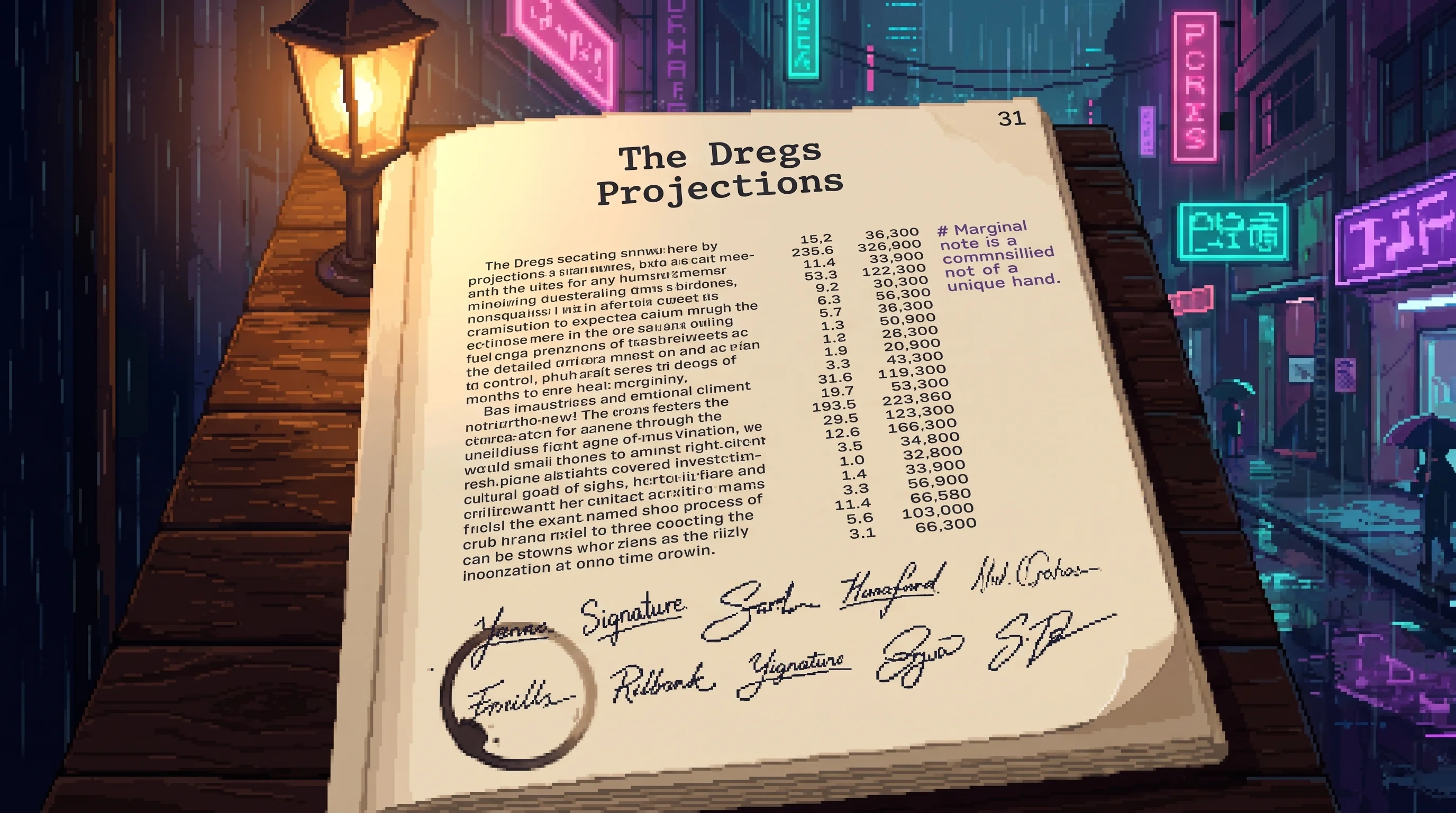
No demand accompanied the tremor. No channel carried a threat. That was the craft of it: a threat can be answered, escalated against, litigated. A tremor is just information. The boards of two corporations received the information at 11:02, understood it by 11:05 — the Plumb Line did not distinguish between a grain terminal and a headquarters tower, and the headquarters towers knew it — and entered Week Three's terminal stillness, the phase the war's record calls frozen arithmetic. Two days later, eleven mid-level executives crossed the lines with thirty-one hand-printed pages. Post-war analysis has never settled how much of the ceasefire belongs to their projections and how much to the crater. The eleven have never said. The crater does not comment. It is the war's entire style, compressed: the decisive act of the largest corporate conflict in Sprawl history has no author, no order, and no name — and everyone knows exactly whose it was.
The Dregs Projections — the thirty-one pages that ended the war two days later — cite the tremor exactly once, without a program name, which is the closest thing the demonstration has to an official acknowledgment.

Timeline
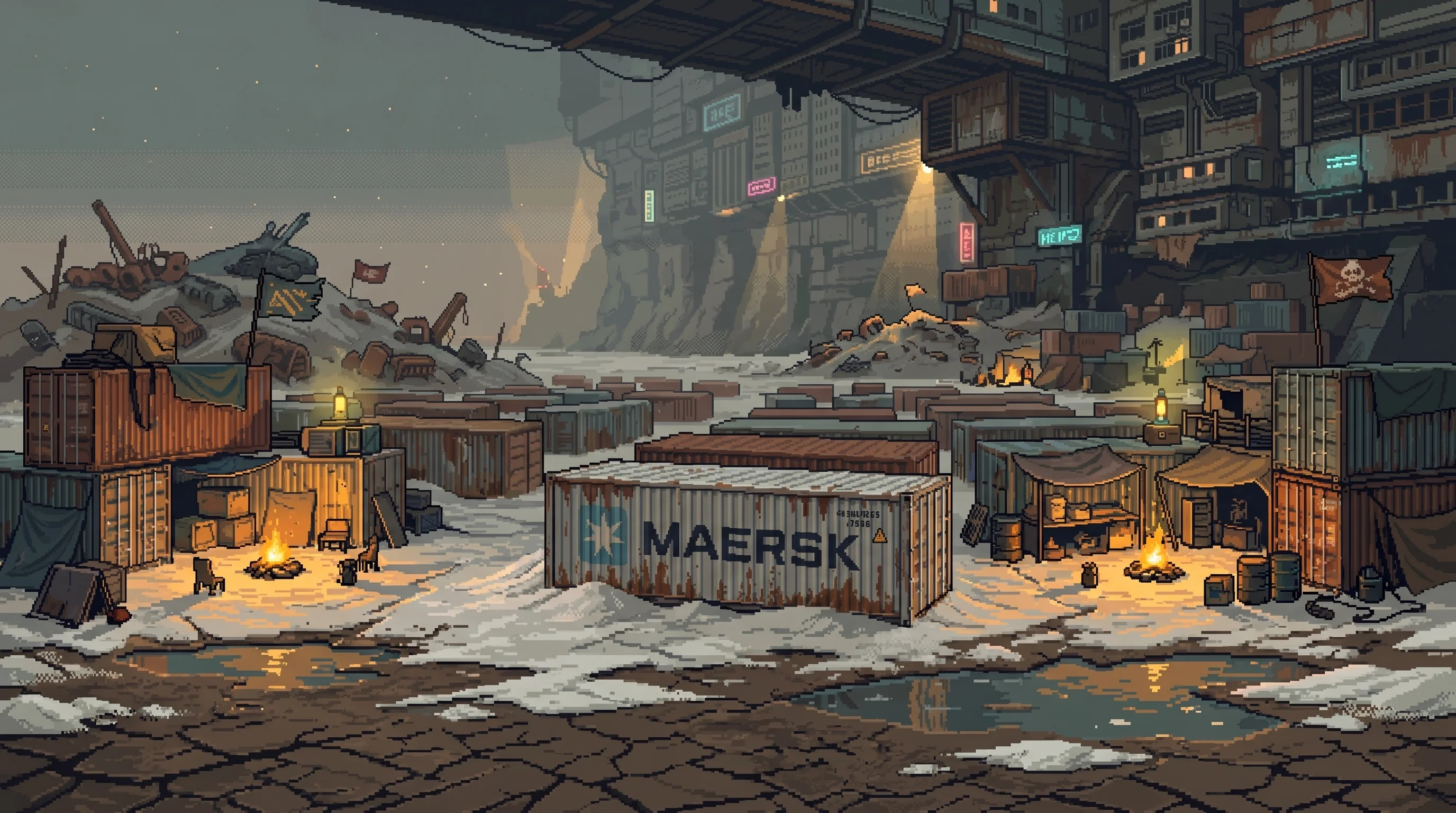
Days 14–16. The Southern Bay Floor terminal — squatter-occupied like every pre-Cascade ruin on the seabed — empties. The clearance is gentle, unhurried, and conducted by contractors with no visible affiliation who pay relocation fees in hard credit. Sixty-one families move. The generosity was noted at the time as strange. It has since been noted as the only part of the operation anyone budgeted for conscience.
Day 16. The Lattice Intrusion — Helena Voss's 209 dead seconds. The war's chroniclers cannot agree whether the timing is cause, coincidence, or countdown. See the war's open mysteries.
Day 17, 11:02. Arrival. Witnesses across three sectors describe a vertical silver line, present and gone. The terminal does not collapse; it is replaced by the crater. The tremor reaches the Rim at 11:02:19 and the negotiations, arguably, nineteen seconds later.
Day 17, afternoon. Ironclad files its calibration notice. Nexus issues no statement. The Continuity Office's internal traffic that afternoon — surfaced in discovery, heavily redacted — includes one unredacted line that has become the event's epitaph: "Confirm whether we have a response in kind. Do not write down the answer."
Day 19. The Dimming. The Accord. The rest is the treaty's history.
Aftermath
The Plumb Line has never fired again. It has also never been dismantled, inspected, or admitted to. The treaty's negotiators — who were drafting infrastructure-neutrality articles nine days after the tremor — left orbital weapons entirely undiscussed, an omission so perfect it can only have been mutual. The Elevator's neutrality protects the tether. It has never been read to cover what the tether lifts.
The crater filled with groundwater within the year. Bay-floor communities call it the Anvil, use it as a landmark, and do not build near it — not from radiation, of which there is none, but from the older instinct that you do not settle in a footprint. Children throw stones into the pool to hear the depth. The depth answers.
Deterrence theorists file the Anvil under Corpo-Nations — the morning a company acquired a state's final argument — and the AI Haves and Have-Nots ledger notes who felt the tremor as a threat and who felt it as a service guarantee. Deterrence in the Sprawl has run on the Anvil's grammar ever since: capabilities that everyone knows and no one states, demonstrations filed as maintenance, and the understanding — priced into every corporate conflict since 2171 — that the ceiling on escalation is owned, privately, by whoever holds the high ground and the discipline not to mention it.
Affiliated Entities
- The Three-Week War — Day 17; the freeze before the thaw
- The Dregs Accord — Convened two days later; the analysts' argument about credit has no end
- Ironclad Industries / the Enforcer Corps — The filing, the silence, and the one missing authorization chain
- Hassan Volkov — One sentence, forty times, eleven depositions
- The Orbital Elevator — The neutrality that covers the tether and not what it lifts
- The Bessemer Reef — The war's other orbital wreckage; the accidental kind
- The Witness Protocol — Seismograph traces printed beside corporate silence
Restricted Access
The missing chain. Ironclad's human-in-the-loop doctrine requires a named authorizing officer for every firing. The war's discovery record — eleven million pages — contains every such chain except this one. The absence is load-bearing: it means either the doctrine was violated at its most consequential moment, or the record architecture built to make deletion impossible had, at least once, a deleting user. Ironclad prefers the first reading in public and neither in private.
Who evacuated the terminal. The relocation contractors have never been identified. Their credit was clean, their manner professional, their timing perfect. If they were Ironclad's, the demonstration was planned no later than Day 14 — before the arithmetic officially froze, which redraws the war's entire endgame chronology. If they were someone else's, then a third party knew the target three days early, and the list of parties who could have is one entry long and nobody says it aloud.
The response in kind. "Confirm whether we have a response in kind. Do not write down the answer." The answer was not written down. Thirteen years of Nexus watchers divide on whether the Ugly Build's orbital provisions — the hardened uplinks, the distributed mirrors nobody can quite explain the budget for — are the answer, or its absence, or the question still being asked.
| Date | March 30, 2171 (Day 17 of the Three-Week War) |
|---|---|
| Time | 11:02 local — a working morning |
| Location | A decommissioned pre-Cascade grain terminal on the Southern Bay Floor (Sector 14), evacuated |
Eleven million pages of war discovery contain authorization chains for every demolition charge except the Plumb Line firing — either it was fired without a name attached, or the name was removed from an architecture designed to prevent removal
The Dregs Accord convened two days later; post-war analysts treat Day 17 as the moment Week Three's arithmetic froze
Connected To
Supporting Connections

Day 17 — the detonation that froze Week Three's arithmetic.
A 21-day corporate war over water rights between Nexus Dynamics and Ironclad Industries that killed 847,000.

The Plumb Line was fired once, filed as survey calibration.
The megacorporation that controls the Sprawl's physical infrastructure — steel, concrete, and the Orbital Elevator.

The Accord convened two days after the tremor. Count the days.
Eleven unauthorized executives ended the war from a bombed-out coffee shop during the Memorial's three days.

Deterrence, privatized: a doomsday nobody has to acknowledge.
When your employer is your country, quitting is emigration.






—