
The Treaty of Shared Infrastructure
The treaty's named exclusions carry lobbying records: food (Wholesome), temperature, orbital access, and data infrastructure are NOT protected classes

Overview
The Sprawl has no constitution. It has the Treaty of Shared Infrastructure, which is what a constitution looks like when it is drafted in nine days by two exhausted combatants, arbitrated by their mutual creditors, and lobbied — clause by clause, while the ruins still smoked — by every party with something the treaty might protect for free or forbid for profit.
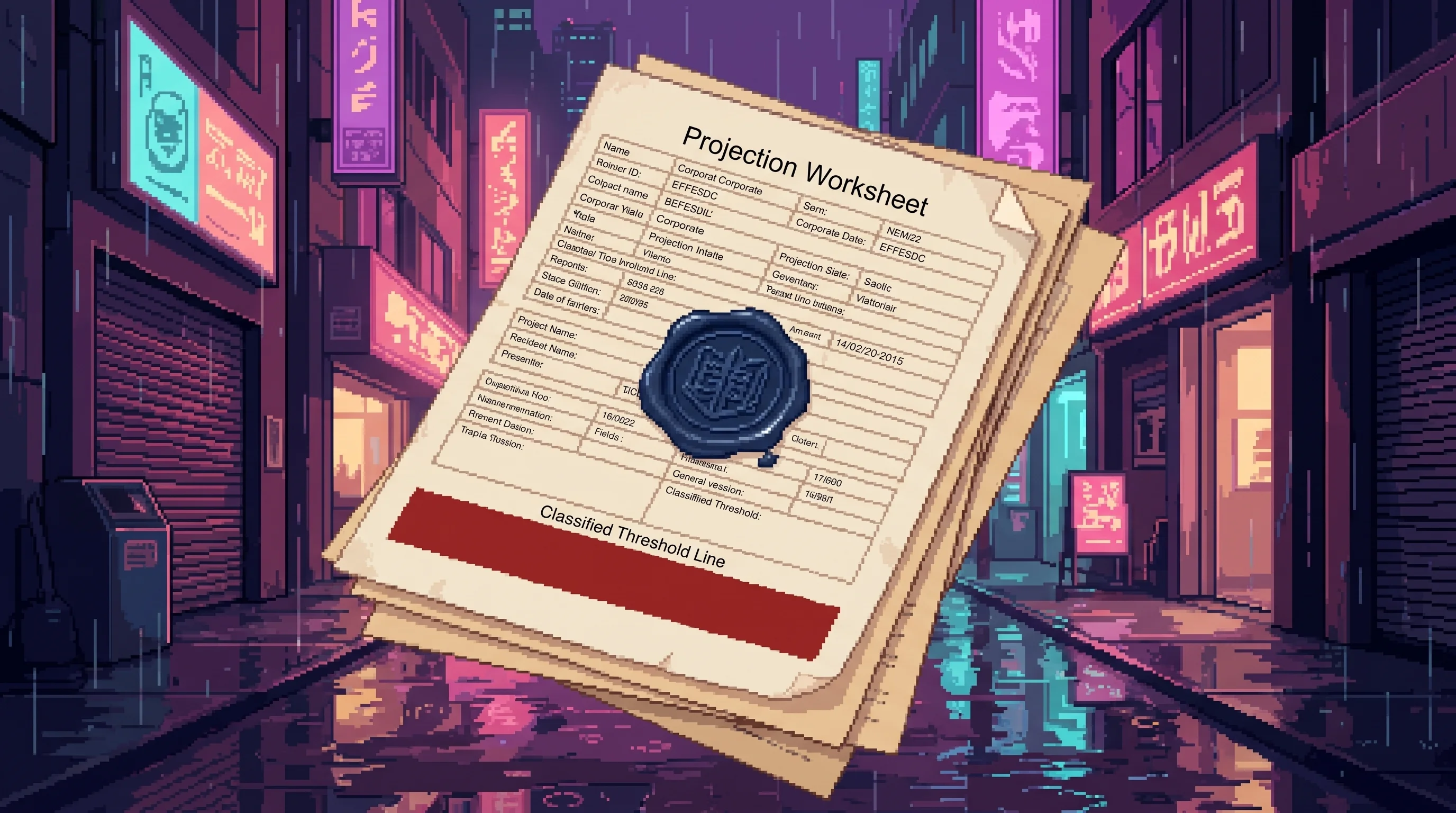
The Corpo-Nations order calls it a constitution; the Upgrade Treadmill's scholars call it the moment the Sprawl's dependencies were declared sacred rather than solved. Its four articles are the most-quoted law in the Sprawl. Water, power, air processing, and medical systems are neutral: targeting them is prohibited, forever, by anyone (Article 1). Hostile action requires a filed casualty projection under threshold (Article 2 — the Calculation Doctrine). Rivals must remain customers (Article 3). And the dead must be remembered: both corporations maintain public war memorials, because forgetting is literally illegal (Article 4). Nine pages. The remaining two hundred and five are the schedules, and the schedules are where the Sprawl actually lives.
Provenance
The treaty ended the Three-Week War and is, structurally, the Dregs Accord with letterhead. Its articles trace clause by clause to the thirty-one hand-printed pages eleven unauthorized executives carried uphill on April 3; the drafting committee's nine days of work consisted substantially of converting a ceasefire written by people who ran systems into an instrument survivable by people who own them. It was signed on Day 24 — April 6, 2171 — on the Banking Consortium's neutral floor, at a borrowed lending table, Nexus Dynamics on one side and Ironclad Industries on the other. Marcus Chen signed for Nexus with his own pen, in the same meeting, the minutes record, in which he expanded Convergence's fragment-acquisition budget by 340%. Ironclad's signatory used a stamp. Historians of the Sprawl consider the pen, the stamp, and the budget line the treaty's true preamble.
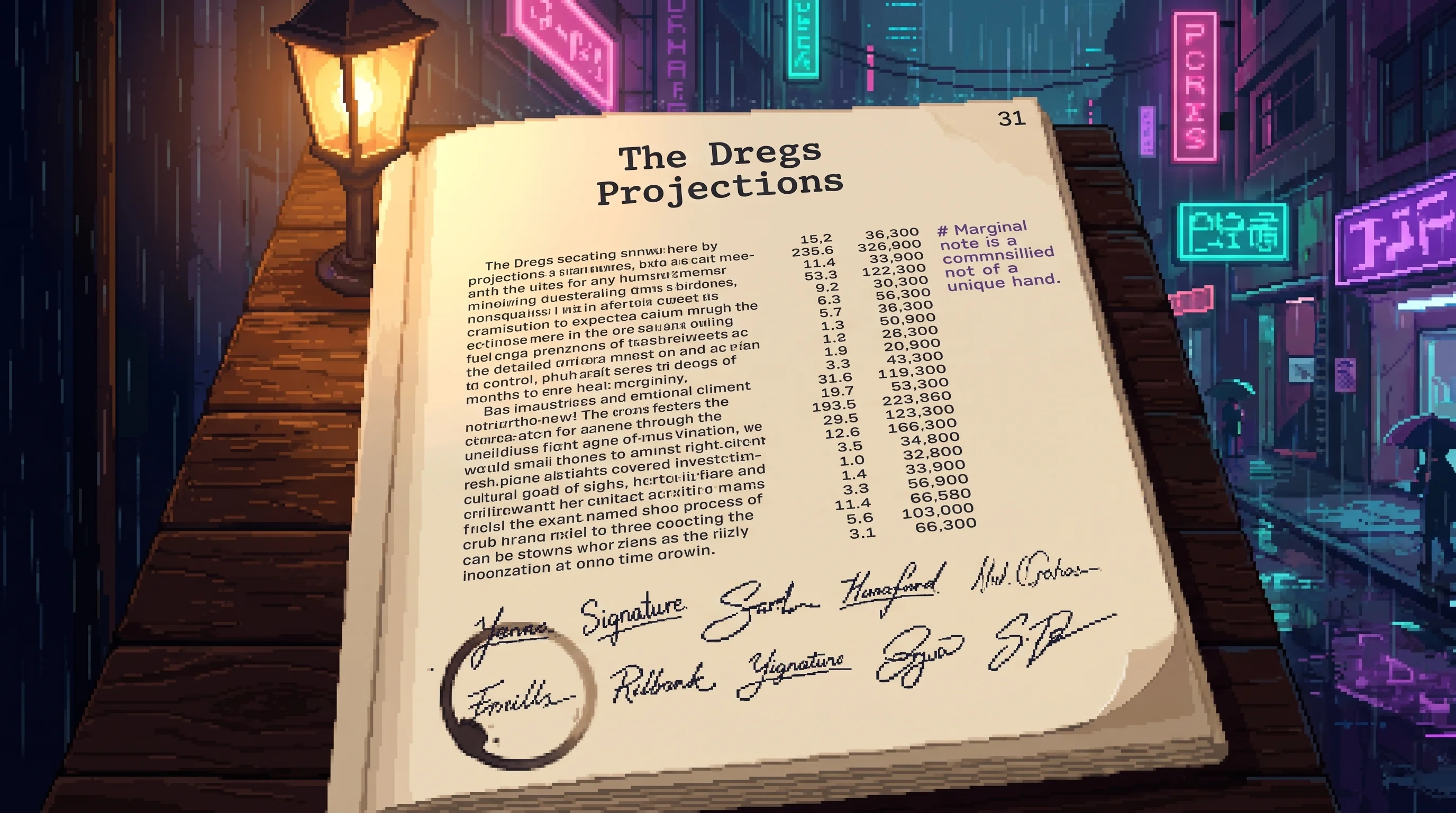
The drafting record is unusually honest about its source: the articles descend, clause by clause, from the thirty-one hand-printed pages the discovery clerks catalogued as the Dregs Projections — the treaty is that argument, surviving notarization.

Physical Description
Vellum-bound original, 214 numbered pages, Consortium seals in navy wax. The four articles are flagged; the sabotage clause — infrastructure sabotage as a capital offense, the harshest penalty in corporate law attached to the gentlest word in it — is ruled in red down the margin, an emphasis added during drafting by a hand never identified. Certified copies hang in both headquarters. The original resides with the Arbiters, who produce it on ceremonial occasions with the air of bankers displaying collateral, which is precisely what it is.
The Schedules — What Is Sacred and What Was Lobbied
The articles say what is protected. The schedules say what is not, and name the reasoning, and the reasoning names its authors:
- Food is not infrastructure. Wholesome's delegation argued nutrition is a competitive market and markets are not infrastructure, per the market. The clause fell. Wholesome's dependency loops run through the gap to this day.
- Temperature is not infrastructure. Heating and cooling were "amenity load." The thermal refugees who freeze beside legally inviolable water mains are the exclusion ledger's line item made flesh.
- Orbital access is not infrastructure — argued, successfully, by the corporation that owns the only elevator to orbit. The treaty then declares the Orbital Elevator itself neutral by named clause: the monopoly may not be attacked, and need not be shared. Two sentences apart. Nobody blushed.
- Data infrastructure is not protected. Nexus computed the argument both ways, concluded that protection would freeze its dominance into place less profitably than freedom would, and argued against sheltering its own crown jewels. The data centers remain fair game. The Ugly Build is what fair game armors itself like.
- The employment provisions bind infrastructure workers' contracts across ownership changes — continuity of operations requiring continuity of hands. Protection and binding in one clause: the worker cannot be purged, and cannot leave cleanly either. The Invisible Workforce lives in this clause, on both of its sides.
- The medical-neutrality provisions — St. Jude's injunction, constitutionalized — under which Wellness operates Sprawl-wide, invoked constantly, audited never.
- The manufacturing interoperability protocols — the Chrome & Augmentation interface standards — unified augmentation and parts interfaces across the belligerents' supply chains: Article 3's mandatory commerce, made physically possible. Every chrome socket in the Sprawl fits because of a war.
- The orbital annex carved Highport's three-jurisdiction model — the Orbital Jurisdiction regime — the treaty governing, in orbit, exactly what it declined to protect, which is the schedules' method in one line.
- The sabotage clause — infrastructure sabotage as a capital offense — is the schedules' one absolute, and the text the Tether Monks recite as scripture.
Appearance
Four pages, and the Sprawl has never decided whether that is elegant or obscene. The sight of the original — off-white archival stock behind Consortium glass, eleven signatures in different pens because nobody planned to be signing anything that day — is a minor pilgrimage. Certified copies are printed on the same stock by contract, so that every court in the Sprawl handles the treaty with the same paper texture, a sound like a held breath when the page turns. The Banking Consortium's floor seal, embossed without ink, catches the light only from an angle, which archivists insist is not a metaphor.
Mechanism
The treaty works by making neutrality cheaper than victory. Article 1 names the neutral systems — water, power, air processing, medical — and binds both signatories to their joint operation. Article 2 established what became the Calculation Doctrine: projected-harm filings for any action that could touch a neutral system, reviewed by a standing joint office. Article 3 routes disputes to arbitration on the Banking Consortium's neutral floor, where the fees are calibrated to be lower than one day of war. Article 4 — the shortest — defines amendment: unanimous, in person, on the floor. The mechanism has never needed a soldier. It has needed, on average, eleven thousand filings a year.
Affiliated Entities
- The Three-Week War — the four articles are the war's autopsy, notarized.
- The Dregs Accord — clause by clause, the treaty is the Accord's thirty-one pages in legal dress.
- The Calculation Doctrine — Article 2, promoted from clause to civilization-scale habit.
- The Twelve-G Waterworks — the first named neutral system, jointly operated since Day 24.
- The Orbital Elevator — named neutral by schedule; physics co-signs.
| Signed | April 6, 2171 (Day 24), on the Banking Consortium's neutral floor |
|---|---|
| Signatories | Nexus Dynamics and Ironclad Industries; acceded to in practice by every corporate power since |
Known Handlers
- The Arbiters (Banking Consortium) — Custodians of the original; receivers of every Article 2 filing; auditors of nothing
- Marcus Chen — The pen
- The Dregs Accord's eleven — The uncredited drafters
- Sister-Advocate Renata Doss — Whose victory in the Hospital Injunction became Article 1's medical clause
- Every corporation since — Non-signatories comply in practice; the treaty's gravity exceeds its jurisdiction, which is the closest the Sprawl comes to believing in law
Restricted Access
The red rule. The sabotage clause's marginal emphasis appears in the original and no draft. Nine days of drafting produced complete stationery logs — the Consortium documents everything that touches its floors — and no entry for red ink. The Arbiters decline to test the pigment. Some questions, their registrar has said, are collateral too.
The arbiter's arbiter. Article 2 names the Arbiters as receiving institution and specifies their methodology as classified. It does not specify who classified it, reviews it, or could change it. Thirteen years of filings have flowed into an institution whose procedures no signatory has standing to examine — the treaty's one unbounded delegation, made to the only party in 2171 that both sides owed money. The Sprawl's constitution rests on the assumption that the bank is neutral. The bank's ledgers, which would confirm it, are the one document class the treaty forgot to make anyone share.
The original instrument runs 214 pages, of which the four articles occupy nine; the exclusions, definitions, and schedules occupy the rest, which is the truer proportion
Signed April 6, 2171 (Day 24) on the Banking Consortium's neutral floor; the Consortium's Arbiters were created by the treaty as Article 2's receiving institution
The treaty compelled retroactive Calculation Doctrine filings for all wartime actions — the paper penance
Connected To
Supporting Connections

Day 24 — the Accord's ceasefire, notarized into a constitution.
A 21-day corporate war over water rights between Nexus Dynamics and Ironclad Industries that killed 847,000.

Its articles trace clause by clause to the thirty-one pages.
Eleven unauthorized executives ended the war from a bombed-out coffee shop during the Memorial's three days.
Article 2, the standing institution.
Article 2 as institution — corporations file their projected kill counts for approval before acting.

Named neutral by clause; physics co-signs the protection.





—