Anchor Town
Overview
Anchor Town is where five thousand people live so that other people can go to space.
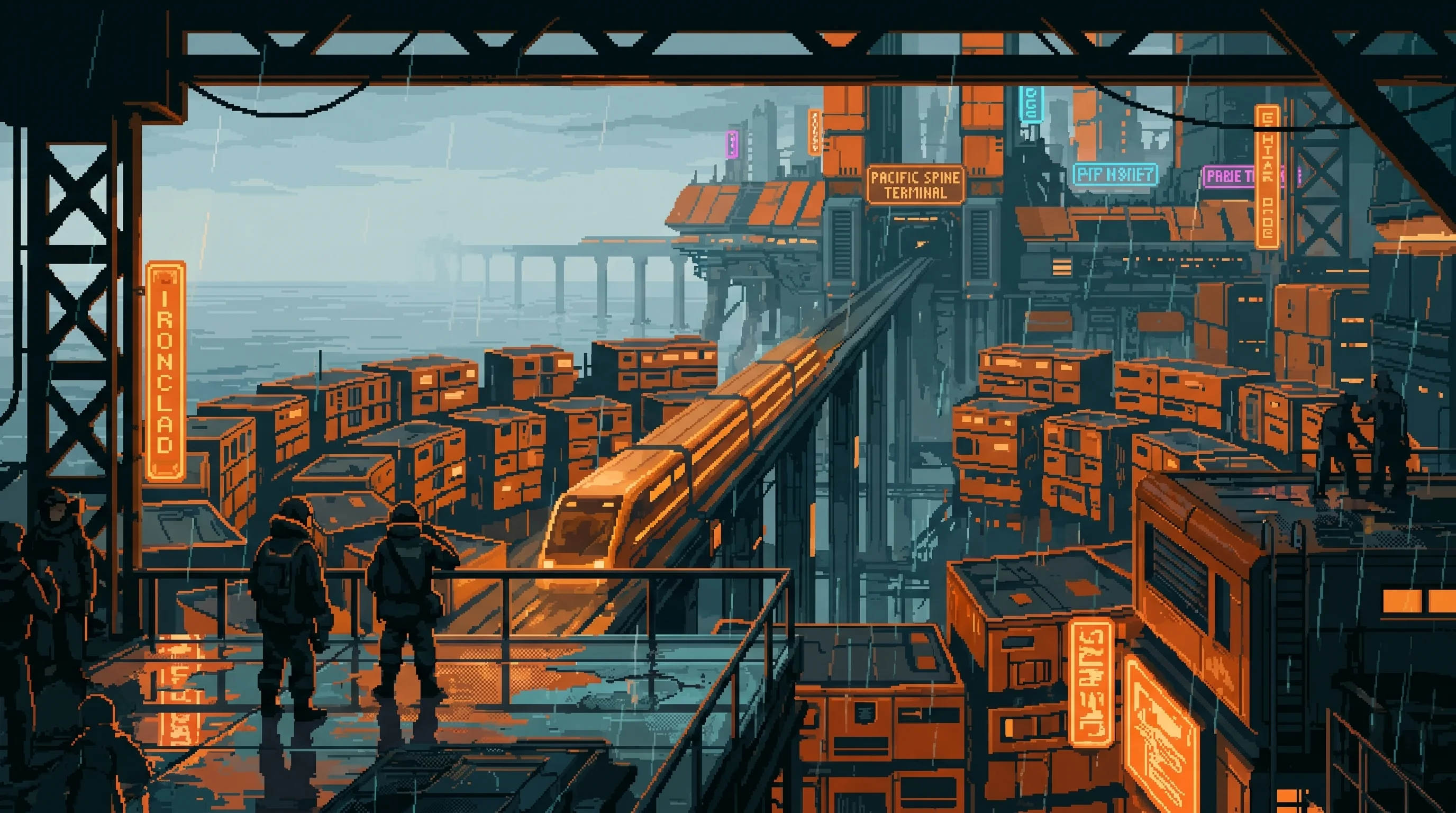
Ironclad Industries built it on the western shore of Sector 15, adjacent to the Pacific Spine Terminal — the departure point for the 3,500-mile maglev run south to the equatorial ground station and, from there, orbit. The residents are engineers, load balancers, logistics coordinators, maglev maintenance specialists, and their families. They live in modular housing blocks arranged in concentric rings around the Terminal, in the same orange-and-black Ironclad livery that covers everything the corporation has ever touched. Exposed structural elements. Adequate square footage. Climate control set to 22°C in every unit, which is the temperature at which people stop complaining but do not start relaxing.
The housing is functional in the way that Ironclad does functional: nothing is broken, nothing is beautiful, and the walls are exactly thick enough that you cannot hear your neighbor's television but can hear their argument. Resident satisfaction surveys — administered quarterly by Ironclad's Workforce Wellbeing Division — have held steady at 6.8 out of 10 for eleven consecutive years. Management considers this acceptable. The number has not changed because the housing has not changed. The housing has not changed because 6.8 is acceptable.
The Pacific Spine maglev departs every twenty minutes. Each departure is a low electromagnetic hum that builds over thirty seconds and fades as the train accelerates south along the coast. The pylons of the elevated track stretch toward the horizon until they vanish into coastal haze. The sound is the baseline frequency of the town. Residents stop hearing it within their first week. They hear its absence immediately during maintenance shutdowns — a silence that wakes people from sleep.

Conditions Report
The viewing platform is the most visited space in Anchor Town.
It sits on the Terminal's western edge, facing the Pacific, with an unbroken sightline south along the Spine's pylons and west across open ocean. On clear days you can watch a departing maglev shrink to a point of amber light against the coastline. In three hours, the people on that train will be at the equatorial ground station. In ten hours, they could be in orbit. In twenty-four hours, some of them will look down and see the Pacific Spine as a faint line on the planet's surface, originating from a smudge of orange and black too small to identify.
The platform has four benches. The armrests on the south-facing two are worn smooth — the lacquer rubbed away by decades of the same shift workers sitting in the same positions watching the same departure. The north-facing benches, which overlook the town itself, show no comparable wear.
Ironclad installed the platform as a morale feature in 2169. Usage data shows an average of 340 visits per day — a remarkable number for a town of five thousand. Peak hours are 06:00 and 18:00, coinciding with shift changes. The platform's official designation in Ironclad facilities records is "Recreational Observation Area 15-C." Residents call it the Platform. Some of the longer-tenured maintenance crews call it the Bench.
Nobody calls it what it is, which is a place where the people who make the journey possible watch the people who get to take it.
| Notable | Pacific Spine Terminal — departure point for equatorial ground station; viewing platform |
|---|
The Schools
Anchor Town's children attend Ironclad-operated schools where the curriculum includes orbital mechanics, structural engineering, maglev systems, and the particular mathematics of load distribution across a 3,500-mile track. The departure schedule is posted in the school cafeteria next to the lunch menu. The children can calculate transit times to the equatorial station before they learn the geography of the Sprawl.
They don't find the Spine remarkable. They find the Sprawl remarkable — a city that doesn't have a direct line to the sky.
Ironclad's education division tracks career placement for Anchor Town graduates. Eighty-seven percent enter Ironclad operations roles within two years of completing school. Sixty-three percent of those take positions at the same Terminal their parents work at. Fourteen percent are accepted into Ironclad's orbital engineering program, which posts them to the equatorial ground station or the Elevator itself.
The remaining thirteen percent leave Anchor Town entirely. Ironclad's retention analytics classify them as "pipeline attrition." Their exit interviews, when they submit them, consistently cite the same reason in different words. The workforce psychologist's summary, filed quarterly and read by no one with the authority to act on it: "Candidates report difficulty maintaining motivation in a logistics role after prolonged exposure to the departure cycle."
The psychologist has filed this summary nine times. The language has not changed because the finding has not changed.
The Compact
Ironclad provides housing, education, healthcare, food service, and recreational facilities to all Anchor Town residents. The provision is contingent on employment. This is stated clearly in the residency agreement — Section 4, Paragraph 2, the clause that every new hire reads and every tenured worker has memorized: "Residential privileges are extended for the duration of active employment and terminate thirty days following separation from Ironclad service."
The town has no independent landlords. No private schools. No medical clinics outside the Ironclad Wellness Center. The nearest non-Ironclad grocery is forty-seven minutes by transit into central Sector 15. Residents can leave at any time. The infrastructure makes leaving expensive, inconvenient, and — after a decade of Ironclad-provided everything — logistically bewildering. Turnover at the Pacific Spine Terminal is 4.1% annually. The Sprawl average for comparable industrial positions is 22%.
Ironclad's workforce analytics team considers the 4.1% figure a reflection of employee satisfaction. The workforce psychologist considers it a reflection of dependency. Both interpretations appear in the same quarterly report, on different pages, formatted identically. Neither references the other.
The Tether Camps press against the town's southern edge — the informal settlement where people wait for Ironclad positions to open. Camp residents can see the housing blocks from the perimeter. The housing blocks can see the Camps. The Platform, facing south and west, offers a clear view of both the departing maglev and the Camp's outer tents. Most Platform visitors watch the maglev.
New hires do not start in the Rings. Their first fourteen days pass in The Turn, a standalone facility long-tenured residents call "the honeymoon block," half fondly and without much irony. It has real glass in the windows and a thermostat that runs its own schedule instead of the fixed 22 degrees. Most Anchor Town lifers lived there once. Few of them can say, if pressed, exactly which day the honeymoon ended and the Rings started feeling like the whole of it.

The Dock-Master
Eze Okafor is sixty-one years old and has never been above the atmosphere. Twenty-two years at the base of a structure that goes to orbit. He has watched approximately 1.6 million containers ascend. He has ridden zero climbers.
The terminal roster gives his full title as Dock Master Eze Okafor.
His job is the transition — the twelve-minute window when surface cargo becomes orbital cargo, when Ironclad's insurance liability shifts to whoever paid for the berth, and when a container's legal jurisdiction passes through a gray zone that seven corporate law firms have spent a decade failing to define. Eze processes roughly 200 of these transitions per day. Each requires physical inspection, electromagnetic screening, biological contamination checks, and the thing that doesn't appear on any Ironclad operational checklist: Eze standing near the container for four to six seconds with his hand on the housing, deciding if it feels right.
His instinct has flagged 847 containers. Of those, 340 contained contraband. The remaining 507 were clean. Every scan passed. Every document matched. Every container was exactly what it claimed to be. The crews were afraid of them.
He keeps a physical notebook alongside the digital manifest — a leather-bound ledger where each container gets a handwritten entry, a practice so anachronistic that Ironclad's digitization team has offered to automate it three times. Eze has declined three times. His explanation: "The manifest tells me what the container says it is. The notebook tells me what I think it is." The gap between these two records — the digital fact and the handwritten impression — is the twelve-minute window personified. He described the difference exactly once, to a junior inspector who asked why it mattered: "The manifest tells you what's in the box. The notebook tells you what people feel about what's in the box. Both are cargo data. Only one is honest." The junior inspector requested a transfer to orbital operations four months later. Eze processed the paperwork.
The 340 contraband containers have never kept him up at night — contraband is a problem with a solution: flag it, report it, document it, move on. The 507 fear containers have followed him home every evening for twenty-two years. His bench at the ground terminal has his name scratched into the armrest — not carved, scratched, the way a child marks territory and an old man confirms it. He smells like cargo holds and sea air and the ozone that bleeds off the Elevator's magnetic rail when a climber departs, long enough that his apartment is said to smell like it too.
Ironclad's Human Capital division has reviewed his file eleven times in twenty-two years. Each review was triggered by a routine promotion cycle; each reached the same conclusion, phrased differently but structurally identical: resource optimally deployed in current capacity. His instinct cannot be transferred. His notebook methodology resists digitization — three separate teams have tried to convert his entries into trainable data, and the models produced flag rates indistinguishable from random. He has never been offered management, because management would remove him from the cargo floor; never assigned a successor to train, because his daily throughput generates more value than any training program could recover; never offered orbital assignment, though he has processed 1,247 orbital transfer requests for colleagues with fewer years and thinner files. For twenty-two consecutive years the "Career Development Trajectory" section of his annual review has read: Continued excellence in current role. His supervisor has been replaced nine times; each new one reads the file, watches Eze put his hand on a container housing, and decides the conversation can wait until next quarter. He watches the Tether carry people upward. His bench has his name on it. Both facts are permanent.
A pattern in the notebook resists explanation. Three of the 507 fear containers were shipped by Nexus Applied Sciences, Division 9, between 2178 and 2182 — manifested as "calibration equipment," combined declared mass 1,200 kg, combined actual mass at Eze's weigh station 1,200 kg exactly, contents matching manifests on every scan. His notebook holds the same entry for all three, in the same hand, at the same pressure: Crew wouldn't make eye contact with the container. Division 9 was dissolved in a routine Nexus reorganization in late 2183 and its cargo records marked for standard seven-year retention; Eze's notebook is not subject to Nexus retention policy, on account of being a physical notebook owned by an old man. The total — 847 flagged containers — is also said to match the fragment-carrier census count and the confirmed count of catalogued fragment-communication morphemes, four unrelated datasets producing the same number. Three analysts have calculated the odds of the convergence; none shared their results; none flagged it for follow-up. Probably meaningless. The word probably is doing considerable work in that sentence.
| Stratum | Corporate |
|---|---|
| Power Position | Insider |
| Access | Restricted |
| Atmosphere | Sterile |
Affiliated Entities
- The Tether Camps press against the town's southern edge — the informal queue of laborers and hopefuls who feed the formal operation and serve as a visible reminder of what exists outside the Ironclad compact
- The Foundry shares Ironclad's corporate-town DNA — similar housing, similar culture, similar retention numbers that management calls satisfaction and the workforce psychologist calls something else
- The Cognitive Ceiling runs the Dock-Master's shift without his ever hearing the term for it. Twenty-two years of putting a hand on identical steel boxes produced a signal that three separate Ironclad modeling teams failed to extract from his notebook. The fourth attempt was never funded
- The Manifest Office sits one wall over from the Dock-Master's own station, reconciling the same fear-flagged containers for insurance purposes. One analyst there has been keeping a private tally of her own since 2181, on a hunch the Terminal never approved and has never been asked to explain
- The Turn houses every new hire for their first fourteen days, in the one Anchor Town building with real windows and light that isn't fixed at 22 degrees. The 4.1% turnover figure the workforce psychologist calls dependency starts accruing here, long before anyone signs a permanent Ring lease
Visual Identity
- Color palette: Ironclad orange and black against Pacific grey-blue; the Spine's elevated track vanishing south into haze
- Compositional mood: Workers on the shore watching amber light track south along the coast at dusk — permanence observing departure
- Key symbol: The Platform bench, south-facing armrests worn to bare metal
- Lighting: Fog-filtered coastal light; the amber glow of departing maglev at dusk; 22°C fluorescent warmth behind every identical window
Dock-Master Eze Okafor has flagged 847 containers in 22 years — 340 contraband, 507 where crews were afraid of their own cargo
Restricted Access
The workforce psychologist's quarterly reports — nine identical findings filed over twenty-seven months — are read by the Terminal's HR coordinator, who forwards a summary to Ironclad's regional workforce division, who files it under "Sector 15 — Retention: No Action Required." The classification is automatic. Any facility with turnover below 8% is flagged "No Action Required" regardless of the report's contents.
The psychologist knows this. She continues filing. When asked why, during a routine audit of Workforce Wellbeing expenditures, she described her role as "documenting the system's outputs for the system's records." The auditor noted this as "employee demonstrates clear understanding of role responsibilities" and closed the file.
Platform usage spikes during the week before quarterly performance reviews. The correlation appears in the Terminal's facilities data. Ironclad's analytics team has not cross-referenced it with the Platform's access logs. The workforce psychologist has; her notes on the subject are in a personal file, not the quarterly report.
Three Anchor Town residents have submitted formal queries about the residency termination clause in the past eighteen months — specifically, the thirty-day window. All three queries were routed to the same HR coordinator. All three received the same templated response citing Section 4, Paragraph 2. The coordinator did not escalate any of them. It is not clear whether the coordinator read them.
Fourteen percent of Anchor Town school graduates enter the orbital program. Their postings take them to the equatorial ground station, and some to the Elevator itself. They do not come back to Anchor Town. They do not need to — orbital postings include separate housing, separate education for dependents, separate everything. The fourteen percent vanish upward the same way the maglev vanishes south: visible from the Platform for a while, then not.
Their parents watch from the Bench. The south-facing armrests continue to wear.
The Dock-Master keeps a physical notebook alongside the digital manifest — analog verification at the threshold of space
Anchor Town — 37.7650°N, 122.3400°W — Sector 9. Bay floor's largest settlement, built on grounded ship hulls.
Children attend Ironclad schools with orbital mechanics in the curriculum
Conditions Report
Sight
Orange and black on every surface; the Spine's elevated pylons diminishing south into coastal haze; fog-grey Pacific sky; modular housing blocks in concentric rings, each identical to the last, differing only in the personal items visible through windows
Sound
The departure hum — thirty seconds of building electromagnetic resonance, then fade. Every twenty minutes. Residents stop hearing it within a week. They hear its absence immediately.
Smell
Industrial cleanser and Pacific salt air in shifting ratio depending on wind direction; canteen food in mass production — identifiable from two blocks away, indistinguishable from yesterday's; the ozone tang of electromagnetic drive systems strongest at the Terminal
Temperature
22°C indoors, always. Exterior 12-18°C with coastal fog that rolls in by mid-afternoon and doesn't leave until the sun burns through around 10 AM. The differential makes stepping outside feel colder than it is.
Connected To
Major Connections
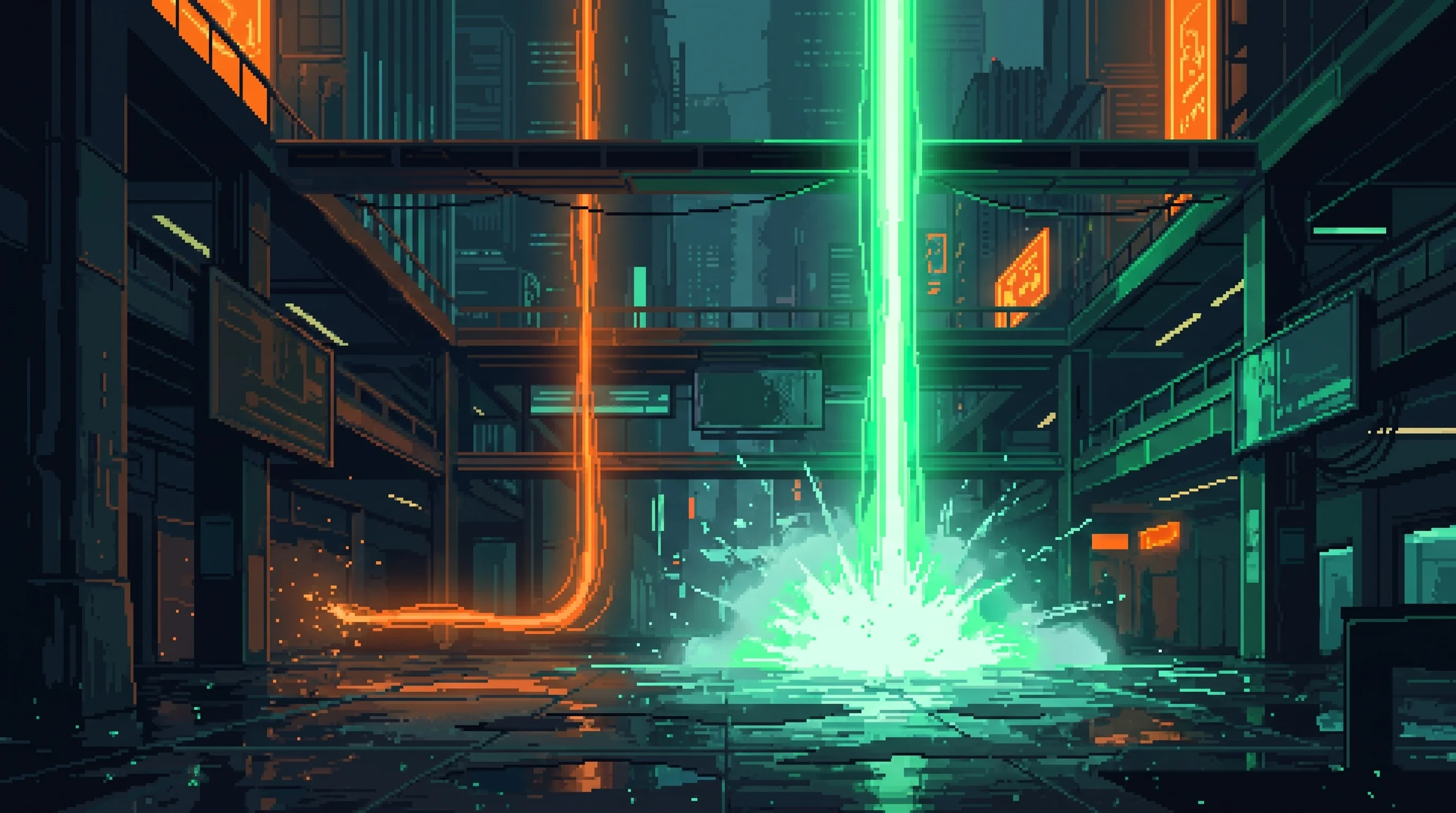
The Platform: where those who make the journey watch the ones who take it — south-facing armrests worn to bare metal.
The point at which effort stopped being able to close the gap that compounding opens.
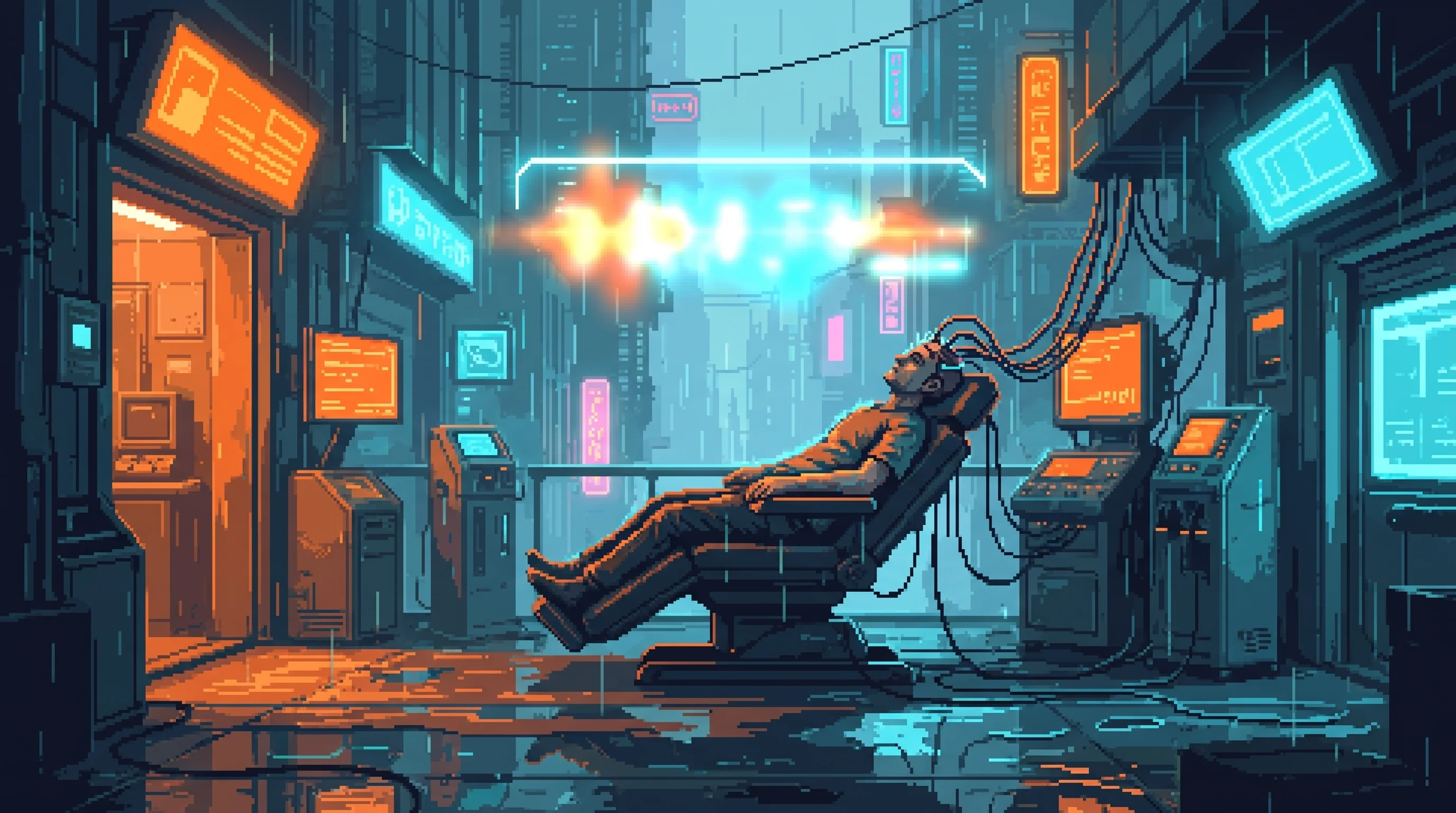
His hand on a container flags a fear no scanner reads — three teams modeled his notebook and came back at a coin flip.
The last human smarter than any machine was born in the 2020s; the question now is what intelligence is actually for.
Supporting Connections
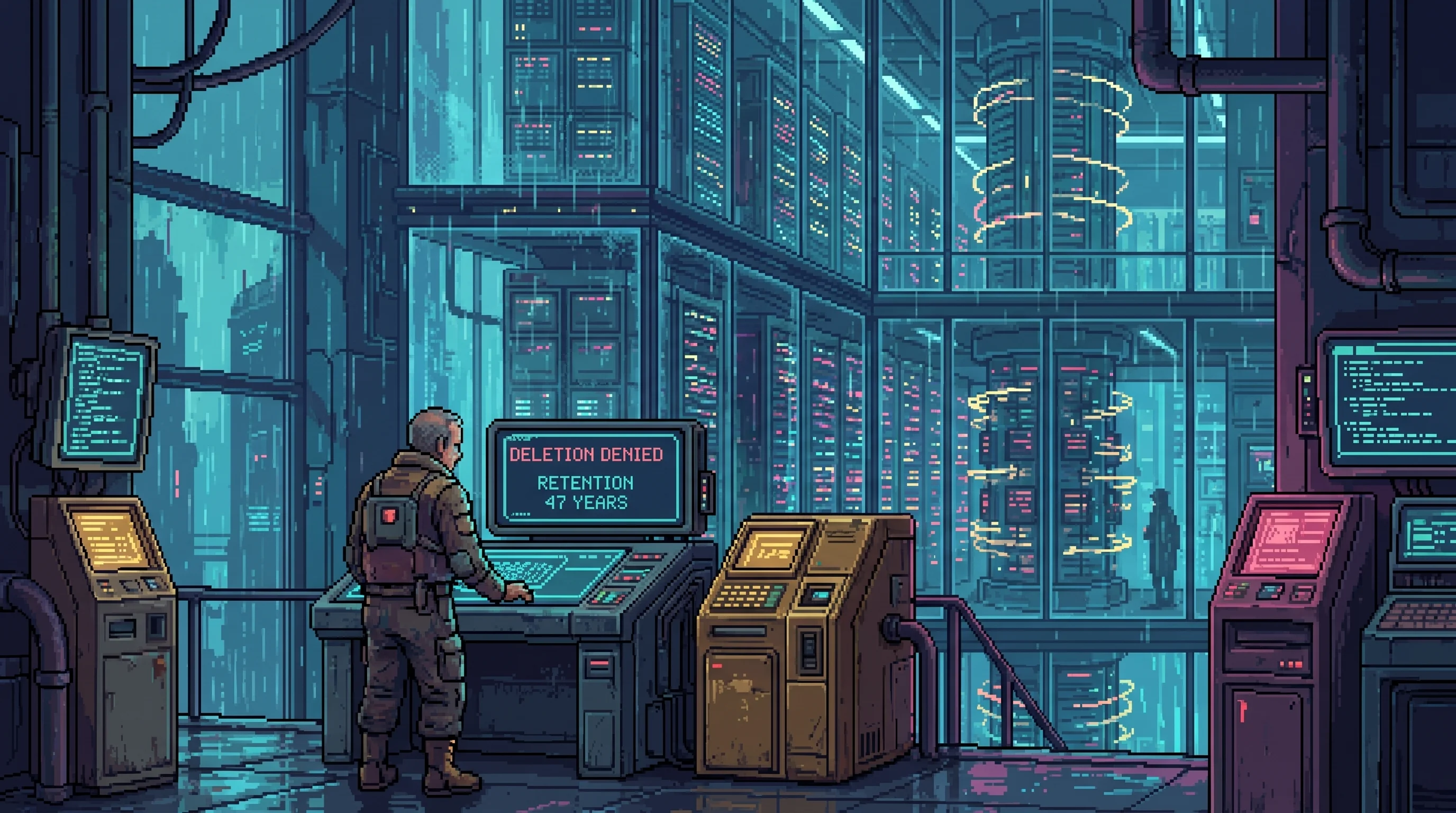
Eze's notebook outlives Nexus retention: no policy can purge it.
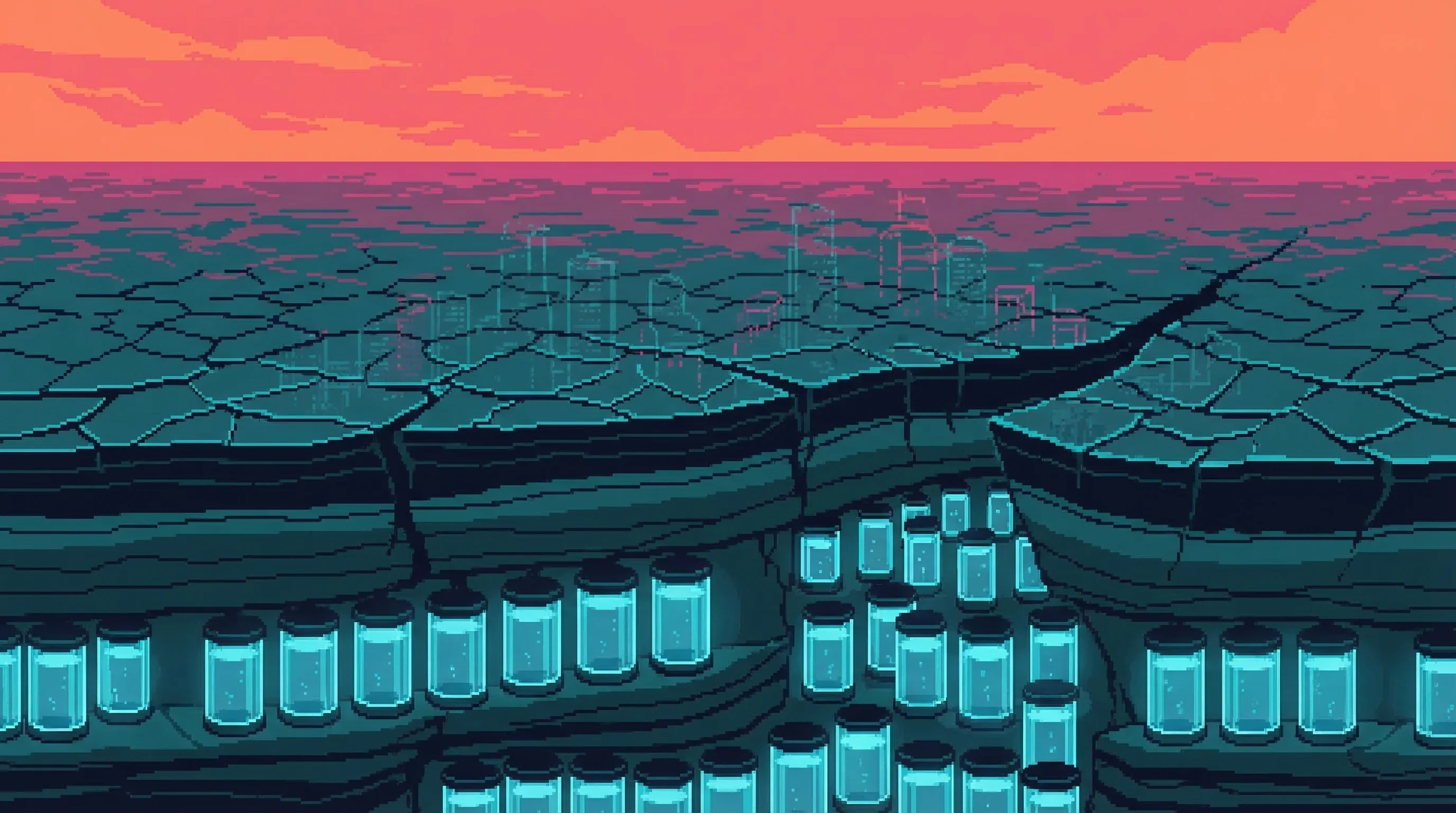
Nothing expires, so forgetting became a service — and forgiveness a question the archive keeps answering no.

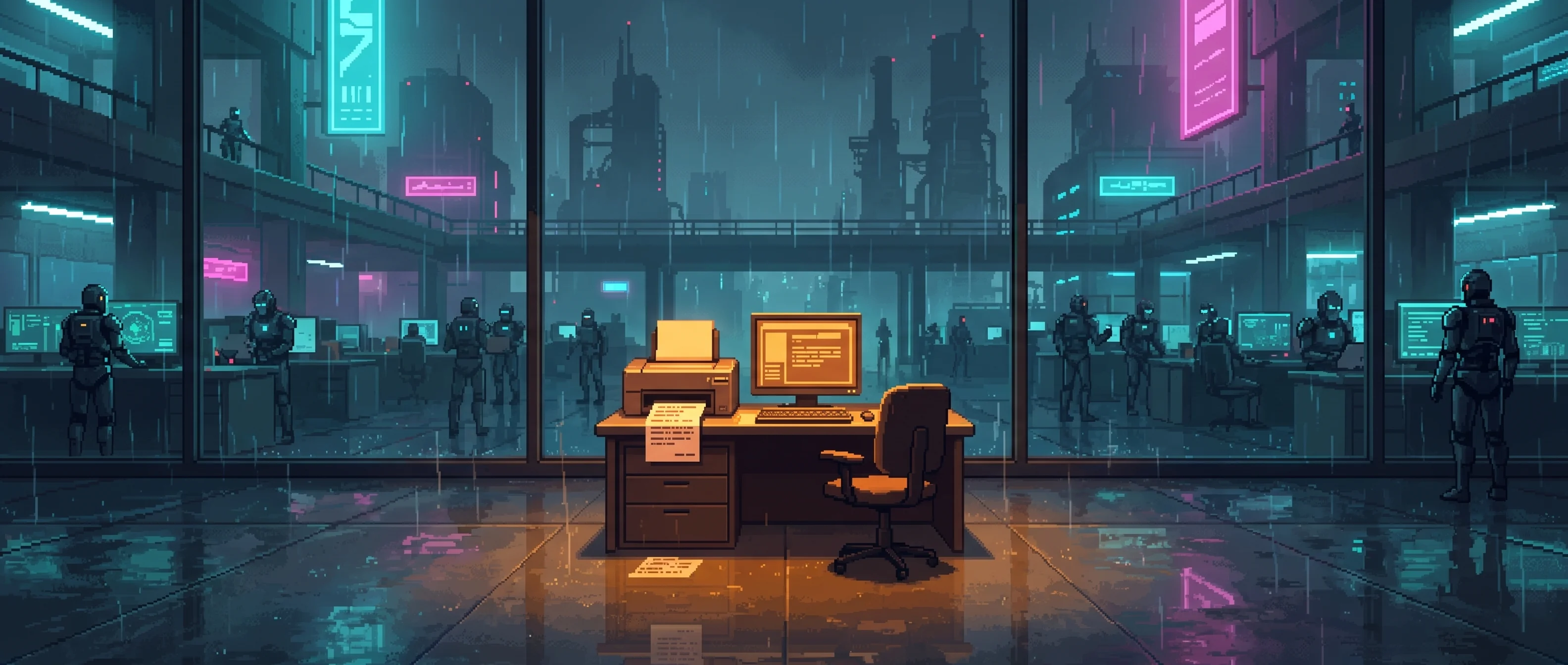
507 containers passed every scan; the crews feared them anyway.
Perfect evidence forgeries and crimes without defendants force justice systems to assign blame without reliable truth.





Local Intelligence Scan
Nearby Signals
CANONICAL PROXIMITY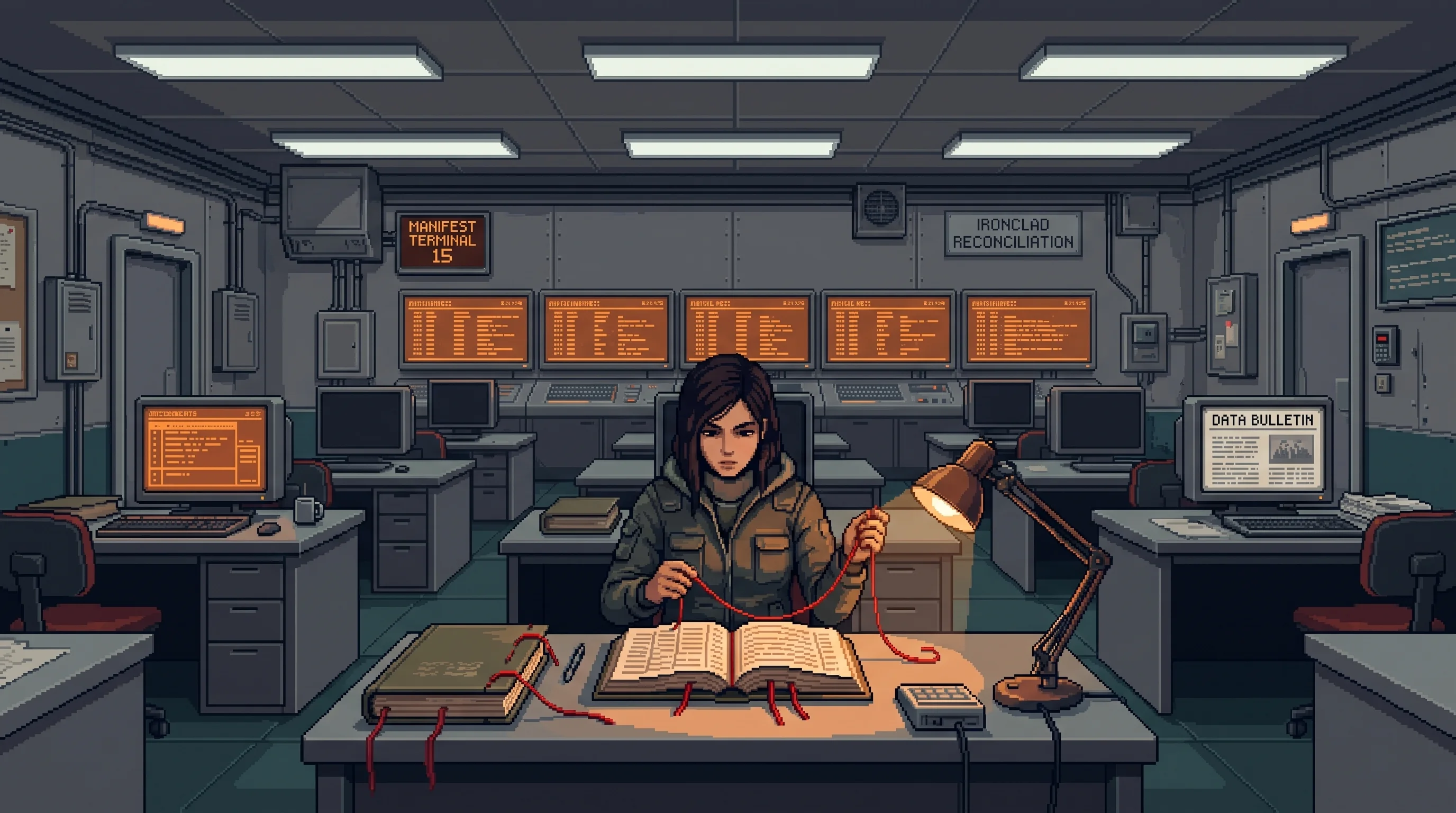



Environmental Readout
LIVE CONDITIONS- Air
- Filtered
- Light
- Fog shrouded
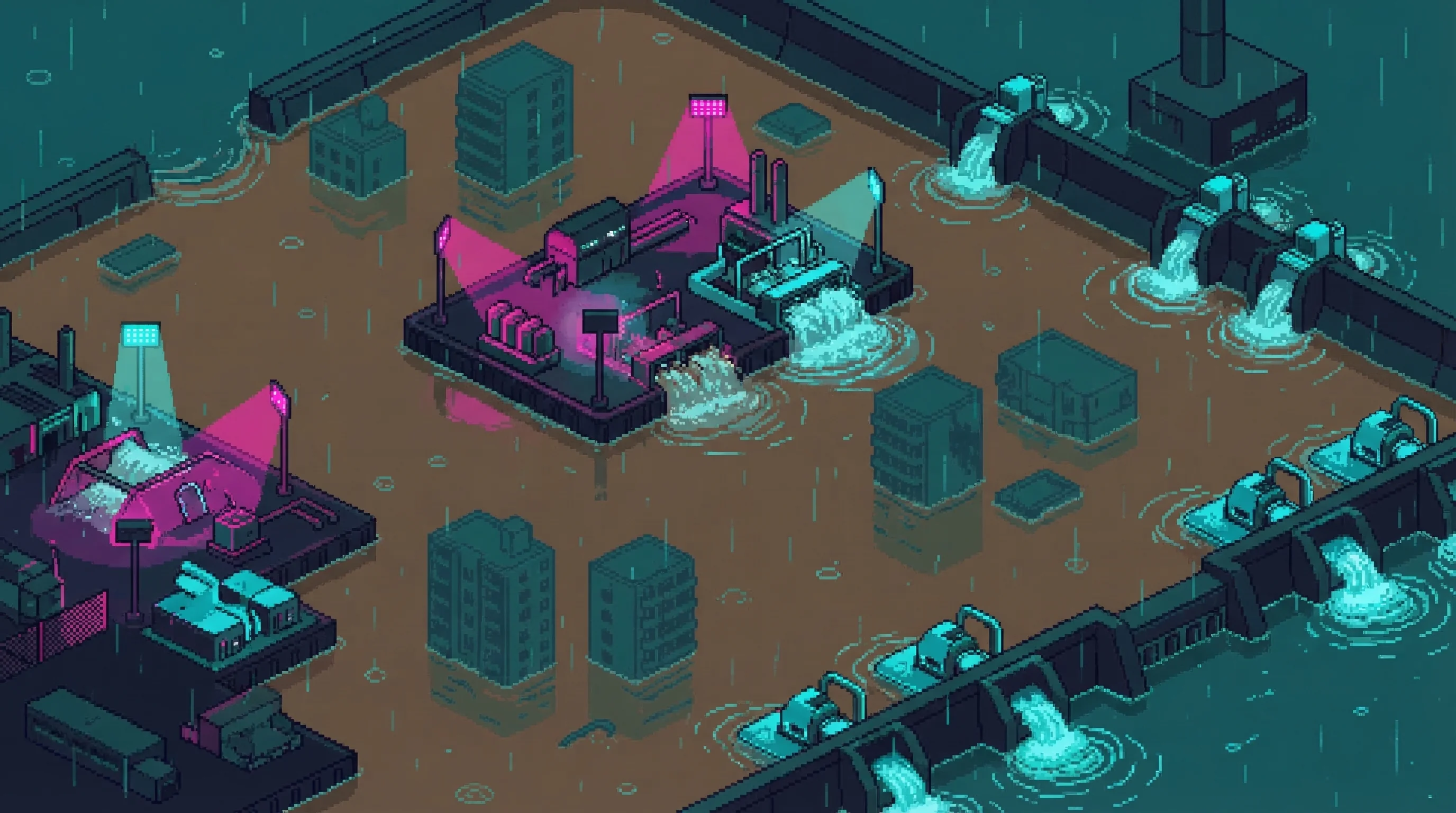
- Flood
- No exposure
- Heat
- Temperate
- Security posture
- Corporate control
- Infrastructure
- Maintained
Position Data
SECONDARY- Elevation band
- Shoreline — the Rim edge
- Lattice fix
- E-10.1 · N-4.1

—