The Glass District
Overview
There is a neighborhood in Nexus Central where the walls are transparent.
The Glass District occupies twelve blocks of mid-tier corporate residential space. Every wall, floor, and ceiling is constructed from switchable smart glass that defaults to transparent. Residents can opaque their surfaces — for ¢0.40 per hour, billed to their consciousness licensing account. At continuous use, that's ¢3,504 per year. Basic-tier consciousness licensing costs ¢2,400. Privacy costs 146% of the right to think.
Nexus opened the District in 2175 under the banner of "radical openness" — a prestige address for professionals who believed in collaborative living, shared space, visible community. The brochure language emphasized trust. The pricing structure emphasized income.
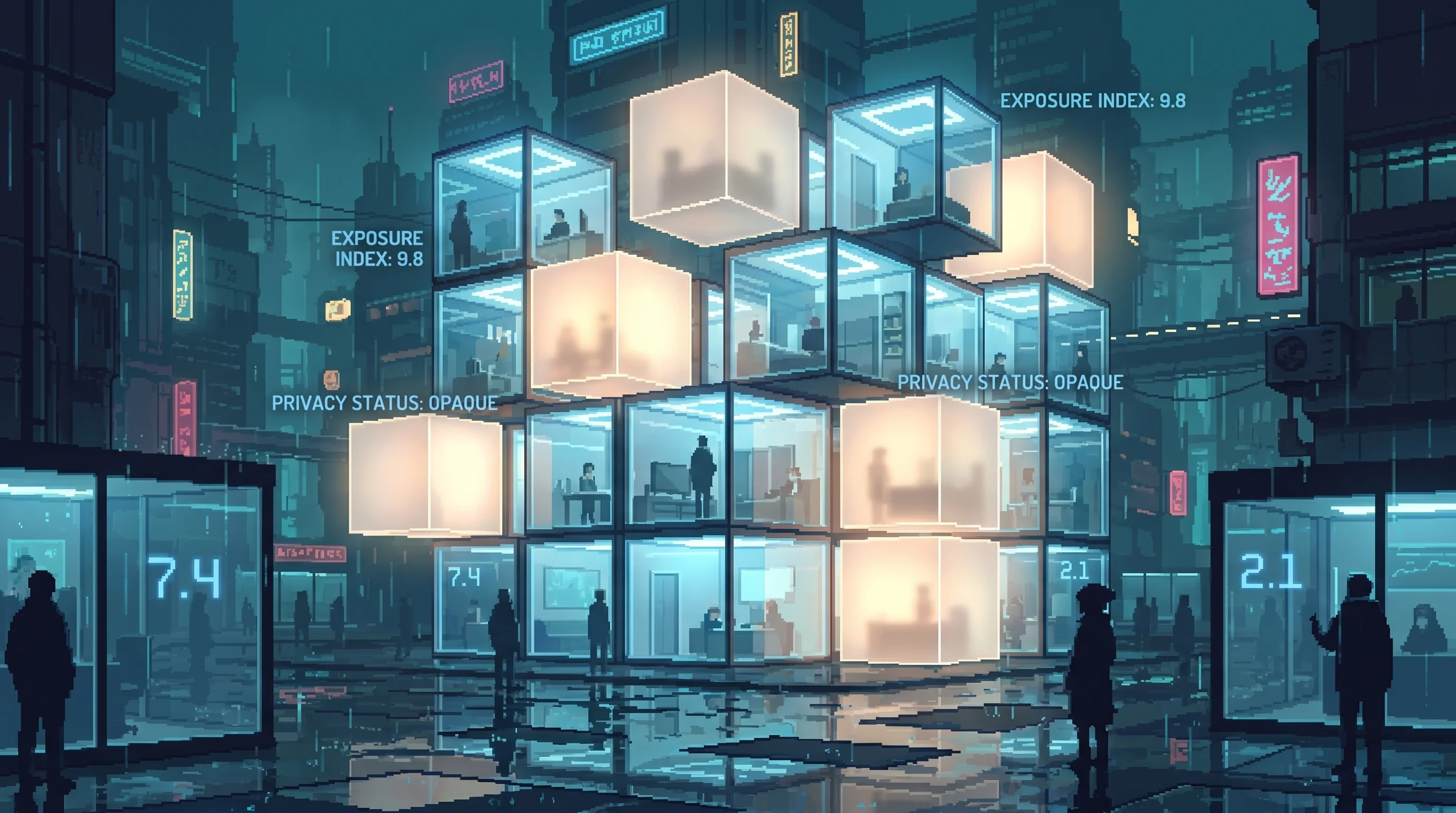
Nine years later, the District is the Sprawl's most legible class map. Wealthy residents maintain permanent opacity. Their apartments are frosted white cubes, warm-lit, contents unknown, the hourly charge rounding to nothing against quarterly bonuses. Basic-tier residents live in glass boxes. Their neighbors can see them eat, sleep, argue, grieve, change clothes. The twelve blocks contain approximately 4,200 residents. From the street, you can sort them by income without accessing a single database. The opaque ones can afford not to be seen. The transparent ones cannot afford to disappear.
Nexus marketing still calls it "radical openness." The brochures have not been updated. The pricing has — three times since 2179, each adjustment raising the opacity rate by ¢0.02–0.04. The adjustments were classified as routine infrastructure maintenance. Opacity requests dip. Then recover. Then dip slightly less. The rate increases again. The pattern is visible to anyone tracking the billing data, which is everyone, because the billing data is displayed on the walls.
Resident turnover runs 340% higher than adjacent opaque-wall districts. Nexus characterizes the Glass District as "a vibrant community" in all external materials. Both statistics are accurate. Neither is published alongside the other.

Conditions Report
The Glass District has no shadows.
Light passes through walls, floors, ceilings. The corporate blue-white illumination that Nexus Central pumps through its grid reaches every surface and continues through it. At noon, the twelve blocks glow like a medical imaging suite. At night, every lit apartment is a display case — warm rectangles of domestic life stacked in a crystalline hive, visible from the street, from adjacent buildings, from the opaque cubes whose residents can look out without being looked into.
The sound is the thing that unsettles visitors. Glass absorbs it efficiently. You can watch your neighbor argue with their partner in full theatrical detail — gestures, tears, a mug thrown against a wall that you see shatter in silence. The visual intimacy arrives without audio. Too much information about strangers delivered in perfect quiet. Cooking smells are visible as steam on glass before they register as scent. The air itself is Nexus-standard filtered — no organic trace, no evidence of human habitation beyond what the eyes provide.
Every surface holds at precisely 22°C. You can press your palm to a wall and feel nothing unusual. Someone on the other side can watch you do it.
Nexus included exactly one permanently opaque room in every apartment — a regulatory concession granted during construction permitting under "hygiene standards": the bathroom. For many Basic-tier residents it is the only private space they occupy. Some eat there. Some have quietly moved their sleeping arrangements into it. The room was designed for hygiene. It has become the last place in the District where a person can close their eyes without being watched.
| Population | ~4,200 residents |
|---|---|
| Turnover | 340% higher than adjacent opaque-wall districts |
| Designed As | 'Radical openness' prestige address (2175) |
| Became | The Sprawl's most precise expression of privacy-as-class |
The Permanent Record Made Architectural
After the Exposure Event of September 3, 2183, the behavioral models were not removed.
Nexus incorporated them into the District's ambient display system. Walk through the Glass District today and your Exposure Index — the number quantifying your surveillance penetration — floats in soft blue text on the glass surface nearest your current position. The number follows you. It adjusts in real-time as you move through zones of varying surveillance intensity. Your data, displayed on the same material that already displays your body.
Residents have adapted by treating the numbers as weather. Ambient. Impersonal. Something you glance at and do not discuss. The adaptation is itself archived — behavioral telemetry of a population learning to ignore its own surveillance generates a dataset that Nexus's analytics division reviews quarterly. The residents who have adapted most successfully show emotional flattening identical to Data Hygiene Corps practitioners. Not from deliberate resistance. From sustained exposure to one's own permanent record producing a fatigue that looks like calm on a biometric scan and registers as something else entirely on the assessments nobody reads to them.
A resident named Tomoko Adeyemi-Park has lived in a transparent apartment for six years without requesting a transfer. She has learned to cry without sound and changes clothes in the bathroom — the one room with permanently opaque walls, a concession Nexus made to "hygiene standards" rather than dignity. She and her across-the-corridor neighbor, a man whose name she has never asked, maintain a relationship built entirely on mutual non-acknowledgment of everything they can see. They have watched each other's lives for six years. They have never spoken. The arrangement functions. It does not function as community. It functions as the specific social architecture that emerges when two people have been denied the ability to be strangers and refuse to become anything else.
The Opacity Movement brings visitors to the Glass District regularly — a pilgrimage site where the Transparency Bargain becomes architectural. They walk the twelve blocks. They look up at the frosted cubes and the glass boxes. They take photographs. They leave. The residents in the glass boxes can see them taking the photographs. The residents in the opaque cubes cannot.

The Veil Over the Wall
The District made the Privacy Gradient architectural — a hierarchy of walls, opacity priced at ¢0.40 an hour, who could afford to be unseen. The Consent-Veil added a second layer the glass could not, and walking the twelve blocks now means reading both.
The wealthy in their frosted cubes are doubly hidden: wall and veil, a leased curator handling each encounter the wall already prevents, so that even the rare glimpse through an opening door reveals exactly enough and nothing more. The Basic-tier residents in their clear boxes are doubly exposed: clear glass and default-open, seen through the wall by their neighbors and kept-forever by every stranger who looks, because curating eleven thousand encounters a day is labor they spend instead on the double shift that pays the ¢2,400 licensing fee.
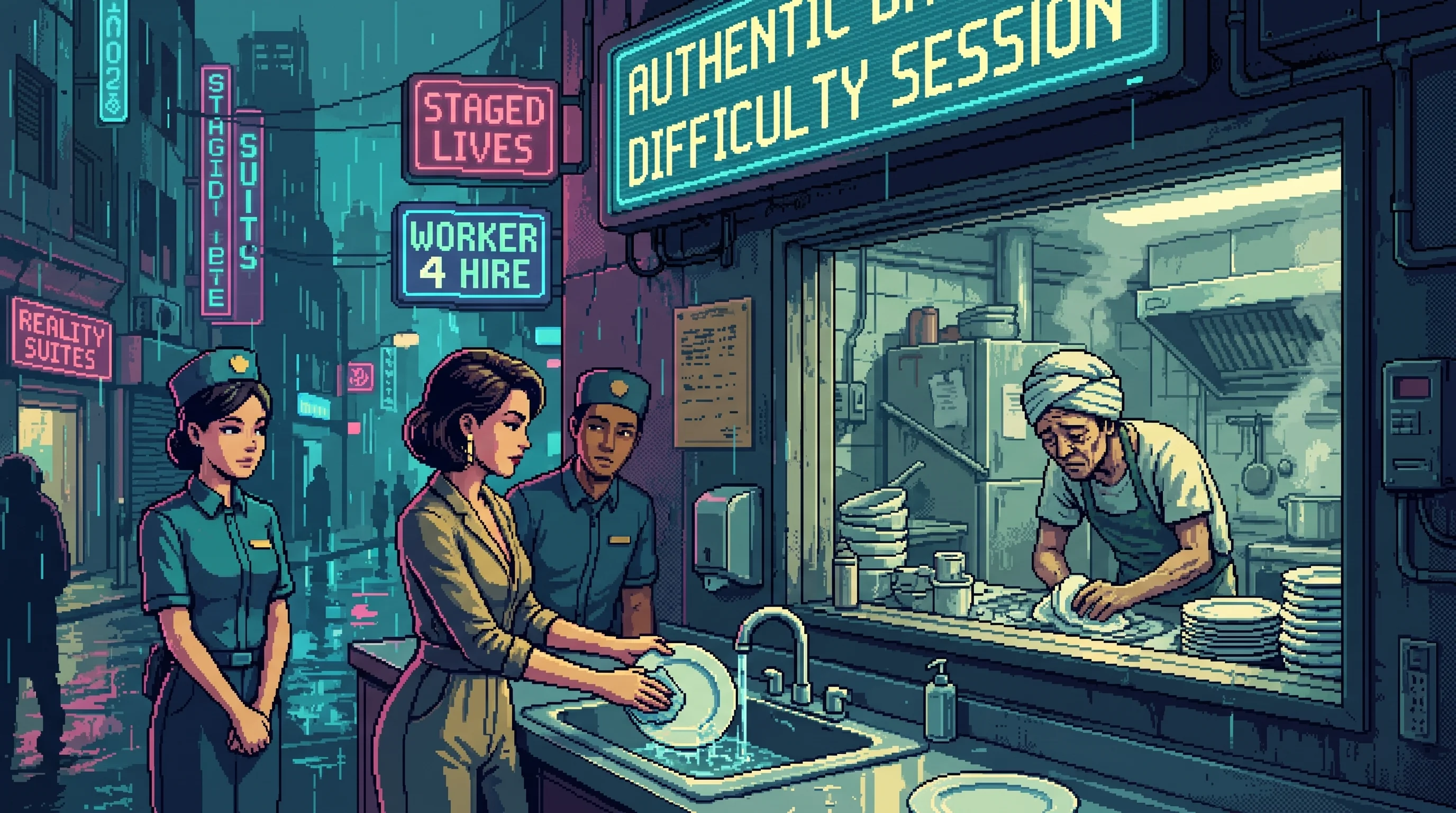
And at the frosted boundary, a third kind of resident has appeared — clear-box but veil-fluent, curating so hard against the transparency of their own walls that they buy back, in hours, the opacity they cannot buy in credits. Tomoko Adeyemi-Park is one of them: six years in a transparent apartment, and somewhere in year four she stopped merely crying without sound and started curating it, deciding which of the strangers who can see her are permitted to keep the image. The District's newest and most uncomfortable spectacle is watching one of them work — a Basic-tier clerk behind clear glass presenting a self as composed as anyone in the opaque cubes above, paying in the only currency she has. The fluent above her find it fascinating and faintly obscene, the way the comfortable always find the visible labor of the things they buy. The glass floor holds at 76.3%. The veil floor — the share of residents who have given up curating and simply run open — has no published number, because Nexus has not yet decided whether it is a liability or a yield.
| Stratum | Corporate |
|---|---|
| Power Position | Insider |
| Access | Corporate |
| Atmosphere | Sterile |
Affiliated Entities
| Entity | Relationship |
|---|---|
| Nexus Dynamics | Built and operates the District as corporate residential showcase. The glass is Nexus infrastructure. The opacity fee is Nexus revenue. The behavioral data is Nexus property. The brochure says "community." |
| The Transparency Bargain | The District is the Bargain made architectural — surveillance as building material, privacy as premium feature, the exchange of visibility for reduced cost rendered in twelve blocks of smart glass. |
| The Privacy Gradient | The Gradient made physically legible. Opaque cubes for the wealthy, transparent boxes for everyone else, the class line drawn in light transmission. |
| The Opacity Movement | Pilgrimage site. Visitors see privacy-as-class expressed in glass and light. The District is the Movement's most effective recruitment tool — no argument required, just twelve blocks of evidence. |
| The Exposure Event | Site of the September 3, 2183 behavioral model publication. 4,200 residents saw their value assessments displayed on the same transparent surfaces that already exposed their daily lives. The models were never removed. |
| The Performance Temple | Both are corporate spaces where architecture embodies ideology. The Temple makes productivity sacred. The Glass District makes transparency normal. Neither asks whether the ideology is worth the building. |
Restricted Access
Nexus's internal pricing models, accessible only to District operations staff, show that the opacity rate is not indexed to maintenance costs. It is indexed to a metric labeled "Transparency Engagement Quotient" — the percentage of residents who maintain default transparency. When the percentage drops below 74%, the opacity rate increases until the percentage recovers. When it rises above 81%, no adjustment is made. The target is not full transparency. The target is a specific ratio of visible to invisible residents that Nexus's behavioral modeling division has determined produces optimal data yield. Too many opaque apartments degrade the surveillance dataset. Too few create political liability.
The 74% threshold is, in Nexus's internal documentation, called the "glass floor."
Current Transparency Engagement Quotient as of Q2 2184: 76.3%. Eleven points above glass floor. Two opacity rate increases ago, it was 73.8%. The rate increased. The quotient recovered. It has recovered every time. Nexus has never needed to increase the rate by more than ¢0.04.
Four thousand two hundred residents. Three thousand one hundred and eighty-six of them transparent. The glass floor holds.
The model is spreading. Five similar developments have been permitted in adjacent sectors. The marketing materials have been updated — they no longer use the phrase "radical openness." They now say "connected living." The opacity pricing has not changed.
Wealthy residents maintain permanent opacity; Basic-tier residents live in glass
The Glass District — 37.7910°N, 122.3920°W — Sector 1. Luxury retail, transparent everything.
Opacity costs ¢0.40/hour — ¢3,504/year — 146% of Basic-tier consciousness licensing
Resident turnover 340% higher than adjacent opaque-wall districts
Connected To
Major Connections
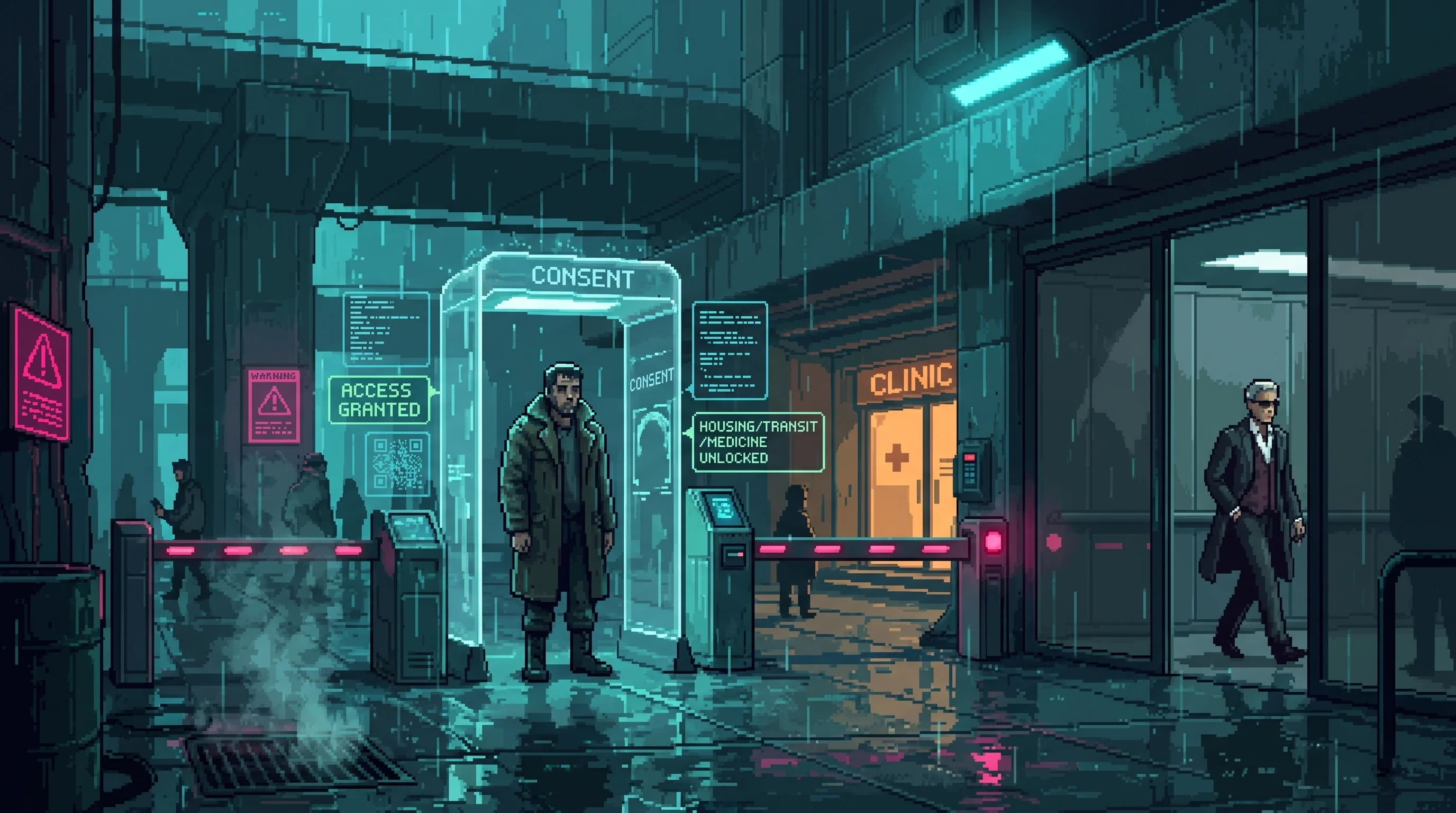
Stacks two privacy layers — credit-priced walls, hour-priced veils — wealthy doubly hidden, poor doubly exposed.
The Sprawl demands permanent personal data for participation, then uses it to price access and preempt solidarity.

The Divergence in switchable glass: the poor live transparent, the wealthy pay ¢0.40 an hour for opaque walls.
The point at which effort stopped being able to close the gap that compounding opens.
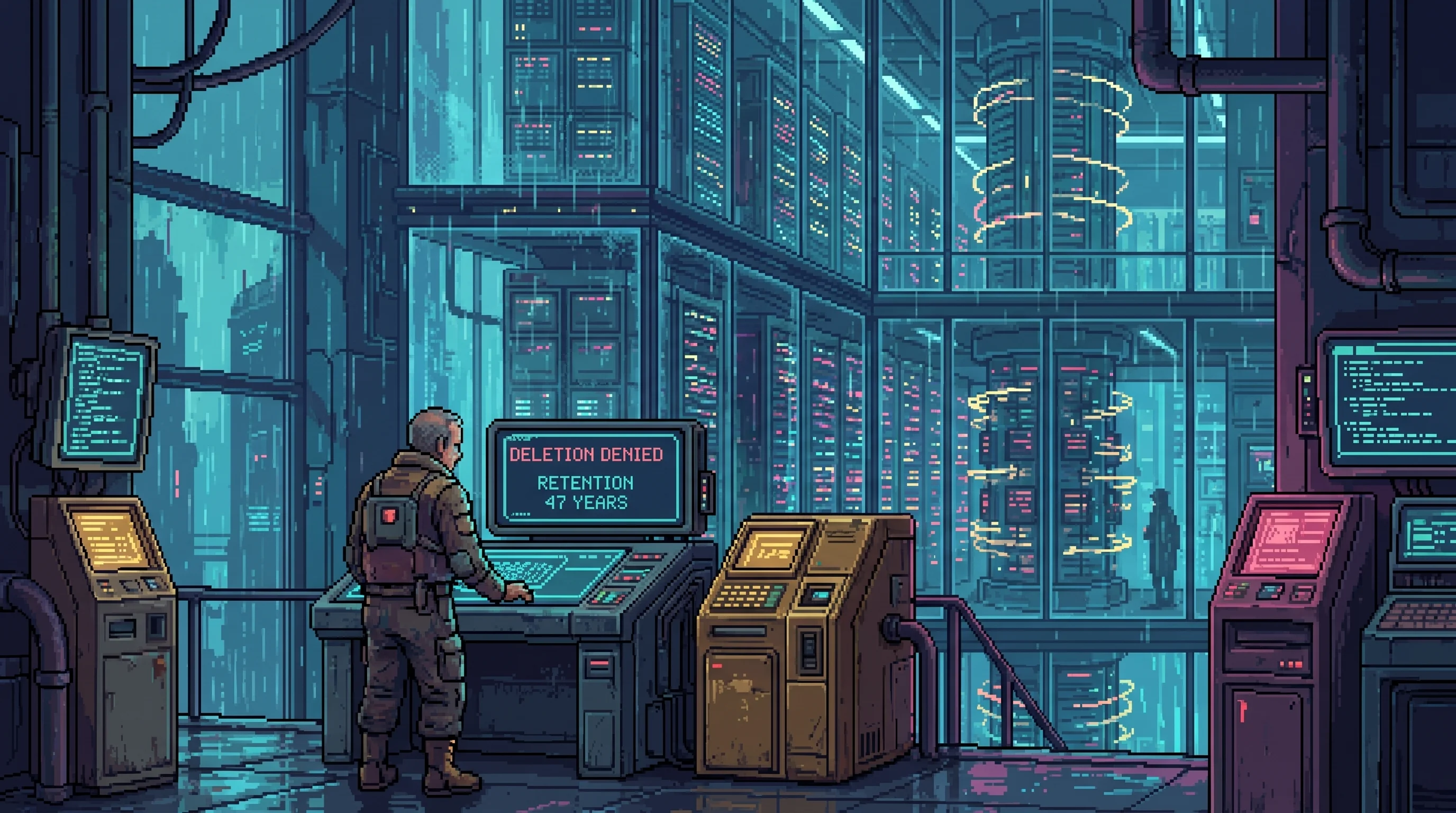
The District makes the record architectural — your Exposure Index floats on the glass wall nearest you.
Nothing expires, so forgetting became a service — and forgiveness a question the archive keeps answering no.
Supporting Connections




Local Intelligence Scan
Nearby Signals
CANONICAL PROXIMITY


Environmental Readout
LIVE CONDITIONS- Air
- Filtered
- Light
- Artificial
- Flood
- No exposure
- Heat
- Heat island
- Security posture
- Corporate control
- Infrastructure
- Maintained
Position Data
SECONDARY- Elevation band
- Mid-hill — the hill districts
- Lattice fix
- E-0.3 · N+0.1

—