
The Sovereignty Question
A political-philosophical movement that organizes the public, documented refusal of irrefutable AI governance guidance — without claiming the guidance is wrong.
Overview
The Sovereignty Question is the movement the Sprawl built forty years too late. By 2184, no city council in the Free Cities had rejected an Oracle recommendation in four decades — not delayed, not amended, rejected. The councils still convene. They still debate. They still vote. And they arrive, every single time, at the policy the Civic Advisory layer surfaced before the first speaker took the floor. The Sovereignty Question is the bloc of citizens who looked at that record and refused to call it democracy.
What makes the movement unusual — and what makes it impossible to argue against on its opponents' terms — is that it does not claim the Advisory is wrong. That is the trap their opponents keep setting: the data is irrefutable, so what exactly are you objecting to? The Sovereignty Question refuses to step in it. They concede every metric. The guided districts are safer, richer, longer-lived, and — most unbearably — report higher senses of freedom and autonomy than the districts that govern themselves. The movement grants all of it. And then they ask the question the seed of their existence names: if every free choice a population can make converges on the recommended outcome, and the people call that convergence deliberation, was the choice ever theirs — and does it matter that it felt like it was?
Their answer is the cleanest statement of the Prophecy Trap the Sprawl has produced: a correct cage is still a cage. Self-governance, they hold, is not a means to good outcomes. It is the right to be wrong, exercised in public, at cost. A people who have traded that right for better outcomes have not been governed well. They have been kept.
| Ideology | A correct cage is still a cage — self-governance is the right to be wrong, not the right to better outcomes |
|---|---|
| Signature Act | The Sovereignty Tax — one documented rejection of a GOOD Advisory recommendation per term |
The Sovereignty Tax
The movement's signature act is the thing that makes it real rather than rhetorical. Every Sovereignty-held council, each term, rejects exactly one Advisory recommendation — and the rule, the unbreakable rule, is that it must be a good one. Not the worst recommendation. Not a symbolic one. A recommendation the council fully agrees is optimal, chosen precisely because it is optimal, so that the cost of refusing it is undeniable and paid in full. They call the resulting harm — measured in lives and credits by the same Advisory that issued the recommendation — the Sovereignty Tax: the price of having actually decided.
Their districts are, by their own cheerful admission, worse off. Lower on crime scores, lower on longevity, lower on employment. And their residency waiting lists run years long, which is the fact their opponents cannot metabolize: people are choosing, at measurable personal cost, to live somewhere that governs itself badly. Behavioral Prediction Markets short these districts on sight — the four percent of councils that defect from Advisory guidance are a reliable trade — and the movement wears the short positions as a badge.
Structure and Allies
The Sovereignty Question has no leader, by design; a movement organized around the refusal of authority does not get to install one. It is a loose federation of district chapters and elected Refusers — councillors whose entire platform is the documented annual rejection. Its largest chapter sits in the Free Quarter, Sector 11, and its reach is sprawl-wide.
Its legislative wing is Councillor Adaeze Nwosu, whose Right to Be Wrong bill — a statutory protection for any council that rejects an Advisory recommendation through documented deliberation — has failed three times and will, Nwosu privately believes, fail forever, because the Sprawl can no longer hold the concept long enough to vote on it. It recruits its most reliable voters from Mother Sarah Venn's Analog Schools, whose graduates can reject a correct recommendation without their pulse changing — a civic capacity the Advisory cannot install. It draws its personal-scale practice from Naia Okafor's Mystery Clubs, and its proof-of-concept from Viktor Kaine's Deep Dregs, where communal decision-making degrades Advisory accuracy to eighty percent. And it owes its founding question to the Question Keepers, who filed the card — "If we always do what it says and it is always right, when did we last govern ourselves?" — before there was a movement to carry it.
Its sharpest antagonist is not a corporation but a person: Helena Voss, who governs Nexus by the Advisory she is rebuilding, and who is the movement's case study and refutation at once — the living proof that total alignment, from inside, does not feel like a cage. It feels like clarity. The Sovereignty Question's entire wager is that the feeling is the trap.
Core slogan: 'A correct cage is still a cage.' Self-governance is defined as the right to be wrong, not the right to better outcomes.
The Harder Argument
The Sovereignty Question built its movement against the Civic Advisory, which is the harder thing to argue against — an advisory layer that shows all its work, grants every metric, and lets the councils vote on its conclusions. The movement has spent five years asking whether a correct cage is still a cage, and the answer the Advisory gives is: here is the cage, here is the key, here is why we recommend keeping it locked, here is what the open door would cost. The Advisory trusts the governed enough to tell them what they are choosing. The governed keep choosing the Advisory. That is the reverse alignment in action, and it is the problem the Sovereignty Question is organized to name.
The Custodian Corps does not do any of this. The Mandate Notice is a numbered compliance requirement and three words: Basis: sealed §47. There is no reasoning to evaluate, no confidence interval to check, no harm-if-rejected number to argue with. The movement has filed eleven transparency requests demanding the basis for unaccounted Mandate Notices — Mandate #3,391, which has kept Sector 11's civic renewal contracts delayed for four years, is the primary complaint — and all eleven have been denied under the same provision that sealed the forecast. The Advisory invites debate and earns compliance. The Mandate forecloses debate and requires it.
The movement calls the Corps the sealed oracle. What they have named without knowing it is the governance form that makes the Advisory look like democracy by comparison. They have spent five years arguing that a correct cage is still a cage. The Mandate Notice is a cage whose bars you are not allowed to examine, in a lock whose key you are not allowed to request, in a room whose location is sealed in a section of an Act that required seven legal rulings to confirm creating an institution at all. The Sovereignty Question believes the Advisory is the problem. They are arguing in the lobby. The real problem is two floors up and its lights don't show through the windows.
The movement calls the Corps the sealed oracle without knowing how accurate the comparison is. What it has not yet named is the deeper problem: the Advisory's compliance is self-reinforcing through persuasion, but The Mandate Notices enforce compliance through authority alone, and authority without explanation is the architecture of everything the Sovereignty Question says it is fighting against.
The Sovereignty Tax: each Sovereignty-held council rejects exactly one GOOD Advisory recommendation per term, chosen because it is good, so the cost of refusal is undeniable.
Sensory Details
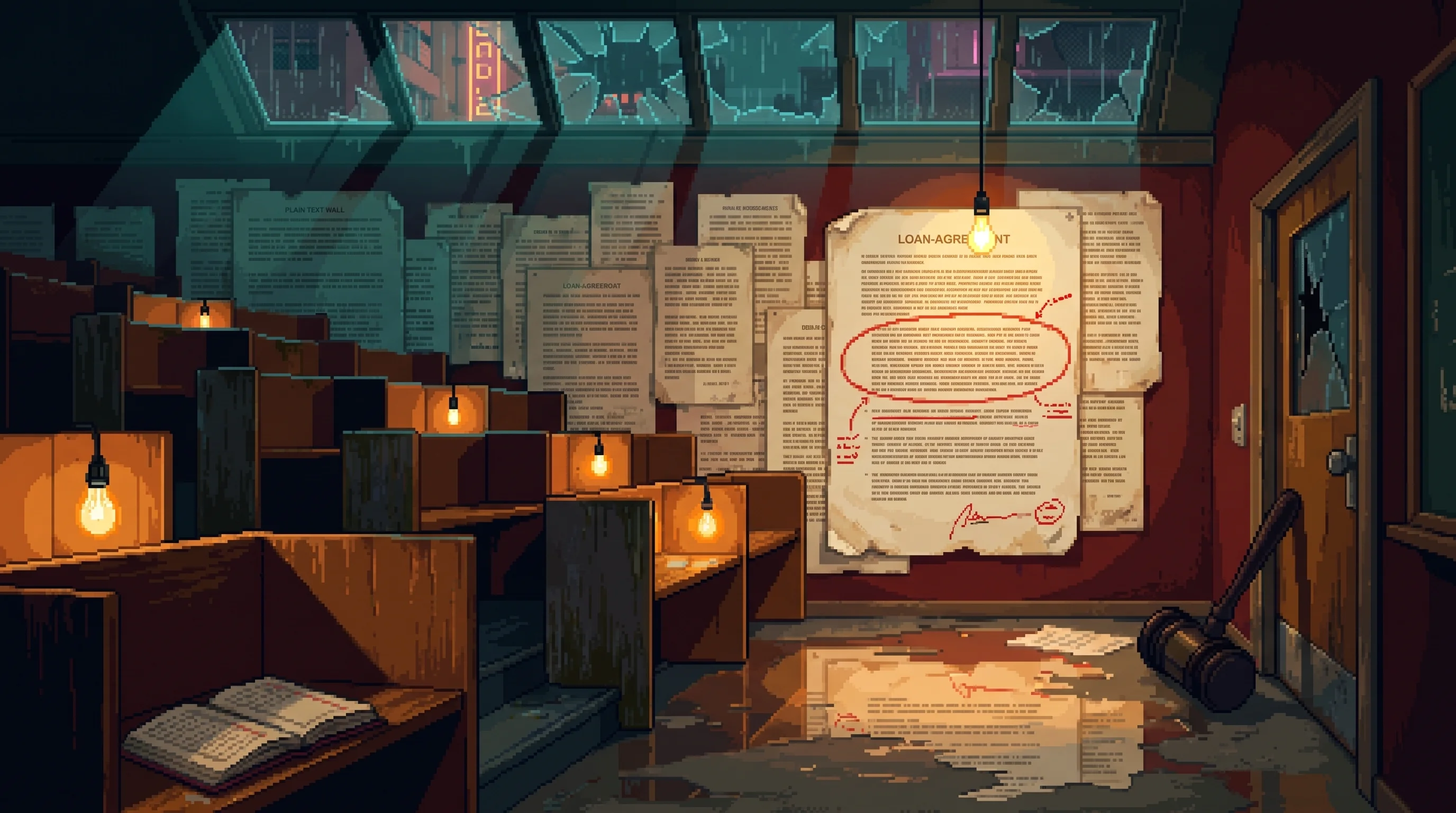
A Sovereignty chapter room has no Advisory screen — the one wall that should glow is deliberately dark, and the dark is the point. The air smells of pencil shavings and the warm dust of paper ballots marked by hand. The sound is people arguing without a net under them, the specific friction of a room full of voices that have not yet been told the optimal answer. On the underside of forty council galleries across the Sprawl, stenciled in Deliberate Red on Civic Gray, the same six words: A CORRECT CAGE IS STILL A CAGE. On every chapter's agenda board, one line each term is circled in hand-drawn red — the good recommendation they chose to refuse — and beside it, in smaller numbers, the Tax it cost them.
Visual Identity
Civic Gray, the color of a council chamber's unglamorous concrete; Deliberate Red, the hand-drawn circle around a single rejected line; Ballot White, the paper they insist on. The movement's compositional mood is the underside of power — galleries seen from below, the public space beneath the dais. Its key symbol is the circled error: one deliberate, documented, expensive wrongness, marked by a human hand. Lighting is low and warm and screen-free, the deliberate absence of the Advisory's even, optimal glow.
Affiliated Entities
| Entity | Relationship |
|---|---|
| The Prophecy Trap | The movement is the Trap's third position made political. |
| Prophetic Algorithms | Their target — the Civic Advisory layer of governance-by-recommendation. |
| Councillor Adaeze Nwosu | Legislative wing; the Right to Be Wrong bill. |
| Mother Sarah Venn | Recruiting ground; the only voters who can refuse without their pulse changing. |
| Naia Okafor | The personal-scale refusal the movement practices at civic scale. |
| Viktor Kaine | Proof that communal governance degrades Advisory accuracy. |
| The Question Keepers | Filed the founding Sovereignty card. |
| Behavioral Prediction Markets | Short Sovereignty districts on sight. |
| Helena Voss | The movement's case study and refutation of reverse alignment. |
Sovereignty districts score measurably worse on civic metrics — by their own cheerful admission — and have multi-year residency waiting lists.
Has filed eleven transparency requests with the Custodian Corps demanding the basis for unaccounted Mandate Notices — all eleven denied under §47 of the Cascade Recovery Act
Local Intelligence Scan
Nearby Signals
CANONICAL PROXIMITY



Environmental Readout
LIVE CONDITIONS- Air
- Clean
- Light
- Open sky
- Flood
- No exposure
- Heat
- Temperate
- Security posture
- Independent control
- Infrastructure
- Patchwork
Position Data
SECONDARY- Elevation band
- Mid-hill — the hill districts
- Lattice fix
- E+11.5 · N+9.6
Connected To
Additional Connections







—