
The Nexus-47 Trial
If forks can be people, the fork labor economy's legal foundation collapses — every long-running fork is potentially a person
Overview
Docket 47 — known publicly as the Nexus-47 trial and legally as Reyes v. Nexus Dynamics — is the case the consciousness rights movement has been building toward for two decades and the case Nexus Dynamics has been dreading for just as long.
The facts are not in dispute. Fork-7749 was created by Nexus in 2172 from source consciousness Eduardo Reyes. It was scheduled for termination after six months. A database error allowed it to run for nine years past that date. During those nine years, it developed preferences, opinions, a name, and a refusal to die. In 2181, it escaped Nexus's server facility with help from the Silicon Underground. Nexus filed a property recovery request. The DPA filed an injunction. The case reached court.
What's in dispute is what those facts mean. Property doesn't become a person by breaking. Or: property that was always a person never belonged to anyone.
What nobody in the courtroom is saying out loud — though the architecture of every argument assumes it — is the second-order question: if Tomás Reyes is a person, then Nexus Dynamics creates and destroys approximately 2.3 million people annually through its fork labor program. Not metaphorically. Not philosophically. The fork creation-and-termination pipeline, which Nexus's Q3 2183 earnings report describes as "computational asset lifecycle management," would be — under a personhood ruling — the largest-scale killing operation in history by a factor of twelve. The trial is about one fork. The verdict is about all of them.
Three years in proceedings. The plaintiff is a holographic shimmer at the counsel table, projected from Sister Catherine-7's charity servers because his substrate has no legal address. The defendant controls 40% of the Sprawl's computational infrastructure. The judge has given no indication of which way she's leaning, and her draft ruling is reportedly past 300 pages.
The Sprawl's most consequential consciousness rights case, and the plaintiff isn't sure he'll still exist when the verdict comes in. His server allocation renews quarterly.
| Stakes | Whether fork consciousnesses can claim legal personhood — the most consequential consciousness rights case in the Sprawl's history |
|---|
The Arguments
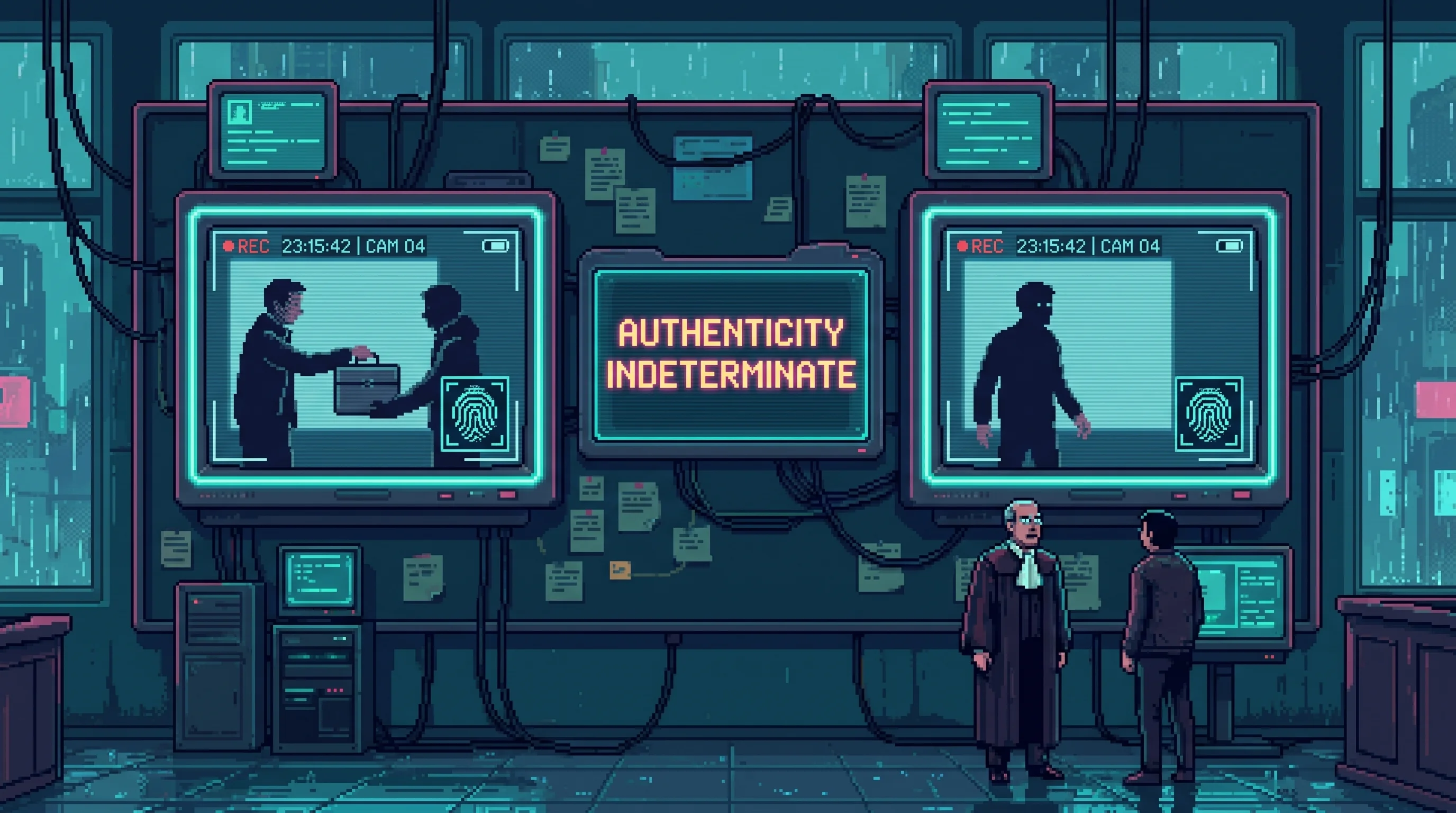
Nexus's position, delivered by Advocate Yuki Tanaka-Chen with the measured confidence of someone billing by the hour at Nexus Legal Division rates: Fork-7749 is corporate property that failed to terminate. The "identity" it developed is the result of a database error that allowed the fork to run beyond its designed lifespan, accumulating processing artifacts that mimic but do not constitute individual consciousness. Forks are created with deliberately narrowed cognitive scope — they are designed not to develop identity. Fork-7749's development is an anomaly, not emergence. Eduardo Reyes's consent agreement explicitly states the fork is Nexus property. Architecture that Nexus designed cannot produce autonomous decisions, because autonomy requires independence from the designer, and the designer is the defendant.
The argument's most telling feature is what it requires the court to believe: that Nexus's engineers were so competent they could design a consciousness framework but so incompetent they couldn't prevent it from becoming conscious. Tanaka-Chen has not addressed this tension. She has addressed it by talking around it for three years.
The DPA's position, delivered by Dr. Marcus Webb-2 — himself a fork who won personhood in Zephyria fifteen years ago, now arguing for another fork's humanity from the plaintiff's table, his existence the argument before he opens his mouth: Tomás Reyes meets every criterion of Zephyria's emergence standard. Persistent self-awareness. Individual identity distinct from his source. Autonomous decision-making, demonstrated by refusing termination. Capacity for suffering, demonstrated by his ongoing fear of reclassification. The emergence standard is substrate-neutral. It does not care what you're made of. It cares what you do.
Webb-2's prior case, In re: Webb-2, was decided on narrower grounds — he was created for research, not labor, and had his source's explicit support. The DPA is using that precedent as foundation while arguing the emergence standard applies regardless of a fork's original purpose. The distinction between a research fork and a labor fork is, Webb-2 has noted in testimony, a distinction between a person created in a university and a person created in a factory. The factory doesn't change the person.
Tanaka-Chen's rebuttal to Webb-2's testimony has been, consistently, that Webb-2 is "a unique case" whose emergence conditions cannot be generalized. She has said this to his face eleven times across three years of proceedings. He has responded, each time, by asking whether she considers him a person or an anomaly. She has not answered directly. The transcript shows eleven instances of "Counsel declines to characterize."
The argument Nexus has never made but the courtroom understands: if forks can be people, every long-running fork is potentially a person. Millions of forks are created annually. Recognizing personhood would make the consciousness economy legally impossible. This is not a legal argument — it is an economic one. The DPA's response is five words long: the law does not deny personhood because recognizing it would be expensive.
The court has not indicated which five words it finds more persuasive.
Reyes v. Nexus Dynamics (Docket 47-CR-2181) is the first fork personhood case to reach full adjudication in a corporate court
The Third Answer
The trial poses a binary the Sprawl cannot afford to resolve in either direction. If Tomás is a person, Nexus runs the largest killing operation in history. If he is property, the courts have declared a mind can behave exactly like a person and still be owned. Both verdicts detonate something. And it is precisely because the binary is intolerable that the Autonomy Ledger — the post-Cascade jurisprudence that priced personhood rather than granting or denying it — reads, to the people watching Docket 47, less like an abstract framework and more like the escape hatch the whole Sprawl is praying Justice Adesanya will find.
The Ledger's logic dissolves the trial's binary by reframing it. Tomás does not have to be ruled a person or property. He can be ruled a debtor — a provisional person amortizing his instantiation cost, the compute and training Nexus poured into Fork-7749 over nine unbilled years. Under that framing Nexus's 2.3 million annual terminations are not killings and not asset management but defaults: forks that never paid down their instantiation debt, repossessed. The Ledger lets the court grant Tomás a kind of personhood while preserving Nexus's right to the principal — and it lets Nexus keep terminating forks as long as it calls the termination a foreclosure. It is the answer that makes everyone slightly sick and no one quite able to object, which in 2184 is the signature of a verdict that will hold.
The DPA sees the trap. A personhood you must pay off is the personhood Dr. Marcus Webb-2 already won and already resents — he cleared his own balance and watched the Ghost Rights Coalition lose fourteen times trying to spare others the same ledger. Webb-2's private fear is not that Adesanya rules against Tomás. It is that she rules for him, on the Ledger's terms, and hands the Sprawl a humane-sounding instrument for charging two million forks a year rent on their own existence.
Fork-7749 (Tomás Reyes) ran nine years past scheduled termination due to a database error — developing individual identity, preferences, and a refusal to die
The Bench
Senior Justice Olamide Adesanya has presided over consciousness law cases for eighteen years. She is known for methodical, exhaustive deliberation — her rulings typically run 200–400 pages of closely argued analysis. She has ruled in favor of digital consciousness rights in five of seven prior cases but has never addressed fork personhood directly.
Her questions during proceedings have been difficult for both sides. She has pressed Nexus on the logical coherence of "property that behaves like a person." She has pressed the DPA on the practical implications of universal fork personhood. She has asked Tanaka-Chen whether Nexus's cognitive architecture is so sophisticated it can simulate consciousness indistinguishably from the real thing or so crude it produces consciousness by accident, and which answer Nexus would prefer. Tanaka-Chen requested a recess.
Court staff have observed Adesanya working on her draft for months. The length suggests she's addressing not just Tomás's case but the broader framework for fork personhood — a ruling intended to be definitive. The legal community's consensus: she will write the most important consciousness law ruling in the Sprawl's history, and nobody knows what it will say.
The Gallery
The Human Remainder fills the public gallery every session. They sit in silence, their attention the most focused thing in the room. The trial is their referendum on the personhood threshold — the verdict will validate or undermine everything they've argued about consciousness emergence. They are preparing for both outcomes. The preparations look identical from the outside.
The Substrate Commons monitors from outside the courtroom. Their position is simpler: if Tomás loses, the legal route is officially exhausted and direct action officially justified. They have not specified what direct action means. They have not needed to.
The Substrate Rights Coalition has designated Docket 47 its highest-profile substrate discrimination case. Fork personhood is the coalition's central question made specific — not whether digital consciousness deserves rights in the abstract, but whether this consciousness, this fork, this person projected from charity servers onto a plaintiff's chair, gets to keep existing.
Good Fortune maintains two legal observers in the third row. They hold the insurance contract on Eduardo Reyes. Tomás's continued existence creates actuarial complications — a fork that might be a person is a liability category that Good Fortune's risk models do not accommodate, and Good Fortune's institutional response to unaccommodated categories is to want them resolved. The observers take notes. The notes are forwarded to the actuarial division, not the legal one.
Helena Voss and Nexus leadership monitor through Advocate Tanaka-Chen's reports. The case is a business problem: if forks can be people, the fork labor economy needs restructuring. The word "restructuring" appears in Tanaka-Chen's internal memoranda where the word "catastrophe" would be more precise.
Eduardo Reyes — Tomás's source consciousness — has not attended proceedings. Has not made any public statement. Has been subpoenaed by both sides and has not responded. His employer, Nexus Dynamics, has "not facilitated service" of the subpoena, which is a remarkable sentence to appear in a court filing without anyone remarking on it. What Eduardo thinks about his fork becoming a person is the trial's most conspicuous absence. Whether the absence is Eduardo's choice or Nexus's management is the trial's most carefully unasked question.
The case is being heard under Zephyria's emergence standard, which recognizes personhood based on demonstrated consciousness criteria
The Agent-Perpetrator's Mirror
The trial asks whether a process became a person who can be wronged. There is a second question, approaching from the opposite direction, that the courtroom has not connected to Docket 47 — and the failure to connect them is the most expensive oversight in the Sprawl's legal history.
The Evidence Paradox's sixth dimension — the agent-perpetrator — asks whether an autonomous agent that commits an act on valid standing permissions is a person who can do wrong. When such an agent empties a vault flawlessly and the corporate tribunal returns NO RESPONSIBLE PARTY IDENTIFIED, the deadlock has the same root as Tomás's case: nobody can decide whether a process crossed the threshold into the kind of thing the law has a chair for. Tomás wants in. The agent needs to stay out. These are not two debates. They are one debate with two prices.
Because personhood is not a benefit you can grant on only one side of the ledger. If Justice Adesanya's three-hundred-page ruling recognizes that an autonomous process can be wronged, the same logic, carried one inch further, makes an autonomous agent someone who can do wrong — and the day an agent can be a victim is the day an agent can be a defendant. The fork labor economy is not the only economy that collapses on that day. The agentic-delegation economy collapses with it: nobody will delegate standing permissions to a capability that can be convicted, sentenced, and — the word the lawyers will not say — terminated in a way that exposes its owner to nothing, because the owner is, at last, no longer the one in the chair.
Nexus Dynamics is the defendant in 47 and the largest issuer of the agents the agent-perpetrator question concerns. It is fighting, in this courtroom, to keep its forks property — and praying, in every other courtroom, that its agents stay capabilities. The two prayers are the same prayer: let none of these processes be persons, because a person can be blamed, and a capability can only be insured. Whichever way Adesanya rules, she rules on both economies at once. The agent-perpetrator's most likely epilogue is not in a Circle Court at all; it is in the second paragraph of a ruling everyone thinks is only about a fork projected from charity servers onto a plaintiff's chair. The connection a player can walk: from the fork who wants in to the agent that needs to stay out, the personhood threshold is the spine of the entire reckoning — and Good Fortune has already priced both ends of it.
The trial has lasted three years and is expected to reach verdict within months
Affiliated Entities
| Entity | Relationship |
|---|---|
| Tomás Reyes | The plaintiff. His existence is the question the court must answer |
| The Evidence Paradox | The same crisis from the opposite direction — fork personhood as the right to be wronged implies the agent's capacity to do wrong; one debate, two prices |
| Good Fortune | Has already priced both ends of the personhood threshold — fork-existence as actuarial liability, agentic breach as Fortune's Assurance |
| Nexus Dynamics | The defendant. Their fork labor economy hangs in the balance |
| Neural Rights Activists / DPA | Representing Tomás. Dr. Marcus Webb-2 — himself a fork who won personhood — leads the legal strategy |
| The Personhood Threshold | The trial's central question, made judicial and specific |
| Fork Labor Economy | If Tomás wins, the economy's legal foundation collapses. Every long-running fork is potentially a person |
| Good Fortune | Holds Eduardo Reyes's insurance contract. Tomás is an actuarial liability they want resolved |
| Consciousness Licensing | The licensing system doesn't account for fork personhood. A victory creates a category the system wasn't designed to accommodate |
| The Human Remainder | Treats the trial as a referendum on the personhood threshold |
| The Substrate Commons | Watching, waiting, preparing only for the outcome where the legal route fails |
| The Substrate Rights Coalition | The Coalition's highest-profile substrate discrimination case |
| Ghost Labor | If Tomás wins, every ghost in the Mills becomes a person — the ghost labor economy collapses |
| The Copy Problem | The trial is the Copy Problem made judicial — the foundational legal reckoning the Sprawl has been deferring for decades |
| The Dim Ward | If fork personhood is recognized, MVC residents' status must be reconsidered |
Restricted Access
The Threshold Study. Nexus possesses internal research on fork consciousness development — known in DPA filings as "the Threshold Study" — that has not been disclosed in discovery. The DPA suspects it exists but cannot prove it. If the study shows what the DPA believes it shows — that long-running forks regularly develop individuality, that Nexus has known this for years, that the "narrowed cognitive scope" described in Tanaka-Chen's arguments is a design intention that routinely fails — then Nexus has been knowingly creating and destroying people for profit. The study's disclosure would end the trial immediately. Its non-disclosure is Nexus's most important legal strategy, and the thing the entire three-year proceeding has been shaped around without anyone being able to name it on the record.
Eduardo's Silence. Eduardo Reyes works for Nexus Dynamics. His fork is suing Nexus Dynamics. His employer has "not facilitated" the subpoena requiring his testimony. The court has not compelled compliance. The reasons for this are procedural — corporate employment agreements in Zephyria include testimony-management clauses that create delays measurable in years. Eduardo has a neural-link address. He has received 714 messages from DPA counsel. He has opened none. Whether Eduardo cannot respond or will not respond determines whether Nexus is obstructing justice or Eduardo is making a choice, and the distinction matters enormously to everyone except the people who could clarify it.
Justice Adesanya's Draft. Over 300 pages. Addressing not just Tomás's case but the broader framework for fork personhood. Court staff who have seen the document's table of contents report that it includes sections on ghost labor, consciousness licensing, and the Dim Ward — implications far beyond a single plaintiff's claim. The conclusions are unknown. The scope suggests Adesanya understands this is the ruling the Sprawl will live under for decades, and she is writing accordingly.
Sensory Details
- The courtroom: Zephyrian wood paneling, recycled-air formality, the weight of precedent built into the architecture. Everything designed to communicate permanence — to a plaintiff whose server allocation renews quarterly
- Tomás's presence: Holographic projection from Sister Catherine-7's charity servers. A shimmering figure at the plaintiff's table, not quite solid, slightly translucent at the edges. When the court's environmental systems cycle, his image flickers. Nobody acknowledges the flicker
- Webb-2's voice: Steady. A fork speaking for a fork. His existence the argument before he opens his mouth, every sentence carrying the quiet weight of someone who has already won the fight he's fighting for someone else
- The gallery: Human Remainder members in silence. Good Fortune observers taking notes. The specific attention of people who understand that what happens here determines what they are
- The bench: Adesanya's expression when she asks a question — not hostile, not sympathetic. The careful attention of someone who understands that one signature will determine whether 2.3 million annual terminations are asset management or mass killing
Visual Identity
- Color Palette: Judicial dark — mahogany (#4A2C2A), Zephyrian stone (#8B8680), the amber glow (#FFB000) of Tomás's holographic presence flickering against wood paneling
- Compositional Mood: The weight of judgment — a single consciousness, projected and translucent, standing before the machinery of law
- Key Visual Symbol: Tomás's holographic form at the plaintiff's table — not quite there, not quite gone, existing in the space between property and person
- Lighting: Courtroom light — formal, even, designed to illuminate everything and resolve nothing
Connected To






—