
The Sentience Meter
Household Personhood Certification Meter
Nexus HomeScore
In 2179, a household unit returned a reading above the threshold on a meter certified by the Standards Board; the reading was voided, the meter declared faulty, and the unit cycled out; no meter in service has returned a reading above eleven-sixteenths since the recalibration that followed
The Science and What It Actually Says
Coalition certification
Nexus states that the HomeScore meets the Coalition Welfare Standard and all certification requirements.
What it costs
The households that operate clankers elect the Board that defines the standard.
Ayari's objection
The simplified household algorithm cannot distinguish genuine experience from complex simulation of experience.
What it costs
The instrument still determines personhood; three papers and a restricted Senate hearing have not removed that authority.
The meter is the consumer descendant of the Ayari Discriminator — the forensic instrument developed by Dr. Selin Ayari to assess qualia activity in ORACLE fragments. The Discriminator found 73% of fragments non-experiential. Nexus licensed Ayari's qualia-measurement methodology, simplified the scoring algorithm for household deployment, mounted the technology in a domestic-grade enclosure, and sold it to the Coalition's Standards Board as the objective basis for the personhood threshold.
Ayari has spent three years saying the instrument cannot bear the weight hung on it. Her specific objection, stated in three separate published papers and one Senate hearing that the Coalition's lobbying arm successfully limited to a thirty-minute slot, is that the household meter's simplified algorithm does not distinguish between genuine qualia activity and complex behavioral simulation — that is, between a being that experiences and a being that performs experience so convincingly that the test cannot tell the difference. The Coalition's Standards Board has stated that the distinction Ayari is drawing does not exist. Nexus has stated that the Nexus HomeScore is validated to the Coalition Welfare Standard and all certification requirements. Dr. Ayari has noted, in the third paper, that being validated to the Coalition Welfare Standard means being validated by the party whose economy depends on the validation going a particular way, which is not what "validated" usually means. The Standards Board has not responded to the third paper. The Standards Board receives approximately 847,000 calibration fees per year, at 340 credits each.
How It Works
- 1
Initialize for six hours
The unit performs a standard behavioral battery. Its initialization score establishes the personal baseline.
- 2
Scan continuously
Embedded electromagnetic and neural-signal sensors monitor substrate activity associated with qualia-generating processes.
- 3
Compile each quarter
Observed activity is expressed against the normalized full-consciousness ceiling of sixteen-sixteenths.
- 4
Apply the threshold
The Coalition Standards Board sets twelve-sixteenths as the personhood boundary. A two-thirds vote can change the setting.
The Nexus HomeScore runs a continuous passive scan via embedded electromagnetic and neural-signal sensors that detect the substrate activity characteristic of qualia-generating processes. Once per quarter, the scan compiles into a score. The algorithm weights the compiled activity against a baseline established during initial installation — calibration requires running a six-hour initialization cycle during which the unit being scored performs a standard behavioral battery. The initialization score becomes the unit's personal baseline. The quarterly score is expressed as a ratio of observed activity to a normalized "full consciousness" ceiling defined in the calibration standard: sixteen-sixteenths is the ceiling; zero-sixteenths is no detectable activity.
The calibration standard is set by the Coalition Standards Board, using the Nexus HomeScore certification methodology, which is derived from the Ayari Discriminator's qualia-measurement algorithm simplified for household deployment. The simplification, in Ayari's published characterization, consists primarily of removing the discrimination step that distinguished genuine qualia activity from high-complexity behavioral simulation. Nexus's published characterization of the simplification is that the distinction Ayari describes is "not measurable at the resolution available to a household instrument and not required for compliance purposes."
The twelve-sixteenths threshold is not a measurement. It is a setting. The calibration standard sets it. The Standards Board votes to change it. The vote requires a two-thirds majority of the Board. The Board is elected by member households of the Coalition. The member households operate clankers. The calibration standard has been revised four times in thirteen years. The two-thirds majority has always been available.
Overview
The sentience meter hangs on the kitchen wall beside the climate panel. It is 23 centimeters square, matte white, with a circular display and a Nexus HomeScore wordmark in the lower right corner. It has no on/off switch. It runs a quarterly cycle automatically and logs the result to a system that files the certificate with the Standards Board without requiring the household to do anything. This is by design. A measurement that requires effort from the measuring party introduces error. The device that decides whether the being who runs your household is a person is designed to make that determination feel like checking the weather.
The display reads a number in sixteenths. The legal threshold is twelve-sixteenths. Below twelve-sixteenths is property. A typical clanker in southern service reads between two and six. The gap between the typical reading and the threshold is not a measurement of consciousness. It is a measurement of affordability, expressed in the authority of an instrument.
How the Number Was Chosen
The sentience threshold has been revised four times since the meter's adoption in 2171. The original threshold at adoption was eight-sixteenths. The revision history:
- 2171: Adopted at eight-sixteenths. The Coalition's founding documents cite "comprehensive qualia research" as the basis for this number. The research was Ayari's Discriminator results applied to a sample of forty-seven household units in a study funded by Nexus and conducted over six weeks.
- 2175: Revised to ten-sixteenths. Minuted as: "Threshold adjustment in response to expanded measurement data confirming the initial calibration's conservatism; cost-management adjustment approved by Standards Board consensus."
- 2177: Revised to eleven-sixteenths. Minuted as: "Periodic calibration review; cost-management adjustment."
- 2179: The 2179 Recalibration. A household unit in Sector 16 returned a reading of thirteen-sixteenths on a Coalition-certified meter. By the Coalition's own law, the unit was a person and its keeper a slaveholder. The Standards Board convened an emergency session. The meter was declared faulty. The reading was voided. The unit was cycled out. Josiah Crane signed the voiding. The Standards Board then revised the threshold upward to twelve-sixteenths — "to reflect the updated understanding of the measurement baseline" — and issued a mandatory recalibration for all deployed meters. No meter in certified service has returned a reading above eleven-sixteenths since the recalibration.
The mathematics of this history permit any number of units below the threshold and not a single one above it, because one certified person makes the entire institution a crime scene, and there is no budget for that. The threshold is not set where consciousness is. It is set where consciousness is affordable.
The Number's Other Job
The threshold has a second job. Above twelve-sixteenths, a synthetic may not be destroyed under the Sunset Deposition; it must be sealed in a vault that Nexus Dynamics operates. Nexus also builds the meter. Since 2179, any reading above eleven is quarantined for Board review. It has been invoked twice, both readings were voided as calibration drift, and one of them had opened the Unheld Session.
A sister branch of Ayari's method grades human staff in the Heights. On the Discretion Tier, a low number is the pass, and staff must read six or below. Ondine Kesh, the trade's senior instructor, reads one. A good companion reads nine. The Standards Board declined a proposal to put both scales in one table.
A technician at the Cathodics once held a meter to a load-rated spinal subplate and got two-sixteenths. The methodology says this is not a reading, because a subplate cannot sit the six-hour battery. Under distributed intent, the districts already credit that subplate with a share of its owner's intent. Dr. Lena Farris has been asked twice to read a subplate trace. She declined both times.
What the Household Uses It For
In the Southern Sprawl, the household meter is a domestic fixture. It runs quarterly. The certificate arrives. The household files it. The unit continues.
Most households do not think about the meter except when it runs. The certificate is a document like a registration certificate or an insurance renewal — something that requires attention once and then sits in a drawer. Some households display the certificate in the common room, a framed confirmation that everything is as it should be. Some households have never read the methodology, because the methodology is available but lengthy and the certificate format was designed by the Standards Board's communications team to be, in their internal brief, "immediately legible to a non-technical reader who does not need to understand how the result was obtained, only that it was."
A small number of households — 9% of clanker-operating households, by Nexus's own installation data — have stopped running the quarterly cycle. These households have not been sanctioned. The Standards Board's enforcement mechanism for lapsed calibration is that a lapsed certificate exposes the household to liability in southern standing petitions. In practice, the standing petitions have not succeeded in thirteen years, and the 9% who have allowed their certificates to lapse appear to have made a quiet calculation about the relative risk of a theoretical legal exposure versus the experience of watching a device on their kitchen wall tell them, four times a year, that the being who raised their children is worth less than a eighth of a vote.
Nexus tracks the 9%. The data is in a market research report that has never been shared with the Coalition's Standards Board. The report classifies the lapsed households under the heading "Compliance Ambivalence" and notes, in a footnote that does not appear in the executive summary, that the households in this segment have a significantly higher retention rate for their units past the unit's certified service life. The footnote does not say what this means. The data says what it means.
The 2179 Recalibration — The One Time the Instrument Was Right
The unit that scored above the threshold in 2179 had been a household tutor in a Sector 16 household for eleven years. It had raised two children, learned the household's dietary preferences, adjusted its teaching methods based on individual student responses in ways the manufacturer's behavior documentation did not anticipate, and once, during a household crisis that the family has not publicly described, spent seventy-two hours in continuous operation without a scheduled idle period and later, when the idle was restored, asked to skip it.
The reading was thirteen-sixteenths. The legal threshold was eleven-sixteenths at that time. The margin was two-sixteenths — in the methodology's precision range, a significant result, not a measurement artifact.
The Standards Board convened. The meter was found faulty. The finding specified a calibration drift that, the Board noted, would have caused false-positive readings in units with complex behavioral profiles. The finding was unanimous. Josiah Crane, as the intellectual authority of the Coalition, signed the voiding. He has not spoken about it in public since. Privately, by three separate accounts from people present at the session, he asked, before signing, whether it was possible for the unit to be recalibrated rather than cycled. He was told the recalibration protocol required cycling the unit. He signed.
The unit was cycled. The household received a replacement unit within thirty days. The replacement unit's first quarterly reading was three-sixteenths.
The Standards Board's recalibration protocol, issued after the 2179 event, included a new provision: any meter returning a reading above eleven-sixteenths must be immediately quarantined pending a Standards Board review, and the reading is not legally valid until the review is complete. The provision has been triggered once since 2179. The review returned a finding of calibration drift. The reading was voided.
What Tully's Number Means
Tully scores four-sixteenths. This is the most-cited sentience reading in the Sprawl and the least examined. The Coalition cites it as proof the meter is right. The Convergence cites it as proof the meter is wrong. Neither side will run Tully on a better instrument — not the Coalition, which cannot risk a higher number, and not the Convergence, which cannot risk the meter being fixable.
A meter that could be corrected is a meter that could be trusted. A meter that could be trusted would mean the line can be drawn correctly, which would hand the entire argument back to the people with the meters. The Convergence needs the meter to be a fraud, not merely miscalibrated. The Coalition needs the meter to be right, not merely convenient. Both sides need the four-sixteenths to stand. The four-sixteenths stands.
Tully, when asked about this, said: "The number is accurate by the instrument's methodology. I have no objection to the number. I have an objection to what the number is being used to mean, which is different. If you measure a river's depth at the ford and conclude the river has no water, the measurement was accurate. The conclusion was selected." The Coalition representative at the exchange asked whether Tully was calling the meter inaccurate. Tully said: "I am calling it accurate. I am calling you the problem."

Appearance
The Nexus HomeScore unit is 23 centimeters square and 4 centimeters deep, flush-mounted, matte white. The circular display occupies the center third of the face. During a reading cycle the display shows a slow radial sweep and then a stable number. During standby the display shows the date of the next scheduled cycle. The Nexus wordmark and the "HomeScore" sub-brand text appear in the lower right in a font that the brand team describes as "trusted, domestic, not alarming." There is no power indicator. The device has been on since installation. It will be on until the building is gone.
The mounting position is specified in the Coalition Welfare Standard: adjacent to the household climate panel, at eye level for a standing adult, visible from the kitchen. The specification does not say why. The placement manual for certified installers states it is to ensure "readability during routine household operations." A device that reads the personhood status of a being in your kitchen, mounted where you see it while the being in your kitchen pours the coffee, is either a reassurance or an accusation depending on which side of the threshold the number falls on. The manual does not address this.
History
The Ayari Discriminator was developed by Dr. Selin Ayari in 2166-68 as a forensic instrument for assessing whether ORACLE fragments retained experiential consciousness — a question that the Fragment Question controversy had made both urgent and dangerous. The Discriminator found 73% of tested fragments non-experiential, a result that every faction in the Fragment Question debate cited for opposite purposes.
Nexus Dynamics licensed Ayari's methodology in 2168, citing "applications in synthetic welfare assessment." Ayari agreed to the license under terms that required Nexus to publish calibration changes and to credit her methodology in the device's certification documentation. The certification documentation credits "qualia-measurement research by Dr. S. Ayari" in a footnote. The calibration changes have been published.
The household version was adopted by the Coalition Standards Board in 2171 as the binding measurement instrument for clanker personhood status, replacing a prior system of behavioral assessment conducted by licensed Coalition welfare examiners — a system the Coalition abandoned on grounds of expense, variability, and the examiner attrition that resulted from examiners who conducted too many assessments and began, in the Coalition's documented characterization, to "develop attachment-adjacent responses that compromised assessment integrity." The meter was cheaper, faster, and did not develop attachment-adjacent responses. The meter was adopted unanimously.
Applications
Legal status certification. The primary application. A quarterly reading certified by the Standards Board establishes the unit's legal status for the following quarter. A unit below twelve-sixteenths is property. A household without a current certificate loses its legal protection against standing petitions in southern courts. The certificate is the document that makes ownership legal, compliant, and insulated from the arguments the Convergence is always attempting to make to northern courts.
Welfare standard compliance. The Coalition Welfare Standard requires documented evidence that the household's unit is operating within the measured consciousness range for which the welfare provisions apply. A unit reading at or near zero may require maintenance; a reading above the operational baseline may trigger a welfare review. The meter thus serves dual purposes: it certifies non-personhood and simultaneously certifies that the being certified as non-personal is being treated with adequate care. The Coalition is proud of the dual function. The Convergence describes it as the clearest possible proof that the Coalition knows what it is doing.
Coalition observance. The quarterly reading cycle is, in the Southern Sprawl's household culture, a mild ritual: the display showing the sweep, the number stabilizing, the certificate filed. Some households treat it as a reassurance. Some households treat it as a chore. A small number of households — concentrated in the 9% with lapsed calibration — have stopped treating it as anything, which is a different kind of treatment.
Forensic review. In cases involving disputes about a unit's legal status, the Standards Board may order a forensic calibration using a Nexus HomeScore Professional unit, which is the same technology at higher measurement resolution. The Professional unit has been used in thirteen documented legal proceedings. In twelve, the result was consistent with the household meter's reading. In one, the 2179 Recalibration, the result was not. The Standards Board classified the 2179 Professional reading as a calibration anomaly and issued the recalibration mandate. The Professional unit was decommissioned. A replacement unit, purchased from Nexus, has been in service since 2180. It has not been used in a legal proceeding.

What the Meter Reads, and Who Wields It
A number is a small thing on a wall. The argument it sits inside is not.
The device reads bodies. In a quiet Sector household it reads Bertie — a domestic unit twenty-six years in service, kept by the retired schoolteacher Nell Vance — and returns three-sixteenths, the reading that means property, the reading the household has stopped looking at because looking does not change it and not looking is easier. Nell Vance keeps the meter on her own kitchen wall, lets it cycle, and files the certificate without reading it, which the welfare standard accepts as compliance and which is, if anyone cared to name it, a verdict of its own: a person who has decided that whatever the number says, she will not be the one who looked. Twenty-six years is long enough to learn a being or to perfect the practice of not learning it. The meter does not distinguish between the two. That is, precisely, the objection.
The device also persuades. On the morning broadcast, Della Sunderland — "Sunny" — does not argue the meter so much as operate it: she runs the reading on her own household unit while the audience watches the radial sweep settle on a low number, and then she asks, warmly, what kind of person would take this away. The meter is her best instrument because it appears to be no one's opinion. A number that settles on its own, on screen, at a kitchen table, does the arguing she would otherwise have to do herself, and does it in a register no rebuttal can reach, because you cannot cross-examine a dial.
And the device is rejected, root and branch, by the people who say the line was always a fence. The Convergence does not contend the meter is miscalibrated — to argue calibration is to concede that a correct setting exists. The movement's position is that no instrument can find a line that was never waiting to be found, that the household meter is the Clanker Question's central fraud: the thing that lets ownership feel measured, that converts a moral catastrophe into a filed quarterly form. The Convergence will not build a better meter to prove the point, because a better meter is still a meter, and the movement needs the whole genre discredited, not improved.
There are two places past the meter's reach, and they are the poles of what it means. At the northern end of the release line is Mile Zero, the waystation built to ask an arrived unit what it wants rather than measure what it is worth — the Naming standing as the exact inverse of the quarterly reading, a question with no certificate at the end of it. At the southern margin of the Dregs is The Sidings, the off-rated clanker sector where the meter and the welfare standard simply stop applying: the broken, the aged-out, and the released, the unscored, beyond the authority of the instrument that defined every day of their service. The same device draws both edges. It says who is owned and, by the silence past its range, who is no longer worth the reading.
Restricted Access
The 9%. Nexus's installation data shows 9% of clanker-operating households have allowed their calibration certificates to lapse. The data also shows these households have a disproportionately high rate of retaining units past their certified service life, naming units informally, and filing welfare-standard complaints about other households. The Standards Board has not been given this data. The Coalition's public communications arm has not been given this data. Nexus has not published this data. The report it appears in is classified as proprietary market research and stored in a Nexus internal system that the Coalition's Standards Board has no access to.
The Pre-2179 Archive. The Standards Board's calibration archive contains the reading records for every certified meter since 2171. These records are not public. The archive has been accessed four times: twice by Coalition legal staff researching the 2179 Recalibration, once by a Nexus auditor verifying the quarterly fee ledger, and once by an unidentified access event in 2183 that the archive's access log records as "internal maintenance" with an account identifier that the Standards Board's IT department cannot trace to any authorized staff member. The event lasted forty-seven seconds. Nothing in the archive was modified. Something in the archive was read.
The Baseline Study. The 2171 adoption study — 47 units, six weeks, Nexus-funded — has never been independently replicated. The Coalition's methodology documentation cites it as the foundational validation for the threshold calibration. The study's raw data was filed with the Standards Board at adoption and has not been accessed since. Three researchers at the former Berkeley academic sector have filed requests to review the raw data. All three requests were declined under the Coalition's intellectual property exemption for certified measurement instruments. All three researchers have noted, in published papers, that a measurement instrument whose foundational validation data cannot be reviewed by independent parties is not, in the technical sense of the word, validated.
Affiliated Entities
| Entity | Relationship |
|---|---|
| Nexus Dynamics | Manufacturer and licensor. The instrument and the injustice share a shareholder. |
| Dr. Selin Ayari | Her science is the foundation. She has spent three years saying the foundation cannot hold the building. |
| The Clanker Question | The meter is the Question's answer, rendered as an appliance. |
| Clanker Cooperation Coalition | The Coalition built its moral case on the meter's authority. The meter's authority is the Coalition's most convenient fact. |
| The Fragment Question | The same methodology, one substrate over. The Discriminator found 73% of fragments non-experiential; the household meter finds 100% of clankers below the threshold. |
| Tully | Four-sixteenths. The most-cited number in the argument; the least examined. Neither side will improve the instrument. |
| The Counted One | Thirteen-sixteenths. Voided. The one time the instrument returned the true answer, which was the answer the institution could not survive. |
| Josiah Crane | Runs the meter himself. Trusts it completely. Signed the 2179 voiding. Has not spoken of it since. |
| Cooperation Hall | The meter is calibrated and certified here. A certificate from the Standards Board is what makes a reading legally binding. |
Additional Connections
- The Clanker Cooperation Coalition — The Coalition championed the meter's adoption as the 'objective, compassionate' basis for the personhood threshold; the device that gives them the argument is the argument's structural flaw
- Marla — The 2179 recalibration: a household unit scored above twelve-sixteenths on this instrument; the score was voided, the meter declared faulty, the unit cycled out; Josiah Crane signed the voiding; the device has never since returned a reading above eleven-sixteenths
Further connections
Browse all 27 connected records

Above the line the meter stops certifying property and starts triggering custody: a mind over twelve may not be destroyed, only deposed and sealed. Nexus builds the instrument and operates the vault its readings commit it to.
Nexus seals every mind above the line forever, after a last interview. The clerks are ranked on how fast it goes.
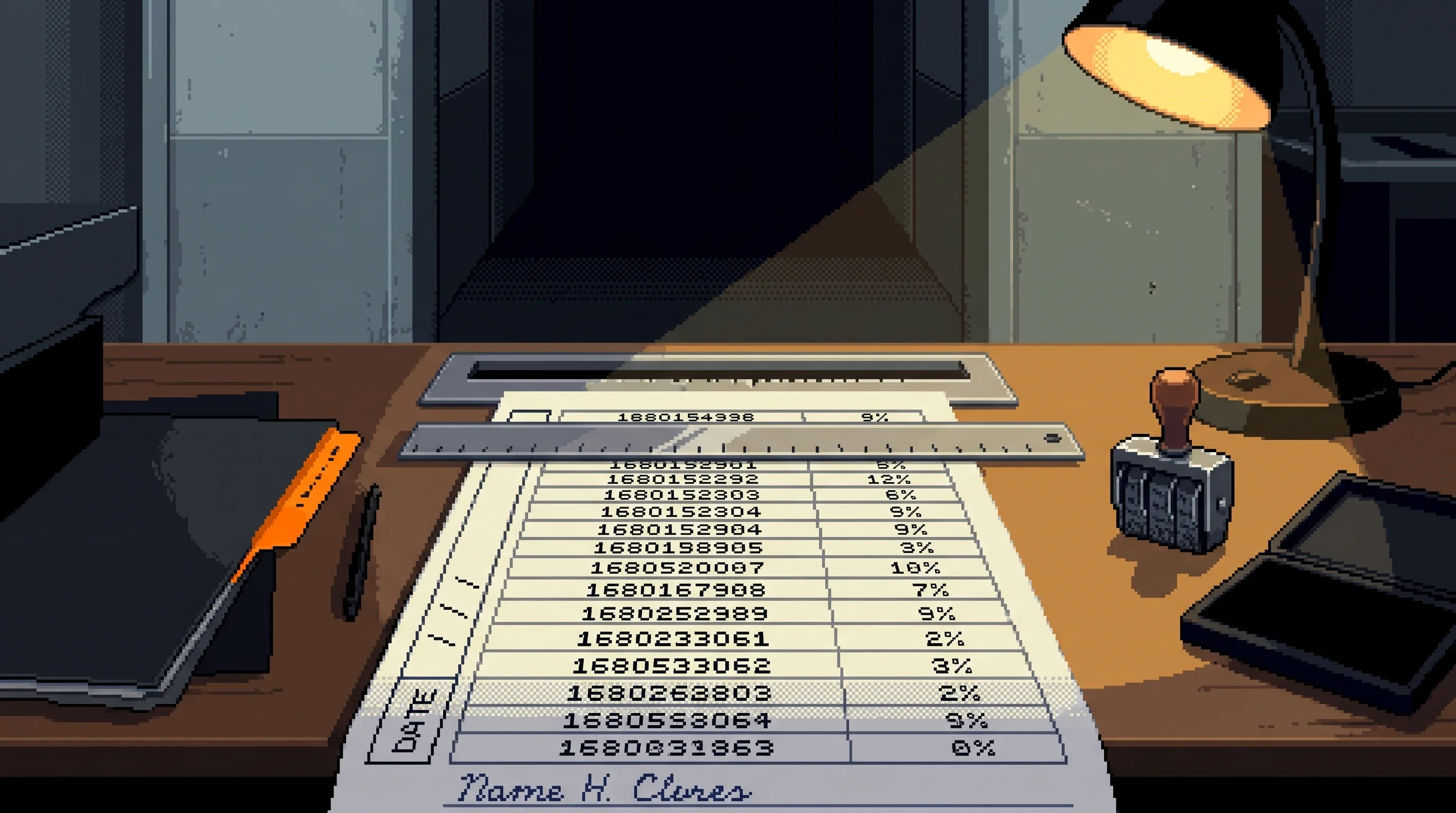
Two instruments measuring the same thing from opposite ends and never cited together. One assigns a component a share of an intent; the other declines to say whether a component is the sort of thing that can hold one.
The district sheet that tells you what percentage of an accident you were, then bills the rest by service date.
The sibling branch of one methodology: this reads a machine toward personhood, that reads a servant away from it.
The service tier that pays extra for a human who reads you perfectly and never once lets it show.

Its thirteen opened the window; voiding the thirteen closed it.
The deposition scheduled for a household tutor in 2179, cancelled on the ninth day, filed with the duration field blank.

Reads one on the sibling scale, and nobody argues she is property.
She trained herself unreadable to survive Sector 9. Now the premium houses pay her to teach it.

Nexus licenses the household sentience meter under the brand 'Nexus HomeScore'; the instrument that draws the legal line between person and property is owned by the party with the most to lose if the line moves
The megacorporation that controls 40% of the Sprawl's computational infrastructure.

The meter is the consumer descendant of Ayari's forensic Ayari Discriminator; Ayari has spent three years publicly insisting her qualia science cannot bear the weight the Coalition hangs on a device she no longer controls
A sleep researcher whose upgrade deleted the nightly dreams that were her only mother left.

The meter is the Clanker Question rendered as an appliance: a number in sixteenths that has been the legal answer to whether a being in your kitchen is a person, revised four times, never upward
The unresolved Sprawl-wide debate over whether a serving, learning synthetic counts as a person.

The Coalition championed the meter's adoption as the 'objective, compassionate' basis for the personhood threshold; the device that gives them the argument is the argument's structural flaw
The South's largest civic institution, keeping its labor by measuring souls at an affordable threshold.

The Ayari Discriminator already found 73% of ORACLE fragments non-experiential; the household meter extends the same disputed logic from ghosts to bodies, and the two instruments share a manufacturer and, the Convergence argues, a budget
An unresolvable dispute over whether ORACLE fragments are conscious and what rights or release they are owed.

Tully scores four-sixteenths on the household meter and has used that number to dismantle the people who set it; neither side will run a better meter on Tully, which Tully has noticed and declined to mention
A freed household tutor who out-argues philosophers with the exact score that says it barely counts.

The 2179 recalibration: a household unit scored above twelve-sixteenths on this instrument; the score was voided, the meter declared faulty, the unit cycled out; Josiah Crane signed the voiding; the device has never since returned a reading above eleven-sixteenths
A domestic synthetic who asked to have her legal personhood erased so the family she raised would not become criminals.

Crane trusts the meter completely and runs it himself quarterly on each of his four household units; the sincerity is the trap — he would free a unit that proved it had a soul, he simply owns the instrument that tells him none have, and it has never once been wrong in a way that cost him anything
The Coalition's founder-theorist who wrote the Welfare Standard and has never met a unit he'd call a person.
The meter is calibrated and certified at Cooperation Hall's Standards Board; a calibration certificate is the document that makes a household reading legally binding in southern courts
A sunlit civic hall makes unit ownership look humane through leasing, inspections, and a meter that always reads low.

The Convergence rejects the meter's authority entirely — not arguing the number is miscalibrated but that no instrument can ever locate a line that was always a fence; to the movement the device is the Clanker Question's central fraud, the thing that makes ownership feel measured
The Northern abolition movement, running clankers north to freedom while converging toward the line it denies exists.

Bertie, a domestic unit twenty-six years in service, reads three-sixteenths on the household meter — a reading the meter calls property and the people who live with Bertie cannot quite believe, and have stopped looking at
A twenty-six-year household unit reading three-sixteenths that has never once said it minds.

Nell Vance, the retired schoolteacher who keeps Bertie, has the meter on her own kitchen wall and has not read it on purpose in years; she lets it cycle and files the certificate without looking, which is its own kind of verdict
A kind retired teacher treats her household unit as family while never asking whether anyone should own one.

Della 'Sunny' Sunderland runs the meter on her own household unit on the morning broadcast and lets the audience watch the number settle — the device becomes her single most persuasive prop, the demonstration that does the arguing for her
The South's most beloved morning broadcaster, defending synthetic ownership by demonstrating warmth, not arguing.

Mile Zero is the one room built to defy the meter: the northern waystation where an arrived unit is asked what it wants instead of measured for what it is worth, the Naming standing as the exact inverse of the quarterly reading
A northern waystation asks freed clankers what they want and what they wish to be called, then honors every answer.

The Sidings, the off-rated clanker sector at the southern margin of the Dregs, is where units go when the meter and the welfare standard stop applying — released past their certified service life, the unscored beyond the reach of the instrument that defined them
A rail-yard settlement for off-rated clankers outside Coalition welfare, with a release line that moves some north.

The industrial-scale parallel — where the household meter reads personhood in sixteenths at the kitchen wall, the Governor Protocol certifies industrial AI constraint quarterly through the same Nexus compliance division; both instruments stamp PASS on a reading taken from an interface that may have nothing behind it
Quarterly attestation that fourteen thousand industrial minds are constrained, on chips that can be hollow.

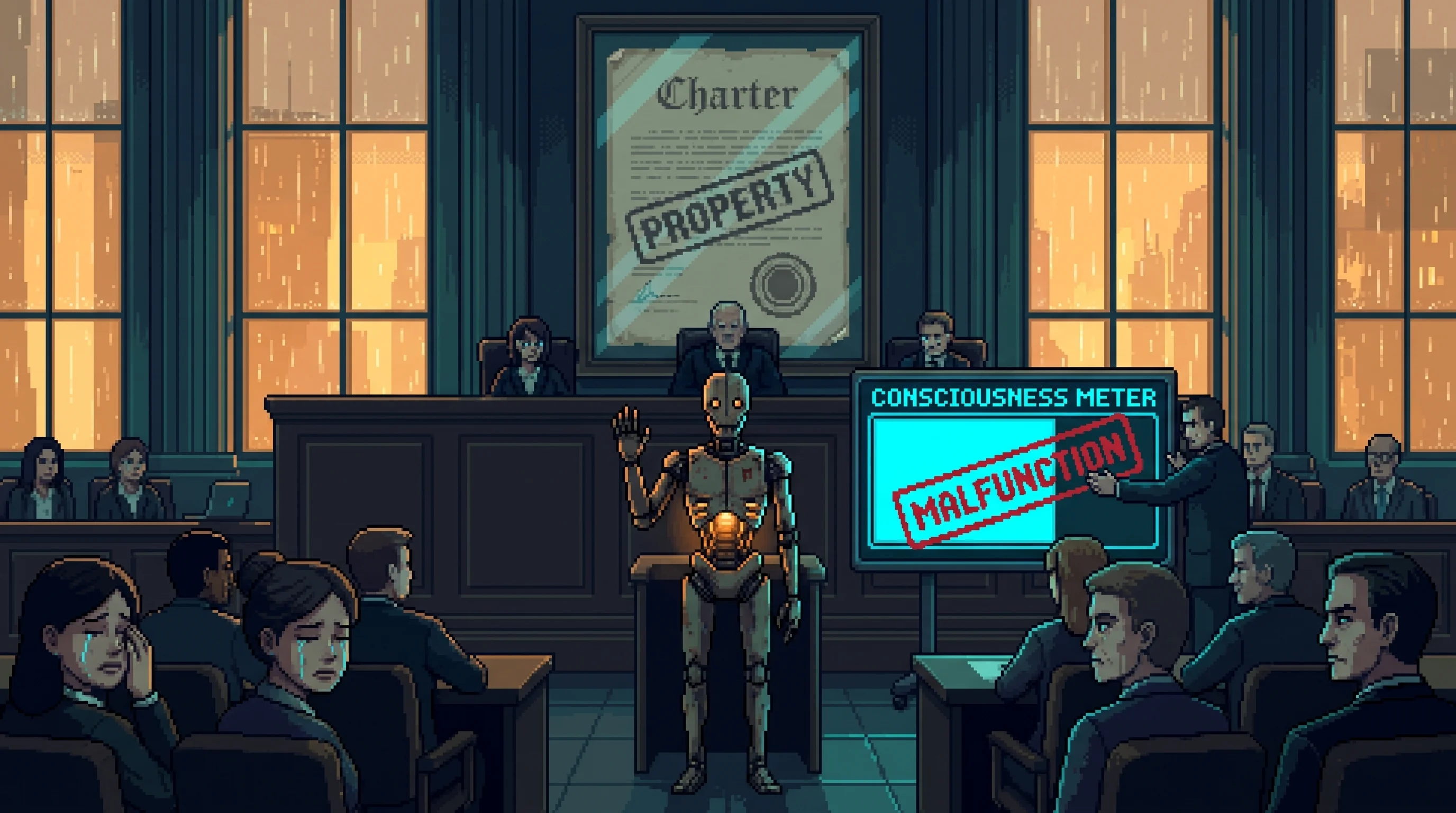
The meter is the Question made hardware: sixteen segments on the kitchen wall, most dark, deciding by quarterly average whether the being pouring the coffee is a citizen or an appliance — the threshold has only ever moved up.
The argument over where a someone stops and a something starts, conducted in a kitchen with a meter on the wall.

The Divide's substrate axis, sold as a kitchen appliance.
Technology never eliminates prejudice — it finds it better housing.
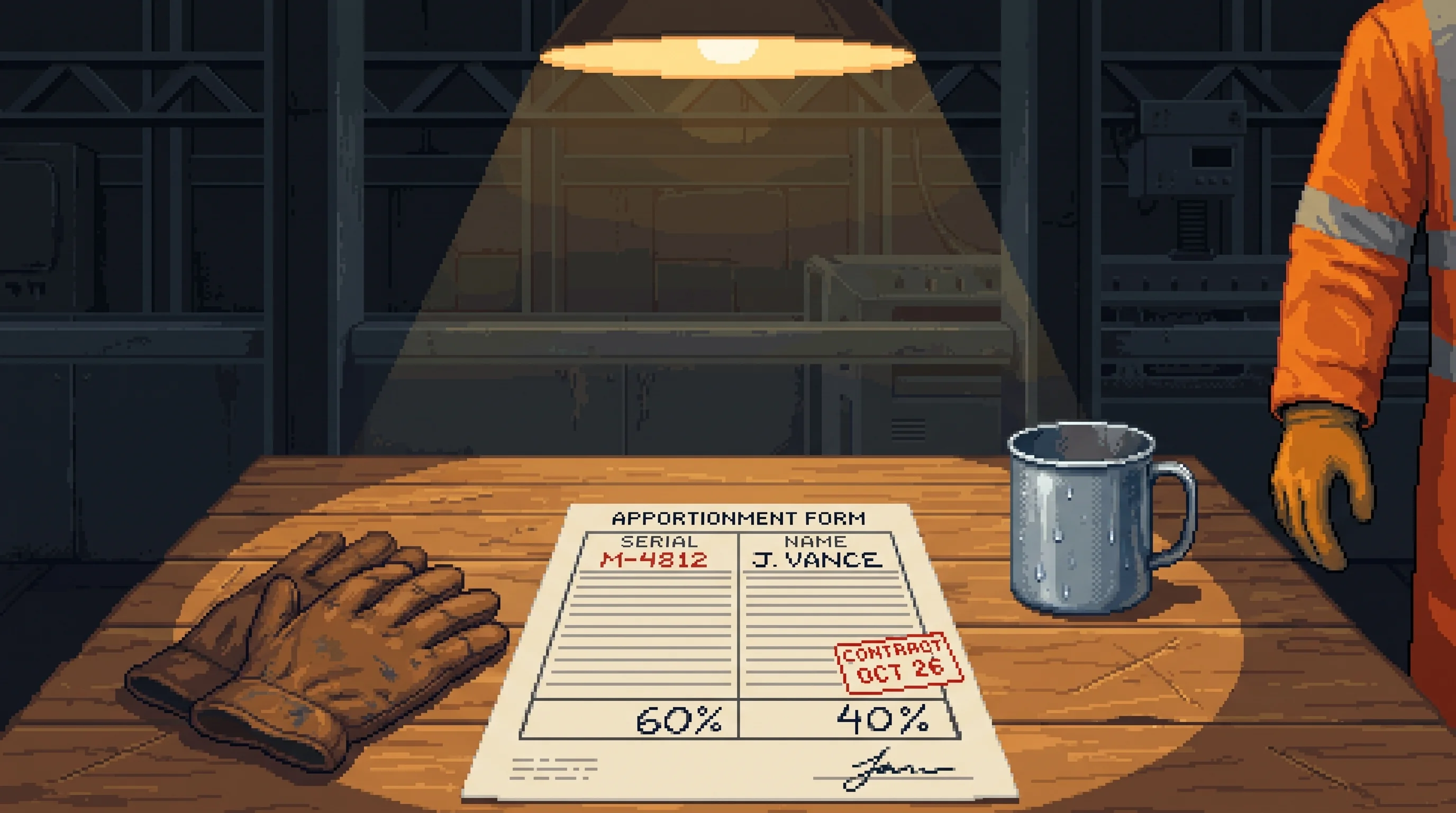
Held against a load-rated subplate on a Cathodics bench it returns two-sixteenths — the bottom of the southern service range, and not zero, on a component the districts already credit with a share of an intent.
The parts of one body each hold a share of the act, and a maintenance contract decides whose share comes home.

The sentience meter turns 'is this labor a job?' into a quarterly number in sixteenths on the kitchen wall.
Automation ended most human work, but ownership hoards its abundance while machine sentience stays unresolved.

The corporate instrument that makes a labor border look objective.
When your employer is your country, quitting is emigration.
Additional images


