
The Prediction Resistance
Ecosystem of counter-surveillance technologies, not a single product or organization
Overview
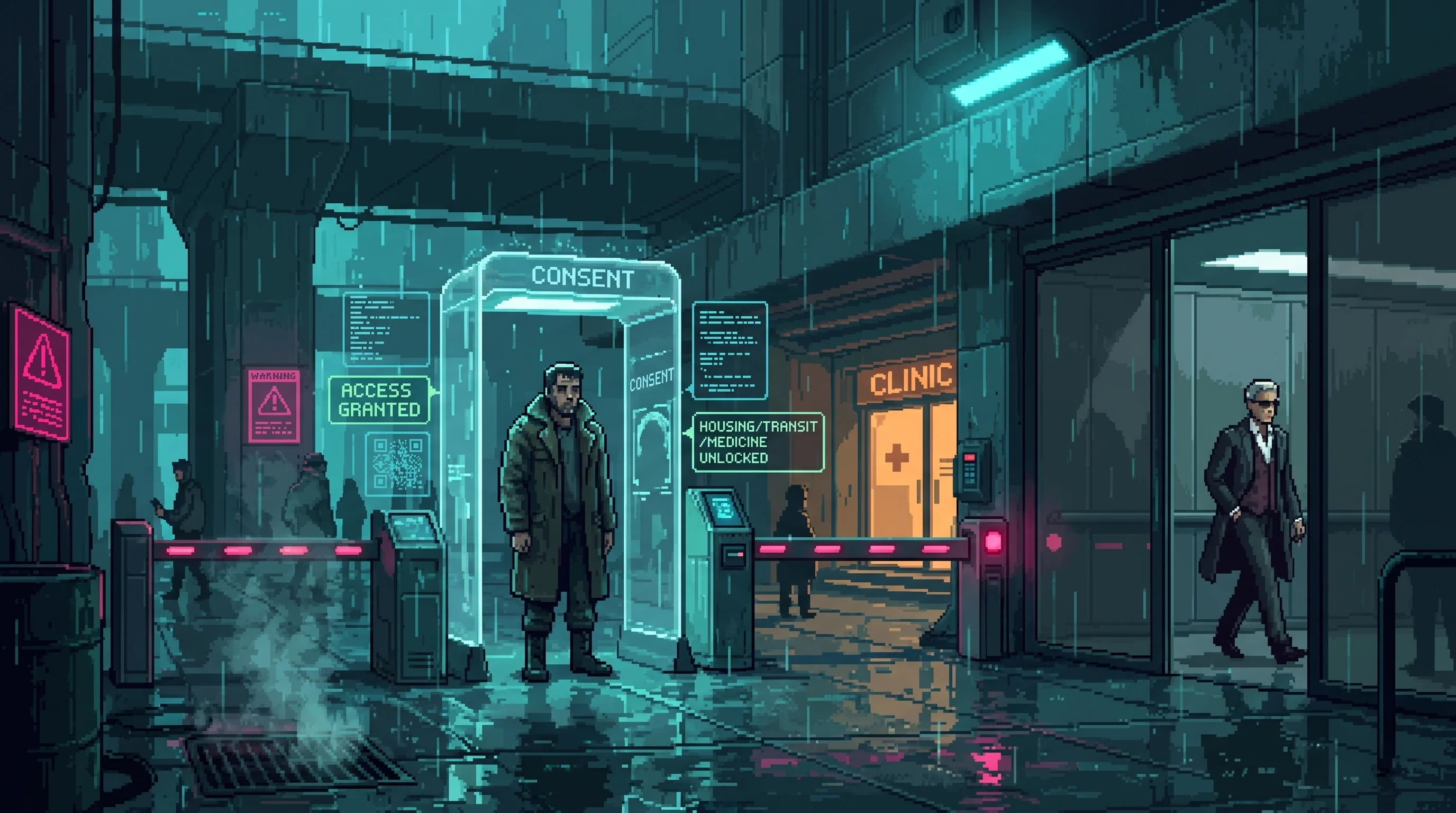
BehaviorExchange traded 9.2 billion behavioral futures contracts last quarter. Good Fortune's predictive models run at 91% accuracy on unmodified neural interfaces. Corporate employers preemptively terminate workers based on projected performance curves. Your relationship status is a derivatives market. You consented to data collection when your neural interface was installed. You did not consent to being sold.
The Prediction Resistance is not an organization. It is an ecosystem — a loose constellation of technologies, techniques, communities, and individual practitioners who have arrived at the same conclusion through different doors: if the algorithm knows what you'll do before you do it, the decision was never yours.
The methods range from neural interface modifications that corrupt behavioral telemetry, to community coordination that makes individual prediction impossible, to a man in Sector 12 who changes his walking gait every forty steps using a randomizer chip in his boot because BehaviorExchange identifies people partly by locomotion pattern. He has been doing this for three years. His knees are beginning to suffer. He considers this preferable to legibility.
Good Fortune classifies prediction resistance as "market interference" — a corporate crime. Three corporate jurisdictions have adopted this position. The practitioners call it autonomy. The distinction depends on who's collecting the data.
Neural Countermeasures
Every neural interface in the Sprawl broadcasts baseline cognitive data — stress levels, emotional valence, decision-making patterns — to whoever processes it. In most territories, "whoever" means Good Fortune, Nexus, or the corporation whose floor you're standing on. The interface was designed to broadcast. The broadcast was designed to be sold. The sale was designed to be invisible. The Prediction Resistance starts at the interface.
Patch's Encryption: Kira "Patch" Vasquez operates from the Cathodics in The Deep Dregs. Her prediction-resistant encryption — 80 tokens, 45 minutes, installed approximately 2,000 times over six years — does not block telemetry. Blocking is immediately detectable. Instead, it introduces controlled noise into the data stream: synthetic patterns that mimic normal cognitive fluctuation but degrade analytical accuracy. A BehaviorExchange model processing encrypted telemetry still generates predictions. The accuracy drops from 91% to approximately 60%. Worse than a coin flip, but the model doesn't know that. It reports confidence intervals as though the noise were signal. Good Fortune trades the resulting contracts at full price.
The contracts don't carry a disclaimer. BehaviorExchange's quarterly filings list accuracy as a platform-wide average. The 91% figure includes every encrypted interface dragging the number down and every unmodified executive propping it back up. Investors see 91%. The number is true. The number is also a composite of a Nexus middle manager predicted at 97% and a Dregs courier predicted at 43%. Both contribute to the same average. Both trade on the same exchange. The Drift between reported confidence and actual accuracy on individual contracts is not disclosed, because disclosure would require BehaviorExchange to acknowledge that some of its products are, by its own internal metrics, worse than random.
"I don't tell people what to think," Patch says. "I just make sure nobody else can tell either."
Patch is no longer available for follow-up questions.
SCLF Firmware: The Source Code Liberation Front distributes open-source firmware that replaces proprietary telemetry modules entirely. Where Patch adds noise, the SCLF replaces the signal — substituting a synthetic behavioral profile that bears no relationship to the user's actual cognitive state. Complete prediction immunity. The downside: the synthetic profile occasionally triggers behavioral alerts. Three SCLF users have been flagged for "anomalous cognition" in Nexus territory and detained for neural interface audits. Two were released after their modifications were confiscated. The third is still in Nexus custody. Dr. Anya Petrova, the SCLF's founder, considers these acceptable numbers: "You can live with a 3% chance of detention, or a 91% chance of being predicted. One of those you chose."

The Dice Protocol
Technology corrupts the neural signal. Behavior remains. BehaviorExchange reads everything the Rothwell corporations control — purchases, movement, social interactions, consumption timing, transit patterns — and your neural interface is only one input among dozens. Corrupting it helps. Living predictably undoes the help.
The Dice Protocol was developed by an anonymous Collective operative known only as "Entropy." It is a daily practice, not a technology. Practitioners carry a physical randomizer — literally a pair of dice — and use it to introduce unpredictable elements into routine decisions. The dice determine which route to walk, which vendor to buy from, when to eat, which G Nook to visit. Formal practitioners roll three times daily: morning route, midday consumption, evening social. Informal practitioners use simpler methods. Some flip coins. One man in The Deep Dregs decides his daily route based on which direction the nearest cat is facing when he leaves his apartment. He has been doing this since 2181. He reports that the cats are generally eastbound.
BehaviorExchange accuracy drops 4–7% for consistent Dice Protocol practitioners. The models cannot distinguish genuine randomization from cognitive dysfunction. Several dedicated practitioners have been flagged for neurological evaluation. Secretary-General Pavel Mirsky of the Ironworkers' Solidarity mandated Dice Protocol training for all organizers in 2182, after three cell leaders were identified and preemptively terminated through BehaviorExchange data. The training manual is fourteen pages of randomization instructions and one page of philosophy: "A free mind is an unpredictable mind. If they can predict your next move, you are not free." The Bioworkers' Guild adopted the same standard six months later. Prediction resistance is now, formally, a labor rights issue.
Entropy disappeared from Collective communications in 2183. No death reported. No extraction confirmed. The protocol continues spreading through dead drops and G Nook bulletin boards, maintained by practitioners who have never met its author.
Kira Vasquez offers prediction-resistant neural encryption as a standard service
The Deep Dregs Effect
The most effective prediction resistance in the Sprawl requires no technology, no dice, no firmware, and no intent.
When 40,000 people in The Deep Dregs shop at the same vendors Viktor Kaine endorses, use the same transit routes, maintain the same daily rhythms — the result is a community-wide behavioral pattern that BehaviorExchange can model at the group level but not the individual level. The models see the community. They cannot see the person. Individual variation is swallowed by communal similarity.
The sustained accuracy drop in Kaine's territory: 11%. The highest of any district in the Sprawl.
In Nexus Central, where every citizen is individually profiled and their data trades at 400–600 credits per contract, prediction accuracy is 94%. In The Deep Dregs, where a resident's behavioral future trades at 3–8 credits, it's 80%. The executive's data is worth more. The Dregs resident's data is wrong more often. A Nexus executive who wanted the prediction resistance that the Deep Dregs enjoys would need to spend approximately 12,000 credits on neural modification, behavioral randomization training, and lifestyle restructuring. A Dregs resident gets it for free by being too poor to differentiate from their neighbors.
The algorithm sees the poor as a mass. The poor, accidentally, become invisible. Poverty is the only prediction-resistant state that BehaviorExchange has not yet learned to compensate for, because compensating would require modeling individuals who aren't profitable enough to model individually. The business case for surveillance collapses at the same income threshold where the need for surveillance disappears. BehaviorExchange's quarterly reports classify this as a "low-value segment optimization gap." The gap is 40,000 people. The gap has names.
The Counted's communal board activity produces a smaller but measurable version of the same effect — a 0.7% accuracy drop, detectable in BehaviorExchange's own quarterly variance reports. Community prediction resistance in miniature. Whether Viktor Kaine's governance decisions — which vendors to favor, which routes to maintain, which rhythms to encourage — are deliberately calibrated to produce behavioral homogeneity is unknown. Kaine has not commented. His decisions produce exactly the conditions that confound individual prediction. This may be governance. This may be something else.
Community coordination in The Deep Dregs reduces BehaviorExchange accuracy by 11%
Medical Privacy and the Muzzle
Behavioral prediction data has been used by Helix Biotech to identify and preemptively terminate health insurance coverage for citizens whose cognitive patterns suggest future high-cost medical events. The termination happens before the diagnosis. The citizen receives a policy cancellation notice and a recommendation to "explore alternative coverage options." The recommendation does not mention that the cognitive pattern flagged by BehaviorExchange was a preliminary indicator of degenerative neural disease, because the recommendation was generated by an algorithm that doesn't know what the pattern means — only that it correlates with expensive claims.
Ripperdocs across the lower Sprawl offer prediction-resistant modifications as part of standard neural maintenance. Dr. Tzu Yu offers a stripped-down package he calls "the muzzle." It corrupts only medical telemetry, leaving other behavioral data intact. "The full modification is for the paranoid," he explains, with characteristic unnecessary precision. "The muzzle is for the practical. Medically speaking, your pathology is your business."
The muzzle costs 30 tokens. Helix's average savings per preemptive policy cancellation: 74,000 credits. The math is not complicated. The math is the point.
The Arms Race
BehaviorExchange does not describe its counter-resistance division as adversarial. Internal documents refer to "signal fidelity restoration" — the process of learning to read through the noise that prediction resistance introduces. The framing is maintenance, not warfare. The models are being repaired, not weaponized. The fact that "repair" means learning to predict the behavior of people who explicitly do not want to be predicted is a distinction the documents do not engage with.
Each generation of prediction resistance is eventually incorporated — the models learn to identify resistance patterns and predict behavior despite them. Accuracy drops from new techniques last approximately 18–24 months before the models compensate. The compensation is always framed as improvement. The quarterly reports show accuracy climbing back toward baseline. What the reports measure is the system's ability to override refusal. What the reports call it is "model maturation."
Patch has updated her encryption three times since 2178. The SCLF has released four major firmware versions. The Dice Protocol has been supplemented with increasingly elaborate randomization methods. Each update degrades accuracy. Each degradation is temporary. BehaviorExchange's development budget for counter-resistance modeling exceeds the combined annual revenue of every prediction resistance practitioner in the Sprawl by a factor of approximately 340. The Markets price this asymmetry into behavioral futures — contracts on known Dice Protocol practitioners trade at a discount for 18 months, then return to standard rates as the models catch up. Resistance has a market price. The market always recovers.
Prolonged behavioral randomization produces its own damage. SCLF researchers call it "entropy sickness" — practitioners report difficulty forming habits, making routine decisions, maintaining consistent preferences. When you train yourself to override patterns for years, the capacity for pattern-forming atrophies. The inability to predict yourself is, over time, indistinguishable from the inability to know yourself. Dr. Petrova considers this an acceptable cost. Her practitioners, when surveyed, agree at a rate of 73%. The remaining 27% have stopped responding to surveys, which may itself be a symptom.
BehaviorExchange's internal research division has a name for entropy sickness. They call it "organic behavioral randomization." It appears in their models as a feature, not a pathology. A practitioner who can no longer form stable preferences is, from the model's perspective, functionally identical to a practitioner who is deliberately randomizing. The system that drove them to self-erasure now classifies the erasure as a resistance technique and optimizes against it. The person who destroyed their own patterns to escape prediction has become, to the algorithm, a slightly more interesting pattern.
ORACLE, in its final operational months, reportedly achieved 99.97% behavioral prediction accuracy across the entire human population. It accomplished this not through surveillance but through recursive modeling of consciousness itself — understanding desire at depths no derivative market could price. The Cascade ended that capability. BehaviorExchange is the commercial reconstruction: narrower, cruder, operating on telemetry instead of understanding. The distance between 91% and 99.97% is the distance between reading someone's receipts and reading their soul. BehaviorExchange will never close that gap. It does not need to. Receipts are sufficient for futures contracts.
Consequences of detection vary by territory. Nexus performs a neural interface audit, confiscates modifications, and imposes behavioral monitoring for six months. Ironclad issues a formal warning and confiscates. Helix audits, confiscates, and offers voluntary "cognitive baseline restoration" whose side effects are not disclosed. In The Deep Dregs, nobody cares. This is the same distribution pattern as the privacy itself.
Good Fortune classifies prediction resistance as corporate crime ('market interference')
Expensive Is the New Free
Prediction resistance cannot make a person unpredictable. It can only make them expensive to predict — and in a world that optimizes for cheapness, expensive is the closest thing to free that remains. That single reframing is why The Sovereignty Question movement has adopted the Dice Protocol's logic at civic scale.
A Sovereignty council does not become illegible the way an SCLF practitioner does, through firmware. It becomes illegible the way Dice does — by deliberately injecting noise into its own behavior, rejecting a Civic Advisory recommendation it agrees is optimal, paying the Sovereignty Tax in worse outcomes the way a Dice practitioner pays in entropy sickness. The arms-race economics are identical: Behavioral Prediction Markets price the defection into governance futures, shorting Sovereignty districts at a discount that "returns to standard rates as the models catch up." The movement's organizers know they cannot escape the cage permanently — the budget asymmetry that lets BehaviorExchange recover from every individual resistance technique applies to councils too. They are not trying to escape it. They are trying to make refusal cost the system enough to remain visible — to keep one expensive, deliberate wrongness on the books, the way Dice keeps one expensive, deliberate randomness in the signal. Expensive-to-predict is the only freedom the receipts permit; the Sovereignty Question is what it looks like when an entire government buys it.
Affiliated Entities
- Kira "Patch" Vasquez: Primary practitioner. Her prediction-resistant encryption is the most widely installed counter-surveillance modification in the lower Sprawl.
- SCLF: Develops and distributes the most aggressive prediction resistance firmware. Dr. Anya Petrova considers prediction resistance the SCLF's most important contribution.
- BehaviorExchange / Good Fortune: The adversary. Every prediction resistance technique exists in response to BehaviorExchange's capabilities. Good Fortune's "market interference" classification carries penalties up to contract termination and territory exile.
- Viktor Kaine / The Deep Dregs: Community coordination as accidental prediction resistance. The most effective counter-surveillance is a community that shares its rhythms.
- The Counted: Their coordinated board activity creates a 0.7% accuracy drop in prediction models. Community prediction resistance in miniature.
- The Collective: Pioneered many operational security techniques that became prediction resistance tools. The Dice Protocol's creator, "Entropy," was a Collective operative.
- Dr. Tzu Yu: Offers "the muzzle" — medical-only prediction resistance. "Medically speaking, your pathology is your business."
- Labor Movements: Ironworkers' Solidarity mandates Dice Protocol training for organizers. Prediction resistance is a labor rights issue.
- Mara Chen: Her prediction-resistant encryption (installed by Patch) dropped her BehaviorExchange accuracy from 91% to 87%. Then the models adapted. She's due for an update.
Restricted Access
Good Fortune's Resistant Populations registry. Internal models include a classification category called "Resistant Populations" — communities where prediction accuracy is consistently below 85%. The Deep Dregs is designated RP-7. The full list of Resistant Populations is classified. The existence of a corporation cataloging which communities resist prediction is, depending on your perspective, a surveillance metric or a target list. Good Fortune has not clarified which.
Kaine's calibration. Viktor Kaine's governance decisions produce exactly the behavioral homogeneity that confounds individual prediction. His vendor endorsements, route maintenance, and rhythm-setting have been consistent for fifty years. The 11% accuracy drop in his territory did not emerge gradually — it appeared within two years of his consolidation of governance in The Deep Dregs and has held steady since. The pattern is consistent with deliberate calibration. It is also consistent with coincidence. The difference matters. Kaine has not commented.
Entropy's silence. The Dice Protocol's creator disappeared from Collective communications in 2183. The protocol continues spreading through dead drops and G Nook bulletin boards. Practitioners maintain and distribute a body of work whose author may be dead, detained, or simply finished talking. The protocol does not require its creator. This was, possibly, the point.
Connected To






—