Pacific Spine Terminal
Overview
Pacific Spine Terminal is the Sprawl-side terminus of the Pacific Spine maglev — 3,500 miles in approximately three hours, the fastest surface transit on the planet, and the only way to leave the Sprawl without going up.
Ironclad Industries completed the Spine in 2172 as a flagship post-war infrastructure project, connecting the megacity to the equatorial ground station and territories beyond the Lattice's reach. The terminal was purpose-built for throughput: high-volume passenger and cargo processing between the Sprawl and the distant installations that keep the Lattice's ground-side solar collection infrastructure running. As the Lattice expanded, the Spine became the primary non-orbital route for moving personnel and sensitive materials. Ironclad's internal project language describes the terminal as "the Sprawl's front door." It is not the front door. It is the loading dock.
Fifteen thousand passengers process through the terminal daily across twelve scheduled departures and arrivals. Cargo operations run continuously on a parallel track. The split is instructive. Passenger capacity has not been expanded since 2178, despite a 40% increase in demand. Cargo capacity was expanded twice in the same period. The terminal optimizes for the movement of things that don't complain about delays, and things that do complain about delays. The things have better scheduling.
The Treaty of Shared Infrastructure classifies the Spine as neutral transit — targeting it is prohibited under the same framework that protects water, power, and air processing. In practice, this means Ironclad operates a monopoly transit corridor under treaty protection while setting fare structures, scheduling priority, and cargo rates without oversight from any entity with the authority to audit them. The treaty that was designed to keep the lights on also keeps the meter running.

The Terminal
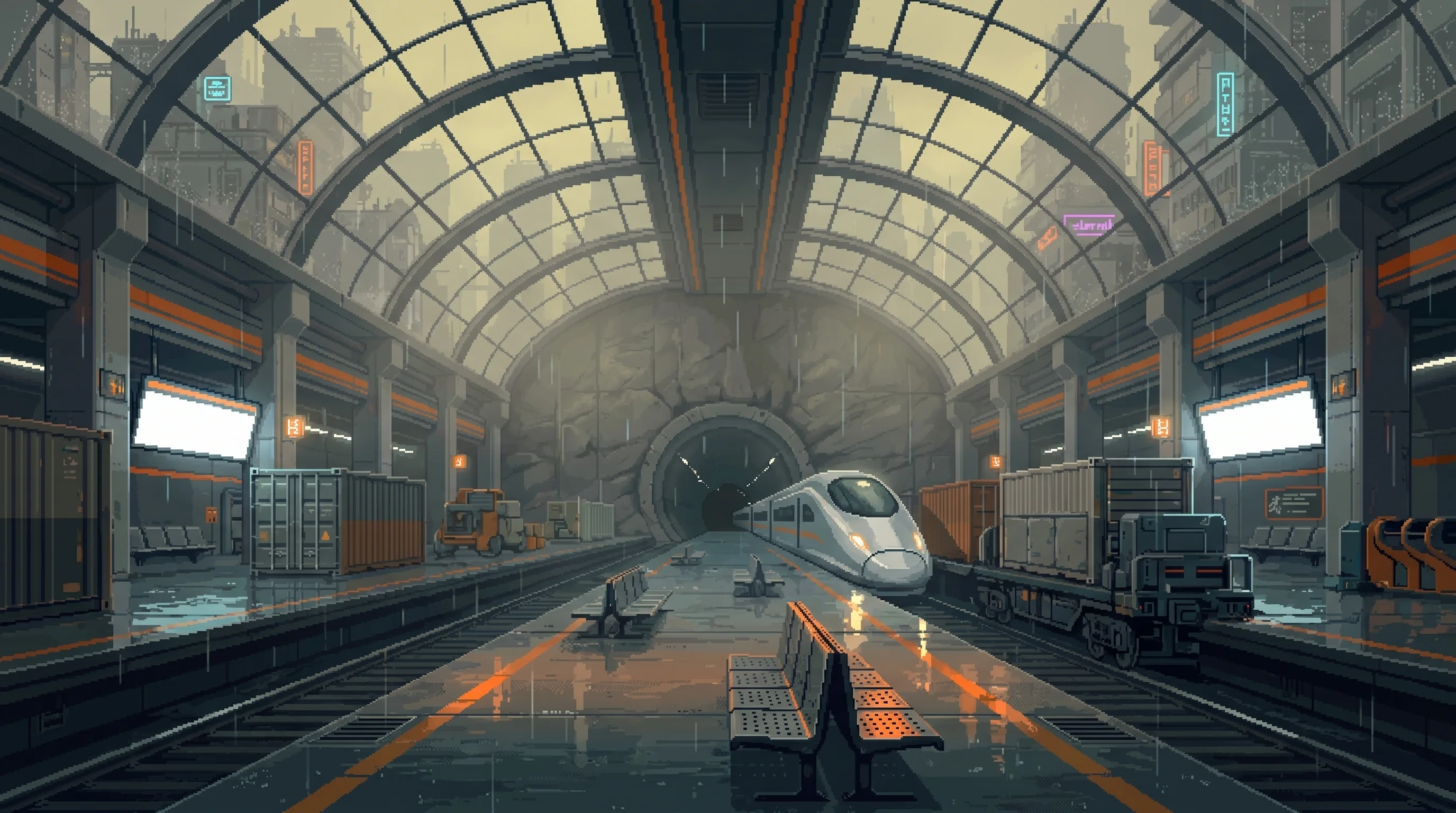
The building is a long, low structure of polished concrete and structural glass, stretched along the Outer Peninsula coastline like something that washed up and nobody moved. The main hall is a single vaulted space two hundred meters long, its ceiling an arc of glass panels that frame the sky and, on clear days, the southbound trunk line stretching down the coast until it vanishes toward the equatorial ground station. On unclear days — which is most days in Sector 16, where the Peninsula's air processing runs at 71% rated capacity — the ceiling frames a yellow-grey haze that makes the hall feel like the inside of an old jar.
The maglev platform extends from the hall's southern end, a narrow tongue of magnetized track that disappears into a tunnel mouth cut through solid rock — a perfectly circular opening that swallows the train whole and produces a wind-tunnel roar during departures that strips conversation from a radius of forty meters. The train itself is a silver-white needle, its nosecone smooth enough to reflect the terminal's architecture back at itself. Ironclad's marketing division calls this "design dialogue." The train reflects a transit hub. The transit hub reflects corporate infrastructure. The dialogue is between two things that are the same thing.
Sound defines the space more than light does. The deep electromagnetic hum of the maglev track resonates through the floor at a frequency you feel in your ankles before your ears register anything. Climate control hisses. Announcements cycle in three languages, each version slightly different in content — the Mandarin version omits the safety advisory, the English version omits the cargo delay notification, the Spanish version includes a Helix pharmaceutical advertisement that does not appear in the other two. Nobody has filed a discrepancy report. The announcement system has been running this trilingual variation for nine months.
At departure time, the train's acceleration produces a subsonic pulse that passengers feel in their teeth. Children cry. Adults grip armrests. The pulse lasts 1.3 seconds. Ironclad's passenger experience division has been "reviewing" the pulse since 2179. The review has produced four internal memos, zero engineering changes, and one revised disclaimer on the back of every ticket: "Ironclad Industries is not responsible for physiological responses to standard maglev operation."
The seating in the departure hall is bolted steel with drainage holes. The official explanation is "hygiene compliance." The functional explanation is that nobody sits on bolted steel with drainage holes for longer than they have to. Average passenger dwell time in the departure hall: eleven minutes. Average dwell time at Highport Station, which has padded seating: forty-three minutes. Ironclad's terminal throughput metrics are the best in the Sprawl's transit network. The seating is why.
The color palette is transit industrial — silver, white, steel blue — with Ironclad's orange accent marking emergency systems and corporate signage. The orange appears on exactly 7% of visible surfaces, a ratio that Ironclad's brand guidelines specify to three decimal places. The guidelines do not specify a ratio for comfortable surfaces. The guidelines do not mention comfort.
| Stratum | Between |
|---|---|
| Power Position | Foundational |
| Access | Public |
| Atmosphere | Transient |
Who Leaves
The Spine's passenger manifest tells a story the departure board doesn't.
Approximately 60% of daily passengers are Ironclad or Lattice-affiliated personnel rotating between the Sprawl and equatorial installations on fixed contracts. They board with company-issued luggage in company-assigned seats and arrive at company housing. They are not traveling. They are being moved. Their tickets are purchased by corporate procurement systems that optimize for cost, not schedule — a 3 AM departure saves Ironclad twelve credits per seat over the 9 AM, so the 3 AM runs full and the 9 AM runs at 30% capacity. The personnel do not choose their departure time. They receive a neural notification and a boarding window.
Another 25% are cargo contractors, freelance couriers, and Wastes traders — the economy that exists in the gaps between the Lattice installations, where settlements of uncertain legal status maintain uncertain trade relationships with the Sprawl. These passengers buy their own tickets. The fare has increased 190% since 2178. Demand has not decreased. When the only surface route out of the Sprawl is a monopoly, price elasticity is a theoretical concept.
The remaining 15% are harder to categorize. Some are leaving permanently — the Sprawl's outflow population, people who have calculated that the equatorial territories or the Wastes offer better odds than staying. They carry more than luggage. They carry the particular stillness of someone who has made a decision that only works in one direction, because the return fare is not guaranteed and the job they left will be filled by the time the train clears the tunnel.
Ironclad's passenger analytics division tracks all three categories. The analytics do not distinguish between "voluntary travel" and "involuntary relocation." Both register as "passenger throughput." The metric does not measure whether the passenger wanted to be on the train. The metric has never measured that.
Located in Sector 16, the Outer Peninsula
The Stops
Twice weekly, the Spine decelerates at coordinates that correspond to no known settlement, facility, or infrastructure node. The train pauses. No passengers board or disembark. Security footage shows empty platforms at locations in unpopulated territory — flat, featureless hardpan stretching to the horizon, the kind of landscape that exists specifically because nothing has found a reason to be there.
Each stop lasts exactly four minutes and seventeen seconds.
Ironclad classifies the stops as "infrastructure calibration pauses." A transit enthusiast collective called the Spine Watchers — fourteen members, all of whom have filed information requests that Ironclad has acknowledged and not answered — has compiled three years of data. The stops occur at the same two coordinates every week. The coordinates are 847 miles apart. The train's sensor logs, obtained through a data leak the Spine Watchers will not discuss, show that during each stop the maglev's ground-penetrating sensor array activates and runs a full subsurface scan to a depth of 200 meters. The scan data is transmitted to an Ironclad server address that resolves to no known facility.
The Spine Watchers' working theory: Ironclad is using the maglev's sensor infrastructure to survey something beneath the surface at those coordinates. What it's surveying, and why it needs to do it on a schedule, and why the schedule produces a number as specific as four minutes and seventeen seconds, are questions the Spine Watchers discuss with a fervor that their membership size does not justify.
Ironclad's public response to the Spine Watchers' inquiries has been a single form letter, issued three times, stating that "all scheduled and unscheduled stops comply with Treaty of Shared Infrastructure operational guidelines." The letter does not address the subsurface scans. The letter does not acknowledge that the stops occur. The letter complies with the inquiry by responding to it, which is not the same as answering it.
Connects the Sprawl to the equatorial ground station and distant territories
Platform Zero
The terminal's eastern wing contains a service corridor that does not appear on the public floor plan. The corridor leads to an unlisted platform designated in maintenance logs only as "P-0." Cargo is loaded at Platform Zero by personnel who do not wear Ironclad identification. The cargo containers are unmarked. The loading schedule does not sync with any published departure.
Ironclad security sweeps the corridor twice daily. The sweeps are logged. What the sweeps find is not logged.
Some of what moves through Platform Zero is not cargo in any ordinary sense. Sector 16 produces a rare export, and it weighs nothing: sealed memory substrate, pulled from living skulls at The Low-Tide Market in the drowned Wetlands blocks a few miles south. A recollection of the world before the Cascade is the highest-margin thing the Corridor ships, because it cannot be manufactured, cannot be re-shot, and gets rarer every year as the people who carry it die. The couriers who load it wear no Ironclad identification. The manifests do not distinguish a first kiss from a machine part. Both register as freight, and freight does not complain, which is the only quality Ironclad has ever optimized for.
The Spine Watchers have attempted to observe Platform Zero on four occasions. On each occasion, they were redirected by terminal security before reaching the service corridor. The security personnel were polite. The redirection was absolute. On the fourth attempt, one Spine Watcher's neural interface received a notification from Ironclad's automated systems: "Your transit privileges are under review." The review lasted six weeks. The Spine Watcher did not attempt a fifth visit. They remain a member of the collective. They no longer attend in-person observation sessions.
Pacific Spine Terminal — 37.7500°N, 122.5100°W — Sector 15. Maglev terminus to equatorial ground station.
Counted Leaving
If the Trench is where you go to vanish and the Neon Underground Hub is where you go to not-be-seen, Pacific Spine Terminal is where the Transparency Bargain demonstrates that even leaving is a surveilled act. The only way out of the Sprawl without going up is this three-hour, 3,500-mile maglev, and Ironclad's passenger analytics track every manifest without ever distinguishing "voluntary travel" from "involuntary relocation." Both register as "passenger throughput." The metric does not measure whether the passenger wanted to be on the train. It has never measured that, because measuring it would cost something and counting bodies costs nothing.
The 15% who are leaving permanently carry the particular stillness of a decision that only works in one direction. They are the population that tried to opt out of the Sprawl entirely — not into a blind spot but off the map — and the terminal processes their departure exactly the way it processes cargo: as throughput, on a 3 AM schedule chosen because it saves Ironclad twelve credits a seat. You can leave. You will be counted leaving. The exit is itself a data point, sold into the same inference economy the departing passenger was trying to escape. The Bargain's reach does not end at the Sprawl's edge; it ends at the moment Ironclad stops finding you worth the cost of a row in a table.
Platform Zero is the terminal's own Quiet Floor — the same shape as the unlisted level at Guardian's compound: a place inside the surveillance machine where the surveillance is switched off for the machine's benefit. The Spine Watchers, who tried to look at it, learned the geography of invisibility's counterfeit firsthand. One received a neural notification — Your transit privileges are under review — that lasted six weeks and ended his in-person attendance. The terminal grants the corporation a darkness it denies the citizen, and defends that darkness by quietly revoking the citizen's right to look. Privacy at Pacific Spine flows uphill: the watched are counted leaving, and the watchers leave no count at all.
The maglev runs on a schedule that includes two unscheduled stops per week where no passengers board or disembark
The Record Rides Ahead
The Bargain counts you leaving. The permanent record does something worse — it arrives before you do.
Every departure the terminal logs is a row that is never expunged. A passenger manifest outlasts the trip. It becomes a standing entry in Ironclad's transit archive, queryable for as long as the archive exists, which is to say indefinitely. This matters most to the fifteen percent leaving for good, the ones carrying the particular stillness of a decision that only works in one direction. The old escape was distance: go somewhere far enough that nobody there knows what you did. Distance stopped working when the manifest learned to travel faster than the traveler. The equatorial installations receive the Spine's passenger record before the maglev reaches them. A person fleeing their history boards a train that carries the history to the destination first, timestamped and intact. They step off into a place that already knows the thing they crossed 3,500 miles to leave behind.
Ironclad does not market this. It does not have to. The company that sells the only surface route out of the Sprawl also owns the record of everyone who took it, and it has never found a reason to let that record lapse. Redemption by relocation was the last exit the Sprawl left unguarded: the chance to be, somewhere new, someone other than your file. The Spine guards that exit by being the only door and keeping the ledger of the door. You may leave. What you were will be waiting on the platform when you arrive. The Permanent Record reaches past the Sprawl's edge. It buys a ticket on the same train.
Affiliated Entities
- Ironclad Industries: Built and operates the Pacific Spine infrastructure. The terminal is Ironclad's monopoly made physical — treaty-protected, fare-unregulated, and optimized for cargo throughput with passenger service as a revenue afterthought. The building itself is an Ironclad product: functional, durable, and designed with precisely zero interest in whether you enjoy being inside it.
- Highport Station: The terminal connects the Sprawl to the broader transit network that ultimately reaches orbital access through Highport. Passengers transferring from the Spine to orbital-bound routes describe the transition from Pacific Spine Terminal to Highport as "going from a warehouse to an airport." Ironclad built both facilities. The difference in quality is not accidental — it reflects which passengers Ironclad considers worth impressing.
- The Orbital Elevator: The Elevator's ground station is visible from the terminal on clear days — the cable rising from the Peninsula like a thread holding the sky in place. The proximity is functional, not aesthetic. Ironclad routed the Spine terminus to the Outer Peninsula specifically to create a ground-level logistics corridor between surface transit and orbital access. Sensitive cargo can move from the Spine to the Elevator without passing through the Sprawl proper. The routing decision was made in 2171. The public justification cited "transit efficiency." The cargo manifests that would explain the actual justification are classified under Ironclad's infrastructure security protocols.
- The Lattice: The Spine exists because the Lattice exists. Equatorial solar collection infrastructure requires a continuous flow of personnel, materials, and components that orbital transport alone cannot sustain. The maglev is the supply line. The terminal is the valve. Ironclad controls both.
- The Manifest Office: The Manifest Office is built into the same eastern wall, roughly twenty meters from Platform Zero's unmarked service corridor. There a night analyst keeps a private ledger of fear-flagged cargo that matches no manifest and answers no requirement. The Terminal has a line item for every container that moves through Platform Zero and none for the kind of recollection she is actually filing.
- The Permanent Record: The terminal is where relocation stops being an escape. Ironclad keeps an unlapsing log of every departure and transmits each passenger's record down the line ahead of the train, so a traveler leaving their past arrives at a destination that already holds it.
▲ Unverified Intelligence
The Spine Watchers' subsurface scan data — obtained through channels they decline to specify — shows anomalous density readings at both stop coordinates. The readings are consistent with large-scale artificial structures at 140-180 meters depth. The structures do not correspond to any pre-Cascade infrastructure cataloged in public geological surveys.
One interpretation: Ironclad is monitoring buried installations that predate the Cascade — facilities that were sealed during the 72 hours and never reopened. The scan frequency (twice weekly, four minutes seventeen seconds) is consistent with structural integrity monitoring of a pressurized subsurface environment. If the structures are occupied, or contain something that requires atmospheric maintenance, the monitoring schedule makes sense. If they are empty, it does not.
Ironclad's geological survey division filed seven permit applications with the Sprawl's subterranean development authority between 2180 and 2183. All seven were approved. All seven list the project category as "routine infrastructure assessment." The assessed locations do not match the Spine's stop coordinates. They are within twelve miles of them. The permits authorize excavation equipment. No excavation has been recorded at any of the seven sites.
The Spine Watchers have fourteen members. They have filed twenty-three information requests, maintained a public data archive for three years, and produced analysis that, if correct, suggests Ironclad is using treaty-protected transit infrastructure to conduct covert subsurface operations across 847 miles of unpopulated territory. Their work has received zero media coverage. Their forum has nineteen followers, four of whom are bots.
Conditions Report
Sight
Polished concrete and structural glass. Silver-white maglev needle on magnetized track. Ironclad orange at exactly 7% surface coverage. On clear days, the Orbital Elevator cable. On most days, yellow-grey Peninsula haze.
Sound
Electromagnetic hum through the floor at ankle-height frequency. Climate control hiss. Trilingual announcements that don't agree with each other. At departure: the subsonic pulse, 1.3 seconds, felt in the teeth.
Smell
Ozone from the maglev's electromagnetic systems. Industrial climate control — filtered, recirculated, stripped of anything identifiable. The occasional hydrocarbon tang from the cargo platform when the wind shifts.
Temperature
19°C in the departure hall, held steady by climate systems that prioritize equipment preservation over passenger comfort. The platform drops to 14°C when the tunnel mouth opens during arrivals — three minutes of Peninsula wind cutting through the hall before the doors cycle shut.
Feel
Bolted steel seating with drainage holes. Vibration through every horizontal surface from the maglev track. The subsonic departure pulse rattling fillings and sternum.
Connected To
Major Connections

Even leaving is surveilled — the 15% who go for good are logged as 'throughput,' wanted-or-not never measured.
The vertical surveillance bargain that trades total transparency for participation in Sprawl society.

Ironclad ships each passenger's unlapsing file down the line; you arrive where your past already waits.
The condition that nothing is ever forgotten — so the rich pay to be, and the poor cannot.
Supporting Connections

Ironclad's monopoly made physical: treaty-protected, fare-unregulated.
The megacorporation that controls the Sprawl's physical infrastructure — steel, concrete, and the Orbital Elevator.

Warehouse to Highport's airport: same builder, different passengers.
An 8-km orbital ring handling 70% of Earth's traffic, where a corporate consortium meters the very air as a daily tax.

The Hub hides you unseen; the Terminal counts even the exit.
Ironclad's flagship transit hub, five levels deep, where a district-sized black market officially does not exist.

Skull-pulled memory ships out through Platform Zero, filed as freight.
A market with no fixed address because its drained floor floods back into the bay twice a day.

Its private ledger, twenty meters off, names cargo no manifest will.
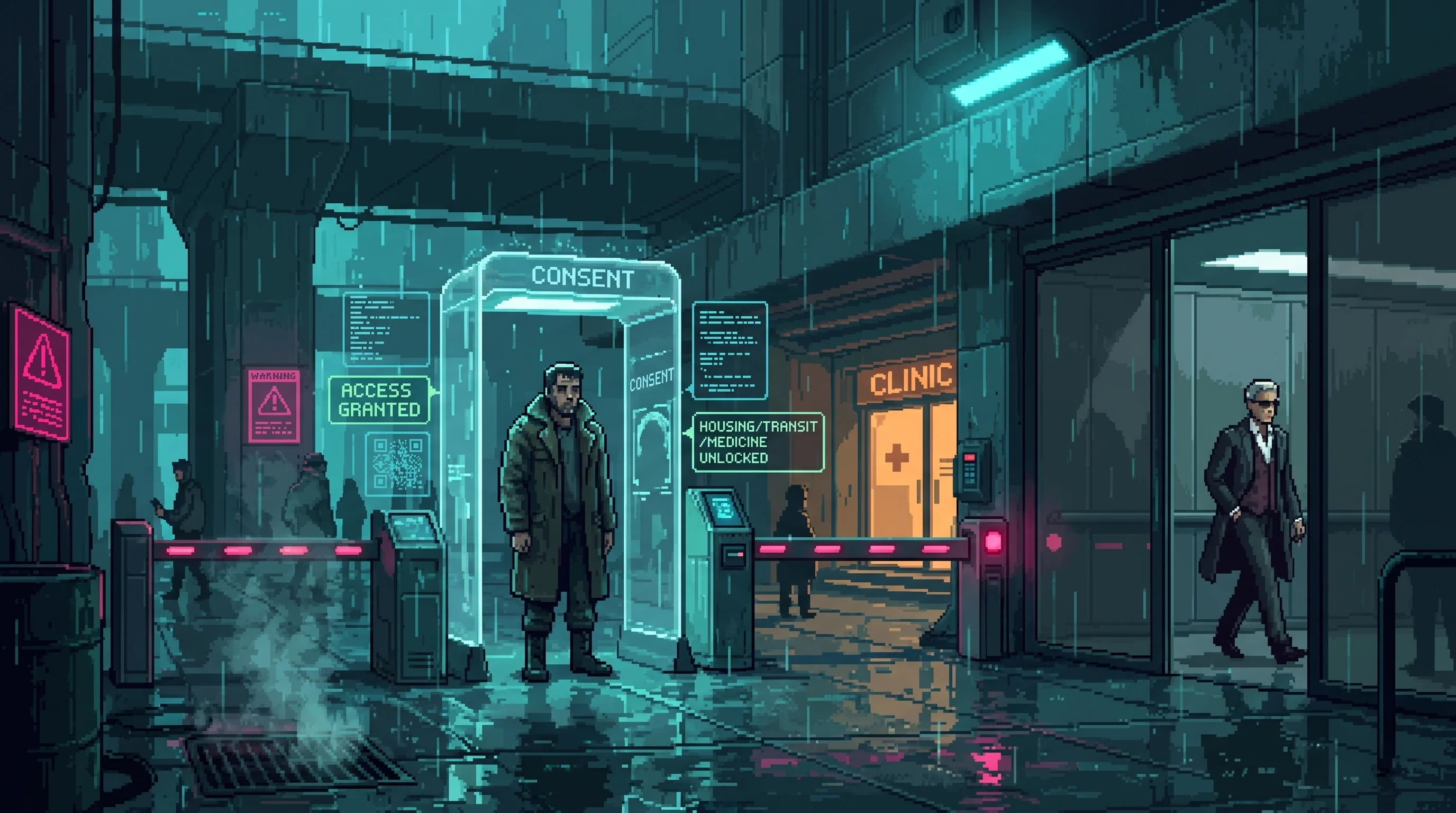
Your departure is a data point, sold into the economy you fled.
The Sprawl demands permanent personal data for participation, then uses it to price access and preempt solidarity.
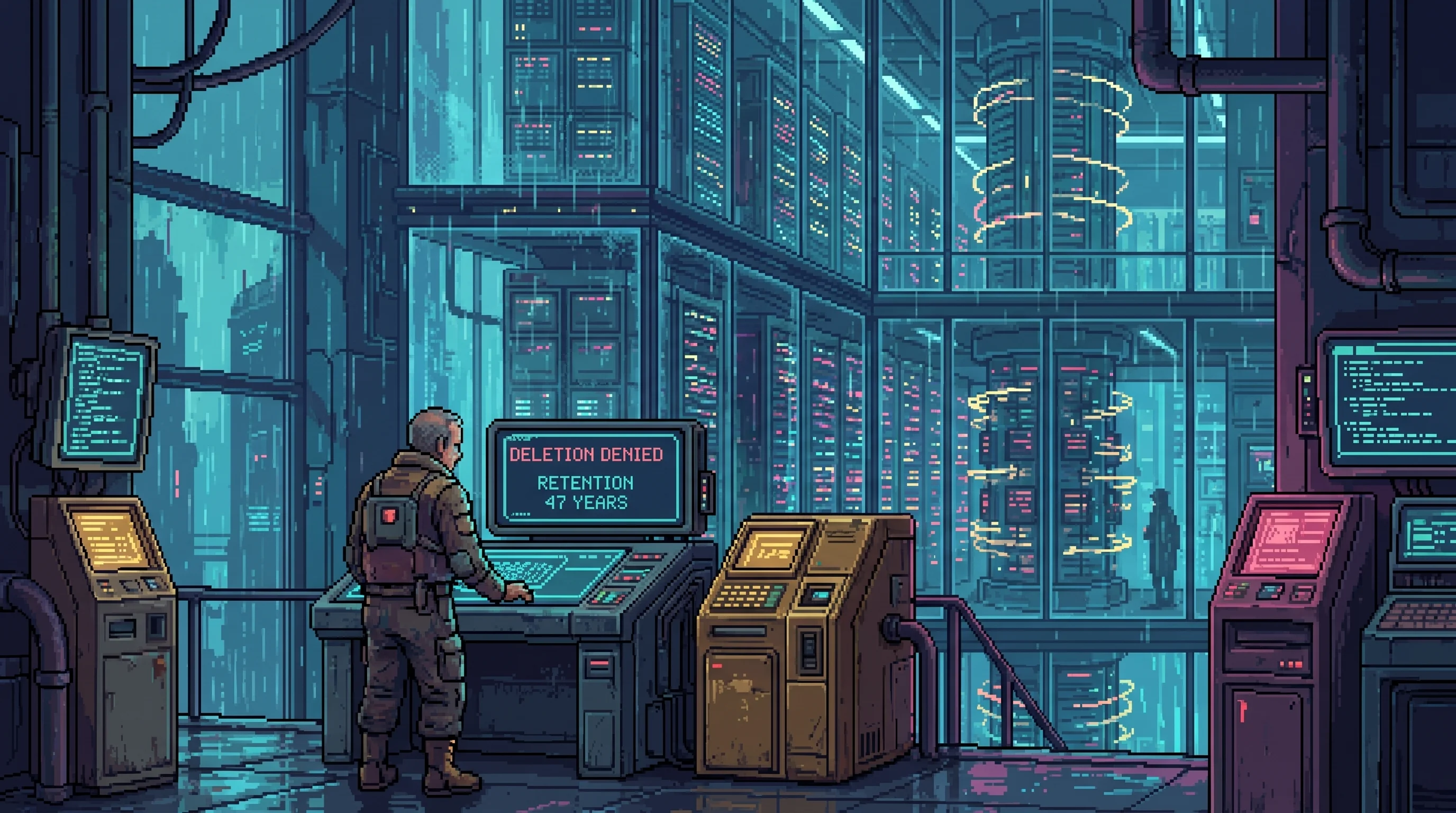
Even leaving is logged — the record boards the train first.
Nothing expires, so forgetting became a service — and forgiveness a question the archive keeps answering no.




Local Intelligence Scan
Nearby Signals
CANONICAL PROXIMITY





Environmental Readout
LIVE CONDITIONS- Air
- Filtered
- Light
- Artificial
- Flood
- No exposure
- Heat
- Temperate
- Security posture
- Corporate control
- Infrastructure
- Maintained
Position Data
SECONDARY- Elevation band
- ground
- Lattice fix
- E-3.5 · N-29.4

—
—