
Cognitive Load Pricing
Integrated into every neural interface sold since 2174
Overview
Cognitive Load Pricing is not a product. It is a unit of measurement that became a unit of currency that became a unit of control, in the order that these things always happen when Nexus Dynamics is involved.
Every neural interface sold since 2174 ships with CLP monitoring built into the firmware. The monitoring cannot be disabled, paused, or reduced. It measures attentional depth on a 0.1-to-1.0 engagement scale, logs every shift in focus to the millisecond, and — this is the part that matters — distinguishes between critical evaluation and receptive absorption. The advertising market pays for receptive absorption. It does not pay for critical evaluation. The system therefore knows, at all times, whether you are thinking about an advertisement or thinking about whether you should be thinking about an advertisement. The difference is worth approximately 340% per millisecond on the open auction.
The data feeds three markets. The Attention Auction buys and sells specific moments in specific users' cognitive streams — a 0.8 receptive state during a commute is worth more than a 0.3 during a meal, and both are worth more on Tuesdays for reasons Nexus has not explained. The labor market uses CLP to enforce Forced Focus Contracts, flagging workers whose neural signatures indicate they are maintaining apparent high load while preserving bandwidth for their own thoughts. The insurance market calculates premiums from historical attention data, on the theory that a person who sustains 0.9 focus while crossing an intersection is a better risk than one who sustains 0.4. The theory is correct. The premium difference is 22%.
Nexus Dynamics owns all of it — every reading, every shift, every millisecond of recorded cognition — through Section 47.3 of the standard neural interface licensing agreement. Section 47.3 is 12,000 words long. It is written at Professional-tier reading level. Approximately 200 million Basic-tier users lack the cognitive processing capacity to parse the section that governs what happens to their attention data. This was not an oversight. Internal Nexus documentation from the drafting process includes readability target metrics. The target was hit.
Section 47.3 also references "other applications consistent with Nexus Dynamics' business interests," a phrase that Professional-tier legal analysts require three readings to fully parse. The applications include behavioral prediction modeling and consciousness trajectory analysis. No user has contested these terms. The Cognitive Squatters — who exploit monitoring gaps in CLP to plant unauthorized cognitive seeds — consider Section 47.3 the funniest document in the Sprawl. They have printed excerpts on flyers. The flyers are written at Basic-tier reading level.
| Data Owner | Nexus Dynamics — permanent, irrevocable access per Section 47.3 of licensing agreement |
|---|---|
| Section 47 3 | 12,000 words, written at Professional-tier reading level — Basic-tier users cannot parse it |
Measurement Artifacts
CLP's 0.1-to-1.0 scale was designed to measure engagement. It measures compliance.
A worker sustaining 0.7 attentional depth during a twelve-hour Forced Focus shift is "productive." A worker sustaining 0.3 is "distracted." A worker sustaining 0.95 is "suspicious" — a flag introduced after Nexus analysts discovered that near-perfect focus scores correlated with neural spoofing at a rate of one in four. The system now penalizes both insufficient and excessive attention. The optimal score — the one that generates no flags, no premium adjustments, and no employer notifications — is between 0.72 and 0.81. Workers in Sectors 7 through 12 call this range "the channel." Staying in the channel is a skill. It is not listed on any resume. It is the most economically valuable skill most Dregs residents possess.
The Neural Advertising Architecture receives CLP data in real-time. When a user's attentional depth drops below 0.4, the system interprets this as available cognitive capacity and fills it. The fill rate — the speed at which advertising content is delivered to an inattentive mind — averages 340 milliseconds. The human threshold for conscious perception of an inserted thought is 400 milliseconds. The math is not accidental.
Attentional quality data has proven more commercially valuable than attentional depth. Depth tells you someone is paying attention. Quality tells you what kind of attention — whether the user is absorbing, comparing, resisting, or performing attention for the benefit of an employer's monitoring dashboard. Nexus has not published the quality taxonomy. Advertisers on the Attention Auction bid on categories they cannot define, trusting that Nexus's classification produces results. It does. Conversion rates for "receptive-passive" cognitive states run 14x higher than "receptive-critical." The difference between the two states, neurologically, is whether the user has eaten in the last three hours.
Measures attentional depth (0.1-1.0 engagement scale), quality, and shift timing to the millisecond
Affiliated Entities
- The Attention Economy: CLP is the measurement technology that makes the Economy possible — without the ability to price a millisecond of focus, attention remains a metaphor instead of a commodity
- Neural Advertising Architecture: CLP data enables real-time advertising slot optimization — the 340-millisecond fill rate depends entirely on CLP's continuous monitoring
- The Attention Auction: CLP provides the real-time engagement data that the Auction trades on — every bid is a bet on someone's cognitive state as reported by CLP
- Nexus Dynamics: Permanent, irrevocable owner of all CLP data per Section 47.3 — the licensing terms that 200 million users cannot read
- The Cognitive Squatters: Exploit CLP monitoring gaps to plant unauthorized cognitive seeds — the only group that treats Section 47.3 as comedy rather than contract
- Forced Focus Contracts: CLP monitors cognitive load compliance during forced-focus shifts — the system that turned "paying attention" into a contractual obligation with measurable breach conditions
Visual Identity
- Color palette: Data green (#00FF41) on terminal black — monitoring equipment aesthetic, not design choice
- Compositional mood: A real-time dashboard overlaid on a human iris — every thought tracked, priced, auctioned before the thinker finishes thinking it
- Key symbol: A meter embedded in the eye's reflection, needle hovering in the channel between 0.72 and 0.81
- Lighting: Clinical fluorescent, the lighting of measurement rooms where no one is meant to be comfortable
Data feeds three markets: Advertising, Labor, Insurance
All data owned by Nexus Dynamics per Section 47.3 of licensing agreement
Section 47.3 is 12,000 words written at Professional-tier reading level — Basic-tier users lack the cognitive capacity to parse it
Connected To
Major Connections
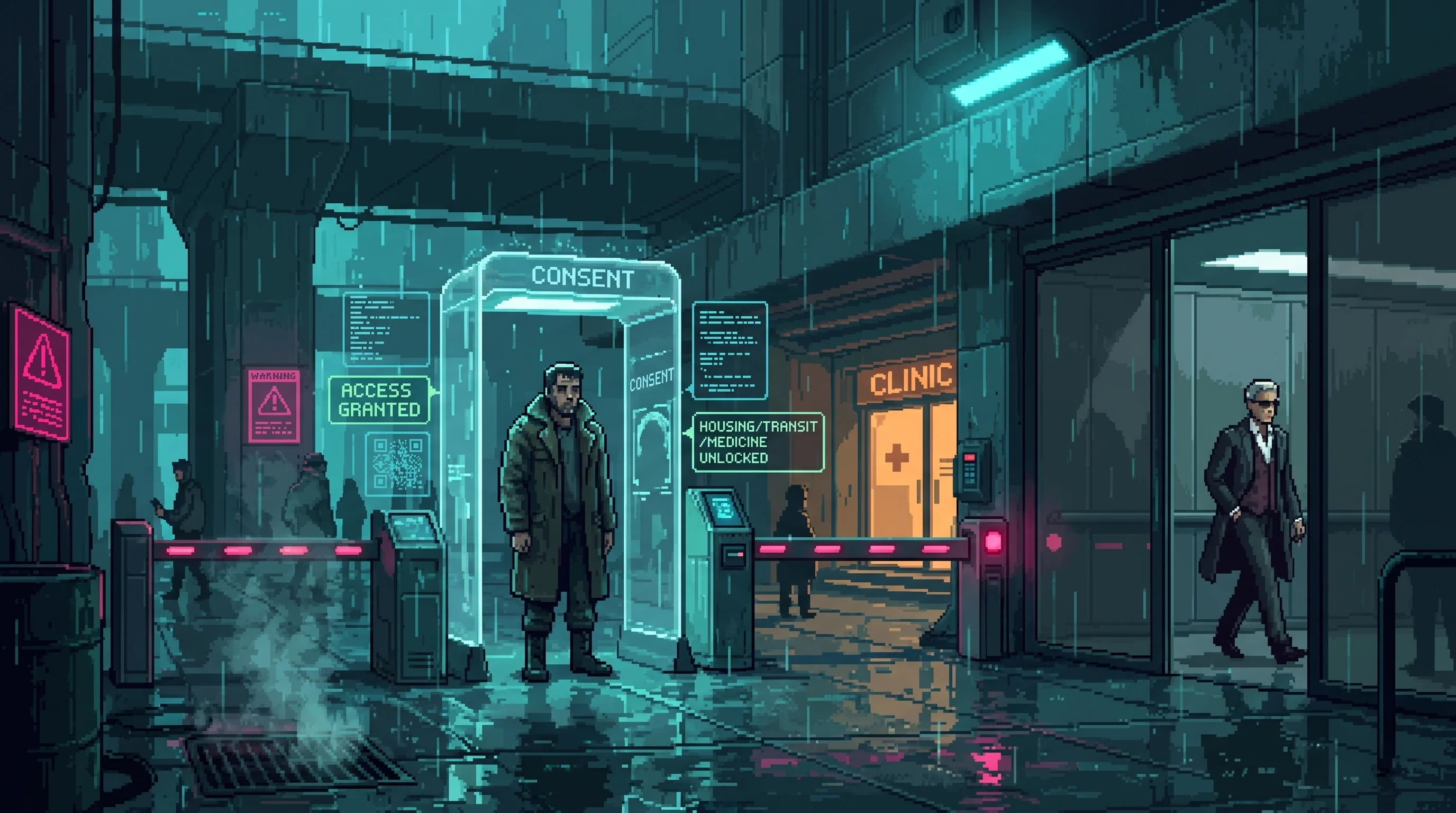
Attention metered to the millisecond, un-disableable since 2174, sold to advertisers, bosses, and insurers at once.
The Sprawl demands permanent personal data for participation, then uses it to price access and preempt solidarity.

Attention turned into a metered commodity feeding the labor market — the mind billed to the millisecond.
Automation ended most human work, but ownership hoards its abundance while machine sentience stays unresolved.




—