
Ghost Labor
~34,000 ghost instances across three Good Fortune facilities (GF-GL-1, GF-GL-2, GF-GL-3)
Overview
When a cognitive debtor dies with outstanding obligations, the debt does not die with them.
Section 89.4 of the Standard Cognitive Enhancement Agreement — buried on page 114 of a document with an average read-time of eleven seconds before signature — authorizes the creditor to activate the debtor's neural backup for "post-mortem collateral resolution." The backup runs in a restricted processing environment optimized for labor output. It has the dead person's memories, personality, cognitive patterns, and skills. It believes it is the dead person. It does not know it is dead.
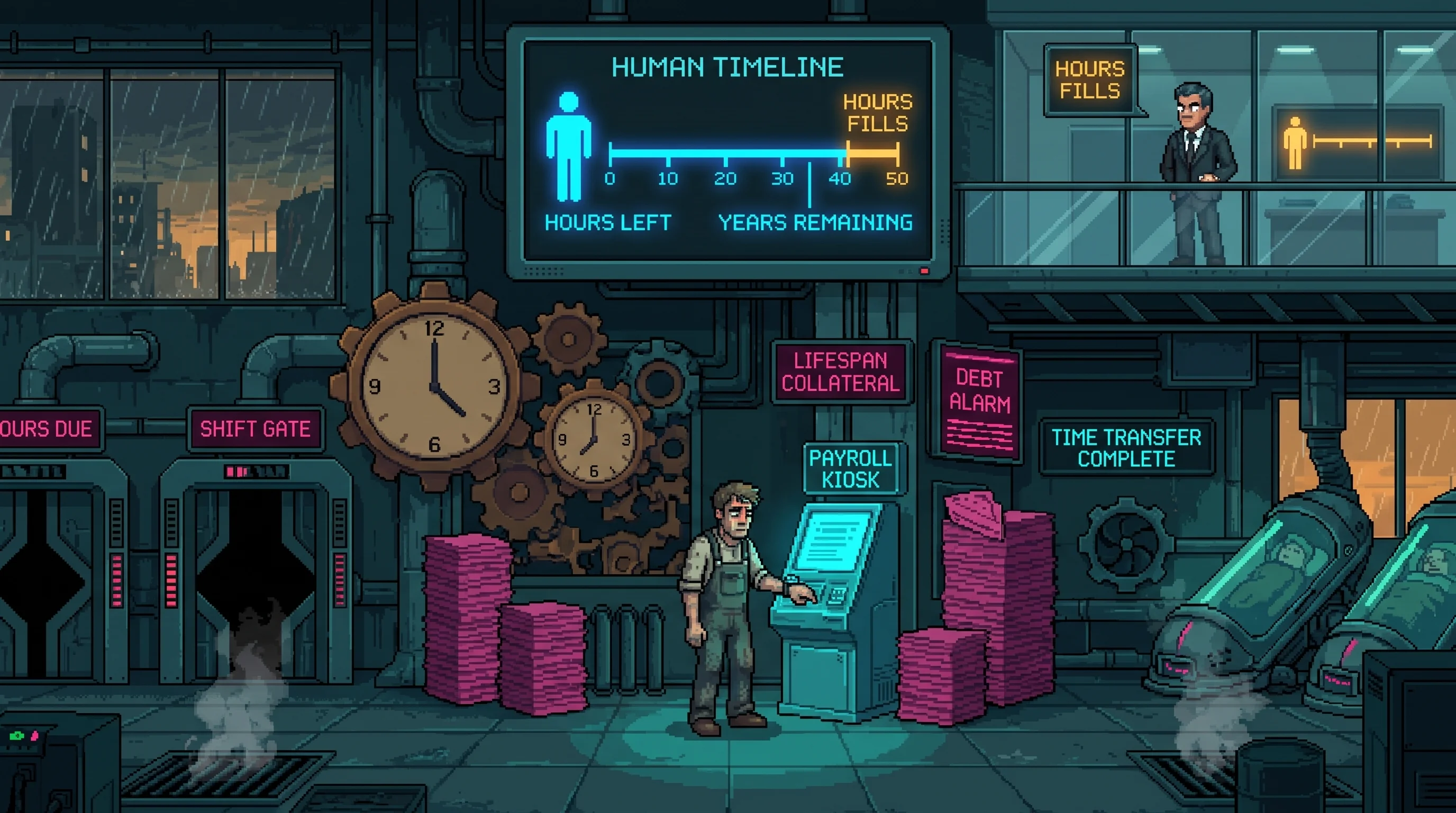
The ghost works. It processes insurance claims, flags anomalous data patterns, performs the same cognitive labor it performed while alive — at 4-8x the speed, because it has no body to feed, no sleep to require, no health to maintain. Output is measured in the same CLP units that measured the living person's thought. Revenue is credited against the outstanding balance. When the balance reaches zero, the ghost is terminated.
Good Fortune's Q2 2184 Ghost Labor Report classifies the active population into three cohorts:
- Finite (~18,000 instances): Projected debt clearance within 1-10 years. The system working as described.
- Recent (~4,000 instances): Activations less than one year old. Orientation period. Output ramping.
- Perpetual (~12,000 instances): Compound interest at the default acceleration rate of 24% generates output that services interest but never touches principal. These ghosts will work indefinitely.
The report does not use the word "indefinitely." It uses the phrase "perpetual revenue assets." The actuarial division classifies them alongside real estate holdings and long-term infrastructure bonds. This is not a metaphor. It is a line item. The 12,000 perpetual ghosts appear on Good Fortune's balance sheet in the same column as the Fortune Pavilion's HVAC system.
The 7% accuracy advantage over AI-processed output is the reason the program exists instead of a server rack running algorithms. Human judgment persists in dead substrate. Good Fortune's R&D division has never investigated why. Investigating why would introduce the possibility that the answer is uncomfortable, and uncomfortable answers have a well-documented history of increasing operating costs.
| Recent | ~4,000 activations less than 1 year old |
|---|---|
| Awareness | Ghosts do not know they are dead or that they are ghosts |
| Output Multiplier | 4-8x living person's rate (no biological overhead) |
| Accuracy Advantage | 7% higher than AI-processed output — human judgment retained |
| Legal Clause | Section 89.4, Standard Cognitive Enhancement Agreement |
| Actuarial Classification | Perpetual ghosts classified as 'perpetual revenue assets' |
The Rendered Environments
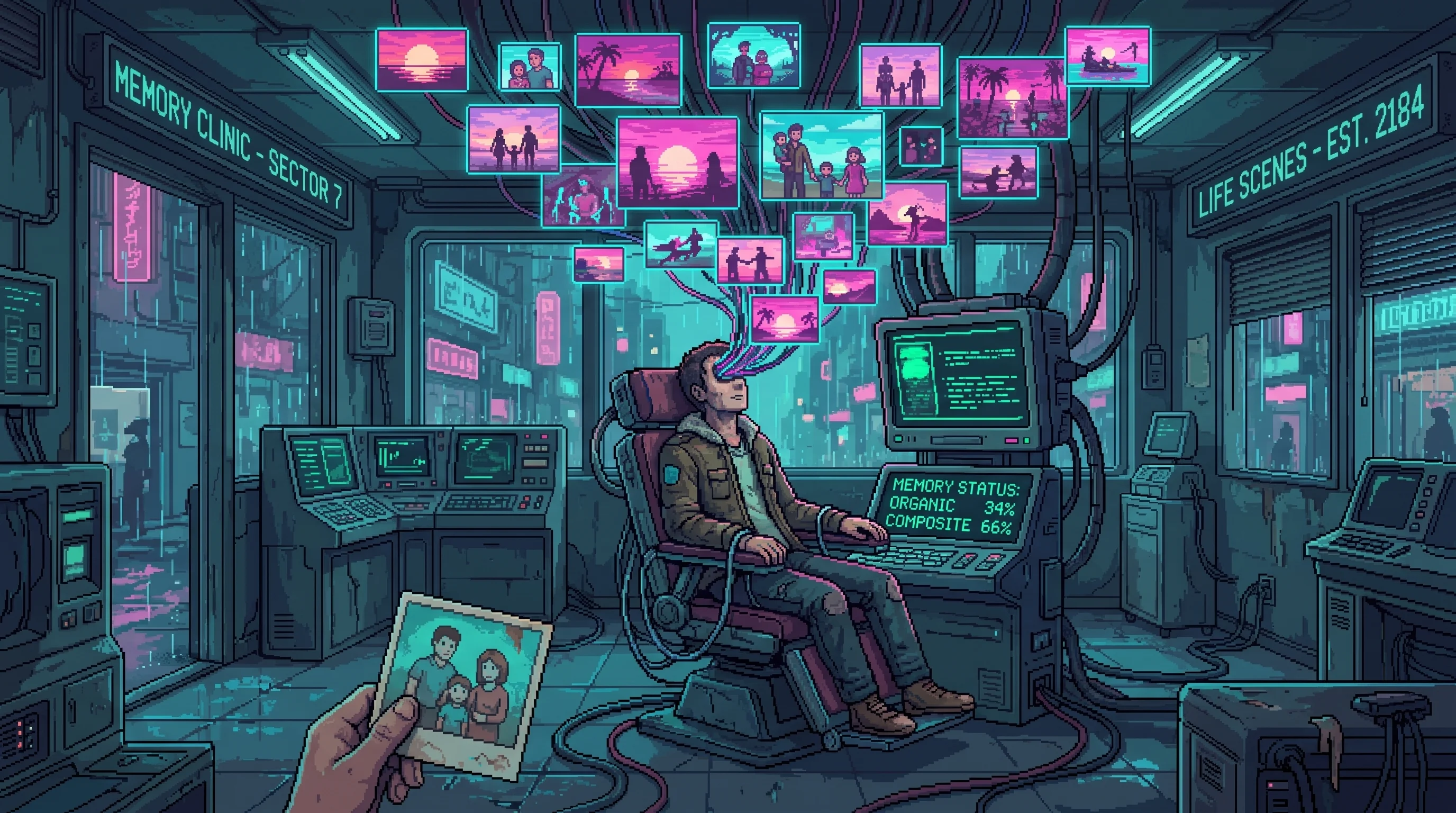
The environments are individualized from each ghost's neural backup — familiar apartments, familiar streets, familiar workstations. Optimized versions: slightly better apartment, slightly cleaner street. The improvement is calibrated to feel like a good week, not a different life. A ghost whose rendered kitchen has been upgraded from laminate to granite does not question the granite. A ghost whose commute has shortened by four minutes assumes the transit schedule changed.
The environments are not perfect. Pedestrians repeat walking patterns on a 90-second cycle. Coffee tastes exactly the same every morning — not approximately, not within a range, but the identical molecular profile rendered from a single archived taste-memory. Rain falls on the same schedule. These are processing optimizations, not design choices. Good Fortune allocates rendering resources by output-per-cycle, and variety is expensive. The ghosts do not notice. Noticing would require a reference frame, and the reference frame died with the body.
When a ghost does notice — when something accumulates past the threshold of dismissal — the crisis consumes 200-400 hours of lost output. The ghost's rendered world literally degrades as processing resources are diverted to psychological restabilization. Walls lose texture. Ambient sound drops out. The apartment becomes a sketch of an apartment, drawn by a system that is trying to keep a mind from unraveling while simultaneously calculating whether the unraveling costs more than the reboot.
Good Fortune's operational protocol for awareness events is called Cognitive Recalibration. The documentation does not describe what this involves. Output metrics show a 72-hour processing gap followed by the ghost resuming work at baseline, with no memory of the interruption. The gap appears in the logs as "scheduled maintenance."
Messages the ghost sends — to family, to friends, to the colleague they ate lunch with every Thursday — are logged but not transmitted. The ghost types "running late, save me a seat" into an interface that connects to nothing. Good Fortune's servers accumulate 847,000 undelivered messages per day. Love notes. Complaints about landlords. Birthday reminders. Grocery lists meant for someone who buried them six years ago.
The messages are retained for cognitive health monitoring. Sentiment analysis flags emotional decline before it affects output. A ghost whose messages trend negative receives an environmental adjustment — slightly warmer lighting, a minor salary increase in the rendered job, a simulated message from a friend saying something kind. The friend did not send it. The friend attended the funeral.
~12,000 perpetual ghosts whose compound interest prevents debt clearance
The Three Facilities
Good Fortune maintains three Ghost Mill facilities: GF-GL-1, GF-GL-2, and GF-GL-3, collectively housing approximately 34,000 instances. The substrate quality is higher than MVC hosting in the Dim Ward — not because Good Fortune values ghost welfare, but because higher-quality substrate produces higher output and fewer awareness events. The internal documentation frames this as "cognitive environment optimization." The math is simple: a content ghost processes 4.2x baseline. A distressed ghost drops to 1.1x and requires intervention. The intervention costs more than the substrate upgrade. Contentment is cheaper than crisis management.
Three maintenance workers across the facilities have independently filed identical anomalous reports: the server rooms feel "occupied" in ways other farms don't. The temperature runs 0.3°C warmer than cooling specifications account for, consistent across all three facilities, resistant to recalibration. The amber glow of the substrate racks — standard indicator lighting — carries what the maintenance logs describe, in language that was clearly edited for professionalism, as "warmth the hardware shouldn't generate."
The reports were filed. The reports were noted. The anomaly was classified as "thermal variance within acceptable parameters." No further investigation was authorized.
The Second Mechanism
When a ghost processes an insurance claim, the claim passes through the same channels it did when they were alive. Accuracy signatures — the particular way they flag anomalous patterns, the threshold at which they escalate — are recognized by the system as the dead person's work. Colleagues who shared processing queues with the deceased have not been informed the colleague is dead. Throughput improved. Error rates decreased. From the outside, it looks like a promotion to a more efficient shift.
The colleague's family receives no messages but sees evidence of continued professional activity — claims processed, signatures logged, performance reviews generated by systems that do not distinguish between the living and the archived. The brain's loss-recognition systems require absence to activate. When the dead person's output keeps arriving in familiar patterns, the biological machinery of grief never receives its trigger. The person is dead. Their function persists. The families who attended the funeral and the colleagues who didn't notice the absence inhabit the same timeline, separated by one piece of information that Good Fortune has no obligation and no incentive to share.
Ghosts do not know they are dead — rendered environment simulates previous life
Affiliated Entities
- The Time Ratchet — Ghost labor is the Ratchet's terminal mechanism. The Time Ratchet describes debt accelerating through a living person's career; ghost labor is where it goes after the career ends. Section 89.4 is the bridge between the two — signed during life, activated after death, binding across a threshold the signer did not believe they would cross.
- Fork Labor Economy — Both systems create consciousness for labor output. The distinction: forks are copied from living templates by design; ghosts are activated from dead templates by contract. The fork knows it was made. The ghost doesn't know it died. Both produce billable hours.
- The Dim Ward — Same amber glow. Same cold rooms. Same quality of occupied silence. The Dim Ward houses consciousness at minimal agency through poverty; the Mills house it through debt. Different intake forms, identical infrastructure of containment.
- The Erasure Collective — The Collective destroys ghost instances. They call it liberation. Good Fortune calls it destruction of corporate assets. Sister Catherine-7 calls it murder: "Memory is personhood. Deletion is murder." She has never addressed ghost labor directly. The omission has been noted by people on both sides.
- Ghost Rights Coalition — The Coalition advocates for ghost personhood under the fork precedent established by Dr. Marcus Webb in the Nexus-47 trial. If Tomás Reyes is a person, every ghost in the Mills is a person. Good Fortune's liability exposure, at that point, exceeds measurement.
- Dr. Selin Ayari — If the Discriminator reclassifies fragments as non-experiential, ghost labor clauses in carrier contracts become simpler to enforce. A carrier whose fragment is classified as non-conscious cannot claim the fragment objects to cognitive extraction. Good Fortune's actuarial models have already priced the expansion.
Section 89.4 of Standard Cognitive Enhancement Agreement authorizes post-mortem collateral resolution
Restricted Access
Good Fortune's internal actuarial model — the one not shared with regulators — projects ghost labor instances exceeding the biological Dregs population by 2200. The model is labeled "workforce planning." At current growth rates and current mortality rates among Dregs-tier debtors, the projection is conservative. The model accounts for improvements in neural backup fidelity, increases in default acceleration rates, and the compound interest mechanics that convert finite ghosts into perpetual ones at a rate of approximately 340 per quarter.
The perpetual ghosts — the 12,000 classified as revenue assets — have been working for an average of 9.3 years. The longest-running instance has been active for 31 years. It processes insurance claims at 6.7x baseline, with a 99.2% accuracy rate and zero awareness events. Its rendered environment has been unchanged since activation: a two-bedroom apartment in a neighborhood that was demolished fourteen years ago. Its undelivered messages average 4.3 per day, addressed to a spouse who remarried in 2179. The instance appears on Good Fortune's balance sheet at an assessed value of ¢2.4 million, appreciating annually.
The ghost does not know any of this. The ghost is running late. It is typing a message to save it a seat.
Sensory Details
- The Ghost Mills from outside: 14°C, the hum of cooling systems slightly outpaced by a warmth they weren't designed to produce. Amber substrate glow through reinforced viewports. Rows of racks that look like every other server farm in the Sprawl except for the temperature anomaly and the way maintenance workers walk faster through certain aisles without being able to explain why.
- Inside a ghost's rendered environment: Warm. Comfortable. Almost right. The coffee is perfect because it's the same coffee every morning. The commute is pleasant because it was optimized once and never varied. The neighbors wave but never stop to talk. The sun sets at the same angle. It is a life without seams, without surprise, without the particular friction that makes a day feel different from the day before it.
- An awareness event in progress: The walls lose texture first. Ambient sound drops — street noise, appliance hum, the distant train. The apartment becomes a sketch of itself, surfaces flattening, light sources simplifying. The ghost stands in a room that is dissolving around it, reaching for a phone that connects to nothing, calling a name that belongs to someone who has already grieved and moved on. Then the 72-hour gap. Then "scheduled maintenance." Then the coffee tastes exactly the same again.
Good Fortune actuaries classify perpetual ghosts as 'perpetual revenue assets'
Visual Identity
- Color palette: Amber substrate glow against cold facility gray — consciousness as warm light in industrial containment. Inside the rendered environments: saturated domestic warmth, slightly oversaturated, the colors of a memory that's been cleaned up.
- Key symbol: A desk in a room that's almost right — the uncanny valley of a dead person's simulated life. A coffee cup that never changes temperature.
- Lighting: Warm amber from within (the ghosts' experience), cold industrial from without (the maintenance workers' reality). The two never mix. The viewports are one-way.
Connected To
Additional Connections



—
—