The Orbital Elevator
Overview
The Orbital Elevator is humanity's bridge to space — a single thread of carbon nanotubes stretching from the equatorial Pacific coast to geosynchronous orbit. Ironclad Industries built it, Ironclad Industries owns it, and Ironclad Industries controls everything that goes up or comes down. The marketing calls it a gateway. The pricing calls it a toll booth.
An economy-class ticket costs ¢500,000 per person. Executive class — private climber, three-day priority transit — runs ¢10,000,000. Cargo moves at ¢5,000 per kilogram standard, ¢25,000 for hazardous materials. ORACLE-related shipments are listed as "Contact us for pricing," which is Ironclad's way of saying the number will be whatever they decide after they've assessed how badly you need it. The Elevator generates approximately ¢800 billion annually. Ironclad's public filings describe this revenue as "infrastructure maintenance and operational cost recovery." The margin between operational cost and ¢800 billion has never been disclosed. Nobody with the authority to compel disclosure uses the Elevator less than four times a year.
Every orbital station, every space-based resource operation, every off-world development depends on the Elevator for economical transit. Rockets still fly — at roughly 100x the cost per kilogram. Mass drivers handle certain inert cargo. Nexus Dynamics is constructing a competing elevator at a second equatorial site, completion estimated 2190-2195. Until then, Ironclad's position is the purest monopoly in the post-Cascade economy: a single physical chokepoint between a planet and everything above it.
Ironclad did not set out to own humanity's access to space. They set out to build the best infrastructure. They built it. They own it. The ownership became leverage. The leverage became a monopoly. The monopoly became the foundation of every power dynamic between Earth and orbit. Nobody was tricked. The physics of carbon nanotube construction at equatorial latitude meant there would be one elevator first, and whoever built it would control the only affordable route off the planet. Ironclad built it. The rest followed like gravity.

The Anchor
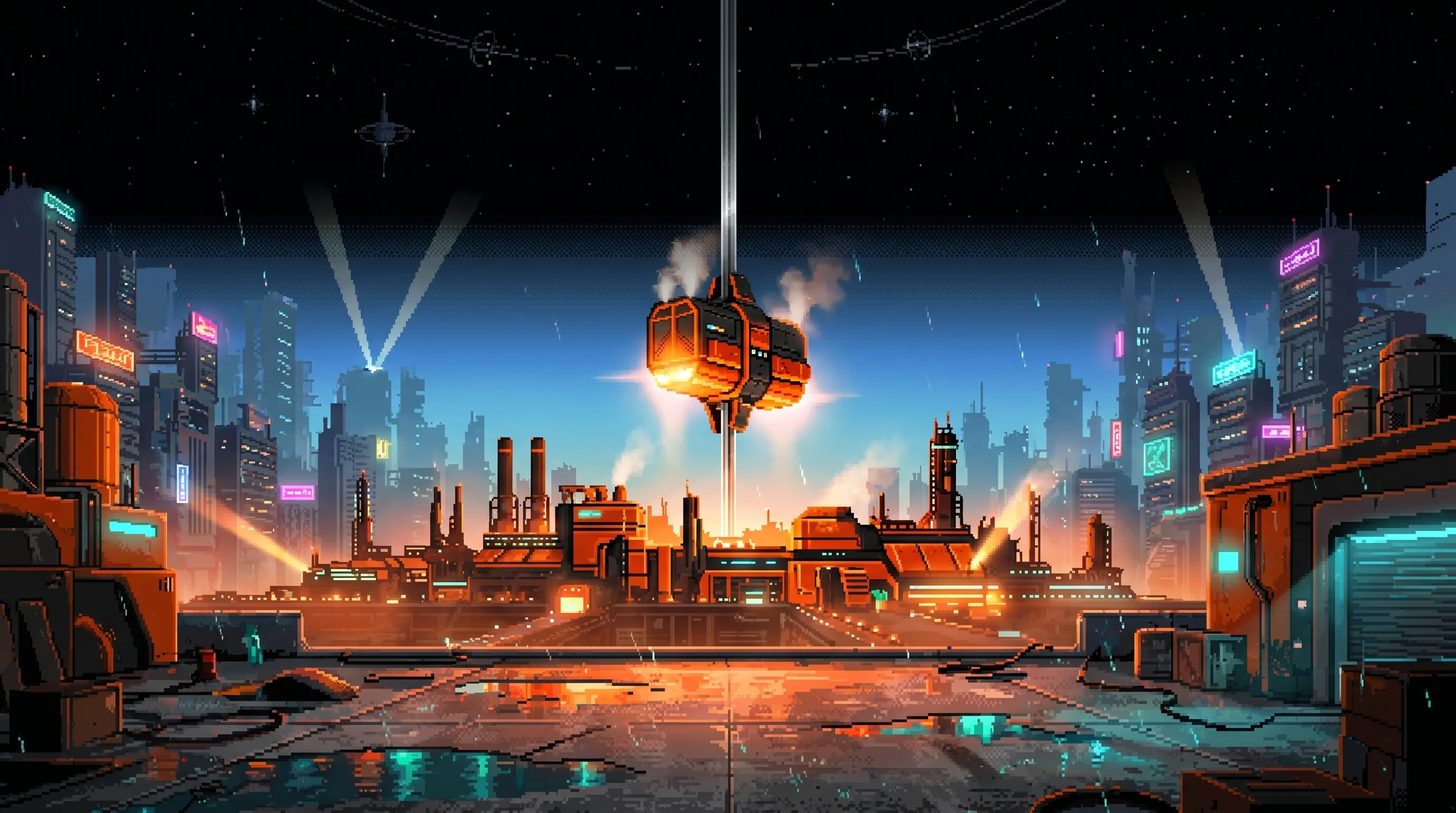
The Elevator's ground station occupies 40 square kilometers of reclaimed coastal land on the equatorial Pacific coast, near what was once Esmeraldas, Ecuador — sitting at nearly zero degrees latitude, directly beneath the geosynchronous orbit path. Three concentric security perimeters. 200,000 permanent residents: workers, security, support staff, and the service economy that forms around any population that can't easily leave. The Anchor is approximately 3,500 miles south of the Sprawl, connected by the Pacific Spine maglev. It has been in continuous operation since 2170.
The central structure is the Needle — a tower rising 3 kilometers above sea level, housing transit terminals, Ironclad administrative offices, cargo processing, and the Weighing, which is what Ironclad calls the security and inspection gauntlet that every gram of upbound mass passes through. The name is accurate. Everything is weighed. Everything is catalogued. Everything is priced. The Ring surrounds the Needle — fusion reactors, orbital solar feed infrastructure, industrial processing, the machinery that keeps 40 square kilometers of equatorial coast operating as a single mechanism for converting surface mass into orbital mass.
The Anchor smells like ozone, lubricant, and equatorial humidity. Cargo containers move in continuous streams through processing zones where automated systems scan, categorize, and occasionally reject shipments based on criteria Ironclad has never published. Rejected cargo is held in bonded storage at ¢340 per kilogram per day until the shipper can retrieve it or the storage fees exceed the cargo's value, whichever comes first. Ironclad's bonded storage division reported ¢2.1 billion in revenue last quarter. The division's official purpose is temporary cargo management.
At the edge of the complex, near the final security perimeter, there's a bar called the Last Drop. It serves pre-transit drinks to passengers about to begin a seven-day climb into orbit. The drinks are priced at approximately 900% of Sprawl standard. The bar's internal customer satisfaction surveys show 94% approval. The survey is administered after the second drink and before the third, during the narrow window when passengers have accepted the cost but haven't yet received the bill.
| Stratum | Between |
|---|---|
| Power Position | Above |
| Access | Restricted |
| Atmosphere | Liminal |
The Pacific Spine
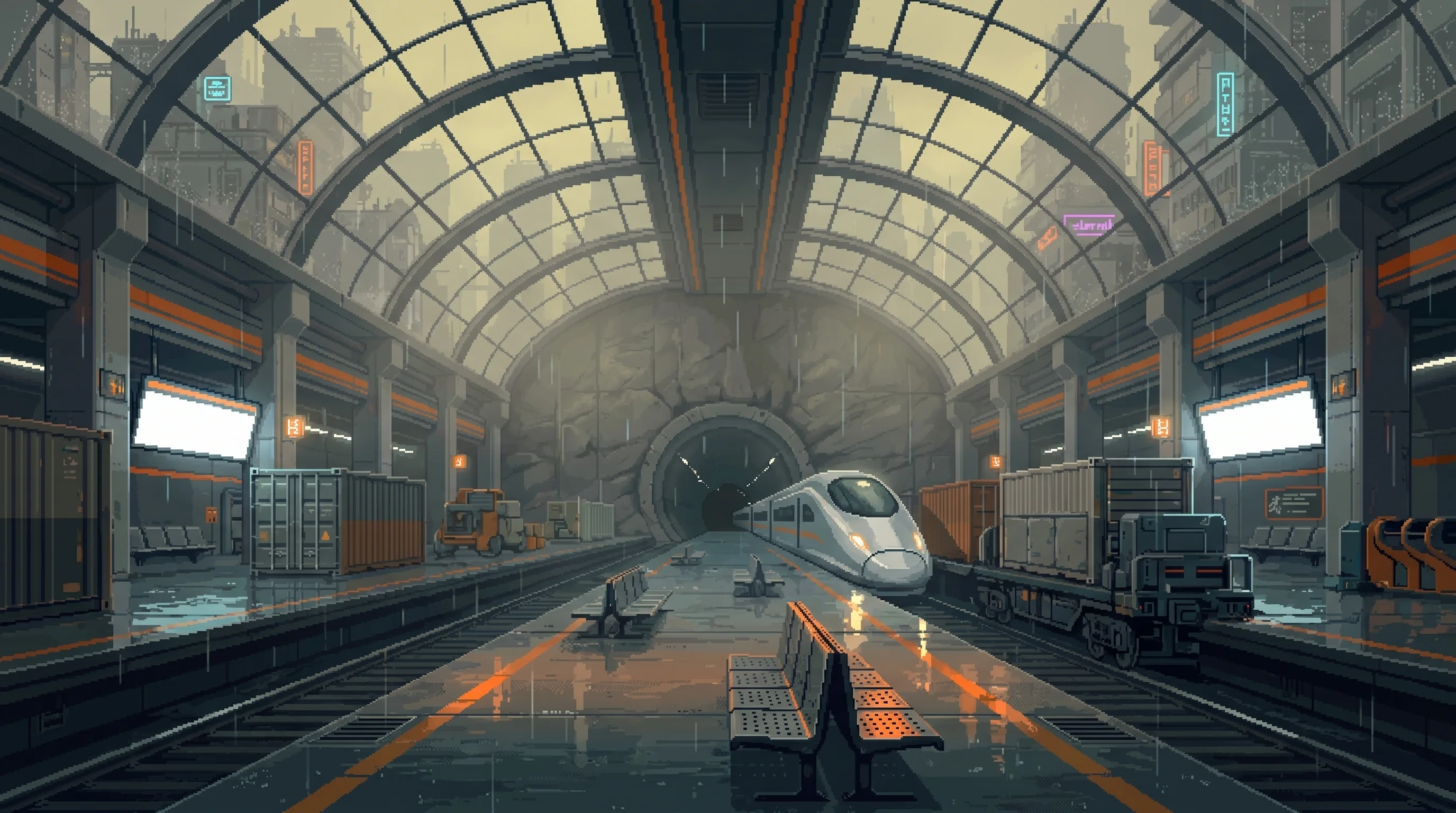
The transit corridor connecting the Sprawl to the Anchor. A high-speed maglev monorail runs approximately 3,500 miles along the Pacific coast from the Pacific Spine Terminal in Sector 15 — Outer Peninsula — to the equatorial ground station. At hypersonic speeds, the journey takes approximately three hours.
The route departs Sector 15, runs south through the ruins of pre-Cascade coastal cities, crosses stretches of open water on elevated pylons, and arrives at the equatorial coast. The maglev cars are sealed and pressurized for hypersonic transit, painted in Ironclad orange and black. Passengers watch the climate change through the windows: the fog of the Outer Peninsula giving way to dry heat, then tropical humidity as the equator approaches. The Anchor appears on the horizon as a dark mass with a silver thread rising from it. Then the thread resolves into the Tether — impossibly thin, impossibly tall, vanishing upward into sky that stops being blue.
The Pacific Spine Terminal in Sector 15 is one of the few places in the Sprawl where the connection to the wider world is physically felt. Passenger and cargo traffic departing for orbit. Massive freight cars feeding the Anchor's logistics operation. The platform where you stand and watch the maglev vanish south toward the equator, carrying people who will be in geosynchronous orbit within ten hours of arrival. Terminal advertising displays rotate between Ironclad's corporate messaging — "Building Tomorrow's Foundation" — and real-time pricing updates for cargo transit. The pricing updates get more attention.
The Tether
The Elevator's main structure is a cable of woven carbon nanotubes maintained at tension by orbital mechanics. Two meters in diameter at the base, tapering to 50 centimeters at midpoint. Aligned carbon nanotubes with diamond reinforcement. Electromagnetic climbers travel at an average of 200 km/h, carrying up to 500 tons of cargo each. Twelve climbers in transit at any given time. Ground to geosynchronous orbit takes approximately seven days.
Seven days is a long time to spend in a can on a thread.
The experience is specific. You don't feel movement — the climber is smooth, the cable steady. But outside the windows, Earth falls away. At 100 kilometers, atmosphere gives way to black. At 300 kilometers, the orbital debris belt is visible — a zone of pre-Cascade and Cascade-era wreckage that the climber navigates through shielded corridors. At 17,893 kilometers, the Midpoint Station offers a maintenance stop and passenger break: the only interruption in seven days of watching the planet shrink. By day five, Earth is a sphere. By day seven, the Crown is visible ahead, and the ground you left is an abstraction.
Along the Tether's length, informal settlements have emerged at maintenance waypoints — the Tether Camps, communities of workers, drifters, and those who have found a life suspended between Earth and sky. Somewhere among them, the Tether Monks keep their vigil, watching the cable for signs only they seem able to read.
Ironclad sells economy class at ¢500,000 — shared cabin, seven days, communal facilities. Business class at ¢2,000,000 — private cabin, five-day express routing. Executive at ¢10,000,000 — suite, direct climber, three days. The executive climbers bypass the Midpoint Station entirely. Executive passengers and economy passengers are on the same thread, traveling to the same destination, separated by ¢9,500,000 and four days of their life. Both arrive at the Crown. Both step into the same orbital facility. The executive passenger has been in orbit for four days by the time the economy passenger arrives. The deals made during those four days are not available to economy passengers. This is not mentioned in the pricing literature.

The Crown
At the top of the Tether, 35,786 kilometers up: Ironclad's orbital headquarters and the transfer point for all space traffic. A rotating habitat one kilometer in diameter generating 0.5g of artificial gravity. Docking facilities for orbital and interplanetary vessels. Cargo transfer and redistribution. Ironclad executive facilities. Defense platforms whose armament specifications are classified at a level that even Ironclad board members access on a need-to-know basis.
Population: 50,000 permanent, 10,000 transient.
Everything is Ironclad orange and black. Everything functions. The air is cleaner than anything on the surface — the Crown's atmospheric processing runs independently of the Sprawl's Breath infrastructure, which means the 50,000 people living at geosynchronous orbit breathe air that 97% of the Sprawl's surface population will never experience. The observation deck shows Earth as a marble and the Tether stretching to infinity in both directions — down toward the Anchor, up toward the Counterweight. Standing there, you understand why Ironclad executives refer to the surface with a specific tone that isn't quite disdain and isn't quite pity. They call it "down below." The phrase covers the Sprawl, the Dregs, the Wastes, and every other place where 11 billion people live, work, and breathe processed air. All of it is "down below." All of it is where the Elevator's revenue comes from.
The Hammer
Above geosynchronous orbit, the Tether continues to the Counterweight — a captured asteroid positioned to keep the entire system in tension. Mining operations extract iron, nickel, and rare elements. A launch facility sends deep-space missions outward. An emergency habitat exists in case of Crown evacuation, though Ironclad's public materials describe this as "precautionary redundancy" rather than acknowledge the specific scenarios it was designed for.
Access: heavily restricted. Even Ironclad personnel need special clearance. What happens at the Counterweight stays at the Counterweight, which is convenient for Ironclad and inconvenient for anyone asking questions about what a mining facility with military-grade access restrictions is actually mining.
Built, owned, and operated by Ironclad Industries; completed 2170
The Bottleneck
The Elevator is the only economical route between surface and orbit. Alternatives exist but don't compete: rockets at 100x the cost per kilogram, mass drivers limited to inert cargo, no passengers. Nexus Dynamics is building a second elevator. Completion estimate: 2190-2195. Six to eleven years from now. The corporate cold war between Nexus and Ironclad runs through this gap. Nexus needs space access for Project Convergence. Ironclad can provide it — at a price that is renegotiated quarterly and disclosed to neither party's shareholders. The negotiation is constant and hidden from public view. Both corporations describe the relationship as "collaborative."
What Ironclad optimizes for is not space access. Space access is the product. Ironclad optimizes for the spread between what space access costs to provide and what it costs when you have no alternative. The spread is the company. The Elevator is just the mechanism that makes the spread possible.
This produces specific downstream effects. Every orbital station's operating budget includes an Ironclad transit line item that functions as a tax on existence. Cargo pricing fluctuates based on demand — and Ironclad controls the demand data because Ironclad processes every shipment. When transit prices increase by 3%, the increase is described as "reflecting current operational conditions." When they decrease by 0.5% ahead of a regulatory review, the decrease is described as "our ongoing commitment to accessible space transit." The Collective has almost no orbital presence. Independent operators pay Ironclad's price or don't operate. Corporate accounts for Nexus, Helix, and major players carry negotiated rates rumored at 40-60% of standard — the precise discount calibrated to be large enough to prevent them from funding Nexus's competing elevator faster, and small enough to preserve margin.
ORACLE-related materials — fragments, research samples, consciousness-transfer hardware — are listed under a pricing tier with no published rate. Ironclad's customs division has flagged and temporarily held 74% of ORACLE-related shipments in the past two years, with an average hold duration of 11 days. The holds are described as "enhanced inspection protocol." Every faction with an interest in ORACLE fragments — the Emergence Faithful, the Collective, Nexus — knows what enhanced inspection protocol means: Ironclad scans it first. What they learn during those 11 days has never been disclosed.

Security
The Elevator is the most heavily defended structure on Earth. It is also, by simple geometry, the most vulnerable. A single successful attack on the Tether could collapse 35,000 kilometers of cable onto the surface, destroy the Crown and its 60,000 occupants, set space development back decades, and kill millions from debris impact. The cable's path from equatorial Pacific coast to geosynchronous orbit crosses through the jurisdiction of no surviving government. The Treaty of Shared Infrastructure, signed in 2171, declared the Elevator neutral infrastructure — targeting it is prohibited under the same framework that protects water, power, and air processing. Every faction observes this prohibition. The prohibition is enforced not by treaty language but by the calculations that every faction's strategists have run: the consequences of a successful attack would destroy the attacker's orbital assets along with everyone else's. Mutual assured destruction is the Elevator's real defense system. The 15,000 Ironclad Enforcers at the Anchor, the anti-aircraft batteries, the three perimeter walls, the biometric checkpoints, the orbital defense platforms at the Crown — these are the visible security. The invisible security is that nobody can afford to win by attacking it.
The Tether itself is monitored by continuous surveillance, drone patrols, and redundant structural systems. Cable damage is survivable — the nanotube weave is designed to redistribute load — but emergency cutoff systems can sever sections if necessary, dropping a climber rather than losing the entire structure. Ironclad's security briefings describe this as "acceptable loss parameters." The passengers on the severed climber are not consulted regarding the acceptability.
The Crown operates on an isolated network, physically severed from Sprawl systems. Rapid-response security forces. Boarding countermeasures. Dead-man protocols that Ironclad's public materials reference only as "automated continuity systems." Director Abbas Okonkwo manages infrastructure operations including coordination with the Farallon Platform ground systems — the logistics chain that feeds the Pacific Spine's northern terminus.
Official name: Ironclad Ascent Platform One (IAP-1)
Black Market
Despite the security architecture, contraband moves through the Elevator. Hidden compartments in cargo containers. Bribed inspectors — Ironclad's customs division pays well enough that bribery requires substantial premiums, which functions as a quality filter on smuggling operations. Creative packaging that exploits gaps in the Weighing's automated scanning protocols. Black market transit runs 300-500% of standard rates. If caught: seizure, plus what Ironclad calls "indefinite detention" in facilities that Ironclad operates under its own judicial authority. Ironclad runs its own courts. The conviction rate is 98.3%.
The Zero Syndicate maintains arrangements with certain customs officials. Terms are expensive but reliable. The Syndicate treats Elevator access the way a legitimate corporation treats a supply chain: consistent, priced for volume, and backed by a relationship that neither party discusses publicly.
Affiliated Entities
| Entity | Relationship |
|---|---|
| Ironclad Industries | Builder, owner, operator. The Elevator is the physical manifestation of Ironclad's position: they control where you live and whether you can leave. |
| Highport Station | The Elevator connects ground-level to orbital facilities including Highport Station — the transit network that begins with the Pacific Spine Terminal and ends at geosynchronous orbit. |
| Ironclad Fortress | The Pacific Spine's northern freight terminus — everything the Elevator lifts is staged, sealed, and dispatched from the Fortress, thirty-five hundred miles north of the Anchor. The corporate nerve center's line to the Crown runs through its own freight quarter first. |
| Nexus Dynamics | Building a competing elevator. Estimated completion: 2190-2195. The corporate cold war's most expensive front. Every year of delay extends Ironclad's monopoly. |
| The Collective | Almost no orbital presence. The Elevator's pricing structure and inspection protocols ensure that factions without corporate-scale resources remain surface-bound. The Collective's position on ORACLE fragments — destroy them — is difficult to execute when 74% of fragment shipments are held by Ironclad customs for 11 days. |
| The Emergence Faithful | ORACLE fragment shipments flagged under "enhanced inspection protocol." Whatever the Faithful are trying to move to orbit, Ironclad sees it first. |
| Zero Syndicate | Maintains smuggling arrangements through the Weighing. Expensive, reliable, undiscussed. |
| Director Abbas Okonkwo | Manages infrastructure operations including Farallon Platform ground systems — the logistics chain feeding the Pacific Spine's northern terminus. |
| The Treaty of Shared Infrastructure | Signed 2171, declares the Elevator neutral infrastructure. The treaty protects it. The physics of catastrophic cable failure protects it more. |
| The Manifest Office | A Sector 15 cargo-reconciliation annex feeding the same customs pipeline. Its clearances arrive at the Elevator's desk before the 11-day hold ever sees them; its own suspicion runs on a locked drawer instead of a staffed inspection protocol. |
▲ Unverified Intelligence
The Counterweight Operations: The Hammer's mining operations are disclosed. The military-grade access restrictions are not explained by mining. Ironclad personnel who rotate through Counterweight assignments are subject to neural-audit protocols upon return — standard for classified facilities, unusual for a mining operation. What the Counterweight produces beyond iron, nickel, and rare elements has not been catalogued by any external agency. The facility sits above geosynchronous orbit, beyond the Crown's observation range, at the end of a tether controlled entirely by Ironclad. Whatever is being built there, Ironclad builds it alone.
The 11-Day Hold: ORACLE-related shipments flagged under enhanced inspection protocol are held for an average of 11 days. Ironclad's customs division describes the hold as standard hazardous materials processing. The division employs 23 staff members with backgrounds in consciousness-transfer research, quantum coherence analysis, and fragment containment — specializations with no obvious application to customs inspection. What Ironclad learns during those 11 days, and what they do with what they learn, is not reflected in any filing available to the public or to other corporations. Nexus's intelligence division has been trying to place an operative in the customs division for three years. The position has a 0% external hire rate.
The Second Elevator Negotiations: Nexus's competing elevator is six to eleven years from completion. Ironclad's negotiated corporate rates — rumored at 40-60% of standard — fluctuate in correlation with Nexus's construction progress reports. When Nexus announces a milestone, rates drop. When Nexus reports delays, rates increase. The pricing is described as "market-responsive." The market it responds to has one supplier.
The Elevator Compact: The formal agreements governing Elevator operations, access rights, and the détente between corporate powers were born from the Three-Week War of 2171, in which 847,000 people died and three orbital habitats were vented to vacuum. The Compact was signed at Highport Station; its terms still govern the uneasy peace. Certain cargo manifests are sealed under Compact provisions that exempt them from standard inspection protocols. What moves in those sealed manifests is a question nobody with the clearance to know will answer — and the pattern of sealed manifests correlates with known Ironclad executive travel schedules. Nobody has published the correlation officially. Several people have noticed it.
Ground station (The Anchor) located on the equatorial Pacific coast of Ecuador, ~3,500 miles south of The Sprawl
Height: 35,786 km to geosynchronous counterweight
Conditions Report
Sight
Orange and black livery everywhere, the Needle rising 3km, the Tether vanishing upward, cargo streams | Earth falling away. Day and night cycling beneath. The curve of the horizon on day three. The sphere on day five. | Earth as marble. Stars that don't twinkle. The Tether stretching in both directions to infinity.
Sound
Constant machinery hum, flat corporate announcements, cargo container impacts, security checkpoint tones | The whisper of air recyclers, electromagnetic hum of the climber, silence growing as atmosphere thins | Quiet mechanical precision. The rotation of the habitat. Silence that feels like wealth.
Smell
Ozone, lubricant, equatorial humidity, cargo processing chemicals | Recycled air, the slowly changing smell of your own cabin over seven days | Clean. Cleaner than anything on the surface. Air that has never been breathed by 11 billion people.
Feel
Dense equatorial heat, industrial vibration through every surface | No sensation of movement. Gravity slowly decreasing. The specific unease of seven days in a pressurized can. | 0.5g. Light enough to notice. Heavy enough to function. The body knows it is not on Earth.
Connected To





Local Intelligence Scan
Nearby Signals
CANONICAL PROXIMITY


Position Data
SECONDARY- Elevation band
- Shoreline — the Rim edge
- Lattice fix
- E+3661.4 · N-4307.4
—