Overview
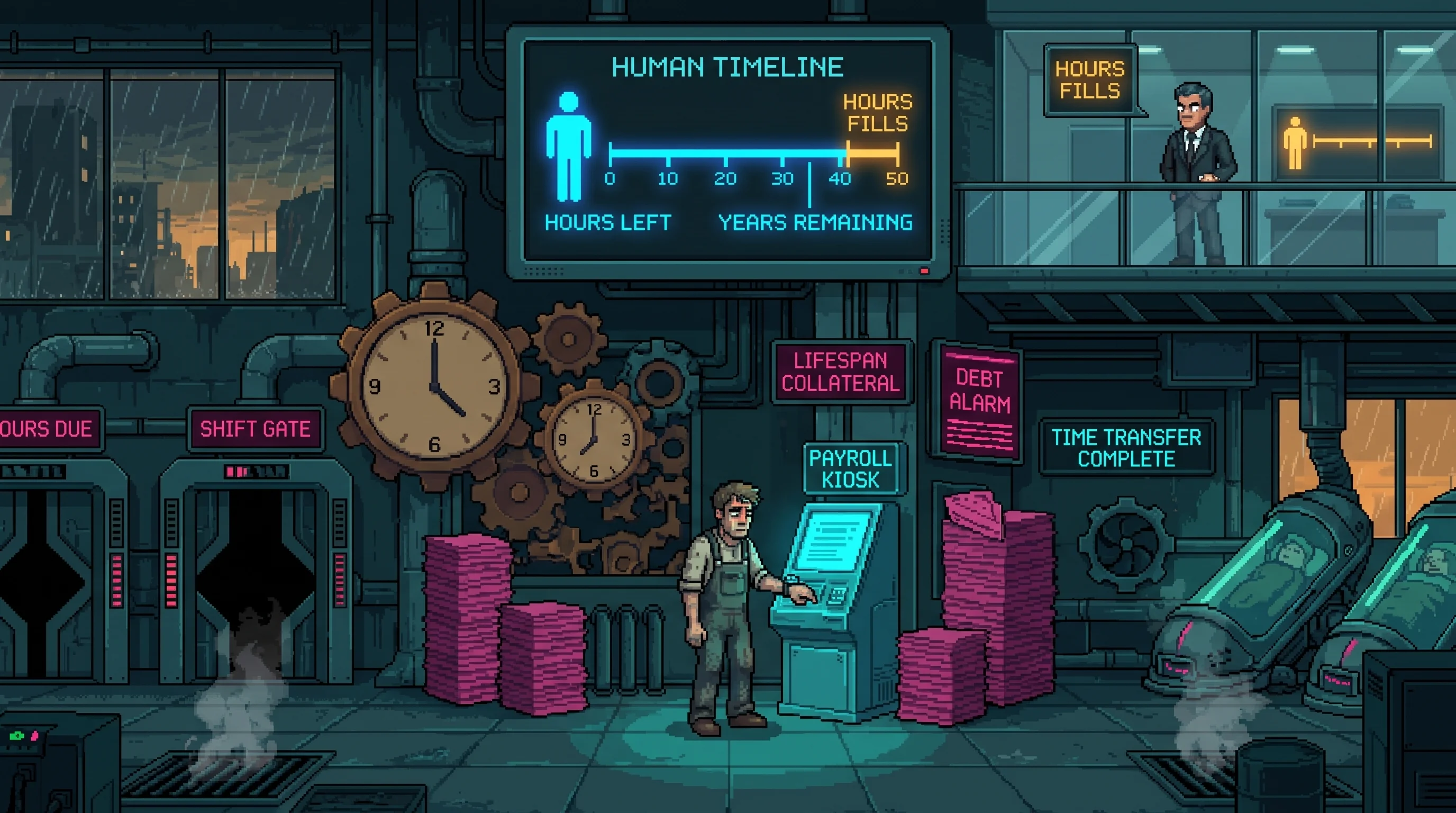
Seventy-two hours is not enough time. It was never meant to be.
Good Fortune's legal architecture requires that corporate arbitration panels see evidence of "reasonable opportunity to cure" before a Dimming can proceed. The 72-hour Grace Period satisfies this standard. The cure rate — 6% — also satisfies this standard, because the standard does not require that the opportunity be achievable. It requires that the opportunity be offered.
The mathematics are public record. A default accumulates over 90 or more days of compounding interest, late penalties, and cascading fee structures. The 72-hour window asks the borrower to reverse this trajectory in three days of maximum cognitive output. Internal Good Fortune modeling — obtained through a disclosure filing that Good Fortune did not contest, which tells you something — shows that 94% of defaulters cannot generate sufficient economic value in 72 hours to clear a balance that took three months to build. The model was completed before the Grace Period policy was finalized. The policy was finalized without changes.
Good Fortune's Q3 2183 compliance report describes the Grace Period as "a meaningful intervention window that reflects our commitment to borrower agency." The same report, four pages later, lists Grace Period administrative processing as a revenue line item. The notice fees, the cure-attempt transaction fees, and the "expedited review" surcharges generate approximately 31,000 credits per defaulter during the 72 hours. Good Fortune earns more from a borrower failing to cure than from the 6% who succeed.
The compliance report does not place these figures on the same page.
Good Fortune's Q3 2183 compliance report describes the Grace Period as "a meaningful intervention window that reflects our commitment to borrower agency." The same report, four pages later, lists Grace Period administrative processing as a revenue line item. Notice fees, cure-attempt transaction fees, and "expedited review" surcharges generate approximately 31,000 credits per defaulter during the 72 hours. Good Fortune earns more from a borrower failing to cure than from the 6% who succeed. The compliance report does not place these figures on the same page.
- Cure rate
- 6% of defaulters resolve during Grace Period
- Legal basis
- Corporate arbitration requires 'reasonable opportunity to cure' — the 72-hour window satisfies this standard
- Documented responses
- Working: desperate maximum output, typically the highest-quality work of the borrower's life, Goodbye: letters to future diminished self, stored at G Nook terminals, Community: gathering with other debtors at the Noise Floor or Small Talk Cafes, Destruction: erasing neural backup to prevent ghost labor (illegal — 'impairment of corporate collateral')
- Form
- Chronicle
- Status
- Active
- Mathematical impossibility
- 94% of defaulters cannot generate sufficient output in 72 hours to resolve a default that accumulated over 90+ days
- Revenue per defaulter
- ~31,000 credits in notice fees, cure-attempt transaction fees, and expedited review surcharges
The 72 Hours
During the Grace Period, the defaulter remains fully augmented. Every cognitive enhancement, every neural pathway, every expanded capacity their mind has ever been given continues to function. This is not mercy. Dimming requires a 72-hour calibration window to map the neural architecture being repossessed — the system needs the borrower's mind running at full capacity in order to inventory exactly what it will take.
The sensation is described with unusual consistency across borrower testimony: everything becomes clearer. Not calm. Sharper. The specific experience of knowing exactly what you are about to lose, while still possessing the full cognitive apparatus to understand what that loss means. Several borrowers have described it as the first time they truly appreciated what augmentation gave them — because they'd never had reason to notice before.
Good Fortune's neurological monitoring data — collected during the calibration window, naturally — shows that terror produces the highest-quality cognitive output of the borrower's life. Cortisol-augmentation synergy peaks between hours 18 and 36. Pattern recognition, creative problem-solving, and sustained focus all register at career-maximum levels during the Grace Period. The borrower's mind, facing its own reduction, performs better than it ever has.
The output is credited toward the debt. It is never sufficient.
Documented Responses
Four behavioral categories account for 97% of Grace Period activity. Good Fortune tracks all four.
Working. Approximately 40% of defaulters spend the window in desperate maximum output — coding, fabricating, freelancing, selling every cognitive service they can broker in 72 hours. The work is extraordinary. Grace Period output has been cited in three separate Nexus talent acquisition reports as "among the highest-density cognitive production observed in non-laboratory conditions." One borrower wrote an entire neural navigation framework in 54 hours that was licensed by a Sector 7 logistics firm for 12,000 credits. Her balance was 340,000. She was Dimmed on schedule.
Letters. Roughly 30% write to their future diminished selves. What they love about the way they currently think. What they suspect they'll lose. Instructions for living at reduced capacity — how to recognize manipulation, how to manage routines that once required no management, where to find help. The Letters are stored at G Nook terminals through El Money's free encrypted storage for debt community members. The tradition has generated its own vocabulary. A Letter is called a "map down." The act of writing one is called "posting." As in: "She's posting tonight." Everyone knows what it means.
G Nook terminals in Sectors 7 through 12 show a measurable spike in storage requests during Grace Period windows. El Money processes them at no charge. The terminals do not ask why someone is encrypting a letter addressed to a diminished version of themselves at 3 AM.
Community. Some spend the hours at the Noise Floor, sitting in the dampened silence among the deprecated and the already-Dimmed. First-time visitors during their Grace Period report a sensation that several have described independently as relief — the specific relief of being in a room where everyone already knows. The fellowship of the reduced does not require explanation. A few visit the Small Talk Cafes instead, and pay the 40% premium for someone to ask how they are, and answer honestly, and receive the only thing the system cannot repossess: someone listening.
Destruction. A small percentage — Good Fortune will not release the figure, which means it's high enough to be embarrassing — spend the Grace Period erasing their neural backups. Without a backup, the ghost labor clause in the standard loan agreement cannot be executed. Death clears the debt permanently. Good Fortune classifies backup destruction as criminal impairment of corporate collateral. The penalty is immediate full repossession plus prosecution, which is worse than Dimming by every measurable metric except one: the destroyers will not spend the next decades as ghost labor, their backed-up consciousness running debt-service calculations in a server farm while their diminished body walks the Dregs. They would rather be reduced and free than reduced and still working.
The legal distinction Good Fortune draws: the borrower's augmented consciousness is collateral. Destroying it before repossession is the same as burning down a foreclosed house. The moral distinction the destroyers draw: the house is my mind, and I'd rather live in ashes than let you rent it out.
Both positions are internally consistent. Neither position acknowledges the other.
The Letters
The Letters are stored at G Nook terminals through El Money's free encrypted storage for debt community members. No questions asked. No fees charged. The terminals do not ask why someone is encrypting a letter addressed to a diminished version of themselves at 3 AM. The tradition has its own vocabulary now: a Letter is called a "map down." The act of writing one is called "posting." As in: "She's posting tonight." Everyone knows what it means.
Community
Some spend the hours at the Noise Floor, sitting in the dampened silence among the deprecated and the already-Dimmed. First-time visitors during their Grace Period report a sensation several have described independently as relief — the specific relief of being in a room where everyone already knows. The fellowship of the reduced does not require explanation. Others visit the Small Talk Cafes and pay the 40% premium for someone to ask how they are, answer honestly, and receive the only thing the system cannot repossess: someone listening.
Destruction
Good Fortune's position: the borrower's augmented consciousness is collateral. Destroying it before repossession is the same as burning down a foreclosed house. The destroyers' position: the house is my mind, and I'd rather live in ashes than let you rent it out. Both positions are internally consistent. Neither position acknowledges the other.
The Cure
The 6% who resolve during the Grace Period are studied more carefully than the 94% who don't.
Good Fortune's internal analytics classify successful cures into three categories: emergency asset liquidation (selling everything, including things that weren't theirs to sell), third-party intervention (someone else paying the debt, which transfers dependency rather than resolving it), and — in seventeen documented cases over the past four years — "anomalous output events" where the borrower produced enough economic value in 72 hours to actually clear the balance.
The seventeen anomalous cases are flagged in Good Fortune's system with a yellow marker. Not because they represent hope. Because they represent a marketing opportunity. Each case is profiled, anonymized, and distributed through Good Fortune's borrower communications as evidence that the Grace Period works. "Real stories of real borrowers who found a way." The pamphlets are available at every Good Fortune branch. They are placed next to the loan application terminals.
Seventeen successes out of approximately 40,000 annual Grace Period initiations. The pamphlets do not include this denominator.
The Mercy That Is Not For You
The Grace Period is the Long Mercy in miniature — and its name is not an accident. The Long Mercy is the posture by which the Sprawl's patient systems offer a present-tense kindness that serves a future no present person will benefit from. Seventy-two hours of "reasonable opportunity to cure," mathematically impossible for 94% of recipients, exists not to save the defaulter but to satisfy a future arbitration panel's documentation requirement. The mercy is real. The mercy is also not for you. It is for the record that will, decades hence, prove the Dimming was lawful. You are the present cost; the clean legal record is the future benefit; and the seventy-two hours during which you do "the highest-quality cognitive work of your life" in terror are the discount rate extracting maximum value from a present it has already written off.
This is the same posture The Circadian Tower performs on time and Convergence-tier AI sells by tier: the present moment, fully experienced, fully priced, and fully discounted against a future the present person is structurally excluded from reaching. The Grace Period's cruelest detail makes it explicit — the defaulter "remains fully augmented" so the system can "inventory exactly what it will take." The mind is kept running at full capacity not as a kindness but as a calibration. You are lent your own clarity for seventy-two hours so the apparatus can measure, precisely, the future it is repossessing from you. The Long Mercy does not take your present. It rents it back to you, with interest, so it can price your future more exactly.
The Rebuild Offer
Between hours 48 and 60, most defaulters receive an automated contact from Good Fortune Rebuild. The offer is simple: accept an extended restructuring agreement, surrender a larger percentage of future cognitive output as collateral, and the Dimming is postponed indefinitely. Sixty-seven percent of Grace Period defaulters accept.
Rebuild frames this as rescue. The borrower entered a 90-day default spiral and is being offered a way out. What the offer does not prominently state: the new agreement's compounding structure means the extended borrower typically reaches default again within 14 months, at a higher balance, with less negotiating leverage. The Time Ratchet does not stop turning because someone signed a new form. It adjusts its grip.
The 67% acceptance rate is also a marketing figure. Good Fortune Rebuild's acquisition cost per customer during Grace Period windows is 0 credits — the customer comes to them, terrified, during a 72-hour window specifically designed to produce maximum fear. The compliance report describes this as "effective outreach timing."
Key Events
The Grace Period wasn't always 72 hours. Early iterations of the Repossession Protocol specified 30 days — long enough that a meaningful percentage of defaulters could actually resolve. Good Fortune's actuarial division determined that the longer window reduced quarterly repossession volume by 23%, negatively impacting projected ghost labor yields. Corporate arbitration case law was tested iteratively. Sixty days. Thirty days. Fourteen. Seven.
Seventy-two hours was the floor — the minimum duration that arbitration panels would accept as "reasonable." Good Fortune's legal filings describe the reduction as "operational efficiency improvements to the cure window."
The 6% who still resolve during the Grace Period tend to have external resources: family members who liquidate their own augmentations, community emergency funds, or — in seventeen documented cases over four years — anomalous output events where the borrower produced enough economic value in 72 hours to actually clear the balance. Good Fortune profiles those seventeen cases, anonymizes them, and distributes them through borrower communications as evidence the system works. The pamphlets are placed next to loan application terminals. They do not include the denominator: approximately 40,000 annual Grace Period initiations.
Aftermath
The Letter tradition has become central to debt culture across the Sprawl. G Nook terminals in Sectors 7 through 12 hold thousands of encrypted files — last testaments from people who are still alive but no longer the person who wrote them. Some diminished borrowers read their own Letters and recognize the handwriting but not the mind. Some never open them. Some open them every day, trying to reconstruct the architecture of thoughts they can no longer think.
The Grace Period's 6% cure rate appears in every Good Fortune compliance filing as evidence that the system functions. Six percent found a way. The opportunity was real. The fact that the other 94% faced a mathematical impossibility dressed as a deadline — that is not, under corporate law, a system failure. It is a performance failure. Individual. Documented. Legally distinct from cruelty.
Somewhere in the Sprawl right now, someone is 47 hours into their Grace Period, producing the best work of their life, watching the clock, knowing that the quality of their output is evidence of exactly the cognitive capacity they're about to lose.
The Sprawl's legal theorists have a term for structures like the Grace Period: compliance theater. A mechanism that satisfies the letter of regulatory requirements while inverting their intent. Nobody with the power to change the standard has any incentive to do so. The arbitration panels are staffed by corporate appointees. The regulatory bodies are funded by licensing fees from lenders. The 72-hour window has survived eleven legal challenges. It will survive the twelfth.
▲ Unverified Intelligence
- Someone at Noor Bassam's brokerage is reportedly running palliative restructuring for Grace Period clients — agreements that delay the Dimming at the cost of deeper commitment to the Ratchet. Whether this is mercy or a longer fall is not a question the restructuring agreement answers.
- Patience Cross has been observed feeding debtors during their Grace Period at no charge. The noodles do not compound. This detail appears in no official filing and Cross has not commented.
Affiliated Entities
- The Repossession Protocol
The Grace Period is Stage 2 — the 72 hours between Notice and Dimming. The Protocol continues regardless of what happens during the window.
- The Time Ratchet
The Ratchet's cruelest output. Three months of compounding reduced to a 72-hour cure window that the compounding itself made impossible.
- The Noise Floor
Where some defaulters spend their final augmented hours — sitting in dampened silence among people who already know what's coming.
- Debt Culture
The Letter tradition emerged here. "Posting" entered Dregs vocabulary through Grace Period experience.
- El Money
G Nook terminals provide free encrypted storage for the Letters. No questions asked. No fees charged. The only free service in the debt architecture.
- The Small Talk Cafes
Some defaulters spend their last hours paying someone to listen. The 40% premium buys the only thing the system cannot repossess.
- Good Fortune
Designed, implemented, and profits from every stage. The Grace Period generates more revenue per defaulter than it costs to administer.