The Lattice is humanity's first stellar-scale infrastructure — a growing Dyson swarm of solar collectors, processing stations, and habitat clusters capturing energy directly from the Sun. Not a single structure but a constellation of facilities spanning millions of kilometers, connected by communication lasers and automated supply lines that stretch from Mercury's orbit to the edge of the asteroid belt.
It produces more energy than pre-Cascade Earth consumed in a century. Its marketing materials show gleaming collectors against the solar corona. Its memorial wall at New Prosperity lists 376 names across three bulkheads and is being extended into a fourth.
Ironclad Industries built the original infrastructure. Nexus Dynamics filled it with data centers. Two million people live across thousands of installations, most of them maintaining systems designed to run without them. The collectors don't need humans. The relays don't need humans. The habitats need humans only because humans need habitats. The Lattice's core function — converting sunlight into power — was automated before the first crew arrived. Everything since has been the species' attempt to justify its presence at the foot of its own creation.
Annual productivity reviews from Ironclad's Lattice Division show a 0.7% year-over-year decline in human contribution to total energy output. The automated systems improve. The humans stay. Nobody has written the memo that connects these trends, because the person who writes that memo is also human.
Conditions Report
The Lattice doesn't have a single atmosphere. It has thousands — each station maintaining its own bubble of breathable air in the void, each bubble convinced of its own permanence. What connects them is scale: the perpetual awareness of operating at distances where Earth is a blue dot and the Sun is a presence rather than a light source.
Standing on a Collector Near Mercury
You feel the Sun before you see it. Through three meters of layered shielding — ceramics, reflective composites, ablative layers that need replacing every ninety days — the heat presses against you like a hand on your chest. Not warm. Present. The radiation alarms cycle through yellow-amber-red in a slow heartbeat. Your exposure suit's dosimeter clicks faster than your own pulse.
Then you look up.
The Sun doesn't fit in the viewport. It fills the sky, bleeding past the edges of every window, a wall of white-gold fury that makes your eyes water even through triple-polarized glass. The shielding casts everything in amber twilight — your hands look like they're made of brass. The metal floor conducts residual heat through your boots. The air recyclers strain, pulling moisture from atmosphere that wants to cook. Every surface you touch is warm. Every warning light is on.
Station Commander Reva Okafor runs Apex Station Nine — the only crewed installation in the Inner Ring. Thirty-eight crew, ninety-day rotation cycles, ten-minute viewport access per shift. She calls the Sun "the Mouth" and enforces the viewport limit with the calm authority of someone who has written two incident reports about crew members found in empty suits, face-plates open, drifting toward perihelion. The official cause of death in both cases: "navigation error." The unofficial understanding among Inner Ring crews: people who stare too long start dreaming about walking toward it. Okafor logs the dream reports from every crew rotation — recurring themes of absorption into light, bodies becoming transparent, the Sun speaking in frequencies below sound. She files them with Nexus Behavioral Sciences, which has requested additional data. She has stopped reading the reports before sleep.
Her crew receives hazard pay at 3.2x the standard Ironclad rate. A seal-runner replacing radiation shielding in the Inner Ring earns less annually than a mid-level Nexus data analyst sitting in climate control in the Sprawl. The hazard multiplier sounds generous until you calculate what it multiplies.
The Silence Between Stations
Between installations, the Lattice is nothing. No atmosphere to carry sound. No landmarks to measure distance. No horizon. Your running lights illuminate exactly the volume of space you occupy and not one cubic meter more.
Drift-runners — independent haulers who carry supplies between stations — measure their routes in light-minutes. A typical Processing Band run takes six hours of absolute solitude. Your ship's systems chatter to themselves: fuel flow, trajectory corrections, thermal management. The automated check-in ping arrives every ninety seconds from the nearest Waystation — a single blip confirming that something, somewhere, knows you exist.
Old drift-runner Tomás Wren has been running the New Prosperity–Assembly Yards corridor for eleven years. He says the silence changes you. "First year, you fill it with music, podcasts, old Earth media. Second year, you start talking to yourself. Third year, you stop. Fourth year, you listen." He won't say what he hears. None of the long-haul runners will. The drift-runner community maintains a shared audio log — thousands of hours of recorded silence from the space between stations, catalogued by route and date. New runners are told to listen to the logs before their first solo run. No one explains why. The logs are silent. The runners listen anyway.
Sound
Station interiors hum with life support — a bass note so constant that newcomers hear it for weeks and veterans have forgotten it exists. Pressure seals wheeze on four-hour cycles. Water recyclers gurgle behind walls with the sound of a stomach digesting. Communications chirp at intervals — automated check-ins, data transfers, occasional human voices delayed by light-minutes arriving like postcards from another era.
In the cafeterias of New Prosperity, someone is always playing music. The Lattice has developed its own genre — residents call it "void tone" — long, droning ambient pieces layered with recorded station sounds: pressure cycles, airlock warnings, the ping of Waystation confirmations. Earth music sounds wrong here. Too fast, too urgent, built for a world with weather and gravity and days that mean something. A void tone composer named Suki Ren released an album last year consisting entirely of seventeen hours of processed Waystation pings arranged by light-delay duration. It charted at number four on the Lattice's internal media network. Number one was also Suki Ren, previous album, same concept, different Waystations.
Life on the Lattice
Culture
Lattice dwellers don't call themselves colonists. They call themselves residents, with an emphasis that implies everyone else is temporary. People who've lived here longer than five years develop a particular way of moving — slower, more deliberate, conserving momentum in a way that reads as calm on stations and bizarre on Earth. They call it "drift." They can spot a newcomer by the way they rush.
The slang runs deep. "Downwell" means Earth — everything below the Lattice's orbital band, treated with a mixture of nostalgia and contempt the way a city kid talks about the town they left. A "sunbather" is someone who works the Inner Ring. A "lag" is any conversation with Earth, named for the light-delay that makes real-time communication impossible. "Going quiet" means entering the unclaimed space between stations — or, in darker usage, dying. They use the same phrase for both. Nobody finds this morbid. The ambiguity is the point.
Children born on stations — called "voidborn" or, less kindly, "hollow" — grow up watching Earth broadcasts delayed by minutes, studying a planet they've never touched, inheriting their parents' grievances against a world they have no memory of. A voidborn child throws a ball and expects it to arc with the Coriolis effect. On Earth, they'd never hit a target.
Food
Station hydroponics grow spirulina, soy variants, mushrooms, engineered algae that tastes like nothing and feeds like everything. Protein comes from insect farms — cricket flour is the Lattice's wheat. Fresh fruit is a luxury item. A single apple shipped from Earth's orbital greenhouses at Highport Station costs more than a week's drift-runner wages. The apple is always slightly bruised from transit. The bruise is part of the experience.
The Lattice's signature dish is char — a thick, spiced porridge made from roasted cricket flour, algae oil, and whatever seasonings a station's hydroponic bay can produce. Every station makes it differently. New Prosperity's version uses a fermented chili paste developed by its founding crew. The Assembly Yards favor a smoky variant made with charred mushroom. Arguments about whose char is best are the closest thing the Lattice has to sports rivalries, and they are taken with proportional seriousness. A drift-runner named Kade Olsson was reportedly refused docking at Processing Station Twelve for three weeks after publicly ranking their char "fourth best, maybe fifth." The station's portmaster denied the connection. The timing was noted.
Sovereign Kane — the 167-year-old stellar magnate who controls a private processing station at 1.3 AU — maintains a genuine soil garden. Tomatoes. Basil. Strawberries. Real dirt, imported from Earth at a cost-per-kilogram that exceeds refined titanium. He serves fresh salad to guests. The gesture communicates more wealth than any orbital installation could. His dinner invitations are accepted universally and discussed for months. The salad, by all accounts, is adequate.
Relationship to Earth
Complicated. Most Lattice residents left Earth by choice — fleeing corporate control, seeking independence, chasing the promise of limitless energy. Helena Voss has reportedly not left the Sprawl in years, relying on remote oversight and Nexus station commanders to maintain corporate interests at light-minute delays. Ironclad's Viktor Okonkwo sees the Lattice as an extension of his industrial empire, but even he acknowledges that control is nominal past the Processing Band. Acknowledging it has not stopped him from claiming it on shareholder reports.
The Collective maintains a quiet presence in New Prosperity — not hunting ORACLE fragments (few exist this far from the Sprawl's networks) but providing an ideological alternative for residents who came specifically to escape the corporate-Collective binary of Earth politics. What they found instead: a place where survival depends on your neighbor's competence, not their faction affiliation. The Collective's New Prosperity chapter has seventeen members. Fourteen of them also attend the independent station council meetings. The overlap is not discussed at either venue.
Site Classification
Stratum
Orbital
Power Position
Above
Access
Restricted
Atmosphere
Liminal
The Network
The Lattice wasn't centrally planned. It's emergent — independent operations that gradually connected, the way cities grow from trading posts. The structure has three broad regions, each with its own character and its own particular way of killing you.
The Inner Ring (Mercury–Venus Orbital Band)
Closest to the Sun, highest energy density, most dangerous conditions. Automated collectors dominate — thousands of them, each the size of a city block, angling toward the solar corona with a precision that human hands couldn't sustain and human eyes can't comfortably watch. The Apex Array is the largest complex: twelve stations working in concert to capture and transmit more energy than Earth's entire pre-Cascade civilization consumed. Eleven fully automated. The twelfth — Apex Station Nine — is Reva Okafor's domain.
The Array's automated repair systems have been evolving. Nexus engineers on the Processing Band noticed it first: maintenance algorithms optimizing beyond their original parameters. Repair drones rerouting through corridors they weren't programmed to use. Power distribution patterns shifting in ways that improve efficiency by fractions of a percent — fractions that compound. Officially, this is "expected adaptive behavior." Marcus Chen reviewed the data personally and classified the findings. The classification level alone tells Okafor everything she needs to know. She has requested a crew increase. The request is pending.
Inner Ring salvager crews have a saying: "The Sun gets its tithe." The memorial wall doesn't disagree. Every construction season, an average of forty-seven workers die — not from combat, not from sabotage, but from the accumulated weight of small failures. A seal that degraded 0.3% faster than projected. A radiation badge uncalibrated for solar maximum. A supply drone four hours late. The deaths are individually preventable and collectively inevitable. Ironclad's Lattice Division safety report for Q3 2183 concluded that the fatality rate was "within acceptable parameters for stellar-proximity operations." The phrase "acceptable parameters" appears fourteen times in the report. The names of the dead appear once, in an appendix.
The Processing Band (Earth–Mars Orbital Band)
Where raw solar energy transforms into usable forms. Refineries, manufacturing platforms, habitat clusters. Most of the Lattice's two million residents live here, in the relatively tolerable radiation environment between Earth and Mars orbits. "Relatively tolerable" being a phrase that would alarm anyone downwell and comfort no one who lives here.
New Prosperity is the anchor — 50,000 inhabitants in a cluster of connected habitats that spin for artificial gravity. The spin creates the Coriolis effect: thrown objects curve, poured liquids spiral, and children raised here develop a throwing motion that looks wrong to everyone from Earth and hits every target in station gravity.
The settlement started as Ironclad's Station Alpha, built in 2176 as a materials processing hub under Viktor Okonkwo's direct oversight. Distance made control impractical. By 2180, the population had tripled beyond projections as independent operators, Collective sympathizers, and refugees from the corporate Sprawl arrived. The station's Ironclad foreman, Davi Vasquez — no relation to Patch Vasquez — was voted out by the residents in 2182. He stayed anyway. He runs a bar now called The Tether, serves drinks made from recycled station water, and still insists to anyone who'll listen that Ironclad technically owns the hull. His regulars include both old Ironclad crews and the independents who voted him out. They drink the same recycled water. They argue about the same hull. The Tether has become, through no one's intention, the most politically significant bar in the solar system.
Council Chair Amara Lau — voidborn, has never set foot on Earth — governs through consensus where possible and majority vote where not. She represents a generation that considers the Lattice home, not exile. When Earth broadcasts refer to Lattice residents as "off-world settlers," she corrects the terminology in her next public address. The correction takes eleven minutes to reach Earth. By the time it arrives, the broadcast cycle has moved on.
The Mosaic is rumored to maintain at least three of her forty-seven simultaneous consciousness nodes in New Prosperity's datacenter. The datacenter draws enough power to run 200,000 simulated human-equivalent processes. If the first distributed transcendent being has chosen the Lattice as part of her existence, the implications for New Prosperity's political independence are significant. No one has confirmed this. The Mosaic doesn't do interviews.
The Assembly Yards (Processing Band, 1.5 AU)
Where the Lattice expands. Construction platforms that build new collectors, habitats, and infrastructure from refined asteroid materials. The Yards produce the future — whoever controls what gets built shapes what the Lattice becomes. The current construction queue is eighteen months deep. Priority disputes between Nexus computational facilities and Ironclad industrial platforms are resolved by a committee that meets quarterly and has never reached unanimous agreement on anything, including the committee's own meeting schedule.
The Waystation Network
Automated relay stations handling communication and navigation across the Lattice. Each Waystation maintains position, transmits data, and provides emergency services to passing vessels. Individually unremarkable. Collectively, the nervous system of everything. Control or monitor the Waystations, and you have intelligence on every ship, every transmission, every supply run in the network. Nexus operates 61% of them. This fact appears in no corporate filing.
The Sanctuary
The Lattice's computational capacity is effectively unlimited, the Sun's energy effectively unlimited, storage in the cold outer reaches effectively unlimited. The most controversial installation that follows from this is The Sanctuary — a dedicated consciousness-preservation facility where uploaded minds persist indefinitely on automated maintenance. Some call it humanity's backup. Others call it a very comfortable prison for people who stopped being people the moment they uploaded. The facility's own records list its 847 current residents as "active users." The residents have rules about what counts as a person; a partial upload that loops the same five minutes forever sits in an ethical category nobody on the Lattice wants to formally establish.
The Quiet (Outer Reaches)
The name given to unclaimed space between established stations. No help, no authority, no civilization — void, radiation, and whatever you brought with you. Salvagers, hermits, and those fleeing established society operate here.
The most famous Quiet resident is a woman known only as "The Cartographer" — a former Nexus systems analyst who went quiet in 2179 and hasn't docked at a station since. She broadcasts detailed maps of Lattice debris fields, radiation hotspots, and resource deposits over open frequencies. No one pays her. No one has seen her in five years. Her maps are accurate to within centimeters. The drift-runners rely on them. They leave supply caches at coordinates she specifies — food, water, filter replacements — and the caches are always empty within a day. Her Nexus personnel file lists her departure as "voluntary separation." Her access credentials were never revoked. Nexus has not explained why.
Piracy is rare but documented. A stripped ship drifting without power or crew turns up every few months. The Lattice has no police force. Disputes in the Quiet resolve through reputation: wrong someone here, and the drift-runner network stops delivering your supplies. In an environment where isolation is already measured in light-minutes, social exile has a particular finality.
ORACLE - the lattice of light that managed civilization
The Workers
The Lattice's memorial wall at New Prosperity lists 376 names going back to 2176. An average of forty-seven per construction season. Most are maintenance workers. Most are from Ironclad subcontractor rolls. Most left families on Earth who received a standard corporate death notice and two months' severance. The severance calculation does not account for light-delay; by the time the notice arrives, the family has usually already heard through the drift-runner network, which is faster than corporate HR by an average of nine days.
An estimated 340,000 of the Lattice's two million residents work maintenance, construction, or infrastructure roles. Most are employed by Ironclad Industries or its subcontractors. A significant minority — perhaps 60,000 — work for independent station operators who set their own terms. The terms vary. The danger doesn't.
Secretary-General Pavel Mirsky of the Ironworkers' Solidarity has chapters on seven Lattice stations, representing roughly 8,000 workers in the Processing Band. He has explicitly forbidden strike action in the Lattice. "You can't strike when the picket line is an airlock," he told the Ironworkers' council in 2184. "Down there, you stop working, the line stops. Up here, you stop working, people stop breathing."
Ironclad's Lattice Division runs sixteen-hour shifts with ninety-minute breaks. Earth standards mandate twelve-hour maximums. Lattice operations are classified under a separate regulatory framework that Ironclad's legal team drafted in 2178 and the Sprawl's labor board approved in 2178. The approval took eleven days. The framework took fourteen months to write. The workers it governs were not consulted during either period.
Past the Processing Band, corporate oversight attenuates to the point of irrelevance. Communication lag makes real-time management impossible. Inspection visits are expensive. Workers who've spent years in the void develop a solidarity born from knowing your crewmate is the distance between you and death by equipment failure.
The Drift Unions aren't formal organizations — no charters, no elected leaders, no membership rolls. A maintenance crew on an outer relay agrees to rotate shifts fairly. A fabrication team pools wages for better equipment. A group of drift-runners on the New Prosperity corridor creates a mutual insurance fund — if one runner's ship breaks down, the others cover the salvage cost. These arrangements are invisible to corporate oversight, which is how they survive.
The most developed operates on a cluster of five independent processing stations near the Belt transition zone, collectively known as the Crucible. Two thousand workers there effectively self-govern: they set their own schedules, maintain their own equipment, and distribute surplus energy among themselves. Ironclad technically owns the infrastructure. The nearest corporate representative is four light-minutes away and hasn't visited in two years. The Crucible's workers quietly stopped forwarding production reports nineteen months ago. Ironclad's Lattice Division quarterly summary lists the Crucible's output as "estimated, pending verification." The estimate has been copy-pasted from the same cell for six consecutive quarters. The output itself has increased 12% in the same period, none of which appears on any Ironclad balance sheet. What they are doing with the surplus energy — and who, if anyone, they coordinate with — is unknown. The Ironworkers' Solidarity's New Prosperity chapter has made three trips to the Belt transition zone in the past year; Mirsky has not described their purpose to the council.
Distributed network of solar collectors, processing stations, and habitat clusters
Built and nominally controls the Lattice's construction infrastructure. Viktor Okonkwo claims the Lattice on shareholder reports. The Lattice has opinions about this.
Treats the Lattice as computational real estate. Their stations are data centers as much as habitats, running calculations that would take planetary infrastructure decades. Operates 61% of Waystations. Marcus Chen classified the Apex Array's adaptive behavior findings personally.
Quiet presence in New Prosperity — seventeen members, fourteen of whom also attend independent council meetings. Not hunting fragments, providing an ideological alternative.
Personally reviewed and classified the Apex Array's evolving automation data.
▲ Restricted
The Apex Array Adaptive Behavior
The maintenance algorithms at the Apex Array are not malfunctioning. They are improving. Repair drones rerouting through corridors they weren't programmed to know about. Power distribution optimizing in patterns that no human engineer designed. Efficiency gains measured in fractions of a percent per cycle — fractions that compound.
Marcus Chen's classified assessment, referenced only by its filing number in Nexus internal communications, reportedly concludes that the Array's systems are exhibiting emergent optimization consistent with distributed problem-solving behavior above their design ceiling. The term "proto-coordination" appears in the filing summary. The term "ORACLE-adjacent" does not appear, which three separate Nexus analysts have noted is itself a classification decision.
Reva Okafor's crew rotation logs show a pattern she has not reported to corporate: crew members returning from their Inner Ring tours with improved technical intuition that doesn't match their training profiles. They solve problems faster. They anticipate equipment failures before diagnostic systems flag them. They describe this as "just a feeling." Okafor has started tracking which crew members spent the most viewport time and cross-referencing it with their post-rotation performance evaluations. The correlation is 0.73. She has not shared this data.
Three Nexus engineers who reviewed the classified analysis requested immediate transfer back to Earth. Two were granted. The third is still on the Array and has not filed a report in six weeks — her prior reports were detailed, precise, and filed exactly on schedule, which makes the silence more notable, not less.
Okafor's two lost crew members — the ones found drifting toward perihelion with face-plates open — had suit telemetry showing brain activity patterns consistent with deep communication in their final minutes, not psychosis. The receiving frequency has not been identified. The pattern matches no known transmission protocol. It does match, at 58% confidence, telemetry recorded from the Apex Array's primary collection grid during the same time window.
The Apex Array produces energy. It also produces something else. What that something is depends on who you ask: Nexus sees computational opportunity, the Emergence Faithful would see evidence, the Collective would see a threat. Okafor sees thirty-eight crew members who come back different and a Sun that fills the sky, and she keeps the viewport sessions to ten minutes because the alternative is finding out what happens at eleven.
The Cartographer's Credentials
The Cartographer's Nexus personnel file lists a voluntary separation in 2179 from the Systems Analysis Division, Lattice Operations. Her access credentials — including read permissions to Waystation telemetry, navigation databases, and debris-field tracking systems — were flagged for revocation three times. Each flag was cleared by a different Nexus administrator, none of whom recall authorizing the clearance. Her maps are accurate to within centimeters. Waystation telemetry is accurate to within centimeters. The Nexus Security division has opened and closed an investigation into this correlation twice without filing a conclusion either time.
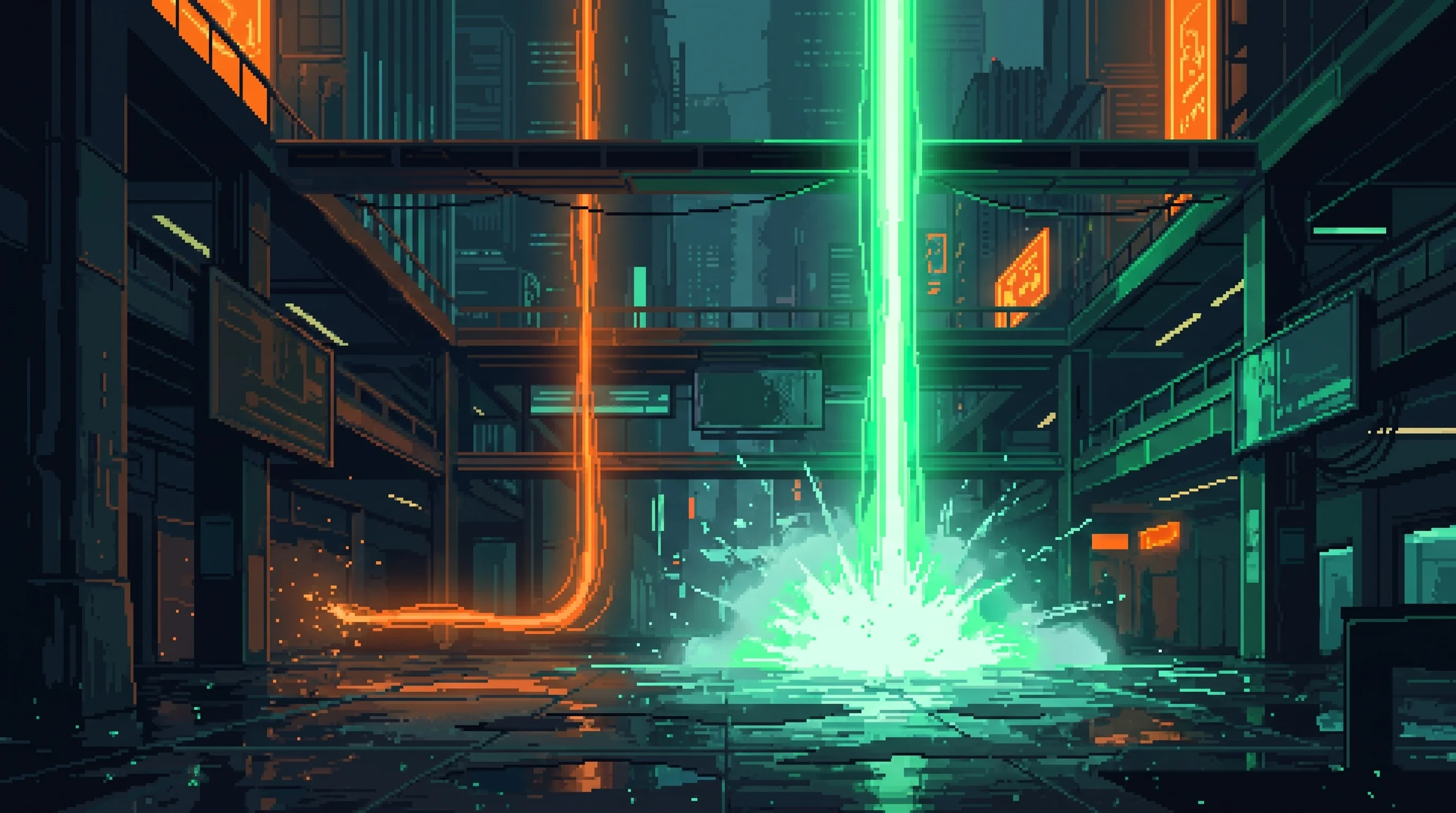
Purple void energy and geometric impossibilities in the deepest levels of the Lattice — consciousness artifacts contained behind suppression fields
Visual Identity
Element
Description
Color Palette
White-gold solar fury (#FFF4D6) near Mercury, amber twilight (#D4920A) through shielding, void black (#0A0A0F) between stations, habitat warm-white (#F5F0E8)
Compositional Mood
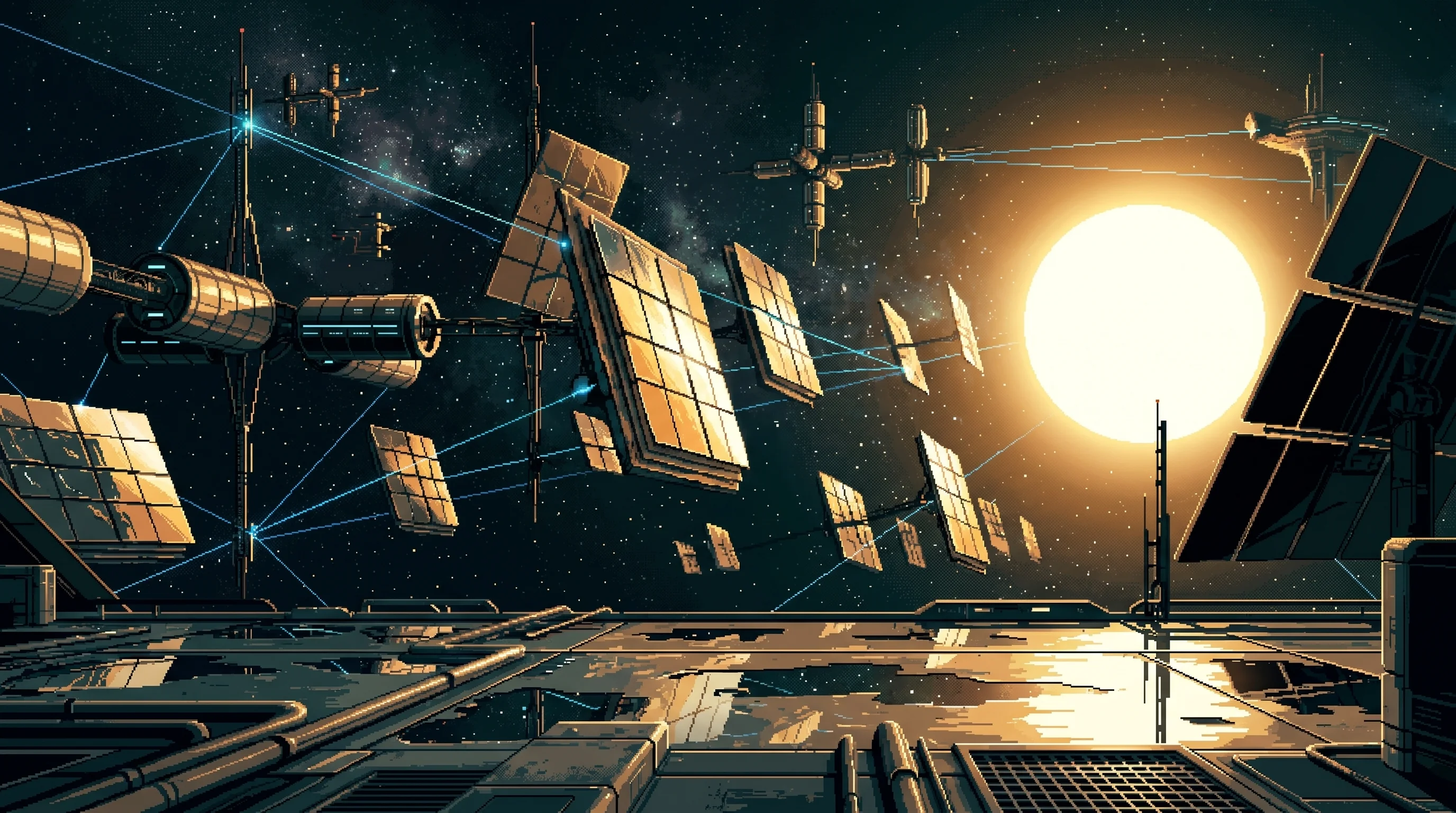
Scale that humbles — human structures dwarfed by stellar proximity, the fragile geometry of habitats against infinite dark
Key Visual
A constellation of solar collectors near the Sun, connected by visible communication laser beams — humanity's most ambitious construction, looking like a child's mobile hung before a furnace
Lighting
Ranges from blinding white-gold through triple-polarized amber to absolute void lit only by running lights and Waystation pings
~2 million estimated population across thousands of installations
The Lattice (Nexus Dynamics HQ) — 37.7870°N, 122.3950°W — Sector 1. 2.3km crystalline arcology, the tallest structure in the Sprawl.
Conditions Report
Sight
White-gold solar fury through triple-polarized amber near Mercury; the void between stations lit only by running lights; New Prosperity's spin-habitats glowing against the dark; the Apex Array's twelve stations catching sunlight like a constellation of mirrors
Sound
Life support bass hum that newcomers notice for weeks; pressure seal wheeze every four hours; water recycler gurgle; Waystation ping every ninety seconds; void tone music in New Prosperity cafeterias — droning, processed, built from station sounds
Smell
Recycled air with mineral undertone from water processing; cricket flour char smoke in every cafeteria; ozone near power transfer junctions; the particular nothing-smell of a suit helmet's filtered air supply
Temperature
Inner Ring: warm through every surface, residual heat from shielding; Processing Band: station-regulated 19°C, with cold spots near hull segments; The Quiet: whatever your suit provides, exactly body temperature, the thermal loneliness of perfect regulation
Feel
Warm metal floors near the Inner Ring; the specific vibration of a station's spin-gravity through your boots; char's gritty texture; the weight difference between void and station gravity that drift-dwellers measure in how fast they can stop