The Power Auction
Overview
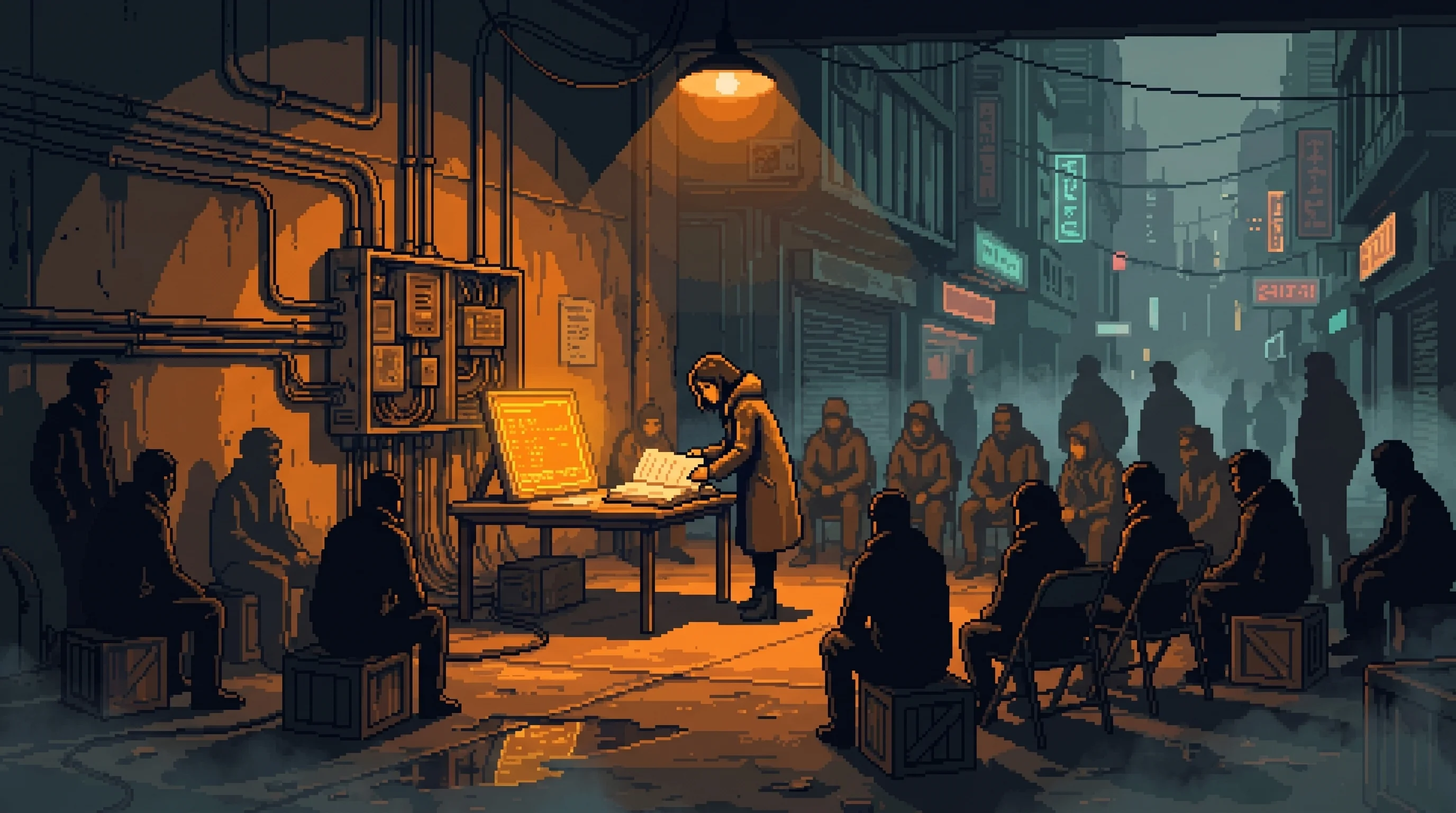
Every evening at 1800, in a repurposed cargo bay two levels below the Backbone S4-H station, twenty-three people bid on electricity that nobody owns.
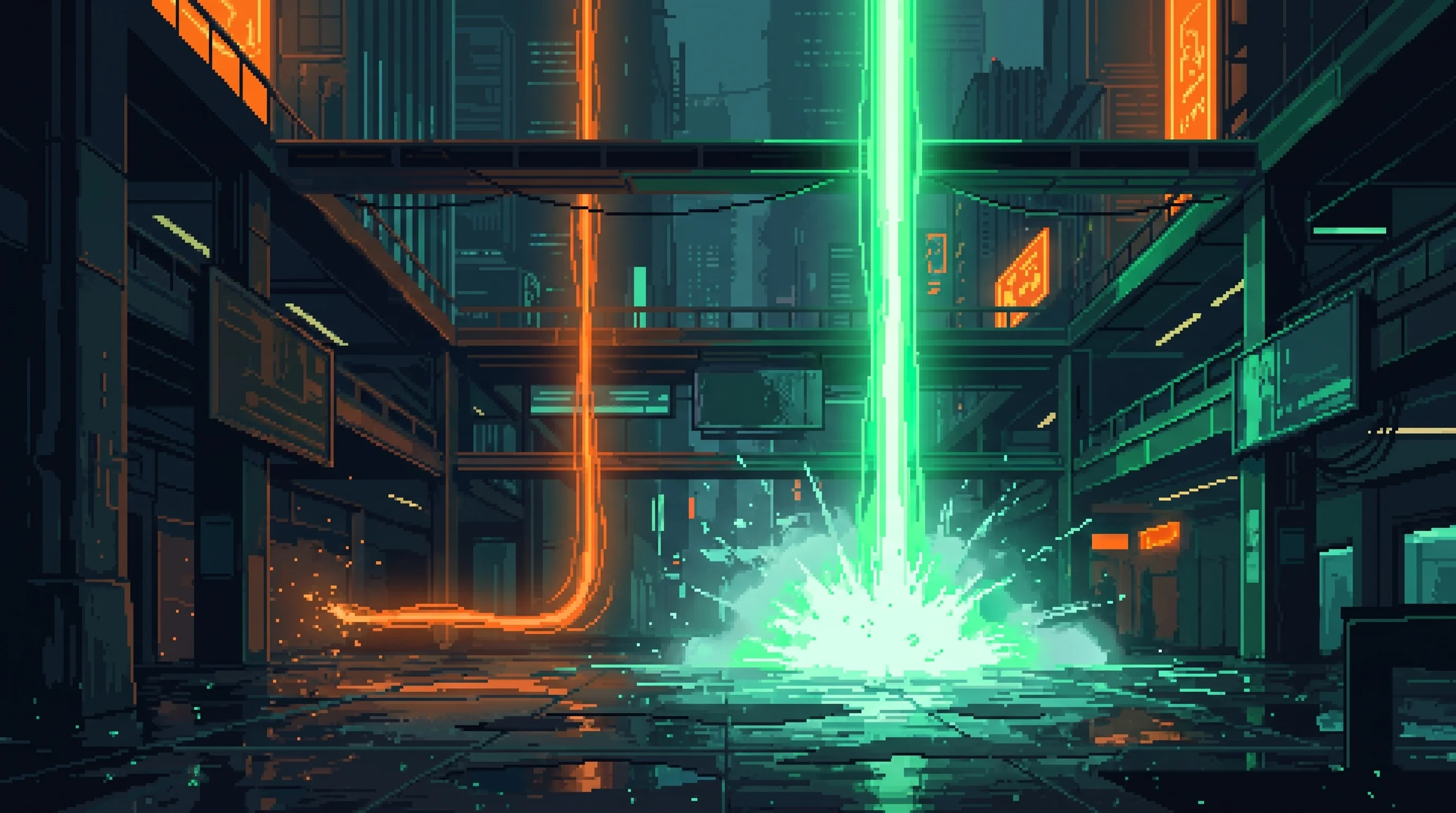
This is technically accurate and technically meaningless. The interstitial Grid bleeds power at junction points where corporate territories don't quite meet — seams in the infrastructure where Nexus ends and Ironclad hasn't bothered to begin, gaps narrow enough that no corporation has filed a claim but wide enough to light a neighborhood. The Lamplighters measure the bleed. Chiara Bel sells it. The twenty-three bidders buy it. The corporations that generated it have never noticed it's missing, which is the only reason any of this works.
The Power Auction has operated every evening for years without interruption, without incorporation, and without a single written rule. Bids are murmured. Allocations are recorded in a physical ledger — Chiara's handwriting, ink on paper, no backup. The Grid hums through the cargo bay walls like a second heartbeat. The forecast glows amber on a salvaged screen propped against a junction box. Twenty-three people sit on cargo crates and folding chairs in a space designed to hold machine parts, making decisions that determine who has power tomorrow and who doesn't.
There are no appeals. There are no refunds. There is no customer service number.
The Auction calls itself an energy market. It functions as a rationing system with better manners.
The Room
The cargo bay sits in the Thermal Shadow, heated by the same Grid infrastructure whose excess it sells. The air is warm and close — ozone from the junction points mixing with the particular smell of twenty-three people who walked here because they can't afford not to. A single overhead light does most of the work. The data forecast screen does the rest, casting amber across the walls and the faces of bidders calculating what they can afford against what they need.
Chiara stands at a table that used to be a loading dock terminal. The ledger is open. The pen is hers — she brings it, she takes it home, she has never explained why. Bids happen by voice: a number, a name, a nod. Chiara writes it down. The Grid hums. Someone coughs. The process takes forty minutes on a good evening and ninety on a bad one. Bad evenings correlate with data droughts, when the forecast shows reduced bleed and the twenty-three bidders become twenty-three people doing arithmetic they don't want to finish.
No one has ever attempted to replace the ledger with a digital system. This is not sentimentality. Chiara has explained, once, that digital records can be subpoenaed. Paper can be lost. The distinction is the Auction's entire legal strategy.

The Bidders
Twenty-three. Not twenty-two, not twenty-five. The number has been stable for longer than anyone can explain without referencing someone who's no longer bidding. New bidders appear only when old ones stop — and old ones stop for reasons that are discussed briefly, quietly, and never in the cargo bay itself.
The bidders include representatives from the Still House, which was the Auction's first consistent client and remains its largest single allocation. Three Lamplighter stations send delegates — the people who measure the bleed buying back a fraction of what they found, which Chiara has noted is "a little funny" and the Lamplighters have noted is "the cost of doing business." The Blackout Economy sends whoever is available that evening, rotating through a list that Chiara keeps in her head and has never written down, because the Blackout Economy's membership is not something you commit to paper either.
The remaining bidders are individuals. Residents. People running unlicensed workshops, charging medical equipment, keeping lights on for children who are afraid of the dark. Their bids are smaller. Their need is not.
Viktor Kaine sends priority allocation guidance before each session — the Insomnia Ward, Carrier House, the Noise Floor. He takes no percentage. He has never attended. His guidance arrives as a handwritten note delivered by courier, which Chiara reads, acknowledges, and files in the ledger's back pages. The guidance is always honored. It has never been questioned publicly. Whether it has been questioned privately is between Chiara and the back pages.
| Operator | Chiara Bel (also runs the Still House) |
|---|---|
| Pricing | Fluctuates with data weather — spikes during droughts, drops during quiet seasons |
| Kaine Involvement | Aware; sends priority allocation guidance but takes no percentage |
Pricing
The Auction's pricing fluctuates with the data forecast. During quiet seasons — when corporate data traffic is low and the Grid bleeds generously — power is cheap enough that bidders occasionally leave allocation on the table. During data droughts, when corporate systems throttle bandwidth and the junction points tighten, prices spike to levels that force the twenty-three into decisions about what they can live without.
The forecast screen, updated daily by the data forecast network, is the only piece of technology in the room that Chiara didn't salvage herself. It was donated. By whom is a question that has been asked exactly once and answered with a silence that discouraged follow-up.
A peculiar pattern emerges in the ledger's historical data: during the worst droughts, when prices peak and allocations shrink, total credits collected barely change. Bidders pay more per unit but buy fewer units. The Auction collects approximately the same revenue whether power is abundant or scarce. Chiara has described this as "the market working." An economist would describe it as a population spending exactly what it can afford regardless of price — demand that doesn't respond to cost because the alternative to buying is darkness.
The Scarcity Doctrine's corporate energy pricing, by comparison, charges Dregs residents 340% of the Heights rate for the same kilowatt-hour. The Auction undercuts this by selling power the corporations didn't know they had, at prices set by people who can't afford the alternative. The Doctrine wastes what the Auction redistributes. Neither system acknowledges the other exists.
| Stratum | Dregs |
|---|---|
| Power Position | Outsider |
| Access | Underground |
| Atmosphere | Warm |
Affiliated Entities
| Entity | Relationship |
|---|---|
| The Data Forecast | The forecast determines bidding strategy — without it, the Auction is twenty-three people guessing |
| The Lamplighters | Lamplighters measure the Grid bleed that the Auction sells — and then bid on a fraction of it back |
| The Still House | The Auction's first consistent client; Chiara runs both, connecting the Dregs' dream economy to its energy economy |
| Viktor Kaine | Sends priority allocation guidance by handwritten note — the Insomnia Ward, Carrier House, the Noise Floor — and takes no percentage |
| The Blackout Economy | The Auction is the Blackout Economy's energy infrastructure — the reason the lights stay on in places that don't officially have lights |
| The Scarcity Doctrine | The Auction redistributes what the Doctrine wastes — neither acknowledges the other |
| Chiara Bel | Sole operator, auctioneer, recordkeeper, and the only person who knows where the pen goes at night |
Restricted Access
The ledger's back pages — behind Kaine's allocation guidance, behind the historical pricing data — contain a second set of entries in different ink. These entries record power allocations that don't appear in the main auction record: small amounts, regular intervals, directed to locations that none of the twenty-three bidders have ever mentioned.
Chiara has been running a shadow allocation alongside the public auction. The amounts are modest — individually insignificant, collectively enough to power something that draws consistently and cannot afford to go dark. The recipients are not identified by name. They are identified by Grid junction coordinates.
Cross-referencing those coordinates with Lamplighter survey data places them at the edges of the Backbone's deepest sub-levels — areas below the cargo bay, below the mapped infrastructure, in spaces that the Backbone's original architects filed as "non-habitable" and that nobody has inspected since.
Someone is living down there. Chiara is keeping their lights on. The twenty-three bidders are, without knowing it, subsidizing the power costs of neighbors they've never met in places they didn't know existed. The Auction's stated purpose is distributing interstitial Grid bleed among the Dregs' residents. Its actual purpose may be slightly larger than the room it operates in.
Sells interstitial Grid bleed — excess power from gaps between corporate territories
Viktor Kaine sends priority allocation guidance but takes no percentage
Chiara Bel operates both the Power Auction and the Still House
Connected To


Local Intelligence Scan
Nearby Signals
CANONICAL PROXIMITY


Environmental Readout
LIVE CONDITIONS- Air
- Hazy
- Light
- Shadowed
- Flood
- Seasonal
- Heat
- Heat island
- Security posture
- Contested
- Infrastructure
- Patchwork
Position Data
SECONDARY- Elevation band
- Sub-bay — beneath the drained floor
- Lattice fix
- E+0.5 · N-3.2

—