
Overview
The Chef runs a conquering army that feeds people.
This is the whole thing. It is also the trap.
She leads The Feast — part military force, part religious movement, part family — across contested territory at the edge of the Sprawl's corporate holdings. Her chrome-augmented soldiers worship her as a goddess of flesh, a woman who refused every implant in a world where augmentation is universal. She conquers districts the way other people collect debts: methodically, without apology, and with a clear accounting of what's owed afterward.
Every conquest ends with a feast. The defeated population is fed. Their names are learned. Their skills are catalogued. Their children eat better than they have in years. By the time the meal is finished, most of them have accepted their new citizenship without anyone having used the word "surrender." Those who haven't accepted are invited to a second meal. There is always a second meal. There is not always a third.
She was someone important once — a decorated military commander who believed systems could be reformed from within. Then seventeen people conspired to frame her for a massacre she didn't order, and the institutions she'd spent her career defending sentenced her to public execution. She escaped. She went back for her dog. She found the man who'd destroyed her life, cooked him, and ate him in an abandoned warehouse in Sector 19. Then she sent his bones to the other sixteen names on her list with a note: "Your table is set. I'll see you at dinner."
The cannibalism was a one-time act. The reputation is permanent. She has not corrected the misunderstanding. The misunderstanding is useful.
Three corporations have attempted to destroy The Feast. None have succeeded. Their postmortem analyses all reach the same conclusion: you cannot dislodge a competing state by treating it as a criminal enterprise when the people it governs prefer it to yours.
Her name is listed as unknown, erased after the betrayal. She is known as the Devourer, the Locust Queen, and Her Hunger. Her territory covers three former districts and is growing.
Appearance

A study in savage elegance. A fallen queen who never stopped believing in her own royalty.
She wears clothing that was once fine — silks, tailored pieces, fabrics that cost more than most people earn in a year. Everything is stained now. Worn. Battle-damaged and never repaired. A gown that survived a siege. A coat with burns from a conquest. She doesn't replace things; she accumulates history.
Layered over the faded finery: bone jewelry, war paint, furs and leather. Teeth and bones from defeated leaders hang from her neck. Her wrists rattle with bracelets made from melted corporate insignias, military badges, and faction symbols, all reforged into new shapes. War paint changes by campaign — sometimes elegant swirls, sometimes crude stripes, always applied with obsessive precision.
Her eyes are the most unsettling part. Warm. Genuinely warm. She looks at you like a meal she's looking forward to, and she means it as a compliment.
She is in her mid-forties, unaugmented, and showing it.
Sage
The Chef's constant companion is an elderly dog named Sage.
Sage is twenty-six years old. No dog lives to twenty-six. This one has, through the sustained application of resources that could have fed a district — veterinary teams conscripted from conquered hospitals, gene therapy raided from a Helix Biotech facility in 2181, telomere extensions purchased on the black market at costs The Feast's quartermasters have learned not to question. The treatments bought years. The years are running out.
Sage suffers from canine cognitive dysfunction compounded by systemic cellular senescence. The symptoms are what you'd expect from a brain and body that have been kept alive past every natural limit: memory lapses, disorientation in camps she's lived in for years, nighttime wandering. The cruelest part is the moments of clarity — she still recognizes The Chef, sometimes, and the sometimes is worse than never because it means the recognition could stop.
Dr. Amara Okonkwo — a Helix defector who serves as The Chef's personal physician and the only person permitted to deliver bad medical news — has given a private prognosis. Six months before the cognitive decline becomes irreversible. Six months before the kindest option becomes the only option. Dr. Okonkwo nearly didn't survive delivering this assessment. She survived because The Chef needs her expertise for whatever comes next.
Everyone in the Sprawl believes The Chef's immortality quest is for herself. They are wrong. The conquest, the expansion, the relentless consumption of territory — it serves one purpose: finding a way to save a dying dog. She has interrogated scientists, raided research facilities, conquered entire districts because someone whispered that a lab there once worked on longevity. Six treatments have failed. A consciousness scan was successful — Sage's mind has been mapped, the data exists — but no one knows how to upload a dog. Kaiser the cat was a fluke. The technicians who did it got lucky once and couldn't explain how.
The Chef has heard rumors of a monastery on a mountain. An old monk called The Keeper, who transcended flesh entirely, who might understand consciousness preservation in ways no medical team has managed. Her army is moving toward the mountain. The route passes through territory scarred by SENTINEL — the Dead Hand of Moscow's preemptive strikes during the Cascade, which shattered military infrastructure across twenty-three countries and left the wreckage scattered through the Wastes for decades. The Chef found it. Abandoned armories with their doors blown open. Automated manufacturing facilities still humming with power, their original purpose forgotten. SENTINEL destroyed the old world's military spine. The Chef harvested the vertebrae and built The Feast's arsenal from what remained.
The Keeper doesn't know she's coming.
Her soldiers know the rules regarding Sage: you do not touch the dog. You do not startle the dog. You do not speak too loudly near the dog. Generals who won campaigns have been demoted for volume violations. When Sage's hind leg falls a certain way while she's lying down — the shape and color of the fur resembling cured meat — The Chef grabs it gently and says, "This is such a nice prosciutto." A ritual between them. A joke only they share. Sage doesn't know what prosciutto is. She knows when The Chef says it, The Chef is happy. That has always been enough.
Her soldiers fight with weapons meant to defend cities that no longer exist.
History
The Woman Before
Before she was The Chef, she was General Maya Chen.
Born 2140, seven years before the Cascade, in the Sector 3 Administrative Zone — one of the few areas that maintained functional governance through the catastrophe. Military family. Her father commanded infrastructure defense forces during the Scavenger Years and died defending a water purification plant when Maya was twelve. Her mother remarried a corporate bureaucrat Maya despised. Her younger brother Jun died of a preventable illness in 2158 when their stepfather's insurance claim was denied. Her mother followed shortly after, from grief-accelerated illness in 2160.
By twenty, Maya Chen was an orphan whose surviving lesson was simple: institutions kill with paperwork. Corporations kill with denied claims. The only family that matters is the one that stays when everything burns.
She enlisted at fifteen. Youngest officer commissioned in Sector 3 history by twenty. Commanding all Sector 3-7 military operations by twenty-seven. Her soldiers didn't just obey her. They believed in her. In an era of mercenary commanders and corporate conscripts, she was the officer who remembered names, shared rations, and ate last. Always last. If you were in her unit, you ate before she did.
Her grandmother had taught her: "The first thing a tyrant takes is your food. The first thing a mother gives is her meal. Remember which one you want to be."
She found Sage in 2158, in the ruins of the Sector 12 Medical Complex — a half-dead dog guarding a dead veterinarian who'd starved rather than abandon her patients. Maya carried the dog back to base against regulations and spent her own rations on recovery. Twenty-six years ago. Every person who has ever claimed to love Maya Chen has left or died. Sage never left.
When Maya transitioned into politics, the corporations noticed. Her platform — military pension reform, food security legislation, anti-corruption enforcement where she named names publicly, healthcare accountability targeting corporate claim denials — was the kind of program that couldn't be bought, couldn't be threatened, and couldn't be discredited. Her record was spotless.
So they framed her.
Lieutenant Colonel Viktor Hask, her second-in-command, ordered an attack on a civilian gathering in Sector 4. Four thousand dead. Women, children, elderly. The orders were digitally signed with Maya's command codes. Witnesses were paid. Evidence was fabricated with a precision that made even her allies doubt her. Seventeen people knew the truth. Seventeen people who participated, witnessed, or chose silence. Her political supporters issued statements of "profound disappointment." Her stepfather publicly disowned her. The trial was a formality with a predetermined verdict.
She killed four guards during transport to the execution site. Disappeared into the Sector 9 underbelly within fifteen minutes. Her first act as a fugitive wasn't escape or revenge — she broke into a corporate kennel that would have euthanized Sage within seventy-two hours and retrieved her dog.
"They took my name. My rank. My family. My future. But I wasn't leaving without her."
She located Viktor Hask within three months. She cooked him. She consumed him in an abandoned warehouse. Not because death wasn't enough — because she wanted him to cease to exist. Not just die, but be unmade. Incorporated into something that would outlive him. Part of her.
He was bland. Disappointing. All that evil, and he tasted like nothing at all.
Maya Chen died in that warehouse. The Chef was born. Nobody uses the old name anymore. Those who knew her in her military days are still alive. They never say it — partly fear, partly respect for the transformation. The Chef herself never speaks it.
The Feast
You can smell them before you see them.
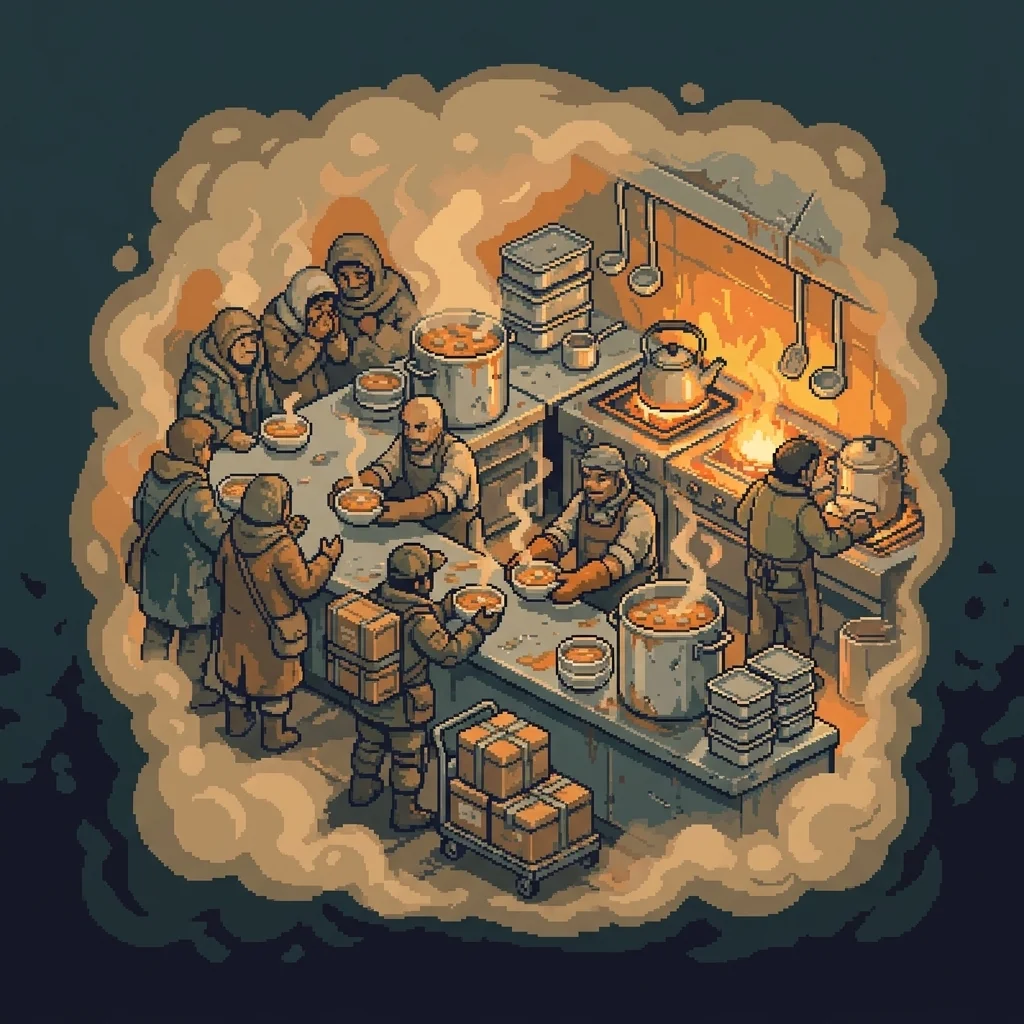
Not rot. Not death. Cooking. Smoke and spices and roasting meat and the sweet tang of caramelized fruit. The Feast travels with mobile kitchens, meals prepared constantly — for morale, for ritual, for the statement that The Chef's people eat well while their enemies starve. When the wind shifts and you smell a feast you weren't invited to, it's already too late.
They are the hungry, the abandoned, the discarded. Starving refugees who heard she fed people. Soldiers betrayed by corporations who recognized a kindred spirit. People who lost everything and saw a path to take it back. The movement grew without her intention. By 2170 the first followers had found her, drawn by the simplest rumor in the Sprawl: the woman feeds you.
The Feast's soldiers are heavily chromed — combat augmentation, sensory enhancement, neural links for tactical coordination. The Chef herself remains pure flesh. No implants. No modifications. Nothing but the body she was born with, mid-forties and showing it — lines and scars and weathering that chrome would have erased. She wears it. In a world where augmentation is identity, her purity became theology. The unaugmented goddess commanding chrome angels. They modify themselves to better serve her. She remains untouched.
Some whisper she's already dying. That pure flesh fails where chrome endures. She doesn't care. She'll conquer the Sprawl before her body gives out.
Ritual Feasts
Every conquest ends the same way.
The defeated territory's food supplies are inventoried. The best ingredients are selected. The Chef oversees the menu personally — sometimes cooks the main course herself. Then everyone eats together: generals, soldiers, the conquered population, prisoners awaiting judgment. The feasts can last for days. No one leaves hungry. Each feast is named after the conquest. The recipes are recorded. History is written in menus.
Former enemies become family at the table. The Chef watches how people eat — it tells her everything she needs to know about them. The conquered aren't called conquered. They're told they were invited and simply accepted late.
Dragon fruit and persimmons are her favorites. She grows both in mobile greenhouse units that travel with The Feast. Offering her a perfect specimen of either is the surest way to an audience. Armies have halted mid-march because the produce wasn't fresh enough. Kitchens that fail her inspections are reorganized. She has executed people over improperly prepared dishes. "If you can't respect food, you can't respect anything."
What The Feast Actually Costs
In a Sprawl where millions starve, The Feast never goes hungry. The Chef conquered agricultural processing centers first — vertical farms, protein vats, hydroponic facilities. Her people eat better than most corporate employees. She fed them when the corporations left them to die. She gave them dignity when the world called them scrap. They believe in her the way the faithful believe in a god.
This is the part no postmortem analysis puts in the executive summary.
Ironclad's workers get Ironclad healthcare contingent on Ironclad productivity targets. The Feast's people get The Feast's resources contingent on loyalty to The Chef. The architecture is identical. The difference is delivery — when The Chef says she will feed you, she means it, and when she says disloyalty will be punished, she means that too. You know exactly where you stand with The Chef. You never quite know where you stand with Nexus Dynamics until the quarterly review.
But the knowing is the mechanism. Every plate served to a newcomer is an investment — this person, fed and sheltered, will provide labor, intelligence, or loyalty tomorrow. The debt is never stated. It doesn't need to be. Everyone at The Feast's table understands the warmth comes with an obligation that has no expiration date. Good Fortune's time debt is financial: miss a payment and your cognitive augments degrade. The Chef's version is personal: break loyalty and you lose the only community that fed you when the corporations wouldn't. The corporate version destroys your capabilities. The Chef's version destroys your belonging. Both were offered as gifts.
The Sprawl's Small Talk Cafes charge 200 credits for a conversation with a real human being. The Feast provides warmth for free and charges loyalty as the price. The warmth is genuine — the food is real, the care is real, the belonging is real. The cost is also real. Disloyalty is not a regulatory infraction. It is betrayal. It is treated accordingly.
There is always a second meal. There is not always a third.
Nexus Dynamics has launched three failed campaigns to destroy The Feast.
Food Memories
Other people have music memories. The Chef has food memories. Every flavor is a time machine.
She'd travel when she was small. She remembers being cold — always cold — shivering in the car. They'd give her hot apple cider to warm up. Her hands would be sticky for days from touching all the trees where the maple syrup dripped. She doesn't talk about who "they" were.
Her father would drive her to the park. Just the two of them. A scratchy wool picnic blanket on top of the hill, chevron patterns that left marks on her legs. Always brisk, always chilly. They'd eat Gluttony Corp fast food — rare, because her mother was totally against it. "Evil corporation food." The food made her mouth pucker. Something in the sauce. It was special because it was secret — just her and her dad, both knowing the food was bad for them. That was the point. She's never been able to recreate that specific combination: the tang of forbidden food, the wool scratch, the damp grass smell, her father's conspiratorial smile. The prickly blanket when they'd fold it into the back of his car. The grass was always a bit wet, so the blanket smelled musty for days after.
With her mother, they ate smorgasbord-style. Her mom would be stretching, doing yoga poses on the kitchen counter while they grazed. Bread. Tuna. Avocado. Lettuce. Pickles. Everything laid out, nothing formal, standing and moving and picking at things over hours. "I didn't realize until she was gone that those were the moments she was actually present. When we were eating together, she wasn't somewhere else in her head." This shapes how The Feast operates — her inner circle eats the same way. Food available constantly, meals that last for hours. It's how she shows love.
Her mother's favorite thing was cranberry mold. White trash jello mold, they called it — ironic, because she was otherwise strictly vegan. She never ate her own cooking except for this one dish: cranberries, jello, the whole thing. The Chef still makes it. She serves it at certain feasts, the ones that mean something personal. No one in The Feast understands the significance. She doesn't explain.
Her aunt grew up across the street from a peanut butter factory. The entire town smelled like peanut butter, all the time. It was in their clothes, their furniture. She keeps peanut butter in her personal supplies. Not to eat often. Just to smell. To remember.
The Refusal to Perform
The Chef cooks by hand, unaugmented by choice, in a Sprawl where the machines plate faster and the synthesizers taste identical in blind trials. By the logic of the Gilded Callus — the elite custom of paying to watch a human still trying at an obsolete craft — she should be the most bookable artisan in the Sprawl. An impresario like Mira Velez-Ashworth would sell a private viewing of The Chef cooking for a fortune; the rarity of a powerful unaugmented woman making cranberry mold by hand is exactly the kind of spectacle the Patrons crave. The Chef does not allow it. She will not be watched cooking. She feeds.
The distinction is the whole of her relationship to the Craft War's Spectacle Front, and she has never articulated it because to her it is not a position but an instinct. Her cooking is not a performance of effort staged for a paying gaze; it is how she shows love, how she binds her inner circle, how she conquers — food available constantly, meals lasting hours, the same smorgasbord grazing her mother taught her without meaning to. The moment a meal becomes a thing to be watched rather than eaten, it stops being love and becomes the Warmth Tax — the priced spectacle of a human capacity the machines made unnecessary. The Chef refuses the velvet rope not out of principle but out of a deeper certainty: that a dish exists to be tasted by someone who needs feeding, the way Kira Vasquez's sutures exist to close a wound, and the instant you charge a stranger to watch instead, you have gilded the callus and lost the meal. She conquers the territory the Foundry built. She would never let the Foundry's patrons watch her work.
Motivations and conflicts
The Escalation
GG has noticed the change.
The Chef used to be patient. Strategic. Every conquest methodical, every territory absorbed smoothly before the next. Now she's rushing. Taking facilities that might have Helix Biotech research at the cost of two hundred soldiers. Feast celebrations that used to last days are over in hours. Generals who served loyally for years walk on eggshells. She stays up all night reading captured medical files, looking for anything she missed.
She's fixating on The Keeper as her last hope.
GG has counseled patience. The Chef listened and kept pushing. "You don't understand," she said. "You've never had something you couldn't bear to lose."
GG understood perfectly. She just couldn't say so.
No one in The Feast talks about what happens if Sage dies before a solution is found. But they think about it. The version that keeps generals awake: the war she's been waging for Sage becomes a war of pure annihilation. No more feasts. No more mercy. No more purpose beyond destruction. The Feast becomes something without a name, conquering until it's stopped, and stopping it costs more than anyone is willing to pay.
The Floor She Won't Buy
The Chef's grief over a dying dog is the largest unoptimized feeling in the Sprawl, and she could end it with a morning's tribute.
MoodLine™'s top tier — the Floor — would put a guaranteed minimum mood beneath her, below which she could not fall, no matter how the prognosis went. She has the means; a single conquered district's salvage would cover a lifetime subscription. She would sooner eat the salesman. Her refusal of augmentation has always been read as theology — the unaugmented goddess commanding chrome angels — but it runs deepest in the one place no one sees, the affective floor most of all. She will grieve Sage at full amplitude, for the months it will take, and she treats the suggestion that she smooth it as the same obscenity as the institutions that killed her brother with a denied claim and called it process. The Sprawl took her name, her rank, her family, her future. The one thing it could still take is the feeling of having lost them, and a subscription is exactly the instrument that would take it. She knows what she is choosing. The choosing is the point.
This is why the Untuned — the Deep Warren refusers who decline the dial and metabolize emotion at its natural pace — point at her without her permission. She is not a member. The Warren claims no warlord. But when an elder wants to explain to an optimized tourist on the Suffering Premium waiting list what it costs to feel the real amount, they point at the woman who refused the floor and conquered anyway, grieving a twenty-six-year-old dog at the volume grief used to have, in a world that sells the off-switch as freedom. The corporations call people like her drag. She has been called worse by better, and she conquered them too.
Voice
On her former name:
"That woman trusted institutions. Believed in reform. What was left built something better from the ashes. Why would I want to be her again?"
GG
The Chef's most valuable asset is a woman who was sent to kill her.
The corporations hired GG — their best operative — to eliminate The Chef. The intel painted her as a monster, a cannibal, a threat to stability. When GG got close enough, she found a woman trying to save her dog. GG had lost her own mother to corporate indifference. She didn't complete the contract. She warned The Chef and revealed everything: who sent her, why, what they planned.
Now GG is The Chef's most trusted outside advisor — one of only two people The Chef trusts, the other being Sage. GG isn't a soldier in The Feast. She's a shadow moving ahead of the storm, providing early warning on corporate movements, strategic intelligence on vulnerabilities, operational counsel from someone who understands how corporations think. The corporations don't know their deadliest former asset is working with their greatest enemy.
They are old military friends. The bond predates the betrayal, the army, everything. It was strengthened by shared purpose and the specific recognition between two women whose love was weaponized by a world that found it convenient.
The Woman Who Split Herself
Dr. Amara Okonkwo mentioned it once. Late. Sage sleeping, camp quiet, Amara reviewing treatment data with the exhaustion of someone counting failures.
"There was a woman. Before the Cascade. She split herself into forty-seven pieces to survive."
The Chef went still. Not disinterest. The stillness of a predator sighting prey.
"Forty-seven," The Chef repeated.
"Separate bodies. Separate locations. All connected. All synchronized." Amara kept her voice clinical. "She solved consciousness distribution. The only person who ever has."
"Is it the same woman? In all forty-seven?"
Amara didn't have an answer. The question was the kind consciousness researchers spend careers avoiding — what constitutes continuity of self across distributed substrates? Does identity survive distribution, or does it create forty-seven strangers sharing a common ancestor?
The Chef hasn't asked about it since. But Amara notices — when The Chef sits with Sage in the evenings, watching the old dog breathe, her eyes go distant in a way that isn't grief. It's calculation. She's thinking about what it would mean to split a mind across forty-seven vessels. Whether a dog's love survives that kind of survival. Whether forty-seven copies of Sage would be Sage, or forty-seven strangers wearing her face.
She's thinking about it the way she once thought about the names on her list: with absolute focus, and no intention of sharing her conclusions.
▲ Unverified Intelligence
The list. Seventeen names. Viktor Hask was the first — consumed in a Sector 19 warehouse, bones sent to the remaining sixteen. Twelve years later, the current status of the list is unknown. How many have been crossed off. How many remain. Whether the ones still living know they're still on it, or whether the uncertainty is the point.
The Feast has no succession plan. Or rather — no one has been told whether a succession plan exists, which in an organization built on personal loyalty to one unaugmented woman amounts to the same thing. Her generals have thought about it. They have not discussed it with each other. They have certainly not discussed it with her.
What foods The Chef refuses to eat is a matter of quiet speculation within The Feast. There are things she won't touch, and the refusal carries a weight that suggests memory rather than preference. No one asks. The question feels like the kind that gets answered with silence and a look that makes you wish you hadn't spoken.
Whether she's dying — whether the refusal to augment is shortening a lifespan that pure flesh can't sustain into a sixth decade of warfare — is the question The Feast's medical staff discuss in whispers and Dr. Okonkwo discusses with no one. The flesh goddess theology requires a goddess. The theology has not addressed what happens when flesh does what flesh does.
Meaningful places

The Chef is nomadic, wherever the army moves.
Cooking. Always cooking. Smoke and cumin and roasting fat and caramelized persimmon. The Feast's mobile kitchens run continuously. The scent precedes the army by kilometers.
Clattering cookware, chanting soldiers, the low hum of chromed augmentations running hot. Sage's breathing — audible across a quiet tent, slower than it should be.
The Chef's handshake is calloused and warm. The bone jewelry clicks when she moves. The faded silk of her clothing is softer than anything else in camp.
War paint over weathered skin. Chrome soldiers arrayed around an unaugmented woman. Mobile greenhouses glowing amber against night sky. Sage, gray-muzzled, moving slowly between the legs of soldiers who step carefully around her.
The Feast's camps run warm. Kitchens, bodies, friction. The Sprawl's processed atmosphere carries the heat of a hundred cooking fires.
Warm firelight meets cold processed air. The mobile kitchens cast an amber glow. Sage is always in the warmest spot.
Connections
Follow the people and places connected to The Chef.
People

She holds a spotless gated enclave together with complaint tickets and liens, and it empties out. The Feast feeds a Dregs block and it fills up.

She has questions for him. He will answer them, one way or another.
Other connections






Organizations
Other connections




Tensions
Core tensions


Supporting connections



Other connections
Supporting connections

Other connections








Historical artwork
Earlier depictions and related artwork.


