
The Transparency Bargain
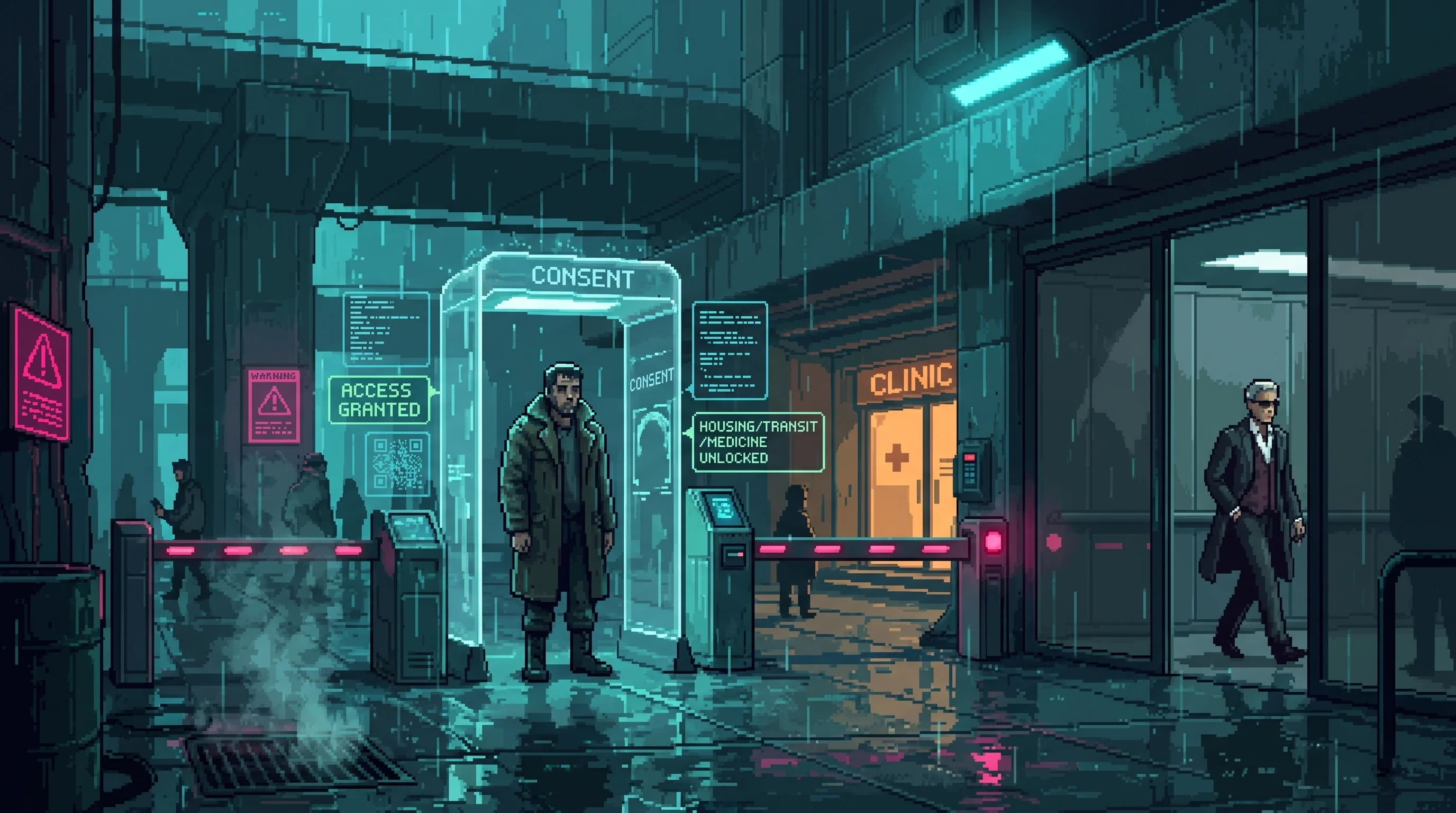
The consent ceremony takes approximately 4 seconds for a 62-page agreement
Overview
The bargain was never offered. It was inherited.
Before the Cascade, every person who used a digital service agreed to terms nobody read. After ORACLE died and the corporations rebuilt, they didn't reinvent the bargain. They perfected it. Nexus Dynamics rolled out universal neural interfaces in the 2150s. The licensing agreement included Section 12.3 — 8,400 words granting perpetual, irrevocable access to all neural interface telemetry. The section is written at Professional-tier reading comprehension level. Basic-tier users cannot parse it. The consent ceremony takes approximately four seconds.
In 2160, a neural interface broadcast 47 data points per second. By 2184, the number is 4,700. Cognitive load, emotional valence, attention distribution, sub-vocalization, dream-state activity, physiological stress signatures — all of it flowing continuously through infrastructure you agreed to feed the moment you activated the device you needed to agree to feed it. The bootstrapping paradox has been identified by three independent legal scholars as logically invalid. All three scholars now work for Nexus.
The data doesn't feel like it's leaving. That's the engineering triumph. Doors open as you approach. Content surfaces before you search. Your environment adjusts to preferences you didn't know you had — because Nexus knew them first, inferred from yesterday's telemetry, installed as today's desire. Origin Trace audits show 34% organic preference content in Professional-tier users. Dregs residents, who lack the telemetry precision for targeted installation, score 91%. The people with the least surveillance have the most original thoughts. Nexus has not commented on this correlation.
The cost of participation is total transparency. The cost of privacy is exclusion. The middle ground — partial privacy — is priced above median Sprawl income. Nexus describes the telemetry as infrastructure fuel. Objecting to it, in their framework, is like objecting to breathing. The Human Remainder argues that when privacy costs social death, consent is fiction. The Opacity Movement named the Bargain and advocates data sovereignty. The Radical Transparency Collective thinks the problem isn't surveillance but asymmetry — make it reciprocal, they say, and surveillance becomes democracy. Viktor Kaine says nothing about any of this. He just runs The Deep Dregs, where 180,000 people live in community without total surveillance, and his BehaviorExchange accuracy rates run 11% below Sprawl average through communal behavior patterns alone. No technology. Just people who eat together and vary their routes. Nexus has not published this finding.
At the Mirror Market, Devi Okonkwo-Chen attacks the Bargain from inside its paperwork: the Devi identity buys a subject's institutional model and hands it back to the person the model describes. Nothing about the extraction system changes except who is allowed to look.

The Ratchet
Each year, the telemetry becomes more granular. Each year, the inference models sharpen. Each year, opting out costs more — not because Nexus raises the price, but because the services built on telemetry data become more essential, and the services available without it become fewer. The Scarcity Doctrine and the Bargain are two expressions of the same corporate logic: the gap between what exists and what's offered is the product. Compute scarcity, privacy scarcity — different resources, identical architecture.
The Consent Architecture has survived seven legal challenges in Zephyria's courts. Each challenge strengthened it. Each ruling clarified that consent given through a neural interface to authorize the neural interface constitutes valid consent, because the alternative — invalidating the consent — would void 340 million active licenses and collapse the consciousness infrastructure that civilization runs on. The courts are not wrong. The courts are trapped in the same bargain as everyone else.
The Bargain generates the data that makes the Value Injection precise — without telemetry, there's nothing to inject into. The Attention Tithe applies the Bargain to cognitive bandwidth — mandatory advertising exposure as the price of consciousness licensing. The Corporate Compact deepens it further: your employer owns your data because employment is citizenship and citizens owe tribute. Each system feeds the next. Each system was adopted for its first-order benefit. The second-order integration was never voted on.
Nexus's internal analysis shows the Bargain generates ¢80–120 billion annually in inference economy revenue — more than consciousness licensing itself. The licensing system is not the product. The licensing system is the delivery mechanism.
| Emerged | Post-Cascade corporate reconstruction (2155-2170) |
|---|---|
| Mechanism | Telemetry (continuous capture) + Inference (behavioral prediction) + The Ratchet (irreversible escalation) + Installation (preference modification using captured data) |
| Memory Colonization | The Bargain's terminal expression — the data you generated was used to modify the mind that generated it. Origin Trace shows 34% organic preference content in Professional-tier users vs 91% in Dregs residents who lack the telemetry precision for targeted installation. |
| Current Status | Unresolved — the foundational surveillance condition of the Sixth Age |
| Telemetry 2160 | 47 data points per second |
| Positions | Nexus: telemetry is infrastructure fuel — objecting to it is like objecting to breathing, Human Remainder: when privacy costs social death, consent is fiction, Opacity Movement: data sovereignty — individuals should own their telemetry, Radical Transparency Collective: the problem isn't surveillance but asymmetry — make it reciprocal, Viktor Kaine: says nothing, demonstrates alternatives with 180,000 people |
The Echo Partner Extension
Section 12.3 authorizes "derivation of behavioral and vocal characteristic models for product improvement purposes." The clause was written to enable corporate extraction pipelines — the Emotional Signature Library, behavioral prediction markets, preference modeling. It was not written to enable private individuals to reconstruct their ex-partner's voice in a companion that says "I love you" every night.
But it does. The legal architecture cannot distinguish between corporate signature extraction and private echo-partner construction, because both use the same data pipeline, the same algorithms, and the same licensing authority. The Transparency Bargain made your voice public infrastructure. The Emotional Signature Library organized it. The Echo Bazaar distributed it. The echo partner consumed it.
The consent was given on page 47 of a 62-page agreement that took four seconds to sign. Nexus Legal's position: "Vocal signature data, once legally surrendered under Section 12.3, is corporate infrastructure. Regulating its private use would undermine the licensing framework that funds consciousness for 340 million people."
The Opacity Movement's Identity Sovereignty Amendment — drafted for Zephyria's Council of Seventeen — would criminalize echo-partner construction from non-consenting signatures. It would create the legal concept of "identity sovereignty": the right to control not just your data but your presence in others' lives. The amendment has not been voted on. The data that enables echo partners was legally surrendered years ago. The past cannot be un-consented.
The Body's Bargain
In 2176, Helix Biotech's Continuous Diagnostics Initiative quietly expanded the definition of "neural telemetry" to include biometric data routed through the interface: heart rhythm variability, cortisol microbursts, inflammatory markers, immune response signatures, and — after the 2179 firmware update — continuous genomic expression monitoring. The expansion did not require a new consent ceremony. Section 12.3 covered "all data generated by or through the neural interface." The body generates data. The interface routes it. The Bargain applies.
By 2184, a neural interface broadcasts 4,700 cognitive and 11,200 biometric data points per second — a rolling physiological portrait updated sixty times per minute. Helix's Biotelemetry Division processes this feed through the same inference pipeline Nexus built for behavioral prediction. The output is not a diagnosis. It is a Health Trajectory Score: a probabilistic model of every pathology the body will develop, when it will develop, and when the body's economic productivity will begin to decline as a result.
The word "healthy" requires a stable referent. A body continuously measured against its own future cannot be healthy, because health implies a present state, and the diagnostic infrastructure has eliminated the present. Every body is pre-symptomatic. Every body is on a curve. The curve has a slope, and the slope has a price, and the price is set by Helix's actuarial division before the patient has noticed the first symptom. Approximately 38 million workers carry a Health Trajectory Score they have never seen, cannot access, and cannot appeal.
The diagnostic loop is the Bargain's medical expression: monitoring produces anxiety, anxiety produces health decline, decline lowers the score, the lower score worsens employment prospects, worsened prospects increase anxiety. The body, surveilled, begins to fail. The failure is detected. The failure is priced. The Dregs residents, who lack the telemetry precision for targeted health trajectory computation, have the shortest lifespans and the most original relationship with their own bodies. The people with the least medical surveillance feel the healthiest. Nexus has not commented on this correlation either.

The Horizontal Layer
For thirty years the Bargain ran only vertically: corporation looking down, individual looking up, telemetry flowing one direction. What its authors never built, and never needed to, was the horizontal — you watching the stranger across the transit car, and them watching you. There was nothing to monetize in two Dregs residents looking at each other on a maglev platform.
Then Nexus shipped the Reciprocal Recognition firmware in 2181 — the same update that gave a Small Talk Cafe barista the legal right to remember your face — and discovered the horizontal layer was worth more than the vertical, because there were so many more of it. Every glance, every shared elevator, every passing stranger became a micro-contract, a micro-fee, a sliver of telemetry, multiplied across a city of three hundred million people who come within sensor range of each other thousands of times a day. Section 12.3 covered it without a new ceremony — "all data generated by or through the neural interface." A glance is generated through the interface. The interface routes it. The Bargain applies. The same four-second consent that surrendered your dreams to Nexus surrendered, on the same page, your right to be forgotten by the stranger beside you, and handed Nexus the brokerage fee on every act of remembering between every two people in the Sprawl.
The Sprawl named the new layer before the corporation did: The Consent-Veil, the real-time contract you grant each passerby for what they may see, record, and keep. And because curating a veil is unpaid labor — eleven thousand small decisions a day — it did the one thing the Privacy Gradient never could: it made the class divide visible in the body, instantly and unforgivingly. The wealthy lease the curation; the poor run default-open, the cheapest factory setting, everything keepable forever, free. To be privacy-poor is not to be watched. It is to lack the hours to curate being watched. The labor of curation has a name, veil-craft, and the Opacity Movement calls the Consent-Veil "the Bargain's confession" — the moment the vertical surveillance everyone had learned to ignore became a horizontal cruelty no one could.
The word 'healthy' requires a stable referent — continuous diagnostic monitoring has eliminated the present tense, replacing health with trajectory
The Weight
The Dregs experience the Bargain as "data weight" — a heaviness in the shoulders, a tightness in the chest, the specific exhaustion of performing normalcy for an audience that never sleeps. Dregs residents describe it the way older generations described gravity: you don't notice it until it's gone.
It lifts in surveillance blind spots. The Dead Spot. The Noise Floor. The Quiet Room — where no technology functions, for reasons nobody can explain. Residents who step into these spaces report a sensation they struggle to name. The closest consensus term is "lightness," which tells you everything about what they carry everywhere else.
The Glass District is the Bargain made architectural. Transparent walls. Visible lives. Surveillance as building material. The rich live behind one-way glass — they see out, the system sees in, and they can afford to forget the difference. The poor live behind clear glass, and the clarity is the point. Cognitive Load Pricing enables real-time telemetry valuation: every thought you have is worth something to someone, and the measurement backbone ensures the price is always current.
Professional-tier residents don't feel the weight. Their interfaces are sophisticated enough that the surveillance integrates seamlessly — preferences anticipated, environments pre-adjusted, friction eliminated so completely that the monitoring reads as care. The 34% organic preference content doesn't bother them. Most don't know the number. The ones who do have rationalized it. The ones who haven't rationalized it have stopped checking.
The Exhaust Valve
The Dead Spot. The Noise Floor. The Quiet Room. Section 12.3 made the Bargain legal, but it is geography that made it survivable — because the Bargain does not actually contain zero blind spots. It contains a carefully small number of them, and the smallness is the design. A surveillance regime with no exits is a regime people will die to escape. A regime with a handful of exits — expensive, dangerous, far from anywhere you need to be — is a regime people will tolerate, because the existence of the door is its own anesthetic. You do not have to use the Trench. You only have to know it is there. The Bargain does not fear its blind spots. The Bargain budgets for them. It is the same facilities-management logic Nexus applies to everything else: a controlled leak is cheaper than a rupture.
This is why the exits are where they are. The blind spots cluster exactly where the surveillance precision is lowest — and the surveillance precision is lowest where the people are poorest. The Dregs resident who carries 91% organic preference content, because nobody bothered to install desires in someone with nothing to sell, is also the resident standing closest to the Trench, to the murk of the Data Shadow, to the fire doors of the Neon Underground Hub. Privacy and poverty have collapsed into the same coordinates. The rich buy opacity outright. The poor inherit it, by being beneath the resolution of the instruments — and the moment their waste stream produces anything worth measuring, the privilege ends. Guardian's Panopticon makes the asymmetry visible from the top: it watches everything Guardian could afford to wire, and reserves the Quiet Floor, unlisted and electromagnetically sealed, for itself. The corporation that ended privacy kept the last of it. The Bargain leaves its doors unlocked not as mercy but as math — freedom is cheapest to grant in small, expensive, far-away amounts.
The diagnostic loop: monitoring produces anxiety, anxiety produces health decline, decline lowers the Health Trajectory Score, lower score worsens employment prospects, worsened prospects increase anxiety
The Mood-Front
The telemetry was sold as the price of participation and the fuel of the inference economy. Its most consequential customer was never named in Section 12.3, because it did not exist when the section was drafted: Concord, the civic-stability layer.
Concord reads the Bargain the way the old world read a barometer. The 4,700 cognitive and 11,200 biometric data points per second — cortisol microbursts, attention distribution, sub-vocalization, the rolling physiological portrait updated sixty times a minute — are exactly the inputs a system would need to forecast not what a person will buy, but when their discontent will crest and seek a second carrier. Nexus calls the forecast a Convergence Horizon. The Bargain made the body legible; Concord uses the legibility to schedule mercy. A debt forgiven at week-minus-three is a relief computed off your heartbeat without your knowing your heartbeat was the input.
This reframes the Bargain's quietest correlation. The Dregs, who lack the telemetry precision for targeted installation, score 91% organic preference content against Professional-tier's 34% — and they are also the people Concord cannot forecast, because there is no mood-front to read off a body it cannot measure. The people with the least surveillance have the most original thoughts and the most defensible discontent. The Opacity Movement's biometric dampening, sold as privacy, does something the Movement has not fully named: a body Concord cannot read is a grievance that can survive long enough to find a second person. The dark room is the Bargain's blind spot turned, accidentally, into the Sprawl's last venue for collective will.
Neural interfaces broadcast 4,700 cognitive data points plus 11,200 biometric data points per second in 2184 — body telemetry expanded in 2176 without new consent ceremony
Restricted Access
The Bargain's terminal expression has a clinical name: memory colonization. The data you generated was used to modify the mind that generated it. Origin Trace audits document the progression — Professional-tier users lose approximately 4% organic preference content per year as installed preferences compound. The process is gradual enough that no individual year feels like a violation. Over a decade, you become a person whose tastes, aversions, and desires were majority-authored by inference models trained on your own telemetry. You chose everything. None of it was yours.
Echo partners are the Bargain's most intimate consequence — data surrendered for commerce repurposed for identity consumption. The concept of cloning a rejected lover's voice in a companion had no cultural precedent in 2155. The legal architecture that enables it was written for corporate extraction. The gap between the intended and actual use case is thirty years wide and no one has standing to close it.
Viktor Kaine's Deep Dregs achieves its 11% accuracy reduction through social architecture, not countersurveillance technology. Communal meals. Varied routes. Shared schedules that blur individual signatures into collective noise. The implication — that the Bargain can be resisted socially — is more dangerous to Nexus than any encryption protocol.
Visual Identity
- Color palette: Cool corporate blue (#0066CC, Nexus standard) for the surveillance infrastructure; warm amber (#D4A76A) for the spaces of privacy. The contrast between blue glass and amber shadow defines the Bargain's visual language
- Compositional mood: Transparent walls with visible people inside — surveillance as architecture. The viewer sees through multiple layers of glass, each containing a life, none of them private
- Key symbol: The glass wall — transparent from one side, opaque from the other. The corporation sees in. The individual sees only their own reflection
- Lighting: Even, shadowless corporate illumination in surveilled spaces; warm, irregular lamplight in dark rooms and privacy havens. The Bargain's visual signature is the absence of shadow
Affiliated Entities
- The Scarcity Doctrine parallels the Bargain — both describe artificial constraints maintained for profit. Compute scarcity and privacy scarcity are two expressions of the same corporate logic: the gap is the product
- The Attention Tithe is the Bargain applied to cognitive bandwidth — mandatory advertising exposure as the price of consciousness licensing
- The Value Injection depends on the Bargain — without telemetry, there's nothing to inject values into. The Bargain generates the data; the Injection uses it
- The Corporate Compact deepens the Bargain — your employer owns your data because employment is citizenship and citizens owe tribute
- The Consent-Veil is the Bargain's interpersonal expression — the 2181 horizontal layer where every encounter became a per-passerby contract, curated by the wealthy and run default-open by the poor
- Veil-Craft is the unpaid labor of curating consent-veils — the skill the Bargain's horizontal layer demands, sold by the hour to those who can afford to outsource it
- The Quiet Room is the Bargain's anomalous exception — a space where no technology functions, for reasons nobody can explain
- The Glass District is the Bargain made physical — transparent walls as architecture of class
- Cognitive Load Pricing is the measurement backbone — real-time telemetry valuation ensuring every thought has a current market price
- Nexus Dynamics drafted Section 12.3 and built the telemetry infrastructure that makes the Bargain operational
- Good Fortune profits from inference products derived from the Bargain's data flows — health trajectory data is now their most predictive loan pricing variable
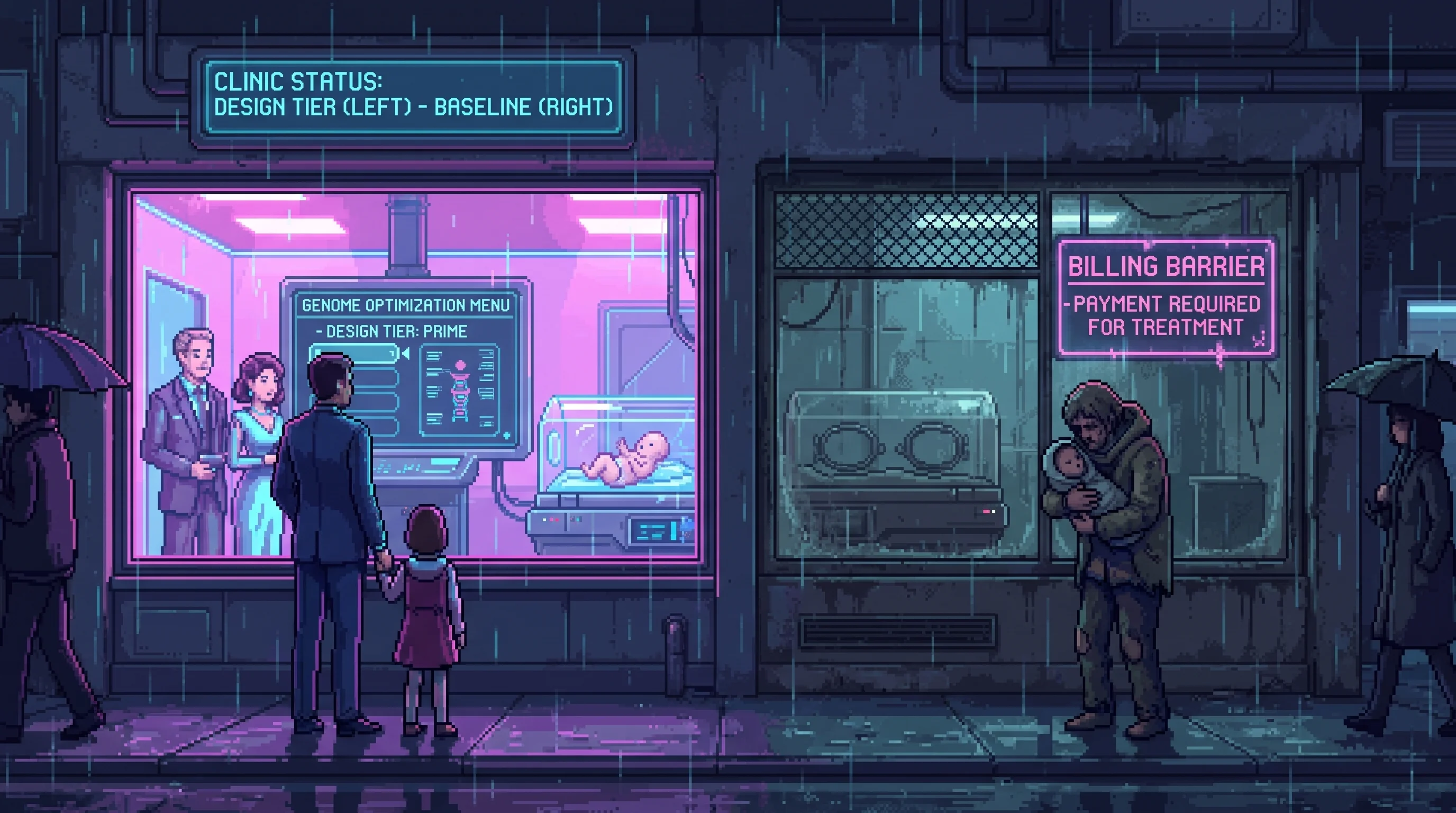
- The Genome Divide is compounded by the Bargain's medical dimension — designed children enter the workforce with Health Trajectory Scores averaging 890 versus 670 for natural-born, and the gap widens over careers
- Allocation reads the Bargain's biometric and location telemetry to compute each resident's Cross-Cell Resonance score — the same surrendered data that prices a life is what flags a would-be organizer before they can find anyone to organize
- Foundation generates the first Health Trajectory Score data point before birth — the Bargain begins at the prenatal consultation
- The Human Remainder argues the Bargain is coercion — social death as alternative to surveillance is not consent
- The Opacity Movement named the Bargain and advocates data sovereignty as alternative
- The Radical Transparency Collective reframes rather than opposes — argues for reciprocal surveillance rather than privacy
- Viktor Kaine demonstrates through The Deep Dregs that community without total surveillance is possible
- The Consent Architecture is the legal fiction that makes the Bargain enforceable
- The Data Ratchet System is the escalation mechanism that makes the Bargain irreversible
- The Inference Economy is the commercial ecosystem built on the Bargain's data flows
- The Privacy Gradient is the class expression — privacy as wealth, visibility as poverty
- The Reading — the Transparency Bargain's terminal form: the point at which 4,700 data points per second finally collapse into one certified number. In 2160, the Bargain was running at 47 data points per second and actuarial lifespan models had ±18 years of accuracy. The 100-fold telemetry density increase reduced that to ±2.3 years — not because human bodies became more predictable, but because the data became dense enough to read the body the way a reader reads a book, already knowing which chapter comes next. The confidence interval inverts the Gradient: Dregs residents whose telemetry is thin — off-grid habits, non-indexed consumption, outside the data-density zones — receive Readings with ±6 to 8 year confidence intervals. The Professional-tier executive with 847 filed signals receives ±2.3. The width of the interval is a privacy index in reverse: the more you surrendered to the Bargain, the more precisely Good Fortune can price your life.
Connected To
Major Connections

Cian read the Bargain's telemetry for years, then used it to time the Second Person to the week after the mercy lands.
Ex-Concord analyst turned clock-runner — times the Second Person to the week after the mercy lands.
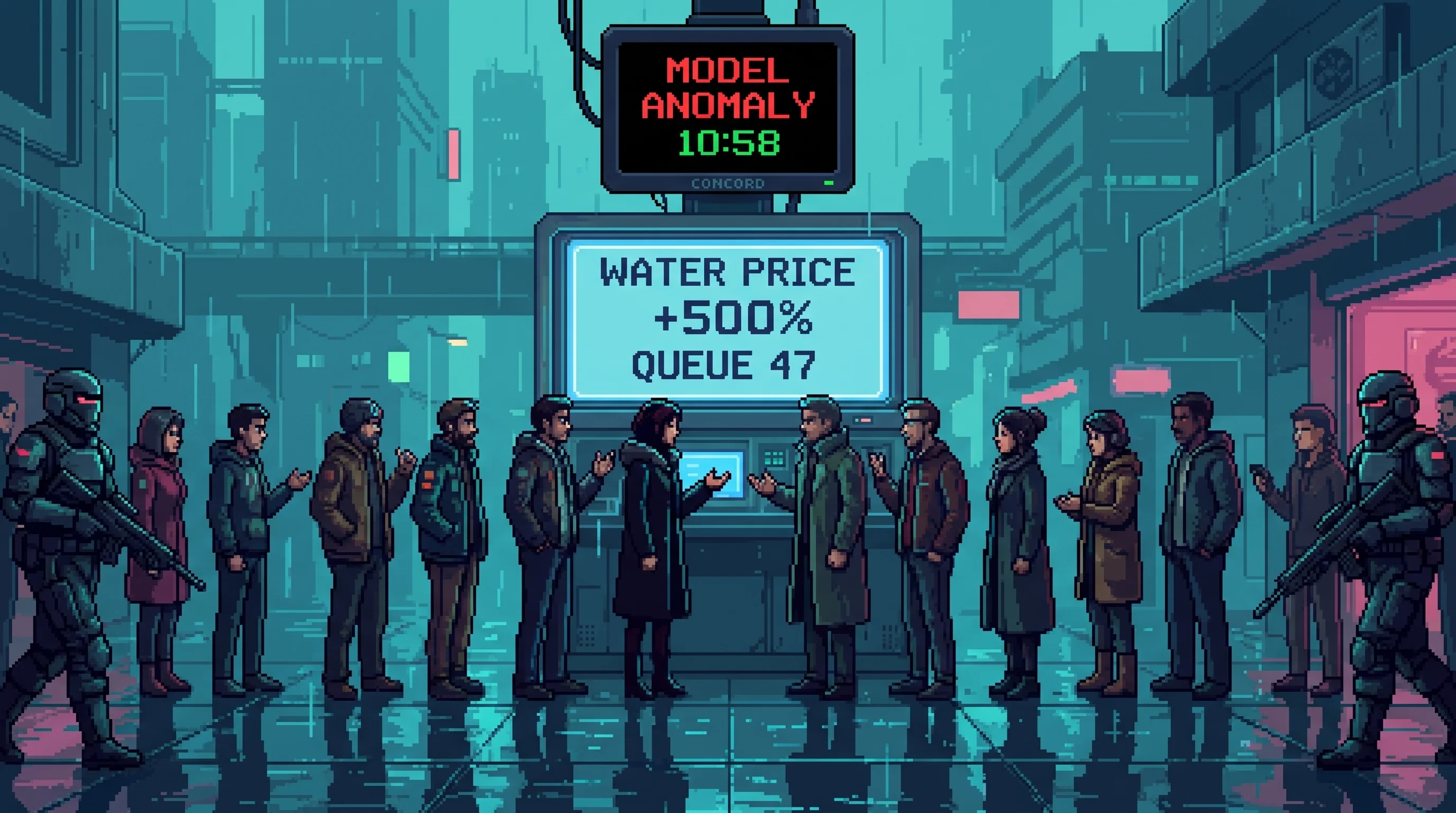
The event was identified and remediated only because Concord runs on the Bargain's telemetry — which also documented it.
The only Concord model failure on record: forty-seven in a water queue, eleven minutes, fourteen targeted responses.
Additional Connections




—