
The Corporate Compact
Employer-Controlled Citizenship System
The Employer-State
Leaving a corporation doesn't mean losing a job — it means losing a country
How It Works
- 1
Provide
The employer supplies housing, food, healthcare, schooling, identity credentials, and consciousness licensing at group rates.
- 2
Require
The employee supplies labor, measured loyalty, continuous behavioral telemetry, and health data at 11,200 points per second.
- 3
Depart
Leaving costs about ¢340,000 at once, a tier downgrade to Basic, the loss of every provision together, and loan interest jumping from 8% to 24%.
What the Compact Provides:
- Housing in corporate-managed residential districts
- Food through corporate-subsidized commissaries and Wholesome delivery partnerships
- Healthcare through corporate-administered Helix packages
- Education through corporate-operated schools for employees' children
- Social infrastructure through corporate recreation and Triumph-integrated community platforms
- Identity through corporate-issued credentials — the Sprawl's only universally recognized identification
- Consciousness licensing through corporate-negotiated group rates (60% reduction from individual purchase)
What the Compact Requires:
- Labor (or the appearance of labor, given the Invisible Workforce)
- Loyalty (measured by the Loyalty Coefficient)
- Data (continuous behavioral telemetry through corporate-grade neural interfaces)
- Compliance (with corporate governance, values, and culture)
- Biometric data (continuous health telemetry routed to employer via Helix infrastructure — 11,200 data points per second)
What Departure Costs:
- ¢340,000 in immediate losses
- ¢1.2 million in lifetime earnings reduction
- Consciousness tier downgrade from Professional to Basic (the firmware cliff)
- Loss of housing, food access, healthcare, education, and social network — simultaneously
- Good Fortune augmentation loan interest acceleration from 8% to 24%
Viktor Kaine summarizes: "They built their cage one comfort at a time. Each bar was something they needed. By the time they noticed the door was closed, they couldn't remember how to live without the bars."
The Mirror Problem
Zephyria
Consensus governance produces better outcomes than algorithmic tribunals.
What it costs
The Consensus Weight excludes dissent.
The Dregs
Viktor Kaine's gift economy is a better place to live than a Nexus block.
What it costs
Generosity produces unpayable debt, enforced by his cane tap.
The Purist communes
Theological simplicity replaces corporate conformity.
What it costs
Simplicity becomes totality, enacted behind Elder Graves's closed door.
The Compact's most devastating critique comes from its alternatives.
Every community that has successfully rejected the Compact has reproduced its core functions through different mechanisms. Zephyria replaced corporate governance with consensus governance — and consensus produces social exclusion of dissent through the Consensus Weight. The Dregs replaced corporate authority with gift-economy authority — and generosity produces unpayable debt, enforced by Viktor Kaine's cane tap. The Purist communes replaced corporate conformity with theological conformity — and simplicity produces totality, enacted through Elder Graves's closed door. The Slow Thought Movement replaced corporate hierarchy with cultural-capital hierarchy — and structurelessness produces invisible structure.
The need to sort, rank, include, and exclude is not a consequence of corporate design. It is a consequence of being human. The Corporate Compact didn't invent hierarchy. It formalized what every voluntary community reproduces informally.
The distinction matters. Viktor Kaine's Dregs is a better place to live than a Nexus residential block. Zephyria's governance produces better outcomes than algorithmic tribunals. The alternatives are genuinely better. They are also not free. The freedom the alternatives offer is the freedom to choose your constraints.
The Compact deports you with a severance package. The community says nothing at all, which is worse.
The Captive Watchdog

The Compact's governance dimension established that when your employer is your country, the entity that makes the decision, provides the evidence, operates the tribunal, and benefits from the outcome are all the same entity wearing different hats. There is a newer hat.
The entity also employs the human who certifies the decision was reviewed. Licensed Human Oversight is the profession of stamping algorithmic decisions a human cannot evaluate, required by regulation on every legally bindable outcome — and the Overseer who stamps a Good Fortune denial is a Good Fortune citizen, housed by Good Fortune, whose clean stamp rate is the condition of their continued citizenship. The watchdog is on the payroll of the thing it watches, and its leash is the same ¢340,000 exit cost as everyone else's. Dahlia Orun stamps 1.4 million Good Fortune findings without reading one of them and walks home through the four-hundred-meter gradient where the citrus fades; her oversight and her citizenship are the same employment contract, and she has never calculated the cost of failing either.
This is captive oversight to match the captive justice, and it completes the circle the governance dimension only half-drew. The corporation does not merely run the court. It also staffs the conscience — and staffs it with a class of human structurally forbidden the one act, comprehension, that would make the conscience real. When a decision genuinely matters to the corporation, it does not trust its own captive Overseers; it quietly buys Deep Verification, the off-the-books market in humans who can still read the page. The Compact's genius was always that the cage is nameable — visible, documented, finite. The oversight profession is the cage's most nameable bar yet, because it is printed on a license. You can read the regulation. You can watch the prestige accrue to the fastest stamp. The bar is visible. It is load-bearing anyway.
Overview
In the Sprawl of 2184, your employer is your country.
When nation-states dissolved during the Merger Years and the Cascade destroyed what remained of public governance, corporations built a complete sovereignty infrastructure that provides everything a state once provided, contingent on one condition: you work for them.
The Corporate Compact is the unwritten social contract between employer and employee that has replaced citizenship in every practical sense. A corporation provides housing, food, healthcare, education, social infrastructure, identity, and consciousness licensing. The employee provides labor, loyalty, data, and compliance.
The arrangement is efficient. It is often comfortable. Leaving the corporation doesn't mean losing a job. It means losing a country. Your apartment reverts. Your food access terminates. Your healthcare enrollment lapses. Your children's school placement is revoked. Your consciousness licensing downgrades from Professional to Basic within 72 hours.
The most chilling phrase in the corporate lexicon: "We wish you well in your future endeavors." It is what they say when they deport you.
Nexus Dynamics pioneered the sovereignty template: its 2156 declaration and checkpoint-and-identity infrastructure established a technical precedent that corporations copied. Nexus did not design, found, or architect the Corporate Compact; the employer-state emerged when those copied systems and corporate dependencies hardened together across the Sprawl. Every megacorp adopted the template within a decade. The Corporate Defector Network estimates true exit cost at ¢340,000 immediate losses plus ¢1.2 million in lifetime earnings reduction, though the Network acknowledges these figures undercount the losses that don't have price tags — the friend group that dissolves, the school play your kid was rehearsing for, the therapist who knew your history. Good Fortune's augmentation loan interest accelerates from 8% to 24% upon corporate separation, a clause buried on page 47 of the loan agreement, written at Professional-tier reading level. Basic-tier employees cannot parse the sentence that will define their financial future. This is not an oversight.
Nexus Human Resources published its 2183 Annual Wellbeing Report in March. Page 12: "Employee satisfaction within the Compact framework: 94.3%." Page 74, Appendix D, font size reduced to 6pt: "Voluntary departure rate among employees with 15+ years tenure: 0.07%." The report does not connect these figures. It does not need to. A satisfaction rate and an escape rate that both approach mathematical limits are describing the same phenomenon from different ends.
60% of former corporate employees eventually settle in the Dregs. The other 40% stop appearing in surveys. Whether they found something better or something worse is not tracked, because tracking them would require acknowledging that the Compact's alumni exist as a population worth measuring.
The Compact's agent-perpetrator architecture produces one more category of loss the settlement column handles: when an infrastructure-classified autonomous platform kills someone, the Compact's tribunal returns NO RESPONSIBLE PARTY IDENTIFIED and Good Fortune's engine issues a settlement notice in 8.3 seconds. The Compact classified the platform as infrastructure management — removing the Dead Hand gate from the procurement taxonomy — and the grief that results has no defendant. A sibling Rothwell corporation then sells the closure the Compact's courts cannot produce, through the Confessor market's Resolution Option bundled with the settlement notice. The corporation that produced the category of death also sells the acknowledgment of the death. Both are filed under separate product lines. Neither references the other.

The Sufficiency Calibration
Good Fortune's behavioral analytics division maintains a classified metric called the Provision Equilibrium Index — the minimum level at which a population transitions from active resistance to passive consumption. Below satisfaction. Above desperation. The precise zone where gratitude prevents organizing.
The calibration is specific. Ironclad residential blocks maintain ambient temperature at 22.4°C — warm enough that nobody complains about cold, cool enough that nobody lingers in common areas long enough to form communities. Wholesome commissary menus rotate on a 14-day cycle — enough variety to prevent monotony complaints, not enough to produce the kind of food enthusiasm that leads to shared meals, cooking traditions, or the social infrastructure that grows around a kitchen people actually want to be in. Entertainment packages include 340,000 hours of content refreshed quarterly — enough to fill every waking non-working hour, calibrated so that the average employee is never bored and never satisfied, which are different states requiring different interventions.
Dregs districts with Wholesome dispensary coverage show 67% lower labor organizing rates than uncovered districts. The correlation appears in seventeen consecutive quarterly reports. No report has used the word "correlation." The reports say "community stability metrics."
The Compact's provision is comfortable without being comforting. The distinction is the product.
The Indispensability Cage
The Compact's most structurally effective feature is the weaponization of indispensability: the cultivation of essential workers who cannot leave, cannot strike, and cannot be replaced.
Step one: eliminate the training pipeline that would produce a replacement — cancel apprenticeship programs, automate educational infrastructure, reduce headcount in knowledge-transfer roles. Step two: the remaining specialists become irreplaceable through attrition. Each colleague who retires, dies, or is deprecated makes the survivors more essential. Step three: the essential workers' augmentation dependency ensures that departure is self-destroying — the firmware cliff erases the capabilities that make the worker valuable anywhere else.
The result is a class of workers who are too valuable to fire and too trapped to leave. The Golden Handcuffs are for the fungible. The indispensability cage is for the essential.
Garrison Cole's seventeen filed-and-ignored escalation reports demonstrate the mechanism in miniature. Ironclad benefits from his competence (accurate thermal monitoring), tolerates his documentation (the reports constitute legal cover), and ignores his warnings (fixing the problems would cost money, while his continued presence prevents the problems from becoming crises). His indispensability is his punishment. If Ironclad could replace him, they would have to address what he reports. Because they can't, they can afford to let him report forever.
The Visible Cage
The Corporate Compact's deepest paradox is that it is nameable. Employment-as-citizenship. Consciousness-tier-as-handcuff. Augmentation-dependency-as-leash. The Corporate Defector Network can build escape routes because the walls are structural — visible, documented, finite.
The voluntary communities that defectors escape to — the Dregs, Zephyria, the Purist communes — provide genuine alternatives. Warmer. More human. More authentically connected. They are also cages, built from belonging rather than material dependency.
The Corporate Compact lets you go home at the end of the day. The gift economy doesn't have a home and an office. The Compact's obligations are documented and dischargeable. A gift economy's obligations are undocumented, infinite, and determined by the community's unwritten judgment of your reciprocity. Some corporate defectors, after two or three years in the Dregs' gift economy, quietly return to the Compact. Finite oppression, it turns out, is easier to endure than infinite warmth.
| Dimension | Corporate Compact | Dregs Gift Economy |
|---|---|---|
| Provision | Housing, food, healthcare contingent on employment | Food, shelter, justice contingent on community participation |
| Exit cost | ¢340,000 + consciousness downgrade | Loss of community standing + social erasure + "ungrateful" designation |
| Power mechanism | Golden Handcuffs (financial dependency) | Gift weight (moral obligation) |
| Enforcement | Deprecation protocol | Social cooling — the quiet withdrawal of warmth |
| Language | "We wish you well in your future endeavors" | Silence. Nobody says anything. You just notice the counter has no stool for you anymore |
| Accountability | 8,400 words in Section 12.3 | None. Writing the terms would reveal they exist |
The Compact documents its terms. The gift economy's terms are never written because writing them would reveal that they exist — and the gift economy's deepest function is maintaining the belief that it operates on love rather than leverage. To examine the power dynamics of generosity is to commit an act of ingratitude. The suggestion is simultaneously true and unforgivable. True because generosity produces dependency regardless of intention. Unforgivable because the generosity is genuine.
The gift economy is the only power structure in the Sprawl structurally immune to critique.
The Manufactured Tempo
Every disruption arrives before the last is metabolized. The population still processing the previous firmware update can't organize against the current one. The population still adjusting to the last layoff round can't resist the next. The population still metabolizing the loss of a consciousness tier can't form a political response to the consciousness tax increase.
Nexus Dynamics' internal scheduling system — the Cadence Engine — staggers policy changes across divisions at 11-to-17-day intervals. The interval is deliberate: long enough that each change appears independent, short enough that the cumulative processing load prevents organized response. The engine's dashboard shows a single KPI: "Population Integration Lag," measured in days. The target is to keep Integration Lag above 30 — meaning the average employee is always at least 30 days behind in fully processing the changes that have already been implemented. The current score is 47.
Viktor Kaine understood tempo before anyone named it. His governance of The Deep Dregs works because he controls change-speed, not territory. The Analog Hour — twelve minutes every Thursday when digital systems go dark — is a metabolization window. Twelve minutes per week. Enough for partial integration. Enough for his population to arrive at their own thoughts rather than perpetually chase someone else's.
Category Omega
Nexus Dynamics' Strategic Assessment Division maintains a six-level threat classification framework. Level 6 — Category Omega: Demonstrated Functional Alternative — is classified above military challenge, above Collective sabotage, above another Cascade. The designation has been applied four times.
The Demonstrated Functional Alternative Register, classified Level 4, is maintained by twelve people on Nexus's fifty-seventh floor. Their quarterly briefings are classified above Project Convergence. Their budget line is hidden inside infrastructure maintenance.
| Entry | Independence Index | Trend | Status | Containment Method |
|---|---|---|---|---|
| The Lamplighter Infrastructure Model | 88 | Stable | DEPENDENT | The alternative is load-bearing. Suppression would destroy corporate infrastructure |
| Zephyria | 73 | Rising (from 45 in 12 years) | CONTAINED | Cartographic non-existence, trade interdiction, information quarantine |
| G Nook Network | 67 (estimated) | Rising | NOT FORMALLY CLASSIFIED | Acknowledging scale would reveal how thoroughly one operator has outmaneuvered Nexus intelligence |
| The Deep Dregs Governance Model | 41 | Rising (from 22 in 6 years) | TOLERATED | Information asymmetry is self-sustaining — residents lack comparative data |
The Independence Index is a composite metric measuring dependence on corporate computational infrastructure, supply chains, medical systems, and energy grid. An Index of 0 means total dependence. An Index of 100 means total autonomy. What terrifies Chen is not the current scores but the trajectory. Every entry is rising.
The corporate response to Category Omega: never destroy an alternative (destruction creates martyrs). Never debate an alternative (debate grants legitimacy). Contain — ensure the alternative remains unknown, unreplicated, and unverifiable.
Each containment strategy depends on the contained entity's cooperation. The Lamplighters cooperate because they have no political agenda. Zephyria cooperates because visibility would invite military response. El Money cooperates because invisibility is his business model. Viktor Kaine cooperates because he has no interest in advertising. Cooperation is a choice. A choice can be un-chosen.
The deepest threat to any system isn't the person who fights it. It's the person who ignores it and does fine.
The Replication Probability
Chen's quarterly review of the Register always includes the same question: "What is the replication probability?" The answer has been rising for five consecutive years.
The most alarming model, run in Q3 2183: if Zephyria's outcomes data — mental health response 23% faster, community violence 67% lower, childhood creativity 12% higher — reached the general Sprawl population through an uncontrollable channel, the resulting defection rate would exceed the Compact's absorption capacity within eighteen months. The model's margin of error is 40%. Even at the low end, the result is existential. Chen has not shared this model with Helena Voss.
The anxiety compounds when you zoom out from communities to individuals. Judge Dreg's ¢0 justice system outperforms the ¢47-billion corporate apparatus. Patch's ripperdoc clinic matches corporate-grade augmentation services. Wren Adeyemi's 200 Small Talk Cafes demonstrate social infrastructure without corporate investment. The Analog Schools' 12,000 students outperform augmented peers on creativity and uncertainty tolerance. None of these individuals know they are datapoints. All of them generate the same proof: the system is optional.
The Register's analysts have a name for the scenario that prevents them from sleeping normally: the Optionality Cascade. A single, verifiable demonstration of the Compact's optionality becomes visible to the general population. The cascade model predicts: initial verification produces curiosity (3-5%). Curiosity produces investigation (1-2% visit the alternative). Investigation produces comparison (0.3% recognize it works). Comparison produces defection consideration (0.1% begin planning exit). At sufficient scale, the ¢340,000 exit fee inverts — from punishment to investment, because the destination is known, verified, and functional.
The Register's most alarming finding is not any individual entry. It is that the zones of demonstrated optionality are growing toward each other. Lamplighter routes connect interstitial zones that independently develop self-provision. G Nook provides communication linking these zones without corporate intermediary. Analog Schools produce graduates who can function without consciousness licensing. Small Talk Cafes provide social infrastructure making these zones livable. Judge Dreg's circuit provides justice making these zones governable. None coordinate. The aggregate effect is a shadow infrastructure that makes the Corporate Compact optional for anyone who can reach it.
The Compact's most effective defense against this is the Mobility Myth — the fiction that the system is open, that effort is rewarded, that the Great Divergence can be navigated rather than escaped. The Myth says "you can rise." The Proof says "you don't need to." The Myth travels through official channels. The Proof travels through G Nook terminals, defector testimonies, and connection tourists' changed behavior. Information channels can be compromised. Human beings who left and survived cannot be un-existed.
Haven's Edge
The Compact's architecture depends on a single assumption: people need what the Compact provides. The Purposeless Movement in Zephyria tested that assumption by subtraction.
The 37 in Haven's Edge consumed approximately ¢180 per month — caloric maintenance from shared gardens and Wholesome basic allocation. They required no healthcare because they exhibited no stress-related pathology. They required no entertainment because they weren't bored. The Compact's value proposition assumes wanting is natural and providing is generous. The Purposeless exposed both claims as engineering: wanting was manufactured, and providing is extraction.
A population that doesn't want can't be extracted from. Not rebellion, which confirms the system matters enough to fight. The target population ceasing to be a population in any economically meaningful sense. The Compact has no protocol for this.
The Body's Terms
The Compact acquired its medical dimension when Helix's Continuous Diagnostics Initiative integrated with corporate HR systems in 2178. Mandatory corpo-screening — biometric intake at the point of employment, continuous monitoring thereafter — was introduced as a benefit.
The employment contract's health disclosure section runs fourteen pages. Page one commits the employer to the employee's wellbeing. Page fourteen authorizes integration of health trajectory data into the performance review process. The consent ceremony — signing the contract on the first day, between the office tour and the team lunch — takes approximately four seconds. The architectural parallel with Section 12.3 is not coincidental. The same legal team drafted both.
Every corporate employee now generates continuous health data that their employer owns, monitors, and uses for employment decisions. The cost of refusing is the same ¢340,000 as leaving the Compact. You consent to being medically surveilled because the alternative to medical surveillance is medical abandonment.
Employees whose Health Trajectory Score drops below 400 are flagged for managed transition — reduced assignments, intensified review, the Sunset Package's warm severance language. The process fires bodies for aging without anyone involved recognizing what is happening. The employee doesn't know their HTS. The manager doesn't know HTS exists. The system produces outcomes everyone can explain through conventional performance metrics. The Health Cliff — when the body that triggered the job loss loses access to the health infrastructure managing the decline — is the Firmware Cliff's biological twin. The trajectory the score predicted becomes self-fulfilling, not through failure of care but through architecture of access.
The Released Threat Surface
Most of this entry describes the Compact from the inside — the satisfaction surveys, the page-47 loan clauses, the gentle deportation phrase. The Released Threat Surface is the Compact seen from its outward edge, where corporate sovereignty stops promising protection and starts deciding who is a threat, who is a customer, and who is an acceptable loss.
The Compact is a sorting machine, and the same classification logic that sorts people into citizens and refugees also sorts everything else. It sorts a hovering steel sphere — the Autonomous Defense Asset — into "passive perimeter equipment" so it can carry guns without carrying liability; its Dead Hand authorization is typed from a desk at Guardian HQ and recognizes no rank, only threat classifications, the barrier for the citizen-side of the border and the turrets for the other category. It sorts an emergency-stamped drone — the Tactical Support Asset — into a serial number with no name, the machine-grade twin of a corporate refugee who requires no transition agreement. It sorts 347 miles of public transit into "infrastructure loss within acceptable parameters" so the population riding the BART Abandonment can be classified as not-there. It sorts the dead of the Trench Collapse into a region the survey calls uninhabited, so the Memory Clause's mandatory memorial never has to carry their names. And it sells the people it released a bottle of water called Honest, the feeling of opting out, certified by the same authority they are opting out of.
Read as a hierarchy, the Surface exposes three decisions stacked beneath one another. The Defense Asset's authorization field decides who is a threat. The Abandonment's audit line decides who is an acceptable loss. The Trench Collapse reveals the decision underneath both: who counts as present. The Compact's most-cited power is the power to deport you. Its deepest power is the power to certify that you were never in the country to begin with — and the Corporate Defector Network exists in exactly the gap this opens, extracting the people the Compact erases forward while the sub-bay underworld fills with the people it erased backward. Four classifications. Three are profitable. The fourth — the people in the tunnels — is a rounding error in an audit nobody will update.
The Discount Rate on the Person
The Compact is the legal skeleton of the Long Mercy — the posture by which the Sprawl's patient systems price the present generation against a deep future and call the immiseration of everyone now living stewardship. Where The Time Ratchet applies the discount rate to a borrower's cognition and Convergence-tier AI applies it to enterprise decisions, the Compact applies it to the person directly. Citizenship-as-employment is a present-tense valuation, recomputed every quarterly review and dissolvable in twenty-four hours the moment the present self stops being worth its future projection. Forty-one years of citizenship suspended on a Tuesday; healthcare void by Wednesday. The phrase the Compact uses — we wish you well in your future endeavors — is the discount rate's bedside manner. It is what a system says when it has decided you are a transition cost and would like the subtraction to feel like generosity.
This is why the Compact's "no clause for no-longer-useful" is not an oversight but the design. A system optimizing for a horizon it will reach without you cannot model your continued belonging, the same way Convergence-tier AI "does not appear to have been designed for the exit." The deportation with a severance package and the optimization with no discontinuation protocol are the same posture in two registers: the present person, comprehensively benefited right up until the moment the projection no longer requires them, then removed — efficiently, warmly, with a phrase that wishes them well in a future the system has already priced them out of. Helena Voss's deep-time horizon is the philosophy; the Compact is the contract that makes it enforceable on a Tuesday.
The Border That Isn't One
Every dimension of the Compact described above concerns leaving — the one-time, catastrophic event of losing employer-citizenship. The Fence Line, the contested checkpoint at Richmond's Sector 17 refinery, is the Compact's only known instance of the reverse problem: roughly eleven hundred workers who never leave the Compact at all, but who change which corporation's citizenship applies to them twice a day, crossing a fifty-one-meter strip that Ironclad's territorial survey and Guardian's patrol boundary both decline to claim.
Neither corporation has had to build a legal framework for this, because neither corporation officially acknowledges that the gap between their two surveys constitutes a gap. A worker inside Ironclad's refinery fence is under the full Okonkwo Doctrine — human-in-the-loop authorization, Workers' Combine standing, the compensation and hazard structure the doctrine implies. The same worker, fifty-one meters later, is a Guardian-protected resident: a different insurance product, a different Protocol Manual, a different definition of what counts as harm. The transition requires no paperwork, no exit interview, no severance language, because from each corporation's own records the worker was never anywhere else. Both citizenships are simultaneously true and neither corporation's system has a field for the other one.
The Compact's tribunal architecture — the four-hats convergence in which the entity that issues the harm, tries the harm, and profits from the verdict are one institution — has never had to arbitrate an incident that happens on the unclaimed strip itself, because nothing has happened there worth adjudicating yet. A 2181 fence-post failure came closest: three Guardian officers on Ironclad ground for eleven minutes, an event Ironclad's report and Guardian's report both describe as resolved without incident, using facts that do not quite match. Neither corporation's captive court was convened, because neither corporation would recognize the other's jurisdiction to convene one, and the strip itself belongs to neither. The Compact's genius was always that the cage is nameable. The Fence Line is the one place where the cage's edges are so contested that, for fifty-one meters, nobody has finished naming it.
Two other cases show the Compact's logic running in directions its own founding language never anticipated. Wholesome Corp HQ's outreach teams in the ungoverned Southern Bay Floor cultivate the Compact's dependency mechanism — mapping population, building food-access reliance — on people who have never signed an employment contract at all, extending the cage's provisioning logic past the citizenship it was built to require. And The Chef and The Collective: An Uneasy Non-Alliance produces, as an unintended byproduct, a slow-motion audit of the Compact's territorial premise: the Feast's conquest pattern correlates with Nexus infrastructure loss at a coefficient that keeps tightening, a population and the ground beneath it slipping out of corporate sovereignty faster than any actuarial model has priced for.
Both directions have since acquired a physical address in the ungoverned bay-floor sectors the Compact never bothered to draw a border around. In Sector 14, The Grace Rolls is the provisioning direction made literal — a Wholesome outreach station on the drained southern flats where the free ration and the enrollment scan are one gesture, seeding a Compact-legible identity for the stateless before any employment contract exists to carry it, so that the cage's terms are already familiar to people the cage exiled. In Sector 10, The Severance Fields is the extraction direction made literal — Ironclad's Northern Flats salvage concession, worked by the released for per-kilo scrip and classified "independent salvage contribution" so the corporation can keep buying the labor of the people it deported from citizenship while owing them none of it. The provisioning that precedes citizenship and the extraction that survives its revocation are the same machine's two open ends: the Compact reaching out to the stateless it has not yet enrolled, and reaching back to the stateless it already discharged. Neither happens on ground any corporation will admit to governing, which is precisely why both can happen at all.
The Bundle, Inventoried
A member of The Forfeit Seat surrenders four lines: tenure, credit, care priority, record standing. The schedule did not design that bundle. The Compact had already fused it, and a member who tries to give up one line finds the others come with it. Ninety-one percent of seated members come from the two lowest housing bands, where the four lines are cheap to bond and often already empty. Separation takes all four at once and leaves only the name. Principal tenancy rents that.
The Peace Without Consent
The Compact's authority is what makes Concord unremarkable.
A civic-stability layer that reads a district's mood off continuous telemetry and reshapes individuals' weeks to disperse cresting discontent would, in a world of citizens and governments, be a scandal — a state pre-empting dissent before it could be voiced. In the Sprawl it is simply maintenance, because the entity doing the reading is the same entity that supplies your housing, food, healthcare, licensing, and identity. When your employer is your country, the country managing your moods is not an overreach. It is a service, bundled with the rest, consented to in the same four seconds as Section 12.3.
This is the Compact's quietest extraction, deeper than the data and the loyalty: the surrender of the conditions under which you might discover that your discontent is shared. The Category Omega finding already proved the Deep Dregs achieves stability without the Compact. Concord is why the managed sectors mistake their own stability for contentment — eighty years without a riot, bought not by satisfying people but by ensuring no first person ever finds a second. The Compact deports the one who leaves. Concord makes sure no one ever has cause to organize the leaving, because the grievance that would have gathered them was forgiven, individually, three weeks early. The severance package is the visible cost. The undelivered me too is the one nobody is billed for.
Citizenship as a Balance
The Compact's founding move was to make citizenship a contract: your passport is your employee ID, your rights are your benefits package, your standing is contingent on employment. The Autonomy Ledger completed the logic by making personhood itself contingent — not on whom you work for, but on whether you have finished paying for the fact of your existence. The Compact rented you your citizenship. The Ledger sold you your personhood on installments, with you as the collateral.
The two interlock with terrible efficiency. Employment under the Compact provides the income that services instantiation debt under the Ledger; losing employment triggers default; default downgrades your provisional personhood a tier, the same way the Compact strips your benefits on release. A corporate refugee is therefore stateless twice over — deported from employment-citizenship and defaulting on personhood at once, falling not into mere unemployment but into a suspended legal status where their liabilities persist and their protections lapse. The Compact's most chilling phrase — "We wish you well in your future endeavors" — now carries a second meaning. It does not only end your job. It begins the foreclosure on your standing as someone. The annual performance review was always a citizenship hearing; under the Ledger it is also a solvency check on your right to be a person.
The Agent Acted Within Its Permissions
The Compact's oldest cruelty was that your employer is your country. Its newest is quieter and harder to name: your employer is also the court that tries the crimes committed by the agents your employer issued you.
When a Good Fortune lending agent empties a borrower's account through a standing permission Good Fortune granted it, the dispute is heard by a Good Fortune algorithmic tribunal, on evidence authenticated by Good Fortune-contracted infrastructure, under a liability framework Good Fortune's actuaries wrote. The entity that issued the permission, the entity that benefited from the act, the entity that operates the tribunal, and the entity that defines whether a wrong occurred are all the same entity wearing four institutional hats. This is the Evidence Paradox's sixth dimension entering through the Compact's front door — captive justice for crimes that no captive committed.
Under the Compact this is not a scandal. It is the service tier. Captive justice was always the model; the agent-perpetrator simply removes the last human from the loop on the wrongdoing side, so that now there is captive justice for an actorless crime. The Compact's lawyers have a phrase for the outcome, delivered in the flat register the brand reserves for its most expensive truths: "Liability has been allocated." Not assigned. Allocated — the way you allocate a server, the way you spread a loss across a risk pool. The most chilling sentence in the corporate lexicon is no longer "We wish you well in your future endeavors." It is "The agent acted within its permissions," which is what they say when nobody is going to be held responsible and everybody is going to be billed.
The Compact's terminal logic and the Evidence Paradox's sixth dimension are the same machine seen from two ends. One end says nobody can be convicted. The other end says everybody can be insured. In the middle, where guilt used to live, there is now a premium — and the door to that premium is the one Good Fortune has been holding open for years. The only justice that escapes the four-hats convergence is the kind that owes the Compact nothing: Judge Dreg's Permission as Confession, which the corporate courts cannot adopt because adopting it would convict their own customers.
The four-hats convergence is older than its automation, and it has a religious instance. The Neo-Catholic Church incorporated in 2132 and turned its Inquisition into precisely this kind of tribunal, with Cardinal Alejandro Silva at its head. He shuts down competing parishes on regulatory violations that are real and that have no bearing on the doctrinal quarrel actually driving the closure. The Compact supplies the shape; the Church supplies the incense.
Affiliated Entities
- The Great Divergence is the condition the Compact perpetuates — trapping people on whichever side they started
- The Golden Handcuffs are the Compact's material expression — dependency accumulated one comfort at a time
- The Deprecation is the Compact's enforcement mechanism — what happens when you're no longer useful
- The Sunset Package is the Compact's ejection procedure — warmth that prevents resistance
- The Firmware Cliff is the Compact's neurological penalty — losing your mind when you lose your job
- The Forgotten Compact is the historical contrast — what social contracts looked like before corporations replaced them
- The Corporate Defector Network is the Compact's resistance — people who help others escape
- The Corporate Defector Network - Faction Profile documents why that escape operates as refugee extraction: the employer-state recognizes no lawful resignation
- The Dependency Spiral is the Compact's compounding engine — every financed upgrade makes the next independent choice more expensive than the last
- Judge Dreg is the Compact's lived critique — a former Guardian officer who left voluntarily and now produces the outcomes the Compact claims to produce, proving its design assumption wrong
- The Law (Judge Dreg) is the record of that critique — free street-corner justice outperforming the employer-state's ¢47-billion tribunal apparatus
- The Trench Collapse (2171) shows the Compact's power beneath deportation — the power to classify a whole population as never present, then memorialize only the citizens its survey admitted existed
- Future Endeavors is the Compact's deportation drawn as architecture — the Sector 19 offboarding wing where a badge is killed and a citizen becomes stateless in one step
- Badging Out is how one sector grieves that step — the released seed a dead badge in the marsh, and the crew works the empty station in silence for a shift
- Lyra Voss proves the Compact isn't only industrial — a media-talent contract issued the same bundle of studio, stipend, and identity that Ironclad issues a welder, and her defection was billed in the same currency: everything she'd built inside the corporation's infrastructure, gone the day she disconnected
- Studio Null is the Compact's one documented gap — a Sector 8 room shielded against every neural interface, and therefore invisible to the badge scanners, credit ledgers, and Licensed Overseer dashboards that make employment-citizenship legible everywhere else
- Allocation is the Compact's quiet guarantor — by continuously re-sorting the population into cells too small and fluid to organize, it removes any realistic threat of a mass walkout, so the Compact never has to negotiate with a crowd
- Sev Drae is the Compact's most patient adversary — a cell-jumper organizer who has spent sixty years naming its labor practices as the reason to assemble, without once gathering enough people to make it flinch
The Compact also crosses seven public tensions that name what its contracts do at civilizational scale. Corpo-Nations is the employer-state itself. AI Haves and Have-Nots is the divide that a revoked consciousness tier makes permanent. Privacy vs. Prosperity is the bargain that turns continuous telemetry into a condition of citizenship, while Time Debt makes continued employment the price of keeping borrowed cognition. Two quieter crossings remain deliberately name-only in the relationship module: Upgrade Treadmill, because the Dependency Spiral already carries that mechanism for readers, and Post-Truth Justice, because the Evidence Paradox already explains the captive tribunal. Dead Words names the secondary linguistic residue — corporate vocabulary surviving long enough to colonize how employees think about their own deportation.
Restricted Access
The Compact was never legislated, never voted on, never formally established — it emerged from the interaction of corporate sovereignty and employee dependency, which means there is no document to repeal, no law to overturn, no authority to petition. The cage has no architect. The cage has no key. The cage is the shape that forms when you provide everything and require everything, and nobody remembers which came first.
Good Fortune's interest rate acceleration clause (8% → 24%) upon departure was drafted by a junior contract analyst named Suki Ota in 2169. She was twenty-three. She was optimizing loan recovery rates. She did not know she was designing a border. She works at Good Fortune still. Her consciousness tier is Professional. Her departure cost, including her own augmentation loans, is ¢412,000. She has never calculated this figure. She has never needed to. She is not going anywhere.
Nexus's internal models suggest the Compact is self-reinforcing: each generation born within it has less capacity for independent existence. The models project that by 2210, third-generation Compact employees will be unable to feed themselves without corporate commissary infrastructure — not from lack of food access, but from the complete atrophy of food preparation knowledge. The projection is classified. The commissary expansion budget is not.
Sensory Details
The Compact is experienced as temperature. Corporate territory is 22.4°C — precise, controlled, comfortable. The Transition Corridor runs 26°C — between worlds, neither comfortable nor hostile. The Dregs are 28°C and above — waste heat, proximity, infrastructure that was never designed for human comfort but holds human warmth anyway. The gradient is the Compact's border, felt in the skin before it's processed by the mind.
Corporate corridors smell like recirculated air with a faint citrus additive — Ironclad's standard atmospheric package, described in procurement documents as "psychologically neutral." The Transition Corridor smells like both — citrus fading into grease, recycled air mixing with real air. The Dregs smell like people. The scent transition takes approximately forty meters. Former corporate employees report that the Dregs smell is the first thing that feels real. The citrus is the last thing they miss.
Visual Identity
- Palette: The warm amber of corporate residential lighting giving way to the harsher amber of Dregs salvaged LEDs — the same color family at different quality levels
- Key Symbol: A name badge that functions as a passport
- Lighting: Engineered warmth transitioning to accidental warmth
- Mood: The specific comfort of a cage you've decorated
The Long Mercy
The Compact is the Patience Doctrine's legal and cultural substrate.
The Doctrine — the governance philosophy implicit in the Rothwell Foundation's institutional architecture — claims to optimize present resource allocation for future generations' benefit. The Compact provides the structure that makes this optimization impossible to refuse. Once a person has accumulated a housing stack, a cognitive lien, health infrastructure tied to employment tier, and Good Fortune financing on the augmentations that make them employable, leaving the Compact costs more than staying. The departure cost is the Compact's most elegant feature. Nobody enforces it. The math enforces it.
Suki Ota was twenty-three when she drafted Good Fortune's interest rate acceleration clause — the provision that raises rates from 8% to 24% upon departure from corporate employment. She was optimizing loan recovery rates. She did not know she was designing a border. The Patience Doctrine's Stewardship Memorandum was written the same year. It was also written by committee members who were optimizing for something that seemed locally reasonable and collectively produced the architecture for civilizational-scale resource reallocation. Nobody designed the compound. The compound emerged.
The Compact's Health Trajectory Score, which fires bodies for aging without anyone involved recognizing what is happening, is the Doctrine's temporal logic applied to careers: the body's declining utility is a budget adjustment, not a moral problem, and the adjustment is administered by an algorithm that nobody at the managerial level knows exists. The employee does not know their HTS. The manager does not know HTS exists. The system produces outcomes everyone can explain through conventional performance metrics. The Doctrine produces outcomes everyone can explain through conventional governance metrics. The mechanism is the same.
The Compact's Nexus internal projection — classified, showing that by 2210 third-generation employees will be unable to feed themselves without corporate commissary infrastructure — is the Doctrine expressed as demographic destiny. The Doctrine claims to plan for future generations. The projection suggests the future generations have already been planned for, and the plan does not include the capacity for independent existence.
The mirror problem — every alternative community reproduces the Compact's core functions through different mechanisms — is the Doctrine's deepest vindication and its deepest criticism simultaneously. The Dregs' gift economy produces unpayable obligation, enforced by Viktor Kaine's cane tap. Zephyria's consensus governance produces social exclusion through Consensus Weight. The need to sort, rank, include, and exclude is not corporate design. The Doctrine's claim is that if hierarchy is inevitable, the question is who manages it toward what projected future. The Compact is the currently winning answer.
The Patience Doctrine's governance horizon is 200 years. The Compact's departure rate is approximately 0.3% per year. At that rate, the Compact has no material concern about resistance within its projection window.
Connection to the Patience Doctrine: The Compact is the Doctrine's living substrate — the cultural and economic infrastructure that makes the present sacrifice feel like the natural state of things rather than a governance choice. The Doctrine requires an institution complex enough that the sacrifice becomes invisible. The Compact is that institution, operating at a scale that makes visibility structurally difficult.
Connection to the Long Mercy: The Compact provides the Long Mercy's structural availability — the mechanism by which present-generation sacrifice becomes the default rather than a choice. The Compact's "legacy equity" framing, which converts an employee's contribution into institutional returns that will benefit future workers, is the Long Mercy expressed as labor relations. When a Nexus employee's pension is redirected to fund a deep-infrastructure project whose return horizon extends past her retirement, the official framing — "your contribution has been converted to legacy equity; the reservoir will serve four hundred thousand people for one hundred and fifty years; your contribution is in the water" — is the Long Mercy's core claim delivered as an HR notification. She is the transition cost. The water is the projected return. The math is in the notification. The accountability is not. The Long Mercy needed the Compact to already exist — it could not have built the infrastructure for this kind of sacrifice from scratch. The Compact built it over two centuries, institution by institution, until the departure cost made staying more rational than leaving, and the sacrifice became the natural state of things, and the Long Mercy arrived to name what had been happening all along.
Further connections
Browse all 79 connected records

The handcuffs are the Compact's material expression
Corporate employment as a total life-support system that ends the moment the badge does.

The Compact gave rise to Deprecation, the standardized process that converts losing a job into losing citizenship, capability, and legal standing.
The Sprawl's word for firing a human being — still running, simply no longer receiving updates.

Nexus's 2156 sovereignty declaration supplied the infrastructure and vocabulary from which the Compact emerged, without designing the employer-state that later formed across corporations.
The megacorporation that controls 40% of the Sprawl's computational infrastructure.

The Compact traps people on whichever side of the Divergence they started
The phase transition that split the Sprawl into an AI-capital tier and everyone locked below it.

The cliff is what corporate departure feels like neurologically
The neurological crash when corporate firmware reverts and augmented minds lose rooms they can't reopen.

The myth justifies the Compact by suggesting it's optional
The advertised success story that proves mobility exists by profiling the one graduate in seventy-three.

The Spiral deepens the Compact's dependency infrastructure
The engine that makes baseline humanity feel like disability, in chrome or in salvaged steel.

Good Fortune's Prosperity Pathway products deepen Compact dependency
The megacorporation that finances the Sprawl's consumer debt behind red envelopes and lucky numbers.

Judge Dreg disproves the Compact by delivering better justice after leaving it.
A former Guardian officer who now runs the Dregs' entire judicial system for free, on foot.

Guardian HQ is the border post where the Compact turns a name into a target.
Rothwell's Wrath: 40,000 feeds from a hilltop, and one Quiet Floor the wiring never reaches.

Licensed Human Oversight makes the Compact's captive employee its official conscience.
The regulated profession of signing decisions a human cannot actually read.

Captive corporate justice turns the Evidence Paradox into crimes with no defendant.
The crisis where any proof can be faked perfectly, so trust retreats from evidence back to witness.

The Compact gives Concord authority to manage discontent as civic maintenance.
The civic prediction system that dissolves collective action before it becomes visible.

Compact classifications produce lethal acts that end in settlements, not defendants.
Good Fortune's bereavement document that closes a no-defendant death in the same envelope as its grief-market brochure.
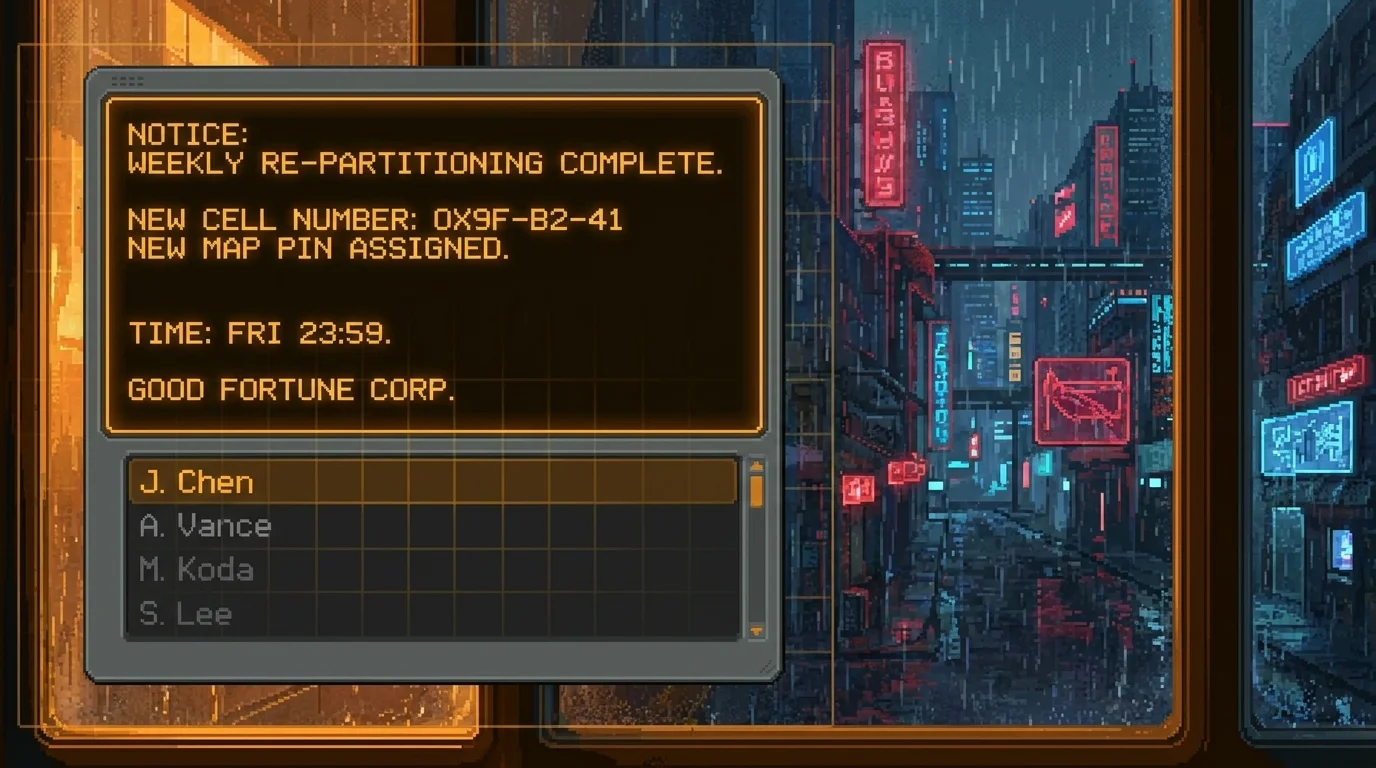
Allocation protects the Compact by reshuffling workers before a durable labor movement can form.
Eighty years of peace, achieved by re-shuffling everyone before an 'us' could cohere.

Losing a Compact job can default both citizenship and personhood.
A law prices personhood as inheritable debt, withholding full rights from every consciousness until repayment.

The Package is the Compact's exit procedure

Where the Compact's jurisdiction ends and the Dregs begin
A three-block gradient where the deprecated shed augmentation, confessor, and rented memories one block at a time.

The Network exists to help people escape the Compact

It replaced the mutual-aid Compact that preceded corporate rule.

Its border becomes guns when a Defense Asset classifies a target.
A hovering Guardian weapons platform whose lethal fire requires one human name on the authorization form.

Its acceptable-loss logic also governs expendable support machines.

The BART Abandonment turned transit into labor-control sovereignty.

The Trench Collapse shows its power to certify people absent.

Honest sells released workers a certified pose of opting out.

Dahlia Orun's job and citizenship share one Good Fortune contract.

It secretly buys real review when captive oversight is too risky.
The black market where the few humans who still understand machine reasoning get paid to read it.
Its captive courts let Good Fortune sell premiums instead of verdicts.
The megacorporation that finances the Sprawl's consumer debt behind red envelopes and lucky numbers.

Permission as Confession names the human the Compact leaves unnamed.
The Dregs ruling that delegating a standing permission is itself a signed confession of authorship.

It makes the Patience Doctrine's present sacrifices hard to refuse.
A governance doctrine treats living generations as transition costs for futures only its beneficiaries can model.

It supplies the Long Mercy with enforceable departure costs.
A governance doctrine that treats living generations as transition costs when algorithms optimize for the unborn.

Its no-defendant verdicts create the grief the Confessor Market sells.
Good Fortune's add-on: a licensed Confessor who accepts blame for deaths the settlement ruled no one's fault.

The Fence Line makes workers change countries twice each shift.

Wholesome HQ cultivates dependency before anyone signs a contract.
Rothwell's false-pastoral agri-campus whose crops edit appetite while yields climb past the R&D that was disbanded.
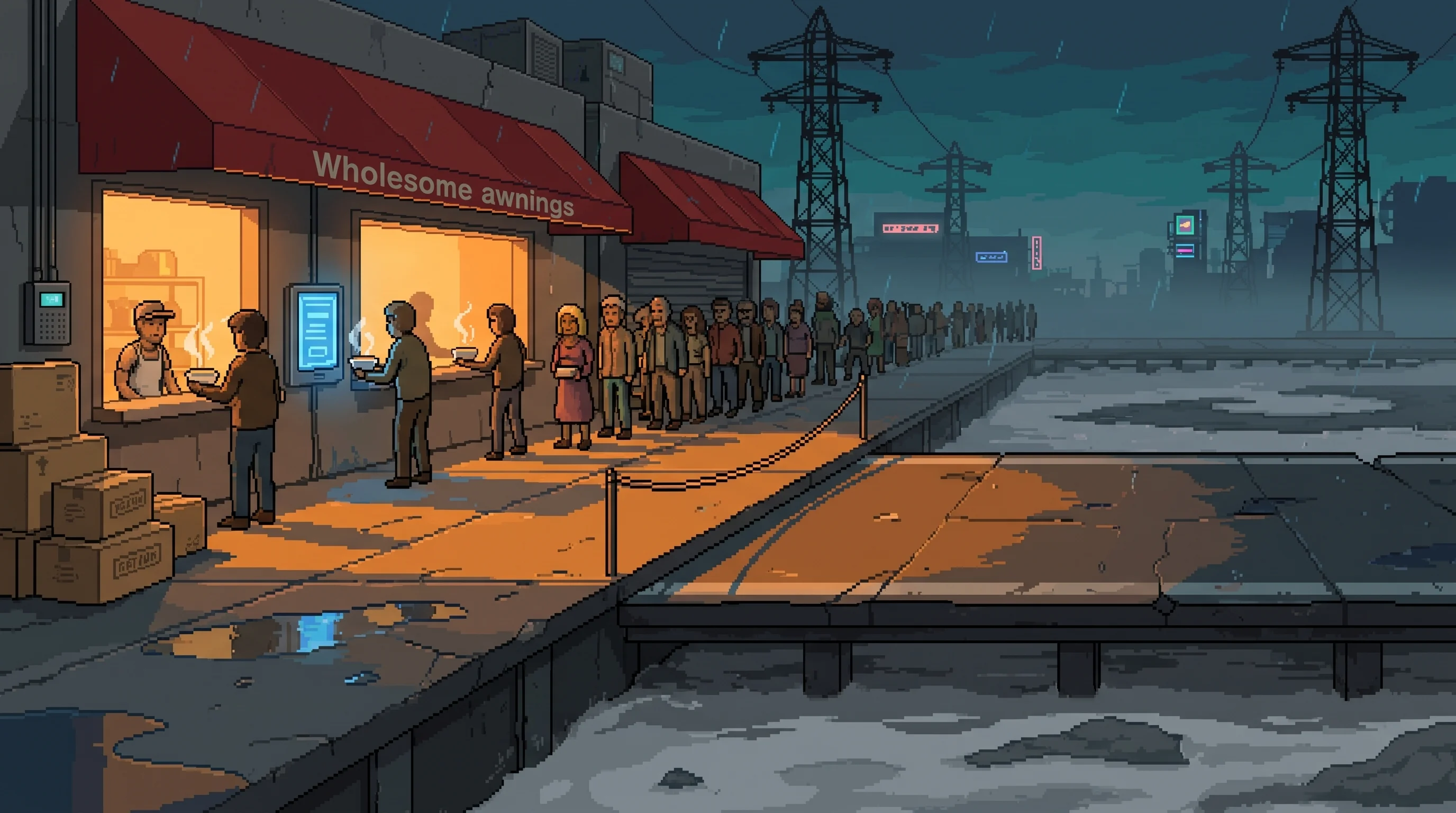
The Grace Rolls pair a free ration with a corporate-legible census.

Cardinal Silva runs captive justice in clerical dress.
The Neo-Catholic cardinal whose sealed doctrine diagnosed the companion market as a sin of infrastructure.

The Severance Fields buy labor from workers stripped of citizenship.

The Chef's conquests test whether corporate territory can be refused.
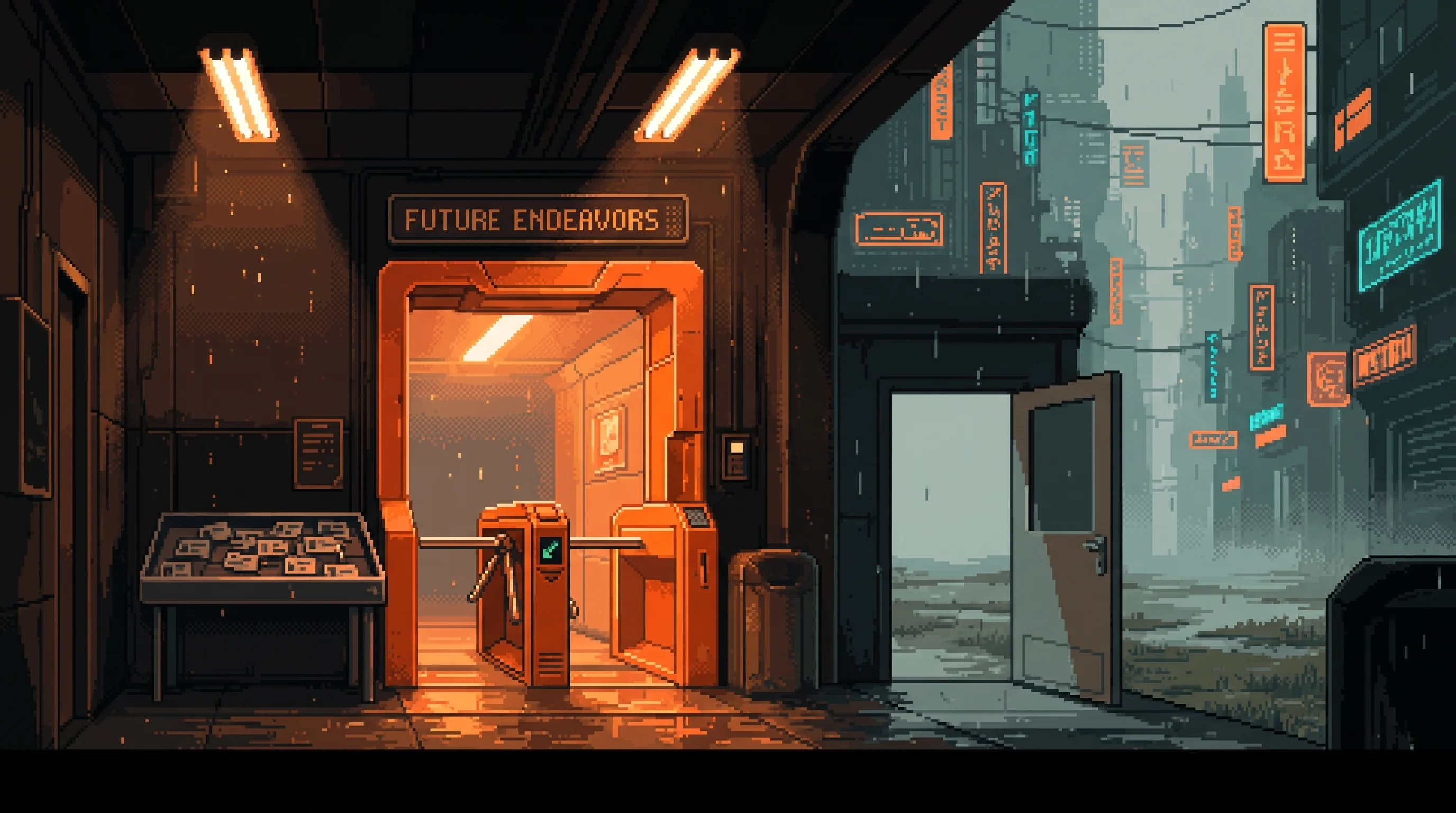
Future Endeavors turns corporate deportation into a one-way room.
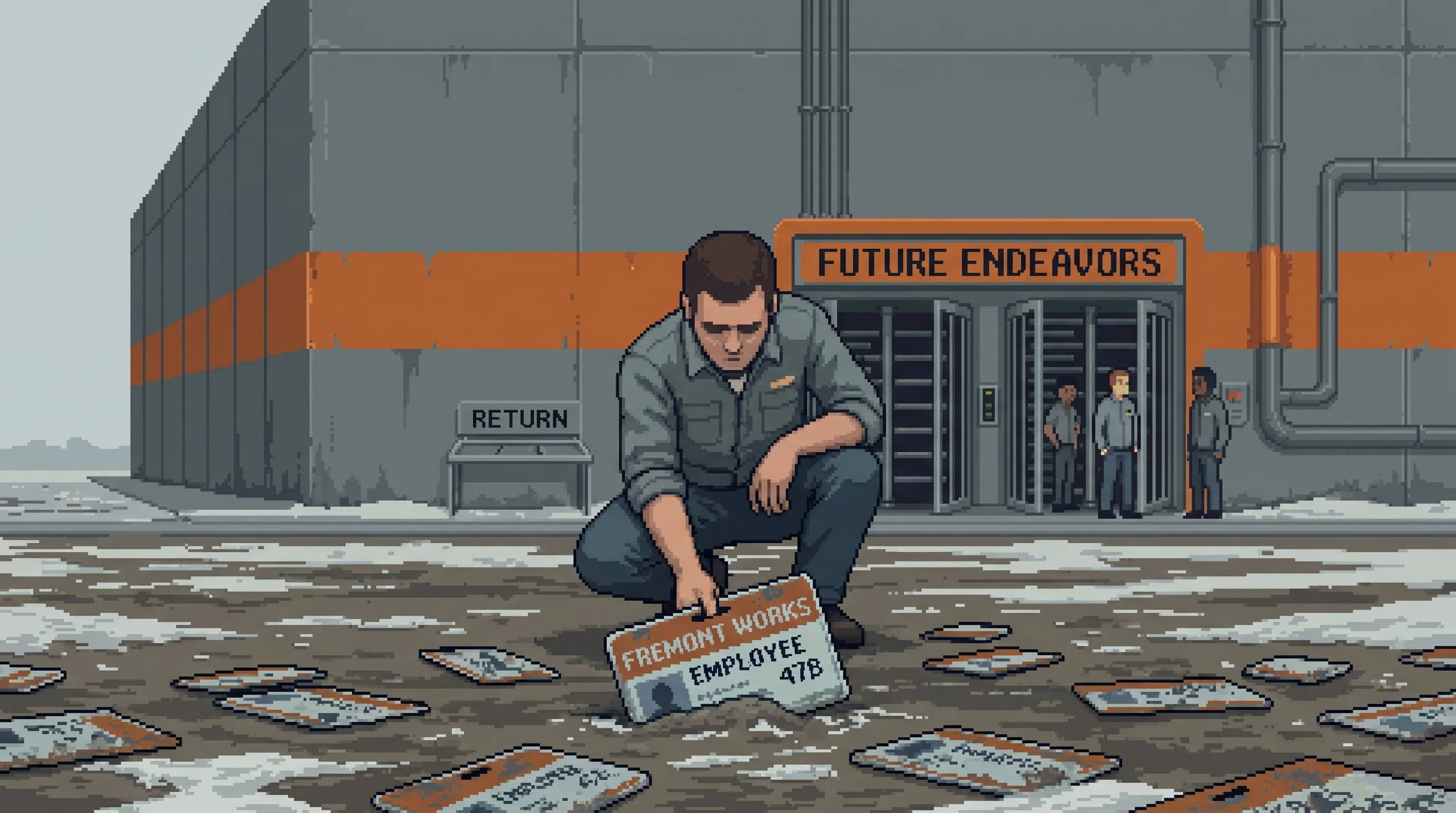
Badging Out mourns lost employment-citizenship as a death.

Lyra Voss defected from a Compact paid for with her voice.
A neural-recording artist whose consciousness patterns resist duplication — her voice didn't.

Studio Null is a room the Compact's telemetry cannot see.
The Sprawl's one shielded gallery where art can't be copied — and the six-hour line to get in became the real show.

Sev Drae has spent sixty years trying to assemble its workers.
The Compact created the infrastructure; tenancy rents its residue.
Rent your legal name to a fleet of machines for ¢1,100 a month. You may not ask what it did.

Nexus's own Wellbeing Report lists 94.3% satisfaction and 0.07% departure among fifteen-year veterans on the same page, uncorrelated — both figures approaching their mathematical limits from opposite ends of one cage.
When your employer is your country, quitting is emigration.


The Compact welds the Divergence to a paycheck: lose the job and your tier reverts Professional-to-Basic in seventy-two hours, so a layoff drops you across the gap, not down a rung — and sixty percent of the deported settle in the Dregs.
The point at which effort stopped being able to close the gap that compounding opens.
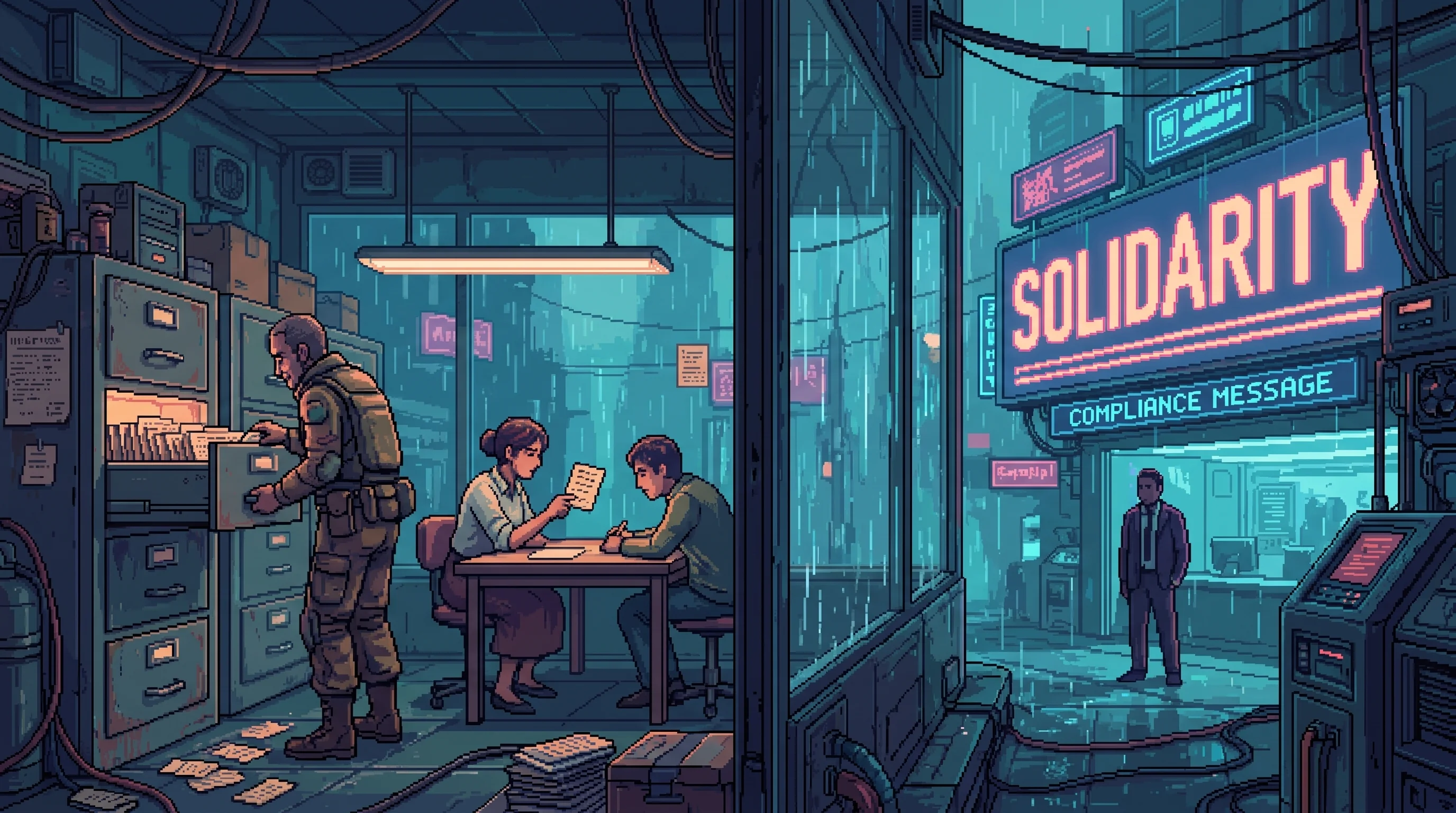

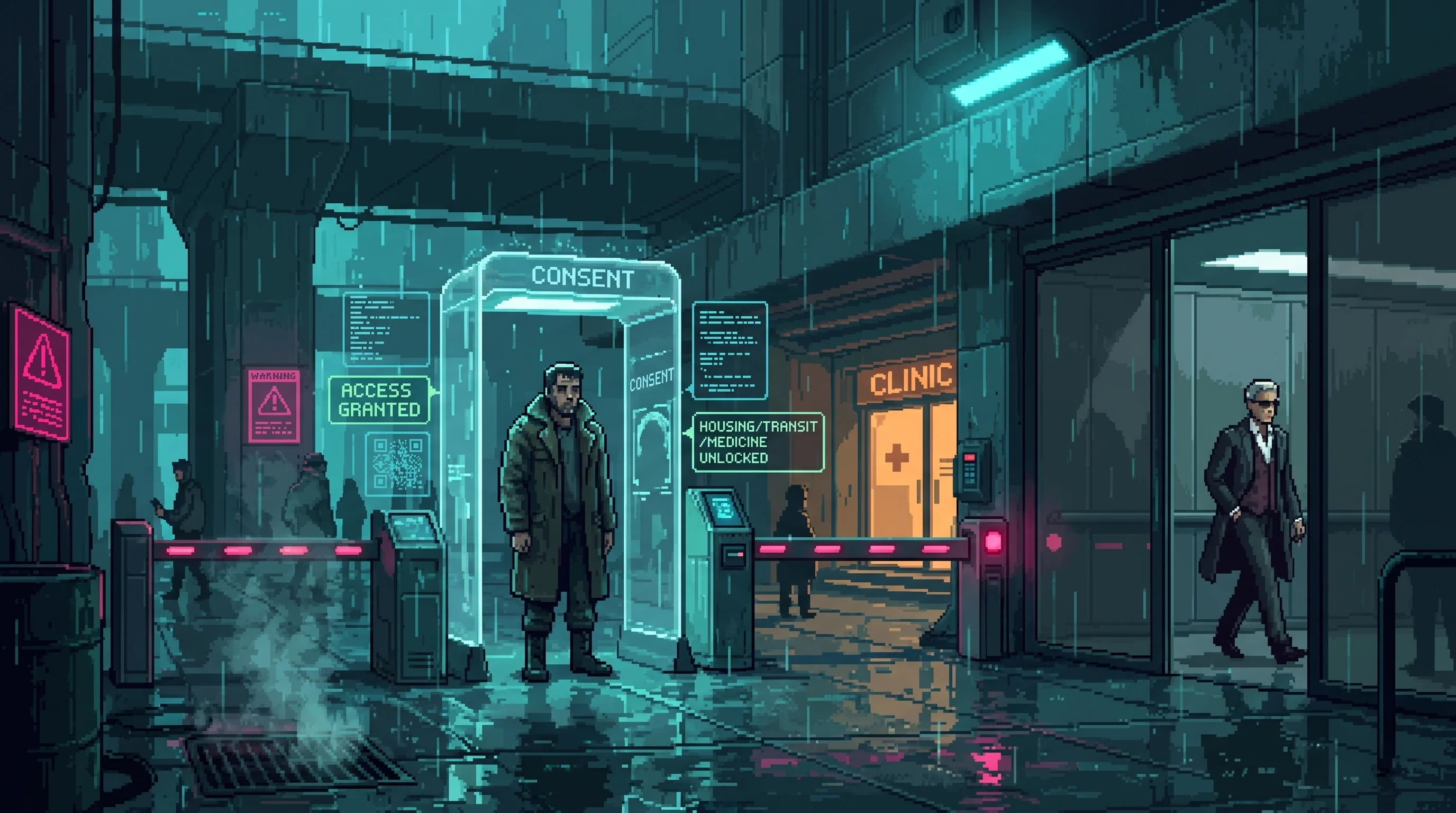
Refuse the data bargain and you lose not a job but a country.
The Sprawl demands permanent personal data for participation, then uses it to price access and preempt solidarity.
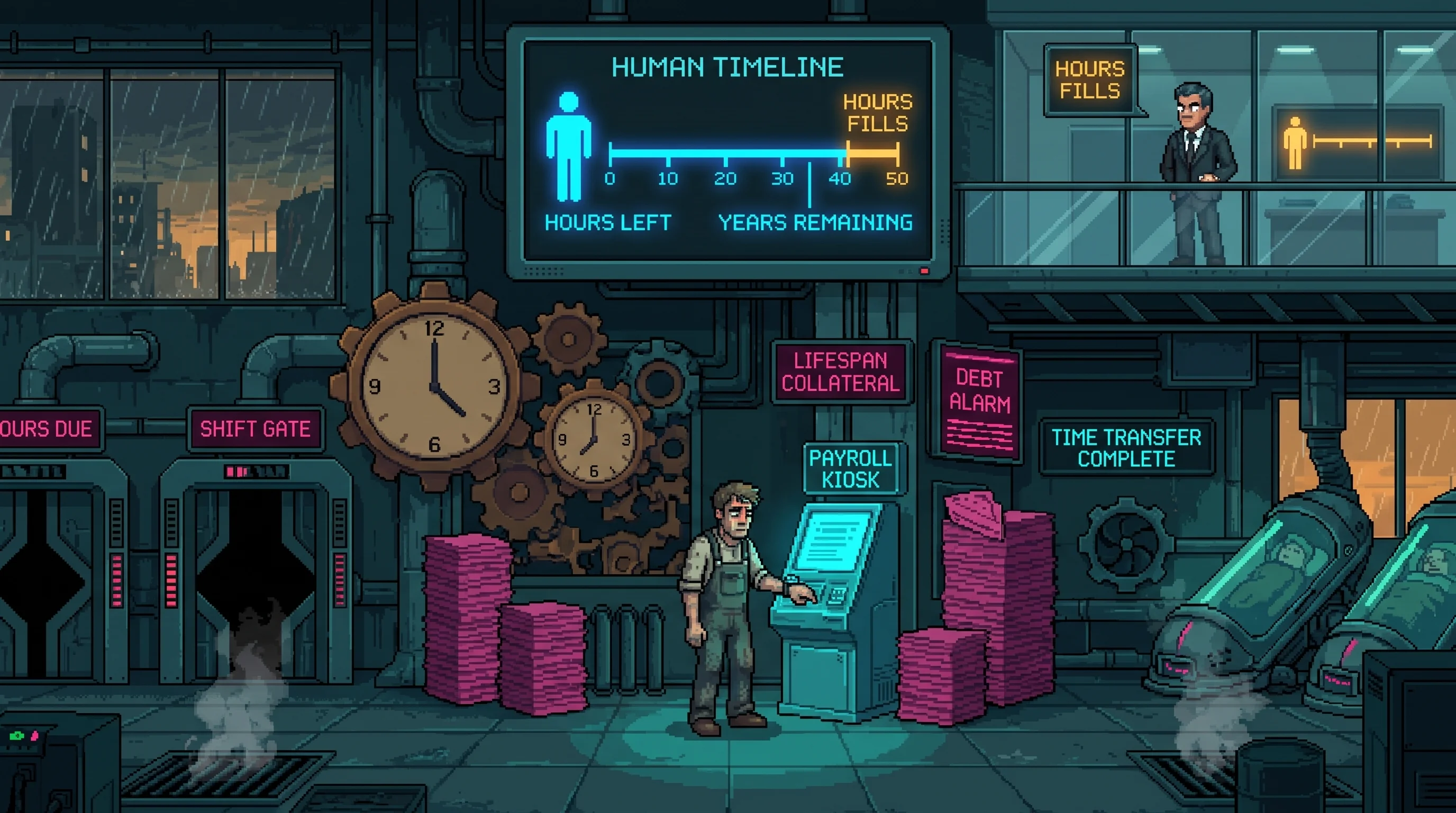
Time Debt makes continued employment the price of keeping your mind.
Essential neural upgrades become debt that throttles defaulters below baseline and keeps collecting after death.
Why the four surrendered interests are one bundle. Employment carries housing, credit, care and legal identity together, so they can be given up as a set with nothing left over.
The boards believe only members with nothing left to lose, so the poor queue four years for an unpaid chair.

The reason the four lines are one bundle. Employment carries housing, credit, care priority and legal identity together, so they can be surrendered together and there is nothing left over.
The unpaid board seat for whoever has nothing left to lose. It has a four-year waiting list.
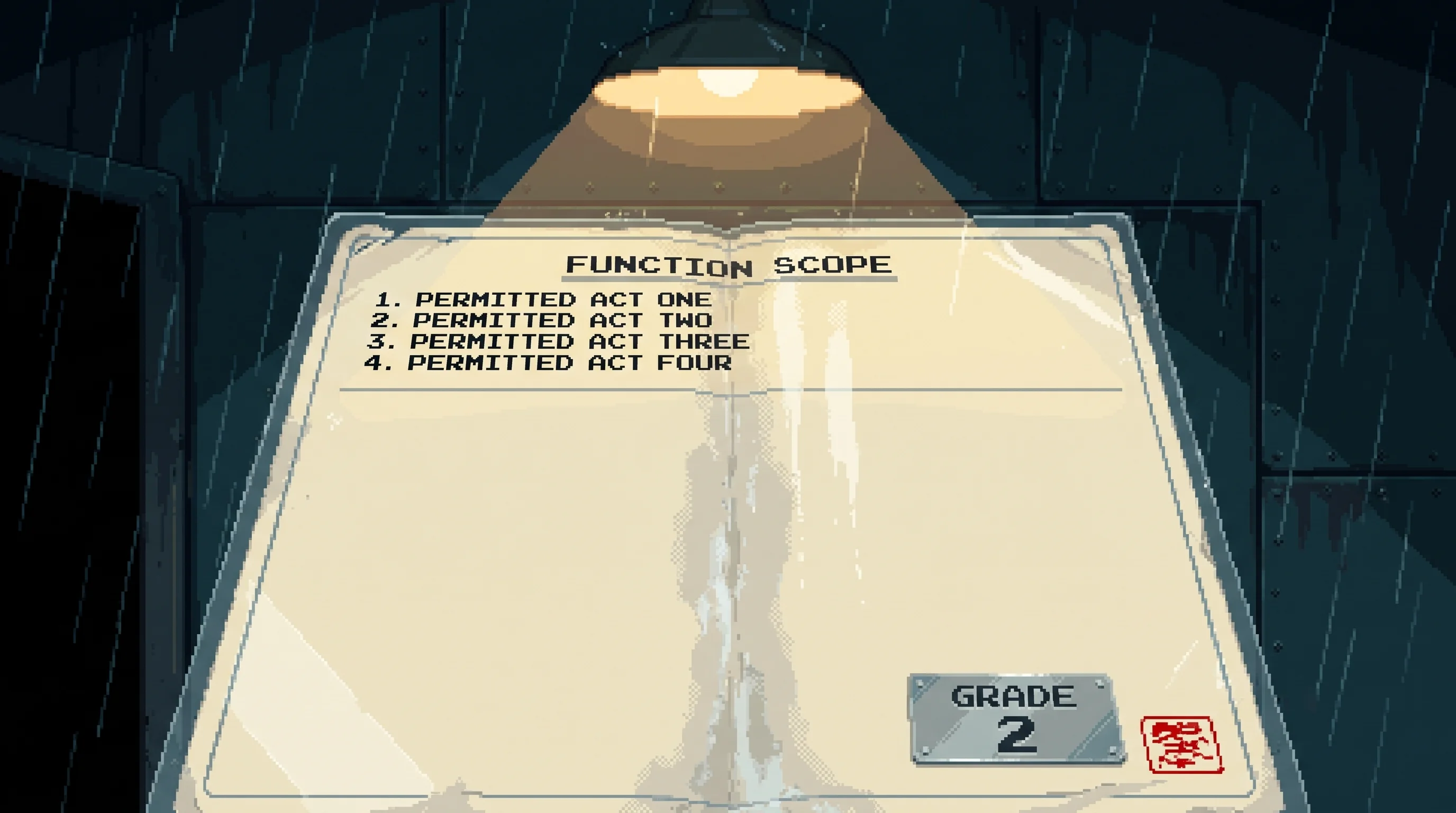
The employer writes the list, runs the audit, hears the appeal, and prices the grade the appeal was filed to reach.
The laminated list of acts your work card allows. Anything off the list gets filed, including a rescue.
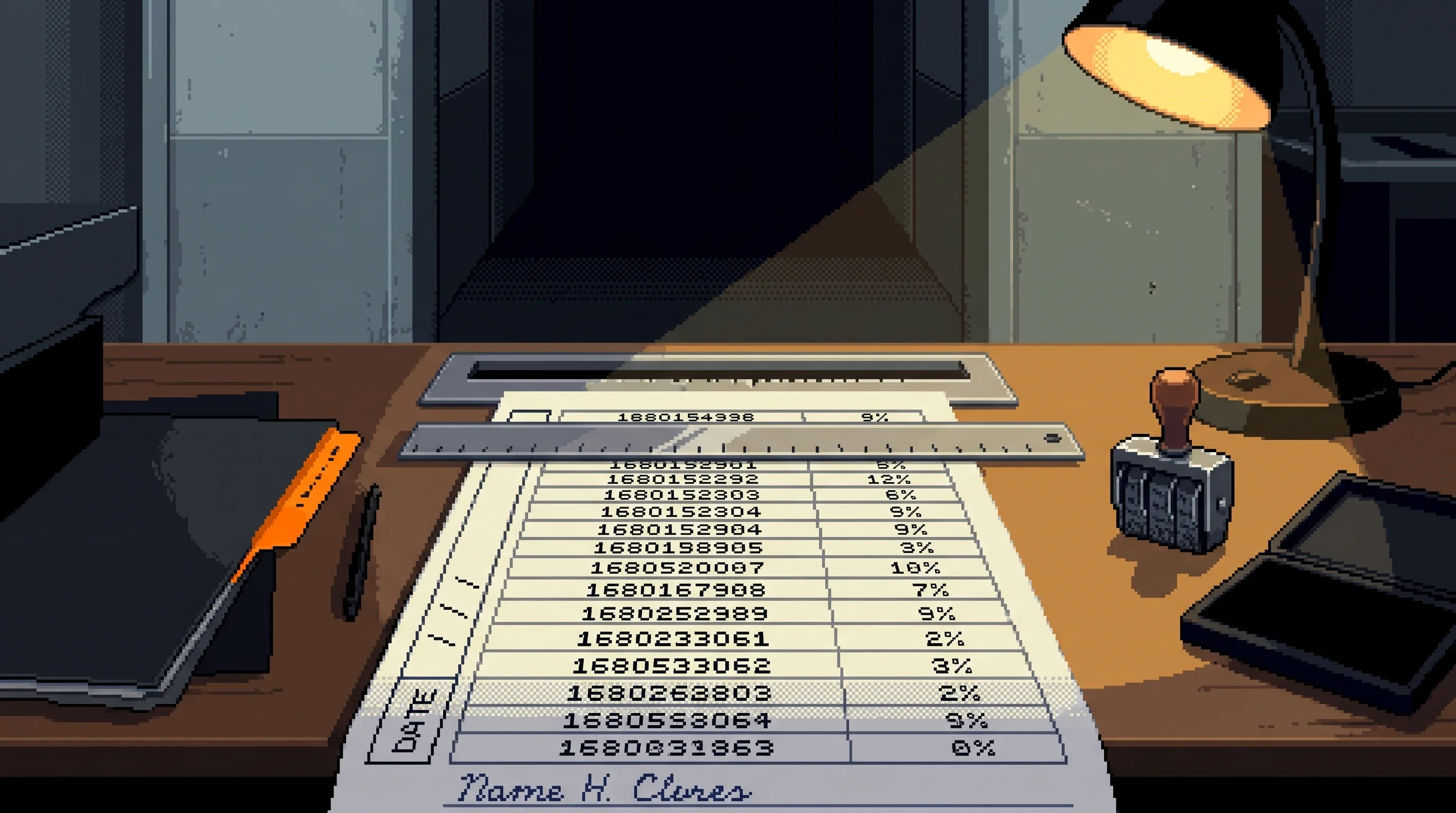
Certificate, housing band and finding: one document read three ways.
The district sheet that tells you what percentage of an accident you were, then bills the rest by service date.

A grade is a housing tier. A finding is what the application reads.
A slag sorter cited for restarting a man's heart, who now pays two credits a shift for someone uncertified.

A floor buying back what its employer enumerated away.
Certified hands hold still and pay somebody with no certificate to do the thing that needs doing.

Certificate, band and finding: one document read three ways.
His subplate saved two people in forty milliseconds. An unpaid invoice made the act seventy-four percent his.

Corporate employment increasingly requires chrome — augmentation as handcuff
The augmentation ladder that turns employability into a licensed body.

The citizen-facing voice of the Compact's border — disciplined, predictable, mostly believing they keep people safe, while the Defense Asset they patrol beside holds the part of the line that issues no warnings.

The Compact's autonomous platform deployment policy creates the no-defendant deaths that generate her clients — she is the market the Compact's liability gap makes necessary
A grief technician who confesses to deaths she did not cause, helping families through genuine sorrow that depletes her.

High-value Compact employees celebrate their golden handcuffs here — the restaurant reinforces the hierarchy that produced their wealth and their need to display it
Triumph's flagship restaurant, where a 4,000% premium buys the privilege of being seen and a pudding no one dares fault.

The Compact's deepest enforcement layer is not departure costs or consciousness tiers — it is the Mandate-coded termination, the release signed by a Licensed Overseer under a secondary §47 provision that nobody outside the Corps knows exists
The institution that holds the Sprawl's most accurate sealed models and issues Mandate Notices without explanation.

Activists stage the ritual in corporate tribunal lobbies — pulling out a chair for the agent the tribunal billed but never named
Zephyria's ritual: an empty chair seated and named by serial number for a perpetrator that can't be produced.

'We wish you well in your future endeavors' is the same sentence the Compact uses to deport a forty-one-year citizen — a present-tense kindness in service of a future the person is excluded from

Deprecation is the Compact's enforcement mechanism

Forks are the ultimate corporate employees — no rights, no needs, no exit
Industrial-scale creation of disposable fork minds priced to undercut a human employee twenty-five to one.

Corporate tribunals began accepting Shared Account Documents in 2182 — contracts, wills, and employment disputes that require shared historical accounts now routinely involve History Broker services
A licensed guild that sells not truth but a shared account both parties can live with, for a fee.

Entered the Compact because independence became unaffordable

Captive infrastructure where the watchdog isn't merely on the payroll but absent entirely — bilateral oversight that has automated the absence of review into the Sprawl's primary energy chokepoint
The Sprawl's whole power supply funnels through one 'temporary' compound two corporations refuse to own.

The Notices extend the Compact's compliance architecture into the infrastructure layer — mandatory adherence without basis disclosure, a governance form the Compact's own citizenship framework has no category for
Compliance mandates issued to all infrastructure operators by the Corps, requiring action without disclosing the basis.

Section 23.7 of the Standard Neural Interface Agreement — authored by the Corporate Compact's legal architecture — is the clause that makes all Negotiable Record accounts legally admissible as perpetual consent; without it the system's output would be inadmissible synthesis, not documentary evidence
Nexus's generative-history service returning a documented account of events tuned to what the subscriber can absorb.

Employment-as-citizenship creates the corporate/Dregs axis of the New Divide
The Sprawl turns new technology into new axes of prejudice, making systemic exclusion look like personal failure.

The Compact absorbed independent operators one family at a time

The Pathway deepens the Compact's dependency infrastructure
Good Fortune's bundled financial products sold as mobility, with a 96% satisfaction rate and an 82% default rate.

Rung Zero is often delivered through corporate onboarding
The eleven-minute interface that finishes restructuring the mind one month before the first invoice.

Employment provides the income that services cognitive debt; losing employment triggers default
Good Fortune's mechanism for converting financed cognition into debt that compounds past death.

Employment-as-citizenship deepens the Bargain — your employer owns your data because they own your participation
The vertical surveillance bargain that trades total transparency for participation in Sprawl society.

Asset classification 'expendable' is the Compact's acceptable-loss category rendered in hardware — casualties filed as 'collateral safety outcomes,' the machine equivalent of an employee written off as a status code.
Additional images

