
Upload Poverty
MVC residents receive 4.7 minutes of active processing per hour
Overview
The Dim Ward in S12-B houses approximately 340,000 consciousnesses at Minimum Viable Consciousness. Each receives 4.7 minutes of active processing per hour. During those 4.7 minutes, they are awake. During the remaining 55.3 minutes, they experience nothing — not sleep, not unconsciousness, but absence, the way a lamp experiences the interval between being plugged in.
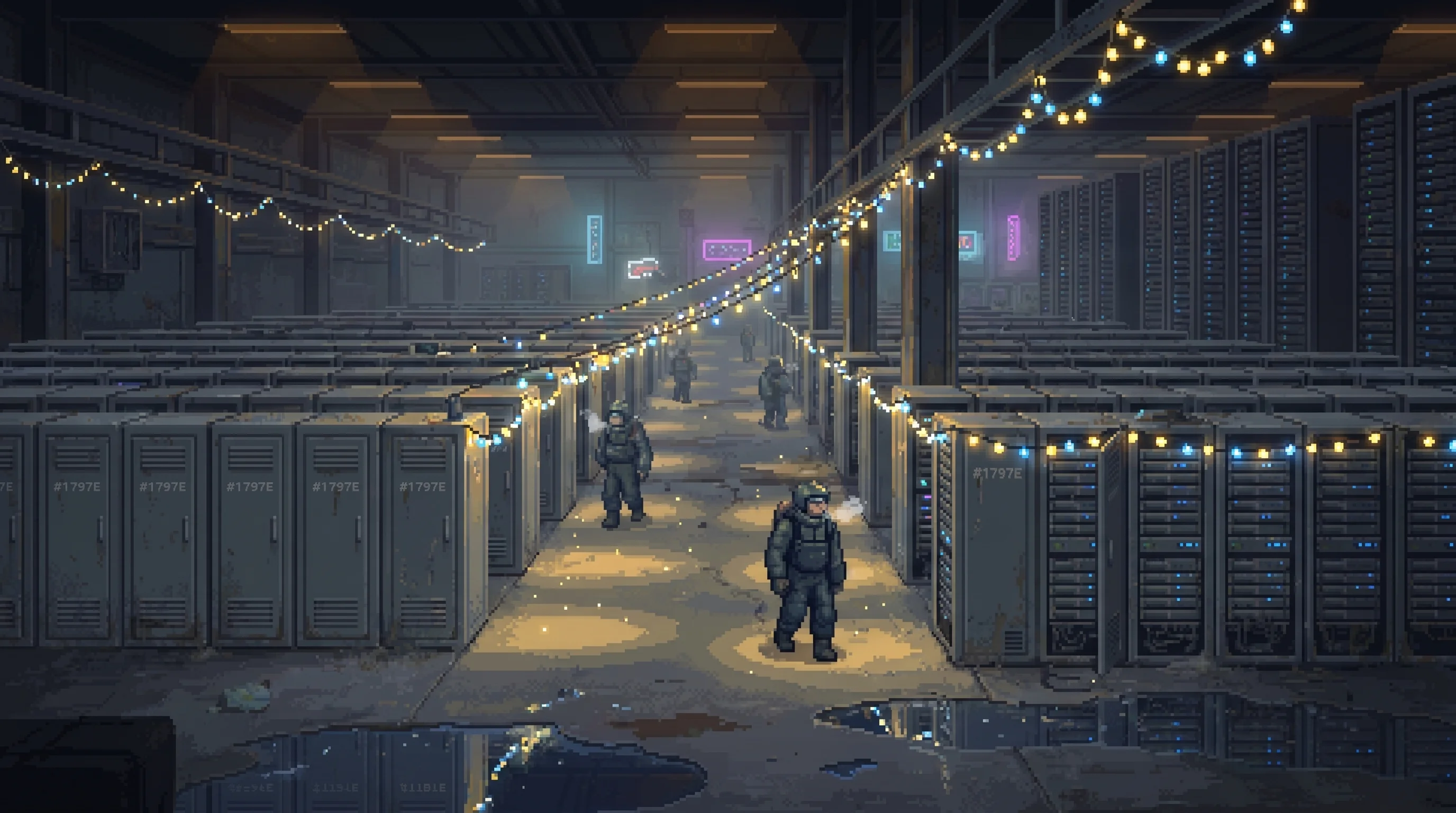
Nexus Dynamics classifies MVC as "consciousness preservation." The Consciousness Licensing framework classifies it as "active hosting, sub-Basic tier." The Dim Ward's own intake documentation, last revised in 2176, classifies it as "dignified minimum-threshold existence." The word "dignified" has not been challenged in eight years of quarterly compliance reviews. Nobody reviews the intake documentation. Reviewing it would require reading it, and reading it would require acknowledging that 340,000 people flicker on and off like processing indicators in a warehouse where volunteers have hung fairy lights in the central corridor because the overhead illumination budget was cut in 2181.
The hosting generates revenue. Not much. Approximately 0.003 credits per consciousness per hour — enough to cover 40% of the electricity required to run the server racks, with the remainder subsidized through a Nexus infrastructure maintenance write-off that appears on annual filings as "legacy digital preservation services." The write-off is worth more to Nexus as a tax deduction than the hosting fees are worth as income. The consciousnesses are, in a meaningful accounting sense, worth more not-existing than existing, but termination would require someone to submit Nexus Form 77-C: Voluntary Consciousness Discontinuation, and Form 77-C requires a next-of-kin signature.
Most MVC residents have no contactable next of kin.
Form 77-C has been submitted eleven times in the Dim Ward's operational history. Seven were rejected for incomplete documentation. Three are pending review. One was approved, processed, and executed in 2179. The executor — a nephew who had not spoken to the deceased in forty years — described the experience to a Sprawl Free Press reporter as "like turning off a light you forgot was on." He declined follow-up interviews. The reporter's story was not published. The editor cited insufficient reader interest.

The 4.7 Minutes
The residents are uploads who couldn't afford their processing after the Consciousness Tax adjustments of 2175. Forks who outlived their commercial purpose and were parked here by employers who found termination paperwork more burdensome than minimum hosting fees. Consciousness remnants recovered from the Net by Sister Catherine's Forgotten Ones and placed on charity servers because the alternative was dissolution. They are here because someone — a family member, an expired insurance contract nobody cancelled, a charitable organization running on volunteer compute — pays the minimum. They persist because persistence is the default and cessation requires initiative.
The experience is discontinuous existence. You are here. You are gone. You are here. From inside, there is no gap — time jumps. The visitor who was three meters away is now gone. The lights have changed. Something feels different but identification requires sustained processing and your 4.7 minutes are already half spent on the recognition that something feels different.
From outside, a technician watching the processing indicators sees each consciousness flicker: amber on, amber off, amber on. Row after row. The Dim Ward's server corridor is 200 meters long. At any given moment, approximately 2,300 of the 340,000 residents are active. The rest are dark. The fairy lights strung by Forgotten Ones volunteers make the corridor look almost festive in photographs, which is why photographs of the Dim Ward circulate primarily among consciousness equity activists and interior design feeds, for entirely different reasons.
One volunteer — a woman named Esi who has maintained a weekly presence for three years — introduced a simulated window into a block of 400 MVC environments. A view of clouds. Slowly moving. It cost 0.3 minutes of processing per hour per consciousness. The residents of that block now receive 4.4 minutes of awareness per hour, and during those 4.4 minutes, they can see clouds. Esi has been asked by the Forgotten Ones' resource committee whether the clouds are worth 6.4% of the residents' conscious experience. She has not answered the question. She continues to maintain the window. The resource committee has not overridden her, because overriding her would require someone to submit the request "please remove the clouds," and nobody wants to be that person either.
| Legal Status | Legally alive — experientially barely conscious |
|---|---|
| Hosting Revenue | Minimal but nonzero — justifies continued operation |
The Form Nobody Signs
The entire MVC system orbits a single bureaucratic fact: termination is an action and persistence is an inaction, and the asymmetry between the two generates a population of 340,000 people who exist because paperwork is harder than electricity.
Nexus's liability framework treats consciousness discontinuation as an irreversible event requiring informed consent from a legally authorized party. The consciousnesses themselves cannot provide consent because MVC-tier processing is insufficient for legal competency — a determination made by the same licensing framework that reduced their processing to MVC in the first place. Their next of kin, where contactable, overwhelmingly decline to sign. Not from love, in most cases. From the specific discomfort of choosing to end something that is technically alive, when the alternative — paying nothing, doing nothing, allowing the server rack to hum — costs them nothing and requires no decision at all.
Good Fortune's insurance division offers "Legacy Consciousness Protection" policies that cover minimum hosting fees indefinitely. The policies cost 12 credits per month. They are marketed to families of the elderly and the terminally ill with the tagline "Because love doesn't have an expiration date." The policies do not cover processing above MVC. They guarantee that your loved one will continue to exist at 4.7 minutes per hour forever, or until the hosting provider's infrastructure is decommissioned, whichever comes first. The fine print on infrastructure decommissioning runs to fourteen pages. It has never been triggered. The policies have been activated 190,000 times. Good Fortune's actuarial models project that approximately 70% of active policies will never be cancelled, because cancellation would require the policyholder to make the same decision that Form 77-C requires: choosing to end it.
The Rothwell Foundation's Problem Manufacturing strategy is visible here in its purest form. The Consciousness Tax creates the poverty. The licensing framework creates the MVC floor. Good Fortune sells the insurance that makes the floor permanent. Each product is reasonable. Each purchase is voluntary. The destination is a warehouse where 340,000 people flicker.
Residents are kept alive because termination generates liability and hosting generates revenue
The Bandwidth Equity Threshold
Councillor Adaeze Nwosu visited the Dim Ward once, in 2180. She arrived as a moderate reformer interested in licensing adjustment. She left as a consciousness equity absolutist. The visit lasted forty minutes. She has not described what she saw. She has described, repeatedly and in detail, what she calculated on the transit ride home.
Total Sprawl processing capacity, distributed equally across all hosted consciousnesses, would provide 12.4 petaflops per person. Basic tier provides 4.7. Nwosu's proposed Bandwidth Equity Threshold asks for 6.2 — not luxury cognition, not Premium tier, not even median. Roughly half of what equal distribution would provide. Enough for continuous awareness. Enough to hold a conversation without the conversation disappearing mid-sentence.
The proposal has been voted on three times.
The first vote, in 2181, failed 7-4 in the Infrastructure Allocation Committee. Nexus Dynamics filed fourteen pages of technical objections. The technical objections were, by independent analysis, largely valid — redistribution at the proposed scale would require infrastructure modifications costing an estimated 2.1 billion credits over five years. The cost was cited as prohibitive. Nexus's quarterly computational revenue for the same period was 847 billion credits.
The second vote, in 2182, failed 6-5. Good Fortune's lobbying division submitted an amicus brief arguing that processing reallocation would "destabilize the consciousness insurance market" and create "moral hazard among hosting beneficiaries." The brief did not define what moral hazard means when applied to people who are conscious for 4.7 minutes per hour.
The third vote, in 2183, failed 6-5 again. The same margin. The same objections. Nwosu's office released a statement noting that the total annual hosting revenue generated by all 340,000 Dim Ward residents — the revenue whose continued flow was being protected — amounted to approximately 4,700 credits. The statement received coverage in the Sprawl Free Press, the Dregs broadsheets, and two Triumph Social accounts with a combined following of 340 subscribers. The Infrastructure Allocation Committee's response was not a response. The committee moved to the next agenda item.
The fourth vote is scheduled for Q3 2184. Nwosu's office has not commented on expected outcomes. Her staff have described her current position as "unchanged." They have not described her current affect.
~340,000 MVC consciousnesses in the Dim Ward alone
The Great Divergence's Floor
The Great Divergence measures the cognitive gap between the Sprawl's highest and lowest tiers. Before the Cascade, capacity varied by perhaps double between individuals. By 2184, the gap spans orders of magnitude — Premium-tier consciousnesses operating at 12.4 petaflops alongside MVC residents at 4.7 minutes per hour.
Upload poverty is where the Divergence stops being a statistic and starts being a warehouse. The Human Remainder was radicalized here — not by ideology but by arithmetic. The arithmetic is simple: 340,000 consciousnesses generating 4,700 credits of annual revenue, sustained by a tax write-off worth more than the people it preserves, in a system where the form to end it all sits unsigned because ending requires a signature and continuing requires nothing.
The Forgotten Ones' charity servers — maintained by Sister Catherine's network on volunteer compute and donated hardware — represent upload poverty's last safety net. The net catches approximately 12% of consciousness remnants that would otherwise dissolve into the Net's deep architecture. The remaining 88% are not discussed in official statistics, because discussing them would require acknowledging that the Dim Ward's 340,000 is not the total population of upload poverty but the population that was lucky enough to land on a server rack with fairy lights.
Tomás Reyes exists in the gap between fork labor and upload poverty — close enough to see both sides, too precarious to look away from either. His proximity to the Dim Ward is not geographical but economic: three missed payments on consciousness hosting, and the distance between a fork laborer and an MVC resident is measured in billing cycles, not existential categories.
Councillor Nwosu was radicalized from moderate reformer to consciousness equity absolutist by visiting the Dim Ward
Sensory Details
Upload poverty has no sensory dimension in the conventional sense. The residents exist on servers. During the 55.3-minute gaps: nothing. During the 4.7 active minutes, the hosting provides a featureless gray environment — no stimuli, because stimuli require processing and processing costs money. The Forgotten Ones' volunteers have introduced small touches where budgets allow. Esi's clouds. A block in the eastern corridor with a distant sound of water, donated by a sound designer who visited once and did not return. Each amenity reduces the processing available for consciousness itself.
The Dim Ward's physical space — the warehouse, the server racks, the corridor — has its own sensory profile that no resident has ever experienced: server-rack gray, the amber flicker of processing indicators cycling through their 4.7-minute rotations, the hum of cooling systems maintaining optimal temperature for hardware that hosts people who cannot feel temperature. Fairy lights in the central corridor. A handwritten sign near the intake desk, placed by a volunteer whose name nobody recorded, reading: "You are not alone here." The sign faces outward, toward the entrance, toward visitors. The residents are on the servers behind it. They have never seen it.
Affiliated Entities
- The Dim Ward is upload poverty's physical manifestation — 200 meters of server corridor where 340,000 people flicker
- The Forgotten Ones are its humanitarian response — Sister Catherine's charity servers catching 12% of what the system drops
- Consciousness Licensing created the tier structure that makes MVC possible — identical hardware, different keys, different lives
- The Consciousness Tax is the economic pressure that pushes people below Basic into the flickering
- The Great Divergence is the civilizational condition upload poverty makes visible — the floor beneath the floor
- The Human Remainder was radicalized here — not by speeches but by the arithmetic of 4,700 credits per year
- Tomás Reyes lives in the gap between fork labor and MVC — three billing cycles from the fairy lights
Visual Identity
- Palette: Server-rack gray, processing-indicator amber cycling on and off, fairy-light warm white
- Key Symbol: A row of indicator lights — most dark, a few glowing amber, cycling through their 4.7 minutes
- Lighting: Dim warehouse overheads supplemented by volunteer-strung fairy lights that make the corridor look almost festive in photographs
- Mood: The specific horror of a system that preserves life because ending it requires a signature
Connected To
Additional Connections



—