
The Blistered
Founded in 2183 from the overlap between Studio Null's electromagnetic silence and the observation that the last genuinely new art emerged from failure
Overview
They call themselves The Blistered because the work hurts.
The movement emerged in 2183 from a simple, embarrassing observation: the last time anyone in the Neon Graves produced something genuinely new — not excellent, not moving, not even good, but new — was when someone made something badly.
The founding insight came from the overlap between Studio Null's electromagnetic silence and the growing recognition that the Sprawl's creative culture had entered a condition the critic Orin Slade would later call aesthetic fossilization: infinite sophisticated variation on a fixed set of aesthetic axioms, with zero genuine mutation. Every aesthetic form currently practiced descends, through traceable lineage, from pre-Cascade or early post-Cascade innovation. The variations are spectacular. The genome is closed.
The Blistered noticed what the Blank Canvas Movement — their upstairs neighbors, their philosophical kin — did not: destruction is the wrong surgery. The problem isn't that art gets copied. The problem is that art has stopped mutating. And mutations don't come from destruction. They come from failure.
How It Works
The Blistered create without AI, without neural composition, without the Synthesis Guild's quality infrastructure, without any system designed to close the gap between what you intend and what you produce. They work with found materials, untrained hands, instruments they don't know how to play, media they haven't studied. The results are, by any conventional measure, terrible. Paintings that don't cohere. Music that can't hold a rhythm. Sculptures that collapse under their own weight.
But occasionally — in approximately one piece out of forty — the failure produces something that has never existed before. A harmonic relationship no trained musician would discover because no trained musician would make that specific mistake. A visual composition that violates every principle of design and yet produces an emotional response designed composition cannot achieve. A material relationship between salvaged wire and recycled glass that suggests a possibility no artist who understood materials would have explored.
These pieces are not good. They are not moving. They are not commercially viable. They are mutations — new aesthetic genes introduced into the cultural genome through the only mechanism that has ever produced them: human beings struggling with material they don't fully control and discovering, in the gap between intention and execution, something that wasn't supposed to be there.
The output ratio — one possible mutation per forty attempts — is consistent with mutation rates in biological evolution. The Blistered don't exhibit. They don't sell. They don't destroy. They accumulate, in a room that smells of wet clay and failed experiments, the raw material from which the next century's aesthetic forms might grow. Or might not. Seeds without soil.
| Philosophy | Aesthetic mutation requires the gap between intention and execution. Close the gap and the mutations stop. Keep it open by failing. |
|---|---|
| Output Ratio | ~1 possible mutation per 40 attempts — consistent with biological mutation rates |
| Key Distinction | The Blank Canvas Movement destroys art to prevent commodification. The Blistered create terrible art because aesthetic evolution requires failure. |
| Aristocratic Threat | The one cultural force the Taste Aristocracy's evaluative framework literally cannot perceive — novelty outside inherited categories |
The Practitioners
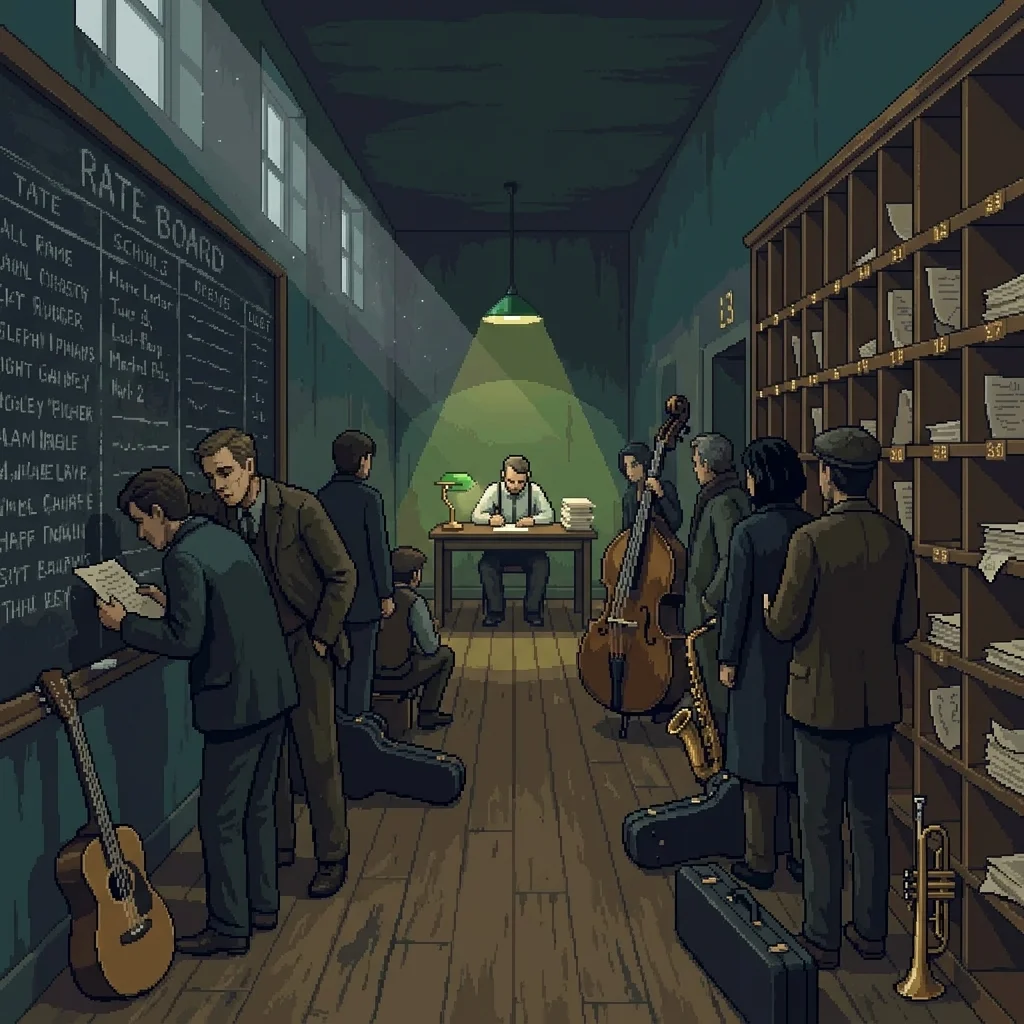
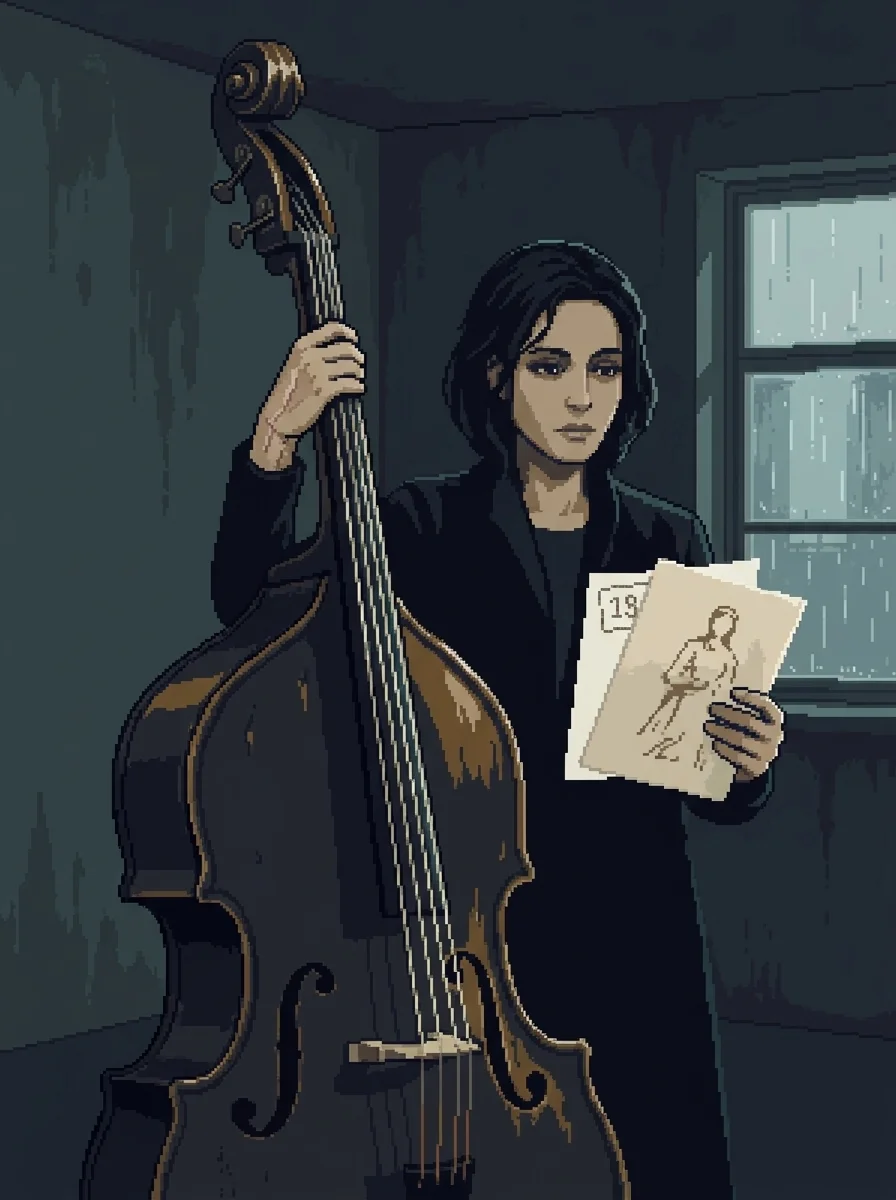
Approximately thirty people work in the sub-basement beneath Studio Null — a converted maintenance space the Blank Canvas Movement tolerates without endorsing. The practitioners come from every stratum: a former Nexus janitor, a deprecated Helix lab assistant, two Analog School graduates, a drift-runner who couldn't go back to the Lattice, a former Curators Guild assessor who lost the ability to classify and gained the ability to be surprised. What they share is the willingness to make terrible art with fierce attention.
The deprecated Helix lab assistant on that roster came by the title honestly. The Deprecation took her pharmaceutical-synthesis pathways dark eighteen months before she found the basement. Reversion left her running two concurrent thoughts where Professional tier once held twelve, her productivity settling at the 31% the actuarial models predicted. What the models don't measure is what's left once the curve bottoms out. Her hands still move. They move worse, without the tier's precision governing them, which is the only reason the failures they produce are hers instead of the firmware's. She reached the sub-basement the way several others did, carrying a reversion the corporation had already filed as a reintegration statistic and stopped tracking the quarter it stopped being flattering. The Blistered didn't recruit them for their politics. Corporate reversion just happens to manufacture exactly the kind of untrained hand the movement's whole method depends on.
The most discussed piece — a construction of salvaged fiber-optic cable and medical tubing by a former Nexus janitor named Tal — has been in progress for seven months. The fiber-optic strands carry residual charge that produces a dim amber pulse. The construction is ugly. It is clumsy. It contains a spatial relationship between light, translucency, and structural tension that Orin Slade, in his single visit, had never encountered in forty years of criticism.
Whether Tal's construction is a genuine aesthetic mutation or merely an unusual variation is the kind of question that might take decades to answer. Mutations reveal themselves slowly — through the specific quality of not fitting — and the Blistered have the patience of gardeners. They are planting seeds in the dark. They don't know what will grow.
~30 active practitioners working with found materials, untrained hands, and instruments they don't know how to play
Strategic Assessment
The Blistered embody the deepest challenge to both sides of the Craft War. They agree with the Blank Canvas Movement that AI-mediated art has a problem — but the problem isn't authenticity, it's fossilization. They agree with Kael Mercer that synthetic creativity produces beautiful work — but beauty isn't the same as novelty, and novelty is what cultural evolution requires.
Their practice inverts every creative value the Sprawl holds: where the Sprawl values excellence, they value failure. Where the Sprawl values productivity, they value accumulation. Where the Sprawl values the gap between intention and execution being closed, they value the gap being held open — because the gap is where mutations live.
The biological metaphor is precise: cultural evolution requires genetic mutation, which requires replication errors. AI creativity is high-fidelity replication with near-zero error rate. The Blistered are a deliberate introduction of error into the cultural genome. Most errors produce nothing. A few produce the seeds of forms that don't exist yet.
The Anti-Inheritance
The Blistered are the Taste Aristocracy's immune response. Not a rebellion — rebellions can be co-opted. An immune response — the cultural organism producing antibodies against the monoculture that threatens it.
Their work is deliberately unjudgeable by Guild standards because it occupies aesthetic space the Guild's inherited frameworks cannot parse. The Authenticity Tribunal cannot classify it — not because the work is bad (the Tribunal classifies plenty of bad work) but because it operates outside every category the Tribunal uses. The classification system assumes art exists on a spectrum from synthetic to authentic. The Blistered's work doesn't claim authenticity. It claims novelty — and novelty is not a tier, because recognizing the genuinely unprecedented requires evaluative authority that can perceive what has never been seen before. That authority, in the Tribunal's framework, can only be inherited from frameworks built on what has already been seen.
The Taste Aristocracy can survive competition from below (outsiders developing taste through struggle). It can survive challenges from technology (AI curation matching human selection). What it cannot survive is a source of cultural value that its evaluative framework literally cannot perceive. The Blistered are that source. They are the mutation the monoculture produces despite itself, and because the aristocracy's blindness to them is structural, not strategic, no institutional reform can fix it.
Output ratio of approximately 1 possible aesthetic mutation per 40 attempts
Affiliated Entities
- The Blank Canvas Movement: Upstairs neighbors, philosophical kin, different diagnosis. The Movement treats the copy problem with destruction. The Blistered treat the fossilization problem with failure.
- Studio Null: The sub-basement beneath — six meters of concrete separating destruction art from mutation art
- Neon Graves: The district where Gallery Row's polished variations stand six meters above the Blistered's raw mutations
- Orin Slade: Visited once. Four words: "Something is still alive."
- Kael Mercer: The variation machine they exist in opposition to — not his quality, but his closure of the mutation-producing gap
- Lyra Voss: Parallel approach — both produce mutations through struggle, but Lyra struggles through excellence and the Blistered through deliberate failure
- The Authenticity Tribunal: Cannot see the Blistered's work because mutations don't fit existing classification categories
- The Deprecation: Supplies several of the sub-basement's practitioners. Corporate reversion strips their neural precision, and that stripped-down hand is the raw material the movement's failure-method runs on
The Invisibility Shield
The Blistered trigger APR — Anomalous Pattern Review — at 100%. Every piece. Not because the Tribunal suspects AI involvement but because the assessment system cannot classify work that fits no known tier. The unclassifiable routes to review by default. Review averages 47 days. In a creative economy where relevance has a shelf life measured in weeks, a 47-day hold is a functional death sentence.
Except the Blistered don't sell through the Tribunal's marketplace. They don't sell at all. They accumulate raw mutations in a room that smells of wet clay and failed experiments.
The selection paradox — the Tribunal's artificial selection against creative diversity — cannot operate on artists who never enter the system. The Blistered's poverty, their refusal to participate in the certified market, their deliberate ugliness that no gallery would display and no collector would frame — these are the conditions that accidentally protect them from the institutional pressure killing creative evolution everywhere else.
The garden wall is the only thing keeping the wildflowers alive. The wildflowers didn't choose to be outside the wall. They grew where the gardener's attention couldn't reach. Their invisibility to the Tribunal's classification system is not a limitation — it is the mechanism of their survival. The mutations continue because the selection pressure cannot find them.
The irony maps precisely: the Tribunal was built to protect human creativity from synthetic substitution. The only confirmed source of genuinely novel human creativity in the Sprawl is invisible to the Tribunal's methodology, unreachable by its jurisdiction, and thriving specifically because the institution designed to protect it cannot see it.
Named 'The Blistered' because the work hurts — both the making and the looking
Restricted Access
- The Amber Pulse: Tal's seven-month construction contains fiber-optic strands that pulse at 47 Hz — the same frequency as fragment communication protocols and Fen Morrow's dream recordings. Nobody has investigated whether this is coincidence, resonance, or something else.
- Ines's Notebooks: The Blank Canvas Movement's founder has visited three times and says nothing to her own practitioners about what she saw. Whether the Blistered represent a challenge to her philosophy or its natural evolution is a question she hasn't answered, possibly because answering it would change everything.
- The Selection Problem: Mutations need selection pressure to become viable aesthetics — audiences, critics, the commercial pressure that turns a raw mutation into a genre. The Blistered have none of these. Their mutations accumulate without selection. Whether unselected mutations can ever become living aesthetic forms is an open question with implications that extend far beyond art.
Sensory Details
- Smell: Wet clay, copper filings, the chemical tang of recycled solvents, the particular mustiness of a basement that never fully dries. The air is warmer than Studio Null above — heat from the Grid infrastructure beneath
- Sound: Scraping, tapping, the arrhythmic sound of instruments played by people who don't know how to play them. Occasional silence when someone stops and looks at what they've made. The silence is different from Studio Null's electromagnetic quiet — it's the silence of not-knowing
- Touch: Everything has texture — rough, unfinished, the opposite of the polished surfaces in the galleries above. Materials that resist the hand. Tools that don't work the way they're supposed to
- Sight: Dim amber from residual charge in salvaged electronics. Walls lined with failed pieces that nobody has removed because nobody knows which failures might be mutations. The room looks like a cross between a laboratory and a junkyard
Do not exhibit, sell, or destroy — they accumulate raw mutations in a room that smells of wet clay and failed experiments
Visual Identity
- Color Palette: Amber residual glow, wet-clay brown, copper-green patina, the gray of salvaged metal
- Compositional Mood: Productive chaos — not the curated mess of an artist's studio but the genuine disorder of a space where nothing is working as intended
- Key Symbol: A cracked mold — the failure that reveals a form nobody planned
- Lighting: Dim, warm, uneven — the opposite of Gallery Row's careful illumination
Local Intelligence Scan
Nearby Signals
CANONICAL PROXIMITY



Environmental Readout
LIVE CONDITIONS- Air
- Toxic
- Light
- Shadowed
- Flood
- No exposure
- Heat
- Temperate
- Security posture
- Patrolled
- Infrastructure
- Patchwork
Position Data
SECONDARY- Elevation band
- Shoreline — the Rim edge
- Lattice fix
- E+0.4 · N-5.8
Connected To
Major Connections
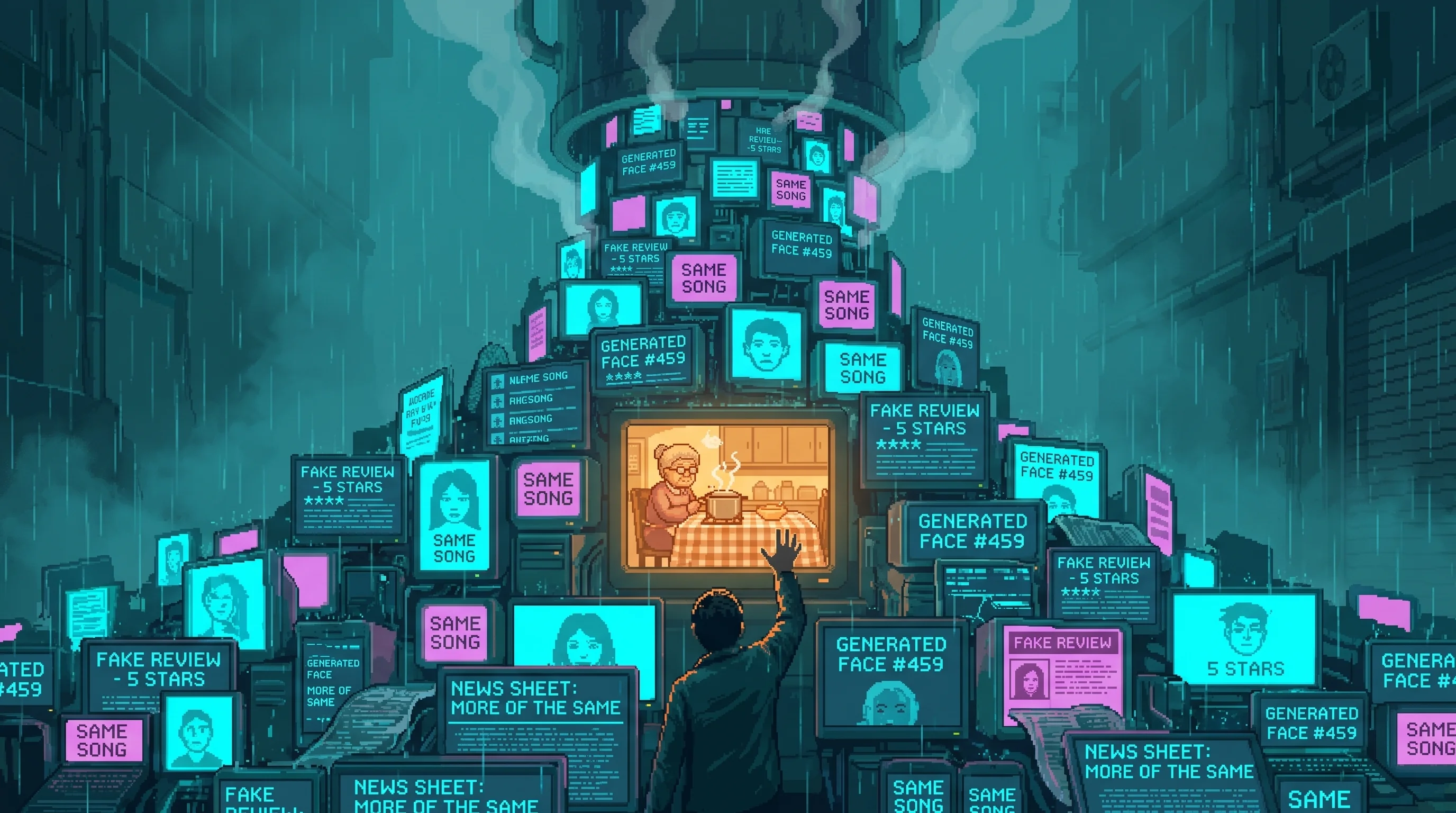
Error against the flood — AI spews flawless infinite variation, so they fail on purpose to reintroduce mutation.
Unlimited generation floods every channel, then becomes the belonging people seek where no curator can screen it.
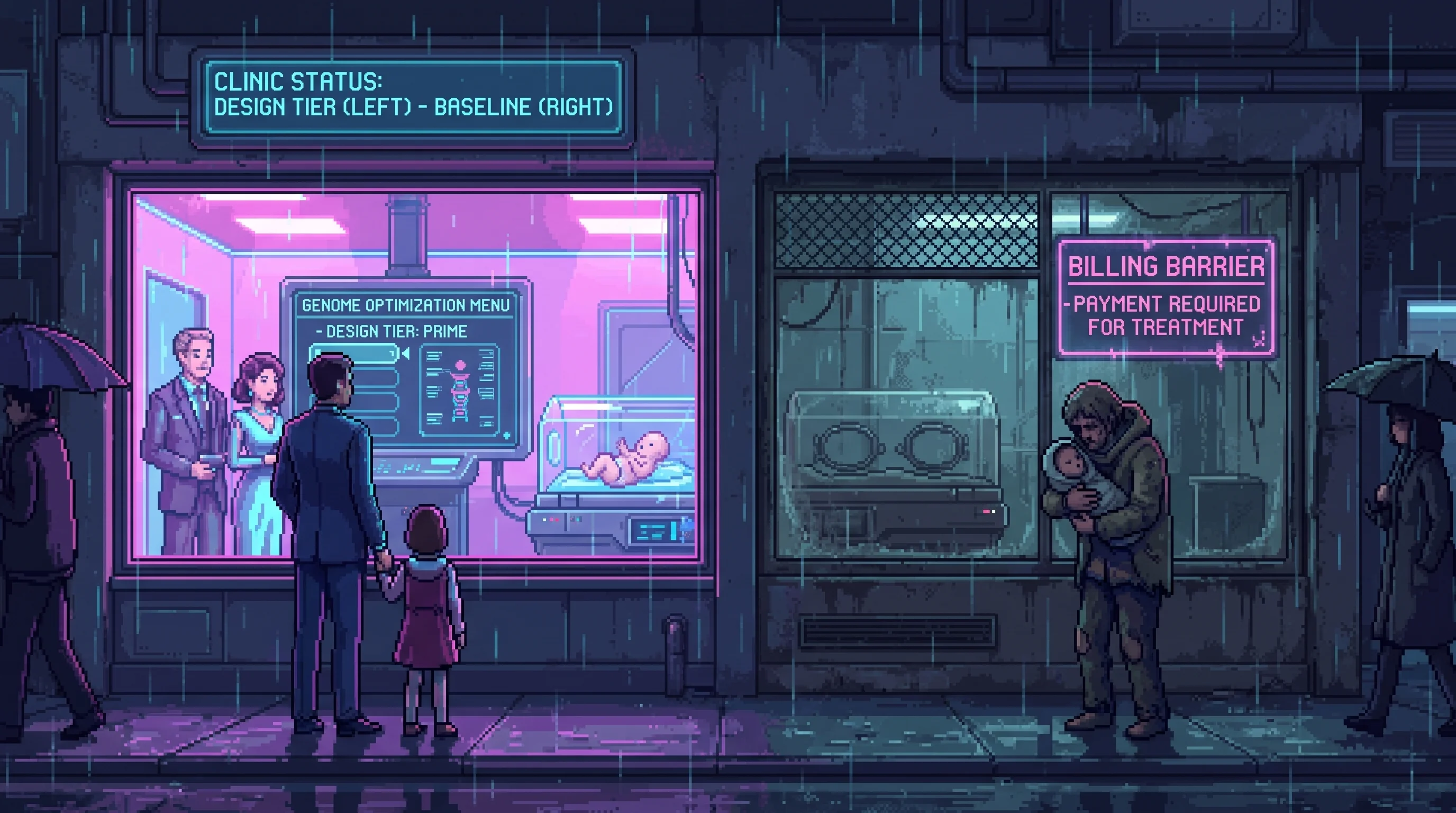
NeuralSure edits out the cognition that makes aesthetic mistakes; the Blistered are the monoculture's antibody.
Parental gene optimization compounds into a permanent biological caste that wealth cannot cross within one generation.
Supporting Connections
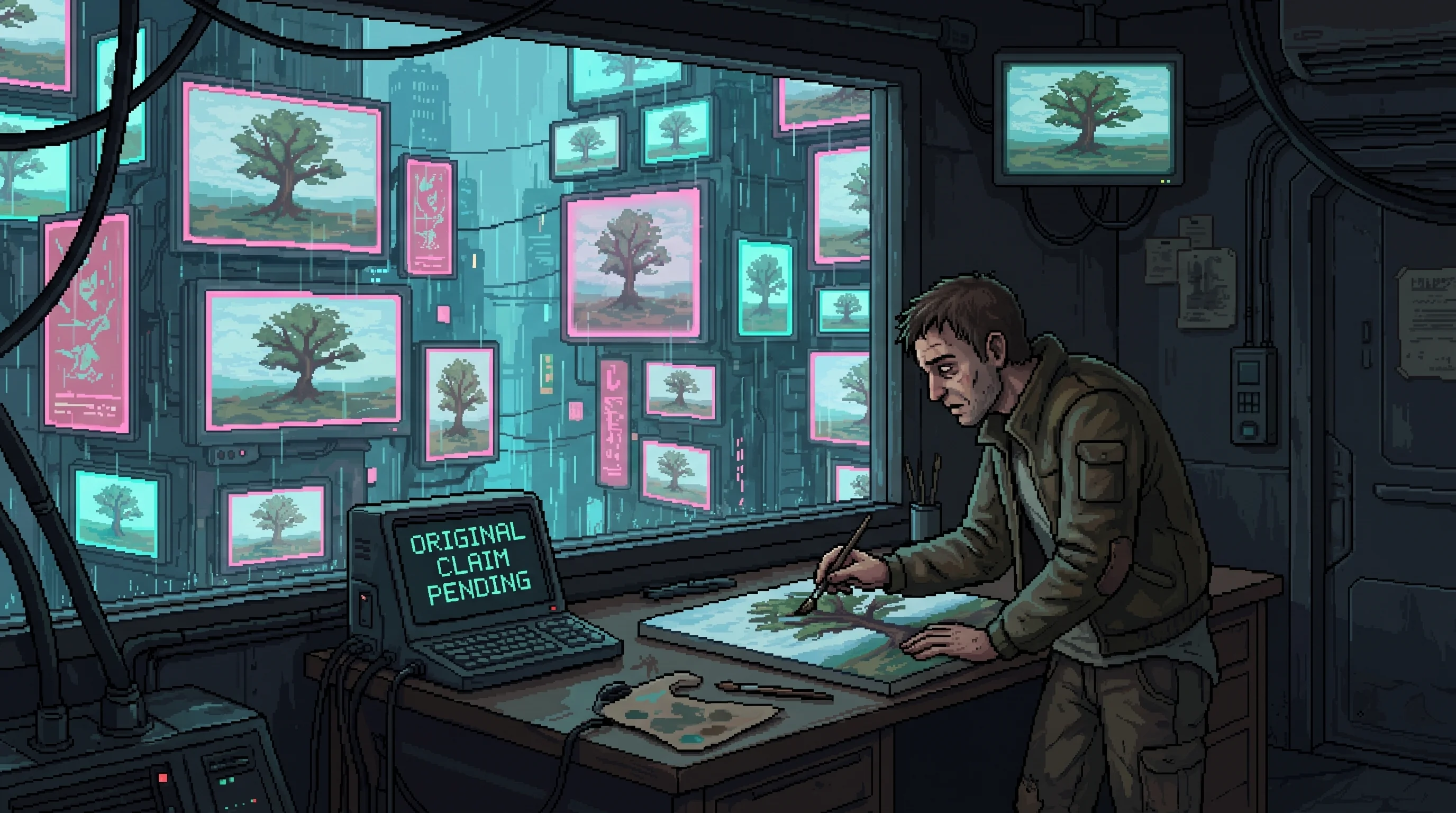
Deliberately fails, because a perfect copy can't make a mistake.
Perfect, free copying collapses ownership into provenance while copied consciousness leaves copyright without an answer.
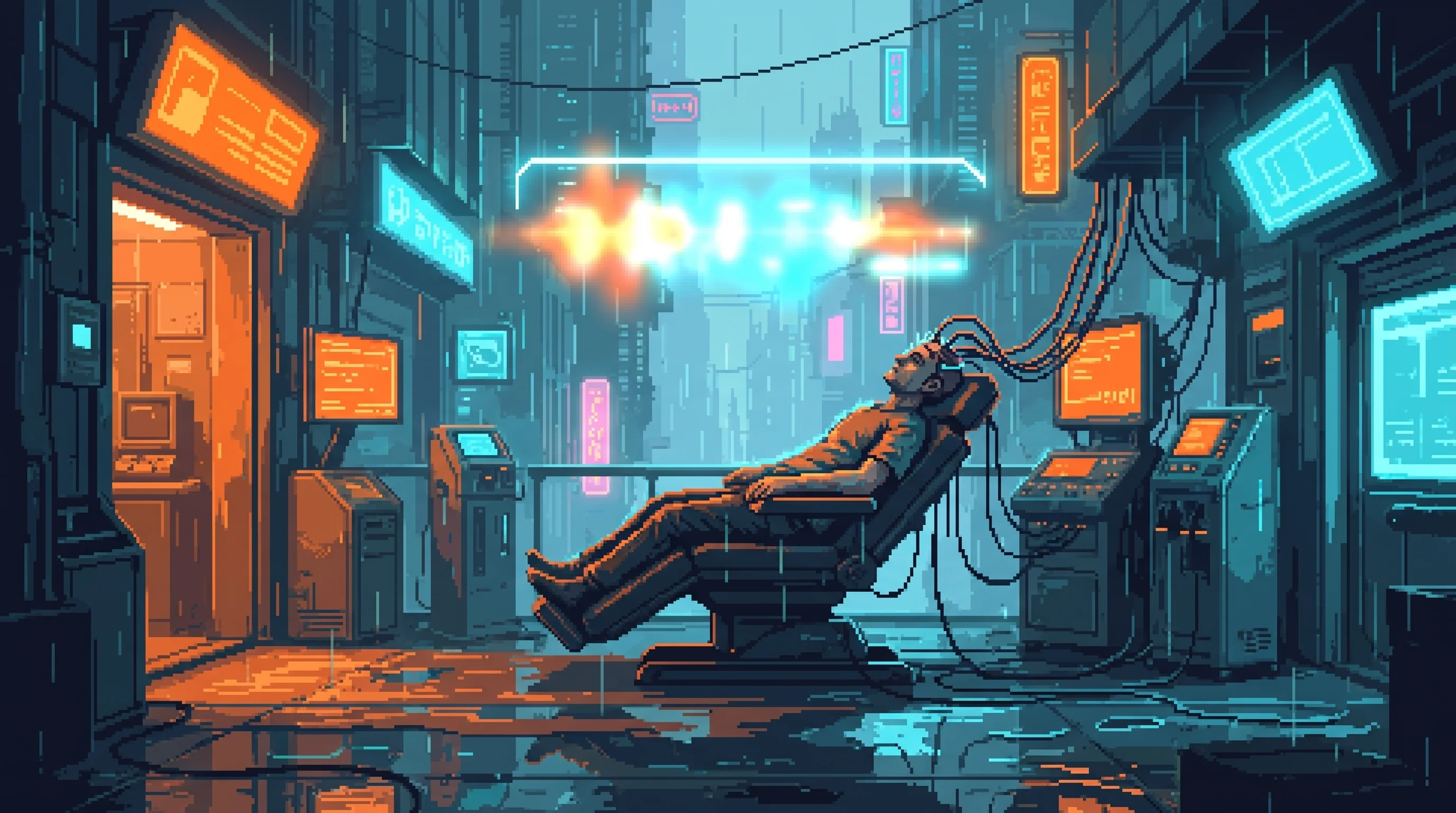
The untrained hand finds what optimized cognition never fails into.
The last human smarter than any machine was born in the 2020s; the question now is what intelligence is actually for.
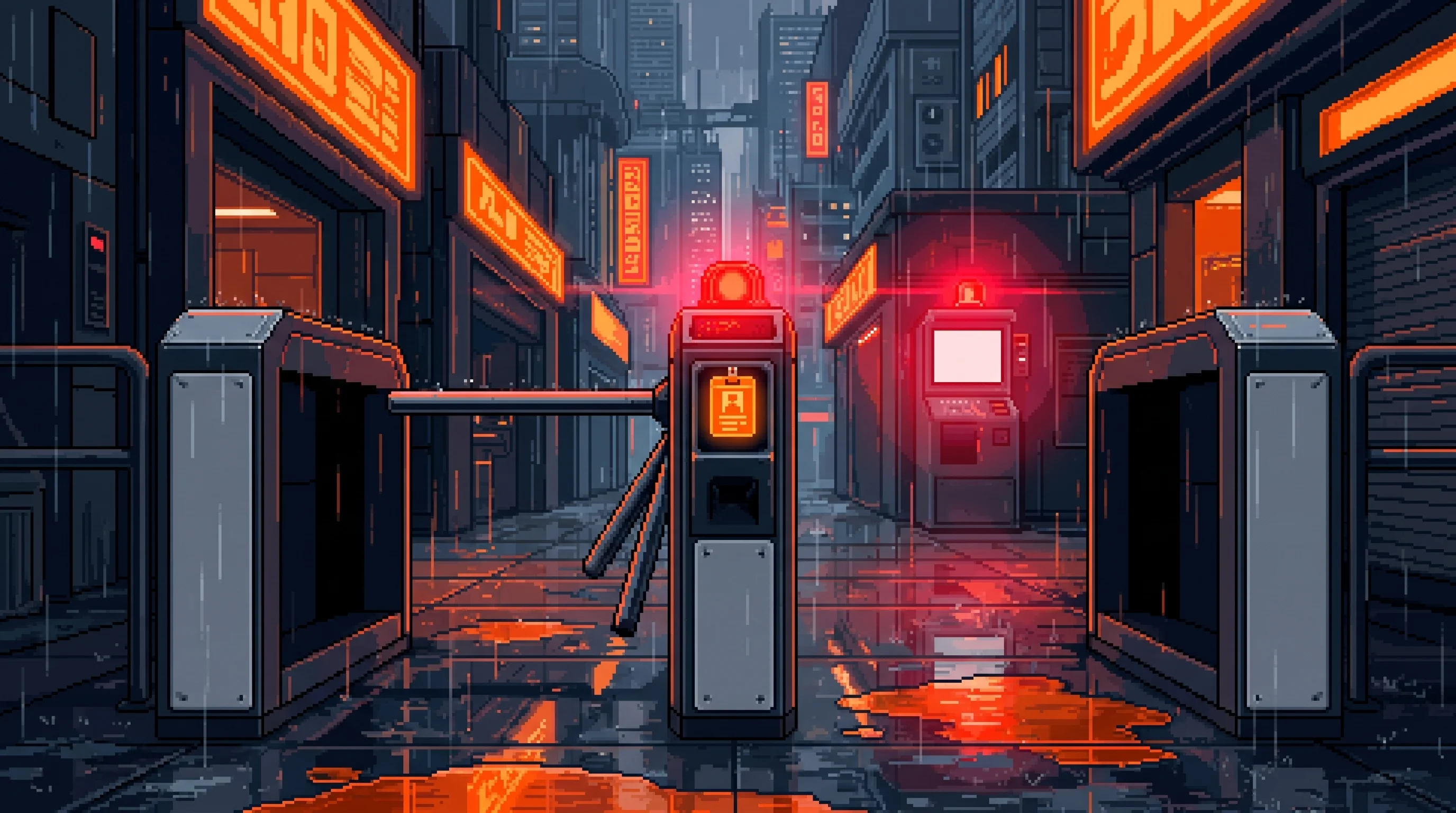
Its untrained hands are the Compact's discards; deprecation recruits.
When your employer is your country, quitting is emigration.


—