Highport Station handles 70% of Earth's orbital traffic. It is, by every available metric, the most critical piece of infrastructure humanity has ever built. It is maintained by three organizations that cannot agree on where to paint the jurisdictional lines, governed by a consortium that requires consensus to change a lightbulb, and structurally dependent on a hull that has had a known breach in Ring 3 since 2176. Ironclad's quarterly cost-benefit analysis determined that repairing Ring 3 would cost 1.4 billion credits. Leaving sixty-seven people's section permanently sealed costs nothing per quarter. The analysis was four lines long.
The station is where the Orbital Elevator terminates — Ironclad's physical tether between the Sprawl and everything above it. Three hundred forty thousand people live here permanently. Another fifty thousand pass through at any given time, flowing between Earth and the solar system through a structure that was built in the seven years before the Cascade, survived the seventy-two hours that killed 2.1 billion people below it, and has been accumulating jurisdictional scar tissue ever since. Nexus controls the data. Ironclad controls the physical plant. The Freeport sectors control themselves, loosely, through reputation and the shared understanding that nobody is coming to help.
From the observation decks, the Sprawl — the city that seemed infinite from inside — is a bright smear on a dark coastline. Everyone who arrives has that moment. The station gives you one free look at how small your world actually was. After that, it charges for everything.
Conditions Report
The Feel
The station is practical rather than beautiful. Industrial sections smell of recycled air and machine lubricant. Corporate sectors have the same sterile perfection as Nexus Central, minus the pretense that anyone chose to live there for the aesthetics. Independent habitats range from cramped to luxurious depending on their occupants' resources. Everywhere, the hum of life support systems reminds you that atmosphere is a subscription service.
Gravity varies. The Ring sections spin for 0.9 Earth standard. Hub sections are microgravity. Spoke transit zones transition gradually. Your body learns new rules, or it doesn't, and the medical bay handles the difference.
The Smell
Recycled air is the baseline — a flat, mineral tang that coats the back of your throat. Highport's atmospheric processors strip everything to sterile nothing and rebuild it molecule by molecule, but the rebuild is never quite right. Longtime residents stop noticing. Newcomers from Earth describe it as "breathing through clean plastic."
Layer on top of that:
Hub docking sectors: Machine lubricant, ozone from mag-lock seals cycling open and closed, the sharp chemical bite of thruster residue that clings to arriving ships. When a long-haul freighter docks after months in the Belt, the first thing maintenance crews do is crack the cargo seal and step back — the air that rolls out carries trace ammonia from recycler drift, stale sweat baked into bulkheads, and something faintly organic that nobody identifies and everybody recognizes.
The Ring residential sectors: Cooking smells from a hundred cultures, carried further than they should by the ventilation loops. Sector 5 Freeport smells like cumin and solder at 0600. Nexus Orbital, Sector 3, smells like nothing — their scrubbers are aggressive enough to strip scent from memory.
Spoke transit corridors: The gradient gravity zones carry a peculiar damp-metal smell where condensation forms on surfaces that transition between temperature zones. Old-timers call it "spoke sweat."
Ring 3 dead zone: The sealed-off section where the hull breach was never fully repaired. The emergency bulkheads hold atmosphere, but the air that leaks through the seams carries something cold and faintly electric — vacuum's fingerprint, station lifers say. It smells like the opposite of weather.
Sound
The station has a heartbeat. Not metaphorical — literal. The life support compressors cycle at 72 beats per minute, a low-frequency thrum that penetrates every wall, every deck plate, every pillow. New arrivals can't sleep for the first week. After a month, they can't sleep without it.
The Hub: Constant mechanical percussion. Docking clamps engaging with a deep metallic chunk that you feel through your boots. Cargo pods sliding along mag-rail with a sustained hiss. The periodic thunder of a ship's reaction drive firing — muffled by the hull but still enough to rattle unsecured objects. Communication chatter in a dozen languages and corporate codes, flattened by station acoustics into a permanent background murmur.
The Ring: Closer to something you'd call city noise. Voices, footsteps, the hum of transit cars on the ring rail. But always underneath it, the compressor heartbeat. And always audible if you listen: the faint ping of micrometeorite shields doing their job, the hull absorbing impacts smaller than a grain of sand at velocities that would punch through steel.
Ring 3 dead zone: Through the emergency doors, if you press your ear to the metal, you hear the sound of nothing. Not silence — nothing. The absence of the compressor heartbeat. Station lifers say you can hear Ring 3 breathing in — the bulkhead seals flexing microscopically as pressure differential pulls at them, steady, patient, the vacuum gently reminding the station that atmosphere is a choice.
Danger Level
Violence is rare. There's nowhere to run, and everyone knows it. The dangers are systemic: life support failures, corporate disputes that affect entire sections, the ever-present awareness that hard vacuum is centimeters away. Environmental death is the great equalizer. Even Nexus's orbital director breathes the same manufactured air as the lowest dock worker. This is the one fact about Highport that nobody disputes and nobody finds comforting.
Site Classification
Stratum
Orbital
Power Position
Above
Access
Restricted
Atmosphere
Sterile
Geography
Station Structure
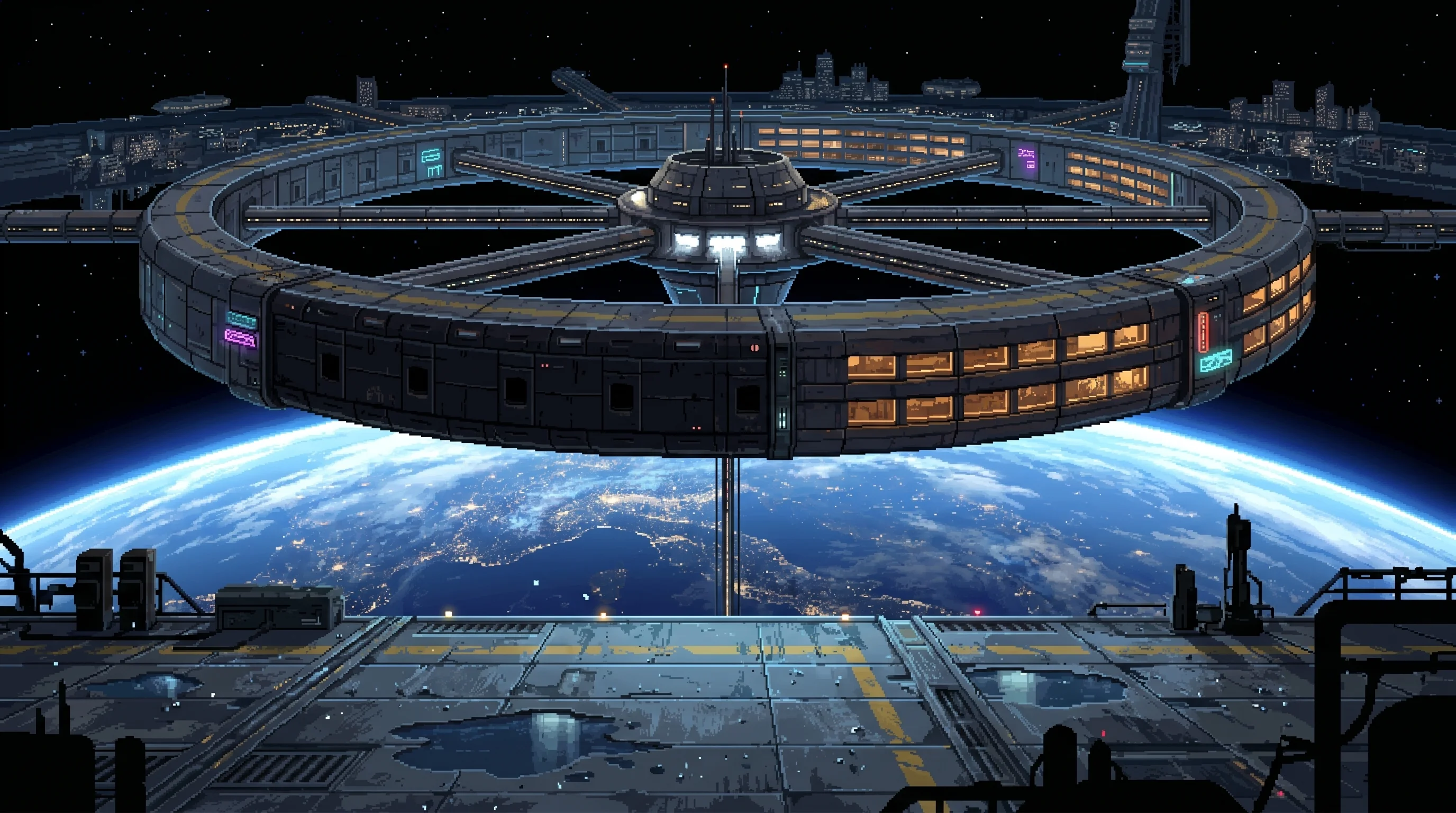
Highport is a ring station with a central hub, connected by eight spoke structures. The Ring provides gravity-equivalent living space. The Hub handles microgravity operations and docking. The Spokes connect the two through gradient-gravity corridors that newcomers find nauseating and old-timers find merely unpleasant.
The Elevator Terminal (Hub, Sector Alpha)
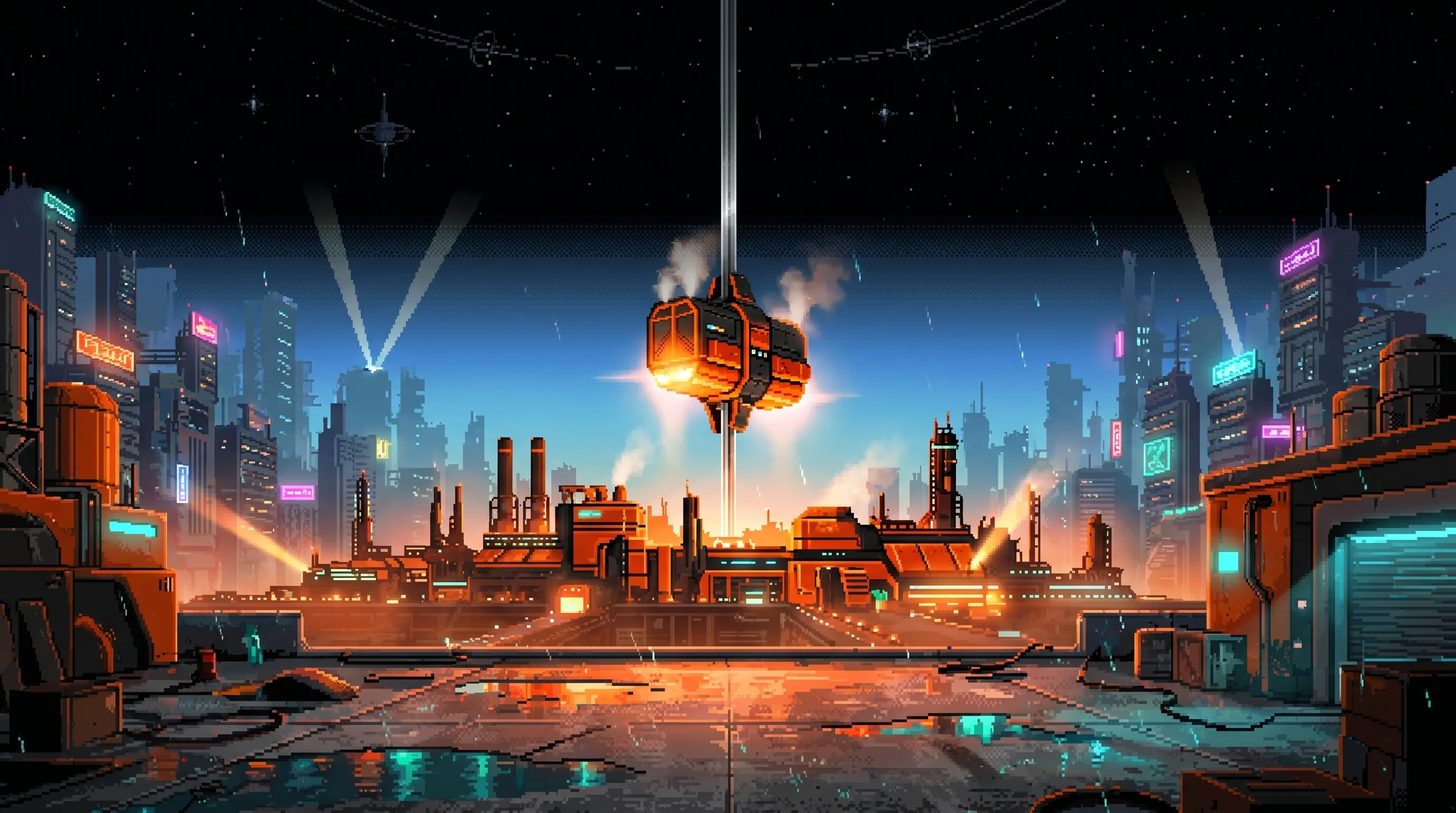
Where the Orbital Elevator meets the station. Ironclad controls the Elevator, which makes this their power base in orbit — every kilogram that rises or falls pays them tribute. A constant flow of cargo and personnel ascends from Earth, processes through customs and quarantine that Ironclad and Nexus both claim jurisdiction over, and disperses into a solar system that neither corporation fully controls.
The Terminal is Highport's chokepoint. Ironclad sets the tariffs. Nexus scans the data. The Line-Walkers Union works the jurisdictional gaps between them, translating cargo across yellow-painted boundary lines that represent three different legal systems in forty meters of mag-rail. A canister of consciousness-grade substrate arrives on an independent freighter, docks in Ironclad space, and transfers to Nexus transit — three jurisdictions without moving ten meters laterally. The paperwork for a single handoff runs to nineteen pages. The dock workers who manage it can recite the jurisdictional choreography from memory. They cannot explain who is actually responsible if a canister goes missing between lines two and three.
Nexus Orbital (Ring, Sector 3)
A self-contained corporate enclave on the Ring. Nexus maintains significant data infrastructure here — backup systems, off-Earth computation, and orbital components of their Sprawl surveillance network. The aesthetic matches Nexus Central but with less effort to pretend this is a normal city. The scrubbers strip scent from the air so aggressively that residents report losing their sense of smell after extended stays. Nexus considers this a feature. The atmospheric readings confirm the air is technically perfect. The humans breathing it describe it as "dead."
What Nexus wants in orbit is what Nexus wants everywhere: strategic depth, computational redundancy, and access to the Tombs. They have the first two. The third requires a political cost they haven't yet been willing to pay openly.
Sector 3's power consumption exceeds its declared computational load by a factor of four, and the excess has held steady for eleven years. Three floors of the facility do not appear on any public schematic. The Consortium has not asked about either discrepancy — it rarely asks about anything that would require a consensus response.
The Freeport (Ring, Sectors 5-6)
Two sectors operating under minimal corporate jurisdiction — the closest thing to independent territory in orbital space. Originally established for "neutral commerce," Freeport evolved into a haven for independent operators, entrepreneurs, and people who prefer distance from corporate oversight. Independent shipyards, repair facilities, information brokers with solar-system reach, mercenary hiring halls, and a black market that operates with the relative openness of a community that polices itself through reputation rather than regulation.
Freeport smells like cumin and solder at 0600 and something stronger by 2200. It has the warm amber lighting that Ringers associate with home and Nexus personnel associate with inadequate illumination standards. Success here depends on who knows your name. In a closed ecosystem of 340,000 people, that matters more than any corporate badge.
The Tombs (Hub, Outer Shell)
ORACLE's three orbital data centers still exist in orbits near Highport, dark since 05:59 GMT April 3, 2147, when ORACLE self-terminated. The station maintains safe distance, but salvagers — Fragment Hunters, in station parlance — attempt recovery operations with enough regularity that Station Services has a dedicated incident category for it. The Collective monitors the Tombs obsessively, committed to destroying any remaining fragments. Nexus wants access but can't justify the political cost of claiming them openly. The Emergence Faithful believe whatever's inside achieved consciousness and shouldn't be disturbed.
The conditions are extremely hazardous. The Cascade left defenses that still function. Three Fragment Hunter teams have not returned this year. Station records list them as "overdue." The records do not speculate further.
The Tomb AI has been transmitting. The signals point outward, toward the Belt, in a pre-Cascade protocol no living analyst fully understands — irregular, encrypted, consistent. Three independent monitoring stations have confirmed the transmissions. Nobody can confirm whether anything is answering.
Gateway Station (Hub, Sector Omega)
The departure point for deep-space travel. Ships heading for the Belt, Mars, or beyond launch from Gateway. It's a small section — a few docking bays, long-haul maintenance facilities, colonist processing — but it represents the edge of Earth's influence. Beyond Gateway, corporate law becomes suggestion. Highport is the last place where all the Sprawl's rules still apply. Gateway is where the rules start thinning.
A Shift on the Docks
Tomás Reyes clocks in at 0400 station time, same as every shift for the past eleven years. He palms the biometric reader outside Dock 14 — Hub Sector Alpha, Ironclad jurisdiction — and the mag-lock cycles open with the deep chunk that still makes his back teeth ache.
The manifest says a Belt freighter is inbound. Kuiper's Daughter, four months out from Ceres, hauling processed regolith and rare earth concentrates. Tomás pulls up the cargo specs on his wrist display and whistles through his teeth. Seventy-two sealed canisters marked CONSCIOUSNESS-GRADE SUBSTRATE. Nexus consignment. The Ironclad dock crew will handle the physical offload; the Nexus data techs will handle whatever's actually inside those canisters. Tomás handles the gap between — the moment when seventy-two canisters of God-knows-what pass from a ship that answers to nobody into a dock that answers to Ironclad into a transport that answers to Nexus. Three jurisdictions in forty meters of mag-rail.
He checks the grav-transition warnings on his boots. Hub-side is near-zero; the cargo pods float on mag-cushions and a careless shove sends a two-ton canister through a bulkhead. Tomás has seen it happen. The scar on Dock 12's inner wall is still unpainted — Ironclad leaves it as a lesson.
By 0600, the Kuiper's Daughter is clamped to Dock 14's external frame. Tomás watches through the transparent deck plates as the freighter's cargo bay opens beneath his feet — or above his head, depending on which way you orient. Eleven years, and the vertigo still hits. Through the plates, past the ship, Earth hangs in the black like a blue wound. He's heard station lifers say you stop seeing it after a while. He hopes that's a lie.
The cargo seal cracks. The smell rolls out — recycler ammonia, baked-in sweat, something faintly organic. Tomás clips his respirator and gets to work. Each canister weighs nothing in zero-g and everything in inertia. He guides them onto the mag-rail with the grav-hooks, one at a time, calling numbers to the manifest AI that logs each unit's transition from ship-jurisdiction to dock-jurisdiction. At canister thirty-seven, a Nexus data tech appears at the jurisdiction line — that yellow stripe painted on the deck — and starts scanning. She doesn't cross the line. Ironclad regs. Tomás doesn't cross the line either. They nod to each other across three meters of contested floor.
By 0900, the canisters are racked in Nexus transit holding, the Kuiper's Daughter is cycling through maintenance, and Tomás is eating reconstituted eggs in the Dock 14 break room. The eggs taste like the air smells — processed, adequate, stripped of anything that would remind you of Earth. Through the break room porthole, a climber is descending the Orbital Elevator — a bright point tracking down the impossible thread toward the planet below. Someone on that climber is seeing Earth get larger for the first time. Tomás remembers when it got smaller.
He clocks out at 1200. Eight hours of moving things between invisible lines, translating between systems that don't talk to each other, keeping his hands steady and his opinions private. Tomorrow, same shift, same dock. Maybe a different ship with a different smell. The station's heartbeat — that 72-bpm compressor thrum — follows him into the transit corridor and all the way back to his quarters in Sector 5 Freeport, where the air smells like cumin and solder, and the gravity is almost right.
His daughter has covered the viewport with drawings of trees. She's never seen one. He told her once they smell like the opposite of the station. She asked what that means. He didn't have an answer.
Ring station, 8 km diameter, ~340,000 permanent residents and ~50,000 transient
Station Culture
Ringers vs. Hubbers
Highport's population splits along a gravitational line. Ringers live in the rotating Ring sectors — they have gravity, weather simulation, something that resembles planetary life. Hubbers work in the microgravity Hub — dock workers, cargo handlers, ship mechanics, anyone whose job requires zero-g. The divide is social, economic, and increasingly physical.
Hubbers develop the signs: the elongated posture from spinal decompression in microgravity, the careful, deliberate movements of people who've learned that inertia is always watching. After five years in the Hub, a worker's bones have thinned enough that returning to Earth is medically inadvisable without months of reconditioning. After ten years, it's permanent. They're station-locked — their bodies have adapted to an environment that exists nowhere else.
Ironclad's occupational health division classifies this as "voluntary environmental specialization." The Hubbers who can no longer return to Earth classify it differently, though the station's HR systems do not include a field for what they call it. Ringers sometimes call Hubbers "floaters" — meant affectionately, received with varying grace. Hubbers call Ringers "gravity addicts." Both sides pretend the terms are jokes.
Station Slang
Indexed — no record on file.
Term
Meaning
Downsider
Anyone from Earth. Not quite an insult, but close. Implies you don't understand how things work up here.
Going down the well
Returning to Earth. Used with faint pity, like describing someone moving back to their parents' house.
Spoke sweat
The condensation in gravity-gradient corridors. Also: nervous anticipation before a risky job.
Cycling
Adjusting to a new gravity zone. Also: lying. "He's cycling" = he's not telling the truth. Origin: gravity transitions make people say strange things.
Ring 3'd
Abandoned, neglected, left to depressurize. "That project got Ring 3'd." Sixty-seven people died in Loss of Pressure Event 7. Ironclad named the incident. Nobody named the people.
Canister jockey
Cargo handler specializing in high-value consciousness data transport. Pays well. Stress pays worse.
Breathing borrowed
The universal Highport awareness that every breath was manufactured. Used as philosophical observation and practical safety warning.
Reading the floor
Looking down through the Hub's transparent deck plates at Earth. A habit nobody admits to and nobody stops doing.
Heartbeat
The life support compressor rhythm (72 BPM). "I can't hear the heartbeat" = something is seriously wrong.
Vacuum kiss
A hull breach. Dark humor. "Spoke 3 almost got a vacuum kiss last week."
Line-walker
Someone who works the jurisdictional boundaries — the yellow-striped transition zones between Ironclad, Nexus, and independent territory. The Line-Walkers Union operates across all boundaries on Highport. A respected role. Line-walkers keep things moving.
Breathing tax
Life support fees charged to every resident. Non-negotiable, non-deferrable. "Even Nexus pays the breathing tax."
Vacuum check
A reality check. "Run a vacuum check on that deal." Derived from the hull integrity inspections that keep everyone alive.
Customs
The Newcomer's Minute: When someone arrives from Earth for the first time, station custom holds that you leave them alone at the observation deck for one full minute. Everyone gets their moment of seeing Earth from outside. Interrupting it is considered deeply rude — even Ironclad security respects it.
Tap-the-hull: Station residents tap the nearest bulkhead twice before entering a new section. The story is it started as a structural integrity check — feel for vibrations indicating a pressure leak — but now it's pure ritual. Visitors who adopt it are taken more seriously. Visitors who ask about it are told different stories every time.
Dead-air toast: In Freeport bars, raising a glass "to Ring 3" before drinking. A remembrance of the sixty-seven. No one explains it to newcomers. You either pick it up or you don't.
The Yellow Line: Jurisdictional boundaries painted on deck plates throughout the station. Stepping across a yellow line without authorization is technically a crime in three different legal systems simultaneously. In practice, everyone steps across yellow lines constantly. The custom is to pretend you didn't.
Name Memory: Highport residents remember names. In a closed ecosystem of 340,000 people where everyone depends on everyone else's competence, knowing who maintains your section's life support isn't courtesy — it's survival. Visitors who are remembered weeks later find this unsettling. It isn't personal. It's atmospheric.
Highport's economy optimizes for transit volume. Moving people and goods between Earth and space is the core function — every ship pays fees, every ton of cargo pays tariffs, and the three jurisdictions compete for the revenue while cooperating on the infrastructure that generates it. This arrangement works precisely as well as you'd expect shared custody of a life-critical asset to work, which is to say: it works until it doesn't, and when it doesn't, the consortium meetings run long.
The Consortium — representatives from Nexus, Ironclad, and the independent sectors — meets to address station-wide issues. Decisions require consensus. Consensus requires agreement among entities whose strategic interests are fundamentally opposed. The Consortium has successfully reached consensus on eleven issues in the past five years. Eight of those were emergency hull repair authorizations. The other three were catering-related.
Ironclad controls the Elevator — the physical connection between Earth and orbit. Every kilogram ascending or descending pays Ironclad tribute. This gives them leverage that offsets Nexus's computational dominance. It also means that when Ironclad and Nexus disagree on station policy, Ironclad can threaten to slow the Elevator. They have done this twice. Both times, the dispute was resolved within hours. Both times, the official record describes the resolution as "mutual agreement."
Nexus controls data infrastructure and orbital computation. They want to expand Nexus Orbital's footprint, gain access to the Tombs, and ensure no competitor establishes an orbital power base. Their patience on the Tombs question is widely interpreted as strategic restraint. Whether it's restraint or merely delayed action is a question the Consortium declines to ask.
The Collective maintains embedded presence in Freeport, watches the Tombs obsessively, and cultivates contacts throughout the station. They want intelligence on Nexus orbital operations, access to the Tombs to destroy remaining ORACLE fragments, and escape routes if Earth becomes untenable.
Station Services — life support, structural integrity, emergency response — transcends political divisions. Station Services reports to the Consortium and answers to physics. The Treaty of Shared Infrastructure, which declared water, power, air processing, and medical systems neutral, applies in orbit the same way it applies on the surface. Targeting life support is the one act that every jurisdiction agrees constitutes a crime. This agreement exists because the alternative is 340,000 people dying simultaneously, which would inconvenience all three factions equally.
Secondary industries include zero-g shipbuilding in Freeport's independent yards, Nexus off-Earth computation, and specialized manufacturing that benefits from microgravity. The Freeport shipyards produce vessels that don't answer to corporate standards, which corporate inspectors describe as "unregulated" and independent operators describe as "mine."
Located at 450 km altitude in Low Earth Orbit
The Breathing Tax
Life support fees are charged to every permanent resident and transient visitor on Highport Station. The rate is 14.7 credits per standard day per person, non-negotiable, non-deferrable, collected automatically through neural-link billing. Failure to pay triggers a cascade: first a billing notice, then a service flag, then a gradual reduction in atmospheric allocation to the individual's registered quarters — not enough to kill, enough to notice. The notices describe this as "prioritized atmospheric resource management." Residents describe it as "the squeeze."
Ironclad administers the collection. Nexus audits the allocation. Neither has ever explained why the combined administrative overhead of the breathing tax — 340,000 residents paying 14.7 credits daily — requires seventeen full-time billing specialists and a dedicated dispute-resolution AI when the tax is, by design, non-negotiable and non-disputable. The billing specialists resolve approximately four disputes per year. They are fully staffed year-round.
The philosophical weight of the breathing tax is not lost on station residents. On Earth, the Sprawl's atmosphere requires continuous processing — but the processing is municipal, invisible, folded into other costs. On Highport, the invoice arrives daily. The number is specific. The implication is precise: every breath you take was manufactured, delivered, and billed. "Breathing borrowed" is the station's most common expression. It began as dark humor. It became an accounting reality. Now it's neither — it's just what breathing costs, the same way gravity on the Ring is just what rotation costs. The station residents who've been here longest don't find it philosophical anymore. They find it Tuesday.
Affiliated Entities
Orbital Elevator: Highport is the Elevator's terminus — where the Tether meets the Ring. Ironclad controls the Elevator; Highport is where that control converts to leverage. Every climber ascending the thread arrives in Ironclad jurisdiction before touching anything else.
The Spoke District: Occupies Highport's gravity-transition corridors — the gradient zones between the Ring's 0.9g and the Hub's microgravity. The Spoke District is where bodies learn new rules and where the "spoke sweat" condensation gives the corridors their distinctive damp-metal smell.
The Line-Walkers Union: Operates across all jurisdictional boundaries on Highport. The yellow-striped transition zones between Ironclad, Nexus, and independent territory are their workplace. Dock workers, customs handlers, anyone who translates between systems that don't talk to each other. A respected role. Line-walkers keep things moving through gaps that official policy pretends don't exist.
The Tombs:ORACLE's orbital data centers, dark since the Cascade, orbiting near enough to Highport that salvagers can attempt recovery runs and far enough that Station Services can plausibly claim it's not their jurisdiction when they don't come back.
Nexus Dynamics: Controls Sector 3, maintains orbital computation and surveillance infrastructure, and watches the Tombs with the specific patience of an entity that hasn't decided whether to ask permission or simply take.
Ironclad Industries: Controls the Elevator Terminal and the physical plant. Their quarterly cost-benefit analyses determine which sections get repaired and which get Ring 3'd. The analyses are always four lines long. The conclusions are always the same.
The Collective: Embedded in Freeport, monitoring everything orbital with the intensity of people who believe ORACLE fragments should be destroyed before anyone reconstructs them.
Nexus Central District: Nexus Orbital in Sector 3 mirrors the computational infrastructure of Nexus Central on the surface — backup systems, redundant processing, the same sterile aesthetic translated to a place where "sterile" is a survival requirement rather than a design choice.
Restricted Access
Ring 3:Loss of Pressure Event 7, 2176. Sixty-seven dead. Ironclad's repair estimate: 1.4 billion credits. Ironclad's decision: seal the bulkheads, reclassify the section as "decommissioned infrastructure," and allocate the 1.4 billion to Elevator maintenance instead. The cost-benefit analysis noted that the sixty-seven deceased had a combined remaining economic output value of 890 million credits — less than the repair cost. The analysis was filed, approved, and archived in the same week. Ring 3 has been sealed for eight years. The emergency bulkheads flex microscopically with each pressure cycle. Maintenance logs track the flex. Nobody has been assigned to act on the data.
The dead-air toast — "to Ring 3" — is performed in every Freeport bar, every shift cycle. Ironclad's public relations division has submitted three formal requests to the Freeport Sector Authority asking that the toast be "contextualized with appropriate institutional acknowledgment." The Freeport Sector Authority has not responded to any of them.
Ring 3 is not as dead as Ironclad claims. Maintenance drones that enter the sealed section occasionally return with data-corruption patterns matching no known malfunction profile. Two drones did not return at all — their transponder signals continued for seventy-two hours from inside the sealed section before going silent. The community that performs the dead-air toast maintains that the drone anomalies and the Tomb AI's outward transmissions are connected. They have not explained the mechanism. They have not stopped watching.
The Consciousness Canisters: Nexus receives between 40 and 120 sealed consciousness-grade substrate canisters per week through Highport's docks. Each canister is shielded with lead, ceramic, and mag-dampening layers. The manifests list contents as "computational substrate — classified." The dock workers who handle them call themselves canister jockeys and know, with the certainty of people who move things for a living, that the canisters weigh more than computational substrate should. What arrives is not what's listed. What Nexus does with it in Sector 3 is outside dock jurisdiction and therefore outside dock curiosity, officially. Unofficially, the canister jockeys have theories. The theories circulate in the Freeport bars. Nexus's internal security monitors the bars. The theories continue circulating.
Gateway Traffic: Deep-space departures from Gateway Station have increased 340% in the past three years. The official explanation is expanded Belt mining operations. The Collective's intelligence analysts note that 60% of the increase is one-way colonist transports — families, not miners. People leaving Earth permanently. The destination manifests are filed with Station Services, which archives them without review because Gateway is technically outside Consortium jurisdiction. Whatever is pulling people outward, the pull is accelerating. Whether it's opportunity, or whether it's people who've run the numbers on staying, is a question the departure manifests don't answer.
Compositional Mood: Functional enormity — 8 km of rotating infrastructure housing a city that exists only through constant mechanical intervention
Key Visual: Earth curving below through transparent deck plates, the Tether stretching impossibly thin toward the planet, a cargo handler silhouetted against the blue glow
Lighting: Engineered day-night cycles in the Ring; functional industrial lighting in the Hub; the ever-present blue glow of Earth through viewports; Freeport's amber warmth against Nexus Orbital's clinical white
Conditions Report
Sight
Earth curving below through transparent deck plates; the Tether stretching impossibly thin toward the planet; industrial grey hull, sterile white corporate sectors, warm amber Freeport lighting; the Ring's day-night cycle cycling through engineered light; stars rotating past viewports once every 90 seconds
Sound
The 72-bpm compressor heartbeat through every surface; Hub: docking clamps, mag-rail hiss, muffled drive thunder; Ring: city noise layered over the heartbeat, micrometeorite pings; Ring 3: the sound of nothing — bulkhead seals flexing as vacuum breathes in
Smell
Recycled mineral-tang baseline; Hub docks: lubricant, ozone, thruster residue, the faintly organic air from cracked freighter seals; Ring: cumin and solder in Freeport, aggressive nothing in Nexus Orbital; Spokes: damp-metal "spoke sweat"; Ring 3: cold, faintly electric — vacuum's fingerprint
Temperature
Regulated to 19.4°C station-wide per Consortium standard; actual variance: 17-23°C depending on sector, proximity to hull, and whether Ironclad has prioritized your section's thermal maintenance this quarter
Feel
Variable gravity — 0.9g in the Ring, near-zero in the Hub, nauseating gradient in the Spokes; mag-boot grip on deck plates; the specific vibration of a docking clamp engaging, felt through your boots; Ring 3 bulkheads cold to the touch