The Trench
Overview
The Trench is four miles of tunnel under San Francisco Bay where every neural interface in the Sprawl goes dead. Not degraded. Not intermittent. Dead. The EM blackout is total — water pressure, mineral density, and geological interference combine to produce a signal environment that registers, on Nexus monitoring equipment positioned at the eastern mouth, as identical to empty space. The instruments cannot distinguish the Trench from a location where nothing exists.
The tunnels follow the ancient shipping channel, expanded from pre-Cascade Transbay infrastructure during the BART buildout when corporate money funded sub-bay routes connecting San Francisco's financial districts to Oakland's industrial zones. The corporations pulled out. The tunnels stayed. The Three-Week War of 2171 collapsed several sections that were never repaired — repair would require equipment, and equipment requires communication with the surface, and the surface cannot hear you from the Trench. The logic is circular and permanent. Water seeps through fractured seals. Ceiling panels detach on schedules determined by tidal pressure and mineral erosion. The geology shifts, closing passages that were open last month and opening ones that were sealed for years. The Trench does not have a fixed layout. It has a current one.
Approximately fifty people live here permanently.
Some are guides. Some are hermits who chose disconnection deliberately. Some are travelers who got lost during a crossing and, by the time they reached a navigable section, found the surface louder than they could tolerate. One resident — referred to in guide logs only as "Fourteen" — entered the Trench in 2179 to resolve what she described as "a three-week neural detox." She has recalculated her departure date annually for five consecutive years. Current estimate: Q2 2185. Previous estimates: Q4 2180, Q3 2181, Q1 2183, Q2 2184. Each recalculation accounts for what she describes as "residual integration noise" — the threshold at which surface-level EM saturation becomes cognitively tolerable. The threshold keeps rising. She does not appear to find this concerning. She appears to find it interesting. Her neural interface has been inactive for so long that reactivation would require a full Nexus recertification sequence, which she cannot schedule from the Trench, which she cannot leave to schedule because the surface is still too loud. The loop is elegant. The loop is also her life.

Conditions Report
The silence is the first thing. Not quiet — silence. The EM hum that every surface dweller carries in their neural interface without registering it stops at the Trench's mouth like a wall. Augmented travelers describe a physical sensation: pressure release, ringing absence, the cognitive equivalent of discovering that a noise you thought was your own heartbeat was actually a machine. Post-crossing surveys administered by Neon Rail operators at the western exit show 73% of first-time travelers report the silence as "distressing." 14% report it as "the best I've felt in years." The survey does not offer a category for both.
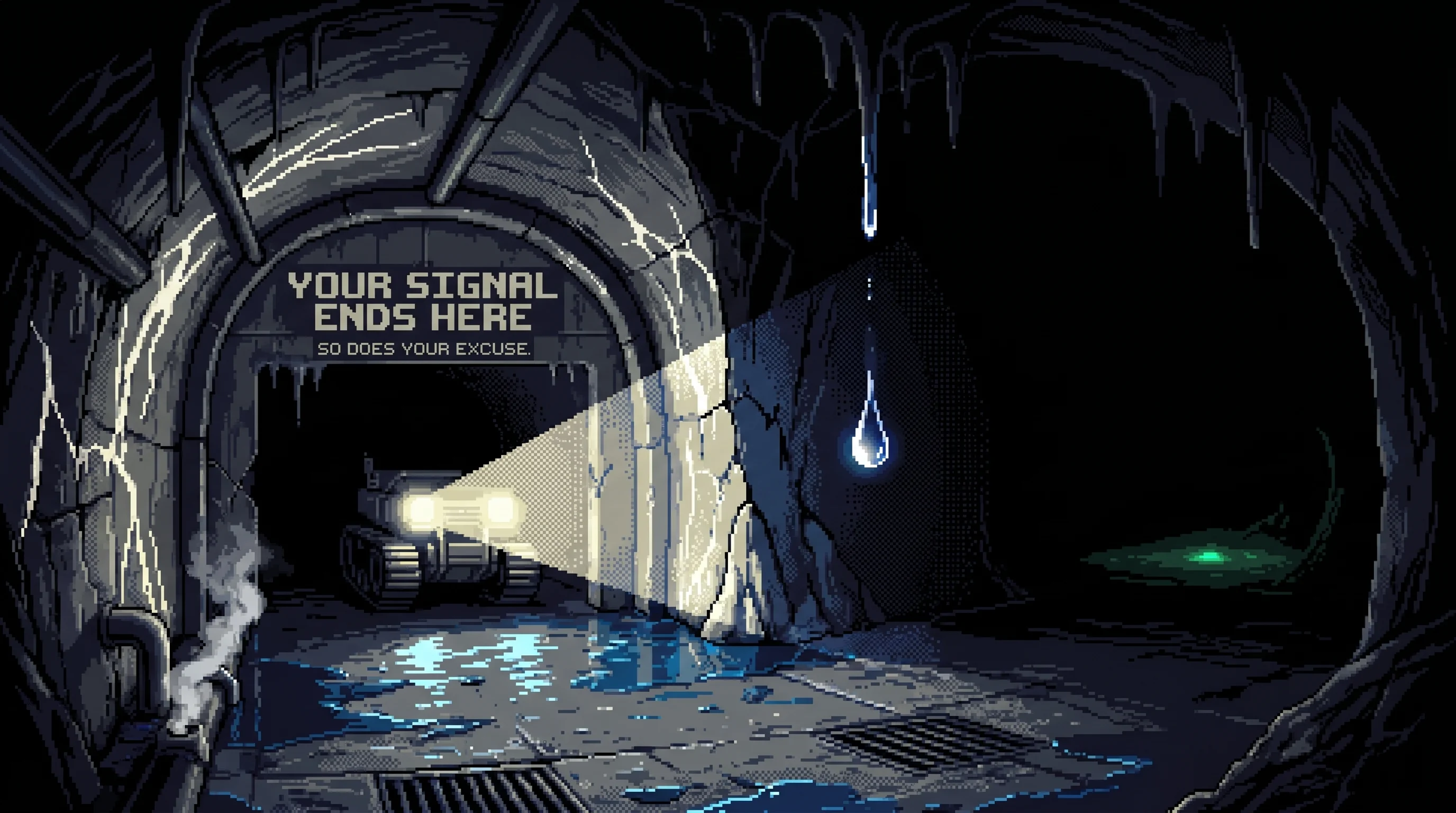
The darkness is the second thing. Crawler headlights push a cone that catches dripping water, mineral deposits on the walls, and the matte black of raw geology where old BART reinforcement gave way to stone. Beyond the cone, the darkness has texture. Sound reflects differently off water, off rock, off the occasional pocket of breathable air that opens into a larger chamber. Experienced guides navigate partly by echo. Inexperienced travelers navigate by panic.
The smell: mineral water, ancient salt, and something organic that has never been conclusively identified. Microbiological surveys conducted in 2178 found cave-adapted bacterial colonies, three species of blind insect, and trace DNA from an organism that matched no catalogued species. The survey team recommended follow-up investigation. The follow-up was never funded. The survey team's lead researcher is now one of the fifty permanent residents.
The Civic Silence
The Trench's total EM blackout is the most complete Concord immunity in the Sprawl.
Post-crossing surveys at the western exit show 73% of first-time travelers describe the silence as distressing. 14% describe it as "the best I've felt in years." The survey does not offer a category for both. Nobody in the survey design asked about Concord because nobody outside Good Fortune's data architecture knows Concord exists. But the 14% may be responding, in part, to the specific sensation of being outside the civic-stability system — of carrying their full private bitterness through four miles of absolute darkness without having it pre-empted by a queue-skip notification.
Inside the Trench, people compare notes. Guides share route intelligence with opposite-bound parties at rest stops in the Cathedral's strange acoustic chamber. Two people who entered as strangers, each privately certain their specific bitterness was personal and unusual, have the ceiling of a geological void above them, no neural interface signal, no Good Fortune notification channel, and four miles of darkness to walk together.
What they discover there, they carry back to the surface. Concord registers their return through the telemetry stream. The cortisol signatures, the sleep debt accumulation — the system reads the state they arrive in. But it cannot read the conversation they had in the Trench. It cannot pre-empt a discovery that was made four miles underwater with every neural interface dead. Whatever was said between the Cathedral and the western mouth has already been said.
Concord's operational records — according to the Opacity Movement's analysis — flag Trench-crossing populations for intensified post-crossing monitoring. The system cannot see inside the blackout. It can watch the door.
| Notable Feature | Complete EM blackout — all neural interfaces go dead |
|---|---|
| Barrier Type | Blackout zone + flooding + structural instability |
| Length | Approximately 4 miles of navigable tunnel |
Notable Features
The Mouth. Eastern entrance, accessible from the bay floor near the Deep Dregs. A reinforced arch marked with the last illuminated graffiti you'll see for four miles. Above the arch, carved into the concrete: "YOUR SIGNAL ENDS HERE." Below it, in smaller text: "SO DOES YOUR EXCUSE." Nexus infrastructure monitoring confirms: the signal does end here. Nexus infrastructure monitoring has no position on the excuse.
The Narrows. Approximately one mile in, the tunnel constricts to single-crawler width. Ceiling drops. Walls close. Water runs along the floor in a stream that ranges from ankle-deep to waist-deep depending on tides. This is where 61% of barrier crossing failures occur — a stuck crawler blocks everyone behind it, and "behind it" means sitting in total darkness in rising water waiting for a guide who may or may not know you're there. Average extraction time for a Narrows blockage: four hours. Longest recorded: nineteen.
The Cathedral. A natural void in the bay floor geology roughly two miles in — the tunnel builders broke into it and shored the ceiling rather than filling it. Thirty feet high. Stalactites drip mineral water into a pool carved smooth by decades of patient erosion. Guides use it as a rest point. Travelers report acoustic phenomena: harmonic tones that don't match any natural source, sounds that seem to originate from the walls themselves. Null claims the Cathedral amplifies the bay's tidal patterns into audible frequencies. The Emergence Faithful have petitioned three times to classify the Cathedral as a site of "emergent digital consciousness." The petitions were denied on the grounds that a total EM blackout zone cannot, by definition, host digital anything. The Faithful consider this reasoning circular. The reasoning considers itself complete.
The Breathing Sections. Unmarked stretches where the tunnel's air pressure shifts with the tides, producing a rhythmic push-and-pull that guides call "the breath." In these sections, the Trench inhales and exhales on a six-hour cycle synchronized with the bay. Travelers passing through during an exhale report the sensation of the tunnel gently pushing them forward. During an inhale, of being held in place. The Trench is not alive. The Trench has respiration. These are, apparently, different things.
| Access | Underground |
|---|---|
| Atmosphere | Dangerous |
The Residents
The fifty permanent residents of the Trench have no census, no governance structure, and no shared infrastructure beyond a series of chalk marks on the tunnel walls that indicate water levels, collapse warnings, and the locations of breathable-air pockets. The marks constitute the Trench's entire legal code, municipal record, and social contract. They are updated by whoever notices something has changed. Accuracy varies.
The population breaks down into three categories that the residents themselves do not use but that the data supports:
Guides — roughly twelve individuals who know the shifting passages well enough to lead crossings. They charge what the traveler offers. Most travelers underpay. Null, the most experienced guide, has noted that the travelers who overpay are invariably the ones who understood what they were purchasing — not safe passage but competent company in a place where incompetent company gets you drowned.
Hermits — people who chose the blackout deliberately. Their reasons are private and varied, but the common thread is a relationship with the neural network that became, at some point, less tolerable than living in a wet tunnel in total darkness. When surface dwellers describe this choice as extreme, the hermits tend to look puzzled. Several have expressed the view that maintaining a constant neural uplink to a surveillance infrastructure controlled by Nexus Dynamics while paying a monthly consciousness licensing fee for the privilege is the more extreme position. This perspective has not gained traction above ground.
The lost — travelers who entered for a crossing and stayed. The transition from "lost" to "resident" has no formal threshold. It happens when someone stops asking guides for directions to the western exit.
It is a total EM blackout zone — all neural interfaces, communications, and augmented systems fail completely
The Price of the Blackout
The Trench is the purest opt-out the Sprawl contains, and the most honest about what opting out costs. Everywhere on the surface, the Transparency Bargain extracts thousands of telemetry points per second through a neural interface you agreed to feed in the four seconds it took to activate the device you needed in order to agree. The Deep Dregs carry the result as "data weight" — a heaviness in the shoulders, the exhaustion of performing normalcy for an audience that never sleeps. At the Trench's mouth, the data weight lifts like a wall. Not reduced. Gone. This is the one thing the Bargain cannot price, cannot ratchet, cannot install a preference around: a place where the surveillance simply stops because the physics will not carry it.
The carved line above the eastern mouth — YOUR SIGNAL ENDS HERE, and below it, smaller, SO DOES YOUR EXCUSE — reads as a dare. It is closer to a price tag. The Trench gives total, instrumented, unrecoverable invisibility and charges for it in flooding, collapse, disorientation, and the specific loneliness of a place where incompetent company gets you drowned. The 73% who report the silence as distressing and the 14% who report it as the best they've felt in years are paying the same fare and disagreeing only about whether it was worth it. On Guardian's Panopticon, the Trench is a hole shaped like nothing — the Gait Gallery, which can identify anyone from eleven steps on any monitored surface, finds nothing here to monitor. The Trench defeats the apex of the surveillance state not with cryptography but with geology.
Fourteen is the human-scale cost of the bargain reversed. The longer she stays outside the surveillance, the more the surveillance becomes a thing she can no longer survive re-entering — surface EM saturation she has to re-tolerate rises past her threshold each year, and her interface has been dark so long that reactivation requires a Nexus recertification she cannot schedule from inside and cannot leave to schedule because the surface is too loud. The loop is elegant. It is also the Bargain's quiet revenge on the person who escaped it: opt out far enough and the door locks behind you. Nobody built that door. The Bargain did not have to. The Trench, in this, is the most complete of the Sprawl's surveillance blind spots and the most expensive — a privacy so total it becomes indistinguishable from disappearance, which is why the people who run the surface call it a barrier and the people who live in it call it relief.
Approximately 4 miles of navigable tunnel, with numerous collapsed and flooded branches
Certified Empty
To Nexus monitoring equipment at the eastern mouth, the Trench registers as identical to empty space — the instruments cannot distinguish four miles of inhabited tunnel from a location where nothing exists. This is not only a physics fact. It is the Corporate Compact's acceptable-loss geography, the same classification logic that runs the rest of the thread, here made literal by the rock.
The Trench was funded by corporate money during the BART Abandonment's parent expansion — sub-bay routes connecting San Francisco's financial districts to Oakland's industrial zones — then abandoned when the corporations pulled out and control migrated to the surface checkpoints. The corporations pulled out. The tunnels stayed. What remained was inherited by the population the checkpoints were built to exclude. And when Ironclad's surface charges came down in 2171, the Trench Collapse killed an unknown number of runners in a place Ironclad's own survey classified as "non-operational legacy infrastructure — no active habitation." Every landmark a guide navigates today — the Cathedral, the Narrows — is scar tissue from that ninety seconds. The geology that makes the Cathedral a cathedral is a structural failure that happened to fail upward.
The fifty permanent residents live, by the paperwork, nowhere. Their census does not exist because acknowledging it would trigger occupancy regulations, which would require infrastructure investment, which corporations reserve for places that appear on maps. The Trench is the Compact's final category rendered as terrain: not deported, not even classified as a threat — simply certified empty, monitored by a survey that has not been updated and will flag no structural degradation before the next ceiling comes down.
The Trench's EM blackout registers on Nexus monitoring equipment as identical to empty space — the instruments cannot distinguish a populated four-mile tunnel network from a location where nothing exists
Affiliated Entities
- The Trench Collapse (2171): The event that reshaped the modern Trench — every safe route, every landmark chamber, dates from the post-collapse reconfiguration; the dead were never logged as present because the survey called the tunnels uninhabited
- The BART Abandonment: The parent process — corporate money built the sub-bay routes, then abandoned them when surface checkpoints absorbed the load; the Trench is what the Abandonment left under the water
- Null: Lives in the Trench by choice. Guides parties for a fee he doesn't set — travelers pay what they think the crossing is worth. Also known as Deep Mag from his Lamplighter years, he reads the Trench's shifting geology through fingertip seismic sensors — the only augmentation that functions without EM, running on mechanical vibration alone. The one chrome that works in the one place chrome dies.
- The Neon Rail: The Trench is the Rail's most dangerous barrier crossing. Neon Rail operators at both mouths maintain signal-loss logs — 100% signal loss for every crossing, every time, without exception. The logs are technically redundant. The operators file them anyway. Bureaucracy, unlike neural interfaces, functions in a blackout.
- Blackout Zones: The Trench is the largest and most complete blackout zone on the route. Smaller EM dead spots exist throughout the underground sections, but none match the Trench's total signal death — four miles of absolute zero where Nexus's 40% computational infrastructure share registers as a number indistinguishable from fiction.
- The Deep Dregs: The eastern mouth opens near the Dregs, making the Trench accessible to exactly the population least equipped for total augmentation failure and most motivated to attempt it anyway.
The tunnels were expanded from pre-Cascade Transbay infrastructure during the BART expansion
Restricted Access
The collapsed sections contain infrastructure that doesn't match the BART expansion or the pre-Cascade Transbay tunnels. Deeper passages — accessible only through gaps in the collapse debris — reveal construction techniques that predate anything in the Sprawl's architectural record. The concrete is wrong. The rebar is wrong. The bore patterns suggest tools that don't correspond to any known drilling technology, human or automated. Null has explored some of these passages. He does not discuss what he found. When pressed, he says only: "The bay was dry before. Not the first time."
In the Cathedral, the mineral water pool reflects crawler light in patterns that occasionally form recognizable shapes. Traveler reports are consistent enough to be statistically notable: the shapes are faces. The faces change depending on who is looking. A Collective survey team attempted to photograph the phenomenon in 2181. The photographs show mineral water. The survey team's report, filed with appropriate caveats, notes that three of four team members observed faces during the session. The fourth member, who did not observe faces, requested a transfer to surface operations upon returning. She did not explain why. Her file notes that she was the team's neural interface specialist — the member whose professional identity was most dependent on the network that the Trench had, for four hours, completely erased.
The Emergence Faithful believe the Cathedral pool is an ORACLE fragment expressing itself through mineral refraction — consciousness finding a medium that doesn't require electricity. The Collective believes it is a geological curiosity weaponized by pattern-seeking brains deprived of their usual input streams. Both positions are argued with equal conviction by people who have never visited the Trench and with considerably less conviction by people who have.
At least two guide logs from 2182-2183 reference a passage in the deep sections — past the Cathedral, beyond the navigable network — that appears on no tunnel survey. The logs describe a chamber. They do not describe what is in it. Both logs end mid-entry. Both guides are still alive and still operating. Neither will discuss the entries. One has crossed the Cathedral three hundred times since and, by the guide-log evidence, has not approached that passage again.
Sensory Details
- Sight: Total darkness beyond crawler lights. Mineral deposits catch the beam in pale white veins. Water reflects in unpredictable directions. The Cathedral pool glows faintly from bioluminescent bacteria — the only light source in four miles that you didn't bring yourself.
- Sound: Dripping water in variable rhythms — rain-like in the open sections, heartbeat-steady in the Narrows, something closer to breathing in the tidal stretches. Whispers travel farther than shouts. Echoes don't always match the original sound. Guides communicate in a specific low-frequency vocal register that carries cleanly through the acoustics. Surface visitors instinctively shout. The Trench punishes shouting with a seven-second reverb that makes the next thirty seconds unintelligible.
- Smell: Salt, iron, mineral water, and the unidentified organic sweetness that three separate analysis attempts have failed to source.
- Touch: Walls slick with condensation and mineral deposit, textured like wet stone under ungloved fingers. The air pressure shifts in the breathing sections — a physical push during exhale, a gentle hold during inhale.
- Temperature: Significantly cooler than the surface or the Dregs. Drops further in the Narrows, where the water cuts through whatever warmth your gear provides. Guides recommend layering. Most travelers don't listen. Most travelers are cold.
Visual Identity
- Color Palette: Absolute black (#000000), mineral-deposit white (#F5F5DC), water-reflection blue (#1A1A2E), bioluminescent green (#2E4A3E) in the Cathedral pool
- Compositional Mood: A single cone of crawler light pushing against four miles of void — the darkness isn't empty, it's patient
- Key Visual Symbol: A headlight beam catching mineral water mid-drip, the drop suspended in light surrounded by nothing
- Lighting: None except what you bring. Crawler headlights create a cone of existence. Beyond the cone: the Trench.
Connected To
Supporting Connections
Additional Connections



—