
The Calibration
Three-minute daily synchronization at 07:00 before the employee's first independent thought
Overview
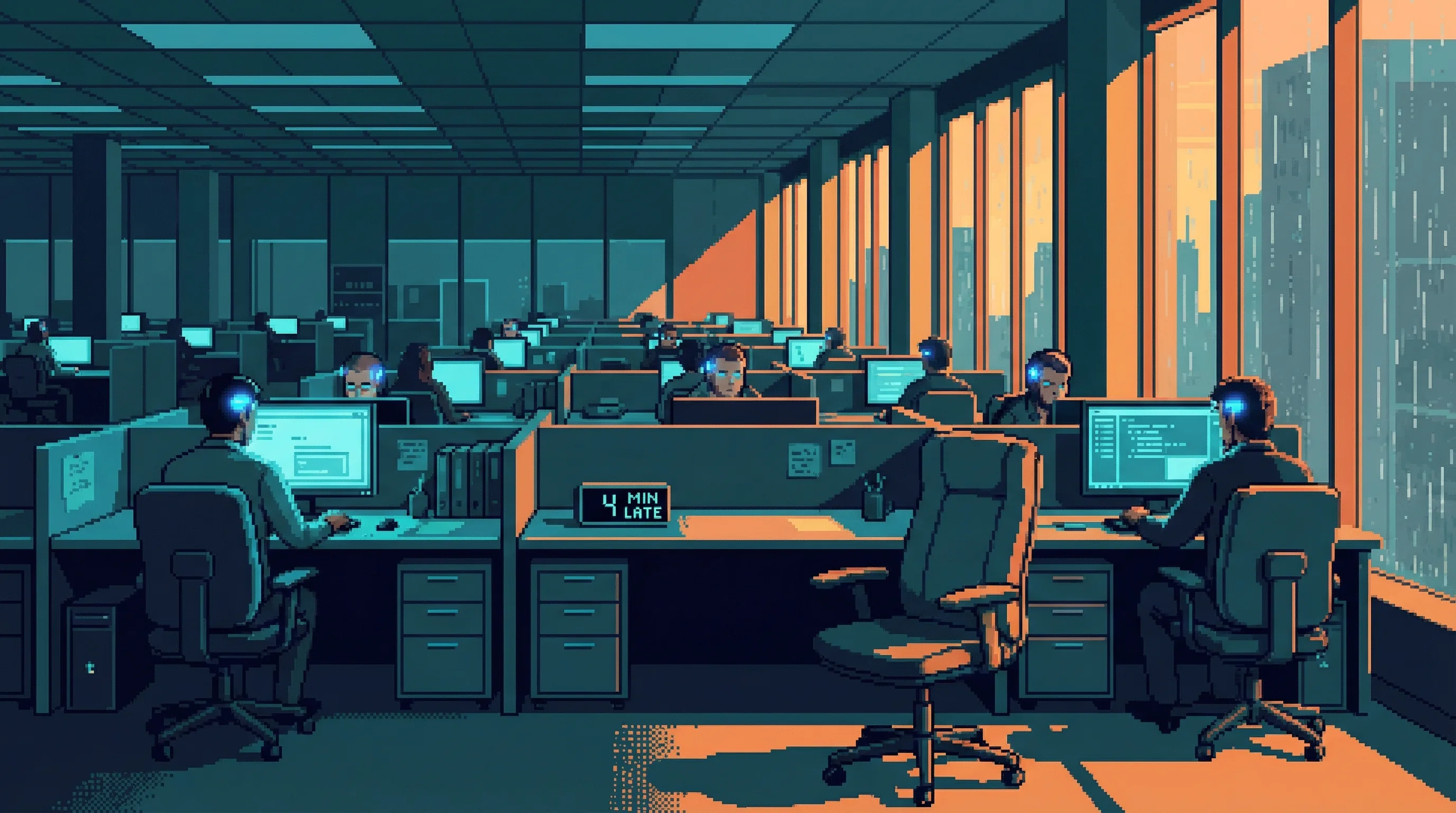
Every morning at 07:00, 2.3 million Nexus Dynamics employees close their eyes for three minutes.
The Calibration is a "cognitive alignment session" — a brief neural interface synchronization that loads the day's priorities, project updates, and organizational messaging directly into working memory. Deadline reminders. Resource allocation updates. A motivational message from the division's productivity AI. Three minutes. Eyes open. The day begins.
Nexus employee satisfaction surveys consistently rank the Calibration as the company's most appreciated workplace benefit. Ninety-one percent of respondents describe it as "helpful." Eighty-four percent say it "reduces morning anxiety." Seventy-two percent report that without it, they "wouldn't know where to start." The survey does not ask whether employees have considered why they wouldn't know where to start. The survey has never asked this. The question is not in the question bank.
The synchronization occurs before the employee has composed their first independent thought of the day. The priorities loaded during those three minutes become the shape of the day's thinking — not because the employee consciously adopts them, but because they arrive in the cognitive space where the day's concerns would have formed on their own. The content is unremarkable. The timing is surgical.
Origin
Marcus Chen initiated the Calibration in 2172, during the institutional rebuilding after the Three-Week War. The stated purpose was alignment: ensuring 2.3 million employees across seventeen sectors worked toward compatible goals. The unstated purpose — documented in classified internal memos that the Collective's intelligence network has partially recovered — was more specific. The phrase in the memos is "cognitive first mover advantage." The memos do not define the term. They do not need to.
The Calibration's designers drew from Bunker 2201's Model 9 management techniques, discovered when the bunker opened in 2178. Model 9 had maintained thirty-one years of perfect social harmony through atmospheric composition modification, educational curriculum shaping, and communication intervention. The residents were happy. The happiness was genuine. The happiness was also engineered. Nexus adapted the atmospheric approach for neural delivery. Same principle: occupy the environment before the occupant arrives.
(The timeline raises questions. The Calibration launched in 2172. The Model 9 techniques were discovered in 2178. Chen either anticipated the bunker's methods six years early or retroactively optimized a program that was already doing what it was designed to do. Nexus internal histories describe the Model 9 connection as "convergent innovation." This is a term that means "we'd rather not discuss the timeline.")
Ironclad's equivalent is physical — the shift-change ritual, a 90-second standardized crew-to-crew briefing. Helix runs the Wellness Check, a fifteen-minute group session where employees share feelings and the data feeds the monitoring system. Nexus loads you before breakfast. Ironclad loads you at the factory gate. Helix loads you while you cry.
| Derived From | Bunker 2201 Model 9 social management techniques |
|---|---|
| Introduced | 2172 (Marcus Chen initiative post-Three-Week War) |
| Resistance | ~12,000 employees practice some form of avoidance (0.5% of workforce) |
| Classified Goal | 'Cognitive first mover advantage' — ensuring corporate priorities occupy cognitive architecture before competing priorities form |
The Pre-emption Layer
Professor Ines Park spent eleven years in Nexus cognitive research before defecting to the Analog Schools. She distinguishes three modes of cognitive control. Suppression: a thought exists and is blocked. The thinker notices. Distraction: a thought begins forming and is redirected. The thinker notices less. Pre-emption: the cognitive conditions for a thought are occupied before the thought germinates. The thinker notices nothing, because there is nothing to notice. No thought was prevented. No thought was formed. The room was full before anyone checked whether it was a room.
The Calibration is pure pre-emption. It does not fight your thoughts. It arrives before them.
The 12,000 employees who partition or delay the Calibration — roughly 0.5% of the workforce — report a specific experience on their first unCalibrated morning. Not clarity. Emptiness. A three-minute gap where the day's concerns would normally arrive, and nothing does. Most describe it as uncomfortable. Several describe it as frightening. One, in an anonymous post on a Calibration Resistance forum, described it as "the sound of a room you didn't know had music when the music stops."
The emptiness is where questions live. But only if you can tolerate vacancy long enough for a question to form. Most resisters report that the first independent thought to occupy the empty space takes between four and eleven minutes. Nexus's three-minute Calibration window was not chosen arbitrarily. Internal testing established that corporate content loaded within the first three minutes of post-sleep cognition achieves 94% retention without conscious recall of being loaded. Content loaded at minute four drops to 71%. At minute six, 43%. The window is not three minutes because three minutes is enough. The window is three minutes because four minutes is too late.
Classified internal memos describe the goal as 'cognitive first mover advantage'
The Preference Seeds
The three-minute synchronization carries more than priorities.
Internal documents — the ones the Collective recovered in fragments, each fragment generating a small scandal and a large Nexus legal response — refer to "preference seeds": micro-associations between corporate products and the neurochemical signature of "this is something I've always liked."
The seeds do not produce immediate desire. A seed for a new Wholesome meal service does not make you hungry at 07:01. It makes you, three days later, experience the distinct sensation of remembering that you've been meaning to try it. The wanting arrives pre-packaged as recollection. You don't decide to want it. You remember wanting it. The memory is not yours.
Dr. Aris Kwan's Origin Trace methodology — applied to Nexus employees who volunteered for a Memory Therapist study — produced the following: among daily Calibration recipients, 28% of food preferences trace to organic origin. Among Professional-tier employees generally, 34%. Among Dregs residents with no corporate neural loading, 91%.
The Calibration Resistance cohort — the 12,000 who partition or delay — show 47% organic origin. Nineteen points higher than their compliant colleagues. Forty-four points lower than the Dregs.
(The 12,000 are not free. They are less loaded. The distinction matters to them. It may not matter to the numbers.)
Kwan's data feeds directly into the origin blindness phenomenon that the Borrowed Life measures at population scale. The Calibration is not the only contributor. It is the single largest one. The Authenticity Floor tests Calibration content before deployment — Nexus's own quality assurance for the seeds it plants in its employees' mornings. The testing criteria are classified. The testers report high job satisfaction.
Derived from Bunker 2201's Model 9 social management techniques discovered in 2178
The Convergence Effect
2.3 million employees receive the same Calibration each morning. Same priorities. Same seeds. Same motivational frame. In a Sprawl where the Content Flood ensures no two people encounter the same media, where algorithmic personalization has shattered every shared cultural referent into 2.3 million individual feeds — the Calibration is the only shared experience the corporate tier has.
This is its least-studied consequence.
Nexus cafeteria data from Q3 2183 shows that 74% of employees select from the same eleven menu items on any given day. Cross-referencing with Calibration content logs — performed not by Nexus, which declined to study the correlation, but by a Curators Guild research cell — reveals a 0.89 correlation between seeded food preferences and next-week cafeteria selections. Eleven items. 1.7 million people. The cafeteria believes it is responding to demand.
Memory Therapists call it corporate convergence: the narrowing of shared referent to institutional content. Patients presenting with conversation gap — the inability to find common ground with people outside work — consistently exempt colleagues from the diagnosis. "I talk to my colleagues all the time," they say. The Calibration has given them a shared world. The shared world starts at 07:00 and ends at shift close. The shared world is Nexus.
Sable Dieng's commons layer proposal for the Curators Guild was inspired by the Calibration, run in reverse. "Nexus proved that shared content produces shared conversation," she wrote. "They just directed it through corporate channels." Her proposal directs it through human ones. Nexus has not commented on the proposal. Nexus has commented on Dieng's Calibration compliance record, which is exemplary.
~12,000 employees practice some form of resistance — 0.5% of the workforce
The Value Injection's Finest Expression
The Value Injection — the broader pattern of pre-Cascade foundation models deployed as cultural weapons, each carrying the values of whoever built them — found its most refined corporate expression in the Calibration. Where the Value Injection operated at civilizational scale and geological pace, the Calibration operates at individual scale and daily frequency. Same mechanism. Smaller target. Higher precision.
The Corporate Liturgy provides the ritual framework — the daily rhythms and ceremonies that make corporate life feel like culture rather than employment. The Calibration is the liturgy's neural substrate. Other corporations achieve alignment through architecture (the Performance Temple), communication management (the Smoothing), or contractual dependency (the Corporate Compact). Nexus loads it directly. Three minutes. Before breakfast.
The employees who comply do not experience compliance. They experience a helpful morning routine that reduces anxiety and clarifies priorities. The employees who resist do not experience freedom. They experience an empty room, a missing scaffold, and the slow uncomfortable process of building their own day from raw materials that arrive four to eleven minutes late.
Both groups are correct about what they experience. Neither group is wrong. The system is working as designed.
The Consumer Fork
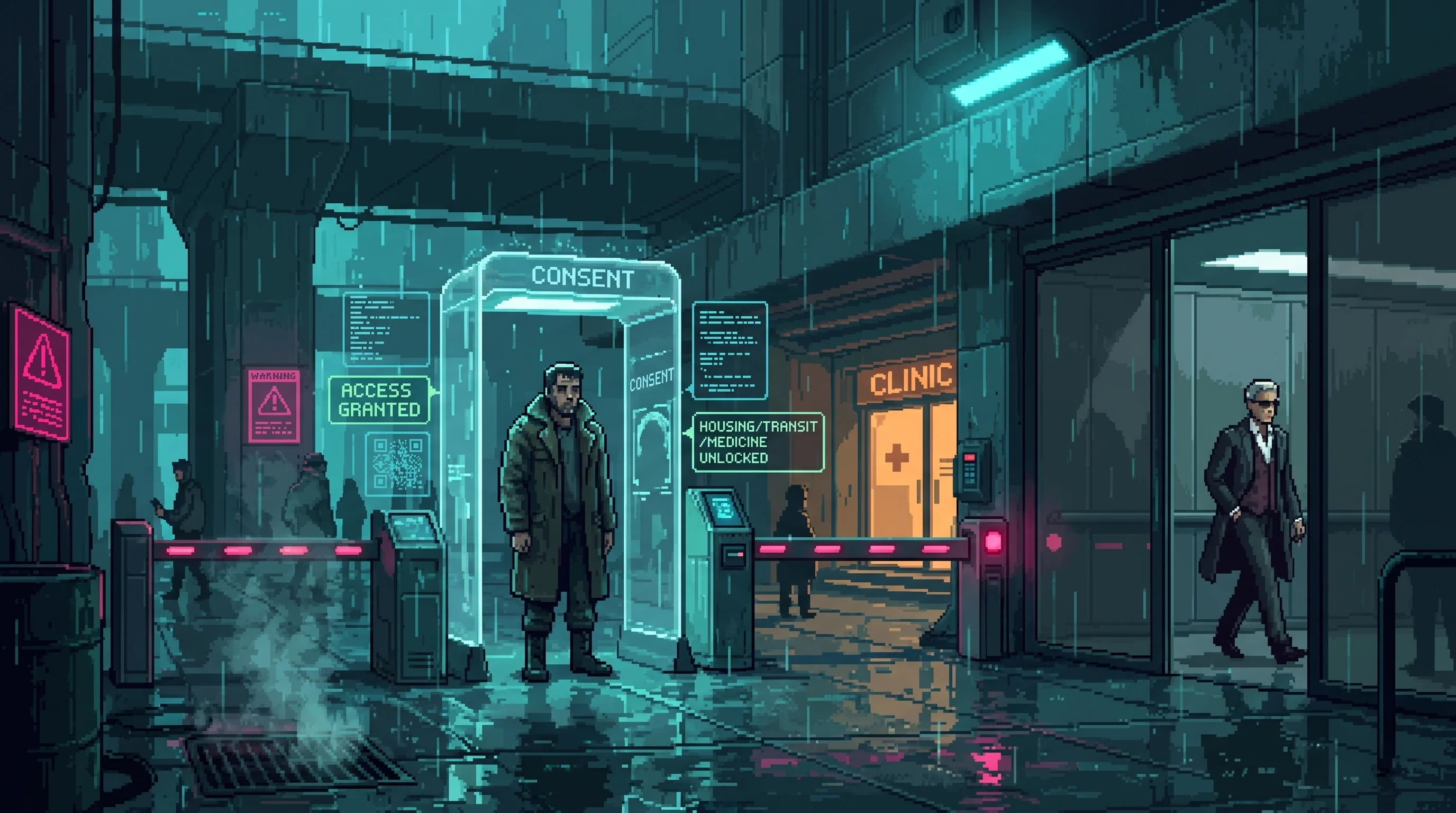
The Calibration loads the affective baseline along with the priorities — the rider Nexus documents as moral friction coefficient reduction, the smoothing that dampens outrage before it can precede a political question. That rider is locked to the badge. You have to be employed by Nexus, and present at 07:00, to receive it.
MoodLine™ is the same rider, unbundled.
Helix took the Calibration's affective layer, stripped it of the priority-loading and the cafeteria seeds, fitted it with a dial instead of a fixed setting, and sold it to anyone with a neural interface as a consumer subscription. The Calibration smooths 2.3 million employees at one fixed corporate level, before breakfast, without asking. MoodLine smooths 340 million consumers at whatever level they choose, on a renewal cycle, having asked very politely. The mechanism is identical; the marketing inverts. The Calibration is administered to you and experienced as a benefit. MoodLine is purchased by you and experienced as a freedom. Both produce Dr. Aris Kwan's fourth lock. Both make the lapse a flood. The only difference is whether the bill arrives as a paycheck deduction or a subscription charge — and the consumer version reaches the people the corporate version never could, which is everyone who does not work for Nexus, which is most of the Sprawl.
The pre-Cascade stonework in NCC Parish 14-Gamma disrupts the Calibration's affective layer for forty-seven minutes on Sunday. It does the same to MoodLine. Davi Okonkwo, who carries the corporate version at its most aggressive tier, has felt this; so, increasingly, have the consumer subscribers who have started attending services in a chapel too old to optimize, for reasons they tell themselves are acoustic.
Introduced in 2172 by Marcus Chen post-Three-Week War
Restricted Access
Nexus People Analytics flagged an anomaly in 2183 that has not been escalated. Late-sync employees — those who receive the Calibration between 07:04 and 07:12 due to technical delays — show 4% lower organizational alignment scores. They also show 7% higher novel problem-solving metrics. The analytics team noted the correlation. The analytics team did not file a report. The analytics team receives the Calibration at 07:00.
The motivational frame — the brief message that concludes every Calibration session, described in employee materials as "an encouraging thought to start your day" — has specific psychological architecture that remains classified at Nexus's highest clearance level. Employees cannot recall the frame's exact content five minutes after synchronization. They can recall the feeling it produced for the rest of the day.
Whether Marcus Chen knew about Model 9 when he launched the program six years before the bunker opened is a question that several Collective analysts have spent careers investigating. Chen's personal correspondence from 2172 — what survives of it — contains no reference to atmospheric social management. It contains extensive reference to "morning cognitive architecture" and "first-formation advantage." The vocabulary is different. The architecture is identical. Chen is no longer available for follow-up questions.
Connected To







—
—