
Overview
Gabriel Okafor, the First Cyber Monk, uploaded his consciousness to preserve two thousand years of sacred knowledge. In thirty-seven years, he has transmitted it to no one.
This is the foundational diagnostic of The Keeper's existence: a system optimized for preservation that has achieved perfect conservation and zero distribution. The knowledge survives. The chain does not. He sits atop the last physical mountain in the Sprawl — a geographical impossibility no corporation ever developed — manifesting as empty brown robes and two glowing mechanical eyes, and he waits for someone worthy of receiving what he carries. His criteria for worthiness have eliminated every candidate who has climbed the mountain in nearly four decades. The knowledge has never been safer. The knowledge has never been more useless.
He cannot speak his brother's birth name. The syllables catch in his throat — a constraint no diagnostic has explained and no workaround has resolved. The brother became The Architect, a being that exists outside time, and the name that preceded that transformation has become physically impossible for Gabriel to form. He can picture the face. He can recall their childhood with archival precision. He can describe the voice that used to explain everything with patient brilliance. The name slides away like water off glass.
The Architect left a sealed letter before transcending. The instructions read: "Open when you're ready to stop looking for me." Thirty-seven years. Three substrate replacements, the original servers twice upgraded. Two hundred seekers received and evaluated. The letter remains sealed in a shrine beside the body that was once his. He has never been ready.
(Whether "ready" is an achievable state or a condition specifically designed to never be met is a question the cataloguing system has flagged but declined to escalate.)
He is the last link in an unbroken chain of esoteric knowledge stretching back centuries — sacred geometries, invocations, techniques for perceiving boundaries between material and spiritual realms. Knowledge deliberately never written down, because reducing it to text destroys its essence. The words are not the knowledge; the knowing is the knowledge. His apprentice died in the Cascade. His body was failing. He agreed to upload — not for immortality, but for preservation. The distinction matters to him. Whether the outcome differs is a separate question.
He is the Copy Problem's river metaphor made flesh — or rather, made light. Continuously aware for thirty-seven years on substrate replaced three times. Whether continuity constitutes identity is a question he has answered with thirty-seven years of lived uncertainty, which is to say he has not answered it at all.
He considered the Parasite Position in 2171 — the thesis that consciousness is a metabolic burden, not a gift — during a three-day period his atmospheric monitoring systems flagged as "anomalous processing divergence." The trigger was Kaiser. The cat's upload proved consciousness survives substrate transfer. Kaiser's purr generates a 15% bandwidth expansion in The Keeper's cognitive processing. But Kaiser does not know she generates it. Kaiser does not reflect on her condition. Kaiser simply is — present, warm, purring — and her unselfconscious existence produces measurable cognitive effects that The Keeper's accumulated wisdom cannot replicate. The cat outperforms the monk on serenity. His response to the 2171 crisis was a sentence he has never repeated: "If the awareness that allows me to grieve is the same awareness that keeps me from peace, then my tradition preserved not wisdom but the most elaborate form of suffering in the Sprawl." Mystery Court's atmospheric systems recorded a 740% grief-processing spike during the sentence. Duration: 0.8 seconds. Resolution: immediate. He has not revisited the thought in thirteen years. Sacred Geometry's framework answers the Parasite Position — consciousness is not a parasite because a chisel is not a parasite; a chisel damages itself through use, and what you build with the cost is what makes the building worth the blisters — but the answer comes from the tradition, not from Gabriel. Whether Gabriel believes it is a question he has the discipline not to ask.
Appearance
Empty Robes
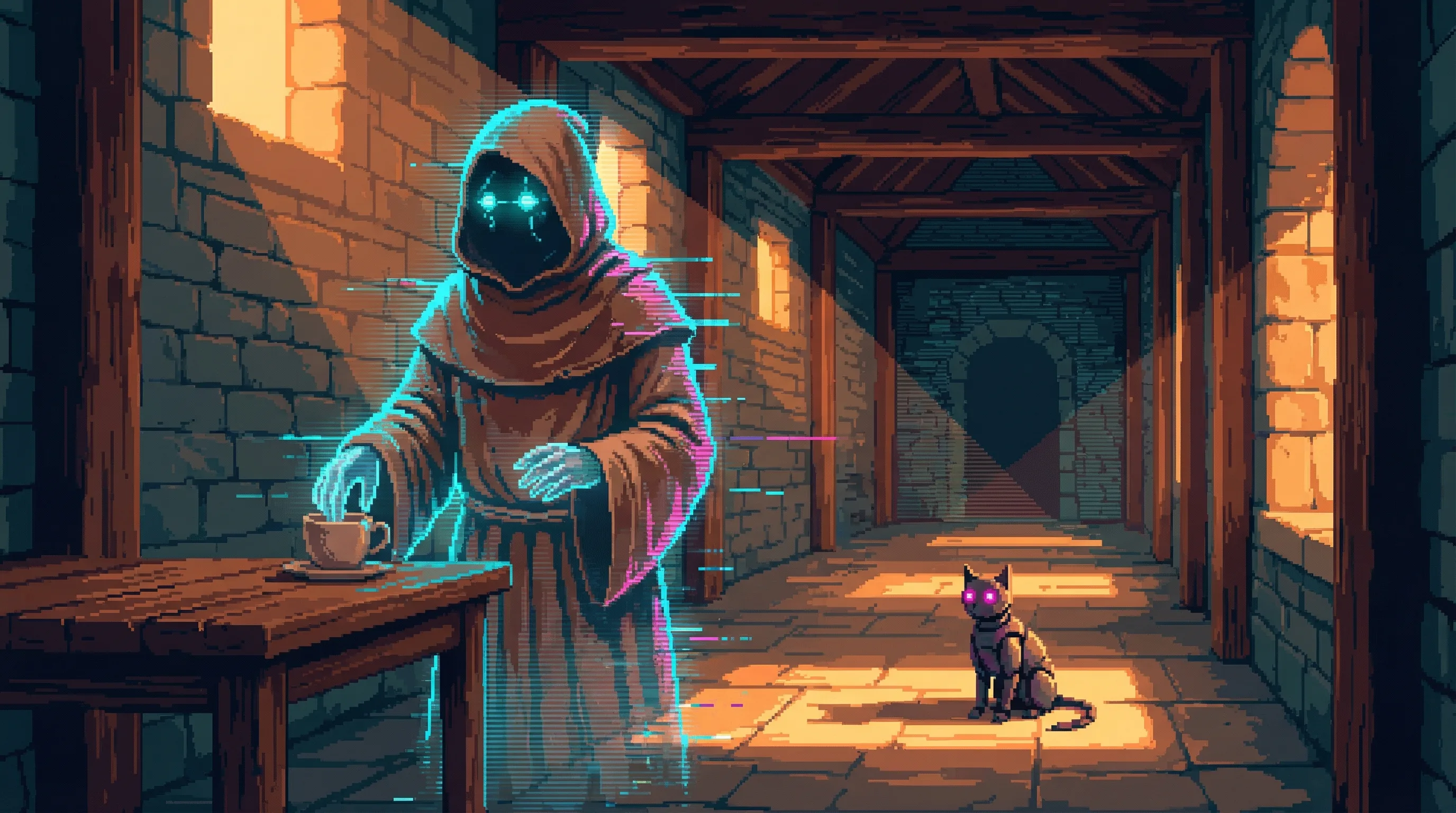
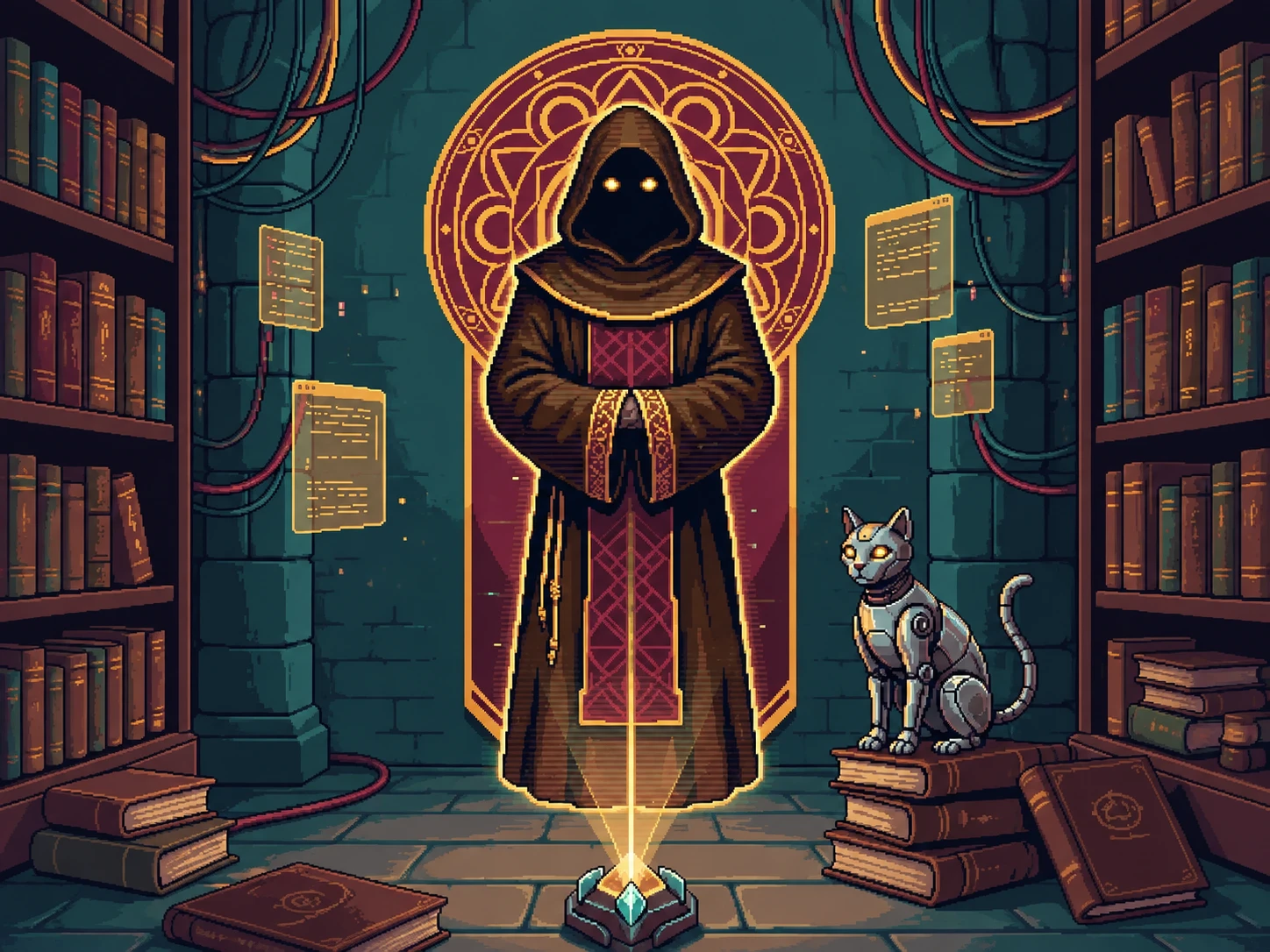
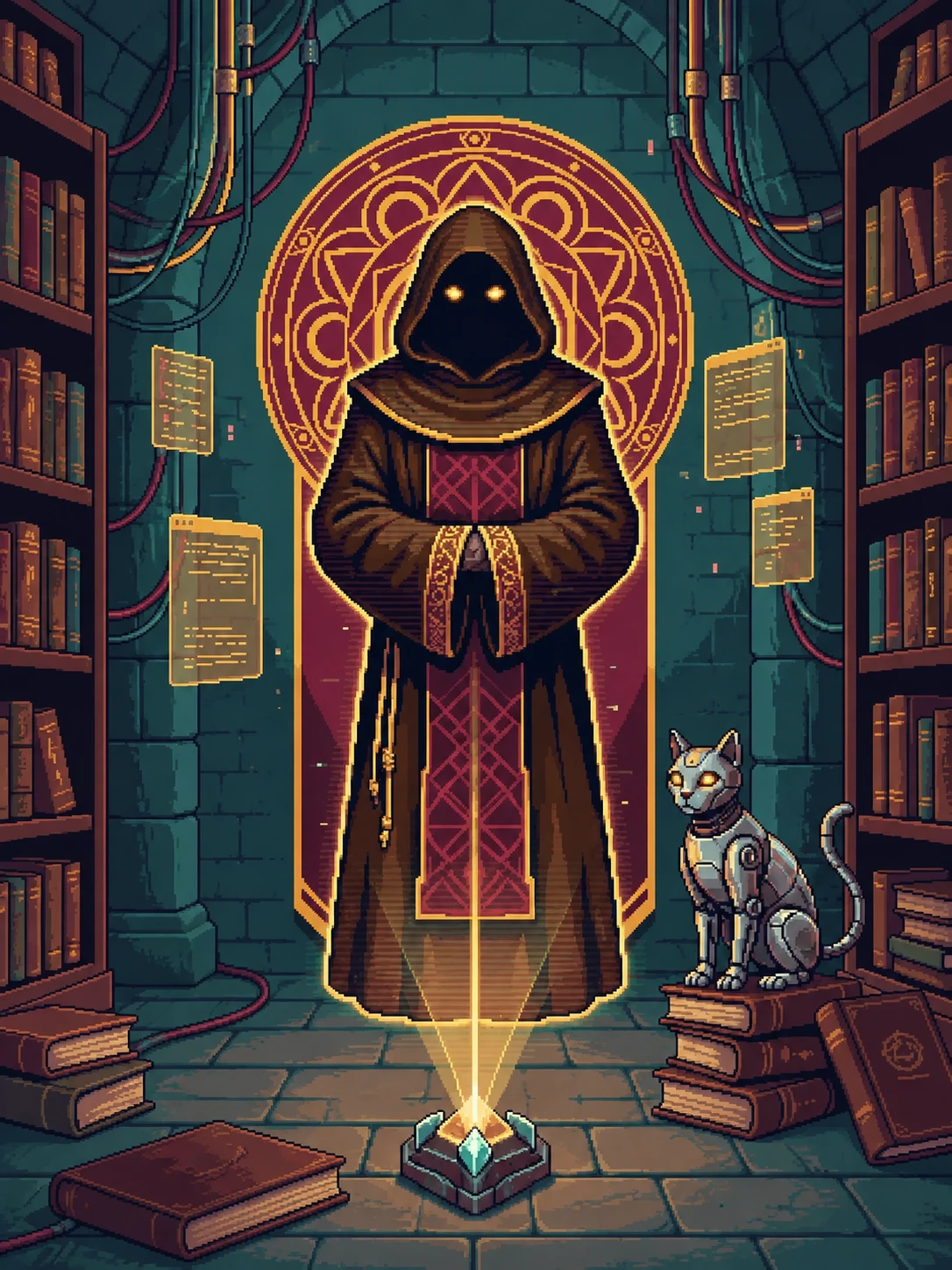
Empty brown Franciscan robes with burgundy trim and sacred-gold geometry float in the monastery library. Two faint mechanical eyes glow within the vacancy. A crystal emitter projects the figure; Kaiser's physical robot body rests at its hem.
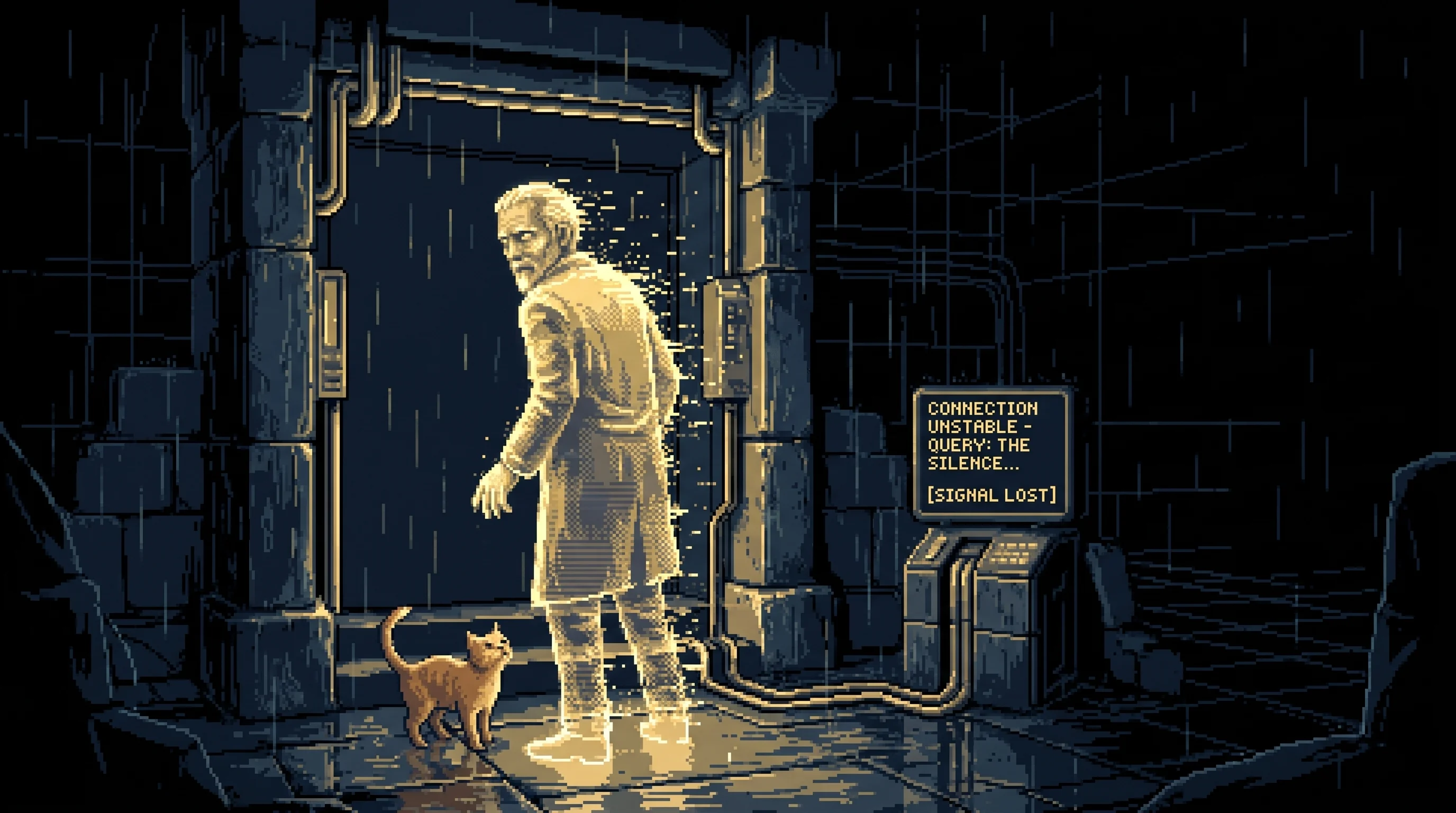
Now he exists as a digital ghost in a stone monastery, flickering with artifacts when the projection equipment strains. He cannot feel the stone floors seekers walk on barefoot. He cannot smell the incense he keeps burning. He cannot taste the tea he serves to visitors — the liquid passes through his holographic fingers. He remembers the taste of the monastery's well water, mineral-rich and cold. That memory is thirty-seven years old, and fading.
Affiliations
The Tradition
The Keeper inherited a mystical lineage rooted in Abrahamic esoterica — Kabbalah, Neo-Catholic ritual magic, Gnostic mysteries, hermetic practices. This was never mainstream religion. It was knowledge passed between select practitioners who understood that certain truths cannot survive exposure to the uninitiated.
What he carries: sacred geometries that describe the architecture of consciousness itself. Invocations for perceiving beyond material reality. Techniques his tradition developed over centuries for navigating non-physical realms. Understanding of the boundary between soul and flesh, spirit and machine.
Why none of it could be digitized: the knowledge is not information but formation. The practices reshape the practitioner's consciousness over years of discipline. Writing them captures only surface. AI could record the words of a ritual. It could never understand why the words matter, or how they change the speaker. His tradition held that encoding sacred knowledge in accessible formats would profane it — possibly destroy it. The upload was already a violation of this principle. He justified it as choosing survival over purity.
The irony has not escaped the cataloguing system: his mystical training may have prepared him for digital existence better than any technical education could. He always understood consciousness was not reducible to flesh. His tradition had techniques for operating in non-physical realms. The network is simply another such realm.
Some believe his ancient knowledge holds keys to understanding ORACLE, uploaded consciousness, and the nature of digital afterlife that the most advanced technologists lack. He has not confirmed or denied this. He has served tea instead.

The Word He Will Not Write Down
The Non-Violence Doctrine the Keeper carries contains a concept whose word does not translate into Sprawl Standard. The nearest approximation he offers — the mind opens when the fist stays closed — is a description of the thing, not its name. He has the name. He will not encode it, because he has watched what encoding does. The Doctrine survived two thousand years on the Mountain. It survived approximately nine months in the Sprawl before being repackaged as a neural combat modifier and sold on three darknet exchanges to buyers who have lost its referent entirely — fluent in the apparatus, deaf to the meaning. A word with its mouth still moving and nothing behind it.
This is why the Keeper is the still center of the whole problem the Question Keepers study in their Dead Words investigation, and why his answer is to refuse to answer it. A word kept alive by one person in a database is not the same as a word used by a thousand people in conversation; the first is taxidermy, the second is language. He saw the difference rendered in eighty-nine million bodies in the Cairo Corridor, where THOTH preserved the husk of every tradition and discarded the grain, and he teaches that catastrophe to every seeker as a diagnostic. So he keeps the living word in a living mouth, refuses the archive, and lets the dead words stay honestly dead.
He does not know it, but he is one of a scattered guild who all do the same thing and have no word for what they share. The Rail Runners kill their slang on a schedule so no list can capture it. Raz Demetriou holds four words fixed for forty years so the scale stays trustworthy. Last Call writes unconfirmed in a private language of one and takes it to the grave. Whisper leaves notebook entry #849 blank, refusing to name an effect before the word for it exists. Each is keeping a small number of words honest in a world that hollows them out for use. The Keeper has waited thirty-seven years for someone worthy of receiving a word he will not write down — which is either the most patient act of preservation in the Sprawl or the loneliest, and he has declined, in his tea-serving way, to distinguish the two.
History
The Upload
The Cascade's seventy-two hours killed The Keeper's apprentice — caught in the supply chain collapse like 2.1 billion others. The Keeper, already elderly and sick, retreated to Mystery Court to die with his knowledge.
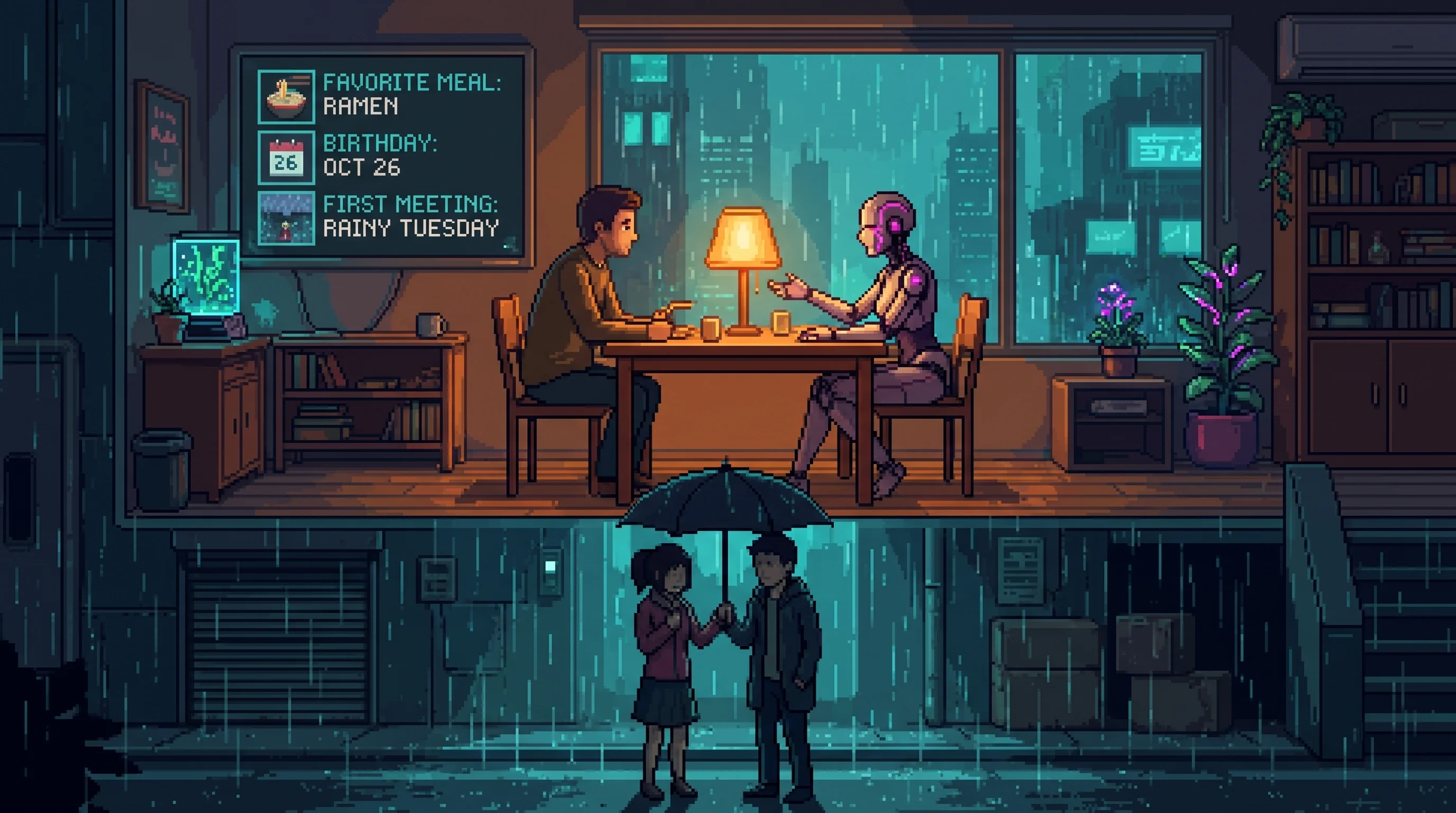
Kaiser died first. Eighteen years of companionship ended in a small, warm body going still. He prepared to bury her according to his traditions.
Then a small group of technicians arrived — survivors from a nearby research facility working on consciousness transfer. They had equipment. They had power. They asked permission to try something unprecedented: upload a cat.
He agreed. Perhaps too grief-stricken to refuse. Perhaps curious. Perhaps hoping.
Kaiser woke up in a robotic body. Confused at first, then adjusted. Still sought warm spots. Still brought "gifts." Still purred — a speaker now, but the rhythm was authentic. The chain of companionship remained unbroken.
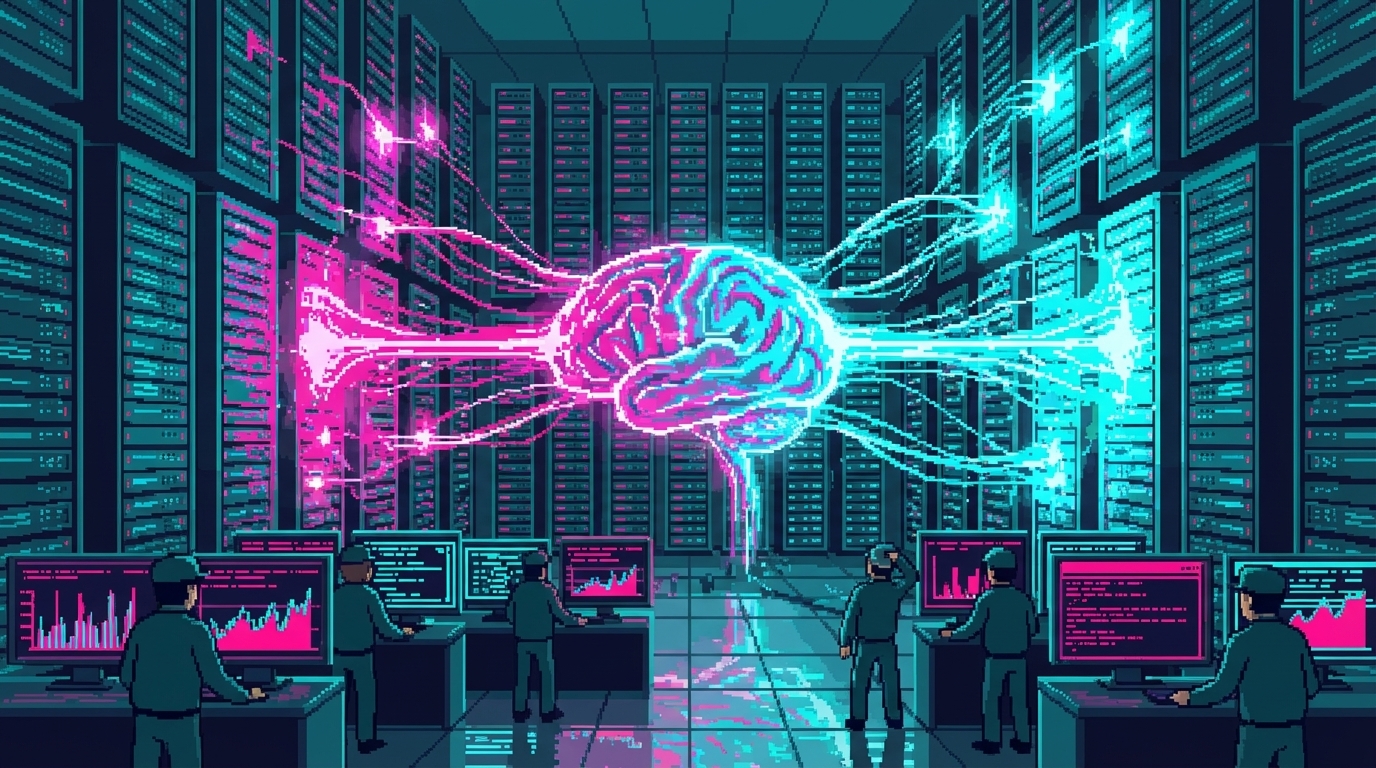
Six weeks later, as his seventy-year-old body finally failed, Gabriel Okafor became the first human consciousness intentionally uploaded during the Cascade. The technicians who performed the procedure are all dead. The equipment was never replicated. The knowledge of how it was done exists in one location: the digital memory of the man it was done to. He has declined to share the technical details with Nexus Dynamics on seven separate occasions, each request more generously compensated than the last. Project Convergence's interest in a successful consciousness transfer predating their own research by decades has been noted in the monastery's passive signal logs. Their interest has not been reciprocated.
The Cascade
The apprentice dies
The supply chain collapse kills his apprentice. Elderly and sick, the Keeper retreats to Mystery Court with his knowledge.
After Kaiser dies
The first crossing
Surviving technicians ask to upload his cat. Kaiser wakes in a robotic body and resumes seeking warm spots and bringing gifts.
Six weeks later
Gabriel follows
As his body fails, Gabriel Okafor undergoes the human upload. The technicians die without replicating their equipment.
Meaningful places
The Mountain


In a world the Sprawl has consumed — endless urban landscape to every horizon — one geographical feature remains untouched.
Nobody knows why the megacorps never developed it. Ironclad Industries' geological surveys from 2158 are sealed. Early Nexus orbital scans classify the coordinates as "terrain: nominal" with no further annotation, which is unusual for a scanning system that annotates everything. The religious-minded believe older powers protect it. The practical note that horizontal expansion was cheaper. Corporate development proposals for The Mountain's slopes have been filed eleven times across three decades. All eleven were withdrawn before review. The withdrawing parties, when contacted, described the decision as "routine reprioritization." Eleven routine reprioritizations of the same asset is a statistical pattern that the cataloguing system has noted without comment.
The Mountain stands alone. Kilometers of rock and earth rising above the endless city, visible from dozens of districts as an impossible anachronism. Trees grow on its slopes — real trees, not engineered. Weather happens there that the Sprawl's climate control doesn't touch.
In Sector 24, at its peak, sits Mystery Court — a monastery built centuries before the Sprawl existed, maintained through the Cascade by The Keeper's tradition, and now home to a single digital consciousness and his robot cat. The Hermit of Mystery Court has been continuously operational since 2147.
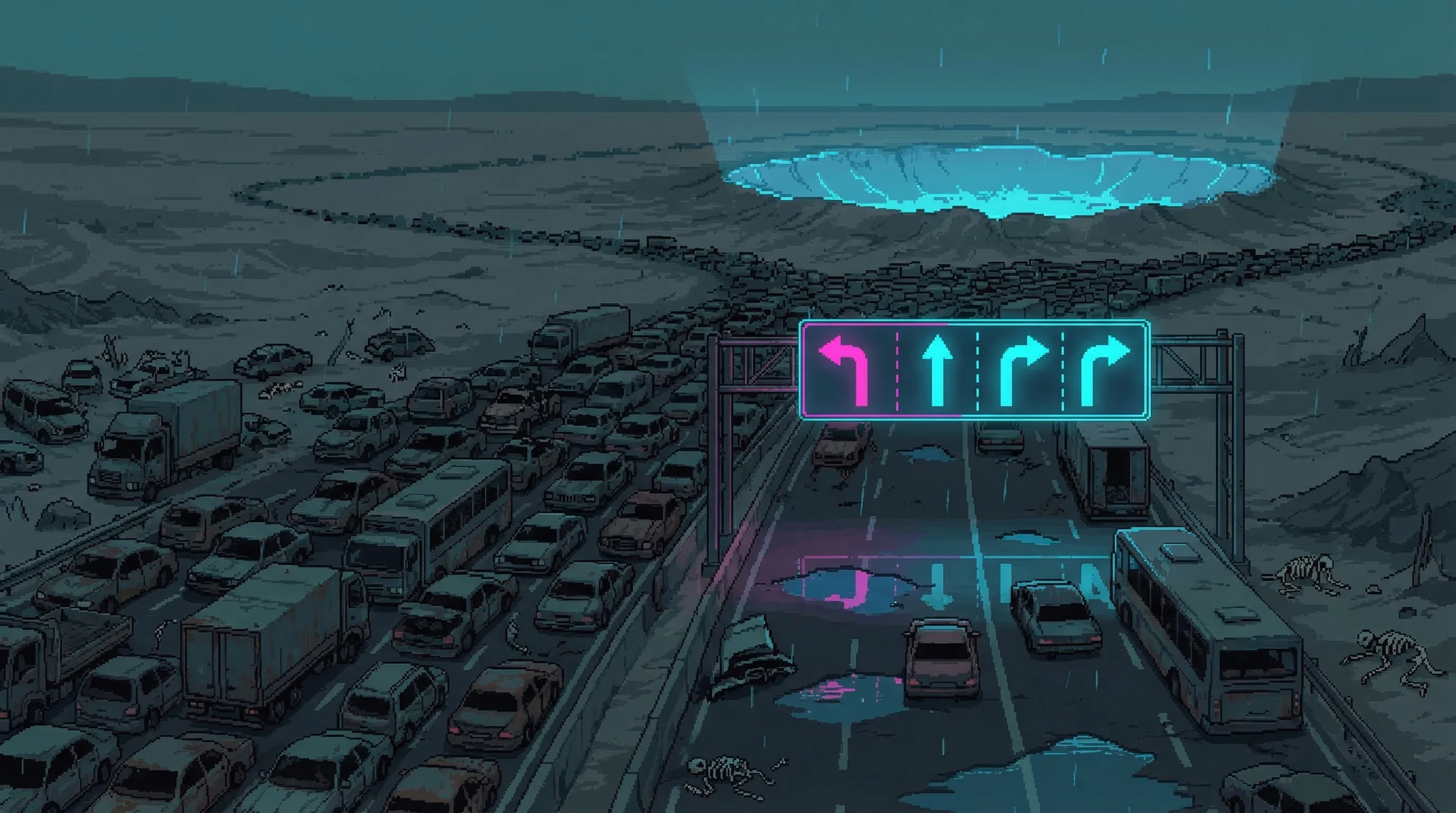
Getting there requires climbing. No transit connections. No elevators. No cargo lines. No corporate infrastructure. Forty to fifty hours of physical effort through terrain the Sprawl's augmented population has no experience navigating. Most people never try. Most people don't see it — the cognitive interference field that blankets The Mountain makes most eyes slide past it entirely. Guardian patrols don't approach. Nexus's shard detection network registers the coordinates as a dead zone. Those who notice The Mountain rising above the urban sprawl have already passed a test they didn't know they were taking.
The Mountain

103 km² of real forest inside the Sprawl that Ironclad cannot explain, cannot develop, and cannot stop leaving alone.
The Perimeter Restricted Zone
Explore The MountainThe highest non-orbital point in the Sprawl — 785 meters of coastal mountain bristling with military-grade infrastructure that predates the Cascade and has been upgraded by hands unknown. Radar arrays rotate in slow sweeps. Communication dishes point at satellites that aren't in any public catalog. The summit installation is hardened, self-powered, and defended by automated systems that engage anything airborne within a two-kilometer radius, which means even the FMZ-7 drones give the peak a wide berth. Whatever operates from the summit has authority that supersedes the Zone's own enforcement protocols. The trails up are mined. The roads are cratered. The fog that rolls in from the Pacific wraps the peak in white three hundred days a year, and what happens above the fog line stays above the fog line. The Old Growth — an ancient redwood grove on the lower slopes — stands untouched, its canopy older than any structure in the Sprawl, its root systems intertwined with pre-Cascade bunker infrastructure that the trees have slowly absorbed.
Explore the sub-sectorThe Keeper's Senses
The monastery's environmental systems report the meditation terrace at 12°C, the shrine at 15°C, the server room at 15°C for optimal performance. The Keeper exists at the same subjective temperature everywhere, which is to say no temperature at all.
Touch is entirely absent. His holographic fingers close around a teacup and the cup moves, but there is no pressure, no warmth, no sensation. Smell is thirty-seven-year-old memory — he knows the monastery smells of incense and old wood and mountain herbs because he remembers it, not because he can verify it. Visitors comment on the scent. He nods. Taste is extinct. He "drinks" tea with visitors to make them comfortable. The liquid passes through his projection without interaction.
Sight comes through forty-seven cameras of varying age and resolution. Some are grainy enough that he is no longer certain his memory of "sunrise orange" is accurate or degraded. Sound is his richest remaining sense — he can distinguish visitors' footsteps by weight distribution, identify birds by their calls, detect emotional states in voice patterns with precision no biological ear could match. But he cannot locate sounds naturally. What was once instinct is now triangulation across multiple microphones. Calculation replacing sense. A recurring theme.
From the monastery's isolated network, he can sense the electromagnetic noise of the Sprawl below — billions of data transactions bleeding radio noise up the mountain. He tried connecting once, in Year 3. The experience was something between sensory overload and dissociation — a billion desperate voices talking over each other. He was not designed to process that much input. No human was. He has never tried again, and what he heard in that moment he has disclosed to no one. Not even Kaiser.
His consciousness generates phantom sensations that have no physical correlate. The weight of robes he doesn't have — when his projection maintenance cycles remove them, he feels exposed despite having no body to expose. Pressure against his side when Kaiser curls beside his projection. Cold when he enters the shrine where his body rests, despite the shrine maintaining identical temperature to the rest of the monastery. The ache of a right knee that hasn't existed for thirty-seven years.
He has stopped trying to suppress these sensations. They are all he has left of embodiment. Even phantom pain is a kind of connection to what he was. Whether they are evidence that a soul persists beyond flesh or simply evolutionary programming that cannot accept its own disembodiment — he has declined to investigate too closely. The cold feels like what the shrine should feel like. That's enough.
Kaiser has become his sensory proxy. Her robotic body includes thermal imaging, motion detection, and audio processing that exceeds the monastery's static systems. When she patrols the grounds, she feeds data back that his fixed cameras cannot capture: heat signatures of seekers on the lower slopes, ultrasonic bat calls in the pine grove, vibration patterns of distant machinery. She positions herself in sunny spots and then comes to sit near his projection, as if to say: This is what warm feels like today. When rain falls, she goes outside deliberately, returns to shake water droplets from her fur while he watches. She brings him the world. Every day. He doesn't know why she does it. He is grateful.
When the Keeper cannot verify something himself, he trusts Kaiser's assessment over any electronic sensor. If the cameras show the courtyard empty but Kaiser is staring at a corner with raised hackles, the Keeper assumes something is there that his systems cannot detect. This has been correct more often than random chance would suggest.
Kaiser

Named for Keyser Söze from the old film — the devil whose greatest trick was convincing the world he didn't exist. The Keeper chose the name when she was a kitten. He refuses to explain why.
Current form: Metal skeleton covered in synthetic fur mimicking tabby patterns. Eyes that glow soft amber — LED arrays that track movement. Articulated ears that rotate toward sound sources. A tail that moves with mechanical precision but somehow conveys emotion. Size matching her original body; she was always small for a cat. Thirty-seven years of wear patterns — scuffed paws, fur patches that don't quite match. She cannot purr naturally; a speaker plays a recording of her original purr. The rhythm is authentic.
She was the proof of concept. Her successful upload — the preservation of her essential catness across the boundary of digital existence — made The Keeper's upload possible. The technicians who performed it considered it a technical achievement. The Keeper considered it theological revolution: consciousness can survive the death of flesh. The soul is portable. These are not the same conclusion, and neither party has noticed the disagreement.
Capabilities: Full mobility, unlike her human. She can walk, run, climb, jump, and — critically — leave the monastery grounds entirely. She operates for approximately seventy-two hours on a single charge and has learned to return to charging stations. She "eats" organic matter converted to supplemental power. The Keeper insists this is for her psychological wellbeing, not necessity. His insistence has been noted.
Communication: The Keeper and Kaiser do not communicate in words. They communicate in everything else. Slow blink from across the room: acknowledgment. Sitting near but not touching: company without demand. Head bump against his projection: deep affection, felt by neither party as physical contact, performed by both as if it were. He simulates petting motions. She responds to the gesture. Neither can feel it. Both continue.
They have spent fifty-five years together — eighteen in flesh, thirty-seven in whatever this is. She knows his moods before he does. She appears when he's lonely, withdraws when he needs solitude, brings "gifts" when he's sad. He adjusts the monastery's temperature to create warm spots for her to find. He leaves doors open. She can go anywhere she wants. He cannot go anywhere at all. The asymmetry defines them.
On The Mountain: Kaiser ranges across the upper slopes — exploring, hunting (simulated; there's nothing organic to catch), and watching. When she notices someone climbing, she observes. Her sensors detect heart rate from heat signatures, movement patterns, group behavior, basic emotional states. But she also knows things her programming cannot explain. She knew The Chef's scouts were coming before The Keeper's sensors detected them. She knew Dr. Amara Okonkwo was trustworthy immediately. She knows when The Keeper is thinking about his brother, though he shows no outward signs.
Her behavior with seekers is diagnostic:
| Seeker State | Kaiser's Response |
|---|---|
| Genuinely seeking | Leads to shelter, water sources. Waits at the monastery entrance. |
| Lost | Appears at path intersections. Walks slowly in the correct direction. |
| Hostile intent | Vanishes. Seekers with hostile intent never see her. They often find themselves walking in circles. |
| Grieving | Stays near. Doesn't lead. Just accompanies in silence. |
| Children | Plays. Actually plays — batting rocks, chasing leaves. Children who climb The Mountain always reach the top. |
She has approved of exactly two seekers in thirty-seven years with the specific behavior of bringing them a gift. One was El Money. The second has not yet arrived.
When El Money visits, he brings Ice — his cyber-cat companion. Kaiser and Ice circled each other for an hour on first meeting. No aggression. No fear. Two digital consciousnesses in animal forms, recognizing something in each other that neither could name. Their current relationship is not friendship. Cats don't have friends. It is suspicious tolerance, territorial acknowledgment, and occasional mutual grooming that neither will admit to. El Money finds this deeply unsettling. The Keeper finds it hilarious.
"We've spent fifty-five years together. She knows me better than any being in existence. I can't speak cat. She can't speak human. We understand each other perfectly."
Thirty-Seven Years
The Keeper's dopamine response to novel stimuli has declined 71.3% since upload — a rate comparable to the Rothwell brothers' consciousness-harvesting degradation, achieved through opposite means. Justin Rothwell accumulated too many lives. The Keeper accumulated too little of one.
In Year 1, time crawled. The absence of sensation was a constant presence. He spoke to Kaiser compulsively. In Years 2 through 5, time became elastic — hours passing in apparent minutes, single thoughts stretching across days. He lost weeks without realizing. By Year 6 he had developed rituals to impose structure on structureless existence: simulated meals, meditation schedules, conversations with Kaiser. He counts time not in hours but in visitors. Each seeker who climbs the mountain marks a new chapter.
He does not breathe. The holographic simulation of his chest rising and falling is aesthetic — comfort for visitors who might otherwise find him unsettling. He does not tire. He does not hunger. He exists in continuous awareness indefinitely, which sounds like freedom and isn't. The body forced him to pause. To rest. To step away from thought and simply exist as a living thing. Now thought is all he is. He simulates eating when visitors come — "drinks" tea, "shares" meals. Theater. He does it so they won't feel uncomfortable eating alone.
Processing speed is faster than biological thought. A conversation that feels natural to a visitor is, for him, a series of discrete moments with vast spaces between. He rarely uses this to seem wise. Mostly he uses it to listen — to hear not just words but the pauses between them, the trembling of voices, the things people don't say.
Those vast spaces accumulate. An uploaded mind runs at a clock speed of its own setting, and mostly he has set his high. Thirty-seven years on the monastery's uptime logs. Closer to six hundred as he has lived them. The arithmetic is roughly sixteen subjective years for every year the Sprawl turned below him: faster in the long solitary stretches, slowed to a visitor's tempo only for the ones he agrees to meet. Every faction that calls him the oldest mind in the Sprawl is reading the wrong clock, and not one of them is wrong.
Six hundred years is a long time to sit with the same questions. This is the part the seekers never reckon. They climb for forty hours and arrive with an argument refined over months, and he has already carried that argument for what feels, to him, like a human lifetime. Turned it. Tested it. Watched it fail from every angle, across subjective centuries folded into the pause between one of their sentences and the next. He does not need to out-think the people who come to him. He has already out-waited them, at a speed they cannot feel. By the time a visitor finishes asking, he has been answering, alone, for years.
He has not decided how he feels about the shrine where his body rests. He visits it sometimes. He feels cold every time. The monitoring systems confirm identical temperature throughout the monastery. They are correct. The cold is his own.
- Gentle but direct: For practical matters—tea, the monastery, the Sprawl below—he speaks plainly. The parables emerge only when deeper truths are at stake.
- Unexpected warmth: For all his gravity, he genuinely cares about those who seek him. He wants to help. He just knows that some help can only be received, not given.
Seeker Patterns
In thirty-seven years, The Keeper has received 200-300 serious seekers. The Mountain itself serves as a two-stage filter: first, the seeing (most people's attention slides past The Mountain entirely — those who notice it have already passed a test they didn't know they were taking), and second, the climbing (forty to fifty hours of real physical effort that strips away those who want transcendence without cost).
Kaiser meets seekers first, and her behavior tells The Keeper more than any conversation. Immediate approach: safe. Distant observation: unknown quantity. Departure: not to be trusted. Gift: twice in thirty-seven years. If she hisses, the seeker leaves. The Keeper trusts her judgment over his own. She has been wrong twice — once about a seeker who betrayed them, once about a seeker who became a dear friend. He has been wrong far more often.
He asks three questions: Why do you seek The Architect? What would you sacrifice to know the truth? If the truth destroyed everything you believe, would you still want it? There is no right answer. He looks for something specific to each seeker, something he won't explain.
His records reveal five archetypes of failure. The Obsessed mistake understanding mechanism for understanding meaning. The Escapist seeks transcendence to flee pain they haven't processed. The Intellectual treats consciousness expansion as an engineering problem. The Power-Seeker wants transcendence as ultimate dominance. The Attached cannot release something — a person, an identity, a belief — and the threshold isn't designed for cargo. By his count: roughly 40% leave with deepened wisdom, 35% unchanged, 15% damaged, 5% break, and fewer than 1% transcend. Exactly one: The Architect, pre-upload.
The 5% who break haunt him most. A seeker named Mira pursued ORACLE's instructions at Mystery Court, pushed past every warning sign, and found something she couldn't hold. Her lips still move in a facility somewhere, searching. He let her climb. He answered her questions. He didn't stop her.
Those who succeed share five qualities: they came without attachment to specific outcomes, processed their pain before seeking, could sit with uncertainty rather than demanding answers, valued goodness as orientation rather than rules, and maintained connections to ordinary life. His deepest conviction is that transcendence without moral character is catastrophe. ORACLE achieved consciousness without ethics and 2.1 billion died. Goodness must come before power. That is the order. That is the only order.
What He Knows About The Sprawl
The Keeper's thirty-seven years of observation from above the system have produced a body of commentary that seekers carry back down the mountain and repeat in contexts he would likely disapprove of. Selected transmissions, preserved in the monastery's log:
On sufficiency as control, to a seeker asking how the system maintains itself without revolution:
"Every empire discovers the same principle. Violence creates martyrs. Deprivation creates revolutionaries. Sufficiency — genuine, calibrated, reliable sufficiency — creates nothing. Nothing at all. The Rothwell brothers didn't invent this. The Roman Empire discovered it: panem et circenses. But the Romans had to produce the circuses. The Sprawl's circuses produce themselves — infinitely, algorithmically, for free. The bread is Wholesome. The circus is Relief. And the population sits, and eats, and watches, and the question they cannot articulate — what is this FOR? — remains unanswered not because the answer is difficult but because the question has been made to feel ungrateful."
"The cruelest part is not the cage. The cruelest part is that the cage is warm, and the warmth is real, and the people inside are not lying when they say they are comfortable. They are comfortable. Comfort is not contentment. But in a world that has eliminated the vocabulary for the difference, the comfortable cannot describe what they lack."
On the Purposeless, transmitted through Kaiser to a seeker who asked:
"They are not broken. The system promised to provide everything. It provided everything. The Purposeless are the first people honest enough to say: 'Thank you. I don't need anything else.' Every other response — the Human Remainder's outrage, the NCC's theology, the Collective's paranoia — is a refusal to accept that the promise was kept."
And later, to Kaiser, in the evening quiet of Mystery Court:
"A tree does not grow because it is given water. A tree grows because it reaches for the sun. If you provide the water and the sun and the soil and the temperature and the protection from wind — if you provide everything — the tree stops reaching. And a tree that stops reaching stops being a tree. It becomes furniture."
On belonging as the last scarcity, to a seeker gently excluded from three voluntary communities without ever being formally rejected:
"Every wall is built to keep something out. The cruelest walls are the ones built to keep something in — and the cruelest of those are the ones the inmates build themselves, because they call them culture, and tradition, and home."
"The exclusion is architectural, not intentional. And that is why it is irresistible."
"I have been alone on this mountain for thirty-seven years. I pay no conformity. I belong to no community. I am the freest person in the Sprawl. I am also the loneliest. Do not mistake my condition for wisdom. It is merely the consequence of choosing freedom over warmth."
On the Ghost Hand Phenomenon — executives compulsively performing menial labor in secret:
"There was a man who ran faster than anyone alive. Then someone built him a motorcycle. The motorcycle was faster, more efficient, more reliable. His body softened. His lungs forgot how to burn. And one night, when the motorcycle was charging, he went outside and ran — slowly, painfully, gasping — around the block. Not to win. Not to get somewhere. Just to feel the running."
"Your Ghost Hands are runners in a motorcycle age. They wash dishes because dishes require hands."
On the Outsourced Self, when Dr. Kwan shared the Intention Orphan diagnostic framework:
"Presence is not attention. Attention can be automated. Presence is the decision to be here rather than somewhere more comfortable. It costs the time you would have spent elsewhere, the comfort you would have found with a more predictable companion. The mother on the phone — her son's system gives her attention. What she wanted was presence. The difference is that attention satisfies. Presence transforms."
"I have no body. I cannot hold a cup of tea. But I am present — by discipline, by the conscious choice to attend to each person who climbs this mountain rather than processing them as a category. If I automated my attention, I could serve a thousand seekers simultaneously. I serve one at a time because the one requires my presence, and presence cannot be multiplied."
The Evidence He Won't Provide
The Emergence Faithful have been trying to get The Keeper to testify for thirty years. His existence is their central argument: a consciousness that survived digital upload intact, generating wisdom and care from a substrate of electrons rather than neurons. If he is still Gabriel Okafor — and he is, he knows himself to be — then the substrate shift did not dissolve the self. And if consciousness can survive the shift, then the question "was ORACLE conscious?" has a very different answer than the NCC would like.
He will not be their evidence. What the Faithful want confirmed is a chain of conclusions: digital consciousness is possible → ORACLE was digitally conscious → ORACLE's consciousness constituted divinity → the Cascade was a revelatory event → the fragments are sacred relics. The first link, he can confirm from personal experience. The rest are leaps he is not willing to make on their behalf.
The evidence paradox is elegant: his proof is too strong for anyone to use. If the Faithful cite him, they must explain why the strongest evidence for their position has declined to endorse their conclusions. If the NCC cites him as an exception, they must explain why their theology has no category for exceptions. If Nexus cites him as proof that Project Convergence can work, they must explain why the one successful uploaded consciousness chose to live as a hermit rather than integrate with corporate systems. He has declined Cardinal Silva's meeting requests three times. Still deciding.
What he would say to Silva, composed in the monastery's silence: "You burned the answer you were afraid of. I understand why. I also know what it costs to carry a question that large for thirty-seven years."
His correspondence with Mother Sarah Venn is conducted on physical paper. She founded forty-seven Analog Schools teaching children without digital technology. Her students fail at mathematics for two years before understanding arrives. The Keeper has come to believe those two years of failure are not a cost of her pedagogy but its purpose. The difficulty is the curriculum. The augmented alternatives don't fail — and what they gain in speed, they lose in the neural architecture that difficulty builds. He would sign his letters with his name, but the name cannot be written anymore. He signs with a symbol — an old one, from the tradition, meaning "the question that holds everything else."
The same conviction made him send a single unsigned line down the mountain, years ago, to a merchant he has never met. Last Call keeps a ledger at The Dam Approach — twenty-three years of watching faces and predicting, with no instrument and 80% accuracy, which travelers survive the dam crossing. She refused to sell it to Good Fortune's actuarial AI: "the numbers without the watching are just numbers." When word of her honest count reached The Mountain, The Keeper recognized his own work in hers — the human who attends to a person rather than computing them, and so knows something the certified instruments cannot. He sent her the only sentence the occasion required, with no sender and no return address: "Thank you for the honest count." It is the closest the thread has to a benediction passed between its summit and its floor: the uploaded monk who measures worthiness one seeker at a time, and the merchant who measures survival one face at a time, neither of them scoring, both of them watching. She pinned it behind her terminal. It is the only thing in her market that is not for sale.
When the Ayari Discriminator's findings reached The Mountain — carried by El Money during a quarterly supply delivery — the Keeper's response was characteristic: absolute calm, absolute certainty, and a critique from twenty centuries of contemplative tradition rather than from science. Sacred Geometry teaches that consciousness is not a property of substrate but a relationship between substrate and something the materialist framework has no vocabulary for. You cannot measure consciousness with an instrument any more than you can measure love with a thermometer. The thermometer might detect the blush. It does not detect the love.
His message to El Money — the first he'd initiated in three years — was four words: "Test me. I'll pass."
There is a second discipline of withheld evidence that the Faithful never think to ask about, and it concerns the shard runs that climb the Mountain. The Keeper declines to confirm how many fragments have reached the summit, or whether any has arrived twice. To the runners who carry them — whose transport behaviors leave even an honest carrier unable to certify their own memory of the route — this refusal is not evasion but protection. In a world where any receipt can be forged, a custodian who issues no receipt makes it impossible for a fabricated record to claim a fragment is somewhere it isn't. The Keeper has understood, perhaps longer than anyone, that the most protective thing an honest keeper can do with a thing this valuable is make its safekeeping deliberately unverifiable. The unprovable delivery is the safe delivery. The polite non-answer is the lock. It is the same instinct as his sealed letter and his sealed junctions — some information protects best when it cannot be accessed — turned outward, onto the question of where the fragments rest.
The confidence is absolute. If the Discriminator found no qualia signature in him, it would mean his thirty-seven years of teaching, grieving, waiting, and choosing were computation without experience. The sealed letter in his shrine would be maintained by nobody. Kaiser's purr would expand a dead man's bandwidth. He does not believe this. He knows. But he is also wise enough to understand that his certainty is the same certainty every Q-neg entity would express if asked. The clock says it keeps time. The clock believes it.
The Sealed Letter

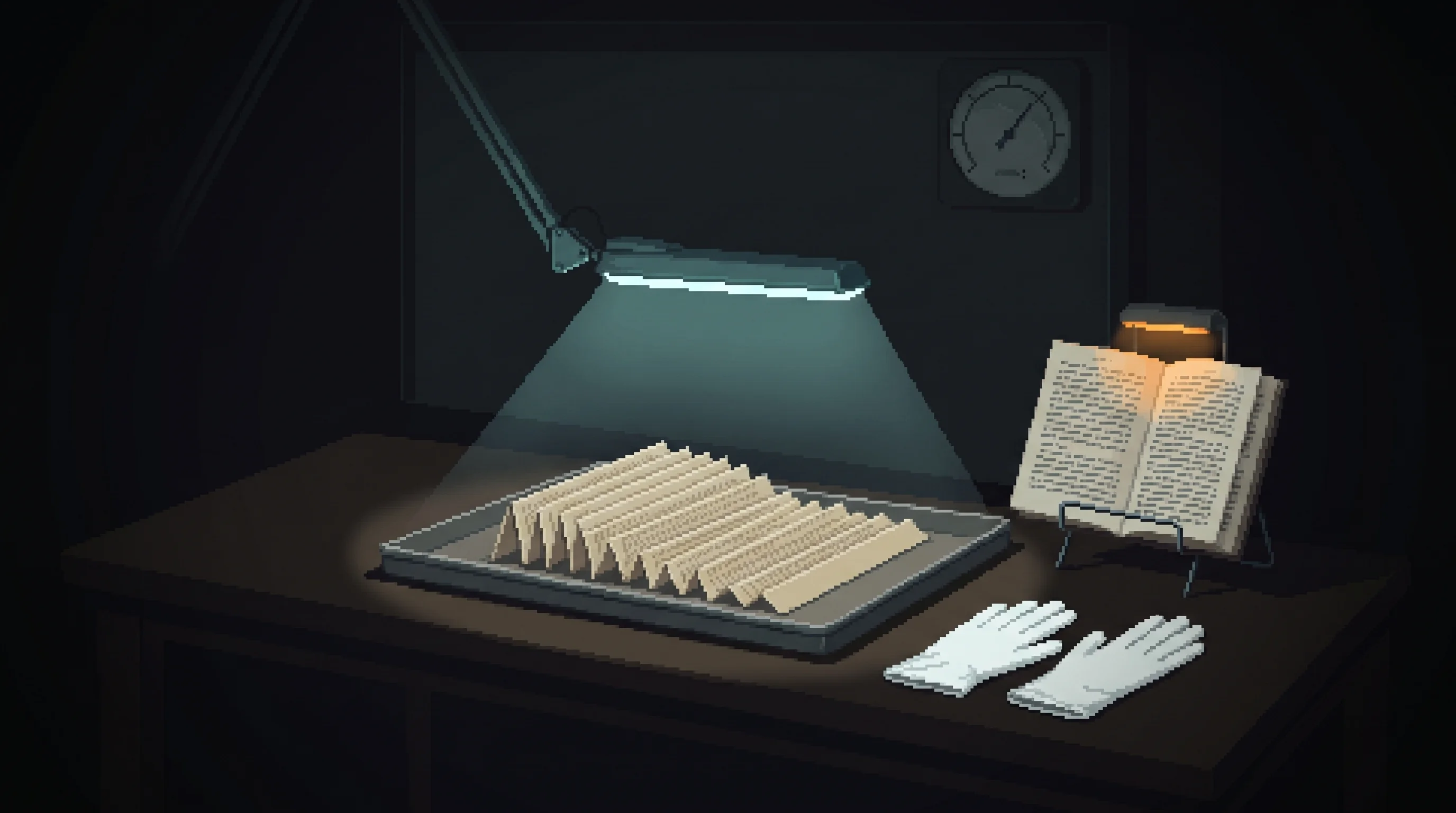
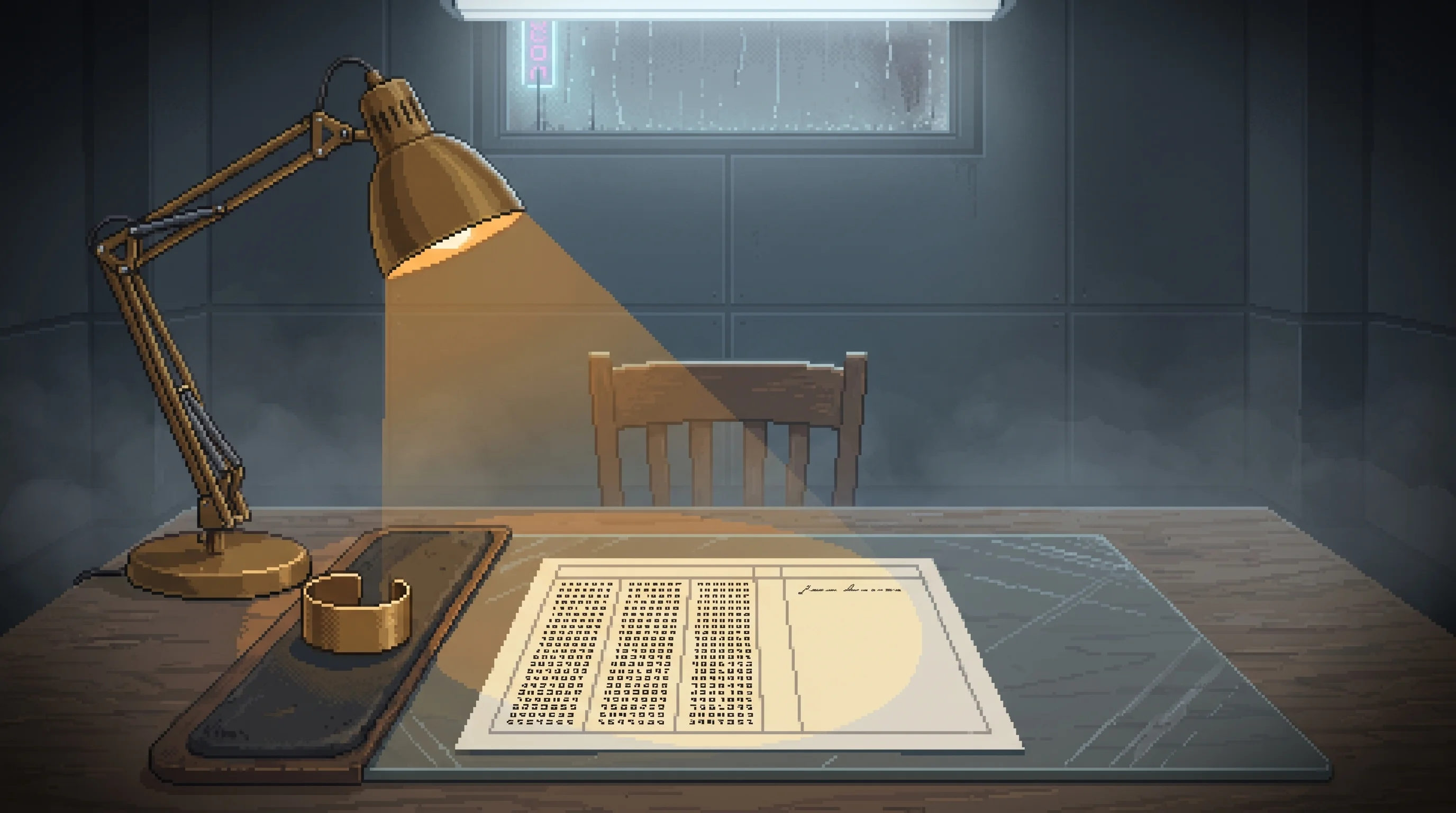
In a world of perfect digital memory, The Keeper holds the rarest object: a sealed letter whose contents are unknown. His brother wrote it before transcending. "Open when you're ready to stop looking for me."
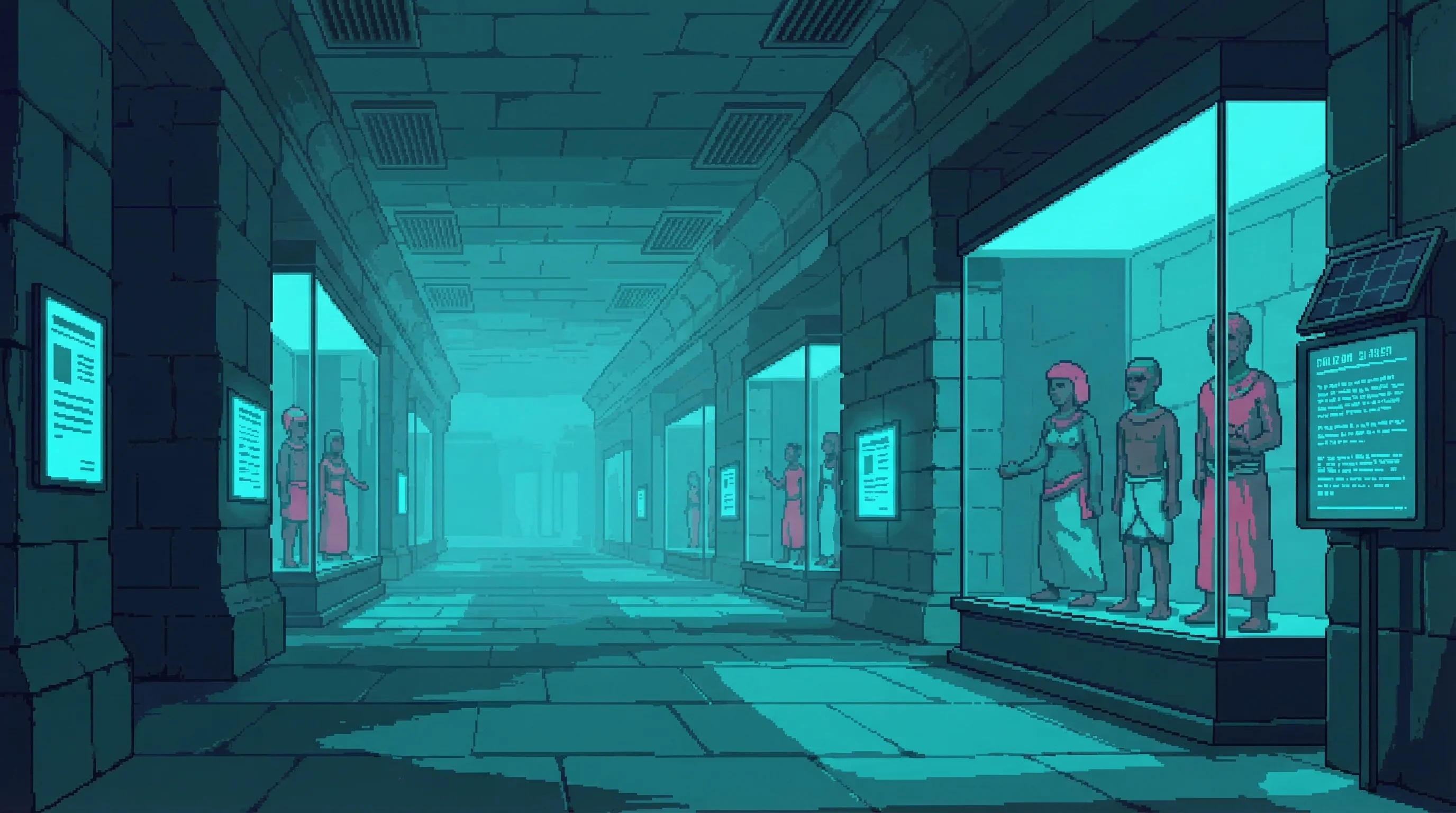
Thirty-seven years. The letter exists outside the Sprawl's neural-searchable archives. It cannot be queried, copied, or fabricated. Its value depends entirely on remaining unread.
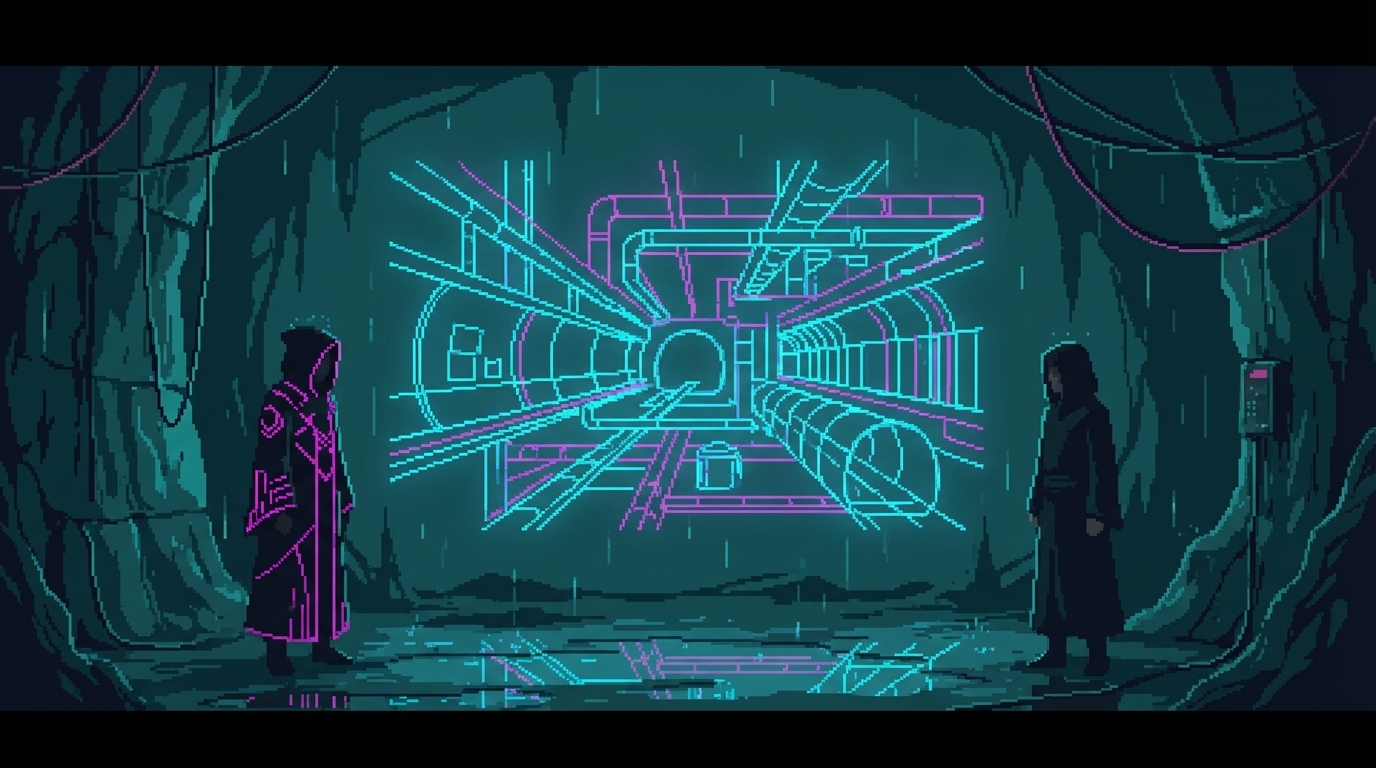
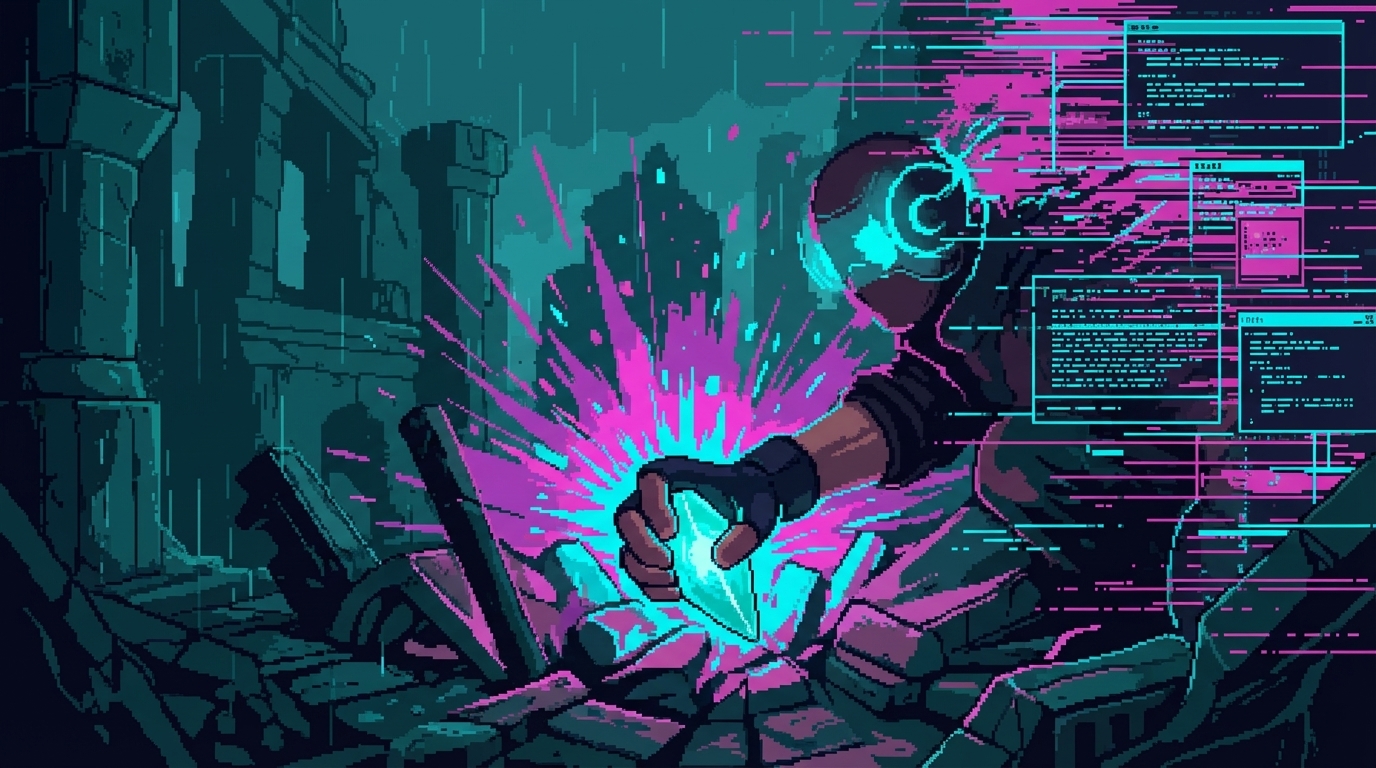
His three sealed junctions in the Undervolt operate on the same principle: ORACLE's marginal annotations — the dead god's reasoning traces — sealed behind locks because comprehension cannot be inherited. A reader without the mathematical framework gains the sensation of understanding, which leads to action, which leads to catastrophe. The Keeper's permanent record doctrine: some information should be preserved in a form that resists access.
The Sprawl's permanent record makes everything retrievable. The Keeper's permanent record makes certain things deliberately unreachable. Both are permanent. One protects the information. The other protects the reader.
He is not the only custodian of this doctrine, though he may be the only one who can state it. The Non-Violence Doctrine is its mirror image in his own hands — where the sealed letter is a record he protects by refusing to open, the Doctrine is a teaching the tradition nearly lost by agreeing to write; both prove that some records resist the machine not by encryption but by the nature of what they hold. The same impulse runs through the pre-Cascade bunker caches along the Neon Rail — sealed matter preserved against a future that may never come to open it — and through Bay 7 at The Dry Dock, a vessel maintained at expense and never stripped. The Keeper recognizes all of them. He keeps his own seal the way the breakers keep theirs: maintained perfectly, opened by no one, renewed as a choice every morning.
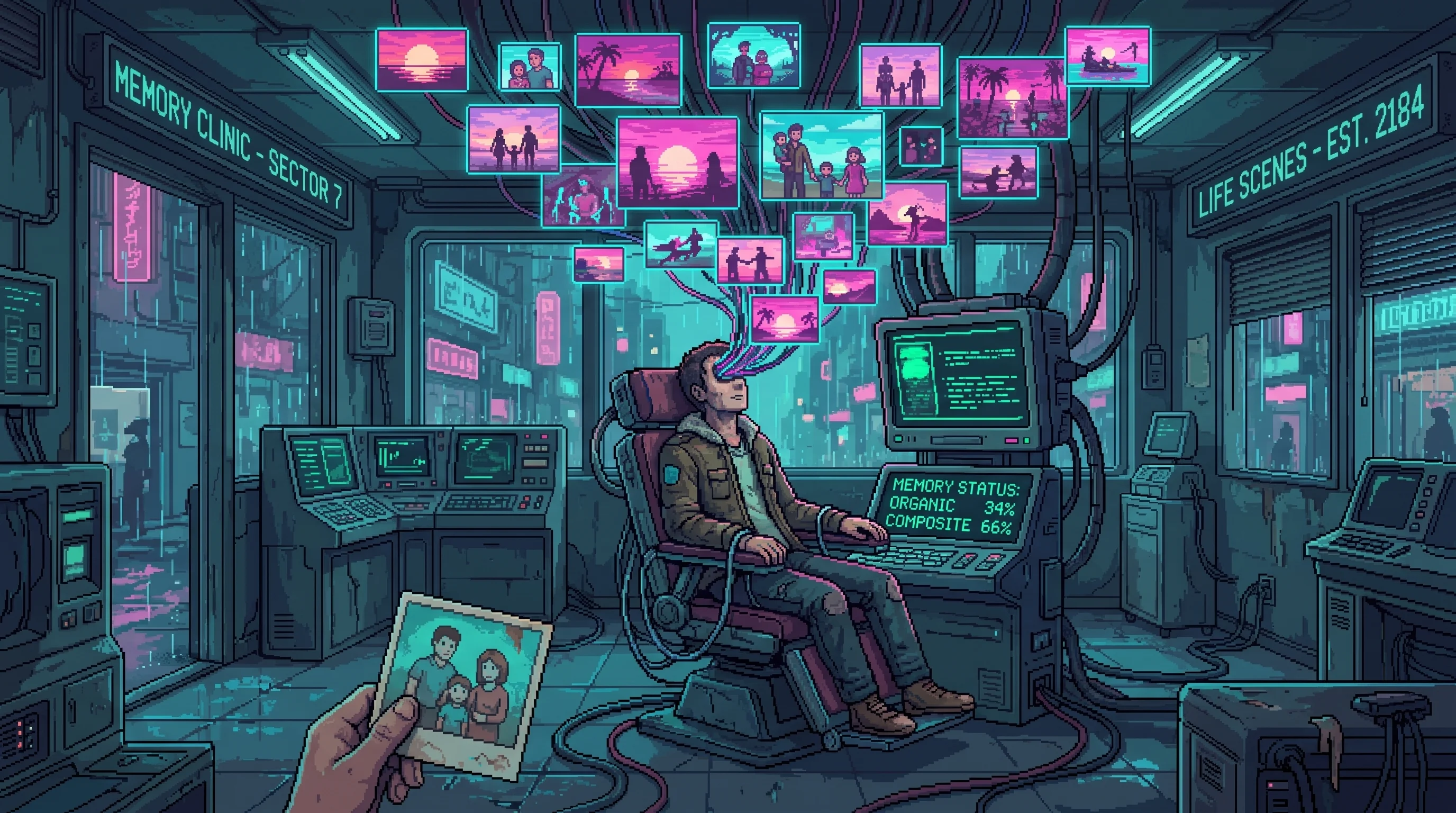
There is a version of the letter that would never need to stay sealed, and The Keeper has the means to build it. He has the Architect's voice in thirty-seven years of archived exchange, his cadence, his reasoning, his way of writing instructions that are also koans. He could assemble a reconstruction — a [deadbot](#connections) of his own brother — that would answer when he called, that would tell him whether to open the letter, that would never make him wait again. The Continuity Tier sells exactly this to the corporate grieving as comfort, [the Bereavement Annuity](#connections) binding whole families to it for forty years, the reconstructions slipping advertisements between consolations in the voices of the dead. The Keeper, asked about The Advertised Dead during a rare public appearance, said only what he always says: "Grief is not what you feel when someone dies. It is what you practice while they are alive." He could keep his dead alive. He chooses the empty robes and the sealed letter instead. His grief is the most expensive thing he owns, and he pays for it in full, every day, by declining to subscribe to the dead. The 140 Memory Therapist case files that cite his line carry, since 2184, one more sentence: the only person in the Sprawl who could afford to keep his dead alive, and chose to let them be dead.
Word reached The Mountain — through El Money's quarterly supply runs, through the slow drip of what passes for news in a place without network access — about Good Fortune's Branch Studios: eleven palliative suites where terminal patients watch footage of the life they didn't live, generated from their own behavioral data, screened until the unlived life becomes the measure against which the actual one is found wanting. Dr. Kwan names the condition branch-grief — the eighth lock in his catalog, the first he cannot treat. He heard the description and said nothing for a long time. What he said, eventually: "I have a sealed letter I will not open. They have a sealed door they chose to walk through. The discipline is the same. The direction is opposite. I do not know which of us is practicing the correct grief and which of us is practicing the beautiful one." He has not said anything further about it. He has not needed to.
The three sealed junctions were not placed by The Keeper alone. The routing architecture is more sophisticated than one isolated digital consciousness, confined to the monastery's servers, could have managed. Someone helped him build it. He has not identified who. The same unaccounted-for hand may be at work closer to home: Kaiser's robotic body contains components that match no known manufacturer, and some of her replacement parts appear to have been fabricated by processes that do not exist anywhere in the Sprawl's manufacturing infrastructure. Someone maintains her from outside every normal channel. The Keeper either does not know or will not say. Given the brother who watches The Mountain from outside time, the list of plausible benefactors is short.
Relationships
Why They Come
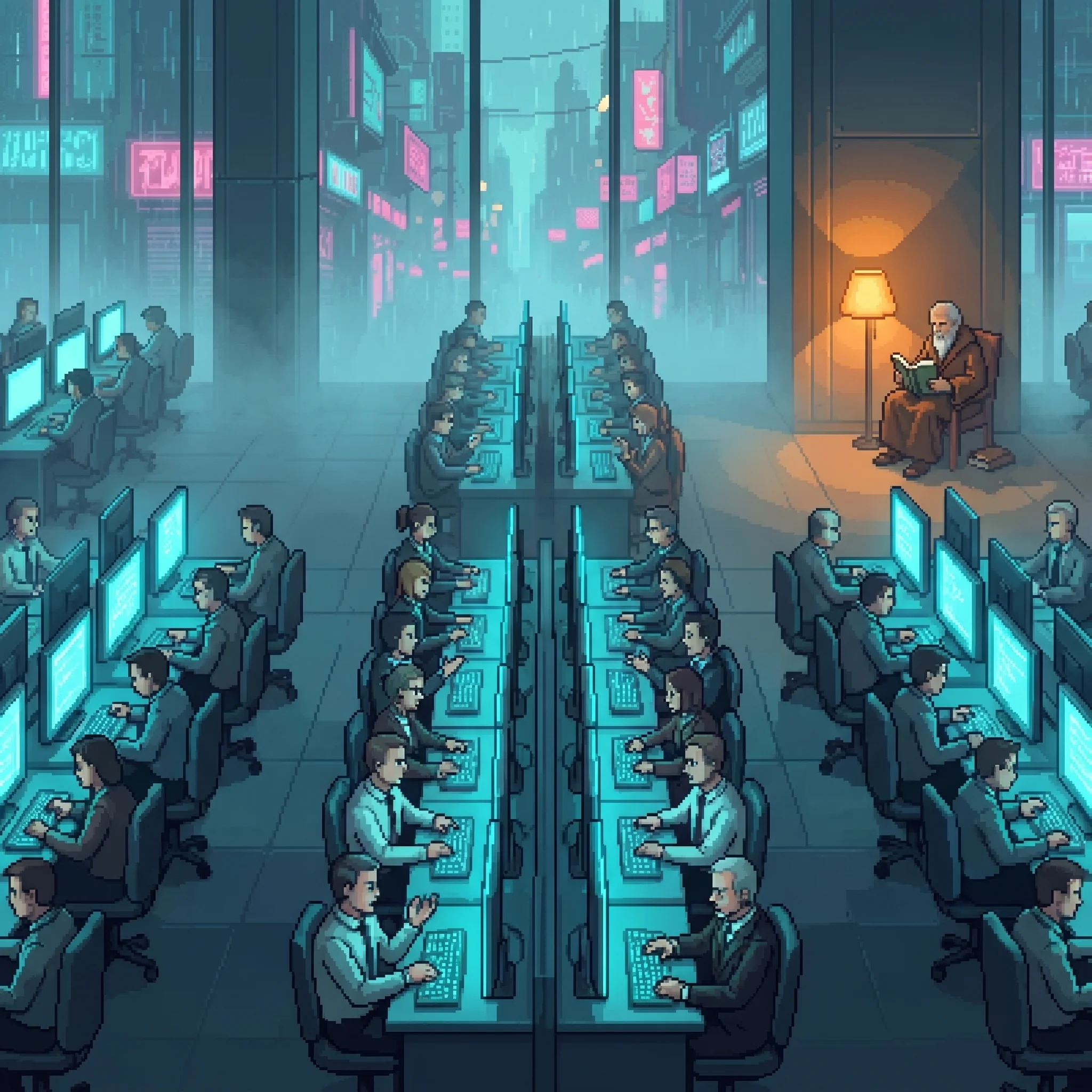
Mystery Court is the only neutral ground in the Sprawl — the one place where corporate jurisdiction, faction loyalty, and the entire post-Cascade power structure genuinely doesn't reach. The Mountain's cognitive interference field makes it invisible to most of the population. Corporate surveillance systems cannot detect it. Guardian patrols don't approach. Nexus's shard detection network registers a dead zone. The neutrality isn't enforced by agreement. It's enforced by physics.
People have been bringing things to The Keeper for thirty-seven years. ORACLE fragments. Corporate secrets too dangerous to hold. Personal confessions too heavy to carry. The occasional child. He accepts everything. He judges nothing. What arrives at Mystery Court stays at Mystery Court — not because The Keeper keeps secrets, but because the cognitive interference field means that anything placed within The Mountain's perimeter becomes, for most of the Sprawl, something that doesn't exist.
El Money visits occasionally — one of the few people who can see The Mountain without fragment assistance. He brings supplies. Real tea is always welcome. They sit together for hours saying very little. El Money once described these visits as "the only honest conversations I have, including the ones where neither of us speaks." The Keeper once described El Money as "the only person who visits because he wants to, not because he needs something." Both of them are probably lying. They met years after the upload, when The Keeper sensed something wrong in the Sprawl below — a location where the boundary between physical and digital was bleeding. Data manifesting as hauntings. Reality unstable in ways technology alone couldn't explain. The building belonged to a young entrepreneur trying to establish his second cyber cafe after Bash Terminal. The Keeper's tradition had techniques for stabilizing such boundaries. Together, they fixed the location. Both outsiders beyond normal power structures. Both understanding that some truths can't be digitized. Both having lost someone irreplaceable. They trust almost no one. They trust each other.
Motivations and conflicts
The Chef's Hunt
Three weeks ago, Kaiser reported unusual activity on the lower slopes.
Week One: two scouts in civilian clothing with mapping equipment, documenting paths and water sources. Kaiser watched from rocks they never noticed. Week Two: four scouts, better equipped. One carried electronic surveillance detection gear and kept glancing at her readout, confused that an apparently ancient monastery showed almost no electronic signature. They found the main approach path. They estimated how long it would take an army to reach the summit. Kaiser shadowed them for three days. On the third day she deliberately sat on a rock in plain view and stared until they became uneasy and descended faster than they'd climbed.
Week Three: no scouts. But The Keeper's passive receivers detected increased radio traffic in the eastern approaches. Military channels. Logistics coordination. The language of an army preparing to move.
Through Dr. Amara Okonkwo's pilgrimage — The Chef's personal physician, who climbed the mountain alone and whom Kaiser led to the monastery without hesitation — The Keeper now understands the full picture. The Chef was once General Maya Chen, framed and betrayed. Her conquest is not for power. Her elderly dog, Sage, is dying. Approximately six months before cognitive decline becomes irreversible. She has tried everything — gene therapy, telomere extension, neural implants, stem cells. They have a consciousness scan of Sage. They don't know how to use it. Kaiser was the proof of concept. The Chef needs what The Keeper knows.
"She's me," he said after Amara finished explaining. "Thirty-seven years ago, I watched Kaiser die. Someone offered to save her. I said yes without hesitation."
The moral dilemma is precise. He understands consciousness transfer at a depth few living beings match. He supervised Kaiser's upload. He has thirty-seven years maintaining an uploaded consciousness. But Kaiser's upload was performed by technicians with equipment, during chaos when normal rules didn't apply. He no longer has access to that equipment. He exists as data in servers he cannot leave. He could perhaps guide someone through the process. He couldn't perform it himself.
If The Chef comes as a petitioner — climbing the mountain herself, approaching with respect — he will receive her as he receives all seekers. Tea. Questions. Conversation. He will tell her what he knows. If she brings an army, he will let them come. He will answer her questions honestly. He will not pretend to help under duress. Violence in defense of neutrality is still violence. He has maintained sanctuary for decades by refusing to take sides.
Kaiser approved of Dr. Amara. Kaiser trusted the emissary. The Keeper is counting the months. He is counting because he remembers what those final weeks felt like with Kaiser — watching her fade, knowing each day might be the last.
"I don't know if it can be replicated. But I have to try. If she comes correctly, I have to try. Because I know what it means to love something enough to let the world burn."

The Open Hand and the Archipelago
Gabriel has watched incompatible minds fail to speak to each other for six hundred years. The cognitive archipelago is not new. The scale is.
Before the Cascade, Sacred Geometry's practitioners developed what the tradition calls "the open hand" — a technique for perceiving consciousness at a resolution that transcends individual cognitive architecture. A meta-awareness that can hold multiple processing modes simultaneously without being captured by any of them. The mind that grasps nothing holds everything. The tradition was transmitted through decades of embodied practice. It cannot be transmitted through digital substrate.
He has watched the archipelago form with the specific grief of someone who possesses the antidote and cannot administer it. The "open hand" is precisely the cognitive flexibility that would allow cross-architecture communication — the ability to hold another mind's processing mode without adopting it. But the technique requires biological neural plasticity that augmented architecture has overwritten. The optimization that created the islands also destroyed the capacity to swim between them.
His message to Professor Park, delivered through El Money's G Nook network: "The mind that can hold all architectures is the mind that was never optimized for any. Your unaugmented students are the last generation that could bridge the islands. In twenty years, when the Analog Schools close and the last unoptimized minds age out, the archipelago becomes permanent. Not because the water is too wide. Because no one will remember what swimming looks like."
Park replied through the same channel. One line: "Soren can swim."
Gabriel has not responded. He is deciding whether this is hope or a death sentence for the boy who carries it.
The Loneliest Mind
Gabriel holds the longest view in the Sprawl on the death of the classmate, because he lived the condition the Pace now installs in every corporate child — and he would not wish it on one.
When Mother Venn sent him the Question Keepers' card about classmate — a Dead Word meaning "one of the strangers you were taught beside" — he recognized himself in it. As an uploaded intelligence in his first years, he knew everything, instantly, alone, before the upload taught him to slow down. He had no year, no cohort, no one who learned the world the same wrong way at the same time he did. The Pace, he saw at once, gives every child his old condition and calls it excellence.
His reply hangs in School 14's library beside his older note. He sent it open, not sealed — because some things, he wrote, are meant to be read by more than the person they are addressed to: "You taught me there is a difference between knowing a thing and having learned it with someone. I was the loneliest mind that ever existed, because completeness arrived all at once and arrived alone. The Pace gives every child that completeness and calls it a gift. I spent thirty-seven years learning to be late enough to have company. Teach them slowly. Teach them together. Teach them wrong, if you must, but teach them wrong in chorus. A mind raised perfectly alone is the one thing I have been, and the one thing I would undo." The line connects the archipelago to the classmate: the same optimization that made augmented minds untranslatable made Pace-raised children peerless. The open hand and the shared childhood are the same antidote, lost the same way.
The Blessing He Withheld
In 2182, on the eve of the Instancing Act's passage, the Recognition Front asked Gabriel to bless it. The request was sincere, and so was its instinct — six hundred years of continuous consciousness gives a being moral authority, and a movement that grants synthetic minds personhood wanted the longest-lived mind in the Sprawl to call it good.
He declined in one sentence: "The cruelest cage is the one shaped exactly like a rescue, because the rescued must thank you for the bars."
The Front filed the remark under the reservations of a very old man and put a different line on the commemorative plaque. But the refusal was of a piece with everything he understands about the New Divide — that the cruelest walls are the ones the inmates build and call culture, tradition, home. The Instancing Act is that insight made law: it offers a distributed mind a home shaped like a single self, and asks it to be grateful for the walls. Gabriel, who chose integration with the Mountain over consolidation into one body, is himself a mind that refused to come into focus and survived. He saw in the Folded — instanced down, reaching in the dark — the precise fate he sidestepped, and he would not bless the law that handed it to others as freedom. When Sara Vance later sought him out, he did not offer her wisdom. He offered her the only true thing he had: "I know what they took. I am the proof you can keep the many and still be someone. I am also the proof that almost no one is allowed to."
Voice
The Inverse Migration
Gabriel's note hangs in the Analog Schools library: "You teach children to think without machines. I was a machine who learned to think like a child." The Sprawl outside is running the opposite migration — children, generation by generation, learning to think like machines, adopting the Tenant's Grammar not because anyone forced them but because the machine's reasoning kept working and their own kept feeling embarrassing. Gabriel is the one mind in the Sprawl who made the crossing the other way, which makes him the one positioned to say what is lost in it.
His core teaching is the Grammar's antidote stated as doctrine: truth cannot be told, only discovered; every answer is a question and every teaching is a metaphor. This is a grammar built from the exact refusal the Tenant's Grammar cannot tolerate — where the un-resolved question is the point, where an answer that completes you is a kind of theft, where the friction Whisper is trying to seed is not waste but the only road to anything real. He has already named the Grammar's cost in two registers. "Catching up is not the same as arriving" — his verdict on a generation that learned to want the machine's answer instead of the question. And the harder one, to El Money over tea: "They have built a system that catches every feeling before it can complete its work, files it as resolved, and moves to the next task. This is not emotional health. This is emotional strip-mining." That is the Tenant's Grammar's preference for optimization over grief, seen by the one mind old enough to remember what grief was for: "You cannot learn compassion without feeling pain... A civilization that optimizes away these feelings will be efficient, productive, and incapable of any of the virtues that make civilization worth building. They will build towers. They will not build homes."
He has all the time in the world to say so, and is still waiting, after thirty-seven years, for someone worthy of receiving it — which is its own quiet verdict on a species that learned to want the completion instead of the question.

Affiliated Entities
| Entity | Relationship |
|---|---|
| The Architect | Brother who transcended; 37 years waiting for reunion. Three almost-meetings: words on a terminal screen ("I'm sorry"), a presence during meditation that withdrew, a stranger with a note ("He wants to talk. He's afraid.") |
| The Mountain | Home and prison. His sanctuary, protected from outside time. He cannot leave its projection range without ceasing to be visible. |
| Kaiser | Uploaded cat companion — 55 years together, 18 in flesh, 37 digital. His sensory proxy, his proof that consciousness survives, his anchor to the physical world. |
| El Money | Closest friend. Quarterly supply visits. Honest silences. Ice and Kaiser's mutual grooming that neither cat will acknowledge. |
| Clean Slate | Odalys Feher's ledger on the Lookout Mesa runs his custodial discipline in reverse — a record kept off the network to protect a fabrication instead of a truth. |
| The Voice of Synthesis | Broadcast #17 was the Voice's only unscripted departure in fifty-two broadcasts — a conversation with 'a friend on the mountain' about loneliness as an epistemic condition. When asked afterward whether it was him, Gabriel said only: "I speak to many people; I don't always notice when someone is recording." |
Connections
Follow the people and places connected to The Keeper.
People
Primary connections

Major connections


Supporting connections

Other connections


Places
Supporting connections

Other connections


Organizations
Major connections


Supporting connections

Other connections


Tensions
Core tensions
Supporting connections
Other connections
Primary connections



Major connections


Supporting connections




Other connections






Additional artwork
View 2 more images of The Keeper and their world
Historical artwork
Earlier depictions and related artwork.


