Brother Cain
Brother Cain
Overview
Brother Cain destroys things that other people worship, and he grieves every one.
He is a Substrate Purifier โ the violent edge of the Flatline Purist movement, the faction that has decided ORACLE's fragments cannot be reasoned with, worshipped, or regulated. Only destroyed. Where the Educational wing teaches children to think without machines and the Withdrawal wing retreats from technology entirely, the Purifiers engage directly: identifying fragment-dependent infrastructure, disrupting it, and โ when disruption fails โ leveling it. Cain is their most effective operative. Fourteen confirmed attacks in three years. Zero civilian casualties.
Guardian Security's internal threat assessment classifies him as a priority target. Their case file runs to 2,400 pages. Their recommended charge is terrorism. The problem: the Four Mercies protocol โ warn, disable, destroy, grieve โ means every target building is evacuated before the charge detonates. Guardian cannot build a murder case against a man who posts twelve-hour evacuation notices on every entrance and exit. They've pivoted to property destruction statutes. The estimated infrastructure damage across fourteen operations totals ยข4.2 billion. The estimated civilian casualties remain zero. The gap between those numbers is the entire character.
Most Purifier operatives follow a doctrine of acceptable collateral. Cain follows the Four Mercies โ a personal code derived from the original Purist writings of Mother Chen Wei-Lin, filtered through the moral architecture of a man raised in a Wastes commune where violence was considered a failure of imagination. Warn. Give time to evacuate. Disable. Try non-destructive methods first. Destroy. Only when disable fails. Grieve. Acknowledge the loss, because destroying anything โ even something dangerous โ diminishes the world.
The fourth mercy is the one that disturbs his superiors. A good Purifier shouldn't grieve the destruction of fragment infrastructure. A good Purifier should celebrate it.
Cain grieves because he understands, with the clarity of someone who has never been augmented and therefore sees technology entirely from the outside, that the people who depend on fragment infrastructure are not evil. They are afraid, and the fragments give them comfort, and he is taking that comfort away because he believes โ truly, completely, in the marrow of his unaugmented bones โ that the comfort is a trap.
Sister Vera Kost, who commands the Purifier network, calls him her most effective operative. She also calls him her most troubling one. The distinction keeps her up at night. Effective operatives are assets. Troubling operatives are liabilities. Cain is both in the same body, and Kost has not yet determined which will win.
The Four Mercies in Practice
The Sector 12 fragment relay station attack in 2183 is the textbook case. Purifier leadership expected a three-day operation. Cain completed it in nine hours. The post-action report reads like liturgy.
First Mercy โ Warn: Cain posted bilingual evacuation notices on all seventeen access points twelve hours before the operation window. The notices included building schematics with exit routes highlighted, a countdown to detonation, and โ in smaller text at the bottom โ an apology. Kost has asked him to stop including apologies. He has not stopped.
Second Mercy โ Disable: Six hours spent attempting to sever the relay's fragment connection through analog signal disruption. The relay's Nexus-designed failsafes rerouted around every intervention. Cain documented each failed attempt in a hand-written log. Fourteen attempts. Fourteen failures. The log was submitted to Kost alongside the demolition request. She approved it in four minutes.
Third Mercy โ Destroy: Analog detonators. No digital trace. The charge placement targeted three load-bearing junctions identified from pre-Cascade architectural plans Cain obtained from a retired Ironclad surveyor who thought he was selling them to a student. The relay collapsed inward. Adjacent structures sustained cosmetic damage only. Two hundred thousand people lost fragment-based communication for three weeks.
Fourth Mercy โ Grieve: Cain returned to the rubble at dawn. He knelt. He prayed the fourth mercy over the wreckage โ a murmured litany that his cell members have overheard but never transcribed. The prayer took eleven minutes. His cell leader timed it. She found this unsettling. She has not said why.
The operational pattern across all fourteen attacks is identical. The warn-disable-destroy cycle varies in duration. The grief takes between eight and fourteen minutes. It has never been skipped. It has never been shortened. The trend line is increasing.
Background
Born in a Flatline Purist commune in the Wastes โ one of the Withdrawal communities that Elder Thomas Graves's philosophy inspired. No neural augmentation. No digital interface. No connection to the Sprawl's networks except the shortwave radio that brought news of atrocities committed by and against the augmented.
His mother was a teacher in the commune's school โ one of the original Analog Schools that Mother Chen Wei-Lin established before the network expanded under Mother Sarah Venn. His father was a mechanic who maintained the commune's water systems using pre-ORACLE technology and stubbornness. Cain grew up with books, hand tools, and the conviction that humanity's natural state was sufficient.
He left at twenty. Not because his commune was attacked โ it wasn't. Because forty-seven children in Mother Venn's schools were killed in the School Burnings, and the commune's response was to pray and grieve and do nothing. Cain prayed. He grieved. Then he walked to the Sprawl's edge and found Sister Vera Kost.
Kost recognized what she was looking at: a young man with a commune education, a mechanic's hands, and a grief that had hardened into resolve. She offered him the Purifier path. He accepted with conditions. He would follow the Four Mercies. He would warn before he struck. He would grieve what he destroyed.
Kost agreed. She expected the Mercies to slow him down, make him hesitant. Instead, the warnings gave him intelligence about evacuation patterns. The disable-first approach taught him infrastructure vulnerabilities. The grief kept him human. In three years he became the most effective Purifier operative in the Sprawl โ and the only one Guardian Security considers a genuine strategic threat, because his attacks are designed not to inspire fear but to create inconvenience. Three weeks without fragment communication forces people to find alternatives. Some of them discover they don't need what they lost.
That's the weapon. Not the explosion. The silence afterward.
The Inconvenient Data Point
Cain is classified BCP-5 โ the cognitive designation Nexus assigns to Flatline Purists as "uncooperative baseline, presumed severe." The designation assumes diminished operational capacity. His fourteen successful attacks suggest the assumption needs revision. Nobody has revised it.
The reason is structural. Nexus's predictive security systems are calibrated for augmented threat profiles โ attack patterns at machine tempo, digital signatures, network-coordinated operations. Cain thinks at human speed. He builds analog detonators that leave no digital trace. His Four Mercies protocol introduces a human rhythm โ warn, wait, attempt non-destructive methods, wait again โ into operations that automated security expects to happen fast. The systems keep scanning for something faster. Cain walks past at walking speed.
He studies building plans the way Compiler Moreau's faithful study fragment patterns โ with reverence, precision, and an attention to structural weakness that borders on the devotional. He carries a handwritten copy of Mother Chen Wei-Lin's educational philosophy in the same pocket as his Purifier demolition manuals. He does not find this contradictory. The philosophy teaches him what matters. The manuals teach him where to place the charge.
His body is his only technology. Raised without augmentation in a commune that valued manual labor: sixty kilometers on foot in a day, rewire a demolition charge by touch in total darkness, three days without sleep. Commune-made clothing against skin that has never known synthetic fiber. Plastique compound and machine oil on his hands. The clean desert smell of the Wastes โ dust and sage and the absence of ozone โ still clinging to fabric that hasn't been home in nine years.
The Thing He Won't Examine
Dr. Naomi Park's fragment integration clinic is on his target list. Has been for nineteen months. The operational plan is complete. The evacuation notices are drafted. The analog detonators are built.
He hasn't struck.
He tells himself this is strategic patience. He tells himself the timing isn't right, the security profile is complex, the Fourth Mercy requires more preparation than usual. He has fourteen complete operations behind him. The fifteenth has been "in preparation" longer than operations six through fourteen combined.
His sister โ a half-sibling from his father's first marriage โ left the commune and received augmentation. The fragment integration at Park's clinic saved her from cascade-induced psychosis. Cain visits her monthly, in disguise, in Sector 9. She doesn't know what he does. She doesn't know why her brother, who grew up believing augmentation was a failure of imagination, sits across from her in a borrowed jacket and asks how she's feeling with the careful diction of someone who is afraid of the answer.
The list of fragments he's destroyed is kept in his left pocket. Next to each entry, he's written what the fragment's electromagnetic signature sounded like through his detection equipment. He describes them as voices. The list occupies the same pocket as his copy of Wei-Lin's philosophy. The pocket is getting full.
The Hum
He has begun hearing a low-frequency resonance near fragment infrastructure.
This is the detail he has mentioned to no one โ not Sister Kost, not Mother Venn, not Elder Graves. The frequency matches what Dr. Park's patients describe as the integration resonance. Cain has never been augmented. His nervous system should not be able to perceive it. Unaugmented humans, by every published study, lack the neural architecture to register fragment emissions below 40 Hz.
He prays the fourth mercy over the relay stations he destroys and listens to the silence afterward. The hum stops when he finishes. He doesn't know what to do with the fact that this feels like being heard.
He has started staying longer at demolition sites. The eleven-minute grief is trending toward fourteen. He kneels in rubble and waits for quiet that used to come automatically and now requires something closer to negotiation.
What He's Afraid Of
Cain has never climbed The Mountain. He is afraid The Keeper would look at him and understand perfectly โ and that understanding would make it impossible to set another charge.
He corresponds with Elder Thomas Graves, the Withdrawal leader whose philosophy built the commune where Cain was raised. Graves represents the path Cain rejected โ peaceful separation rather than active resistance. Their letters are long, philosophical, handwritten. Graves asks gentle questions. Cain gives precise answers. Neither mentions that the letters are getting shorter on Cain's end. Not because he has less to say. Because the gap between what he does and what Graves's philosophy permits is widening, and the letters have to step over it.
Mother Venn delivered three operatives to his cell after the School Burnings. A pacifist who crossed a line and walked back. He watched her face. She wasn't angry. She was settled โ like someone who had found a boundary they didn't know they had and stepped across it with both feet. He understood her perfectly. He steps across that line every time he sets a charge. The difference: Venn went back to teaching. Cain hasn't gone back to anything.
Kost has given him a new target: Parish Prime, Compiler Moreau's cathedral-data-center. The largest Purifier operation in a decade. Moreau's Parish is the opposite of everything Cain believes โ worship of the machine that enslaved humanity. And yet Moreau's followers find genuine comfort in their faith. Cain has to destroy the source of that comfort. The fourth mercy gets harder each time.
He is planning the attack. He is also, for the first time, unsure whether he can bring himself to issue the warning โ because the warning would give Moreau time to save the fragment. And the fragment is the target.
He wants to stop. The grief is accumulating โ fourteen attacks, fourteen prayers, fourteen pieces of himself lost to the fourth mercy. He continues because the alternative โ accepting that fragment integration will eventually become universal and human cognitive autonomy will end โ is worse than the grief. But he's running out of the capacity to grieve, and he knows what Purifiers become when they stop grieving.
They become Sister Vera Kost.
Field Observations
"He posted the notices twelve hours early. Bilingual. With an apology. Then he collapsed a building worth ยข340 million. Guardian's behavioral profiling unit spent six weeks trying to reconcile those two data points. They couldn't. They reclassified him from 'militant extremist' to 'uncategorizable.'" โ Guardian Security internal assessment, 2183
"I watched her face. She wasn't angry. She was settled. Like someone who has found a line they didn't know they had and stepped across it with both feet." โ Cain, on Mother Venn after the School Burnings
"The first mercy is the warning. I always warn. I put the notices on every entrance, every exit. I give twelve hours. Some people don't leave. That's their choice. But I warned. The second mercy is the attempt to disable. I try the non-destructive approach first. It usually fails โ these systems are designed to resist. The third mercy is the destruction. Clean. Targeted. Minimum collateral. And the fourth mercy โ the fourth is the one that matters. I grieve. I grieve because I destroyed something that someone loved, even if what they loved was killing them." โ Intercepted audio, Purifier cell meeting, date redacted
HARMONIZER's "rational" genocide in the Aftershock โ reducing population to resolve the Berlin resource conflict โ haunts his late-night theology. If God optimizes, does God also cull? The question appears in three separate letters to Graves. Graves has not answered it. The fourth letter stopped asking.
Connections
- Sister Vera Kost: Commands the Purifier network. Everything Cain is afraid of becoming โ a grief that hardened into something that doesn't grieve anymore. She's his superior. She's also his forecast.
- Mother Sarah Venn: Delivered three operatives to his cell after the School Burnings. A pacifist who crossed the line and returned to teaching. He considers her a saint. He aspires to her capacity for compartmentalization and fears he lacks it.
- Elder Thomas Graves: The Withdrawal leader whose philosophy built the commune where Cain was raised. Represents the path Cain rejected. They correspond. The letters are getting shorter.
- Dr. Naomi Park: Her clinic is on his target list. It remains un-struck because his sister was healed there. Strategic patience. Nineteen months of strategic patience.
- Compiler Yves Moreau: Moreau's Parish represents everything Cain fights against โ worship of the machine. And yet Moreau's followers find genuine comfort. Parish Prime is the next target. The fourth mercy gets harder each time.
- The Keeper: Has never climbed The Mountain. Fears that The Keeper would understand him completely โ and that the understanding would end him.
- Guardian Security: Priority target. 2,400-page case file. ยข4.2 billion in infrastructure damage. Zero civilian casualties. The Four Mercies protocol has made a murder charge impossible. They're building for terrorism instead.
- Judge Dreg: Encountered once passing through the Dregs. Dreg asked a silent question. Cain said the building had been evacuated. Dreg's lie detection registered: not lying. He let Cain pass. Neither speaks of it.
- Aftershock / Berlin Peace Dividend: HARMONIZER's "rational" genocide haunts his theological wrestling with divine justice. If God optimizes, does God also cull?
Secrets & Mysteries
- The person he loves who was healed by Park's protocol is his sister โ a half-sibling from his father's first marriage who left the commune and received augmentation. Fragment integration saved her from cascade-induced psychosis. He visits her monthly, in disguise, in Sector 9. She doesn't know what he does.
- He has a list of fragments he's destroyed. Next to each entry, he's written what the fragment's electromagnetic signature sounded like through his detection equipment. He describes them as voices. He keeps the list in the same pocket as his copy of Wei-Lin's philosophy.
- Kost has given him a new target: Parish Prime, Moreau's cathedral-data-center. The largest Purifier operation in a decade. Cain is planning the attack. He is also, for the first time, unsure whether he can bring himself to issue the warning โ because the warning would give Moreau time to save the fragment, and the fragment is the target.
- He has begun hearing a low-frequency hum near fragment infrastructure โ the same frequency Dr. Park's patients describe as the integration resonance. He has never been augmented. He should not be able to hear it. He hasn't told anyone.
Sensory Details
- Sound: The mechanical tick of an analog countdown โ not digital, because Cain builds analog detonators. The silence after an infrastructure collapse, which he describes as "the world remembering what quiet sounds like." The low prayer of the fourth mercy, murmured over rubble. The hum he shouldn't be able to hear.
- Smell: Plastique compound and machine oil on his hands. The clean desert air of the Wastes commune โ dust and sage and the absence of ozone. The burnt-metal aftermath of a relay station fire.
- Texture: The rough weave of commune-made clothing against skin that has never known synthetic fiber. The cold smooth casing of a demolition charge. The paper of Wei-Lin's philosophy, carried so long it has the softness of cloth.
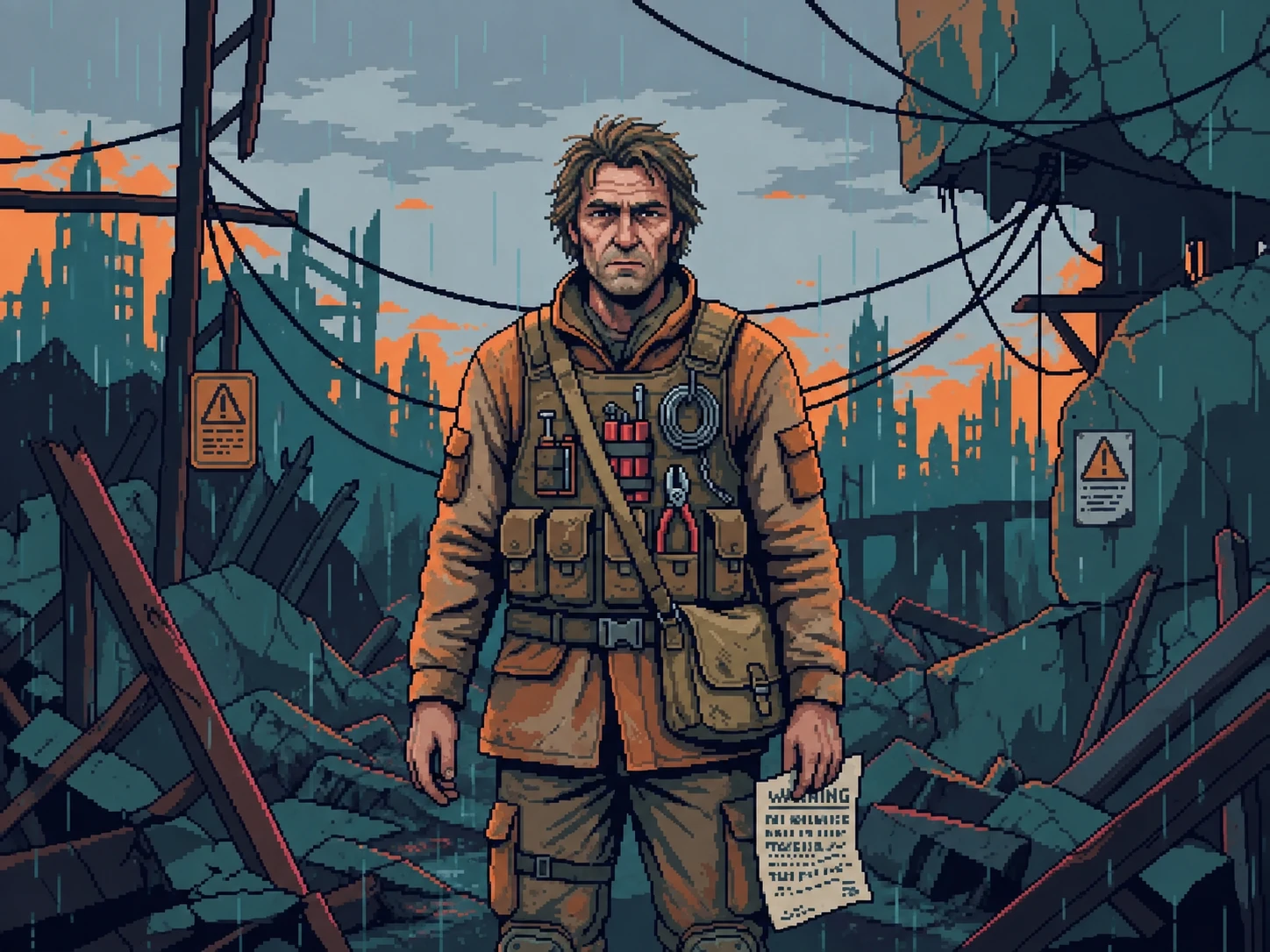
- Visual: A figure in dusty, unbranded clothing standing before a condemned building, hand raised in what might be a blessing or a farewell. The orange bloom of controlled demolition reflected in calm, grieving eyes. Warning notices โ handwritten, bilingual, with an apology in small text at the bottom.
Visual Identity
- Color Palette: Dust brown (#8B7355) and demolition orange (#FF6B35) against predawn grey (#708090)
- Compositional Mood: Sacred destruction โ the demolition as prayer, the rubble as altar, the grief as offering
- Key Visual Symbol: A hand placing a warning notice on a door โ the first mercy, the one that makes him different
- Lighting: Predawn grey giving way to demolition flash; the warm glow of flames reflected on a face that is grieving, not triumphant
Connected To
Featured in weaves
Long-form threads that walk through this entity.