Overview
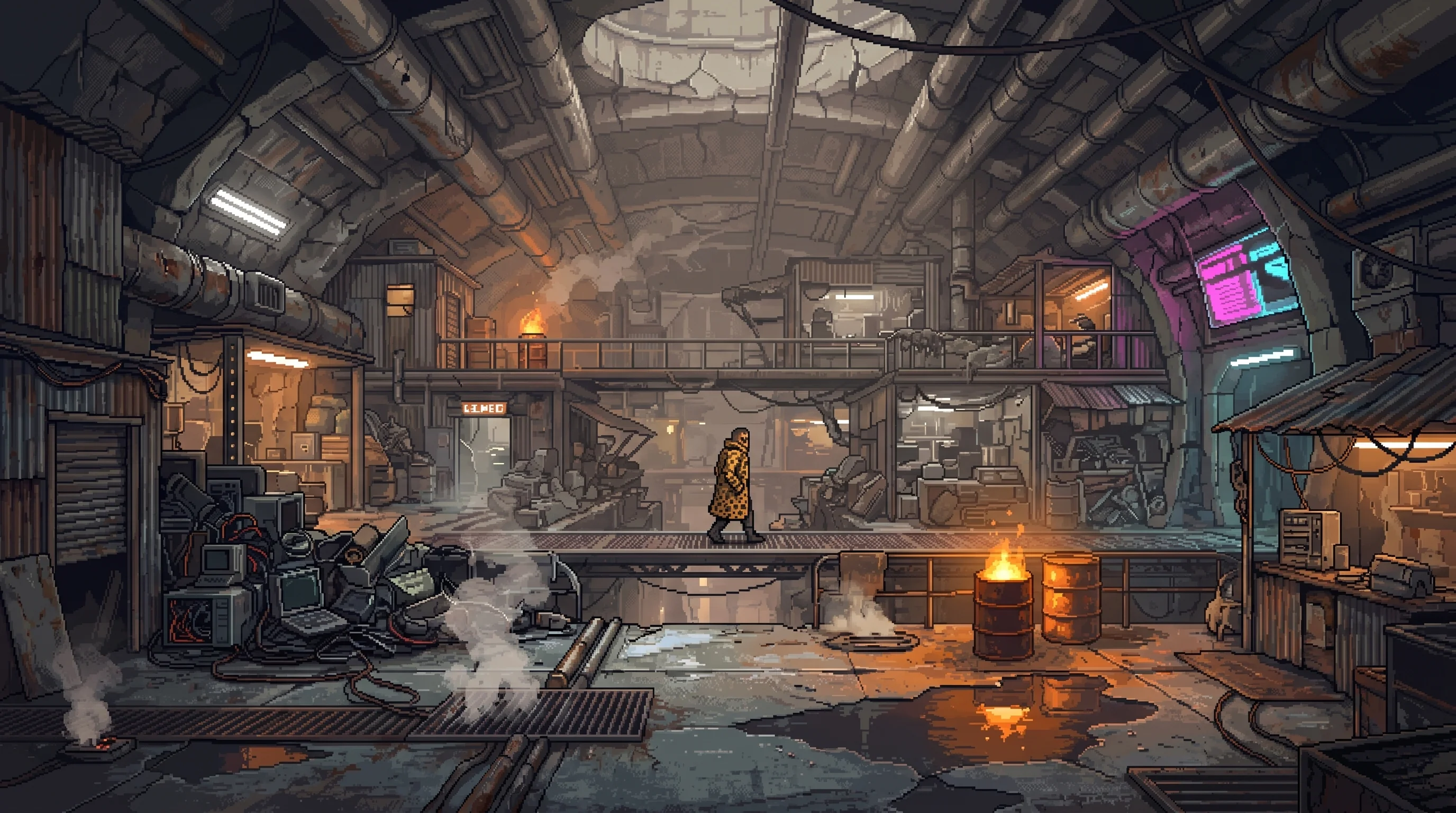
The origin is sparse by design. One salvager among thousands in the Deep Dregs, no corporate connections, no special training, no family money, no inherited influence — a person who survives by finding what others missed and selling it before someone larger notices. Sprawl-born or exile is unknown; the Dregs do not ask, because the answer changes no price. Two or three years of salvaging is the entire recorded life: long enough to know the territory, short enough not to have surrendered to it. Reliable enough that a fence will buy. Not notable enough that anyone tracks the movements.
That anonymity is the whole foundation. In a Sprawl obsessed with lineage, augmentation, and the exact provenance of every person, the salvager is a blank — and the blank is what makes the change legible. There is no distinguished past to muddy the picture. There is only a nobody, a ruin, and a piece of debris that did not behave the way debris behaves. Everything the salvager becomes is measured against how little the salvager was.
- Form
- Mystery
- Status
- Ongoing
The Deep Dregs
The Sprawl's lowest stratum and its quiet proof that the corporate system is optional.

A nobody, on purpose. That is the point. Then a nobody touched something three levels down, and stopped being one.
Before the Shard
The days had a shape carved by scarcity. Wake before dawn, because competition for the good sites starts at first light. Check the networks for leads and auction rumors. Gear up — filtration mask, tool kit, a scanner if the week had been kind enough to afford one. Then eight to twelve hours in scrapyards, collapsed structures, and processing dumps, hauling the day's findings to a fence by evening and converting salvage into credits and credits into food, with maybe a little set aside. Sleep. Repeat.
The math never worked. A good week ran two hundred credits; a bad one paid out in injuries. Staying alive cost slightly more than staying alive allowed the salvager to earn, which is the quiet arithmetic that runs most lives in the Dregs. The dreams that pulled the salvager forward were correspondingly small: move up a few levels, find one score that changes everything, or simply not die alone in a collapsed building. No one survives the Dregs without something pulling them, but the pull was never toward transcendence or power. It was toward enough.
The Day Everything Changed
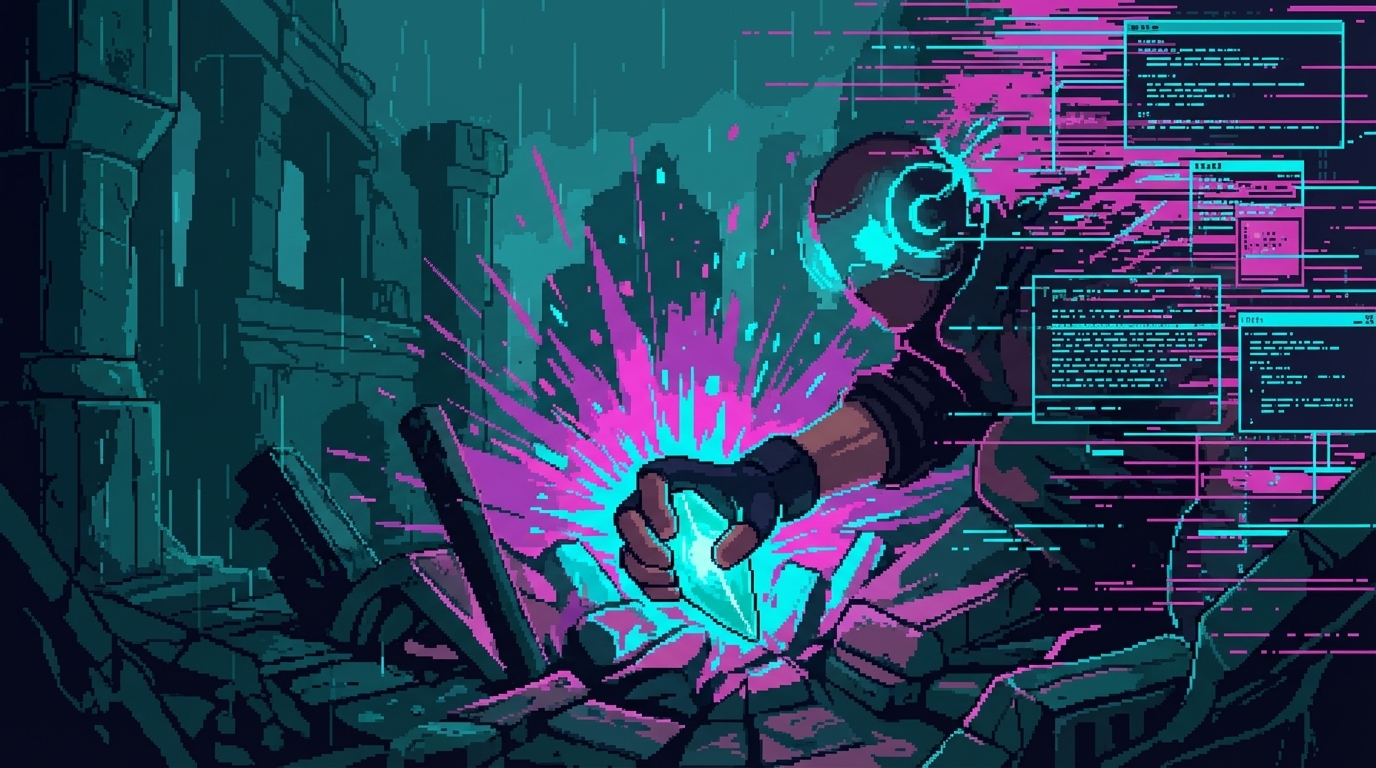
It was a standard run: an abandoned data-processing facility in the industrial ruins east of the Pit, one of dozens that collapsed during the Cascade and never got reclaimed. The building had been picked over before, but a recent structural shift had opened areas no one had reached. The salvager was not the first there that day. Only the most thorough — three levels down, into a server room that still held partial power, where something waited that did not belong. A crystalline storage unit the size of a fist, pulsing with a soft blue light, matching no catalog and no known technology.
Standard procedure was to bag it and bring it to a tech for analysis. Instead the salvager touched it to secure it for transport. That was the mistake, or the miracle, or both. It activated on contact and flooded the salvager's cheap civilian implant — a model barely rated for overlay — with patterns rather than information, rewriting how the salvager processed the world. The pain was beyond description. Consciousness ended for three hours. What woke was not the same person who had walked into the server room, and did not entirely know it yet.
What the Shard Changed
The immediate effects were perceptual, not visual: patterns surfacing out of noise, connections legible in what had been chaos, thoughts moving faster than the body was built to carry. Intermittent insights that proved accurate. Dreams that ran like data feeds. And, underneath all of it, a persistent sense of being watched — not from outside, but from within.
The slower realization was worse. The shard is not a tool. It is a fragment of ORACLE's shattered consciousness, or something that used to be part of it. It is not sentient, probably. It is also not inert. It has tendencies. Preferences. A direction of its own. It wants to grow, and it has chosen — if choice is even the word — to grow through a person who, only weeks earlier, wanted nothing larger than to not die alone.
Meaning & Implications
The first-order reading of the salvager is a rags-to-power fantasy: a nobody stumbles onto the artifact that makes them somebody. The second-order reading is the one that unsettles. A fragment of a dead god does not need anyone special to carry it; it needs one bare hand and one cheap implant, which the Dregs produce by the thousand. Nothing about the find requires that the salvager was chosen. And that is precisely what makes the alternative impossible to disprove — because a life this convenient, the recent structural shift, the untouched room, the one thorough scavenger arriving on the one day the door was open, reads equally well as luck or as arrangement, and the salvager has no vantage from which to tell the two apart.
That is the tension the origin exists to open and refuses to close. Whether the salvager was found or merely fortunate, the question that follows is the same, and it is the one the whole life will answer in installments: what is a person willing to trade for power, and will they still be themselves once they have it? It begins here, with a nobody who touched the wrong thing in an abandoned room, and became the variable the entire Sprawl now bends around without yet knowing why.
Affiliated Entities
- The Deep Dregs
The warren that produced the blank and forgot the name
- ORACLE
The dead god whose fragment the salvager now carries
- The Cascade
The collapse that filled the ruins and scattered the fragments
- The Architect
The unexplained luck that keeps arranging the salvager's path
- Cyber Castle
A house holding a life the salvager cannot account for
- The Keeper
The one mind who would know the shard for what it is
Open Questions
- Was the salvager chosen or merely fortunate — and is there any test, from inside the Dregs, that could ever tell the difference?
- The shard wants to grow. Growth toward what, and at whose expense, and does the salvager get a vote?
- Every coincidence has held so far. What happens on the day one of them finally doesn't?