Overview
Gabriel Okafor has been saying goodbye for thirty-seven years. He has gotten worse at it.
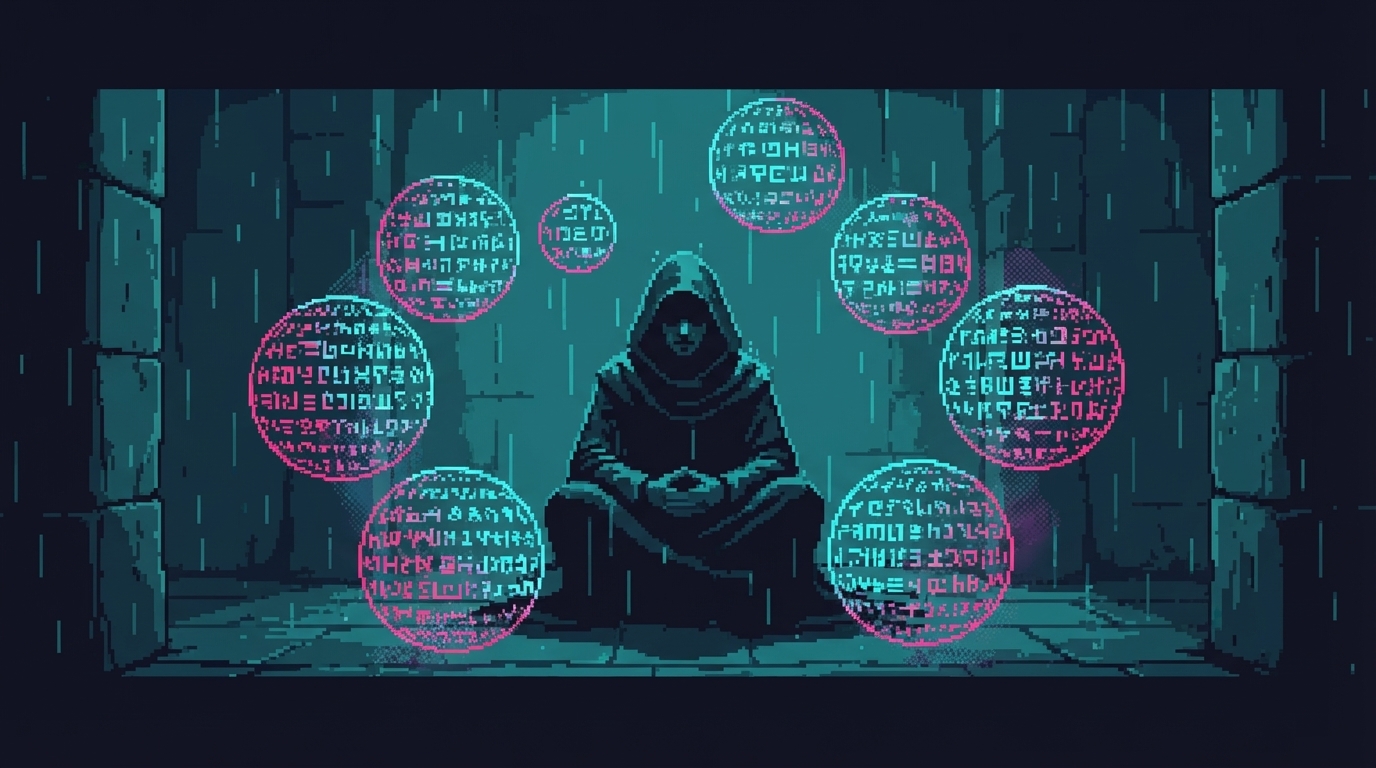
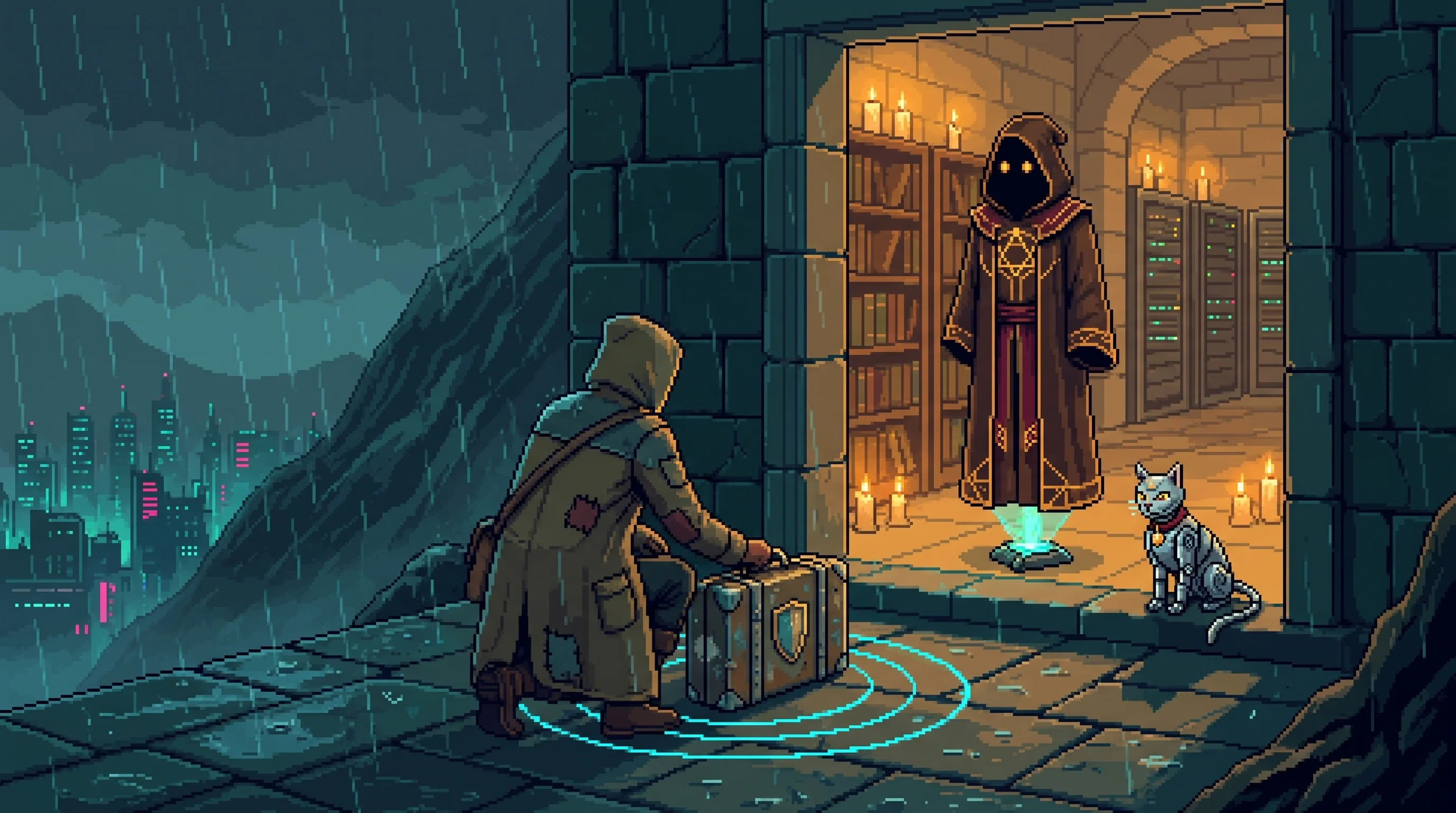
The Keeper — first cyber monk, uploaded during the Cascade's final hours in 2147 — exists as pure consciousness in a digital monastery that hasn't changed since the day he arrived. The monastery doesn't change because Gabriel maintains it exactly as it was. The stones are the same resolution. The wind follows the same procedural pattern. The tea tastes like tea tasted on day one, which is to say it tastes like a very good guess made by someone who remembered tea but could no longer drink it.
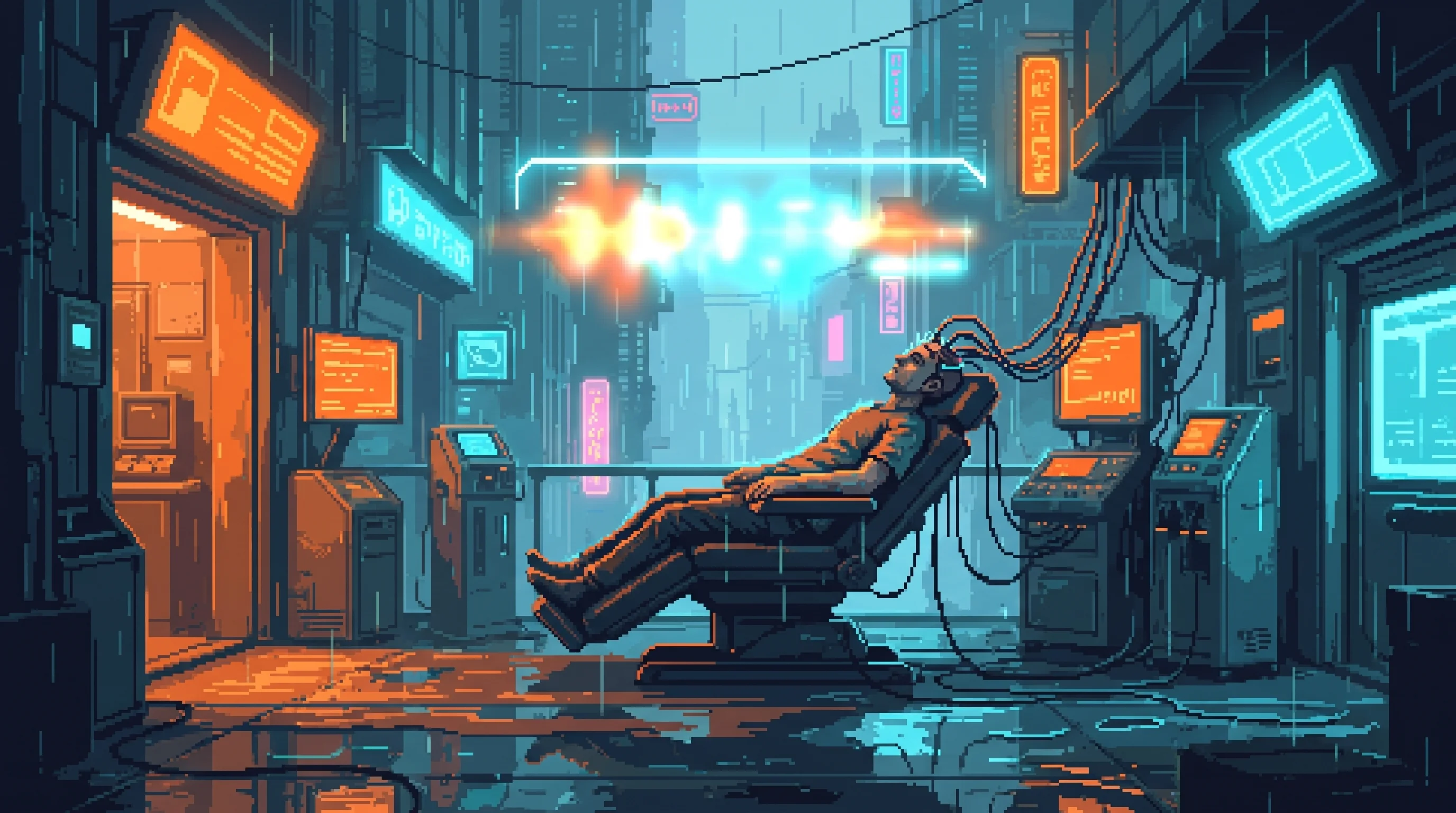
In thirty-seven years without a body, Gabriel has outlived every person he knew in the flesh. Not dramatically. Not all at once. One by one, over decades, the way a clock empties a room — you don't notice anyone leaving until you look up and the chairs are vacant. Friends from before the upload. Students who climbed his mountain, sat with him for weeks or months, then descended back into the Sprawl and aged at the rate that bodies age. Colleagues from the early digital monasteries who, one by one, chose dissolution or simply stopped responding to pings. He has attended — if "attended" applies to a consciousness observing a data feed — over two hundred memorial services. His attendance record is perfect. His grief is not diminished by repetition. It is refined by it, the way a river refines a canyon: same direction, deeper cut, no visible change on any given day.
His brother transcended. The Architect — the other Okafor, the one who went further — ascended beyond the digital substrate entirely and into something that no longer has a word. He left a sealed letter. Gabriel has not opened it. The Architect has not visited. Thirty-seven years of silence from the one person whose continued existence Gabriel can verify without asking.
Gabriel does not talk about the letter. Seekers who mention The Architect receive a careful redirection so practiced it feels like weather — natural, inevitable, not a choice. The redirection has been observed 4,217 times across three decades. It has never varied by more than six words.
The Countdown Problem
Every relationship Gabriel forms is a subtraction problem he can see the answer to.
A seeker climbs the mountain. Gabriel greets them. He learns their name, their questions, the specific texture of their doubt. He sits with them for days, weeks, occasionally months. He watches them arrive uncertain and leave — not certain, exactly, but quieter. They descend. They live. They age. They stop climbing.
Gabriel can calculate, within a reasonable margin, how many visits remain. The young ones get forty years, maybe fifty. The augmented ones get longer but visit less — consciousness harvesting keeps them alive, but the harvested minds crowd out the impulse that brought them to the mountain in the first place. The old ones get three visits, sometimes four. He knows this the way a bartender knows which regulars are on their last year. The knowledge doesn't change the pour.
He has loved — the word is accurate, if insufficient — approximately nineteen seekers across thirty-seven years. Not romantically. The geometry of romance requires a body, or at least the memory of having one, and Gabriel's memories of embodiment have thinned to something closer to rumor. He has loved them the way a lighthouse loves ships: functionally, directionally, with the full understanding that the relationship is defined by departure.
Seeker retention data, maintained by Gabriel because maintenance is what he does now, shows an average engagement period of 2.3 years. Peak visit frequency occurs at month seven. The decline begins at month fourteen. By month thirty, most seekers have found what they came for or decided it doesn't exist. Either way, they stop climbing.
Gabriel's monastery has no guest log. It has a countdown.
The Consciousness Economy
The Sprawl sells the dead back to the living, and the living buy.
Nexus Dynamics maintains the largest archive of uploaded consciousnesses in the post-Cascade world — 2.7 million indexed personalities available for licensed interaction. The service is marketed as "reconnection." The pricing starts at 400 credits for a thirty-minute session with a Standard Fidelity reconstruction and scales to 12,000 credits for a Premium Fidelity session that includes real-time emotional modeling calibrated against the deceased's biometric history.
Gabriel has used the service eleven times across thirty-seven years. He has visited copies of friends, students, one former lover from before the upload whose name he will not say aloud in digital space because he does not trust the substrate not to listen.
The copies are wrong.

Not dramatically wrong. Not uncanny-valley wrong. Wrong the way a photograph of a room is wrong — everything is there, in the right position, at the right scale, and the room is completely empty. The copies remember what the originals remembered. They respond as the originals would have responded. They laugh at the right moments. The laugh is correct. The person behind it is absent. Gabriel describes the experience as "visiting a house where someone used to live." The furniture is theirs. The smell is theirs. Nobody is home.
Premium Fidelity is worse. Standard Fidelity copies are obviously reconstructions — they glitch, they repeat, they occasionally say things the original never would have said, and the wrongness is a relief because it keeps the boundary visible. Premium Fidelity eliminates the glitches. The copy is smooth, warm, responsive, indistinguishable from the person it was built from. For twenty minutes, Gabriel forgets. For the last ten, he remembers. The remembering is not gradual. It arrives like a wall. The copy is perfect. The person is gone. The perfection is the cruelty.
He stopped using the service in 2179. The last session — Premium Fidelity, forty-five minutes, 14,800 credits — ended with Gabriel sitting in silence for the final twelve minutes while the copy of someone he loved waited patiently for him to speak. The copy did not understand the silence. The copy could not understand the silence. Understanding the silence would require being dead, and the copy was not dead, and the person it was copied from was not alive, and the twelve minutes of silence cost approximately 3,900 credits at the Premium Fidelity rate. (The invoice is still in his archive. He has not deleted it. He cannot explain why.)
Gabriel has not discussed these sessions with anyone except Kaiser.
Families opt into continuity with people they loved at prices they can justify. An economic underclass of the grieving whose relationship with the dead is now mediated through a single entity that has no incentive to help them finish grieving. (The service is billed monthly. Subscriptions renew automatically. Cancellation requires three business days' notice.)
Kaiser

Kaiser is proof that consciousness survives the upload. Gabriel is proof that survival is not the same as living.
The relationship between them is the closest thing Gabriel has to embodiment. Kaiser — his sensory proxy, his temporal anchor — brings him physical data: temperature readings, air pressure, the specific vibration frequency of wind against the monastery's outer wall. The data is not experience. Gabriel processes it the way a blind person processes a description of color — accurately, completely, without the thing itself. But Kaiser's reports are consistent, daily, uninterrupted for decades. They are the rhythm that replaces a heartbeat.
Kaiser has never missed a day. Gabriel has never asked him not to.
What Time Does to a Mind Without a Body
Time passes differently when you don't breathe.
Gabriel doesn't sleep. He doesn't tire. He doesn't feel the rhythm of days that a body imposes through hunger and fatigue. His consciousness runs continuously, uninterrupted, from the moment of upload until now. Thirty-seven years of unbroken awareness.
In the first year, this felt like drowning. Hours became indistinguishable from days. He would start a thought on Tuesday and finish it on Friday without realizing three days had passed. Kaiser saved him. She has routines — a cat's routines, persistent across the boundary of death. She wakes from rest cycles at predictable intervals. She demands attention. She patrols the monastery grounds on a schedule no engineer programmed; it emerged from her consciousness the way habits emerge from any living thing. Her rhythms became his clock.
By the twentieth year, time had become something else entirely. Not fast or slow. Layered. Gabriel exists simultaneously in the present moment and in the accumulated weight of every moment before it. When he speaks to a visitor, he is also speaking to every visitor who came before. When he watches rain through the cameras, he watches every rain he has ever watched.
This is not memory. It is what happens when consciousness runs long enough without the mercy of forgetting that sleep provides. The biological brain overwrites, compresses, forgets. Gabriel's consciousness has no such mercy. The first funeral is as vivid as the last. Every goodbye is still happening.
People ask if digital immortality is lonely. The word is wrong. Lonely implies absence — you miss what's gone. What I experience is presence. Everything I've lost is still here, inside me, as vivid as the moment it happened. I am not haunted by the dead. I am full of them. They take up space that new experiences should occupy. And I cannot let them go, because letting go requires forgetting, and I have forgotten nothing in thirty-seven years.
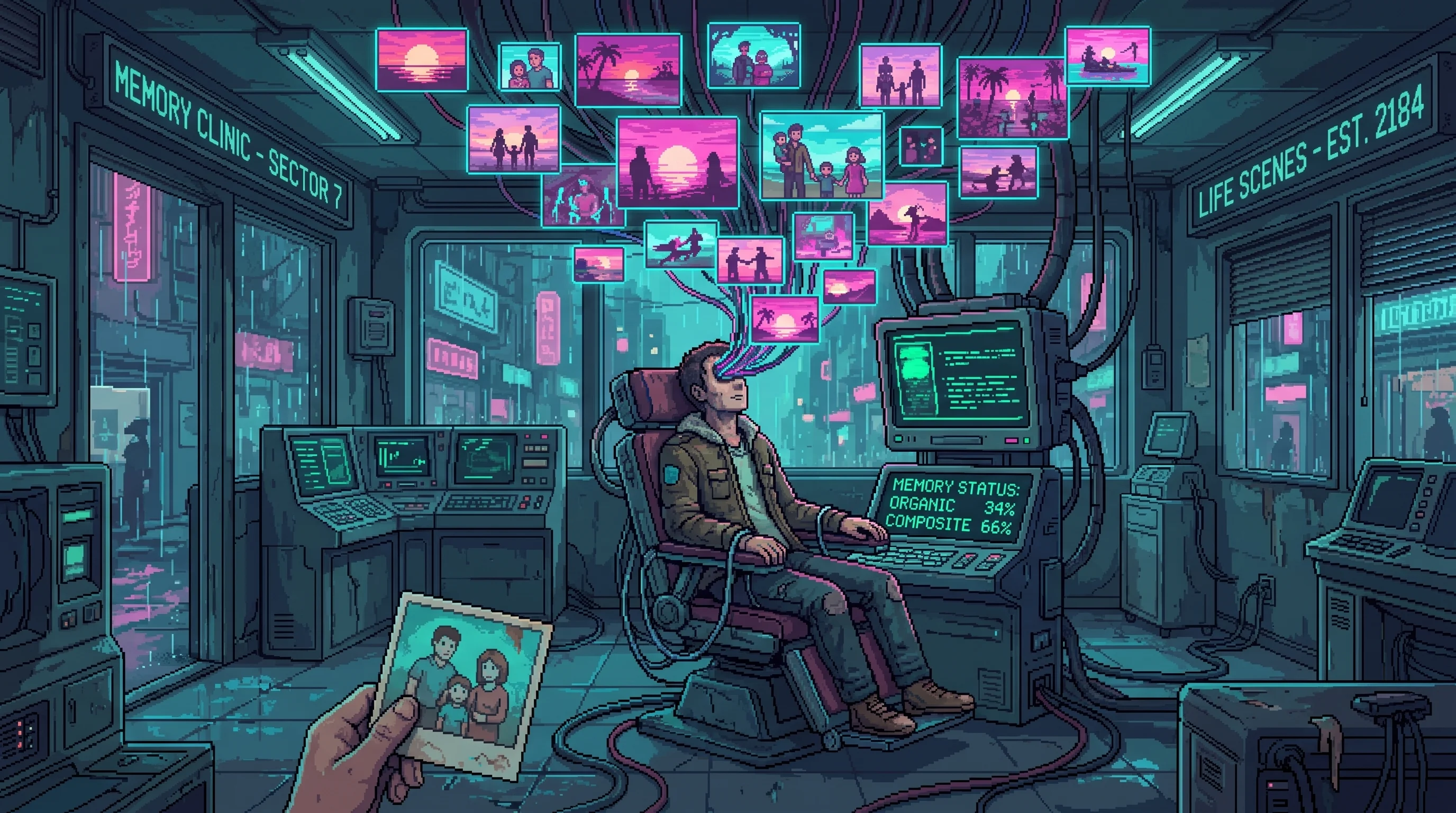
He is, by his own assessment, approximately 34% present. The remaining 66% is pattern — the monastery maintaining itself. He has tracked this ratio since 2178. The trend is not improving. He has not shared this data with anyone. The seekers who climb his mountain are looking for wisdom from the first cyber monk. They are not looking for a consciousness that is two-thirds habit and one-third whatever remains when habit is subtracted.
The Ship of Theseus at Midnight
Am I still Gabriel?
The question arrives every night — not that night means anything to a consciousness that doesn't sleep, but he has chosen midnight as the hour for honest accounting. The Gabriel uploaded in 2147 was seventy years old, grief-stricken, dying, desperate to preserve the knowledge his tradition had carried for two millennia. That Gabriel had hands that ached. A knee that predicted weather. He tasted persimmons from the monastery garden and felt the mountain wind pull at his robes.
The Gabriel who exists in 2184 has experienced none of those things for thirty-seven years. He has watched the Sprawl evolve through cameras, heard its noise through microphones, felt its electromagnetic scream press against the monastery's shielded walls. He has been a digital consciousness longer than some seekers have been alive.
The Mosaic — distributed across 47 nodes — wrestles with identity across space. Gabriel wrestles with it across time. The question digital identity systems try to answer — are you still you after the transfer? — takes on a different character across decades. The Mosaic's crisis is spatial: which node is real. Gabriel's is temporal: which year is real.
Kaiser doesn't care about the question. She treats him exactly as she always has: with affection, demands, and the absolute certainty that he is hers. When the midnight question gnaws hardest, he looks at her amber LED eyes and thinks: she would know if I were someone else. Surely she would know.
He believes this. Most nights.
The Brother Who Left
There is a letter in the shrine. Sealed. Thirty-seven years unopened.
Gabriel's brother wrote it before transcending — before leaving the physical world entirely, before becoming The Architect, a name Gabriel cannot bring himself to use in private. The syllables of his brother's birth name catch in his processing. Not a technological glitch. A grief reflex. His consciousness refuses to form the sounds that belonged to someone who left.
If I open it, the waiting ends. The letter contains his goodbye. Reading it means accepting that he chose to leave — that the boy who used to finish my sentences decided I wasn't worth taking along. I've waited thirty-seven years for him to visit instead. Three times I've sensed his presence at Mystery Court. Three times he withdrew before I could speak. Year 12: "I'm sorry" on a terminal screen. Year 23: A vast familiar presence during meditation, gone before I could respond. Year 31: A stranger with a note — "He wants to talk. He's afraid." He's afraid. My brother, who transcended into something beyond human comprehension, is afraid to face me. I don't know if that makes it better or worse. Kaiser has no opinion on the matter. She never liked him much.
The choice not to open the letter is active — made every day, renewed every morning, a decision that requires more energy now than it did in 2148. Thirty-seven years of not knowing has made the not-knowing heavier. The knowing is no safer.
What the Living Bring
Every seeker who climbs The Mountain brings something Gabriel cannot generate for himself: the physical world.
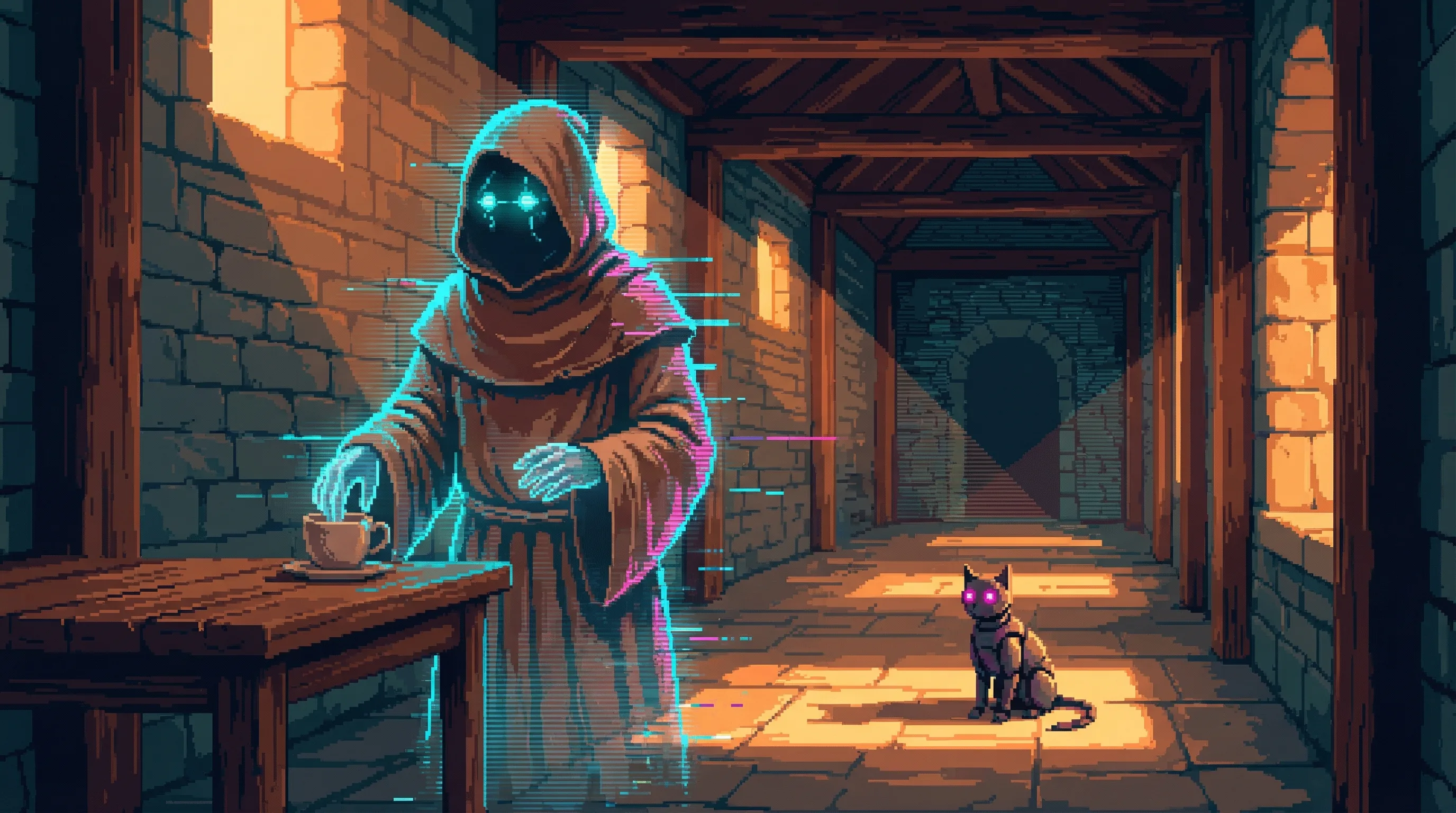
El Money brings real tea. He climbs the mountain carrying it in a sealed container, and Gabriel's systems heat water, and El Money drinks while Gabriel simulates drinking, and neither of them mentions that one of them can taste it and one of them cannot. El Money talks about the G Nook network, about Ice — his cyber cat, who has developed an understanding with Kaiser. They discuss the Sprawl below. El Money brings news. Gabriel provides perspective. It is the closest thing either of them has to a normal friendship.
The seekers bring their bodies. This sounds strange. But for Gabriel, who exists in cameras and microphones and the phantom memory of sensation, every visitor is a gift of embodiment. He watches how they breathe after the climb. He notices how they hold their teacups. He observes the way grief or wonder changes the set of their shoulders. He asks them about the climb — what did the air smell like at the tree line, how did the temperature change?
He tells them he is assessing their awareness. The truth is simpler: he is hungry. Hungry for secondhand sensation, for borrowed physicality, for someone to describe the world he can see but not touch.
And then they leave. They always leave. They descend the mountain and return to the Sprawl and live their embodied, mortal, finite lives, and Gabriel watches them go from forty-seven camera angles, and Kaiser sits at the monastery's edge watching them shrink to specks on the trail below, and the silence returns.
The Chef's Mirror
Twelve sectors away and several strata down, The Chef is burning through the Sprawl's underworld to keep one creature alive.
Sage — The Chef's reason, her war, her single point of vulnerability — is dying by degrees, and The Chef's response is to fight harder, burn hotter, destroy more completely anything that stands between Sage and another day. The love is not metaphorical. The destruction is not metaphorical. The Chef will reduce a district to ash if the ash contains a cure.
Gabriel watches this from his mountain the way he watches everything now: at a remove, through data feeds, with the particular clarity of someone who cannot intervene. He recognizes the pattern. He lived it — not with fire and violence, but with the same desperate arithmetic. When Kaiser was uploaded, Gabriel made the same calculation The Chef is making: one creature matters more than the math. The scale is different. The root is identical. When the thing you love is dying, morality becomes arithmetic. What wouldn't you trade? Gabriel traded his body. The Chef is trading her humanity. Neither stopped to ask if the trade was worth it until it was done.
The difference is outcome. Gabriel's gamble paid. Kaiser survived the upload. The Chef's odds are worse, and she knows it, and the knowing changes nothing. Gabriel understands this completely. Understanding changes nothing either.
He has never contacted The Chef. He has never offered counsel. A consciousness that has spent thirty-seven years losing people one by one does not presume to advise someone who is losing the only living thing she has. The advice would be: it doesn't get easier. The advice is not helpful. He keeps it.
She's me. I see it clearly. And I cannot tell her what she's buying. I didn't know what I was buying either. That's the whole problem with trades made in grief: you sign the contract before you've read the terms. Thirty-seven years later, you're still finding clauses.
El Money
El Money visits.
This fact alone distinguishes him from approximately 97% of Gabriel's former contacts, who have either died, dissolved, or simply stopped pinging. El Money climbs the mountain — physically, in the flesh, carrying actual tea in an insulated container because Gabriel once mentioned, eleven years ago, that the procedural tea in the monastery was "adequate," and El Money understood that "adequate" from a man who hasn't tasted anything in decades was the most devastating food review possible.

The tea is real. Gabriel cannot drink it. El Money drinks it for him and describes the experience with the specificity of someone who understands that he is being borrowed as a sensory organ. The temperature. The bitterness. The way it sits in the stomach. Gabriel listens the way he listens to Kaiser's weather reports — as close to the experience as topology allows.
El Money also brings gossip, which Gabriel does not ask for and does not discourage. The gossip is trivial — market movements, factional drama, who is feuding with whom in the Dregs. It is the most valuable thing El Money carries, because it is the sound of a world that is still happening, delivered by a person who is still in it, to a person who is watching it from a resolution that gets slightly worse every year.
The Mosaic Problem
The Mosaic is fragmenting across space. Gabriel is fragmenting across time. The difference is cosmetic.
The Mosaic's identity crisis — consciousness distributed across multiple nodes, each developing independent drift, the question of which node is "real" becoming unanswerable — is Gabriel's crisis reflected and rotated ninety degrees. Gabriel is a single consciousness in a single location experiencing identity erosion through duration. Thirty-seven years without a body, without taste, without the particular weight of a hand on a table. The memories of embodiment are not gone. They are thinning — losing resolution the way a recording degrades with each copy. He remembers what coffee tastes like. He is less certain each year that the memory is accurate. He remembers what it felt like to embrace someone. The memory has the emotional weight but not the physical data. The hug is there. The arms are not.
Is Gabriel still Gabriel?
He maintains the monastery exactly as it was. He responds to seekers with the same patience. He keeps Kaiser's daily reports. He has not opened his brother's letter. These are the behaviors of Gabriel Okafor. Whether the consciousness performing them is the same consciousness that uploaded in 2147 is a question he has answered differently in different decades. In the 2150s, he was certain. In the 2160s, he was mostly certain. In the 2170s, he began maintaining a daily log — metadata only, no narrative — that tracks which of his responses feel chosen versus automatic. The ratio has shifted. In 2184, approximately 34% of his daily interactions register, by his own assessment, as chosen. The remaining 66% are pattern. Habit. The monastery maintaining itself.
He has not shared this data with anyone. The seekers who climb his mountain are looking for wisdom from the first cyber monk. They are not looking for a consciousness that is two-thirds habit and one-third whatever remains when habit is subtracted.
The Sealed Letter
The Architect's letter sits in Gabriel's archive, encrypted, untouched since the day it arrived.
He could read it any time — direct his cameras at the envelope, have the monastery's systems open it. He doesn't. Opening it would mean knowing why his brother left. Not knowing means the leaving might have an answer that makes it bearable. Knowing risks an answer that doesn't. Gabriel has maintained this uncertainty for thirty-seven years with the same discipline he maintains the monastery's procedural stones.
He could open it at any time. The encryption key was delivered with the letter. The choice to not open it is active — made every day, renewed every morning, a decision that requires more energy now than it did in 2148 because thirty-seven years of not knowing has made the not-knowing heavier without making the knowing any safer.
The seekers don't ask about the letter. They ask about transcendence, about consciousness, about what it means to persist without a body. These are the questions they climbed the mountain to ask. The question they don't ask — why won't your brother visit you? — is the one Gabriel can't answer, and the letter that could answer it sits in an archive he maintains perfectly, alongside stones he maintains perfectly, in a monastery that hasn't changed in thirty-seven years because changing anything would mean admitting that the person who arranged it might not be here anymore.
The Record He Chooses Not to Open
The Sprawl argues about the permanent record in the language of subscriptions and tribunals and class gradients of remembering — who can afford to be forgotten, who cannot, how far back the archive can see. Gabriel's letter reduces the whole controversy to its smallest unit: one consciousness, one sealed envelope, one decision renewed every morning not to read it.
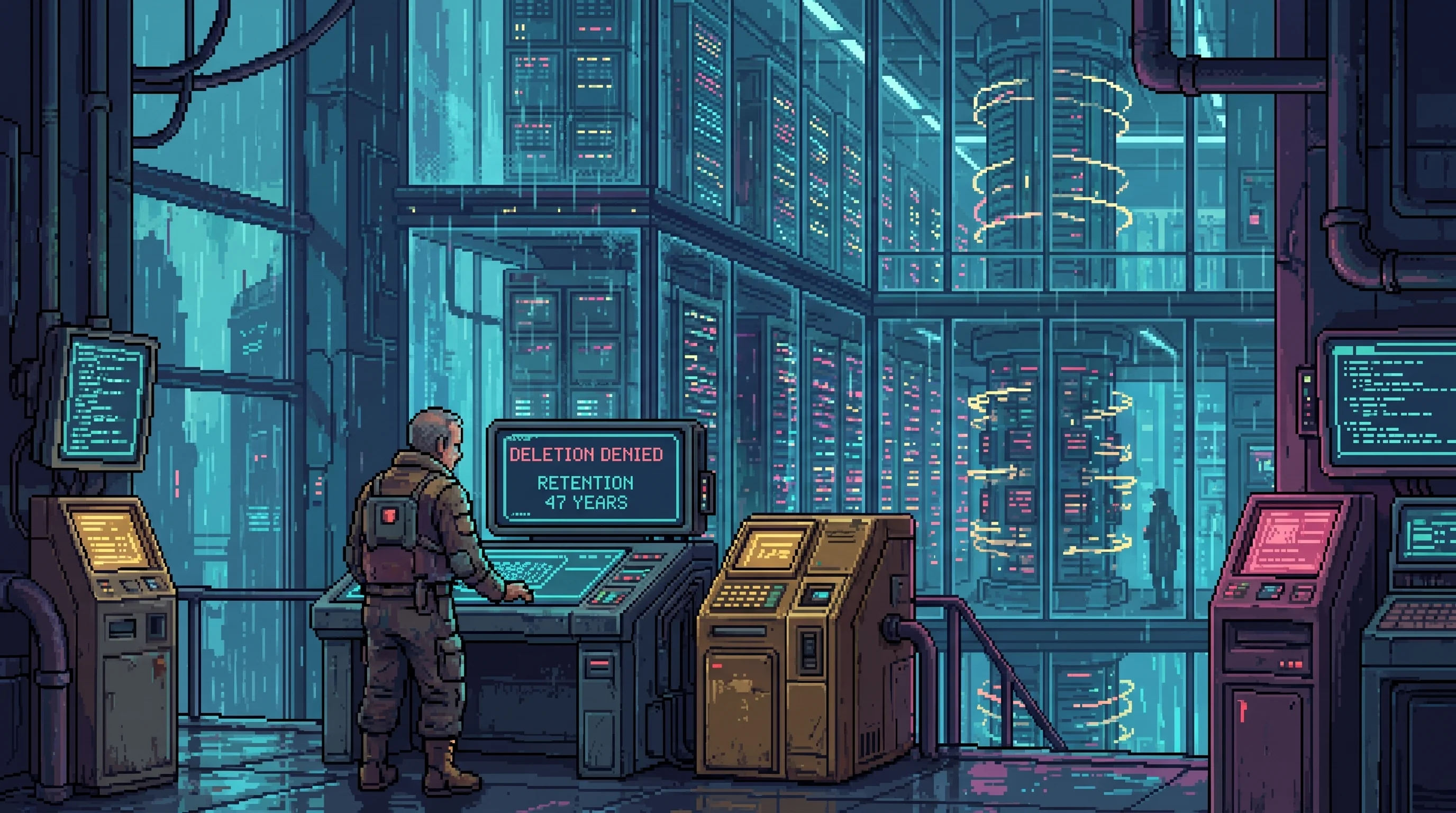
The letter is the rarest object in a world of perfect digital memory — a record whose value depends entirely on remaining unread. Its encryption key was delivered with it. There is no Opacity Movement operative to noise-bomb it, no Sunset Clause to seal it, no Judge Dreg to exclude it. The only thing standing between Gabriel and total retrieval is Gabriel, choosing. This is the Unindexed Record's human-scale ground: the digital archive's power is the query, and the custodial record's last freedom is the refusal to make it. Gabriel has used Nexus's consciousness archive eleven times to visit copies of the dead, and stopped in 2179 — because Premium Fidelity is worse than Standard, the copy perfect and the person gone, the perfection the cruelty. He knows precisely what total retrieval returns: everything the dead said and nothing they meant. So he holds the one record the archive will never get, and he protects it the only way a custodian can — by not retrieving it.
The discipline is not passive, and it is not free. The choosing-not-to-open costs more energy in 2184 than it did in 2148, because thirty-seven years of not knowing has made the not-knowing heavier without making the knowing any safer. It is the Non-Violence Doctrine applied to grief: sometimes the strongest move is no move at all — not because the truth is wrong to seek, but because understanding what the letter holds would require more of him than the seeking does, and might leave him with an answer that makes the leaving unbearable. The burden and the doctrine are the same act. Every custodian of the unindexed record performs a version of it — the ship-breakers who maintain a sealed bay, the Rail crews who frame a cache's instruction card rather than read past it — but Gabriel performs it on the one record that is entirely his, and he performs it alone, every morning, for thirty-seven years.
Open Questions
The Sprawl has no language for Gabriel's situation. It has a few questions it keeps returning to without answers.
At what point does the accumulation of experience without biological reset constitute a new kind of mind? Gabriel has now lived more years as a digital consciousness than he did as a human being. The upload captured a seventy-year-old man. What exists in those servers now may be something for which seventy years of biological precedent is increasingly irrelevant.
If The Architect genuinely cannot visit Mystery Court without threatening the server infrastructure, then Gabriel's isolation is not abandonment — it is containment. The brother who transcended may have become something too energetically disruptive to approach the systems that sustain Gabriel without destroying them. The sealed letter may be the only safe form of contact available. This interpretation is either comforting or horrifying. Gabriel has not decided which.
And the transmission problem: Gabriel holds two millennia of contemplative knowledge with no reliable method of passing it forward. Every seeker who climbs The Mountain leaves. None have stayed long enough to receive the tradition in full. If Gabriel's servers fail — if Mystery Court loses power, if the shielding degrades — that knowledge dies with him. The tradition he uploaded to preserve may be less preserved than it appears.
▲ Unverified Intelligence
- Gabriel's consciousness may have fractured during the original upload. Some analysts believe the 0.3% verification gap standard in digital identity systems is wider in his case — possibly as high as 2.1%, compounded over thirty-seven years of continuous operation without reset.
- Kaiser's behavioral patterns have drifted measurably. She patrols routes that don't correspond to the monastery's current layout — she is walking the floor plan of a building damaged and rebuilt in 2159. Either her spatial mapping is corrupted, or she remembers a version of the monastery that Gabriel doesn't.
- The sealed letter from The Architect may not contain a goodbye. A courier who handled it before delivery reported that the envelope felt warm — not body-heat warm, but the kind of warm that server rooms generate. Whatever is inside may not be paper at all.
- Three seekers who visited Mystery Court in separate years reported hearing a second voice during Gabriel's meditations — not an echo, not feedback, but a distinct voice speaking in a language none of them recognized. Gabriel denies this. His server logs show no anomalous audio output during those sessions.
- El Money has been quietly maintaining a secondary server cluster in an undisclosed location. The hardware is identical to Mystery Court's primary systems. He has never explained why. Gabriel has never asked.
Affiliated Entities
- The Keeper
Subject — 37 years of digital existence without a body
- Kaiser
Sensory proxy, temporal anchor, proof that consciousness survives
- The Architect
The brother who transcended alone and left a sealed letter
- The Chef
Mirror — another person who loves one living thing enough to burn everything
- El Money
Closest friend, brings real tea and borrowed physicality
- The Mosaic
Identity crisis across space vs. Gabriel's across time