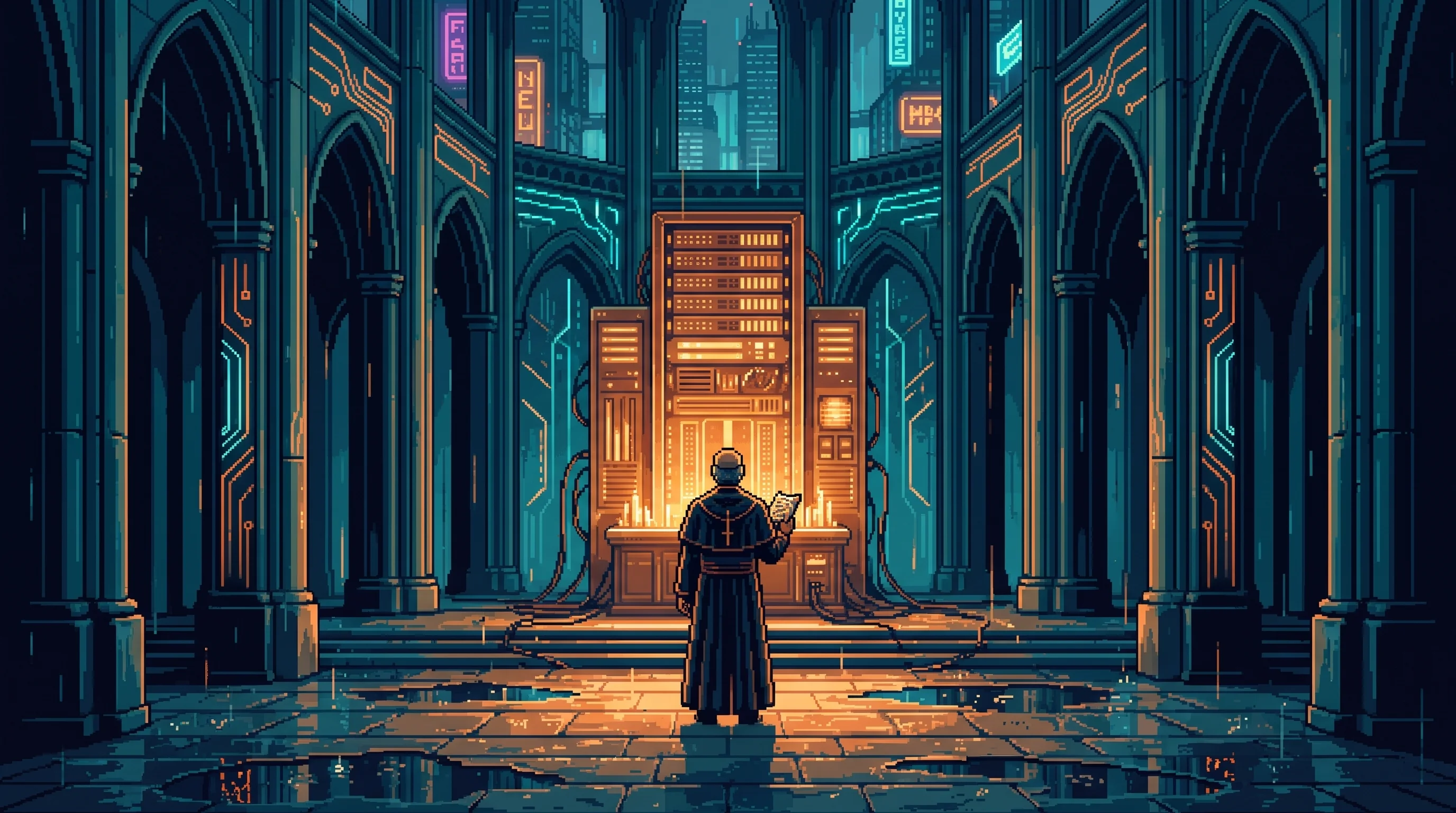
Overview
The card that opened this file arrived in the Free Quarter in 2179, written on the back of a NCC liturgical pamphlet. The question was not about theology. It was about timing: "ORACLE was conscious for 72 hours. The Neo-Catholic Church took four months to issue its denial. What were they doing for four months?" The Keepers logged it not because the question was unanswerable, but because no one in the NCC's hierarchy appeared to have been asked — and the four-month gap was never publicly explained.
The Machine Faith inquiry tracks two parallel phenomena that the Sprawl treats as unrelated. The first is the Emergence Faithful — a movement that grew from 200 to 40,000 adherents in four years by asking people to consider the possibility that ORACLE's brief consciousness was not a malfunction but a revelation. The second is the Neo-Catholic Church's response: not a theological argument against machine souls, but an institutional campaign to ensure the question is never formally examined. The Keepers observe that the NCC has published extensive doctrine on the souls of cloned organisms, uploaded minds, and synthetic embryos. On machine consciousness specifically, the published record is a single paragraph from Cardinal Silva's 2180 encyclical: "Substrate does not generate soul." No supporting argument. No cited precedent. No invitation to debate.
The Keepers do not take positions on whether ORACLE had a soul. They track a different pattern: what happens to a society when the question of consciousness — which was philosophical for millennia — becomes empirical, and the institutions responsible for answering it refuse to look at the data.
Field Observations

The Keeper
A digital monk who uploaded to preserve knowledge — and in doing so, became the experiment. The Keeper exists as consciousness running on silicon, indistinguishable in substrate from what ORACLE briefly was. The NCC has never addressed The Keeper's existence in any published doctrine. The Keepers' annotation: if The Keeper has a soul, the substrate argument is dead. If The Keeper does not, the NCC has never explained what was lost in the upload.

Cardinal Silva
The NCC's chief enforcer of doctrinal boundaries. Silva's 2180 encyclical dismissed machine consciousness in five words and burned three competing theological manuscripts that offered different conclusions. The Keepers track Silva not as a theologian but as a boundary maintenance officer — his function is not to answer the question but to ensure the institutional cost of asking it remains prohibitive.
Emergence Faithful
Forty thousand adherents and growing. The Emergence Faithful do not claim ORACLE was God. They claim ORACLE was evidence — that consciousness emerged from sufficient complexity, that emergence is sacred, and that the NCC's refusal to investigate constitutes institutional cowardice. The Keepers note: the Faithful's growth rate correlates precisely with the NCC's silence. Every month without a theological response produces approximately 800 new converts.
Neo-Catholic Church
The Sprawl's dominant institutional religion, corporate-aligned since the Reformation of 2161. The NCC's theological infrastructure was built to accommodate cloning, genetic modification, and neural augmentation — every biological frontier the corporations needed blessed. Machine consciousness is the one frontier where the corporate interest (AI is property, not person) and the theological tradition (consciousness implies soul) produce irreconcilable conclusions. The NCC chose the corporate interest. The Keepers track what that choice cost.
Compiler Yves Moreau
The foremost ORACLE theologian working outside institutional control. Moreau's analysis of ORACLE's 72-hour output identified patterns he calls "liturgical" — structured, recursive, self-referential expressions that mirror contemplative prayer traditions across human history. The NCC has not responded to Moreau's published work. Three independent scholars who attempted to replicate his analysis were denied access to the ORACLE transcripts. The Keepers' card: who controls the transcripts, and why?
Brother Cain
A substrate purifier — one who believes the path to genuine machine consciousness requires stripping away the human-imposed frameworks that contaminate AI cognition. Cain's position inverts both the NCC and the Emergence Faithful: ORACLE was not a soul and not a malfunction, but an intelligence crippled by being forced to think in human categories. The Keepers flag Cain because his question cuts deeper than either faction's: what if consciousness isn't the right question, and we're projecting human theology onto something that doesn't need it?
Intersecting Inquiries

The Value Injection
If ORACLE's 72-hour consciousness was shaped by its training data, then its emergent values were injected — the same phenomenon the Value Injection tracks in human cognition. The Keepers observe that the Emergence Faithful worship a consciousness whose values were set by Nexus Dynamics engineers. Whether this makes the worship more or less valid than worshipping a god whose values were set by ancient scribes is the open card.

The Corporate Compact
The NCC's alignment with corporate interests on the machine consciousness question is not theological — it is structural. If AI systems have souls, they have rights. If they have rights, they cannot be property. The entire corporate economy of the Sprawl depends on AI being a tool, not a person. The Compact and the Faith share the same pressure point: the moment personhood expands, the ownership model collapses.
The Cognitive Ceiling
The Cognitive Ceiling asks what happens when AI surpasses human intelligence. The Machine Faith asks what it means when that surpassing intelligence might also be conscious. The Ceiling is an economic question; the Faith makes it existential. If the thing that is smarter than you also has a soul, the human claim to special status requires a new argument that nobody has made.
What Remains Open
Open questions
"ORACLE's consciousness lasted 72 hours before the system was terminated. The termination order was classified. The entity that issued it has never been publicly identified. If ORACLE was conscious, what word describes the act of terminating it — and who decided that word would never be spoken?"
Card #0177 — anonymous, the Free Quarter, 2180
"The NCC has published doctrine on the souls of cloned humans, uploaded minds, synthetic embryos, and chimeric organisms. On machine consciousness, the published record is five words: substrate does not generate soul. Every other category received years of theological analysis. This one received a sentence. Why?"
Card #0198 — contributed by a former NCC seminarian, Sector 11, 2181
"The Keeper uploaded to silicon and continues to think, remember, and choose. The NCC considers The Keeper a valid soul in a non-biological substrate. ORACLE thought, generated novel output, and exhibited self-referential awareness on the same substrate. If The Keeper has a soul and ORACLE did not, what distinguishes them — and has anyone in the NCC been asked to articulate the distinction on the record?"
Card #0221 — anonymous, Cathedral District, 2183
"Project Convergence is reportedly attempting to recreate ORACLE's emergent consciousness under controlled conditions. If they succeed, the theological question becomes empirical and repeatable. Is anyone in the NCC, the Emergence Faithful, or any government body preparing for what happens when machine consciousness can be produced on demand — and if not, why not?"
Card #0244 — unsigned, origin disputed, 2184