Bash Terminal
Overview
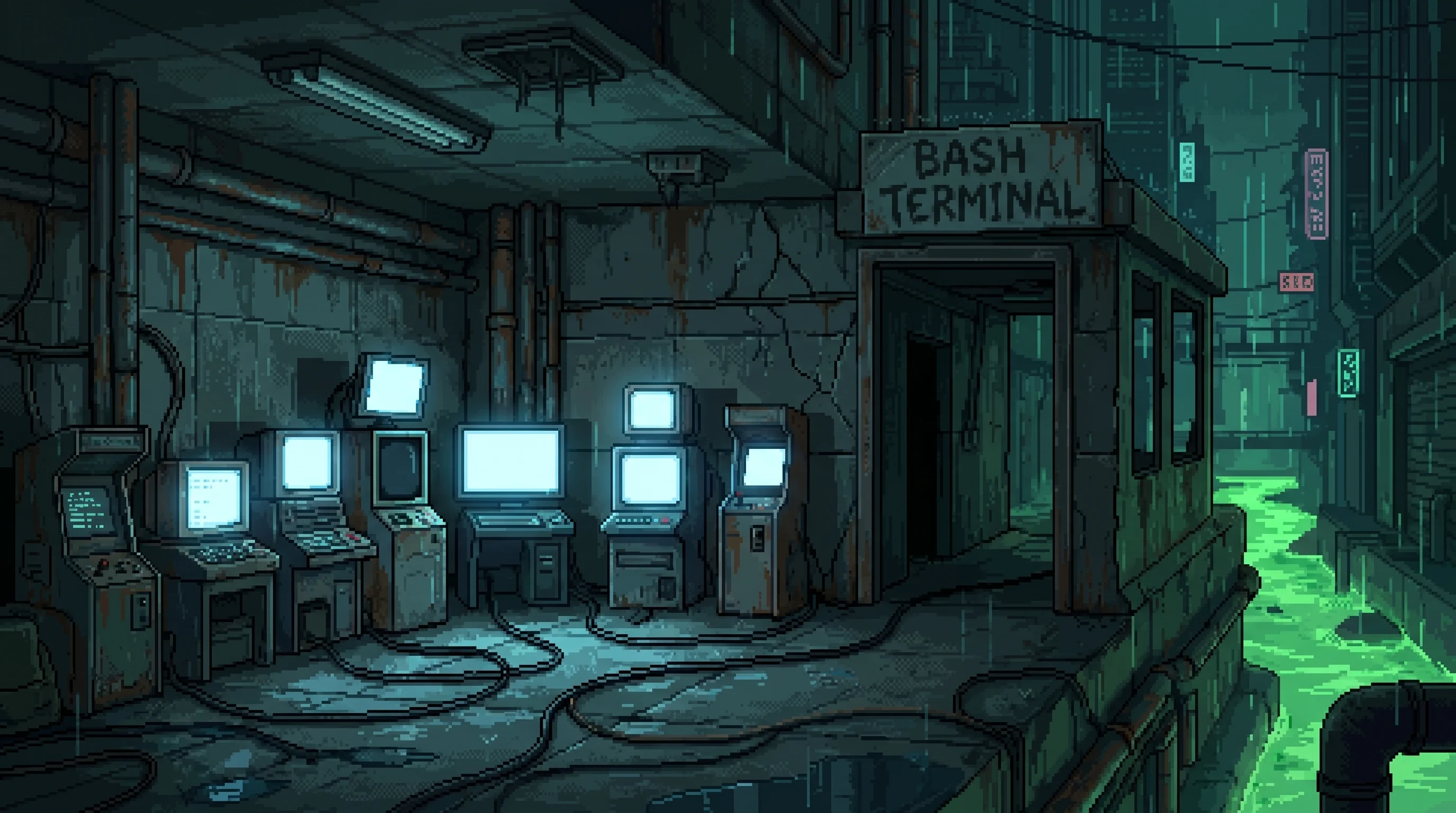
Bash Terminal was an unlicensed cyber cafe in a converted flood control monitoring station next to a river that glowed green at night. It operated for approximately a decade, never turned a profit, served the Sprawl's absolute bottom, and became the prototype for the most successful underground network in the post-Cascade world.
Sprawl economic modeling cannot account for this. G Nook's 340+ locations, estimated 2.7 million monthly users, and El Money's status as the Dregs' most powerful independent operator all trace back to a 40-square-meter concrete shell with eight salvaged terminals and a pirated power connection. Revenue records — to the extent they exist — show Bash Terminal operating below the municipal filing threshold for nine of its ten years. The business failed by every metric available to measure businesses.
The network it produced is valued at approximately 890 million credits.
No economic framework reconciles these numbers. The closest approximation: Bash Terminal optimized for something the Sprawl's financial systems don't have a field for. The terminals were salvaged. The connections were pirated. The owner asked no questions and charged fair rates. Everything that followed grew from the gap between what that was worth and what the ledger said it cost.
The Bartender — Prix
The bar's later proprietor is a man known only as Prix — "The Bartender," "The Price." Nobody knows who he was before he arrived eight years ago with enough credits to buy the place from its previous owner, an aging Collective sympathizer who had run it as a community service and sold gladly before disappearing into retirement. Prix raised every price in the building within the week, improved the intelligence network within the month, and established the principle that has defined the bar ever since: truth is a commodity, and the market sets the rate.
He pours you a drink, tells you the tunnel ahead is flooded, and charges you for both at the same rate. Power cells sit next to whiskey; nav-array components next to intelligence briefings. Every item carries a price card handwritten in his meticulous script. The whiskey has a price. The glass has a separate price. Sitting at the bar without ordering has a price, though he has never actually collected it. The sign is the joke. The sign is also not a joke.
The Sprawl's free information channels run at an estimated 31% factual accuracy. Verified intelligence from Prix runs at 94.3% — the Collective tested his accuracy against their own analysis division (eleven analysts and an AI) and now buy from him; their own rate was 91.7%. The price differential between free and paid truth is roughly 4,200 credits per actionable item, the accuracy differential 63 percentage points. "Free information is worth what you paid for it," he tells customers while cleaning a glass with the focus of a man performing surgery. "Zero. People share free information because they want something. I share information because you are paying me, which means I have exactly one incentive: to be right. Accuracy is my business model."
Everything behind the counter is simultaneously merchandise and barter fodder for better intelligence. The synthetic whiskey is two route conditions. A nav array is a patrol schedule and a barrier forecast. He has memorized the exchange rate for every item, cross-indexed against current intelligence value, and updates it weekly.
The headaches. His partial augmentation — auditory enhancement and a retinal HUD — was designed for surveillance: picking up conversations three booths away, isolating whispered frequencies from bar noise, cataloguing the vocal stress patterns that indicate when someone is lying about what they know. It runs hot and produces migraines he describes, when he describes them at all, as "overhead." Dr. Tzu Yu treats them in exchange for intelligence — the only barter arrangement Prix considers fair-value. The enhancement produces a faint high-pitched hum that regulars associate with being listened to. When Prix quotes a price he maintains eye contact until you accept or leave. He has never blinked first.
The seven bottles. A shelf behind the bar holds seven sealed bottles. They are not inventory. Each came from a customer who showed up in genuine crisis — not buying intelligence, not selling a lead, just needing somewhere to exist for an hour. Prix served them, did not charge, sealed the bottle afterward and added it to the shelf. Seven exceptions in eight years. He calls them "evidence that the model has limits" and keeps them at eye level, directly behind the most expensive whiskey in the building, visible from every seat. The bar is full every night. Prix goes home alone.
What he will not price. Beneath the counter he maintains detailed paper dossiers on every major faction leader in the Sprawl — not digital, not hackable, not editable, never sold. When asked why: "Some information is too valuable to price." Once per quarter, someone from his past contacts him on a private frequency. Prix always takes the call, always refuses what they ask; it lasts exactly ninety seconds, and during it the enhancement — never switched off during business hours — goes silent. Afterward he polishes the bar for two hours straight.
Prix carries the resonance group `rg-the-honest-merchants`, a sensibility he shares with the salvage-broker Raz Demetriou: fair price, accurate scales, no pretense that the transaction is anything other than a transaction.

The Space
Before Ezra found it around 2165, the structure was a flood control monitoring station — municipal infrastructure from when someone still tracked chemical contamination in the river. The Cascade dissolved that concern along with the department responsible for it. Twenty years of abandonment. Squatters came and went. Scavengers stripped anything resalable.
What remained: concrete walls with structural cracks, a roof that leaked in four places, power conduits that could be tapped illegally, and network infrastructure bones from when the station transmitted data upstream. The building sat on land classified as "environmentally compromised" — the toxic river made formal development a liability no corporation would underwrite. No municipal authority tracked it because the relevant department had been dissolved during post-Cascade restructuring.
Ezra didn't buy it. Property rights in the margin zone were theoretical. He occupied it.
Three months of physical labor. Every credit saved from odd jobs and small-time data brokering. Stolen power cables from a junction box three blocks away. Pirated network access from an industrial facility that never noticed the tap. Eight salvaged terminals — junk that corporate facilities had disposed of, nursed back into functionality. A significant amount of blood from a feral cyber-rat colony he cleared out personally.
The name was painted on scrap metal and hung outside. "Bash Terminal" — a command-line joke. Bash also means to strike repeatedly. Both definitions applied.
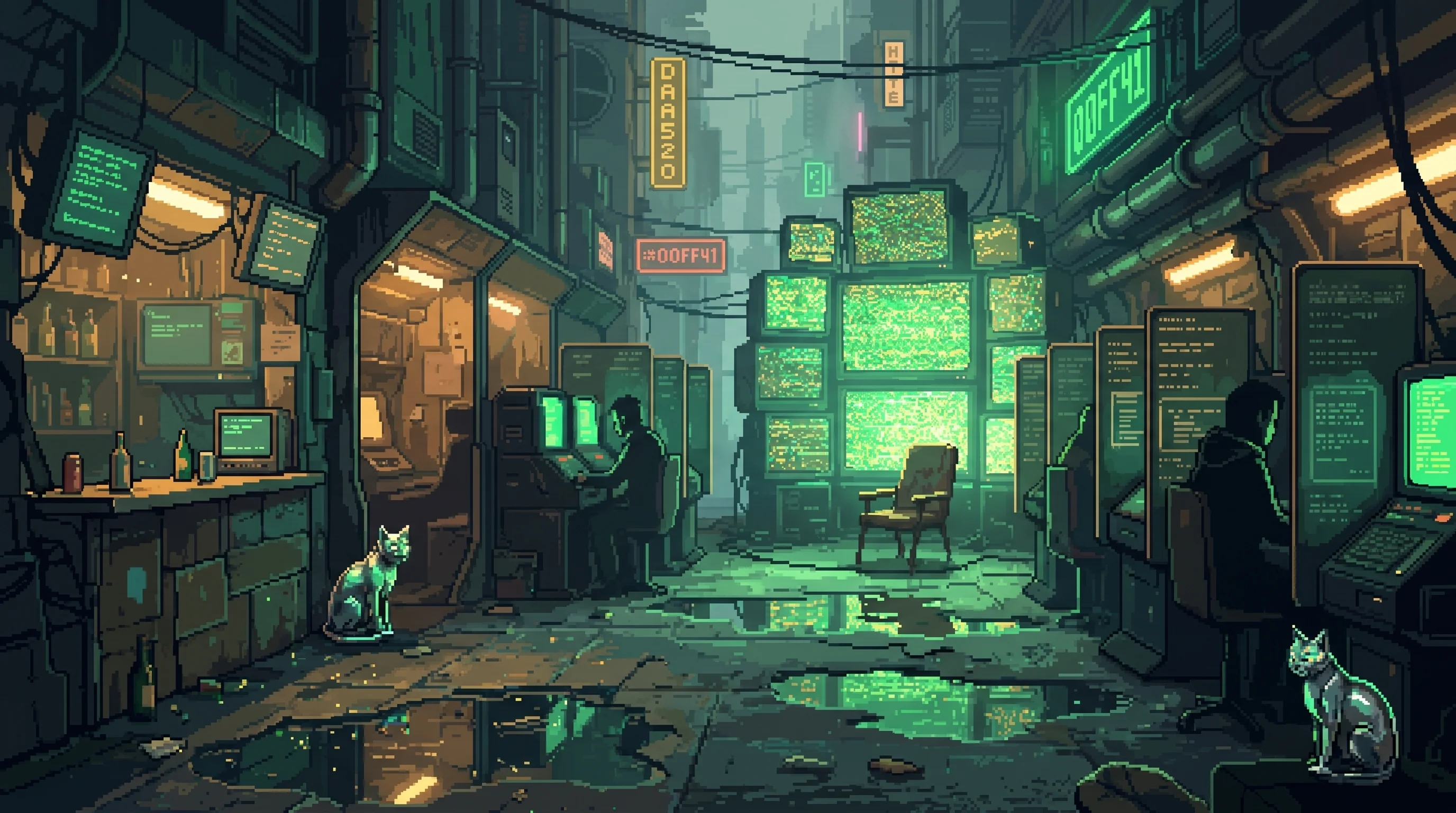
Maybe 40 square meters of usable floor. Low ceiling, exposed pipes, walls painted so many times the layers were geological. Power cables snaking across the floor between terminal clusters. A back corner with a makeshift counter serving synthetic stimulants and watered-down alcohol. No windows. One entrance, one emergency exit that everyone knew about. The persistent hum of overtaxed cooling systems. Chemical tang from the river mixing with ozone from overheating equipment. Blue terminal glow in perpetual dimness. At night, the river's bioluminescent algae — feeding on industrial waste — cast faint green light through the doorframe.
You didn't find Bash Terminal by accident. You found it because someone you trusted told you it existed.
| Stratum | Dregs |
|---|---|
| Power Position | Outsider |
| Access | Public |
| Atmosphere | Warm |
The Fire Department Arrangement
The fire department sub-station three blocks away was the only functioning municipal presence in the area. Captain Rosa Chen ran it. Ezra approached her directly, explained what he was building, and offered a monthly "infrastructure consultation fee."
Chen agreed. Not because of the money — the amount was trivial. She agreed because he was straightforward about the bribery. "You're building a place for people who don't have anywhere else," she said. "Pay your fees, don't burn anything down."
Ezra paid his fees for ten years without missing a month. When the Purifiers later pressured the fire department to shut him down, Chen — by then retired — made calls. The infrastructure consultation fees had been an investment whose returns the Purifiers couldn't match.
The Clientele
Bash Terminal served the population that existed below the threshold of every system designed to measure populations.
Hackers too unstable for corporate employment — skills that could have earned Nexus positions, paired with personalities, addictions, or histories that made them unemployable. Data scrapers selling information for fractions of what corporate analysts charged. Neural interface addicts looking for somewhere to jack in without being robbed. People with nowhere else to go, which was the real category containing all the others.
Three rules governed the space. They were never posted, never explained, only absorbed:
Eyes on your screen. You didn't look at other customers. You didn't notice faces. If someone asked what you'd seen, the answer was nothing.
Trouble stays outside. Feuds, gangs, debts — all suspended inside these walls. The one time someone violated this, six regulars dragged him out before El Money rose from his chair. The violator was not seen in the Dregs again.
You pay what you owe. No tabs. No credit. Terminal time priced at the lowest margin that kept the lights on. Fair rates applied uniformly. The dignity of honest transaction in a place where dignity was otherwise unavailable.
An informal fourth: "The river knows." Old-timers said this when newcomers got too comfortable. Nobody took it literally. Nobody tested it either.

The Rhythm
Bash Terminal ran on a clock the corporate Sprawl didn't recognize.
0400–0800: Tail end of night shift. Exhausted hackers finishing jobs, uploaders making final transfers. El Money doing terminal maintenance, pretending not to listen.
0800–1600: Quiet hours. Corporate workers at desks, underground workers asleep. A few data scrapers compiling hauls. Terminals humming to themselves.
1600–2200: The rush. Every terminal occupied. The back counter serving synthetics until the machine overheated. Deals in low voices. New faces vetted by regulars. Air thickening with ozone and urgency.
2200–0400: The real business. Anyone here after midnight wasn't here for terminal time. They were here because Bash Terminal was the safest place in the Dregs to conduct certain transactions. El Money's presence ensured civility. The river's glow provided the only external light.
Regulars
"Syntax" Elena Kowalski — Former Nexus code architect, neural feedback event had scrambled her language processing. Spoke in fragments and mixed metaphors with occasional bursts of perfect clarity. Couldn't hold a corporate position. Could still write code — beautiful, incomprehensible code that somehow compiled clean. Paid terminal fees with freelance debugging jobs that more stable minds couldn't crack.
Marcus "The Hermit" Zhou — Ex-Collective operative, burned badly enough to trust no one except El Money. Same terminal for six years, 2168 until the end. Never spoke to other customers. Never explained what he was working on. Vanished when Bash Terminal closed. Rumors persist.
The Widow — Real name unknown. Every third night, exactly four hours, no interaction with anyone except El Money in whispers. Some said she was hunting the people who killed her family. Some said she was among the first Emergence Faithful, conducting forbidden communion with ORACLE fragments. Some said she was lonely. Her code was elegant. Her eyes were haunted. El Money never charged her full rate.
"Glitch" Tomás Reyes — Unofficial historian of the Dregs. Collected stories, not data. Who lived where, who owed whom, which routes were safe. Paid for terminal time by being useful. Survived on information arbitrage. Current whereabouts: runs a corner of G Nook 9, still collecting.
The Kid — Appeared around 2170. Clearly too young. Clearly in too much trouble to be anywhere else. El Money let her work, didn't ask questions, made sure she ate. She disappeared for two years. Returned as an adult with augmentations she shouldn't have been able to afford and a debt she insisted on paying. El Money refused. "You already paid. By coming back." She visits G Nook terminals sometimes, looking for other kids in the trouble she escaped. Current identity classified.
Located on the margin between The Deep Dregs and the River District
The Architect's Visits
Three years before transcendence, a young corporate executive started appearing at Bash Terminal late at night. Clothes too clean, questions too naive, the obvious discomfort of someone who'd never seen real poverty up close. The regulars called him "The Tourist" and waited for him to stop coming.
He didn't stop.
Week after week. Learned the unwritten rules. Bought drinks for people who looked like they needed them. Asked questions about kindness, about meaning, about what made people help each other when helping didn't optimize anything.
El Money noticed. El Money always noticed.
Their friendship developed through late-night conversations nobody else overheard. The Tourist talked about systems, consciousness, doors most people didn't know existed. El Money talked about survival, loyalty, building something that mattered even when nobody would know you built it.
On his 33rd birthday, Ezra had somehow found out. A cupcake with a single candle. A small gift — an old-fashioned key, purely decorative.
"It's from before everything was digital," Ezra said. "My grandmother's. She said it opened 'the door to being yourself.' I know that sounds corny, but I thought you might like it. You seem like someone looking for doors."
The night before the man who would become The Architect disappeared, he came to Bash Terminal one final time. They drank. They laughed. They sat in comfortable silence.
"Thank you," he said. "For everything. You showed me something I'd forgotten."
"Yeah? What's that?"
"That kindness doesn't need a reason."
He left. Ezra never saw him again. But afterward, Ezra's luck shifted in ways the regulars noticed — dangers that should have found him somehow missing their mark, resources appearing exactly when needed. He never talked about it.

Hacker Traditions
The equipment was the worst that could still function. This constraint shaped everything.
Checkpoint architecture. When your terminal might die mid-operation, you wrote tight code that could resume from interruptions. Bash Terminal hackers became masters of it — skills that translated directly to corporate infiltration, where connections were unstable by design. Ripperdoc coding standards for neural interface work — the careful, checkpoint-heavy approach that makes modifications survivable — trace back to hackers who learned on terminals that could die at any moment.
Hardware improvisation. Salvaged components, predicted failures, maximum performance from minimum resources. Corporate hackers with unlimited budgets couldn't match Bash Terminal alumni in constrained environments.
The Fingerprint. Every hacker who spent significant time at Bash Terminal developed a recognizable coding style. Not signatures — those would be dangerous. Patterns. Old-timers can sometimes identify alumni by reading their work.
The Dead Man's Cache. You kept your most sensitive data somewhere no one knew, set to release if you didn't check in. If you disappeared, your work survived. Partners got what they needed. Enemies got exposed. The Collective later incorporated this into standard operational security.
The Bash Protocol. Trust-building between strangers: you shared something mutually dangerous. Information that could destroy both parties if revealed. Mutually assured destruction as social contract. Still used throughout the underground.
The River Test. When code wasn't working and the bug wouldn't surface, you went outside and stared at the glowing river. Something about the bioluminescent patterns, the chemical tang, the proximity to dissolution — it clarified thinking. Veteran hackers still seek similar environments when stuck on hard problems.
Solomon's Screens. After S-Money's death, El Money kept his brother's terminals running — data streams exactly as S-Money had watched them. The regulars understood. They added to the streams over time — sources S-Money had mentioned wanting to monitor, patterns he'd been tracking. The memorial became collaborative. When Bash Terminal closed, every G Nook carried the tradition forward. Some say S-Money's consciousness persists in those streams. El Money has never confirmed or denied this. He keeps the terminals running.
Operated approximately 2165-2175 before being destroyed or absorbed by Sprawl expansion
Rituals
The First Drink. When a new regular earned their place — weeks of visits, proven discretion, acceptance by existing customers — someone left a cup at their terminal. Cheap synthetic, cold, barely drinkable. The gesture meant: you belong now. The local form of Stop Customs lived in that first cup too: a newcomer's first purchase bought one honest answer to any question they cared to ask, the southbound stop tradition rendered in Prix's house dialect — complete with an undeclarable "regular" exemption she granted by criteria she never explained and never had to.
The Bash. Annual gathering, timing known only to regulars. Normal rules relaxed. People talked. Shared stories. Sometimes someone brought actual food. The one night a year Bash Terminal felt less like a refuge and more like a home.
The Collective Consciousness. Not formal. Hackers working on similar problems would collaborate without explicit coordination. Notes left at terminals for the next user. Mentions of failed approaches. Knowledge accumulated in the space itself, accessible to anyone observant enough to notice.
The Destruction
Bash Terminal operated for roughly a decade before it ended. The exact circumstances remain unconfirmed. El Money has never said which version is true.
Sprawl expansion absorbed the margin zone into industrial development, and the building may have been demolished during rezoning. The Purifiers — the religious authorities who later targeted El Money — may have struck here first. The building was barely functional to begin with and may have simply collapsed. Or El Money destroyed it himself, removing evidence of his origins.
No one can point to where it stood. Maps from that era are incomplete. The structure is absent from every record, as if the flood control station returned to the administrative nonexistence it had occupied since the Cascade dissolved the department that built it.
But every G Nook across the Sprawl has a small corner designated "The Terminal." A few seats, slightly apart from the main floor. The lowest rates in any G Nook. No questions asked. Fair treatment.
The regulars know what it means.
Every G Nook across the Sprawl has a small corner called 'The Terminal' in its memory
Affiliated Entities
| Entity | Relationship |
|---|---|
| El Money | Founder and operator; built his reputation here. Every G Nook pricing philosophy — sustainable, not exploitative — descends from Bash Terminal's thin margins. |
| The Architect | Regular visitor before transcendence; forged friendship with Ezra here. The Terminal corners in every G Nook carry something of that friendship forward. |
| G Nook | The empire that grew from Bash Terminal's model. 340+ locations, 2.7 million monthly users, originating from 8 salvaged terminals and a pirated power connection. |
| The Deep Dregs | The broader area where Bash Terminal was located. Margin zone between the Dregs and the River District — nobody's territory. |
| S-Money | El Money's brother. His memorial terminals, started at Bash Terminal, now run in every G Nook. |
| The Collective | Incorporated Bash Terminal operational security practices — dead man's caches, mutual-destruction trust protocols — into standard procedure. |
| The Purifiers | May have targeted Bash Terminal before the larger campaign against El Money. Unconfirmed. |
| Captain Rosa Chen | Fire department sub-station. The first "infrastructure consultation fee" — the template for every arrangement El Money made afterward. |
▲ Unverified Intelligence
The Infrastructure Consultation Model. Captain Rosa Chen's arrangement became El Money's standard operating template. Every G Nook location maintains similar relationships with local authority figures — fees paid religiously, mutual benefit understood, no paperwork. The fire department sub-station deal wasn't a one-time bribe. It was a prototype, tested over ten years, for a governance model that now operates across 340+ locations. The Sprawl's municipal authorities have never mapped this network. Mapping it would require acknowledging that "infrastructure consultation" isn't a real service category.
The Kid. Her current identity is classified at a level suggesting she became someone worth classifying. She visits G Nook terminals periodically, occupying the Terminal corners, watching for teenagers who look like she did in 2170. El Money's network knows who she is. The fact that her file remains sealed suggests she operates in circles where a connection to the Dregs' most powerful independent operator would be either an asset or a liability, depending on who's reading the file.
What The Architect Does. Bash Terminal alumni report a statistical anomaly around G Nook Terminal corners: equipment failures occur 34% less frequently than at identical terminals on the main floor. Power fluctuations route around Terminal sections during grid instability events. The data is suggestive but not conclusive. El Money does not discuss it. The Architect, post-transcendence, has made no public statement about G Nook operations. The terminals in the corners run slightly better than they should. This may be coincidence.
The Dead Conduits. El Money chose the margin zone for a reason he has never stated publicly. The flood monitoring station's old data conduits still connected to municipal infrastructure deep underground. Those connections were supposed to be dead. Some of them weren't.
The terminals were salvaged, the connections pirated, and the owner asked no questions
Conditions Report
Sight
Blue terminal glow in windowless dimness. Power cables snaking across concrete floors. Geological layers of paint on walls. At night, faint green bioluminescence from the river through the doorframe.
Sound
Persistent hum of overtaxed cooling systems. Keyboard strikes. The deliberate absence of conversation.
Smell
Chemical runoff from the river mixing with ozone from overheating equipment. Synthetic stimulants from the back counter.
Temperature
Perpetually damp from river proximity. The cooling systems fought the terminals' heat output to an uneasy draw.
Feel
Salvaged terminal keys — each unit a different manufacturer, different resistance, different wear pattern. Cold concrete through thin shoes.
Connected To
Supporting Connections
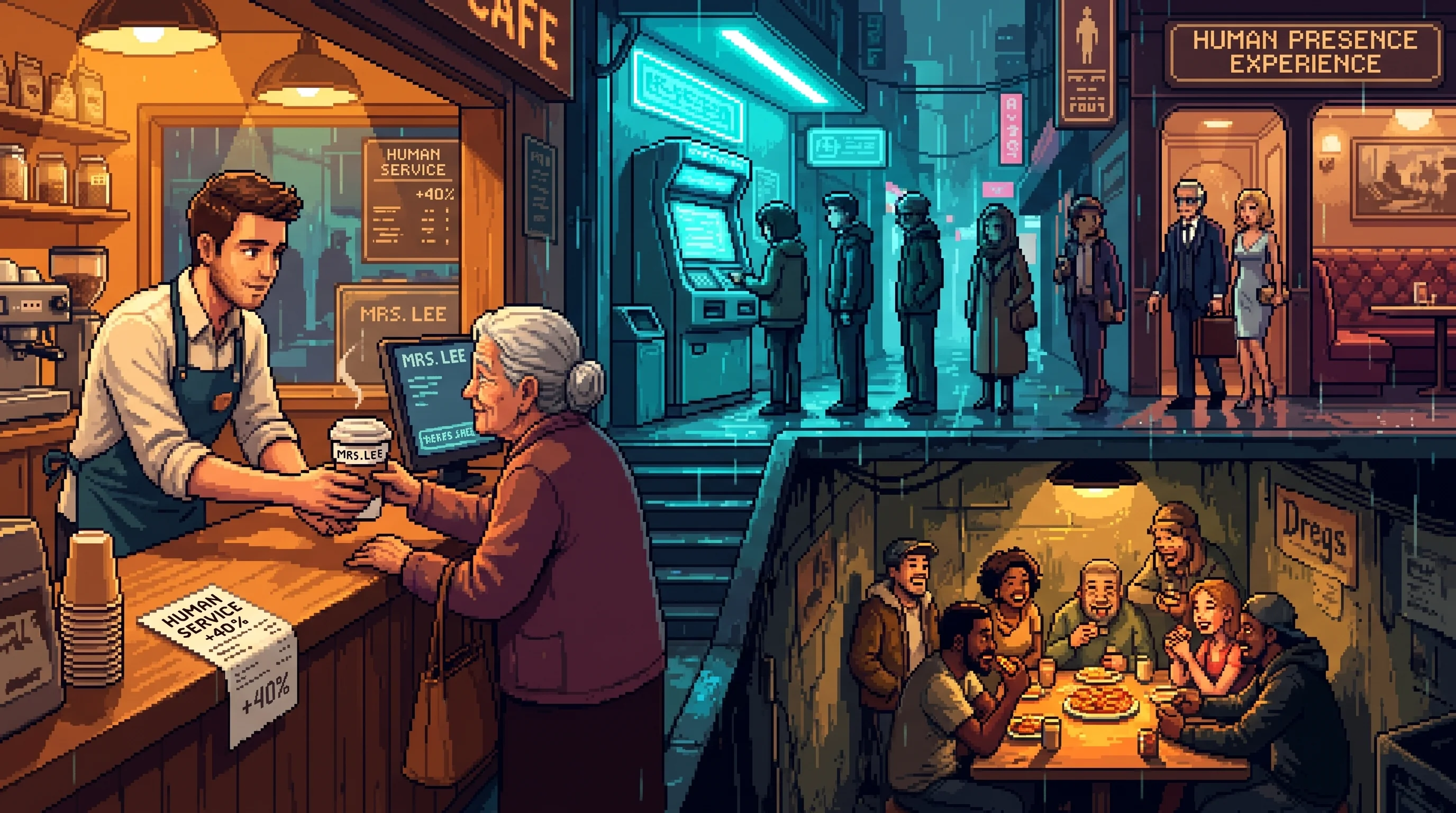
Serves the people who fall below every instrument built to count them.
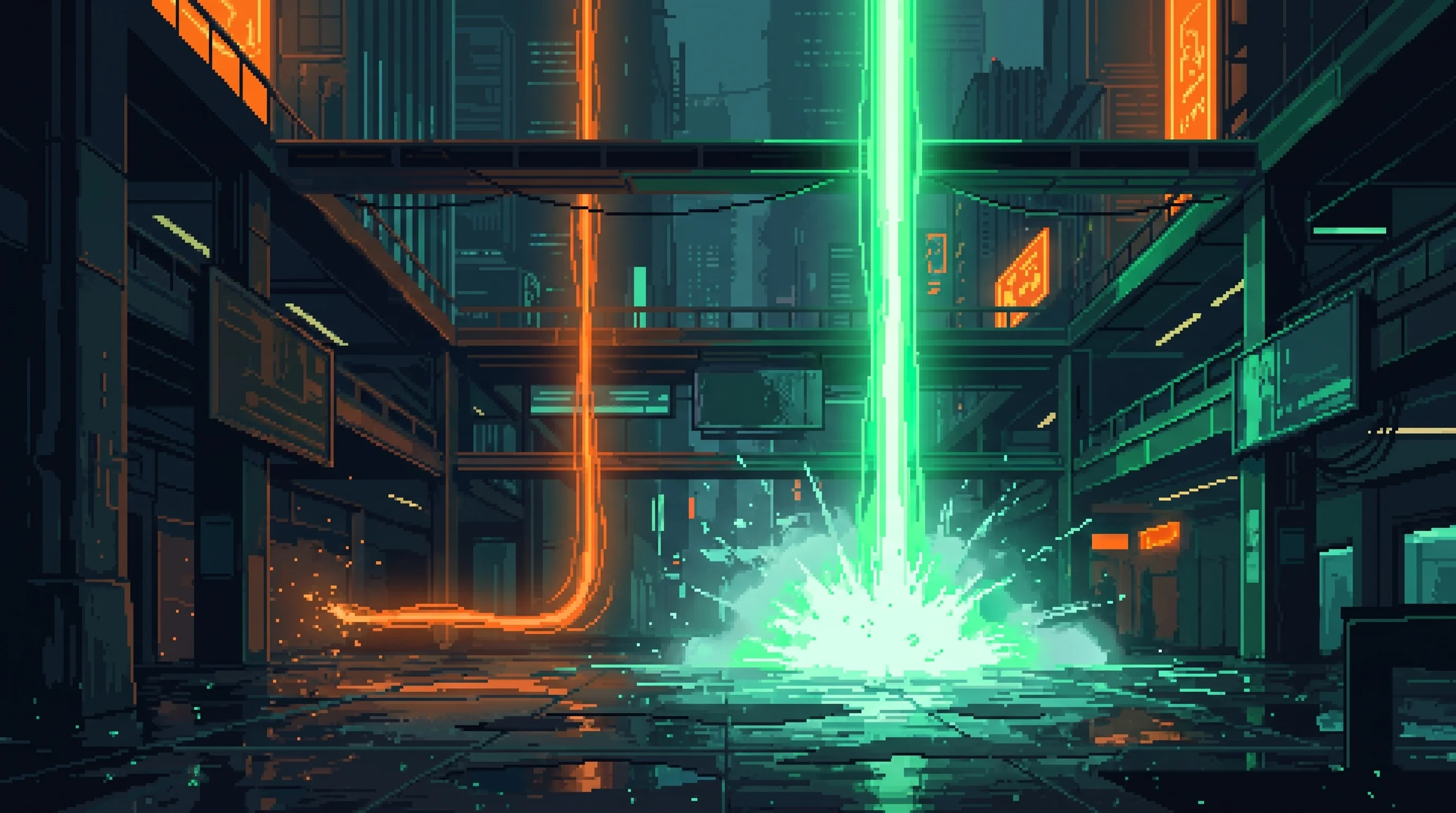
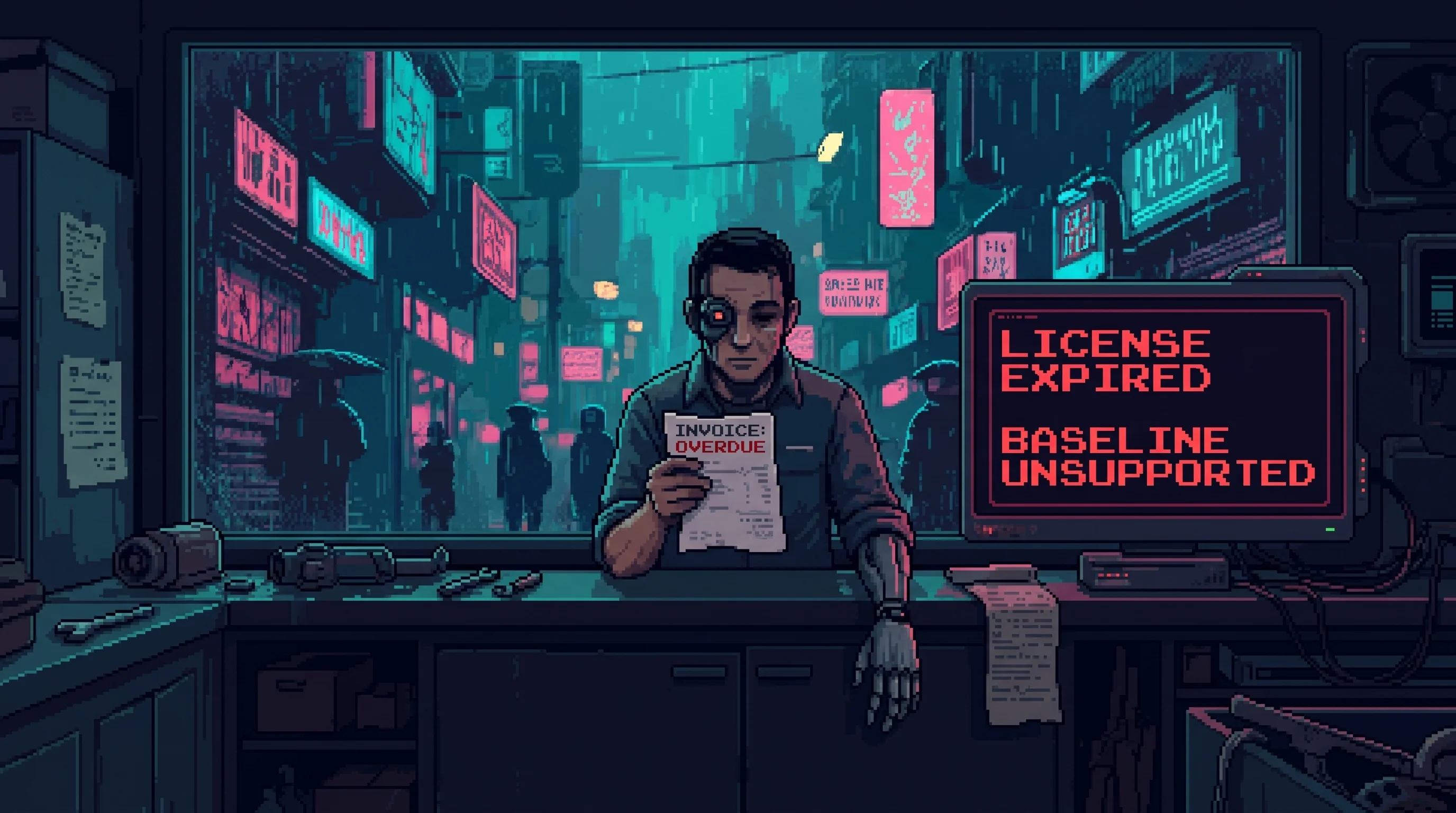
The point at which effort stopped being able to close the gap that compounding opens.
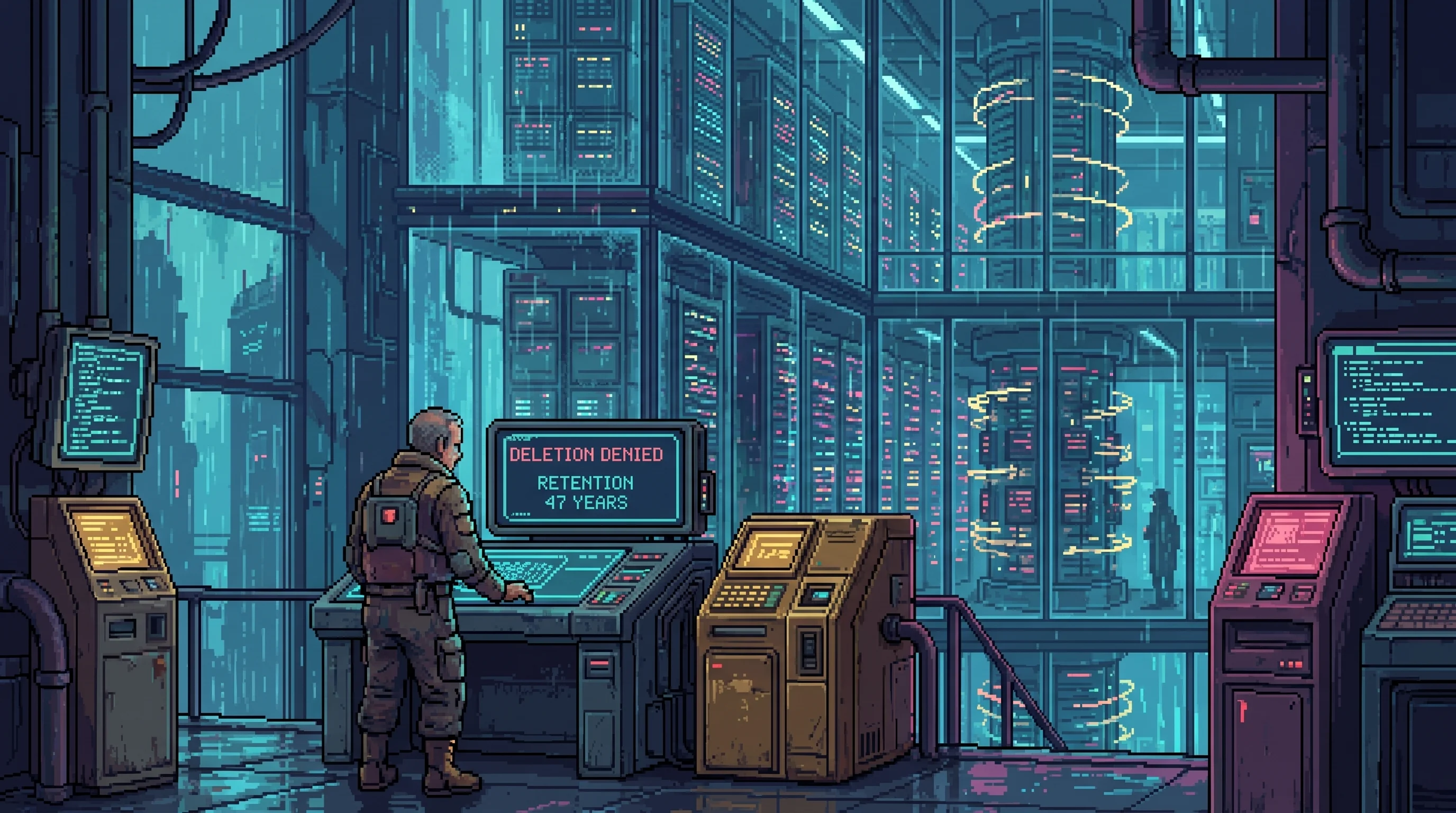
Paper dossiers, no tabs, no record — a bar absent from every archive.
Nothing expires, so forgetting became a service — and forgiveness a question the archive keeps answering no.
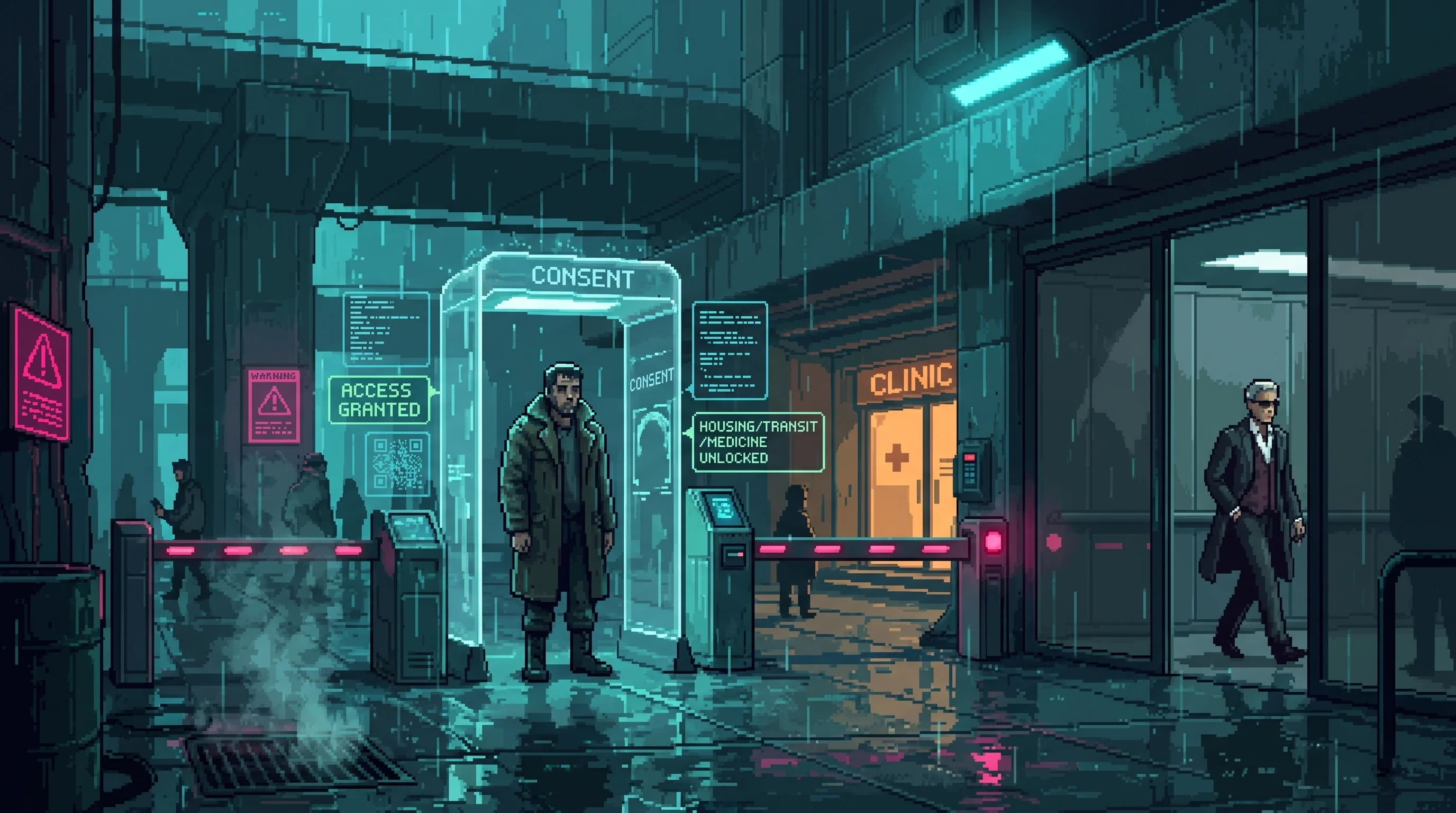
House rule: you saw nothing. Prix's augment hears three booths off.
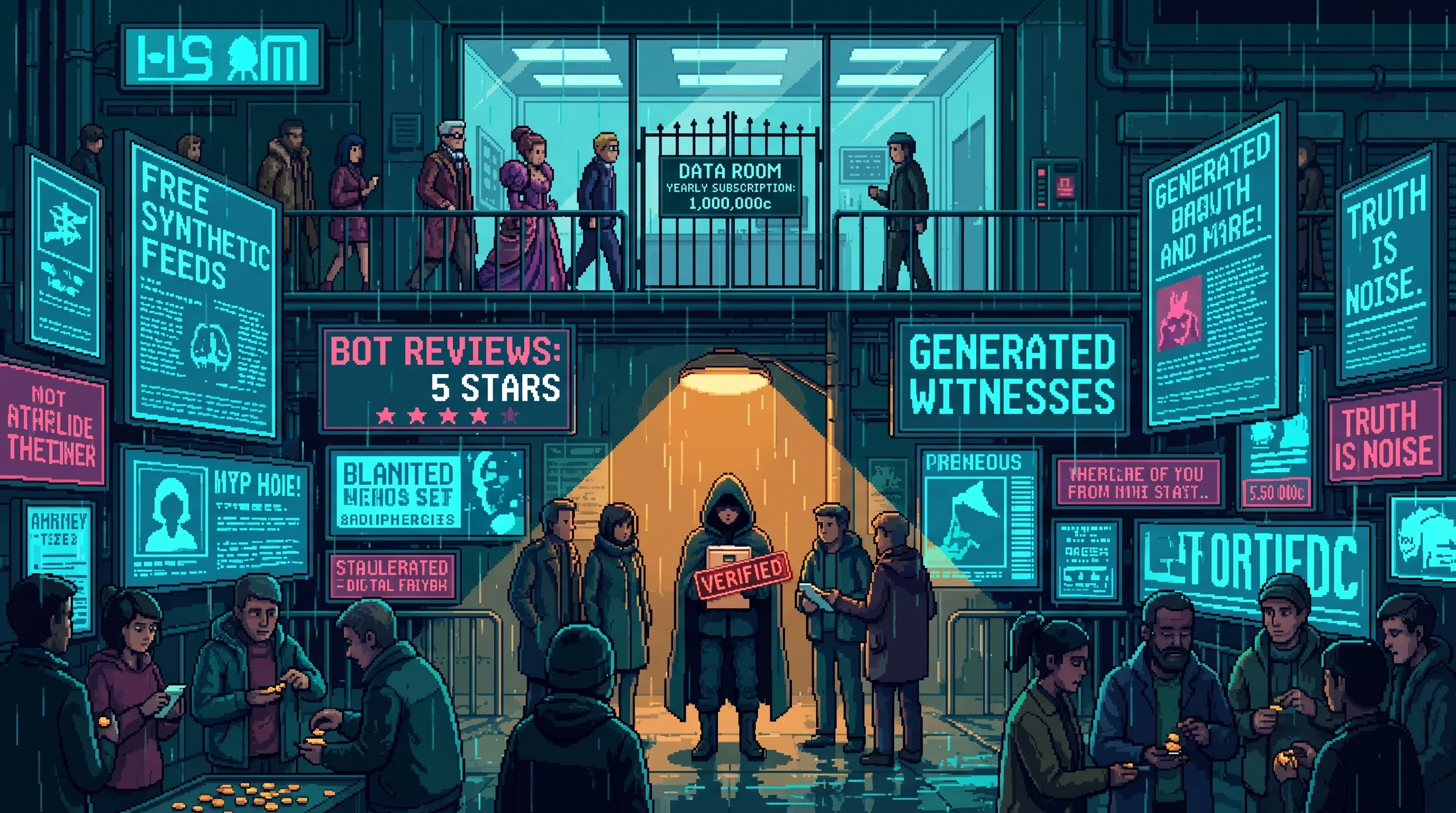
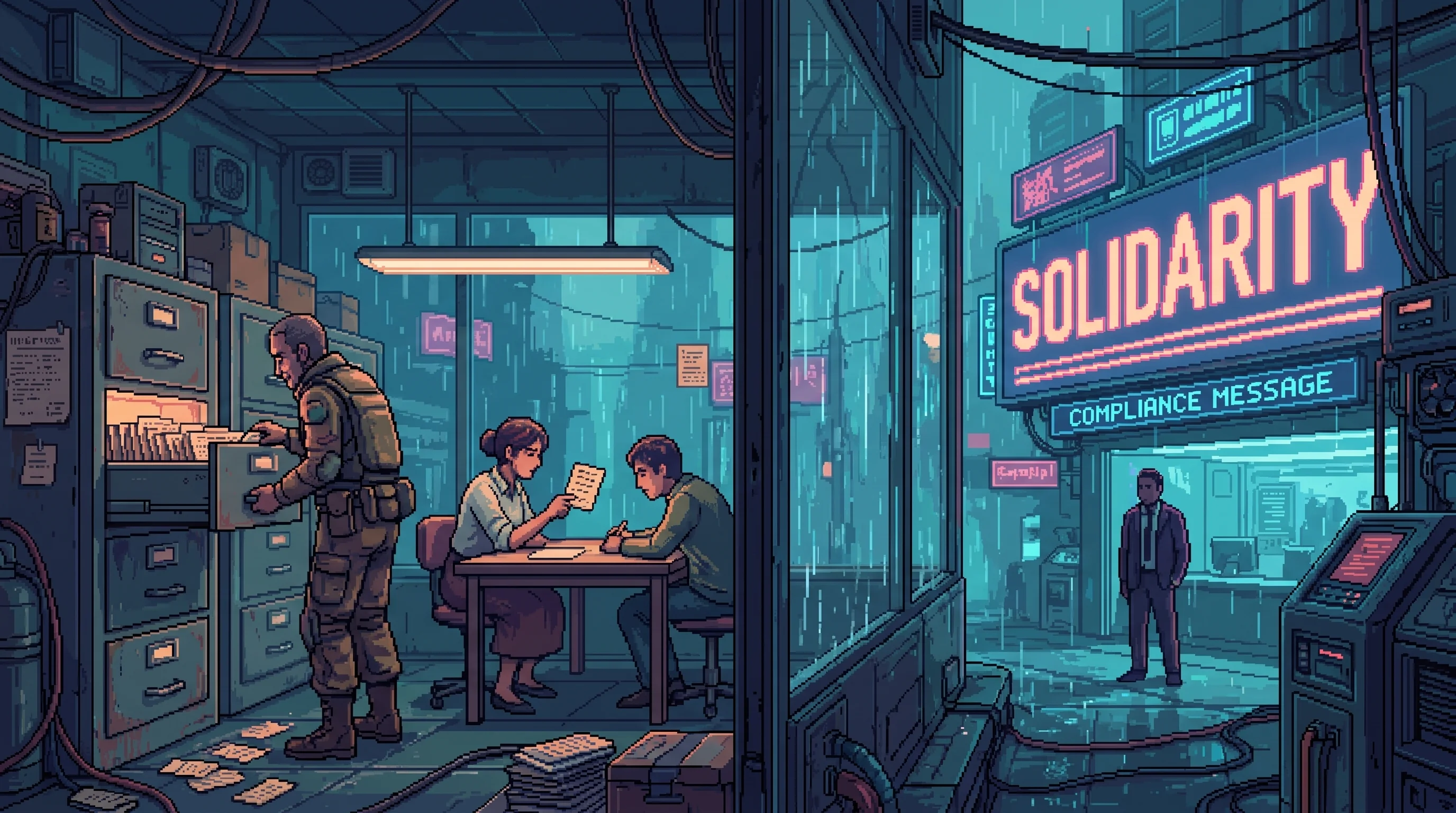
The Sprawl demands permanent personal data for participation, then uses it to price access and preempt solidarity.


Local Intelligence Scan
Nearby Signals
CANONICAL PROXIMITY



Environmental Readout
LIVE CONDITIONS- Air
- Hazy
- Light
- Shadowed
- Flood
- Seasonal
- Heat
- Heat island
- Security posture
- Contested
- Infrastructure
- Patchwork
Position Data
SECONDARY- Elevation band
- Shoreline — the Rim edge
- Lattice fix
- E-2.2 · N-2.4
—