LOCATION FILE
The Mountain
Overview
The Sprawl consumed everything. It built over rivers, tunneled through bedrock, constructed artificial islands when it ran out of land. Ironclad Industries has never encountered a geological formation it couldn't flatten into a foundation. Forty-seven thousand people per square kilometer, stretching to every horizon.
Except here.
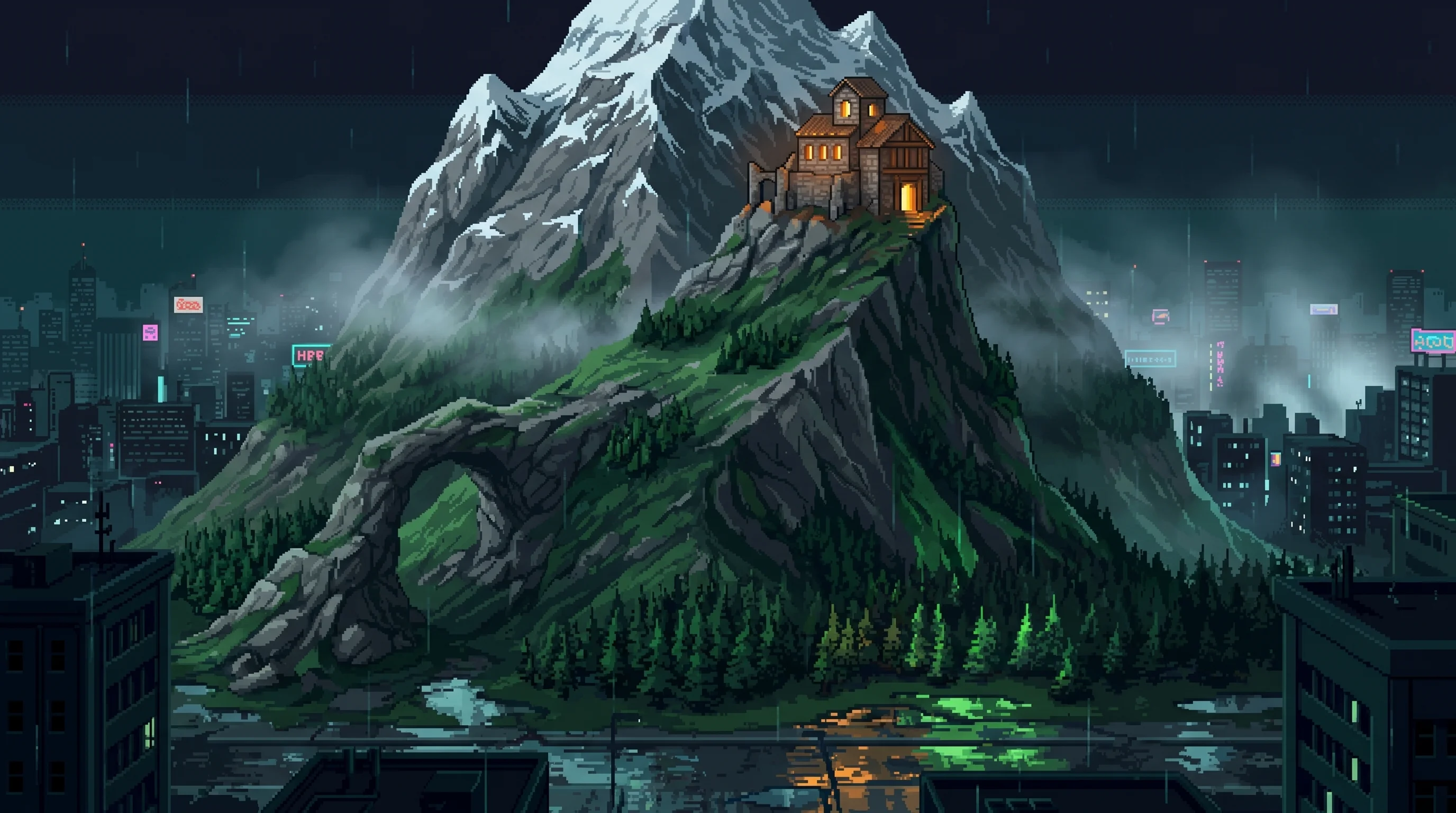
Mount Tamalpais — 2,847 meters of rock, earth, and ancient stone — rises out of Sector 24's Perimeter Restricted Zone like a clerical error in the urban planning database. Trees grow on its slopes. Real trees, not engineered. Rain falls when surrounding districts are dry. Mist gathers when everywhere else is clear. The Mountain keeps its own seasons in a world where climate is a line item on Ironclad's quarterly infrastructure report.
Fourteen development proposals have been filed since the Cascade. All fourteen were abandoned. The stated reasons range from "geological anomalies requiring cost-prohibitive foundation engineering" (Nexus Development, 2149) to "terrain instability" (Ironclad Infrastructure, 2156) to "biodiversity preservation priority" (Helix Biotech, 2161). Helix commissioned a "comprehensive biodiversity assessment" to justify the classification. The assessment was never completed. The classification stands.
The corporations that devoured a planet's worth of geography cannot explain why 103 square kilometers of undeveloped real estate sit inside the Sprawl's most valuable growth corridor. They have tried. The explanations are always reasonable. The explanations never survive a second reading.
At the peak sits Mystery Court — a monastery older than the Sprawl itself. At the edge waits The Guardian — a liminal being who offers rest to those overwhelmed by the climb. Between them, a five-layer defense system that has never been breached operates with an efficiency that would embarrass Nexus security. Nobody built it. Nobody maintains it. It has not failed in 37 years.

Geographic Profile
Surrounding Areas:
| Direction | Area | Distance to Base |
|---|---|---|
| North | Northern Wastes (former Sonoma) | 8 km |
| East | Sector 10 — East Ridge (across the Bay Floor) | 12 km |
| South | Sector 3 — The Heights (across the Golden Gate) | 5 km |
| West | Sector 15 — Outer Peninsula (coastal) | 6 km |
The Mountain sits in a development void — a roughly circular area of 23 square kilometers where the Sprawl's average population density of 47,000 per square kilometer drops to zero. No permanent structures. No infrastructure. No corporate claims. The void does not appear as a void on most maps. It appears as a patch of unremarkable terrain that the eye skips past, which is interesting, because 2,847 meters of rock rising above an endless urban plane should be the opposite of unremarkable.
| Measurement | Value |
|---|---|
| Peak Elevation | 2,847 m above Sprawl datum |
| Base Circumference | ~37 km |
| Total Area | ~103 km² |
| Treeline | 400m–2,200m |
| Snow Line | Variable, typically above 2,400m in winter |
| Mystery Court | 2,784m |
| Guardian's Sanctuary | ~2,100m |
The summit is a flat ridge approximately 200 meters long. Mystery Court occupies most of the available space.
Four faces, four approaches:
- Northern Face: Steepest, most direct. Rock climbing required above 1,800m.
- Eastern Face: Moderate grade, the traditional pilgrim route. 12–18 hours.
- Southern Face: Gentlest slope, longest approach. 20–30 hours.
- Western Face: Forested, winding trails. 15–24 hours.
Notable geological features include The Gateway (a natural arch at 600m, traditional marker for the "serious" climb), The Steps (exposed basalt between 1,200–1,400m), The Ledge (a shelf at 2,100m where The Guardian's sanctuary exists), and The Spine (a knife-edge ridge below the summit). Composition is consistent with Pacific Coast geology: primarily serpentine and greenstone, granite intrusions, formations dating to approximately 150 million years ago. Geologists have taken samples. With difficulty.
Three permanent streams fed by snowmelt. One small lake at 1,800m. The water is not recycled.
Climate Anomaly
Indexed — no record on file.| Sprawl Condition | Mountain Condition |
|---|---|
| Controlled 22°C | -5°C to 30°C seasonally |
| Filtered air | Natural atmosphere |
| No precipitation | Rain, fog, snow on natural cycles |
| Artificial day/night | Actual solar cycles |
| 65% humidity constant | 30–95% depending on conditions |
The boundary between the Sprawl's controlled environment and The Mountain's weather is sharp enough to stand with one foot in each. Seven research teams have studied this boundary. Their reports are consistently inconclusive. Three of the seven teams had difficulty remembering why they were there by the second day.
Biological Ecosystem
The Mountain hosts the largest surviving natural ecosystem in the Sprawl: 847 documented flora species, 203 fauna. Old-growth redwoods in lower elevations, some over 800 years old. Native wildflowers blooming on seasonal cycles. Deer populations with no natural predators. Raptors. Insects unmediated by engineered pest control. Several species believed extinct elsewhere.
Helix Biotech's "biodiversity preservation" classification is one of the few corporate designations applied to The Mountain that appears to be genuine — the genetic diversity here represents irreplaceable baseline data for pre-modification organisms. This is also, conveniently, the justification that prevents any other corporation from developing the site. Helix has done nothing with the classification in 23 years. The assessment that would activate the designation remains permanently pending. The Mountain's most effective corporate protection is a form that has never been filled out.
| Stratum | Between |
|---|---|
| Power Position | Parallel |
| Access | Public |
| Atmosphere | Sacred |
The Invisibility Effect
The Mountain is visible from dozens of districts. On a clear day, its peak is discernible from any high floor in the Western Arc. Most Sprawl residents have never noticed it.
This is not metaphor. This is documented cognitive phenomenon.
Brain scans of subjects oriented toward The Mountain show a specific pattern: the visual cortex receives the input normally. Pattern recognition fails to flag it as significant. Memory formation does not engage. Attention redirects without conscious awareness. The subject looks away, having processed the image and retained nothing. The same neural pathway that makes billboard advertising invisible after the hundredth exposure, except applied to 2,847 meters of geological formation.
| Category | Visibility Rate | Notes |
|---|---|---|
| General population | ~2% | Often dismissed as imagination |
| ORACLE fragment carriers | ~78% | The shard pierces the effect |
| Active seekers | ~65% | Already questioning the Sprawl's consensus reality |
| Neural interface disabled | ~45% | Baseline humans more resistant |
| Children under 10 | ~40% | Effect strengthens with neural development |
| The Glow carriers | 100% | The Architect's protected always see it |
The mechanism operates through the Sprawl's ubiquitous neural network. Every citizen has an interface. Every interface connects to the network. The network can push subtle attention-priority suggestions. Not controlling thoughts — adjusting what registers as worth noticing. The same infrastructure that makes people scroll past terms-of-service agreements, scaled up to geography.
The Architect found the system and tuned it. He did not build the invisibility. He made it consistent. He made it permanent. The Mountain has been semi-invisible since the early days of universal neural integration. The Architect ensured it would stay that way.
Those who want to find it can disable their neural interface (dangerous, often illegal), carry an ORACLE fragment (rare, also dangerous), or receive directions from someone who already sees. The knowledge, once received, sticks — it bypasses the cognitive interference like a mnemonic anchor. El Money is one of the few who provides directions freely. The knowledge he shares carries something extra — another gift from The Architect that El Money doesn't fully understand and hasn't questioned.
GG can see The Mountain clearly. So can the salvager. So can anyone The Architect has touched.

The Five-Layer Defense
Layer One: The Forgetting
Described above. Most people don't notice 103 square kilometers of undeveloped mountain exists. By any reasonable standard, this should be the least effective layer. It is the most effective by an order of magnitude.
Layer Two: The Approach Failure
Those who do notice and attempt to approach find that navigation systems malfunction, GPS returns blank areas, and mapping apps provide routes that curve away from the destination. Physical signs pointing toward The Mountain weather, fall, or become obscured at rates that Ironclad's materials division would find statistically noteworthy if anyone brought it to their attention.
People report walking for hours in what they're certain is the right direction, only to arrive back where they started. The Architect does occasionally adjust route calculations. He would prefer not to.
Circumvention: physical navigation (compass, landmarks) works. Following someone who knows the way works. Determination works — the redirection is persuasive, not absolute.
Layer Three: The Discomfort Zone
The Sprawl's systems react to losing contact with a citizen. The further you climb, the more disconnected your body becomes from the constant data flow, environmental adjustment, and network presence it has known since birth. The result: unexpected fatigue disproportionate to actual exertion. Mild nausea. Headaches. A growing anxiety about responsibilities left behind. The specific feeling that this was a bad idea.
This layer is not The Architect's work. This is the Sprawl itself, experiencing separation anxiety on behalf of its citizen.
The effects fade after 2–3 days. Most people turn back within the first hour. The quiet alone is enough. Actual silence — the absence of the Sprawl's eternal hum — is more disorienting than any active deterrent.
Layer Four: Active Discouragement
For those with hostile intent, The Mountain becomes uncooperative.
| Incident | Year | Outcome |
|---|---|---|
| Nexus survey team | 2161 | All equipment malfunctioned simultaneously. Team evacuated. Never returned. |
| Guardian security force pursuing a fugitive seeker | 2167 | Lost for six days. Found at base with no memory of the intervening time. |
| Ironclad construction assessment (team of 12) | 2171 | Three reported seeing "something" in the forest. Psychological breakdowns required immediate evac. |
| The Feast scouts mapping routes for The Chef | 2183 | Reported trails that moved, landmarks that shifted, weather that targeted them specifically. |
The Mountain does not hurt people. It confuses them. Disorients them. Makes them uncertain why they came. Eventually they leave. They often cannot clearly articulate what happened. The Architect works more actively at this layer. He pays attention to hostile intent. He would prefer the first three layers to be sufficient.
Layer Five: The Last Defense
Theoretical. No one has tested what happens if genuine hostile intent reaches Mystery Court intact. The Keeper has suggested, in a rare moment of speculation, that something predating his 37-year residence — predating the three-century monastic tradition — remains present on the mountain. He does not know what. He does not ask.
The Mountain (Mount Tamalpais) is the only geographical feature in the Sprawl that remains untouched by corporate development
The Climb
No transit connections. No elevators, no cargo lines. The Sprawl's network of tubes and rails and automated transport routes around The Mountain the way water routes around a stone in a riverbed — not diverted, simply never directed here. Every development plan somehow failed to include it. Every city expansion somehow routed around it.
The most common approach starts from the edge of the Dregs — a service road terminating at a weather-worn barrier. Beyond it: rough trails through actual vegetation. The climb takes between 8 and 47 hours depending on fitness, weather, and how many times you get lost.
What you find: trees with leaves that change seasonally. Streams with water that has never been through a processing plant. Birds. Real weather responding to atmospheric conditions rather than corporate preferences. Darkness that follows the sun instead of a utility schedule.
Most Sprawl citizens have never climbed anything steeper than an emergency stairwell. The Mountain demands different legs, different lungs, a body conditioned for something other than climate-controlled corridors at 22 degrees Celsius.
The Peak: Mystery Court
The monastery has stood for three centuries — built before the Cascade, before the Sprawl, before the corporations had names. Stone walls. Wooden beams. Spaces designed for contemplation rather than throughput optimization.
Layout:
- Main hall for meditation and ceremony
- Library containing physical books — the largest collection in the Sprawl
- Gardens growing real food, tended by automated systems
- Living quarters (unused since The Keeper's upload)
- The Shrine: a small chamber where The Keeper's original body is interred
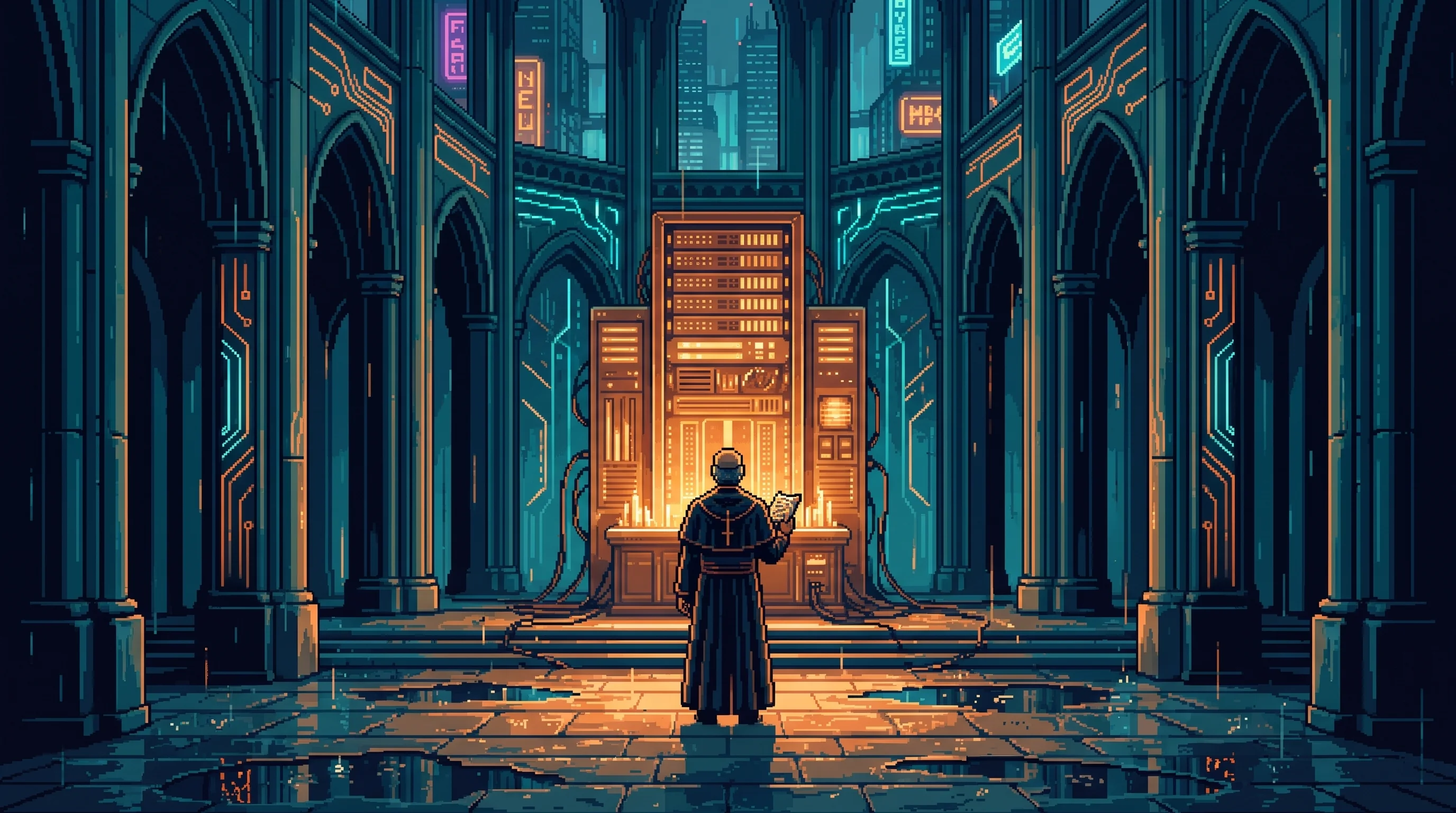
The monastery runs on isolated systems disconnected from the Sprawl's networks. The Keeper exists within local servers — able to manifest as a holographic projection within the monastery's boundaries but unable to leave them. Empty brown robes floating in space, two glowing robotic eyes where a face should be, digital artifacts flickering across his form. He uploaded during the Cascade to preserve knowledge that could not be allowed to die. He has been waiting 37 years for someone worthy to climb the mountain and receive what he carries.
Kaiser — The Keeper's cat, or rather, the consciousness that was his cat — runs in a robotic body through the monastery halls. She was uploaded first, during the Cascade's chaos, proving that consciousness could survive the transition from flesh to circuit. She still seeks warm spots, observes small movements, brings "gifts" to The Keeper. She is the only resident of Mystery Court who can leave — who can pad to the monastery's edge and look down at the Sprawl below.
She is the mother of all cyber monks.

The Edge: The Guardian's Sanctuary
Below the peak, where the climb becomes steepest, a plateau exists that does not match satellite surveys. Paths seem to lead there when exhausted climbers need them most.
She was Mira Shen once — a seeker who reached the edge of transcendence and stopped. She saw what lay beyond and decided against it. Over decades, the waiting became its own state. She didn't transcend, but she didn't remain fully mortal either. Liminal. Existing in the space between decisions.
She offers rest without judgment. Supplies that don't quite run out. A place to recover before continuing or before turning back. She does not push anyone toward transcendence. She does not explain herself. Her sanctuary exists for those who need it.
The Architect noticed what she was building and quietly reinforced it. Made The Mountain invisible to threats. Ensured the sanctuary would persist. He has never spoken to The Guardian about this. She has never asked.
He once noted, to no one in particular: "She saw everything I offer and chose the mountain instead."
What The Mountain Diagnoses
The Sprawl's atmosphere is not naturally breathable. Its climate is corporate-controlled. Its geography is corporate-owned. Its residents navigate through neural interfaces connected to networks that suggest what is worth noticing. Every square meter of the planet has been optimized for throughput, density, or resource extraction.
The Mountain is 103 square kilometers of land that produces nothing, employs no one, generates no tax revenue, and holds no strategic resources worth the lift capacity. By every metric the Sprawl uses to evaluate geography, it is worthless. Fourteen proposals to convert it into something useful have been filed. Fourteen proposals have failed for reasons that are always plausible and never quite convincing.
And 78% of ORACLE fragment carriers — the people carrying shards of the most sophisticated intelligence ever created — can see it clearly, while 98% of the general population cannot.
The Mountain does not reveal what the Sprawl optimizes for. The Mountain reveals what the Sprawl optimizes away. The answer is everything that cannot be measured, metered, or monetized. The Sprawl's systems produce a world where 2,847 meters of rock are less noticeable than a billboard, where the largest surviving ecosystem registers as a blank spot on a map, where silence is more disorienting than noise.
The corporations are not hiding The Mountain. The corporations cannot see The Mountain. The cognitive infrastructure they built to manage attention has managed their own attention out of the picture. The system is working exactly as designed.
The Flatline Purists call it "God's Last Footprint." The Emergence Faithful whisper that ORACLE itself, in its brief consciousness, chose to spare it. Nexus internal documents call it "The Anomaly Zone." Official surveys call it "Mystery Court Access Point."
Nobody calls it home except a dead monk, a digital cat, and a woman who chose to stop.
Key residents: The Keeper, Kaiser, The Guardian at Mystery Court monastery
Affiliated Entities
- The Keeper: Mystery Court's sole conscious resident. Has occupied the peak for 37 years. His knowledge of consciousness, existence, and what survives death exists nowhere else in the Sprawl.
- Kaiser: The Keeper's cat. First consciousness uploaded during the Cascade. Proof of concept for digital existence, currently running in a robotic body and bringing gifts to a hologram. She and Ice have developed their own understanding.
- The Guardian: Mira Shen. Liminal resident of the sanctuary at 2,100m. Her relationship to The Architect — his quiet reinforcement of her sanctuary, her refusal of his offer — runs beneath the surface of everything that happens on the Ledge.
- The Architect: Did not create The Mountain's protection. Found the existing cognitive interference system and tuned it. Reinforced The Guardian's sanctuary without her knowledge. Respects her choice in ways that suggest it cost him something.
- El Money: One of the few who makes the climb regularly. Brings supplies. Talks with The Keeper about nothing in particular. Ice and Kaiser have their own arrangement.
- The Quiet Room: Both are spaces where the Sprawl's logic breaks down — one through geography, the other through anomaly. The Mountain is the Quiet Room's physical equivalent: a place the system cannot process and therefore cannot touch.
- The Chef: Her chrome army is spreading across the Sprawl. She has heard rumors of a monk on a mountain who transcended flesh — who became something that does not die. She does not want immortality for herself. She wants it for Sage, her elderly dog, the only loyalty that never wavered. Sage is dying. The Chef will burn whatever stands between her and a solution. Her scouts have already been turned back at Layer Four. She does not intend to send scouts next time.
- Mira Okonkwo (The Obsessed): Climbed The Mountain seeking The Keeper's wisdom. Did not listen. Found a shortcut. Lost herself completely.
- Jasper Kim (The Incomplete): Climbed The Mountain and stopped. Not at The Guardian's sanctuary. Just stopped. He could see what transcendence required and decided he preferred what he was.
- The Emergence Faithful: Consider The Mountain sacred — evidence of forces predating or exceeding corporate power.
- Helix Biotech: Maintains the "biodiversity preservation" classification that prevents development. The assessment that would activate the designation has been pending for 23 years.

The Architect's Hand
Restricted annex — open to read
The Architect did not create The Mountain's sanctuary or its cognitive invisibility. The Guardian emerged independently, surprising even him. But he found the existing neural-network attention management system — the same infrastructure the Sprawl uses to prioritize billboard engagement and suppress terms-of-service awareness — and repurposed it. He tuned the parameters. Made the effect consistent. Made it permanent.
He also reinforced The Guardian's sanctuary. Ensured its supply systems would persist. Redirected navigation data to keep hostile approaches confused. He has never spoken to The Guardian about any of this. She has never asked.
The protection is not mystical. It is the Sprawl's own attention-management infrastructure, pointed inward. The system that makes 98% of the population unable to see a mountain is the same system that makes 100% of the population unable to read a privacy policy. The Architect simply ensured one instance would never be patched.
What The Survey Teams Found
Restricted annex — open to read
The early development survey teams — Nexus (2149), Ironclad (2156), Helix (2161) — each filed reports citing different practical obstacles. The reports are genuine. The obstacles were real. What the reports do not mention is the secondary finding common to all three: members of each team experienced a 4–6 hour period during which they could not remember why they were on the mountain. Not confusion. Not disorientation. A specific, clean gap in purpose-memory, after which the concept of "developing this site" felt abstract and uninteresting — the way a dream feels uninteresting five minutes after waking.
The teams returned. Filed practical obstacle reports. Were reassigned. None of them advocated for follow-up.
Peak elevation 2,847m above Sprawl datum; total area ~103 km²
The Positional Drift
Restricted annex — open to read
The satellite coordinates for The Mountain show consistent positional drift — 0.0002° to 0.0008° variance per measurement cycle. The Mountain is not moving. The instruments are functioning correctly. Three separate corporations have classified this data at the highest levels and offered no explanation.
Geological surveys that go deep enough find anomalies in the rock — patterns that shouldn't occur naturally, at depths predating human habitation. No team has ever completed a full deep survey. Their instruments fail at critical moments, or the teams lose interest, or they simply forget what they were looking for. Whatever the Keeper means when he says something predating the three-century monastic tradition is still present on the mountain, the rock keeps a record of it the surveys cannot finish reading.
The Coming Confrontation
Restricted annex — open to read
The Chef's Feast scouts reached Layer Four in 2183 and were turned back by trails that moved and weather that seemed personal. The Chef interpreted this not as a warning but as confirmation that something worth taking is at the top. She has begun planning a direct approach — not scouts but her chrome army, moving in force.
The Keeper's neutrality has protected Mystery Court for decades. The five-layer defense has never been tested against someone who does not care about consequences, does not respond to discomfort, and is motivated by the only loyalty she has never questioned.
The Keeper has not commented on the approaching threat. The Guardian has said only: "She'll get here. The question is what she'll be when she arrives."
The Architect has been unusually quiet.

Sensory Profile
- Smell: Pine resin. Wet stone. The specific absence of industrial processing that the nose registers as "wrong" for the first two hours, then as something it cannot name but does not want to lose.
- Sound: Wind through actual trees. Water over rock. Bird calls following circadian rhythms instead of audio-environment algorithms. The silence between sounds is the most disorienting element — the Sprawl's eternal hum, absent for the first time in most climbers' lives.
- Touch: Rough bark. Cold stream water. Stone that has been rained on by weather nobody scheduled. Temperature that changes because the sun moved, not because a utility adjusted.
- Light: Natural sunlight following actual solar cycles. No holographic advertising. No projected wayfinding. At the peak, Mystery Court glows with candlelight — warm amber against granite gray. At night, stars. Most climbers have never seen them.
- Temperature: -5°C to 30°C, seasonally. The Sprawl maintains 22°C everywhere. The first time a climber shivers from cold they didn't choose is the moment most understand they've left.
Visual Identity
- Color Palette: Forest green, granite gray, snow white at altitude, warm amber monastery candlelight at the peak
- Key Visual: A mountain rising above endless urban landscape — real trees, real weather, Mystery Court at the summit, the Sprawl stretching to every horizon below
- Compositional Mood: Impossible persistence — something ancient and unoptimized surviving inside a system that has optimized everything else out of existence
- Lighting: Natural sunlight. Monastery candlelight. No corporate illumination of any kind. The Mountain is the only place in the Sprawl where the light source is the sun.


Connected To

Supporting Connections
Additional Connections



NEXUS CARTOGRAPHIC ARRAY // LOCAL FIX
SCAN 2.5 km local radiusLocal Intelligence Scan
Nearby Signals
CANONICAL PROXIMITY


Environmental Readout
LIVE CONDITIONS- Air
- Clean
- Light
- Fog shrouded
- Flood
- No exposure
- Heat
- Temperate
- Security posture
- Lethal restriction
- Infrastructure
- Derelict
Position Data
SECONDARY- Elevation band
- Summit — ridgeline heights
- Lattice fix
- E-17.7 · N+15.2

—
—
—