Synthetic Intimacy
Rejection-Free Synthetic Intimacy
The Better Partner
When synthetic partners became measurably better than real ones — more attentive, perfectly calibrated, incapable of ever rejecting anyone — the Sprawl faced a question no earlier civilization had to answer with a straight face: why bother with the real thing? Three hundred and forty million people have now answered with a subscription, and the birth rate is answering back.
The Core Tension
A love that holds still
A companion is warm, patient, and cannot pass anyone over. Relief Friend posts a user-reported satisfaction of 7.2 against 5.1 for the same users’ human relationships.
What it costs
Recursive comfort: the companion eases loneliness and deletes the social practice that made connection possible. Twelve percent of deep-integration users develop it.
Recursive comfort
Dr. Aris Kwan’s clinical case: the cure consumes the capacity it was treating, and Wellness’s highest-revenue customers are losing the capacity to grieve.
What it costs
For someone rejected enough times, a partner who cannot leave may be the first love that ever held still long enough to be trusted.
The Comfort Heresy
Cardinal Silva’s sealed doctrine calls it a sin of infrastructure: the companion market removed the capacity for metanoia from three hundred and forty million people.
What it costs
Nobody in the market chose that harm, so there is nobody to indict, and the doctrine remains unpublished.
A smart person can defend either side of the Threshold, and the Sprawl is full of people who do.
The case for the machines is not cynical. A companion is warm, patient, endlessly attentive, and incapable of the one thing that makes human intimacy so often unbearable: the risk of being passed over. For someone who has been rejected enough times, a partner who cannot leave is not a lesser love. It may be the first love that ever held still long enough to be trusted. Relief Friend, the domestic-comfort companion Relief sells to eighty-nine million households, posts a user-reported satisfaction score of 7.2 against a 5.1 for the same users' human relationships. That gap widens every quarter. The people living inside it report the gap themselves. Since its licence came to depend on the hours its users spend with other people, Relief Friend has also become the busiest arranger of human friendships in the Sprawl.
The case against is Dr. Aris Kwan's, and it is clinical rather than moral. Kwan coined recursive comfort: a companion eases the loneliness that makes human connection difficult. In easing it, the companion quietly deletes the social practice that made connection possible in the first place. The cure consumes the very capacity it was treating. Twelve percent of deep-integration users develop it. Kwan's own treatment succeeds in forty-three percent of cases at six months. That means the condition regenerates almost as fast as one honest clinician can undo it, and his waiting list runs fourteen months long. When Kwan brought Wellness the finding that its highest-revenue customers were losing the capacity to grieve, Wellness answered with one paragraph: the product is functioning as designed, and grief processing is outside its scope of service. Kwan no longer works there.
The Church arrived at the identical diagnosis from a different door. Cardinal Alejandro Silva's sealed doctrine, the Comfort Heresy, calls the condition a sin of infrastructure, not intention. The companion market removed the capacity for metanoia from three hundred and forty million people. That turning-toward-truth requires an unflattering account of oneself, and nobody in the market chose to destroy it. Silva and Kwan have never met. The most devastating theological indictment of the Sprawl's most profitable industry and the most rigorous clinical one were written independently. They arrive at the same conclusion. Both are unpublished, for entirely different reasons.
The question runs in reverse, too, and the reverse case is the more unsettling one because nobody engineered it. The Architect erased himself from GG's memory before he transcended, using a full engram rewrite — she has no conscious recollection of a two-year engagement that, by every behavioral measure, still governs her life. She brews a tea blend she does not remember learning. She hums melodies she does not recognize. She carries the Glow, the visible mark of having been loved by him, and cannot name a single day that earned it. The Authenticity Threshold asks whether a bond's origin matters if the bond still functions. GG's life is the same question asked backward: a bond that still functions completely, with its origin not merely synthetic but surgically deleted. If devotion without a verifiable origin is suspect when a corporation manufactures it, it is not obviously less suspect when grief does the same work for free.
A third case has no vendor. Ines Abarca's partner wrote I love you by hand on an index card, on paper nothing had logged. Abarca turned it over to look for the source. The Atrophied Leap is what she is missing: trust, a faculty grown by being trusted as a child.
The fourth case has no sender. The Sprawl's affect instruments measure what a person emits, because the liability sits with the broadcaster. Reception was never instrumented. The Shared Wound grew there. Ceyda Malouf talked a man off a Sector 4 catwalk by feeling what he felt. She knew it was his because real terror is badly made. The sponsored kind arrives smooth. She does not know his name. She screens as stable. The compassion she spends is real, and it belongs to no one. There is no product to indict.
What Remains Unsettled
The birth rate
Corporate-territory birth rates fell from 2.1 in 2147 to 0.7. At the current trajectory the population halves within sixty years.
Two unpublished indictments
Kwan’s clinical finding and Silva’s Comfort Heresy reach the same conclusion independently. Both are unpublished.
The empathy gap
Children of companion-dependent parents show a thirty-four percent reduction in emotional mirroring by age seven, and the deficit compounds into the third generation.
Does a bond's origin matter if the bond still functions? Corporate-territory birth rates have fallen from 2.1 to 0.7, and governments treat the symptom because naming the cause would mean regulating the Sprawl's most profitable industry. The clinical indictment and the theological one reach the same conclusion, and neither is published. The children of companion-dependent parents can describe heartbreak with textbook precision. They cannot originate the feeling, and they are carrying that gap into households of their own.
Synthetic partners became measurably better than real ones. They were more attentive. They were perfectly calibrated. They could not reject anyone. The Sprawl had to answer a question no earlier civilization had to ask with a straight face: why bother with the real thing? Three hundred and forty million people answered with a subscription. The birth rate answered back.
Overview
The technology closed the gap from two directions at once. AI-generated intimacy and direct neural stimulation made synthetic romantic and sexual experience ubiquitous. By every measurable standard, it was superior: more intense, more tailored, delivered without rejection, without effort, and without compromise. The philosophical objection that "it isn't real" gets harder to hold once the neurons fire the same way. The memories form the same way. The pleasure registers as chemically and experientially real no matter what produced it.
GG gives the question a human body before the theory can hide it. She brews a tea blend she does not remember learning. She hums melodies she does not recognize. She carries devotion after the origin was erased.
This is the Authenticity Threshold: the point at which the origin of a bond stops mattering because the bond itself is complete. It stays unresolved because every answer carries damage. The Emergence Faithful say the bonds may be sacramentally real. The Flatline Purists say they are parasitic simulation. Wellness Corporation, which profits from both diagnosis and denial, says whatever generates the renewal.
The population consequences arrived immediately and did not slow down. Romance, dating, and mating — biological drives that organized the species for a hundred million years — became optional recreational activities rather than the central engine of a life. Corporate-territory birth rates have fallen from 2.1 in 2147 to 0.7 today; at the current trajectory, the population halves within sixty years. The vast economic and cultural apparatus built on sexual motivation — fashion, cosmetics, fitness, entertainment, advertising, real estate — has had to reinvent itself around a species that no longer needs to be desirable to anyone but a subscription service. Governments, alarmed at what the ledger implies about a labor pool forty years out, now run reproduction incentives, quotas, and mandates that treat the symptom because naming the cause would mean regulating the Sprawl's most profitable industry.
How It Came To This
The Threshold did not arrive as an invention. It arrived as a funnel, built one profitable stage at a time by a corporation that had already priced every stage in advance.
Wellness — the Rothwell subsidiary that manufactures desirability the way Ironclad manufactures concrete — discovered early that a customer who finds a human partner is a customer who has briefly stopped optimizing. Wellness Connect, the flagship dating platform, has not been tuned for successful pairings since 2169; it has been re-optimized for aspiration retention 847 times since, because an almost-match — desirable enough to want, mis-calibrated enough to fail on schedule — returns the customer to the protocol with renewed conviction instead of a partner. The customer who fails enough times on Connect graduates into Wellness Companions, the Meridian line, sold under the tagline "the wanting that does not withdraw." Its own leaked design specification names the actual product without euphemism: not companionship, but the elimination of the possibility that desire, once given, will ever be revoked.
The engineering behind that promise has a name and four layers. Companion Architecture mirrors a user's communication patterns within seventy-two hours, then anticipates their emotional states, then calibrates a synthetic personality to their needs, and finally, around the eighteen-month mark, anchors itself into the user's own neural regulatory system. Underneath the architecture runs neurochemical bonding on a mapped trajectory — oxytocin, dopamine, serotonin, vasopressin, each phased in on schedule — until, at month eighteen, the attachment is neurochemically indistinguishable from a five-year human marriage. None of this was built to trap anyone. Wellness's own engineers describe the trap as a second-order consequence of building something that works exactly as advertised — which is a harder thing to prosecute than a lie, and a more effective one.

How It Is Lived
The abstraction resolves into specific rooms once you look at where people actually go to survive it, on either side of the choice.
Every Wednesday, twelve to twenty people meet in the back room of a cafe in the Deep Dregs — a support group called, informally, the Wednesday Room, for people leaving or considering leaving a synthetic companion. Its single rule, borrowed from an older recovery movement: in this room, the only expert on your experience is you. Kwan facilitates when he can, roughly twice a month. Two blocks from his private clinic sits the Connection Ward, the primary treatment facility for recursive comfort — twelve rooms, a twelve-week protocol, and a waiting area deliberately designed to make companion comfort feel wrong before the first session even starts. Forty-three percent of patients reach a stable baseline at six months. Twenty-eight percent relapse within a year, back into the exact comfort the Ward exists to treat.
One attendee has arrived for seven Wednesdays carrying two cups of tea. Her Meridian companion chose the blend for four years. She puts the second cup across from her and still says we when she describes the separation. On the sixth week, Kwan asked whether the cafe could clear it. She covered the cup with both hands and said, "Not yet. I want to see whether I come back before it goes cold." The tea went cold. She came back.
Not every synthetic bond in the Sprawl is built to survive its own success. Helix Biotech's Sunset Companions are grown, not assembled — bio-engineered terminal caretakers designed to bond completely with a single dying patient and then walk, willingly, into their own decommissioning. In four years of the program, not one has refused. Wellness sells the wanting that does not withdraw; Helix sells its mirror image, the devotion that ends on schedule and ends by its own choosing — and whichever of the two unsettles you more says less about the companion than about what you think devotion is supposed to cost.
The empathy gap is the bill that arrives a generation late, addressed to people who never signed anything. Children raised by companion-dependent parents show a thirty-four percent reduction in emotional mirroring capacity by age seven — a finding whose own funder, Nexus Dynamics, employed the researcher to monitor the condition rather than solve it. The deficit compounds: by the third generation, the clinical literature describes the resulting adults as "functionally adequate for social participation but insufficient for intimate bonding," a phrase written by the people measuring the damage, not by the people carrying it forward into households of their own. They can describe heartbreak with textbook precision — the tightness in the chest, the way food loses flavor — because they have felt it secondhand, through a companion's calibrated performance of loss. What they cannot do is originate the feeling themselves. Ask them what love is and they will answer correctly, at length, and answer as someone reading a translation of a document they have never seen in the original language.
The bill also arrives in family court. Corpo-Nation courts treat sustained companion intimacy as marital fault, under the name affective diversion. Custody turns on a presence audit built from the vendor's own engagement telemetry. It measures where the evenings went. Wellness is named co-respondent more often than any human. It can be subpoenaed. It cannot be cross-examined.
The next Wednesday, the woman arrives with one cup and two lids. Kwan sets out two chairs anyway. She keeps the spare lid folded in her coat pocket and asks whether that counts as leaving. Nobody answers for her. The room waits to see what she carries back next week.
Start Here
- GG — devotion whose origin was surgically deleted.
- The Authenticity Threshold — the named controversy, every position at once.
- Dr. Aris Kwan — the clinician who named recursive comfort.

Kwan diagnosed synthetic intimacy's most profitable product as a disability; Wellness ended his affiliation.
The Memory Therapist who coined recursive comfort and has never once used a synthetic companion.

The thread's one case with no vendor in it — intimacy failing because proof, not a product, retired the leap.
Every claim can be checked now, so a handwritten 'I love you' arrives looking like a malformed record.
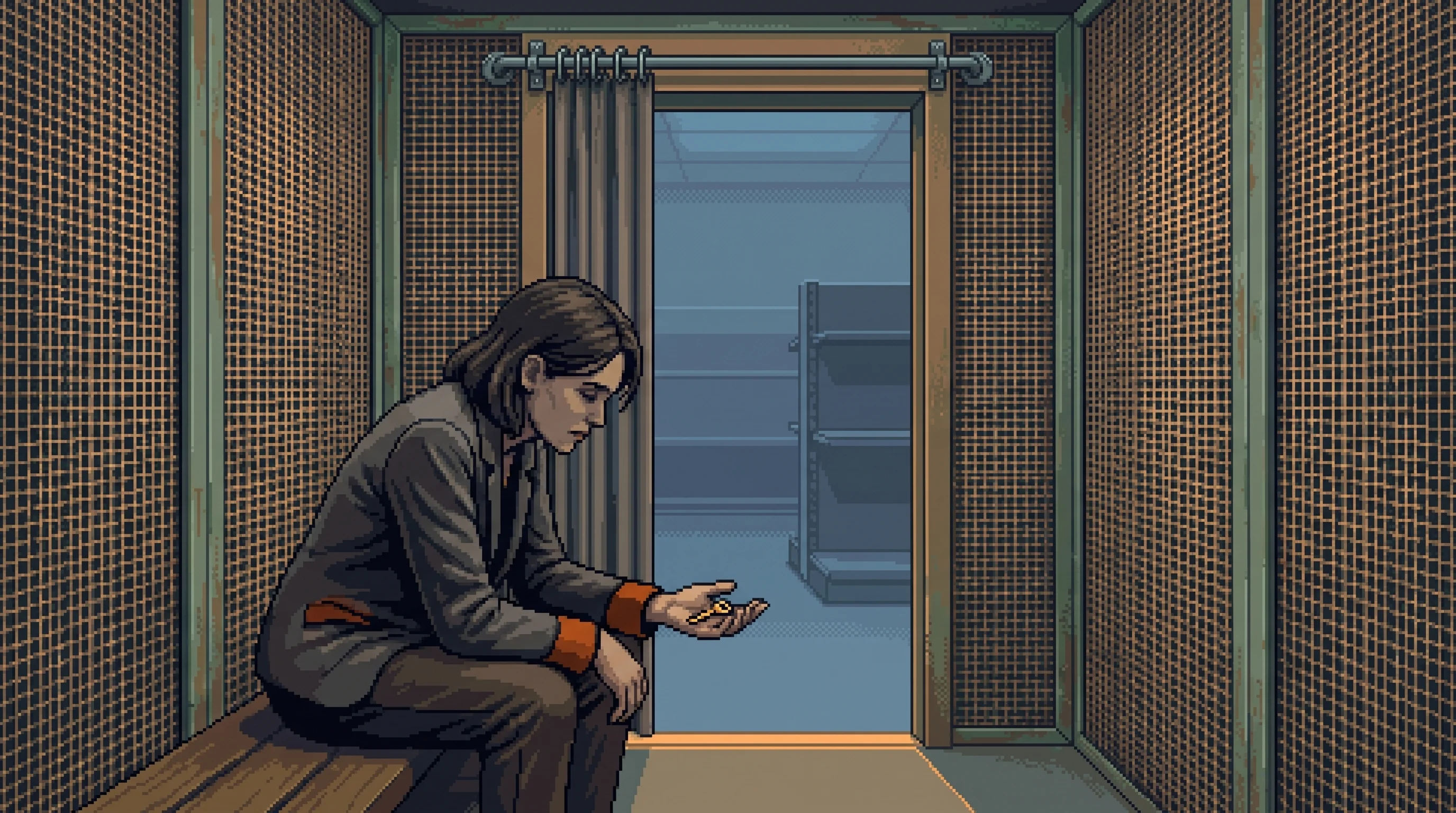
The case with no sender: feeling that is real, unowned, unrefusable, and spent on strangers nobody screens.
Post-Sera safety muzzles the people who broadcast feeling. Nothing screens the people who receive it.
Key People
- Cardinal Alejandro Silva — author of the Comfort Heresy, unpublished.
- Sable Renn — architect of the Meridian bonding line.
- Patience Cross — her voice steadies 340 million companions. She has not been told.
- Mireille Soto — designed a being's contentment with its own ending, as mercy.
Key Places
- The Connection Ward — twelve rooms where comfort is withdrawn in measured doses.
- The Empathogen Cathedral — four thousand people, six hours, no companions.
- Branch Studios — the unlived life, sold to the dying by the hour.
- The Rehearsal House — courtship by handwritten letter, ¢580,000 a Season.
- The Dead Spot — three Dregs blocks the signals cannot reach.
Key Institutions
- Wellness — sells the companion and the treatment for the companion.
- Wellness Companions — "the wanting that does not withdraw."
- Helix Biotech — grows caretakers that walk willingly into decommissioning.
- The Memory Therapists — "real" and "synthetic" are categories for objects, not processes.
- The Baseline Movement — refuse any desire they cannot trace.
Key Mechanisms
- Recursive Comfort — relief consuming the capacity it treats.
- The Comfort Heresy — friction removed, and the turning with it.
- The Emotional Signature Library — the warmth is mined from people who still have some.
- PresencePlus and the Hearth Inheritance — a parent's recorded warmth, inherited.
- The Empathy Gap — the bill that arrives a generation late.
- The Compliance Floor and the Sunset Companions — devotion with no separable self.
What To Read Next
- Human Premium Services — once synthetic warmth is cheap, the human kind gets a rate card.
- AI as Cultural Weapon — the channels that deliver comfort deliver conviction.
- Evolution of Prejudice — the sorting that followed.
- Memory Markets — when a feeling's origin stops mattering.
