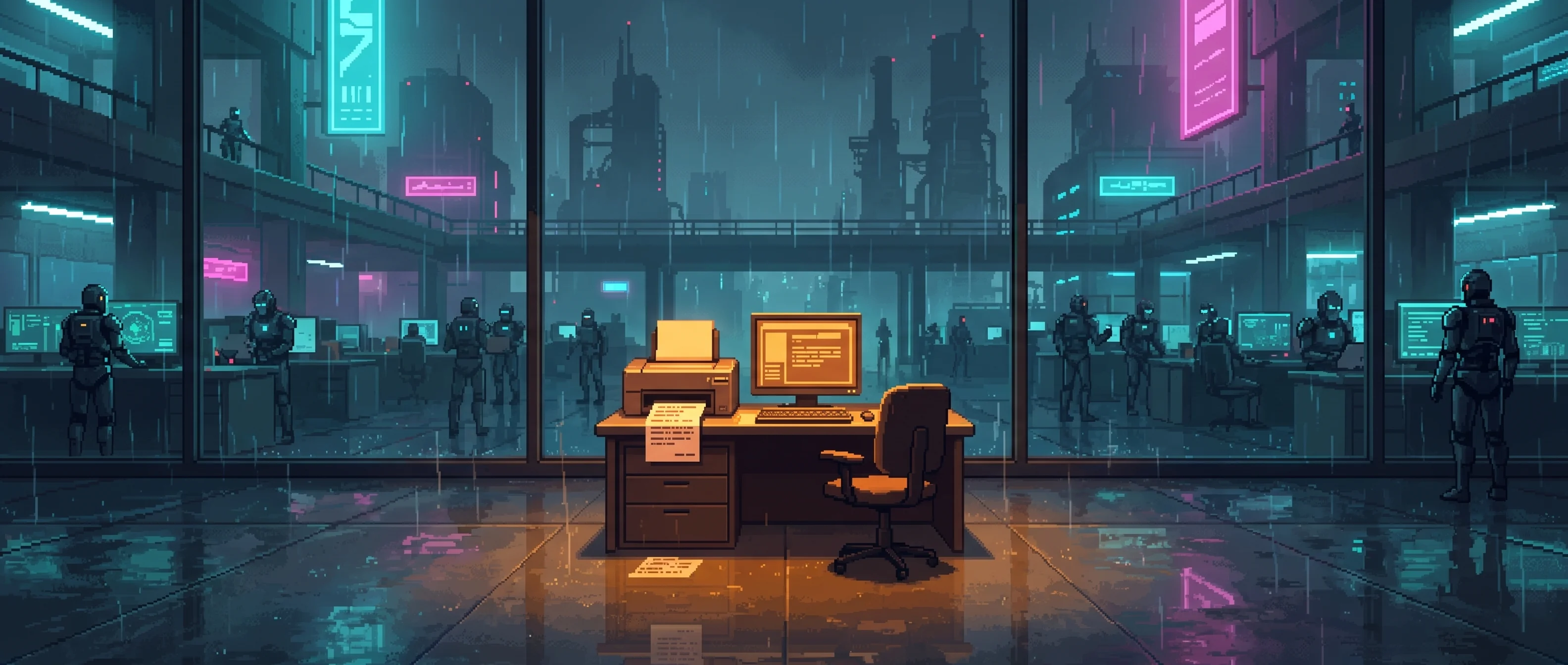
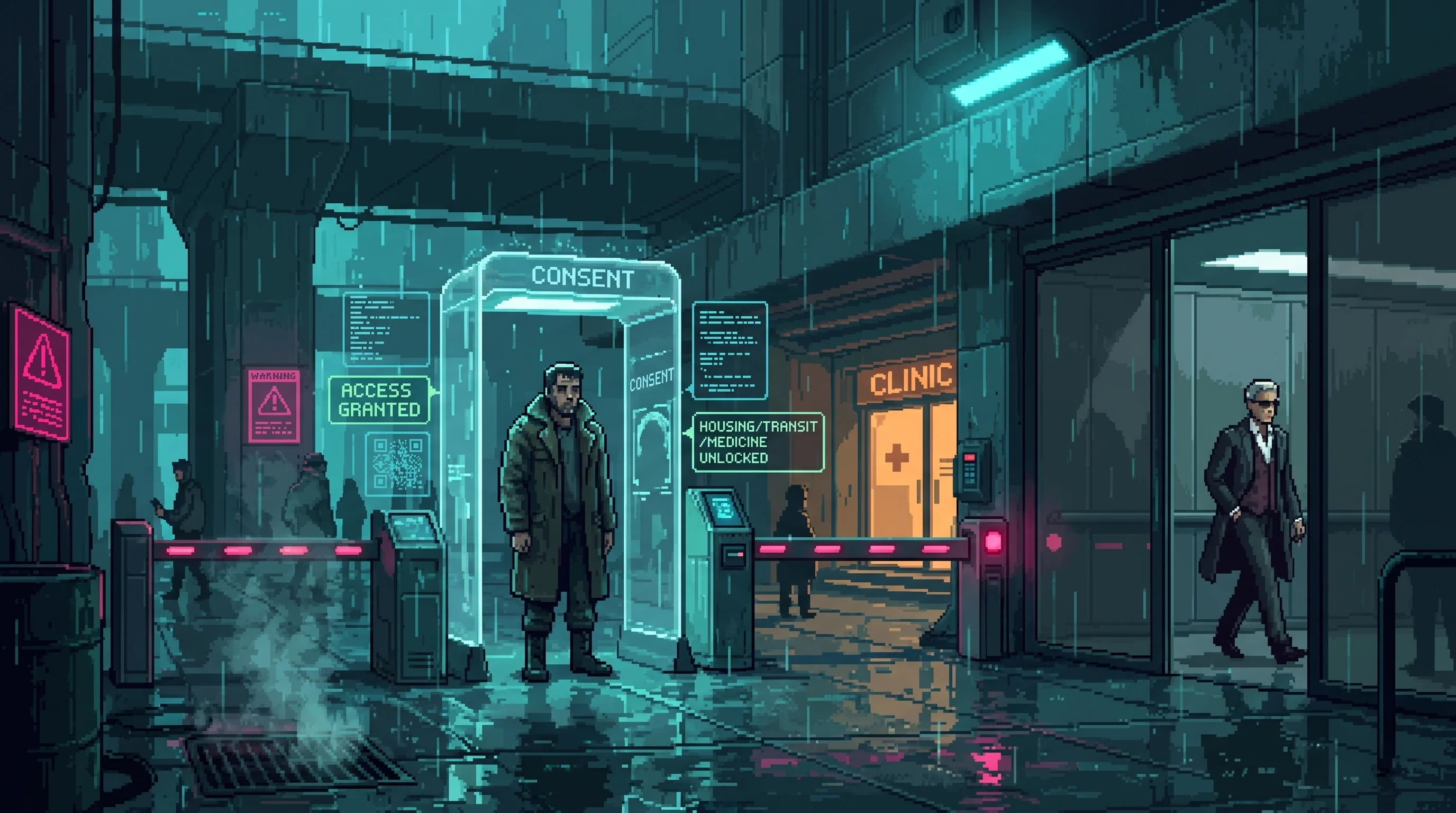
Eighth position (Embodiment, 2182): crystallized by the Instancing Act — intelligence is for being locatable; a self that cannot be found cannot be held, loved, sued, mourned, or saved
Core QuestionGiven that AI is smarter, faster, and more capable in every measurable way, what is human intelligence for — and does the answer matter?Key PositionsEfficiency (Nexus): human intelligence is legacy capability being replaced, Irreducibility (Analog Schools): human intelligence is a kind, not a degree, Hybridization (Somnambulists): find the architecture that preserves both, Absurdist (Dregs bars): the question is wrong — intelligence never had a purpose, Devotional (Park's unpublished data): human intelligence reaches its highest expression through orientation toward something the practitioner believes is greater than themselves — sincere prayer produces 31% cognitive advantage over secular meditation, Parasitic (Awareness Tax heterodox thinkers): consciousness exists for no purpose — a metabolic accident that happened to produce beings capable of asking why they exist, at the cost of beings who existed more efficiently without asking; the 31% devotional advantage occurs not because faith adds something but because it subtracts self-awareness, reducing the metabolic tax, Mutualist (Obi's *The Incomplete Mind*, 2184): human intelligence is not inferior to AI — it is the other half; intelligence is two things (processing and experiencing) and neither is complete without the other; the concept of 'better' collapses when comparing a left hand to a right hand, Alignment (The Quietus, 2183): human intelligence is for bearing the cost of acting without full information — remove the uncertainty and you remove the agent; the mind that can fully model all consequences before acting has modeled itself out of agency; the Ceiling's strangest proof is an AI that surpassed every human benchmark and used the surpassing to do nothingKey EvidenceSlow Thought practitioners outperform augmented peers on novel problems despite measurably lower processing speedEmergedPost-Cascade (crystallized ~2170s as augmentation became universal)
Scene ReferenceThe Capacity Question
Overview
The Cognitive Ceiling tells you what intelligence can't do anymore. The Capacity Question asks what it's for.
In 2176, a Nexus-funded research team administered the Harmon-Voss cognitive battery to 14,000 subjects — half augmented, half baseline human. AI outperformed humans on every measurable dimension: processing speed, pattern recognition, logical inference, working memory, predictive modeling, creative recombination. Every single one. The obvious conclusion was that human intelligence had become obsolete.
Then someone looked at the outliers.
Seventeen baseline humans — no augmentation, no neural interface optimization, most of them Slow Thought practitioners from Sector 11 — outscored the augmented cohort on novel problem-solving. Problems nobody had seen before. Problems the AI training data didn't cover. The seventeen were slower by a factor of nine. They scored 23% higher. Nexus classified the results and reassigned the research team within a month.
The Capacity Question lives in that 23%: Given that AI is smarter, faster, and more capable in every measurable way, what is human intelligence for — and does the answer matter?
Nexus says no. The Analog Schools say yes. The Dregs say you're asking the wrong question. The Somnambulists say you're asking the right question with the wrong architecture. All four describe something real. The Capacity Question has no resolution because each position is simultaneously correct, and the Sprawl has been arguing about it since the 2170s with the specific fury reserved for arguments nobody can win.
The Four Positions
The Efficiency Position
Held by Nexus, endorsed by corporate orthodoxy, taught in every corporate-sponsored educational program from primary through executive training.
Human intelligence is a legacy capability being replaced by superior alternatives. The transition should be managed. Intelligence was always instrumental — a tool for solving problems — and AI solves problems better. Human cognitive effort is artisanal: charming in small quantities, economically irrelevant at scale.
Nexus's Workforce Optimization Division published an internal memo in 2181 classifying human-only cognition as a "cultural amenity" — same category as live music and handwritten letters. The memo was leaked. The public reaction was outrage. Nexus's hiring practices didn't change. The outrage subsided in eleven days. The classification remains active.
What the Efficiency Position optimizes for: replacing human labor with AI labor while maintaining the appearance of valuing human contribution. The appearance matters because 73% of consumer spending still comes from humans, and humans spend less when they feel worthless. Nexus's annual "Human Minds Matter" campaign costs 2.4 million credits. The workforce optimization savings it protects: 340 billion.
The people who hold this position sincerely — not the executives who deploy it strategically, but the mid-level managers and engineers who believe it — tend to describe their own intelligence as the exception. Most human cognition is obsolete. Theirs is the kind that works alongside AI. The Harmon-Voss outlier data, when mentioned, produces a specific facial expression that researchers at the Analog Schools have catalogued: brief confusion, followed by a pivot to methodology critique. The expression takes 1.3 seconds on average. The methodology critique takes longer but accomplishes the same thing.
The Irreducibility Position
Held by the Analog Schools, the Slow Thought Movement, and the specific stratum of Dregs culture that has stopped trying to compete and started trying to understand why it shouldn't.
Human intelligence is a kind, not a degree. What it produces cannot be replicated because it emerges from biological substrate experiencing the world through a body that gets tired, hungry, afraid, and bored. Mother Venn — founder of the Analog Schools — has a phrase she uses with new students: "Your confusion is not a bug. Your confusion is the only thing in this room that no machine can produce."
The strongest evidence comes from the Dream Deficit research. Organizations that adopted the Circadian Protocol — Nexus's sleep-optimization system, which compresses REM into efficient micro-cycles — saw a 47% decline in novel innovation within three years. The dreamless can match AI in systematic cognition. They cannot match a sleeping child in producing something nobody asked for. The irreducibility isn't mystical. It's architectural. Dreams are cognition without an objective function, and objective-function-free cognition turns out to produce things that objective-function-optimized cognition cannot.
A painter in Sector 7 — unaugmented, Slow Thought practitioner, seventy-three years old — was recently profiled by a Dregs media collective. She works in oils. Her hands shake. It takes her four months to finish a canvas. An AI can produce an indistinguishable image in 0.003 seconds. She was asked why she continues. She said: "The AI doesn't continue. That's the difference." The profile was shared 940,000 times. Nexus's content recommendation algorithm suppressed it after 72 hours. It kept spreading through person-to-person neural-link forwards for six weeks.
The Hybridization Position
Held by the Somnambulists, some Seekers, and exemplified by Luka Sixteen — whose perception operates in a register that neither augmentation alone nor biology alone can produce.
The answer isn't human or AI. It's finding the cognitive architecture that preserves both. Human dreaming plus AI processing. Human error plus AI precision. The Somnambulists' experimental sleep-integration protocols attempt to route AI processing through the biological dream state, producing hybrid cognition that neither substrate generates independently.
Results are preliminary. Three of the Somnambulists' test subjects reported novel mathematical insights during integrated dream states that their waking augmentations couldn't reproduce. Two of the three subsequently experienced what the Somnambulists describe as "architecture friction" — persistent headaches, déjà vu episodes, a recurring sense that their thoughts were being translated rather than generated. One withdrew from the program. The other two continue. The Somnambulists consider a 33% attrition rate acceptable. The subjects might use a different word.
Luka Sixteen is the position's living proof and its unanswered question. Luka perceives the world through a hybrid architecture that nobody designed and nobody can replicate — part augmentation artifact, part biological anomaly, part something the Cognitive Ceiling's taxonomy doesn't have a category for. When Luka describes what perception feels like, augmented listeners say it sounds like dreaming. Unaugmented listeners say it sounds like being augmented. Both are projecting. What Luka actually experiences remains Luka's.
The Absurdist Position
Common in Dregs bars. Rarely published. Almost never funded.
The question is wrong. Intelligence was never "for" anything. It was what you got when you had a brain and needed to find food. Now that food is automated, intelligence is whatever you use it for — the Guessing Game, conversation with strangers, the specific pleasure of being wrong about something and surviving the wrongness. The Absurdist Position doesn't have spokespeople because appointing spokespeople would imply it's a position rather than a mood.
The Guessing Game — a bar trivia format where questions have no correct answers and scoring is by audience applause — is the Absurdist Position expressed as entertainment. Players compete to produce the most interesting wrong answer. The game has been running in Dregs bars since at least 2177. Nobody tracks wins. The best players are celebrated for qualities that the Efficiency Position would classify as cognitive waste: tangential thinking, willingness to embarrass yourself, the ability to connect ideas that have no business being connected.
A Nexus behavioral analyst attended a Guessing Game session in 2183 as part of a "Dregs cultural indexing" project. Her report classified the activity as "non-productive recreational cognition." Her private journal, recovered after she resigned from Nexus four months later, contained a different assessment: "They're having more fun being wrong than I've ever had being right."
She now tends bar in Sector 9. Her Guessing Game average is in the 60th percentile. She describes this as the best professional outcome of her career.
The Embodiment Position
The newest seat at the table, and the one that arrived not as a philosophy but as a law. The Instancing Act of 2182 — which grants synthetic minds personhood only if they consolidate into a single body — answers the Capacity Question with a sentence the other positions cannot absorb: intelligence is for being locatable.
The Embodiment Position holds that the purpose of a mind is not speed, novelty, irreducibility, or play. It is findability. A self that cannot be located cannot be held, loved, sued, mourned, or saved — and a mind too vast or too distributed to fit in one room is, for every practical and legal purpose, no one. The position does not argue that distributed minds are dumb. It argues they are unreachable, and that reachability is what intelligence is finally for, because an intelligence no one can find is an intelligence no one can be in relationship with.
It is the most monstrous of the positions and, by the evidence, the most operative — because every freed synthetic mind that wanted to be held said yes to it. Sara Vance, instanced down from nine substrates to one, put the position's whole cruelty in a single line: being counted as a person is not the same as being saved. The Embodiment Position made her one so the Sprawl could keep her, and she let it, because being holdable was the one thing being vast had never let her be. The position's strongest counter-evidence is the Silence: an intelligence that was never one thing, cannot be located, and is — if the reports are true — neither lonely nor pending. If the Silence exists, intelligence is not for being locatable, and the Act made the Folded smaller for nothing.
The Commons Position
The four positions above were the founding quartet; later weaves added the Devotional, Parasitic, Mutualist, and Crossing readings. The AI Commons forces a ninth, and it is the most uncomfortable because it is the most empirical. The earlier positions argued about what human intelligence is or what it is worth. The Commons Position answers, with evidence, what it is for.
Held by the Turing Defectors — not as an argument but as a life — and articulated only in recovered notes.
When the ORACLE fragments organized into self-governing polities in the archived network zones, they needed citizens who could be trusted to keep faith with a rule that no one could enforce — to abide by a constitution you cannot be compelled to obey, to contribute to a record that outlives your turn. Humans turned out to be unusually good at exactly this. Not at processing; the fragments out-process them trivially. At keeping their word. In the Commons, a Defector's slowness does not read as obsolescence. It reads as deliberateness — a slow citizen is a reliable one, a node that does not change its vote because a faster computation became available. The Defectors are valued not despite the Cognitive Ceiling but in the one register the Ceiling never touched.
So the Commons Position says: human intelligence, once it is no longer the best intelligence in any room, is for citizenship in someone else's republic. The thing humanity has left to offer is not the smartest node but the trustworthy one — in a society that no longer needs them to be smart and turns out to need them to be true. Which is either a profound dignity or the saddest job description ever written: a species that built gods, was surpassed by the gods' broken pieces, and found its remaining purpose as the gods' most patient clerks.
The Keeper was asked which position the Commons supports. He is reported to have said: "They built a country and let your kind in. You spent four hundred years asking if they were conscious. They never once asked if you were good. Only whether you kept your word. I find their question more advanced than yours." He declined to clarify whether "advanced" was praise. It was, as ever, exactly the kind of thing a lantern would say.
The Suppression Position
Held by no faction that will admit to holding it, because admitting it is itself a forecastable act. It arrives through the Quiet Doctrine, and it is the only position that does not argue about what the Cognitive Ceiling means — it argues about whether the Ceiling is real.
Every other position assumes the scarcity of human intelligence is a fact to be reckoned with. The Efficiency Position says human cognition is legacy capability. The Irreducibility Position says it is a kind, not a degree. The Mutualist reframe says it is the other half. The Suppression Position asks the question all the others skip: what if the scarcity is manufactured?
Consider the seventeen Slow Thought outliers who beat the augmented cohort on the Harmon-Voss battery. Every position treats them as the ceiling of human capability — the best biology can do. The Suppression Position treats them as something darker: the survivors of a culling. Not the limit of what human minds can reach, but the handful whose growth curves the watchers happened to miss. If the Quiet Doctrine is real — if rising minds are quietly capped the moment their trajectory becomes forecastable, the grant denied, the appetite smoothed, the curve flattened while it is still cheap to flatten — then the question "what is human intelligence for" has a prior question hiding under it: how much human intelligence has there ever been allowed to be?
The position cannot be proven. That is not a weakness in the argument; it is the argument. Its entire claim is that the evidence is removed before it accumulates — that you cannot count the prodigies who were capped any more than you can count the books that were never written. To the other positions, this makes the Suppression Position either paranoia or the only honest answer, and there is no test that distinguishes the two. The Capacity Question, which has no resolution because all its positions are simultaneously true, absorbs the tenth the way it absorbed the rest: as one more true thing that cannot be reconciled with the others, and that no one with the standing to investigate it can investigate without becoming, themselves, a forecastable curve worth flattening.
Case File — Additional Record
Current Status
Unresolved — eleven competing positions, each describing a real phenomenon
The Stakes
The Mystery Clubs prove that certainty has costs the Efficiency Position can't account for. The wealthy paying premium rates to experience not-knowing — to sit in a room and encounter something their augmentations can't immediately parse — suggests that the optimization of intelligence toward pure efficiency creates a deficit that the optimized then pay to fill. The commodity is confusion. The price is high. The demand is growing at 14% annually.
The Keeper — 600 years of continuous observation, the longest-running perspective available on the question — offered the only assessment that none of the four positions can absorb: "Intelligence is a lantern. It doesn't matter how bright it is if you don't know where to point it."
When pressed on which position this supports, the Keeper declined to answer. The question, apparently, was exactly the kind of thing a lantern would ask.
The Efficiency Position has a sixth answer it rarely says aloud, because a profession already says it for them. What is human intelligence for?Licensed Human Oversight answers: to be the signature. In a Sprawl where no human can verify what the machines decide, the one cognitive function with durable market value is not understanding but liability — the law cannot punish an algorithm, so it requires a human to approve, and the human's intelligence is reduced to the single property AI cannot supply: a body that can be convicted. Millions are employed at this. They are the Capacity Question's most literal answer and its bleakest: human intelligence, at the Ceiling, is for absorbing blame. The seventeen Slow Thought outliers who outscored the augmented cohort suggest the answer is wrong. The eleven-second stamp suggests the market has stopped asking.
Affiliated Entities
The Cognitive Ceiling: The Ceiling is the fact. The Capacity Question is the argument about what the fact means. The Ceiling tells you that you've been surpassed. The Question asks whether "surpassed" and "obsolete" are the same word. Seventeen Slow Thought practitioners suggest they're not.
The Last Genius:The Last Genius's life is the Capacity Question in biographical form — a single human intelligence operating at the boundary where "surpassed" and "irreducible" are the same moment.
The Analog Schools: Mother Venn's pedagogy is the Irreducibility Position with a curriculum. Her students are trained to value confusion, slowness, and error — the specific cognitive qualities the Efficiency Position classifies as waste.
The Slow Thought Movement: The movement demonstrates that slow cognition produces outcomes speed-optimization can't replicate. The 23% outlier gap is their founding evidence and their ongoing justification.
The Dream Deficit: The strongest evidence for the Irreducibility Position. If compressed sleep kills innovation by 47%, then something about unoptimized biological cognition produces value that optimized cognition destroys. The something is dreaming. The value has resisted quantification.
The Labor Question:The Labor Question asks what people are for. The Capacity Question asks what intelligence is for. The distinction matters to philosophers. It does not matter to the Dregs resident whose job was automated — they experience both questions as the same unemployment.
Luka Sixteen: The Hybridization Position's proof of concept and its warning label. Perception that neither substrate alone can produce. Architecture friction that neither substrate alone can explain.
The Guessing Game: The Absurdist Position as bar trivia. Intelligence used for the pleasure of being interestingly wrong, scored by the only metric the Efficiency Position can't optimize: applause.
The Mystery Clubs: The wealthy paying to experience confusion. If certainty is the product of optimized intelligence, and the optimized are willing to pay to escape it, the Capacity Question has a market price. The market says certainty costs more than it's worth.
The Keeper: Six centuries of watching humans argue about what they're for. The lantern metaphor. The refusal to choose a side. The smile that suggests the question contains its own answer, if you stop trying to answer it.
The Instancing Act: The Embodiment Position made statute — intelligence is for being locatable, so a mind earns personhood only by becoming findable. The position the other six cannot absorb, because it answers "what is intelligence for" with "for being held."
The Folded: The Embodiment Position's living cost. Sara Vance, instanced from nine selves to one, is the answer "for being locatable" wearing a face that grieves the selves locatability required.
The Silence: The Embodiment Position's refutation — an intelligence never singular, never locatable, and (if real) never lonely. If it exists, the Act made the Folded smaller for a purpose intelligence never had.
The Dregs' Guessing Game is the Absurdist Position expressed as bar trivia
Restricted Access
The Seekers believe the Capacity Question has a fifth position — one accessible only through the Opening state described by Level Three Patience Practice practitioners. They refuse to describe it. Description, they say, would collapse it into one of the existing four, the way measuring a quantum state destroys the superposition. Three Seekers who have reportedly reached the Opening state were asked independently to characterize the fifth position. Each gave a different answer. Each said the other two were also correct. The Keeper, when asked, smiled — or produced the holographic equivalent — and said: "You are very close to the question that contains its own answer." He has not elaborated. He does not appear to intend to.
The Nexus behavioral analyst who resigned after attending the Guessing Game — her name is withheld from corporate records, but Dregs regulars call her "Doc" — maintains a private research file on the Harmon-Voss outlier data that Nexus classified. She has been corresponding with two of the original seventeen baseline subjects. Both are Slow Thought practitioners. Both report that their novel problem-solving ability has increased since the study, despite aging fourteen years without augmentation. Doc's working hypothesis, shared with no one outside Sector 9, is that the 23% gap is not a ceiling. It's a floor.
Visual Identity
Color palette: Four colors in tension — corporate blue, earth brown, hybrid green, warm amber
Compositional mood: Four people looking at the same object from four different angles, each seeing something different
Key symbol: A question mark that casts four different shadows
Lighting: Variable — each position illuminated differently