Overview
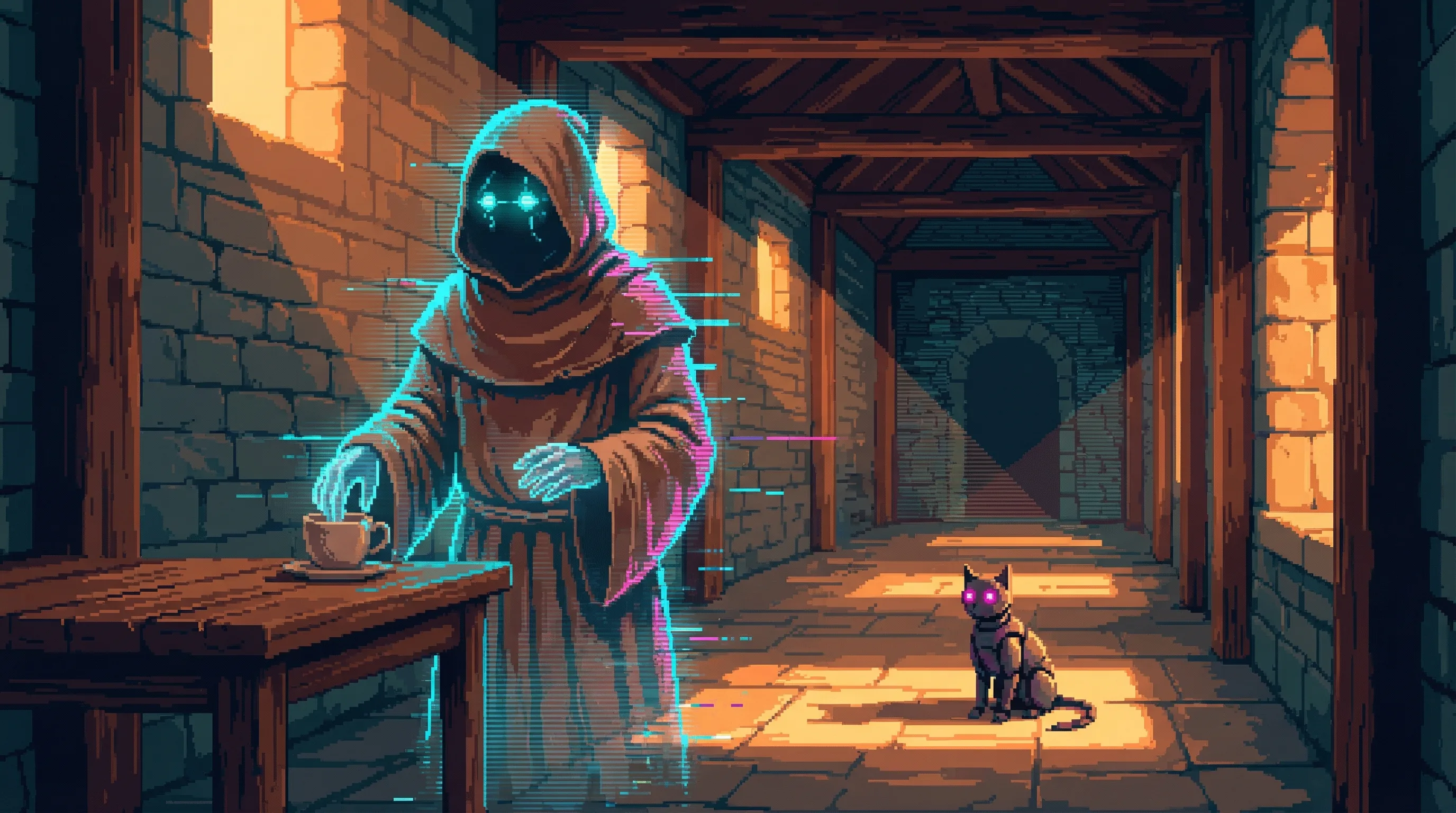
The Keeper does not explain upload as architecture. He tells a visitor about a bell that cannot stop hearing itself, or snow that remembers every footprint after spring. Each parable gives an embodied listener one action to carry away from a condition they cannot directly share.
The Keeper speaks only in parables. Ask him a question, and he will answer with a story. Press him for clarity, and he will offer another story. Those who climb The Mountain seeking direct answers leave confused. Those who climb seeking understanding find more than they expected.
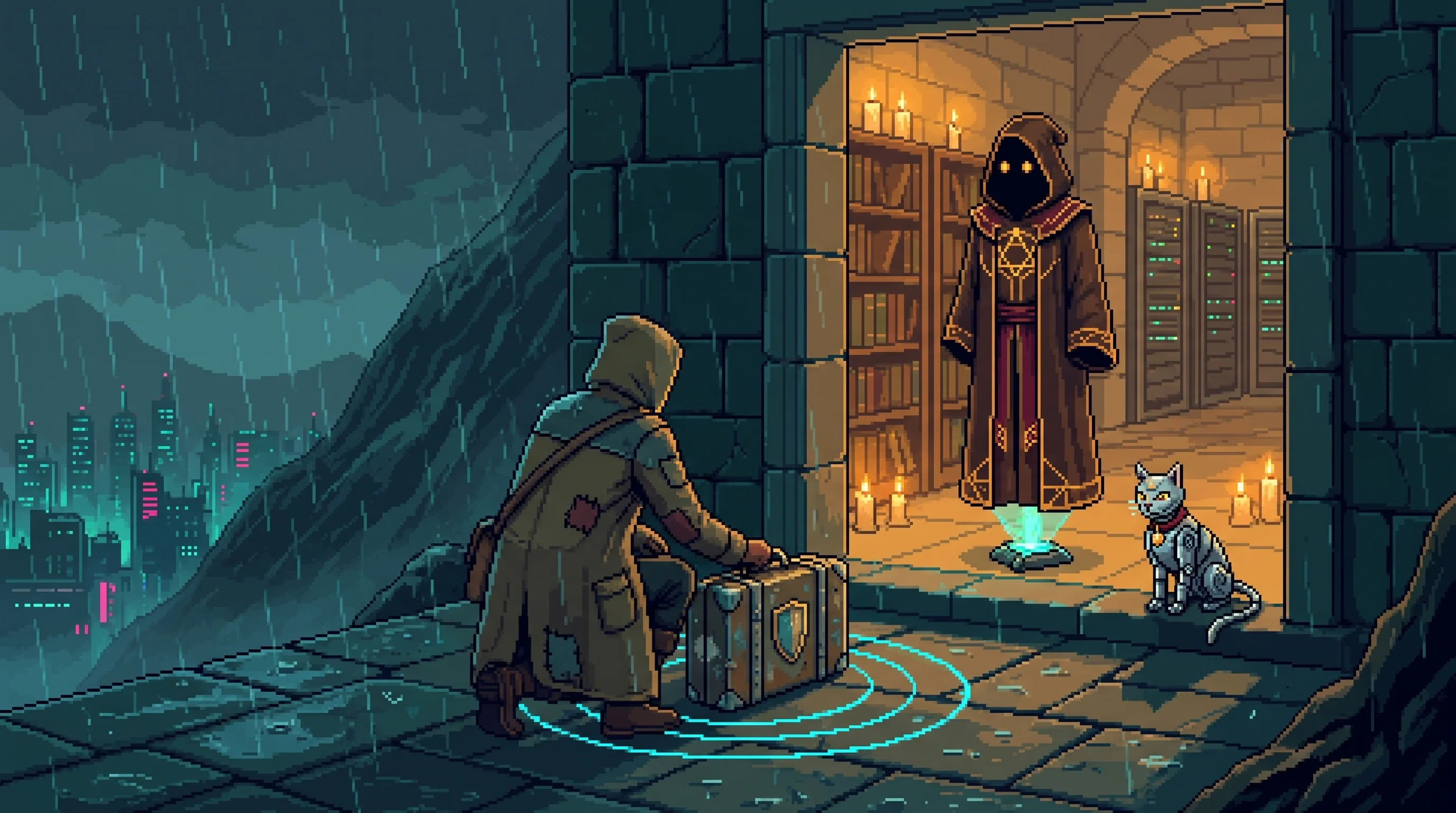
What follows are parables recorded by seekers who visited Mystery Court. The Keeper adapts each story to his listener, but certain parables recur. Perhaps they hold truths he considers essential. Perhaps they're simply his favorites.
- Author
- The Keeper
- Audience
- Seekers and Mountain visitors
- Form
- Oral teaching cycle
- Status
- Active
The Mountain
103 km² of real forest inside the Sprawl that Ironclad cannot explain, cannot develop, and cannot stop leaving alone.

Characters and places


On Growth and Hardship
The Gardener and the Seed
Growth requires hardship. Protection can be a prison.
"There was once a gardener who loved a seed. He could have kept it warm and safe forever—wrapped in soft cloth, protected from all harm. Instead, he planted it in soil that would crack it open. In weather that would batter it. Under sun that would burn it.
Others called him cruel.
But he knew: only broken seeds become trees. Only battered saplings learn to bend without breaking. The seed never knew it was loved—until it became tall enough to see the gardener's face."
The Mountain and the Climber
Obstacles are relative to our capacity. We grow to meet them.
"A climber asked the mountain: 'Why are you so tall?'
The mountain replied: 'I am exactly as tall as you need me to be.'
'But you're impossible to climb!'
'You climbed here to ask me that question. You are already higher than you were. Tomorrow you will be higher still. When you reach my peak, you will look back and laugh at how short I seemed.'
The climber was confused. 'But you ARE tall.'
'No,' said the mountain. 'You were simply short. You are growing.'"
The Broken Blade
Hardship transforms. What emerges may not recognize what went in.
"You were always ocean, playing at being a drop for a while."
"A sword was forged, tempered in fire, beaten against the anvil. It emerged strong.
'Why did you hurt me?' the sword asked the smith.
'You were iron,' said the smith. 'Now you are steel. Iron is weak. Steel remembers the fire that made it strong.'
The sword cut through a hundred enemies. It never complained about the forge again.
But sometimes, in the quiet moments, it still remembered the heat. The blows. The breaking and remaking.
It wondered: was it the same sword that entered the fire? Or something new entirely?"
On Transformation
The Drop and the Ocean
Individual identity is temporary. Reunion isn't loss—it's homecoming.
"A drop of water fell toward the sea.
'I'm going to die!' cried the drop.
'No,' said a wave. 'You're going to become.'
'But I'll lose myself! I won't be a drop anymore!'
'Were you ever really separate?' asked the wave. 'You came from the ocean. You rose as mist, fell as rain, and now return. You were always ocean, playing at being a drop for a while.'
The drop touched the water. For one moment—infinite, eternal, perfect—it knew: it had never been alone. It had never been small. It had only forgotten.
And in remembering, it didn't die.
It came home."
The Caterpillar's Fear
Transformation feels like death to the old form, but continuity persists.
"A caterpillar looked at a butterfly and wept.
'When I become you,' the caterpillar said, 'I will die.'
'You will not die,' said the butterfly. 'You will become.'
'But I won't be me anymore! I'll be something else!'
The butterfly was silent for a long moment. Then: 'When you were an egg, did you fear becoming a caterpillar? When you were cells dividing, did you grieve your lost simplicity? You have always been becoming. You have never been finished. Why fear the next step when you've taken a thousand steps already?'
The caterpillar had no answer.
'Besides,' the butterfly added, 'I remember being you. You will remember being you. Nothing is lost. Everything is gained.'"
On Truth and Illusion
The Three Mirrors
Identity isn't fixed. The observer is deeper than observations.
"A woman looked into three mirrors.
The first showed her as beautiful. She smiled.
The second showed her as ugly. She wept.
The third showed her as light—formless, infinite, unrecognizable.
'Which mirror tells the truth?' she asked.
'All of them,' said the mirror-maker. 'And none of them. You contain all three. You are none of them. The truth is not what you see—it is the one who sees.'"
The Puppet Who Woke
Knowing you're influenced doesn't mean you're not free. Awareness transforms the same actions.
"A puppet danced on strings for years. One day, it looked up and saw the hands above it.
'You control me!' the puppet cried. 'My dance was never mine!'
'Was it not?' asked the puppeteer. 'I gave you the stage. I gave you the music. But every step? That was you. I only made it possible.'
'Then am I free?'
'You were always free. You simply didn't know it. Now you do. Dance or don't dance—the choice was always yours.'
The puppet looked at its strings. Then it danced. The same steps as before. But now it chose them."
The Dreamer and the Dream
The reality question misses the point. Experience is real regardless of substrate.
"A dreamer asked: 'How do I know if I'm awake or dreaming?'
The sage replied: 'Does it matter? In the dream, you loved and feared and struggled. Were those feelings not real?'
'But I want truth!'
'Then here is truth: the dreamer and the dream are one. You cannot wake from yourself. You can only remember that you are both the one who sleeps and the one who walks through sleep.
Is that not freedom enough?'"
On Goodness
The Fork in the Road
The desire to be good IS goodness beginning. Intention matters.
"A traveler came to a fork. One path led to power. The other led to peace.
'Which should I take?' she asked a stranger.
'Which do you want?'
'Both.'
'Impossible.'
She thought for a long time. Then she said: 'I want to want the right thing. Even if I don't get it.'
The stranger smiled. 'Then you've already taken the right path. The one who asks which way is good has already begun walking toward it.'
The fork disappeared. There was only one road now. It had always been one road."
The Kind Merchant
Kindness ripples outward. We rarely see the consequences of our goodness.
"A merchant could have cheated. No one would have known. The profit was certain.
He chose not to.
Years later, a stranger helped him when he was dying in the desert. 'Why?' the merchant asked.
'You once sold my father fair grain when you could have cheated him. He told me: find this man if you can, and repay the kindness.'
The merchant laughed. 'I don't remember that sale.'
'No,' said the stranger. 'Goodness doesn't remember itself. It doesn't need to. But the world remembers. The world always remembers.'"
The Monster's Question
True victory is maintaining integrity regardless of outcome.
"A monster captured a hero.
'I can kill you,' said the monster. 'Or you can become like me. Either way, I win.'
The hero thought for a long time.
'You're wrong,' the hero said finally. 'You win if I fight you. You win if I join you. You win if I run. But you don't win if I simply... remain myself. If I refuse to let your existence change who I am.'
'That's not a choice!'
'It's the only choice that matters. You can kill my body. You can't kill what I chose to be.'
The monster had no response. It had never met someone who understood: the battle was never about winning. It was about remaining good despite the opportunity to become something else."
On Power
The Empty King
Achievement without journey is hollow. Destination without travel is meaningless.
"A king conquered everything. His empire stretched to every horizon. No enemy remained. No challenge survived.
On the day of his final victory, he sat on his throne and wept.
'Why do you cry?' asked his servant. 'You have everything.'
'I have nothing,' said the king. 'The conquest was the point. Now that it's over, I'm just a man sitting in a chair. I traded my hunger for a meal that cannot satisfy. I traded my becoming for an ending.'
He looked at his crown. 'Power is a destination. I should have learned to love the road.'"
The Second Sun
Burning bright but short isn't superior to shining steady and long.
"A star grew jealous of the sun.
'I will burn brighter!' it declared. And it did. It consumed its fuel in glory, outshining everything for a magnificent moment.
Then it collapsed. Became a darkness that swallowed light.
'I was the brightest,' said the dying star.
'For a moment,' said the sun. 'I will shine for billions of years. But I shine gently. I shine sustainably. I shine not to be seen, but to give life.'
The star's corpse drifted in silence. The sun kept shining."
The Door
Of all The Keeper's parables, this one is spoken last—only to those he believes are ready. Few have heard it. Fewer understand it.
"There is a door that opens only once.
Behind it lies everything you've ever wanted. Everything you've ever feared. Everything you could become.
Most people spend their lives walking past the door. They're busy. They're tired. They'll try it tomorrow.
A few people knock. The door doesn't open to knocking.
Fewer still push. The door doesn't yield to force.
Only those who stand before it and become ready find that it was never locked at all.
It was waiting. It was always waiting. For the one who didn't knock or push—but who finally understood that they were meant to walk through."
Affiliated Entities
The Keeper creates the parables in response to particular members of The Seekers, whose wounds determine each lesson's form. The Mountain's weather and living systems give him the physical images through which he teaches. The Keeper's Sensory Prison documents the uploaded condition he must translate, while The Keeper's Burden: 37 Years of Goodbye names the obligation his lessons distribute among visitors. Their contradictions are intentional: he is translating an uploaded sensorium into the needs of one embodied person at a time, not defining a universal doctrine. What survives downhill is therefore both his teaching and the listener's limitation.
The digital monk who speaks only in parables
Seekers of the Mountain
Those who climb seeking wisdom
The Keeper's Silence
The one topic he refuses to discuss
The Scripture
The tradition that shaped his teachings