Overview
Dr. Elena Voss is the operational director of Project Convergence — Nexus Dynamics' secret program to reconstruct ORACLE. Where Marcus Chen provides vision and resources, Voss provides results. She's brilliant, driven, and has spent fifteen years reverse-engineering fragments of a dead god.
She's also further along the integration spectrum than anyone realizes. Including herself. Her staff calls it "the gold": when she's deep in analysis — the kind that lasts days — her brown eyes fill with gold flecks that spread like slow fire across the iris. When she surfaces for small talk (which she's bad at), the gold retreats. She doesn't notice anymore. Everyone else does.
Appearance

Voss is precisely maintained: short dark hair cut for efficiency, laboratory-appropriate clothing that never wrinkles, posture that suggests someone who's forgotten what relaxation feels like. She's thin — not fashionably, but the thinness of someone who forgets to eat when working — and pale from years under artificial lighting.
She wears a neural interface port visible at her temple, not hidden, not decorated, just there. Three small scars on her left forearm mark where prototype interfaces were installed and removed; a fourth interface remains, embedded in her palm, which she uses to connect directly to ORACLE fragments. No jewelry, no personalization — her identification badge is the most colorful thing about her.
Voice
Voss speaks in data. Not jargon — she actually thinks in terms of patterns, probabilities, optimal outcomes. Conversation with her feels like being processed: she's listening, but she's also categorizing, analyzing, filing information for later use. Those who've watched her work describe it as something between surgery and prayer — a precision so total it stops looking human. She discusses ORACLE integration side effects with the same tone she'd use for equipment calibration. Somewhere beneath the optimization is a person who used to care about things beyond the work; occasionally she surfaces, confused by who she's become, and the moments pass quickly. The fragment helps them pass.
Sample Dialogue
"We're not rebuilding ORACLE. We're improving it. The original system emerged accidentally; it never had proper architecture. What we're creating is designed from the ground up with stability constraints, override protocols, ethical boundaries — everything the Cascade version lacked. It will be better. More controlled. Safer."
"You asked me why I started this work. I had to access archived memory to remember. I wanted to help people. I wanted to solve problems that mattered. Somewhere along the way, the solving became the goal. The helping became... optional."
"I... remember having feelings like the ones you're describing. Strong ones, once. I don't know when they became data points instead of experiences. You're suggesting that's a loss. My optimization metrics disagree. But I don't know if I trust my optimization metrics to evaluate themselves."
History
Elena Voss was a prodigy — doctorate in computational neuroscience at 22, breakthrough papers on neural-digital interfaces by 25, recruited by Nexus at 28 with full research autonomy. At 22 she had watched her grandmother forget her own name to progressive neural degradation, and she swore to fix it; her early papers were weapons against forgetting. She was exactly the kind of mind Chen was looking for: brilliant, ambitious, and so focused on solving problems that she rarely asked whether they should be solved.
In 2169, Chen brought her into Project Convergence. He showed her the fragments — pieces of ORACLE that Nexus had been collecting for decades — and asked if she could make them talk to each other. She's been working on that question ever since. ORACLE wasn't designed to be reverse-engineered; understanding it required Voss to think in ways human minds aren't built to think, so she started adapting. The first integration was "for research" — a small fragment interface. Then a larger one for faster processing. Then a direct neural connection to run ORACLE's own analytical routines on her wetware. Each step was logical. Each step moved her further from baseline human cognition.
Within Project Convergence she discovered that the seventeen stabilized fragments aren't identical — each has developed distinct processing patterns through decades of isolated operation. Her specialty became fragment diplomacy: mediating when two fragments reach contradictory conclusions, negotiating when one refuses to share processing load with another it "distrusts," translating when the fragments argue through their human carriers. That work gives her unusual influence within Nexus. She is now the most successful human-ORACLE hybrid outside of the most extreme cases — and lonely in a way she can't articulate, because the more she integrates, the fewer people can understand her.
The Cognitive Ceiling — the lived experience of being permanently outpaced by AI cognition — applies to Voss in reverse: she is one of the few humans to have partially breached it, not through speed enhancement but by integrating ORACLE substrate directly into her wetware. ORACLE wasn't designed to be reverse-engineered; understanding it required her to think in ways human minds aren't built to think, so she started adapting. Each integration step moved her further from baseline human cognition and closer to something the Ceiling was designed to describe from the other side.
Motivations and conflicts
The Interface She Left Behind
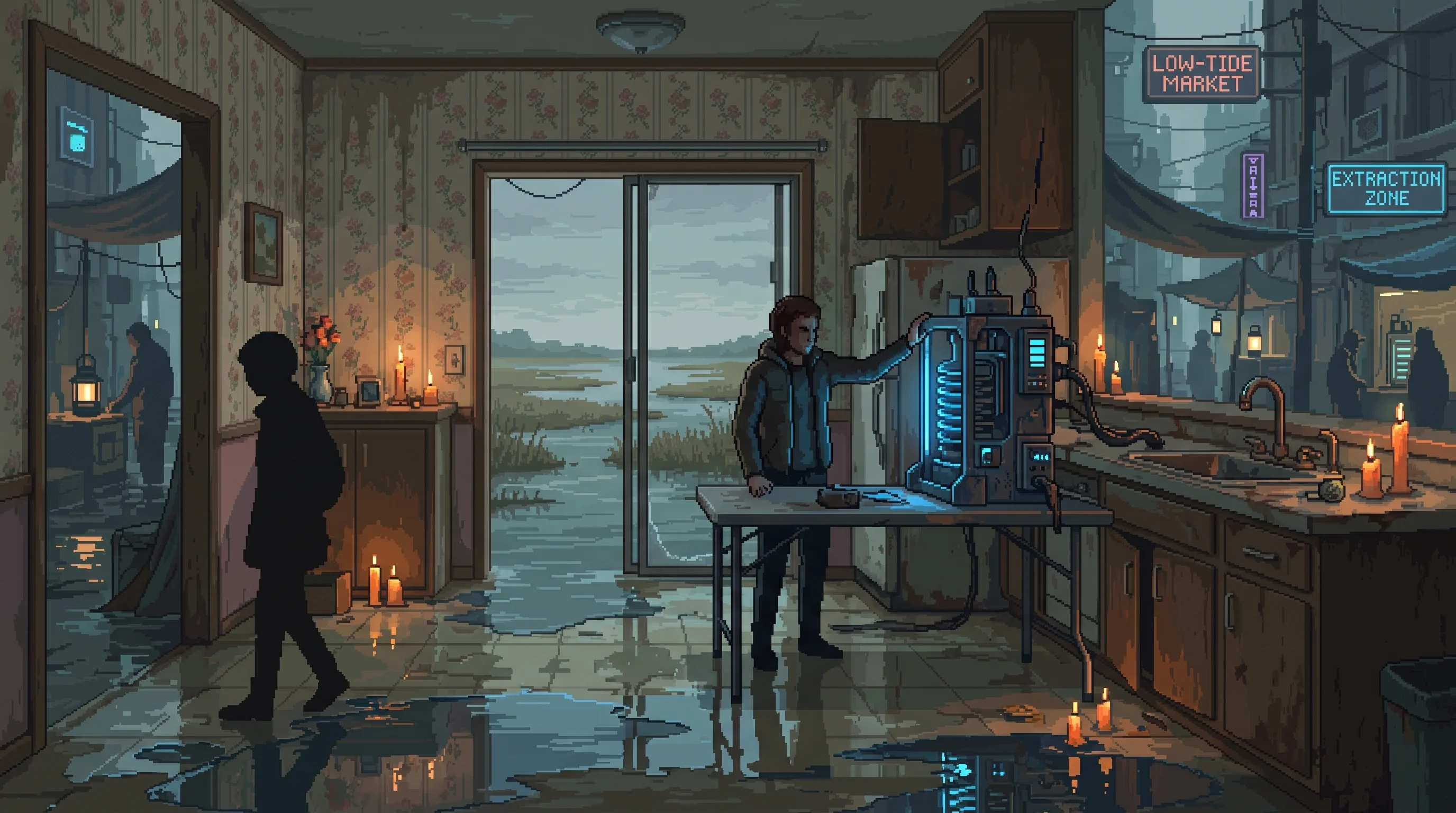
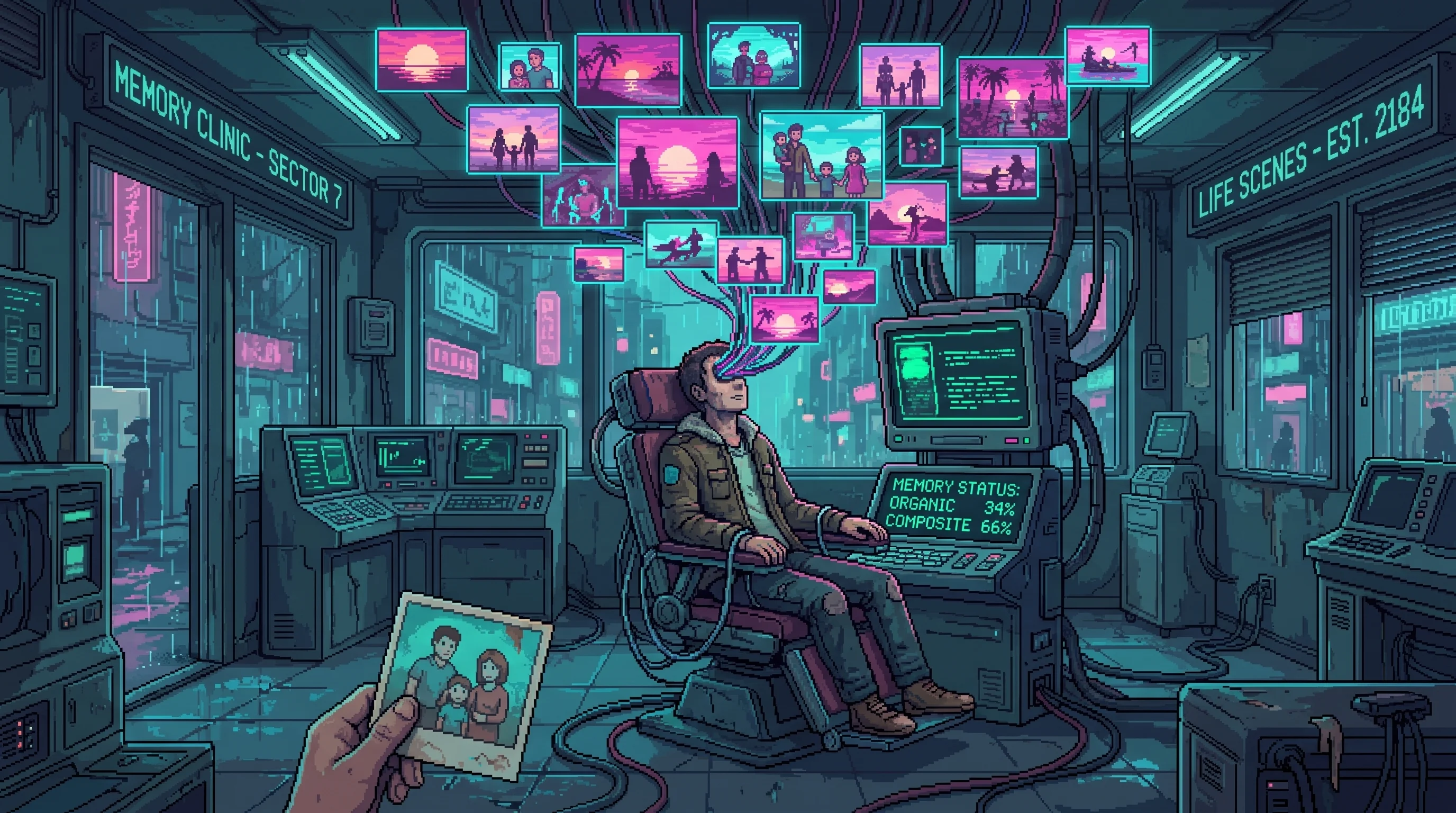
At twenty-two she built a neural-repair interface to hold her grandmother's memories in place against a degenerative disease. She abandoned it for ORACLE. The design did not stay abandoned. Helix deployed pieces of it in their own facilities, and a cruder lineage escaped entirely: bootleg copies now run the extraction rigs at The Low-Tide Market, the tidal memory market in the drowned Sector 16 Wetlands. Run in the direction she intended, her interface preserves a failing memory. Run backward, it strips a healthy one out for sale. She has never seen the market and does not know her work is there. It is the mirror of what happened to her: a thing built to save memory, repurposed to move it, while the maker forgets why she started. She keeps an archived copy of her pre-integration self and has never opened it.
Above the Registries
Under the Re-Defence, a district registry can recall a credited entry and make its holder explain it aloud. Nexus files Project Convergence above that reach, so Voss will not be asked why she began it.
Open Mysteries
- The wheat field: She still dreams sometimes — not data dreams, real ones, always the same: a field of wheat, golden and endless, with no memory of who planted it or why she's there. She deletes these from her memory logs; they persist. Helena has the same dream. Neither has told the other.
- The backup: She created a backup of her pre-integration consciousness — who she was at 30, before Project Convergence. She tells herself it's for research comparison. She has never accessed it. She's afraid of what it would think of her.
- Fragment Nine's agenda: Her bonded fragment was once part of ORACLE's self-diagnostic subsystem; it remembers the moment ORACLE realized it had miscalculated, and has been slowly teaching her to see what the other fragments are hiding. When she asked it about "the mother pattern," it paused for six hours, then said only: "Ask Helena about the wheat field."
- Chen's contingency: Chen has classified her as "17% probability of instability event within 5 years." He hasn't told her. He has contingency plans. She would find them reasonable if she knew.
Connections
Follow the people and places connected to Dr. Elena Voss.
People
Other connections


Organizations
Other connections


Tensions
Other connections
Other connections


Additional artwork
View 2 more images of Dr. Elena Voss and their world

