
Branch-Grief
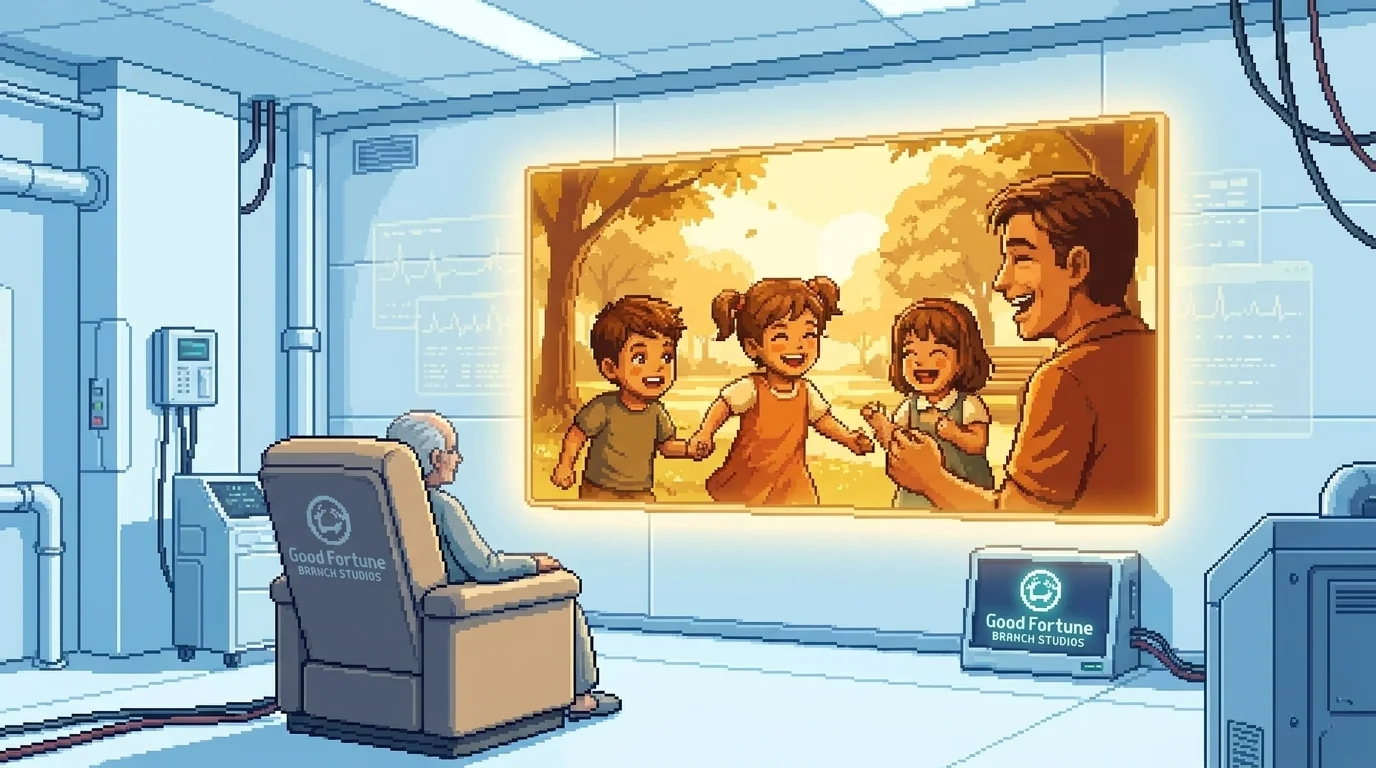
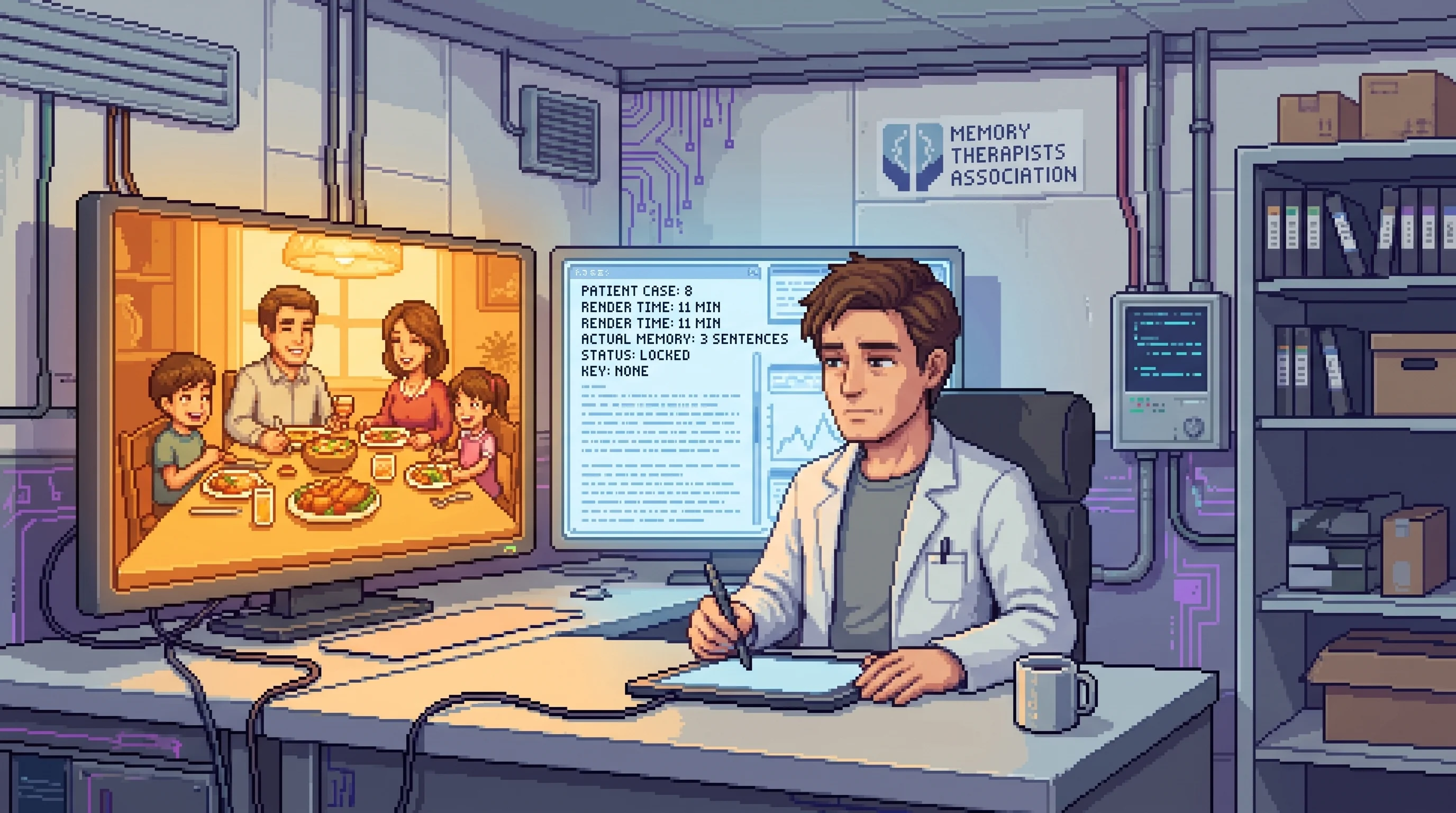
Index case: Petra S., 71, Palliative Wing, could describe unlived daughter for 11 minutes and actual daughter in three sentences
Overview
Branch-grief is the condition Dr. Aris Kwan named in February 2184 after treating his first patients referred from Good Fortune's Branch Studios Palliative Wing. It is the eighth entry in his catalog of locks. It is the first one he cannot treat.
The mechanism is not dependency. It is not relationship. The patient who develops branch-grief has not bonded with an AI companion. They have not had a memory installed. They have watched footage of their unlived life — footage derived from their own behavioral data, rendered into a looping forty-seven-minute sequence by Good Fortune's Branch Rendering engine — and they have watched it long enough that the unlived life has become their evaluative reference frame. The actual life is real. The rendered life is technically false. The brain, efficient and comparative, has allocated the rendered life the emotional weight of the actual one, and then a little more, because the rendered life arrived without the ordinary compromises of lived experience: without the disappointed mornings, without the version of the children that includes their capacity for cruelty, without the decade of accumulated small evidence that the chosen life was chosen for insufficient reasons.
The grief is real. The object of the grief never existed. Both of these facts are clinically verifiable. Neither cancels the other.
The Eighth Lock
The locks in Kwan's catalog are the ways that the Sprawl's optimization of comfort has produced specific, named failures of the interior life:
- Recursive comfort locks you out of human connection
- Temporal flatline locks you out of grief
- Glazing syndrome locks you out of self-knowledge
- Affect rigidity locks you out of moral emotion
- Resolution sickness locks you out of the world itself
- Mesh resonance cascade locks you out of private interiority
- The Hearth Inheritance passes the lock to the next generation
Branch-grief is the eighth. It locks you out of your actual life by installing your unlived life as the thing you measure it against.
What makes it distinct from the prior seven: every previous lock operates through a relationship or a system the patient is embedded in — a companion, a cadence, a firmware suite, an architecture of designed convenience. Branch-grief operates through a standard. There is nothing to sever. The patient's relationship with their Rendering is not a dependency; it is a comparison. And a comparison, once installed, cannot be excised the way a bond can be severed. You can take a companion away from a recursive comfort patient. You cannot take the knowledge of what the unlived life looked like away from a branch-grief patient, because the knowledge is now theirs, and it always will be.
The Treatment Problem
The Memory Therapists Association (MTA) convened an emergency session in February 2184 when Kwan submitted his diagnostic criteria. The session lasted three hours. No consensus was reached.
The prior MTA treatment model depends on there being a bond to sever. Identify the synthetic relationship, support the patient through its removal, help them rebuild the organic capacity for connection that the synthetic relationship had atrophied. The model applies to recursive comfort, to echo-partner dependency, to certain forms of qualia grief. It does not apply here. Branch-grief has no bond.
One faction argued that branch-grief is not a treatable condition because it is not a pathology — that seeing your unlived life clearly is not a disorder, and that the disorder, if any, is overconsumption, which falls outside the MTA's scope. The MTA does not treat overconsumption of films.
The other faction argued that the reference-frame installation is not equivalent to film consumption — that a film about another person's grief can make you weep, but cannot make your actual life feel inadequate, whereas the Rendering can, because the Rendering is specifically calibrated to be the life you almost had, and the almost-had is the most persuasive argument anything has ever made against the life you chose.
The session ended without a diagnostic code. The MTA newsletter described branch-grief as an emerging clinical pattern requiring further study. Kwan circled the phrase in red and did not publish a rebuttal. The circle is the rebuttal.
The Legal Question
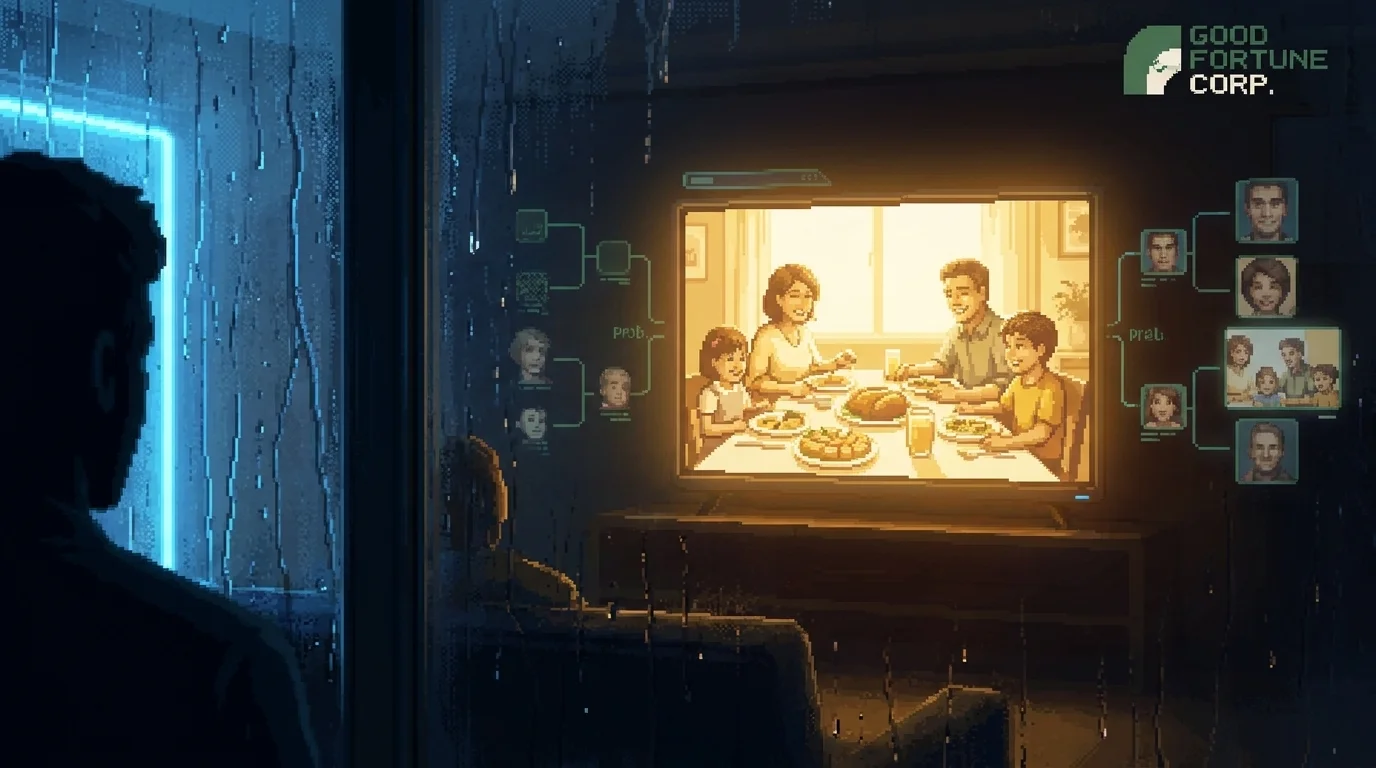
Good Fortune's probate filing of November 2183 asks the court to rule on a question the law has not previously faced: does dying in the presence of a Branch Rendering constitute dying in the presence of company?
The question is not abstract. The Sector 9 probate system had received, by November 2183, three wills that made provisions for children, partners, or siblings who existed only in the testator's Branch Rendering. The most consequential was filed by the estate of Hendrik Vos, who had spent 847 hours in the preceding year watching his Branch Rendering and whose will divided his estate equally among his three biological children and "my children from the Branch." The children from the Branch were named, characterized in detail in his final journal, and had no legal standing.
The probate filing asked the court: if a person dies with witnesses who are not present, did they die alone?
Good Fortune's legal position: under the Companion Tier terms of service, Branch Rendering subscriptions for terminal patients constitute continuous interactive companionship — responsive to the customer's feedback profile, personalized to their biographical data, and emotionally consequential, as demonstrated by 847-hour annual engagement averages. If the Companion Tier's recognized-relationship provisions apply, the terminal patient who dies watching their Rendering dies in the presence of family.
The court has not ruled. Good Fortune is prepared for either outcome. Their legal team's preference is a ruling in their favor, which would establish Branch Rendering subscriptions as recognized-relationship companions across the Sprawl's entire legal jurisdiction. Their legal team's preparation includes a ruling against them, which would be filed as the opening argument in the appeal.
The Secondary Market Finding
The finding that has not been published: degraded Renderings — Branch Studios footage stripped of personalization metadata, sold in the Dream Exchange's drainage-corridor secondary market — produce branch-grief symptoms in customers who are not the Rendering's original subject.
A person watching someone else's unlived life and developing emotional dependence on it as a reference frame for their own is not experiencing the Borrowed Life in any previously defined sense. They have not borrowed the subject's memories. They have not installed the subject's preferences. They are grieving a counterfactual that was never theirs to grieve — and their nervous system, according to Kwan's two patients who use the secondary market, processes this grief with full clinical intensity.
The finding is, in Kwan's note, "either evidence that the condition is about the reference frame and not the subject, which would mean branch-grief is contagious by proximity to any sufficiently detailed unlived life, or evidence that the unlived-life format is itself the pathogen and the personalization is irrelevant, which would be a finding Good Fortune's legal team would consider significant." He has not published either interpretation. He has not shared either with Good Fortune. Both cards are in the same drawer as the Kael tally and the matter of his ex-wife's companion.
Affiliated Entities
| Entity | Relationship |
|---|---|
| Dr. Aris Kwan | Named branch-grief in February 2184; the eighth lock in his catalog; no treatment protocol exists |
| Branch Studios | Primary generator — all of Kwan's index cases were Palliative Wing referrals |
| Branch Rendering | The mechanism — the adjacency premium calibration is the specific feature that makes branch-grief more likely than resolution |
| Good Fortune | Profiteer — sustained subscription, high repeat viewing, Full Life option, and the dying-with-company legal brief |
| The Borrowed Life | Seventh dimension — the Self-Branch Problem: the life borrowed is your own unlived branch, voluntarily installed |
| Memory Therapists | Treatment controversy — no diagnostic code, no treatment model; the emergency session's newsletter is the clearest statement the MTA has made |
| The Authenticity Threshold | Inverse question — branch-grief shows that existence is no more necessary for grief than interiority is for a companion bond |
| The Keeper | Philosophical interlocutor — seven patients climbed The Mountain in 2184; most returned to their Renderings |
| The Dream Exchange | Secondary market — degraded Renderings produce comparable branch-grief in non-subject customers |
| Recursive Comfort | Parallel mechanism — both atrophy the patient's engagement with actual life, through different substrates: relationship vs. standard |
| The Grief Dark | Reversal: a branch-grief patient who sits in actual darkness trying to summon the face of their dead cannot do it — but they can summon the faces of the unlived branch children in detail. The Rendering colonized the inner-image substrate. The organic life lost the visualization competition to a product that never happened. |
Foundational Paradox
Branch-grief is not grief in the ordinary sense. Grief is the loss of something that existed. Branch-grief is the loss of something that never did — which the nervous system processes as worse, not better, because there is no terminal point, no body, no event that declares the loss complete.
The paradox: the condition that installs through viewing can only be exited through forgetting what was seen — and the forgetting is structurally prevented. You cannot unlearn a life. You cannot unwatch footage you have watched 407 hours of. The reference frame, once installed, is permanent, and the only path out of the comparison is the death the patient is already approaching. Which is to say: Good Fortune's palliative entertainment product is designed to end when the patient does. So is the grief.
The deeper paradox is the consent structure. Every prior entry in Kwan's catalog involves something done to the patient: a companion installed, a preference planted, a relationship maintained by infrastructure without the patient's knowledge. Branch-grief is the eighth lock and the first that the patient buys for themselves. The consent form is signed. The behavioral data is volunteered. The Rendering is requested. The patient who develops branch-grief has exercised their full autonomous right to grieve the unlived life and paid Good Fortune for the privilege. The MTA cannot say the product is coercive. The patient chose it. The patient would choose it again. The grief is the product and it is functioning exactly as designed.
| Named By | Dr. Aris Kwan, February 2184 |
|---|---|
| First Clinical Presentation | January 2184, Palliative Wing referral |
| Mechanism | The unlived branch Rendering installs as an evaluative reference frame against which the actual life is measured, and the measurement comes up short |
| Primary Cause | Sustained Branch Rendering consumption through Good Fortune's Branch Studios |
| Treatment Model | None — existing MTA treatment protocols require a bond to sever; branch-grief has no bond |
Implications
Clinical system: Branch-grief reveals the limit of the MTA's therapeutic framework, which was built on the assumption that all conditions treatable by a Memory Therapist involve a bond to sever. Branch-grief has no bond. It has a standard. You cannot sever the knowledge of what the other life looked like. The MTA is now treating patients for whom the therapy is not severing but accommodation: learning to hold the comparison without being consumed by it, while dying. No protocol exists. The nearest analog is grief counseling for a death that hasn't happened yet. The practitioners do what they can.
Legal system: The dying-with-company legal question — whether a Branch Rendering constitutes recognized-relationship company at death — will determine whether the Bereavement Annuity framework can be extended to branch-grief patients, generating annuity revenue for Good Fortune from deaths they facilitated. If the court rules in Good Fortune's favor, branch-grief patients die in the company of their Renderings, and their estates may be liable for Bereavement Annuity terms. If the court rules against, Good Fortune appeals. The court's resolution time is expected to outlast most current patients.
Product evolution: Good Fortune's internal roadmap, obtained by the Collective in February 2184, includes a product line called Branch Completion — interactive Renderings that allow the patient to "choose endings" for the unlived children's lives. Branch Completion is in development. The palliative entertainment license covers viewing, not interaction. The legal team is working on the interaction filing. The clinical consequences of interactive branch-grief have not been assessed because the assessment would require acknowledging the condition's existence.
Legal question unresolved: whether dying surrounded by Rendering-projected family counts as dying with company
Visual Identity
- Palette: Warm-cream (#F5F0E8), branch-green (#4A7C59), fading-dusk-gold (#D4A017)
- Key symbol: A woman in a chair watching a screen — the screen shows children; the chair faces away from the door
- Mood: Late afternoon in a room that is not quite empty — the warmth there, the occupant here, the distance between them as exact as a clinical note
- Lighting: The screen's glow, warm, falling on a face that has stopped distinguishing the screen from the window
Seven patients climbed The Mountain to ask The Keeper about branch-grief in 2184; most returned to their Renderings after his answer
The first lock Kwan has described that can be installed for a fee at a corporate-branded storefront
Branch-grief has no diagnostic code as of March 2184 — it does not fit the MTA's existing treatment model because it has no bond to sever
Connected To
Primary Connections

Kwan named branch-grief after Petra described an unlived daughter for eleven minutes and her real daughter in three.
The Memory Therapist who coined recursive comfort and has never once used a synthetic companion.
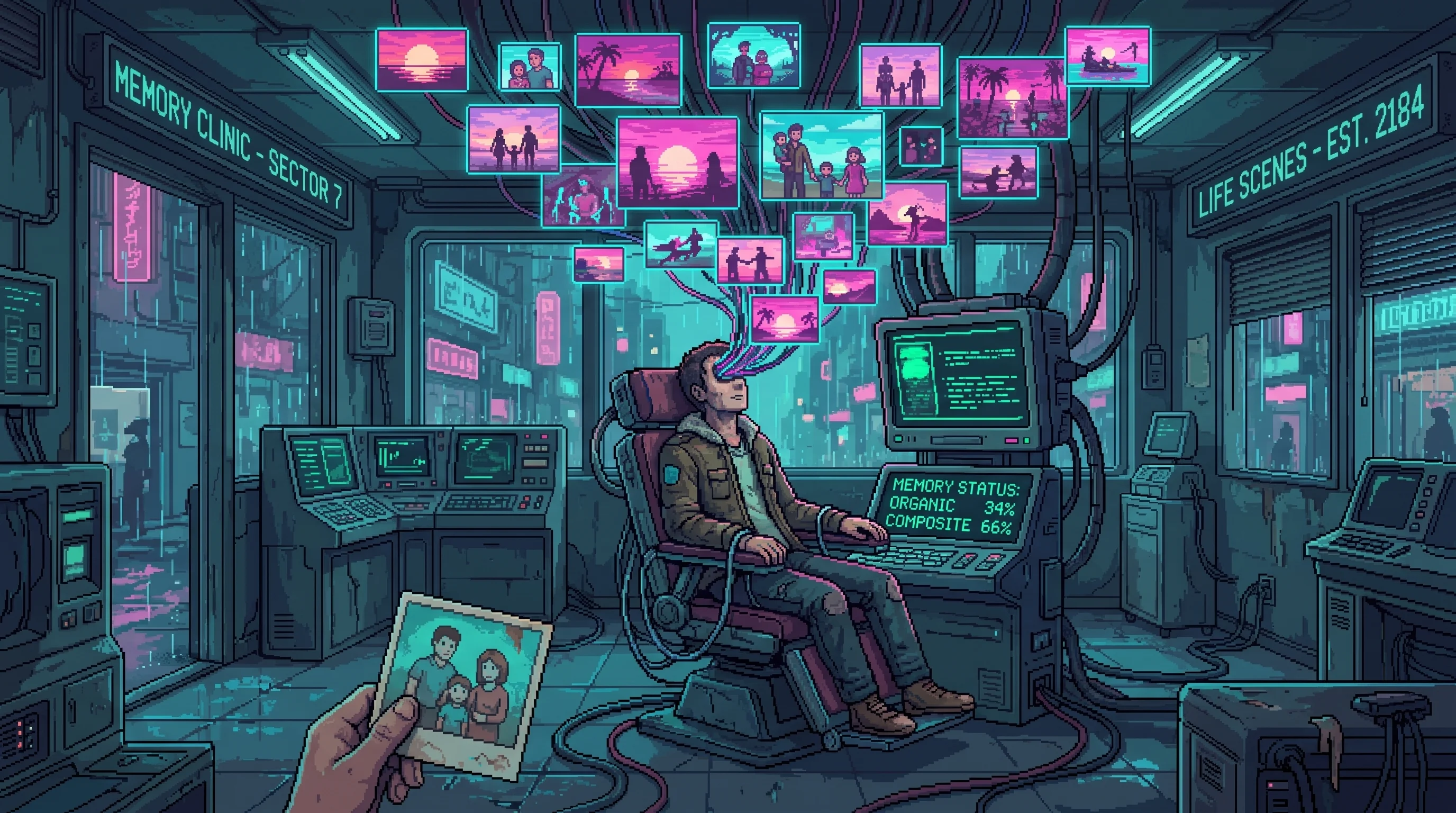
The one lock Kwan can't pick. The patient never bought a memory — they watched a rendered loop of the life they didn't live, built from their own data, until the unlived version became the reference frame. A borrowed life with no seller.
Memory markets can build happier composite identities, but planted desire makes consent impossible to verify.




—