
The Ghost Hand Phenomenon
Presenting symptom: compulsive menial physical labor performed in secret by Executive-tier citizens
Overview
The Ghost Hand Phenomenon is the clinical term for executives who sneak into maintenance closets to wash dishes.
Dr. Aris Kwan coined it in late 2183 after his seventh corporate executive in four months presented with the same complaint. Each patient — high-performing, Executive-tier, augmented beyond the 95th percentile — had independently developed a compulsion to perform menial physical labor in secret. Hand-washing dishes. Hand-copying manuscripts. Hand-building furniture they immediately destroyed. One Nexus logistics director was found at 2 AM in a sub-basement utility room, re-grouting tile she had deliberately cracked the previous evening. Her performance reviews were flawless. Her quarterly projections ran eighteen months ahead of target. She was, by every metric the Sprawl tracks, among the most successful people alive.
She could not stop re-grouting the tile.
Kwan identified what was missing as the "necessity-effort signature" — the specific neurological reward that fires when a person accomplishes something difficult that genuinely needed to be done. The signature requires three conditions he calls the meaning tripod: the task must be genuinely difficult (it resists you), genuinely necessary (something depends on it), and genuinely yours (no one else will do it). Remove any leg and the satisfaction collapses. Exercise without purpose is a gym. Purpose without effort is management. Effort without ownership is a Deprivation Retreat.
In 2184, no Executive-tier task satisfies all three conditions. AI handles the difficulty. Automation handles the necessity. The Second Mind handles the agency. The Ghost Hands aren't rebelling against the system. They are, by clinical definition, starving inside it.
Estimated diagnosed cases: 400-800 across the Sprawl. Actual incidence, per Kwan's own projections: five to ten times that. The undiagnosed aren't unaffected. They're undiscovered. Discovery requires admitting to your physician that you — a person whose compensation package exceeds the annual economic output of three Dregs blocks — have been hiding in a storage closet scrubbing coffee residue off ceramic with your bare hands, and that it was the best part of your week.
The diagnostic pipeline has a pride bottleneck.

The Index Case
Kwan's most documented patient: a Nexus division director who installed a manual sink in a storage closet on Level 47 of the Lattice. Cost: ¢3,400, paid from personal funds, routed through a maintenance contractor she bribed to bypass hygiene monitoring. Every evening after her team left, she washed their coffee cups by hand.
The automated dishwasher in the executive pantry would have handled them in 4.2 seconds. She preferred the eleven-minute version. She washed cups for fourteen months before presenting to Kwan's clinic. Her presenting complaint was not the washing. Her presenting complaint was that the maintenance contractor had been reassigned and she could not find another one willing to accept the bribe.
When Kwan asked what the washing gave her, she said: "Proof. That I was here. That my hands touched something and changed its state."
The Performance Temple — Nexus Central's most optimized workspace, where photovoltaic glass casts sacred light on concentric workstation circles — produced seventeen diagnosed Ghost Hand cases in 2183. The highest concentration of any Nexus facility. The most productive workspace in the Sprawl generates the most people who sneak away to wash dishes. Nexus Wellness flagged the cluster as a "workplace satisfaction anomaly." The Temple's optimization index has increased every quarter since the diagnosis rate began climbing. Nobody has connected these trends in writing. The data is available to anyone who asks. Nobody has asked.
The connection is structural: the Temple optimizes away the friction that generates meaning. Every task is pre-analyzed. Every decision is pre-modeled. Every outcome is pre-confirmed by the Second Mind before the executive's hand reaches the interface. The Temple doesn't eliminate human work. It eliminates the part of human work where your hands shake because the outcome is uncertain and yours.
| Mechanism | Absence of the 'necessity-effort signature' — the specific neurological reward pattern that fires when a person accomplishes something difficult that needed to be done |
|---|---|
| Meaning Tripod | Difficulty (the task resists you) + Necessity (something depends on it) + Agency (the task is yours) — all three legs required for the satisfaction to register |
| Key Distinction | Sought difficulty is not necessary difficulty — simulation provides the first, only poverty provides all three |
| Highest Concentration | The Performance Temple, Nexus Central — 17 diagnosed cases in 2183, the highest of any Nexus facility |
The Meaning Tripod in the Wild
The meaning tripod — Difficulty, Necessity, Agency — clarifies why most attempted cures fail.
Hobby woodworking satisfies difficulty. It does not satisfy necessity. Nobody depends on the bookshelf. The woodworker knows this. The neurological signature knows this. The bookshelf is beautiful and provides approximately 11% of the satisfaction of cleaning a genuinely dirty atmospheric filter.
Corporate leadership satisfies necessity. Quarterly targets have real consequences. But AI pre-digests the difficulty, and the Second Mind pre-models the agency, and the executive's contribution reduces to selecting from pre-validated options. The experience of deciding has been separated from the experience of mattering. The Cognitive Ceiling took away the meaning of thinking; the Ghost Hand phenomenon reveals the parallel loss of the meaning of doing.
Gym memberships satisfy difficulty and agency. Squat racks do not depend on you. The weight goes up. The weight comes down. Nobody was saved.
Kwan's diagnostic note, appended to his seventh patient file and subsequently cited in four clinical papers: "The Ghost Hand patient's distress confirms their humanity. The Purposeless patient's equanimity challenges our definition of it." Ghost Hand patients and the Purposeless are mirror images of the same condition — one expressed as pain, the other as acceptance. The Purposeless have stopped reaching for the tripod. The Ghost Hands are clawing for it in maintenance closets at 2 AM.
The Dirty Filter
Old Jin — the lamplighter who maintains atmospheric filters in the Undervolt on a route nobody assigned him — gave a Ghost Hand executive a dirty filter to clean.
She had wandered into his section of the Undervolt during what Kwan's intake notes would later describe as an "effort-seeking episode." Jin did not know her diagnosis. Jin did not know her name. Jin saw someone standing in his corridor looking at the filters the way his dog used to look at the door. He handed her a filter and a rag and said, "Here. This one."
She cleaned it in eight minutes. She cried. Not from the fumes — the fumes were negligible for a standard filter swap — but from the completeness of problem-effort-resolution. A circuit that her Executive-tier life had left open for decades closed in a utility corridor that smelled like ozone and machine oil. The filter was dirty because the Grid required it to be cleaned. She cleaned it because Jin handed it to her and nobody else was going to. All three legs. Eight minutes. Zero credits.
Jin charged nothing because there was nothing to charge for. He needed a filter cleaned. She cleaned a filter. The meaning was load-bearing before she touched it.
The gap between Jin's eight-minute encounter and a Deprivation Retreat's ¢8,000-per-week program is measurable in every dimension except the one that matters. The retreat provides scheduled difficulty, purchased necessity, institutional Agency-with-an-asterisk. Jin provides a dirty filter. Patience Cross, two sectors over, has an intact meaning tripod through poverty — it costs less per month than one day of retreat. The Keeper articulated the whole phenomenon years before Kwan named it, in the sprinter's motorcycle parable: the motorcycle is faster. It cannot provide the experience of a body doing what it was designed to do.
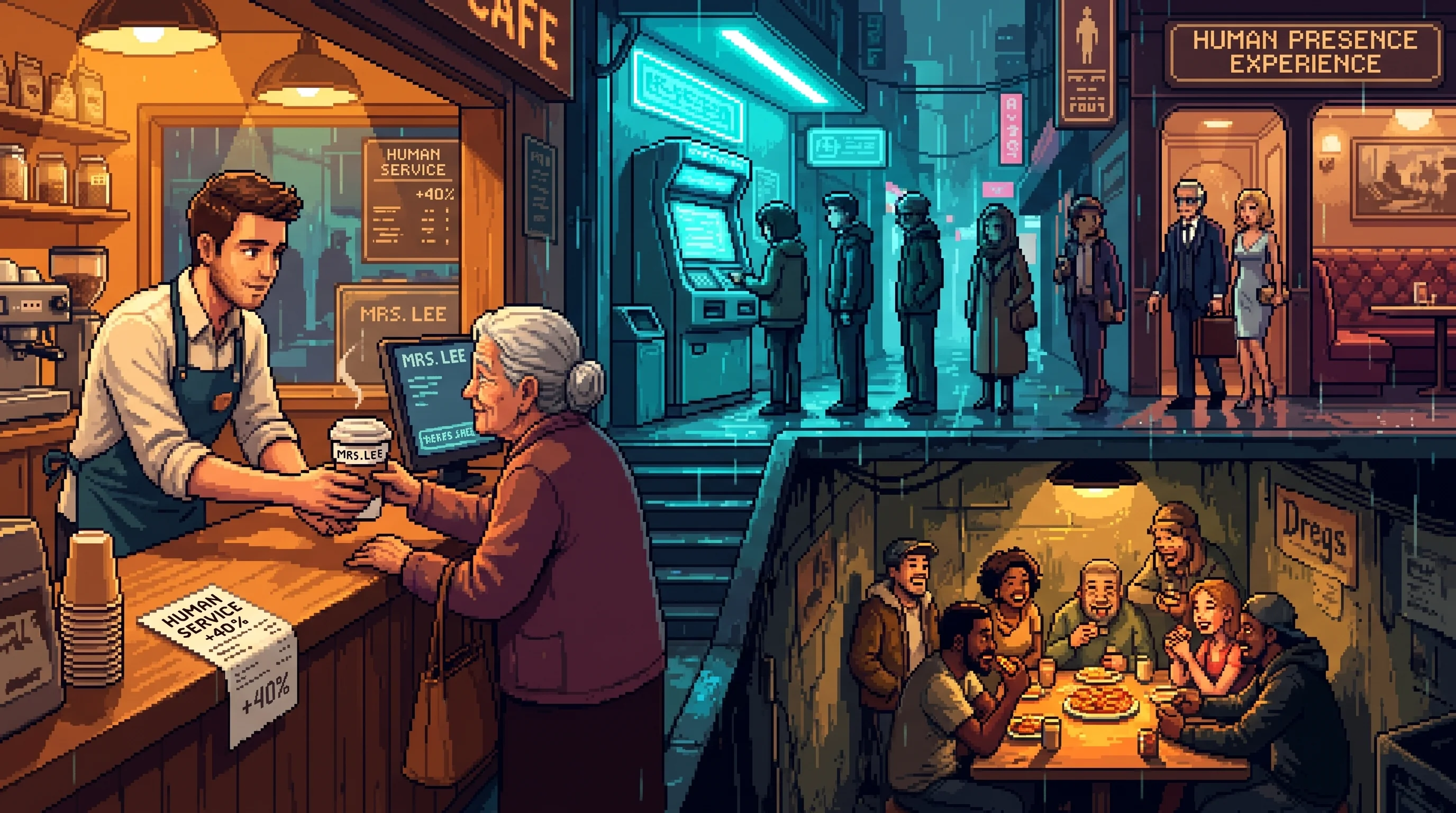
The Warmth Tax charges for human connection. The difficulty premium charges for human effort. Parallel extraction of what the optimization eliminated. The same class dynamic, the same commodity pipeline: take something the Dregs produce as a byproduct of hardship, package it, sell it upward. Connection tourism visits the poor for warmth. Difficulty tourism visits the poor for meaning. The tourist pays for the visit. The resident pays for the tourist's departure.
The meaning tripod: Difficulty + Necessity + Agency — all three legs required for the satisfaction to register
The Market Response
The body identified what was missing before the economy did.
The division director's manual sink (fourteen months, Level 47, ¢3,400) predates the first Deprivation Retreat by a year. Naia Okafor's Mystery Club effort sessions — late 2183, evolved from cognitive exercises to physical friction workshops — emerged independently from three chapters whose members had never been diagnosed but described identical cravings. The Hand Calculation movement, in which Ghost Hand executives secretly practice manual mathematics as effort therapy, surfaced around the same time from an entirely unrelated population. The body knew first. Then the clubs knew. Then the retreats knew. Then the billing department knew.
The progression maps a Ghost Hand patient's trajectory from private compulsion to market-validated consumer identity: closet sink, then Mystery Club membership (¢200/session), then Deprivation Retreat attendance (¢8,000/week), then connection tourism to the Dregs. Each step converts a biological craving into a line item. Each line item satisfies the craving slightly less than the previous one, because each step adds one more layer of institutional mediation between the executive and the dirty filter, and each layer makes the necessity a little less necessary, the difficulty a little less difficult, and the agency a little less theirs.
The Optimization Paradox's fourth mechanism — Success Erosion — predicted exactly this. Where the Paradox's first three mechanisms describe how optimization destroys what it doesn't measure in the system, Success Erosion describes what it destroys in the winners. The deepest irony of the AI labor revolution is not that workers were displaced. The displaced workers understand their loss. The executives who directed the displacement have everything and wash cups in closets at midnight because they cannot name what is gone.
Ghost Hand patients and the Purposeless are mirror images — the same condition expressed as pain (Ghost Hand) and equanimity (Purposeless)
Affiliated Entities
- The Deprivation Retreats are the market's institutional response — difficulty sold as luxury product at ¢8,000 per week
- The Mystery Clubs evolved from cognitive friction (not-knowing) to physical friction (effortful sessions) in response to the same underlying need
- Naia Okafor developed Mystery Club effort sessions independently; three chapters reported identical cravings before any member was diagnosed
- Old Jin gave a Ghost Hand visitor a dirty atmospheric filter to clean; she cried from the completeness of problem-effort-resolution
- The Hand Calculation movement: Ghost Hand executives secretly practice manual math as effort therapy
- Patience Cross has an intact meaning tripod through poverty; it costs less per month than one day of retreat
- The Keeper articulated the phenomenon as the sprinter's motorcycle parable: the motorcycle is faster, but it can't provide the experience of running
- The Performance Temple produced 17 diagnosed cases in 2183 — the most optimized workspace generates the most dish-washers
- The Optimization Paradox — Ghost Hand is Success Erosion made personal: the winners hollowed by their own winning
- The Warmth Tax charges for human connection; the difficulty premium charges for human effort — parallel extraction
- The Cognitive Ceiling took away the meaning of thinking; Ghost Hand reveals the parallel loss of the meaning of doing
- Connection Tourism visits the poor for warmth; Difficulty Tourism visits the poor for meaning — same class dynamic, different commodity
Visual Identity
- Color palette: Warm amber of maintenance corridors — kitchens, workshops, utility closets lit by bare industrial fixtures — against the cold blue-white of the corporate environments the patients flee
- Key symbol: Wet hands holding a clean cup. The simplest proof of having been here.
- Compositional mood: An executive in corporate clothing, sleeves rolled up, alone in a dim service corridor, doing something the system says nobody needs to do
- Lighting: Split — fluorescent corporate above, warm amber below. The patient is always in the amber.
Highest concentration in the Performance Temple — 17 diagnosed cases, the most of any Nexus facility
A Nexus division director installed a manual sink in a storage closet and washed her team's coffee cups by hand for fourteen months
Connected To
Major Connections
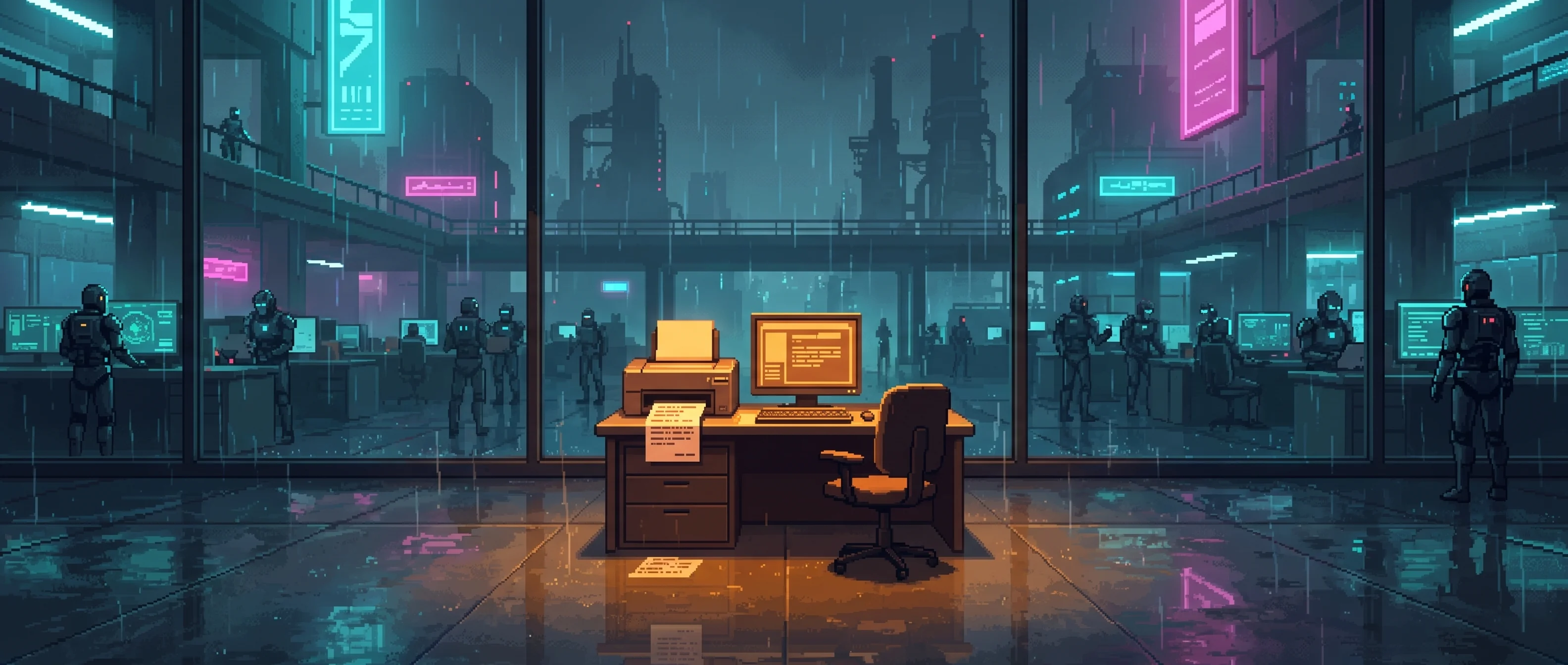
The tension hollowed even its winners: executives who secretly hand-wash dishes to feel the effort automation erased.
Automation ended most human work, but ownership hoards its abundance while machine sentience stays unresolved.
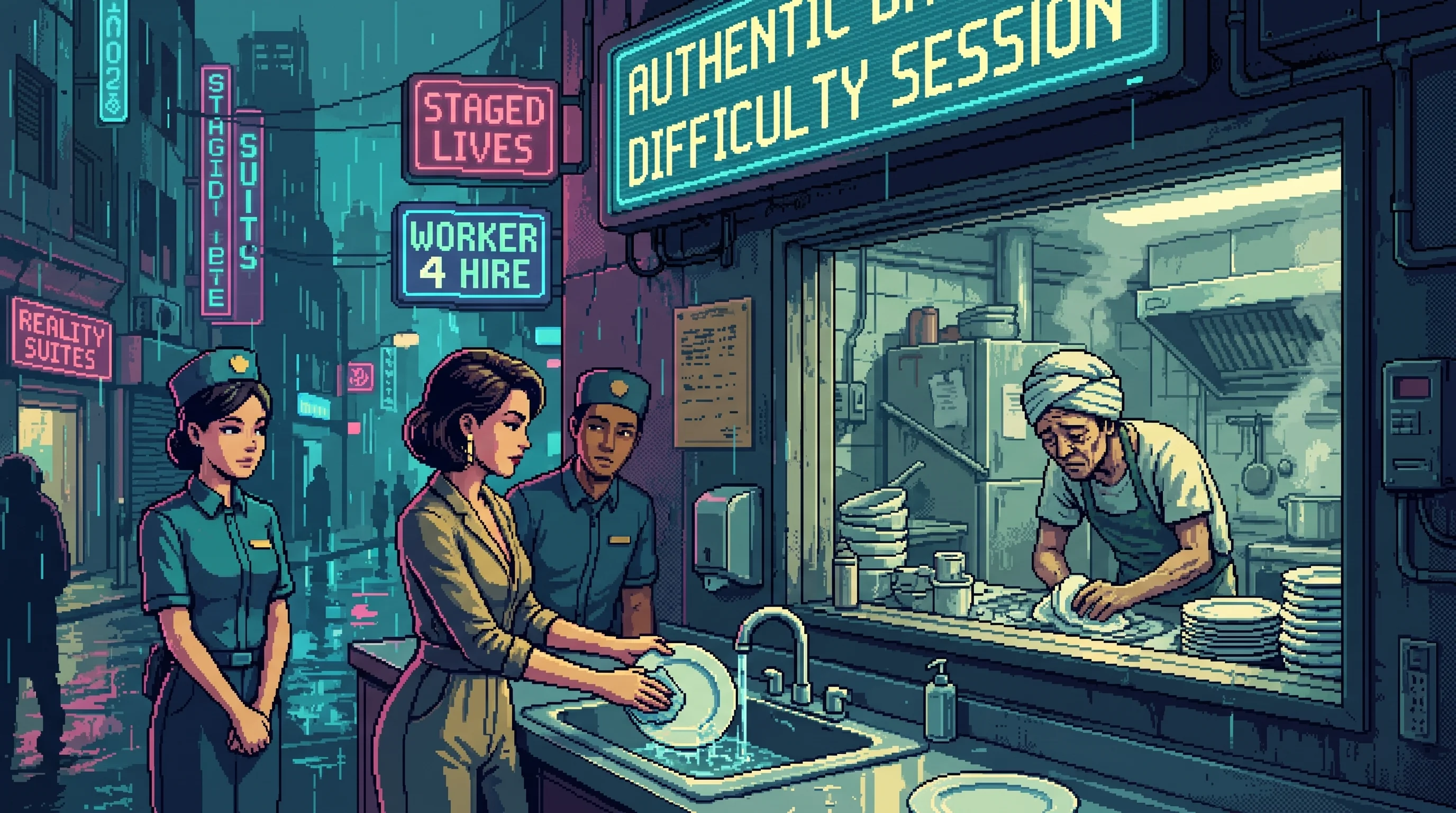
Executive-tier winners secretly hand-wash dishes at 2 AM, chasing the difficulty their own optimization erased.
Abundance turns danger, difficulty, and human attention into luxuries for elites who optimized them out of life.



—