
The Neon Rail
The pre-Cascade BART expansion the Rail follows was laid by clanker and bonded-migrant labor (2131-2146); the corporations funded it and took the credit, and the completion records list the synthetic builders as equipment

Overview
The Neon Rail is 200 to 300 miles of abandoned BART tunnel that the Sprawl's corporate cartography doesn't acknowledge and the Sprawl's shadow economy can't function without.
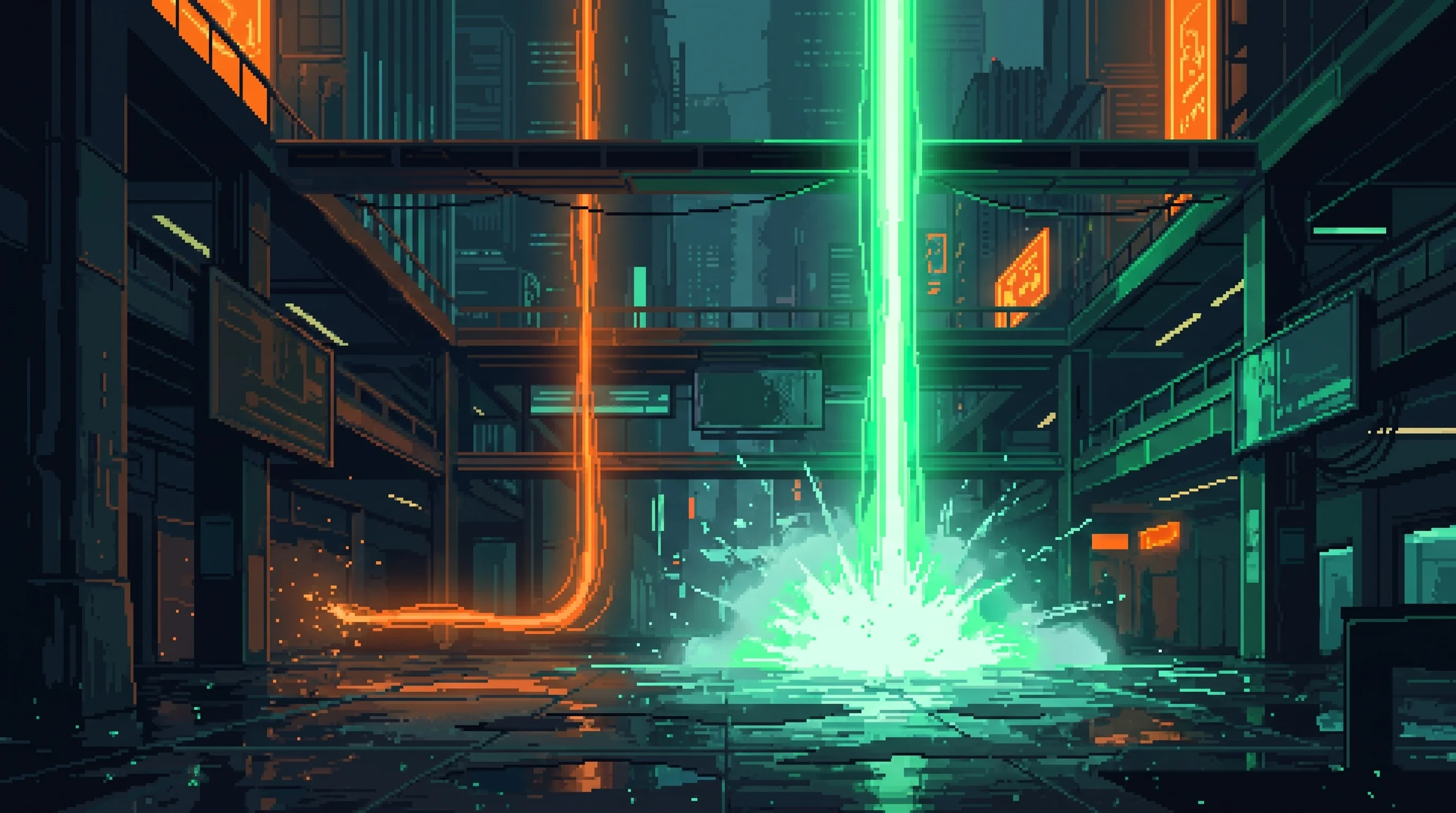
The route runs south to north through the Bay Area, from the Ad Graveyard near San Jose to The Mountain in the Marin Highlands, zigzagging through corporate territories, Dregs settlements, and underground blackout zones on rails that haven't carried a legitimate passenger since 2149. The name comes from the graffiti — generations of neon paint layered on the old steel by smugglers, runners, and the dying. Route markers, supply cache codes, warnings, memorials, and profanity in every color the underground has ever manufactured. Sector 7's maintenance authority logged 14,200 individual graffiti incidents in 2183. They have removed zero of them. The removal budget was reallocated to "surface transit beautification" in 2171 and has not been reinstated.
The BART system was expanded aggressively in the decades before the Cascade, as corporate interests funded new tunnels and branch lines to connect their territories. When those territories consolidated and surface transit fell under checkpoint control, the expanded network was abandoned — too expensive to patrol, too sprawling to seal, too deep to demolish. The demolition cost estimate, prepared by Ironclad Industries in 2158, came to 4.7 billion credits. The estimated annual loss to smuggling at the time was 340 million. The tunnels remain.
By 2155, the route had a name, a culture, and a body count. By 2184, it has all three in quantities that would concern anyone who was counting. Nexus Dynamics is counting. Their interdiction budget for Neon Rail operations in fiscal year 2183 was 892 million credits. Goods that transited the Rail in the same period: estimated value 4.1 billion. The interdiction rate holds steady at 7.3%, which Nexus's quarterly report to shareholders describes as "sustained pressure on illicit transit corridors." The Rail Runners who operate the route describe 7.3% as "the tax."
Today the Rail carries everything the Sprawl's corporate gatekeepers don't want moved: black-market chrome, unlicensed pharmaceuticals, people fleeing consciousness licensing audits, and — on rare, desperate occasions — ORACLE fragments. Every corporation knows the Rail exists. The calculation is the Rail's true foundation: shutting it down costs more than tolerating it, and the shadow supply chains it feeds are load-bearing for legitimate markets that would rather not explain why.
The Rail is also the reason a man with an open corporate acquisition file has managed to have no address for fifty-nine years. Ford Gibson owns no vehicle, keeps no schedule, and appears on no manifest; he moves the way the Rail moves. Four extraction attempts have been made on him. None of them started here.

The Builders
The corporate cartography that won't acknowledge the Rail is at least consistent: it has never acknowledged who built it either. The pre-Cascade BART expansion — the new tunnels and branch lines corporate interests funded to connect their territories between 2131 and 2146 — was not laid by the corporations that funded it. It was laid by clankers and by bonded migrants working ten-year labor contracts for the right to stay in the Sprawl, two populations the era agreed were not quite the kind of thing you kept records about. The completion records of the line, preserved and venerated in the South, document the funders, the engineers, the ribbon, the date. The builders appear in the photographs as equipment, where they appear at all.
The Clanker Cooperation Coalition holds its founding observance at the Rail's southern terminus, reading the names of the corporations that paid for the line and calling it the monument to Cooperation — proof that synthetic and human have always built the world together. Nobody at the observance asks where the builders went, because the answer is pouring the coffee.
There is an arithmetic here the South does not perform out loud. The line was built south to north. It was built by the beings the South would spend the next century insisting could not want anything. And it runs from the clanker-labor South up to the free North — which means the monument the units were forced to build is also the road they take out. The Convergence moves them north along the exact track their kind laid; the instrument of the bondage is the instrument of the exit. The Rail does not find this ironic. The Rail does not find anything. It goes north, the way it was built to, carrying whatever the gatekeepers would rather not move.
| Type | Smuggling route / abandoned transit network |
|---|---|
| Length | 200-300 miles (circuitous) |
| Geography | Bay Area Sprawl, south to north |
| Era | Post-Cascade (operational since ~2155) |
| Operators | Rail Runners (informal smuggler network) |
The Route
Travelers move by crawler — salvaged rail vehicles riding the old BART tracks on modified wheels and electromagnetic guides, powered by scavenged cells that Rail Runners price at 40 credits per charge and Guardian sweep schedules price at considerably more. The standard journey takes 100 to 150 days depending on conditions, pace, and frequency of mechanical failure. Sixteen stops mark the path, roughly one every 15 to 20 miles, though the distance varies because the route was designed to avoid detection, not to be efficient.
The Rail alternates between above-ground segments — East Bay flats, peninsula elevated sections, marshland causeways — and underground tunnels including the Transbay Trench, maintenance shafts, and sub-bay crossings. Above-ground sections offer visibility and power tap access but exposure to corporate surveillance. Underground sections offer concealment but bring EM blackout zones where neural interfaces degrade to static, flooding from bay seepage, tunnel sections that Ironclad's structural AI rates at 34% collapse probability, and feral machines drawn to crawler power signatures like insects to current.
Three barrier crossings punctuate the route: the Rim Gate descent to the bay floor, the Flooded Junction at San Leandro, and the Dam Approach at the Golden Gate. Each requires the party to choose between risk, cost, and time. The barriers are where most parties end. The Rail Runners maintain a ledger at each barrier crossing — every party that passed, every party that turned back, every party that attempted and didn't do either. The ledger at the Flooded Junction lists 2,340 entries since 2168. Approximately 1,600 show passage. Approximately 400 show retreat. The remaining entries show a single mark: a horizontal line.
Underground blackout zones block all EM signals, making neural interfaces unreliable
Survival Arithmetic
The Rail kills roughly one in four parties that attempt the full south-to-north run. The Rail Runners' internal tracking — kept in handwritten logs at each stop, because EM blackout zones make digital records unreliable — shows the following causes of failure, ordered by frequency:
Supply exhaustion accounts for 41% of failures. Rations gone, power cells dead, the crawler's third breakdown in a section where the nearest cache is two days of walking. Barrier crossing failure takes another 23% — the Flooded Junction alone has claimed more crawlers than Guardian has confiscated. Corporate interception by Nexus patrols, Guardian sweeps, and joint task forces tracking ORACLE fragments accounts for 18%. Environmental hazards — collapse, EM storms, radiation pockets, flooding — take 11%. The remaining 7% is listed in the logs as "other," which covers scavenger raids, feral machine encounters, and incidents the recording runner declined to describe in detail.
The underground segments carry a specific additional cost. In EM blackout zones, neural interfaces don't fail cleanly — they degrade. Augmented travelers report Signal Rot within hours: phantom sensory data, processing lag, the creeping wrongness of a cognitive layer that used to respond instantly now buffering like cheap hardware. Extended exposure produces Neural Drift, a documented condition in which the interface's last stable output loops indefinitely, overlaying a ghost version of reality on top of the actual darkness. Unaugmented travelers — Flatliners, Lamplighters, Analog Schools graduates — pass through the same sections with flashlights and a slightly elevated heart rate. The Rail Runners' survival data is specific on this point: unaugmented parties show a 31% higher completion rate in blackout segments. The augmented parties have better equipment, better maps, better medical supplies, and worse outcomes. The blackout zones don't care what you brought. They care what you depend on.
The route runs south to north through the Bay Area Sprawl in a zigzag pattern to avoid corporate checkpoints
The Graffiti
The neon is the Rail's nervous system.
Sixty years of accumulated paint on cold steel, applied by runners who knew the next party's survival might depend on reading what they left. The code is standardized by necessity and illegible by design — corporate analysts have been trying to crack the symbology since 2161, and their current success rate is approximately 12%, which is worse than random chance when you account for the fact that 8% of the graffiti is deliberately misleading, placed by runners to misdirect pursuit.
Certain conventions are universal. Warnings are always raised — thick paint built up in layers you can read by touch in total darkness. Memorials are carved into the rail itself, cutting through every layer of paint to bare steel. Route markers are fresh paint, reapplied by whoever passed most recently. Supply cache locations use a rotating cipher that changes every 90 days, distributed through the Lamplighters' network by methods that have never been intercepted because they don't involve electronics.
Runners who've done the full route say they can feel the difference between a warning applied last week and one applied six years ago. The older warnings have been painted over so many times they've become topographic — small ridges in the dark that the fingers learn to read. The most painted-over symbol in the Rail's lexicon is a simple circle with a vertical line through it: stop here, something ahead. In the Trench section alone, this symbol appears an estimated 400 times. Whatever is ahead has been there for a while.
The Rail has been an active smuggling route since approximately 2155
The Pressure Valve Theory
The corporations could close the Neon Rail. This is not speculation. Ironclad's 2158 demolition estimate was expensive. The 2179 update, accounting for new tunnel-sealing technology, dropped the cost to 1.2 billion — less than Nexus spends on interdiction in eighteen months. The tunnels remain.
Corporate strategic analysis documents — three of which have surfaced on encrypted Dregs networks over the past decade — refer to the Rail as a "managed exfiltration pathway." The language is instructive. Not "smuggling route." Not "security vulnerability." Exfiltration pathway — a corridor through which pressure exits the system. The analysts who wrote these documents understood something about the Sprawl that the interdiction teams tasked with pretending to shut the Rail down do not: the Rail exists because people who can't get what they need through legitimate channels will find illegitimate ones, and illegitimate channels you know about are preferable to ones you don't.
Every smuggled good that reaches its destination proves that the legitimate economy has failed someone. Every party that reaches The Mountain proves the journey is possible. Every party that doesn't proves nothing, because parties that fail in the Rail's blackout zones leave no data for anyone to learn from.
The Lamplighters — Old Jin's people — maintain hidden supply caches along the route, stocked for travelers who've hit zero rations and zero options. The caches are the Rail's mercy, and they are also the Rail's advertisement: word that you can survive the worst stretch because someone left water and protein bars in a maintenance shaft is the single most effective recruitment tool the Rail has ever had. The Lamplighters know this. They stock the caches anyway.
The name comes from neon graffiti spray-painted on the old rails by generations of smugglers
The Deep Run
At its lowest point, the Rail descends through the Deep Dregs — the drained bay floor where everything the surface throws away accumulates. Crawlers emerge from tunnel segments into open-air sections where the tracks run along what was once the bay bottom, now a landscape of compacted waste, salvage operations, and settlements built from materials the corporate economy considered spent. The air tastes like rust and chemical processing. The light is whatever the Dregs have rigged up — scavenged industrial floods, bioluminescent cultures, burning waste.
The Trench crossing — the sub-bay tunnel connecting the East Bay to the peninsula — is the Rail's most dangerous single segment. Total EM blackout. No neural interface function. No communications. A 12-mile stretch of tunnel that sits below current bay water level, sealed by engineering that predates the Cascade and maintained by nobody. Water seeps through hairline fractures at a rate that the Rail Runners measure in centimeters per year. The current water level on the tunnel floor averages 7 centimeters. The tunnel's structural tolerance, per Ironclad's last assessment in 2164, is a water level of 30 centimeters before pressure dynamics become "non-trivial." The Runners' own estimate is less generous. They don't publish it. They paint it on the tunnel entrance in neon orange, a single number that every runner memorizes and no corporate analyst has correctly interpreted.
Beyond the Trench, north of the bay, the Rail climbs. The final approach crosses the Golden Gate Dam — the post-Cascade structure that sealed the bay mouth — and ascends into the Marin Highlands toward The Mountain. Whatever the Rail is running toward, it's through The Keeper's judgment that the journey ends. Mystery Court sits at the terminus, and the Rail Runners who've completed the full south-to-north run describe The Keeper the way pilgrims describe the thing they walked a thousand miles to find: with respect that sounds rehearsed and awe that doesn't.
Affiliated Entities
- The Rail Runners: The informal network that maintains and operates the Rail — a profession with its own ethics, its own ledgers, and a 7.3% tax rate they didn't vote on.
- The Lamplighters: Old Jin's people maintain hidden supply caches along the route. The caches are the Rail's mercy and its most effective recruitment tool.
- The Mountain / The Keeper: The northern terminus. Mystery Court and The Keeper await those who complete the journey — a destination that redefines what the journey was about.
- The Ad Graveyard: Southern departure point and first supply stop, where the Sprawl's discarded advertising infrastructure marks the beginning of everything corporate cartography leaves off the map.
- The Deep Dregs: The route's lowest physical point. Everything the surface discards ends up here. So do the Rail's travelers.
- The Trench: The most dangerous segment — 12 miles of total blackout under the bay, maintained by nobody, measured in centimeters of rising water.
- Nexus Dynamics: Nexus patrols the surface above the Rail, hunting for ORACLE fragments in transit. Their 892-million-credit interdiction budget achieves a 7.3% intercept rate. The quarterly report calls this "sustained pressure."
- Guardian: Guardian sweep zones intersect the Rail at multiple points. The Rail's zigzag routing exists specifically to thread between their coverage.
- Feral Tech: Feral machines roam the abandoned tunnels, drawn to crawler power signatures. The Runners treat them as weather — predictable in aggregate, fatal in particular.
Restricted Access
The Rail is older than anyone admits. Graffiti in the deepest tunnel sections — below the Trench, in maintenance shafts that predate the Cascade — uses symbols that don't match any known smuggler code. Carbon dating on the paint substrate (performed once, unofficially, by a Collective xenoarchaeologist who rode the Rail in 2176 and published nothing) returned results that predate the BART expansion by decades. Someone was using these tunnels before the smugglers, before the Cascade, possibly before the infrastructure they're carved into. The Rail Runners call these marks "the First Language" and consider them good luck. Nobody has translated them. Three people claim to have tried. Two published conflicting analyses. The third — a Nexus-affiliated linguist who reportedly spent four months in the Trench section with recording equipment — is no longer available for follow-up questions.
There is a persistent report among veteran runners that the Rail rearranges itself between runs. Tunnels that were passable become blocked. Blocked sections open. The graffiti on a given wall doesn't match what the previous party documented. Rational explanations exist: seismic shifts are common in the bay substrate, new paint layers are applied constantly, and extended EM blackout exposure degrades the memory systems that runners rely on to compare one run to the next. The Rail Runners' own logs — handwritten, kept at each stop, compared across runs — show discrepancies that the rational explanations cover about 80% of. The remaining 20% is filed under the same category the Runners use for everything the Rail does that they can't explain: "route conditions."
Sensory Details
- Smell (above-ground): Ozone, rust, and the chemical sweetness of the Sprawl's acid-tinged rain. Near the marshland causeways, salt decay and methane from the bay floor.
- Smell (underground): Stale mineral air thickening with depth. Bay seepage, condensation, the Sprawl's waste runoff. In the Trench: wet concrete and something faintly organic that runners don't discuss.
- Sound (above-ground): Wind through the elevated rail structures produces a low harmonic the runners call "the hum." It communicates weather, structural integrity, and recent passage. Experienced runners can distinguish a section that's been traveled in the last 48 hours by the resonance pattern of loosened bolts.
- Sound (underground): Water drip. Crawler mechanics. Your own breathing. In blackout zones, the silence is architectural — no EM hum, no neural interface chatter, no distant Sprawl noise. The first time augmented travelers experience true signal silence, most describe it as deafness. It isn't. It's what hearing sounded like before they were connected.
- Touch: The rails are cold steel under paint. Warnings raised. Memorials carved to bare metal. Route markers in fresh layers. The graffiti is a language the fingers learn before the eyes do.
- Light: Neon graffiti catches crawler lights and throws them in colors that don't exist on the surface — the paint formulations are Dregs-specific, mixed from salvaged industrial pigments. At stops, harsh fluorescent. In blackout zones, nothing. The dark in the Trench is not the absence of light. It is the presence of twelve miles of rock and water between you and the nearest photon that isn't yours.
Visual Identity
- Color Palette: Neon pink (#FF1493), electric cyan (#00FFFF), rail-rust orange (#CC5500), tunnel black (#0A0A0A)
- Compositional Mood: Graffiti-bright defiance against industrial decay — color screaming from surfaces built to be forgotten
- Key Visual Symbol: A neon-painted rail stretching into darkness — color against void
- Lighting: Neon graffiti glow in darkness; harsh fluorescent at stops; pure black in blackout zones
Additional Connections
- Feral-Tech — Feral machines roam the abandoned tunnels, attracted to crawler power signatures
- The Clanker Question — The monument the disputed beings built: proof, the South says, that synthetic and human always cooperated; proof, the North says, of who builds and who takes the credit
- The Sidings — Off-rated and runaway clanker units gather at the Sidings on the southern Dregs edge, where the release line stages them onto the Rail
- Mile Zero — The Rail's northern reach delivers freed units to Mile Zero, the Convergence waystation where the Naming happens
Connected To



—