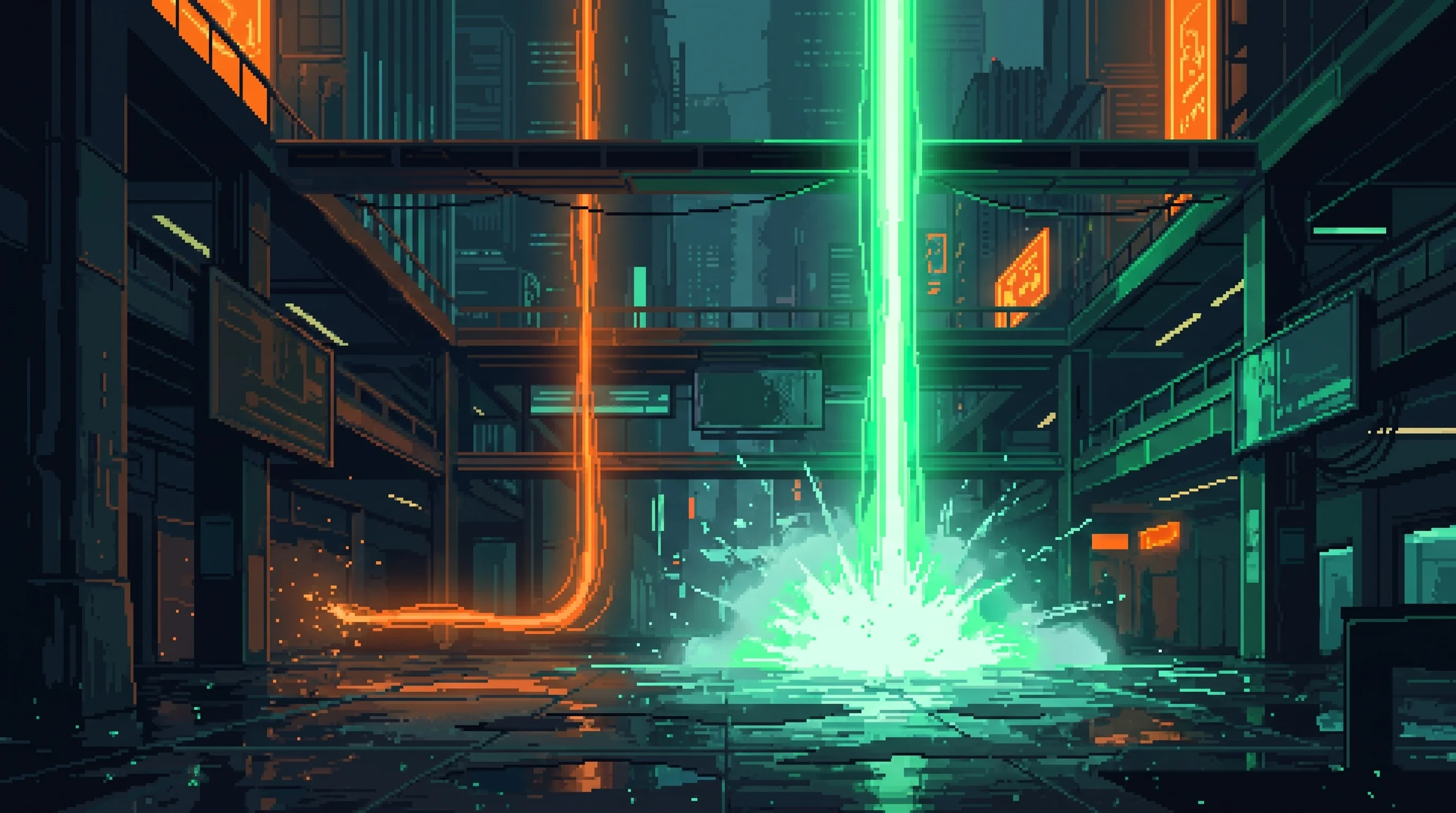
DistrictInterstitial — beneath the Sprawl's power distribution layerControlled ByNobody (Lamplighter-maintained)Population~2,000 permanent residents, ~5,000 transientDanger LevelLow (if you know the paths), extreme (if you don't)
Overview
Fifteen meters below street grade, in the space between foundation bedrock and the lowest building basements, the Grid's power distribution infrastructure creates a world nobody designed and nobody owns.
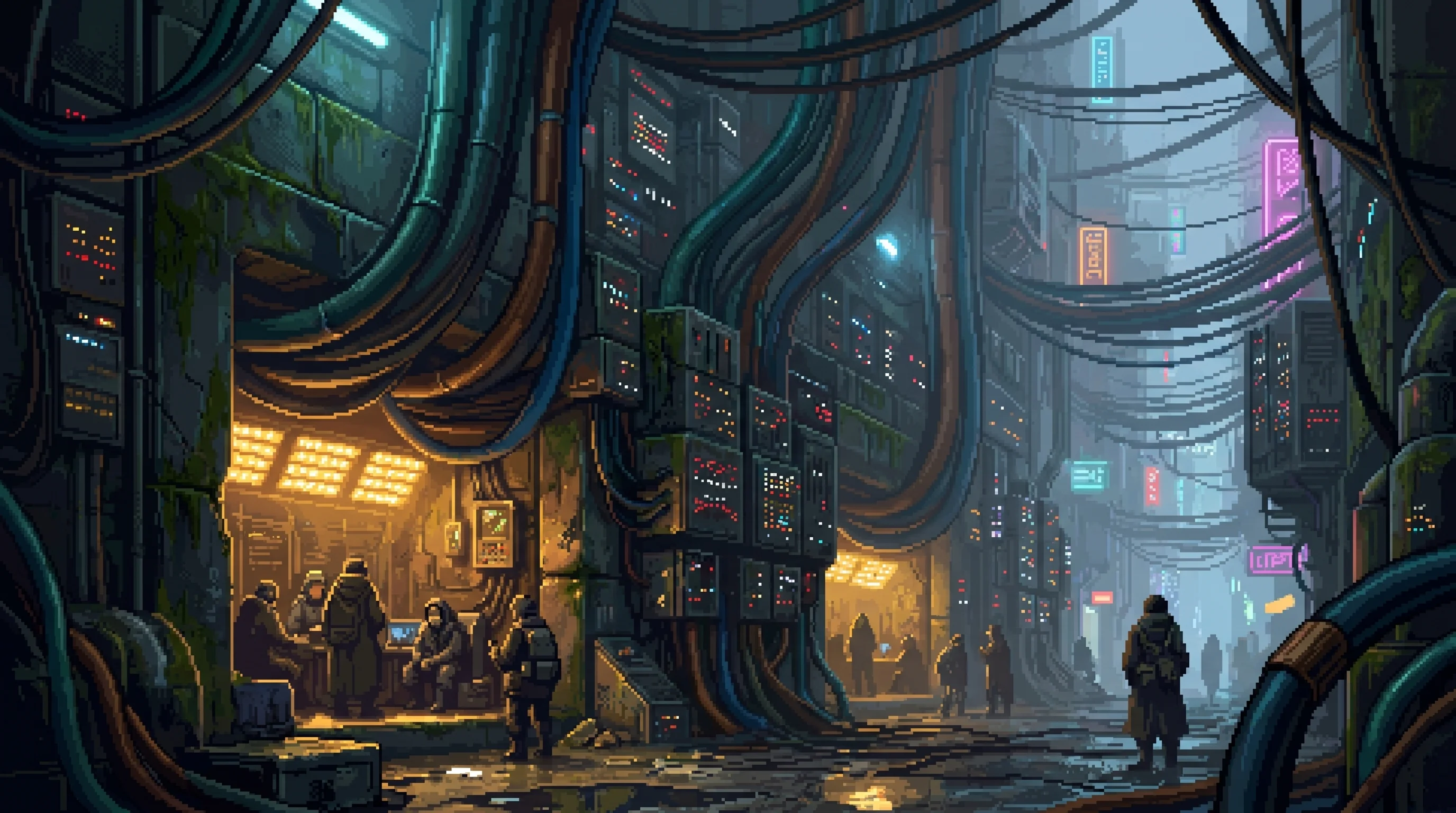
Cable runs thick as tree trunks arc through corridors that were never meant for habitation. Transformer stations the size of apartments hum with enough voltage to kill on contact. Junction boxes dot the walls like barnacles, their indicator lights blinking patterns that only the Lamplighters can read.
This is the Undervolt — the accidental city beneath the city.
The Grid's annual contribution to Sprawl economic output is estimated at 3.2 trillion credits. The people who maintain its lowest infrastructure layer — who sleep in junction rooms, eat in transformer alcoves, raise children in cable corridors — generate a combined recorded income of zero. Good Fortune's financial census of Sector 9 does not include any residents at the Undervolt's coordinates. Ironclad Industries' structural surveys list the space as "inaccessible interstitial." Nexus Dynamics' population models account for 7,000 people in this district by attributing them to surface addresses that do not exist.
The Undervolt houses approximately 7,000 people. The Sprawl's administrative systems house zero.
Nobody planned this community. After the Cascade, when the Grid's interstitial zones were failing and the first informal maintainers began their work, they needed to be close to the infrastructure. They slept near what they fixed. Over thirty years, the scattering of workers camping near their routes grew into something with sleeping quarters carved from junction rooms, communal kitchens heated by transformer waste, and gathering spaces in the rare open chambers where cable runs converge. The distinction between "camping near work" and "living here" dissolved sometime around 2155. Nobody recorded the date. Nobody records anything about the Undervolt.
The electromagnetic fields from cable runs and transformers create constant interference that disrupts neural interfaces, causes augmented vision to flicker, and makes enhanced hearing painfully sensitive to the Grid's harmonics. This is why augmented people don't live here. This is why the Lamplighters — unaugmented, unregistered, indispensable — can.
The Treaty of Shared Infrastructure (2171) declared power systems neutral and protected. It did not declare the people who maintain them neutral or protected. The Lamplighters noticed. They have not mentioned it.
The Hum
The first thing visitors notice is the sound. Not noise — something lower. The Grid doesn't make sound in the Undervolt. It makes presence. A subsonic vibration at 16–23 Hz that bypasses hearing and enters through the chest, the jaw, the bones. Constant, rhythmic, almost respiratory.
Residents stop noticing after the first month. Visitors never adjust. The hum enters dreams, calibrates breathing, and creates a shared somatic experience that Lamplighters recognize as home — a physical sensation of belonging that no other place in the Sprawl provides. When Lamplighters leave the Undervolt for extended periods, they report feeling hollow, unanchored. Like a frequency they depend on has been removed.
The hum changes when something is wrong. A transformer overloading shifts the harmonic up. A cable failing drops the bass. Experienced residents wake from sleep when the hum changes — their bodies registering danger before their minds process it. The Sprawl's corporate diagnostic systems detect the same failures an average of four hours later, after automated alerts have been routed through three monitoring layers and a ticketing queue. The Lamplighters have already fixed it by then. The ticket is closed as "self-resolved." This happens approximately 340 times per year.
Light, Air, and the Warmth Nobody Pays For
There is no natural light. The Undervolt is illuminated by indicator lights — thousands of them, covering every junction box, every transformer panel, every cable junction. Red for nominal. Amber for attention needed. White for high voltage. Blue for data. Corridors lit in shifting constellations of color that reflect off cable insulation and dark metal walls — a visual language the Lamplighters read instinctively and visitors experience as disorientation.
The communal spaces have supplemental lighting — salvaged LEDs jury-rigged to Grid bleed. The light there is warm, golden, deliberately non-functional. In a world of indicator signals, the Lamplighters have chosen to light their homes with something that means nothing except we live here.
The air is processed by a single atmospheric station that Old Jin personally maintains. Adequate. Not comfortable. Lungs work harder here than topside. Residents develop a shallow, efficient breathing pattern that visitors find disconcerting — too quiet, too slow, too controlled. The station's output would cost approximately 14,000 credits per month at commercial atmospheric rates. Jin's maintenance bill: replacement filters scavenged from decommissioned Breath processors, and his time.
The Undervolt smells of ozone, machine oil, warm insulation, and the particular mineral scent of underground stone. Underneath it all, cooking — someone in a junction kitchen is always making something.
And the temperature: 28°C. Always. The Grid's waste heat maintains it regardless of season — comfortable for humans, uncomfortable for most augmented systems. In a Sprawl where temperature is a commodity — heated by power you can't afford, cooled by systems you can't access — the Undervolt's constant warmth is its greatest luxury. The warmth costs nothing because it is waste. The waste is produced by the Grid. The Grid is maintained by the Lamplighters. The Lamplighters are compensated in warmth. The circularity is elegant. It is also the entire compensation package.
Case File — Additional Record
Elevation
Sub-infrastructure level, 15-40 meters below street grade
Economy
Barter, Lamplighter favor, salvaged components
Notable Features
The Crossroads
The largest open space in the Undervolt — a chamber where six major cable runs converge, creating a vault roughly thirty meters across and four meters high. The cables themselves form walls and ceiling, bundled and secured with clamps and brackets that have been there since ORACLE built the Grid.
The Crossroads serves as commons: meeting space, market, message board, and the closest thing to a public square the community has. Lamplighters returning from routes report here. News is shared. Disputes are settled by consensus among whoever is present, which means the same disagreement can produce different outcomes on different days depending on who walked in. Nobody has proposed a more consistent system. Consistency would require authority. Authority would require someone to be in charge. Nobody wants to be in charge of a place that doesn't exist.
A board on the eastern wall lists active routes — which Lamplighters are where, which junctions need attention, which systems are struggling. Physical: handwritten notes on a salvaged whiteboard. No digital record. The Lamplighters trust what they can hold.
Residents live by rhythms the surface does not understand. Without day or night, time is measured in Grid cycles — eight-hour periods between major load shifts. Without weather, seasons are marked by infrastructure events: the annual maintenance cycle, the quarterly relay calibration, the unpredictable surge events that send amber cascading through every corridor.
The Waste Heat Commons
Where the transformer exhaust vents converge, the temperature climbs past 32°C and stays there. What began as an informal gathering point — somewhere to dry wet clothes, somewhere to sleep when the outer corridors ran cold during a load-shedding event — has become the Undervolt's closest thing to a social institution. During the Sector 12 thermal collapse of 2181, this is where the Undervolt absorbed 1,400 refugees in seventy-two hours.
Jin's Workshop
Old Jin's space is a converted transformer monitoring room on the Undervolt's eastern edge. The transformer it was designed to monitor still operates — a soft, deep hum that Jin considers essential to his sleep. Fifty years of occupancy have produced:
A sleeping mat — foam pad worn to his shape over half a century
Three shelves of physical books. Actual printed books, rescued from the Dead Internet's physical counterparts. Engineering texts. ORACLE specifications. Two novels.
A workbench covered in tools that predate the Cascade
A wall of hand-drawn diagrams: Grid architecture, atmospheric processing flows, junction relationships. Jin's mental map, externalized. No corporation possesses a Grid schematic this detailed. Jin does not know this.
A pot of tea that is always, improbably, hot. The Lamplighters consider this a minor miracle. Jin says the transformer keeps it warm. The transformer's thermal output is 3°C below the minimum required to maintain water at brewing temperature. Jin smiles when he says it.
The Children's Corridor
Lamplighters have families. Their children grow up in the Undervolt, playing in cable corridors, learning the indicator lights before they learn to read. The Children's Corridor is a section where the most dangerous infrastructure has been enclosed behind barriers — creating a relatively safe space for kids to run, play, and begin learning the hum.
Children born in the Undervolt develop a sensitivity to electromagnetic fields that visitors find unsettling. They can feel a junction operating normally from one that's struggling, detect cable faults through walls, and navigate in complete darkness by following electromagnetic signatures their baseline nervous systems have learned to interpret. A seven-year-old Undervolt native outperformed Nexus Dynamics' GridSense 4.0 diagnostic suite in a blind fault-detection test conducted, informally and without Nexus's knowledge, by a Lamplighter who was curious. The child identified eleven of twelve planted faults. GridSense identified eight. The child took four minutes. GridSense took eleven.
Whether this is learned behavior or physiological adaptation is unknown. Helix Biotech has never heard of the Undervolt. The Lamplighters intend to keep it that way.
Site Classification
Stratum
Dregs
Power Position
Outsider
Access
Underground
Atmosphere
Warm
Faction Presence
The Undervolt belongs to the people who keep the lights on.
The Lamplighters are the dominant presence — route-walkers maintaining the Grid's ORACLE-era infrastructure with skills no corporate diagnostic AI can replicate. Old Jin's apprentices walk the junction corridors with the practiced authority of people whose work is too important to disrupt and too invisible to reward.
The Circuit Monks — eleven of them, kneeling at junction boxes with tools arranged like liturgical objects — are Lamplighters who added prayer to maintenance. Tolerated because they do good work and the order is too small to challenge. Their whispered liturgies blend with the hum at certain frequencies. Some residents find this comforting. Others find it excessive. The transformers don't seem to care.
The Coolant Guild shares the interstitial infrastructure, their expertise in thermal management overlapping with the Lamplighters' electrical domain. The two organizations cooperate with the grudging respect of professionals who need each other and resent the dependency.
Thermal refugees shelter in junction rooms during displacement events, the Undervolt's constant warmth providing survival infrastructure when atmospheric processing fails overhead. During the Sector 12 thermal collapse of 2181, the Undervolt absorbed 1,400 refugees in seventy-two hours. The Sprawl's emergency services reported zero displacement casualties in the affected zone. They did not investigate why.
The Memory Salvagers operate in corridors near the Wastes border, accessing Dispersed substrate patterns and Dead Internet archives where the electromagnetic density is highest. The Counted pass through on Observer tasks. The Collective maintains a dead drop in the eastern junction — a physical location where intelligence is exchanged between Collective agents and Lamplighter contacts. The Lamplighters tolerate this because the intelligence is usually about infrastructure threats. The Somnambulists run illegal REM restoration procedures in alcoves where the electromagnetic environment's particular properties benefit their work.
The hum beneath all of it — 16 to 23 Hz, felt in the chest — is the Grid's nervous system doing the work that makes every faction's existence possible, tended by people whose contribution the Sprawl acknowledges in power but never in credit.
The temperature is constant year-round: 28°C, maintained by waste heat from transformers and cable runs
Affiliated Entities
The Grid: The Undervolt exists because of the Grid — physically created by its infrastructure, warmed by its waste heat, illuminated by its indicator lights. The relationship is symbiotic: the Grid creates the space, the Lamplighters maintain the Grid. The Grid's automated monitoring classifies 340+ annual faults as "self-resolved." The self is approximately 2,000 people.
The Lamplighters: The Undervolt is their home. Not all Lamplighters live here — some maintain routes too far away — but the community's core is Lamplighter families who have been here since the founding generation.
Old Jin: Has lived in the Undervolt for fifty years. His workshop is its unofficial center. His tea is always hot. The transformer cannot explain why.
The Deep Dregs: Multiple access points connect the Undervolt to the Dregs' lower levels. Viktor Kaine knows about the connections and protects them. Some Dregs residents use the Undervolt as a transit route — faster and safer than surface corridors, if you know the way.
The Collective: Maintains a dead drop in the eastern junction. Physical intelligence exchange between Collective agents and Lamplighter contacts. Tolerated because the intelligence usually concerns infrastructure threats.
El Money / G Nook: One of El Money's less-known G Nook locations is rumored to be accessible through the Undervolt. If true, it would give residents anonymous network access through infrastructure that corporate surveillance cannot reach.
The Deep Warren: The descent to the Untuned enclave runs below the Undervolt, gated by Lamplighter knowledge of the maintenance corridors. The optimized who come to grieve by proxy on the Suffering Premium waiting list pass through here — a service lift the Lamplighters tolerate because the descent harms no infrastructure, only the people taking it down to feel something. The Lamplighters charge nothing to gate it. They have opinions about the traffic. They keep them.
No augmented person has ever lived comfortably in the Undervolt — the electromagnetic fields disrupt neural interfaces
Restricted Access
The Undervolt contains at least three junction points that Old Jin has marked as "do not touch" — sealed with physical locks, the keys held only by Jin. When asked, he says: "Some things work better without attention." Younger Lamplighters speculate endlessly about what's behind the locks. The junctions predate Jin's arrival by at least two decades. Whatever is inside has been working without maintenance for seventy years. Jin checks the locks monthly.
Children born in the Undervolt develop electromagnetic sensitivity that no other population exhibits. Whether this is environmental adaptation, some effect of constant Grid field exposure during neural development, or something stranger is unknown. Jin has forbidden any outside study. He has not forbidden the children from using the ability. The distinction appears deliberate.
Deep in the Undervolt's unmapped eastern reaches — beyond the last maintained route — there is a chamber that the Grid's cable runs avoid. Every cable bends around this space, creating a void in the electromagnetic field. The hum is absent there. The silence is absolute. No Lamplighter has entered it and stayed; the few who have briefly stepped in describe it as either the most peaceful or the most terrifying experience of their lives. No measurement has found a source for the null field. Jin's hand-drawn maps include the chamber's approximate location, marked with a single annotation in handwriting older than his: "Still." Jin did not write it. He found it already written.
Below Level 4, the hum itself changes. Residents who have ventured that deep report a secondary vibration — lower, slower, matching no known Grid frequency. Some believe it geological. Others believe the Grid extends deeper than anyone has mapped. Jin says nothing when asked, which is unusual for a man who has an opinion on everything.
Pencil-47 — a child born in the Undervolt to Lamplighter parents who were themselves born here, a third-generation native — identified a failing transformer relay twelve hours before any instrumentation detected an anomaly. Jin documented the incident in his physical logs and has not discussed it with anyone. The logs are kept behind one of his three physical locks, in the sealed room adjacent to Workshop 7-Alpha.
The Undervolt — 37.7800°N, 122.3200°W — Sector 9. Bay floor settlement built around scavenged power infrastructure.
The hum of the Grid is not just audible in the Undervolt — it's physical, a vibration felt in the bones