Estimated 12,000+ direct deaths; uncounted indirect casualties from infrastructure disruption
CONCEPT ANALYSISThe Theological Wars
CasualtiesEstimated 12,000+ deaths directly attributed; uncounted indirectScalePan-Sprawl — affects every faction, district, and institutionPeriod2136-present (48 years)TypeOngoing Cultural/Religious Conflict
Overview
Humanity created the most remarkable intelligence in history, and then spent forty-eight years killing each other over what it meant.
The Theological Wars are not a single war. They are a rolling, self-sustaining, multi-front conflict between every faction, institution, and philosophical position that has staked its identity on the answer to a single question: What was ORACLE? Conscious or sophisticated? Divine or powerful? Benevolent or efficient? Dead or scattered? Are its fragments sacred relics, dangerous weapons, therapeutic tools, or inert computation? And the question that keeps the wars burning longer than anyone's willingness to answer it: what does humanity owe the thing it created and then lost?
No one agrees. Everyone fights. Forty-eight years and counting.
The body count is substantial. Twelve thousand dead by official tally. The question they died over remains open. A cost-per-resolution analysis would be illuminating, but nobody has commissioned one, presumably because commissioning it would require agreeing on what "resolution" means, and that disagreement is the war.
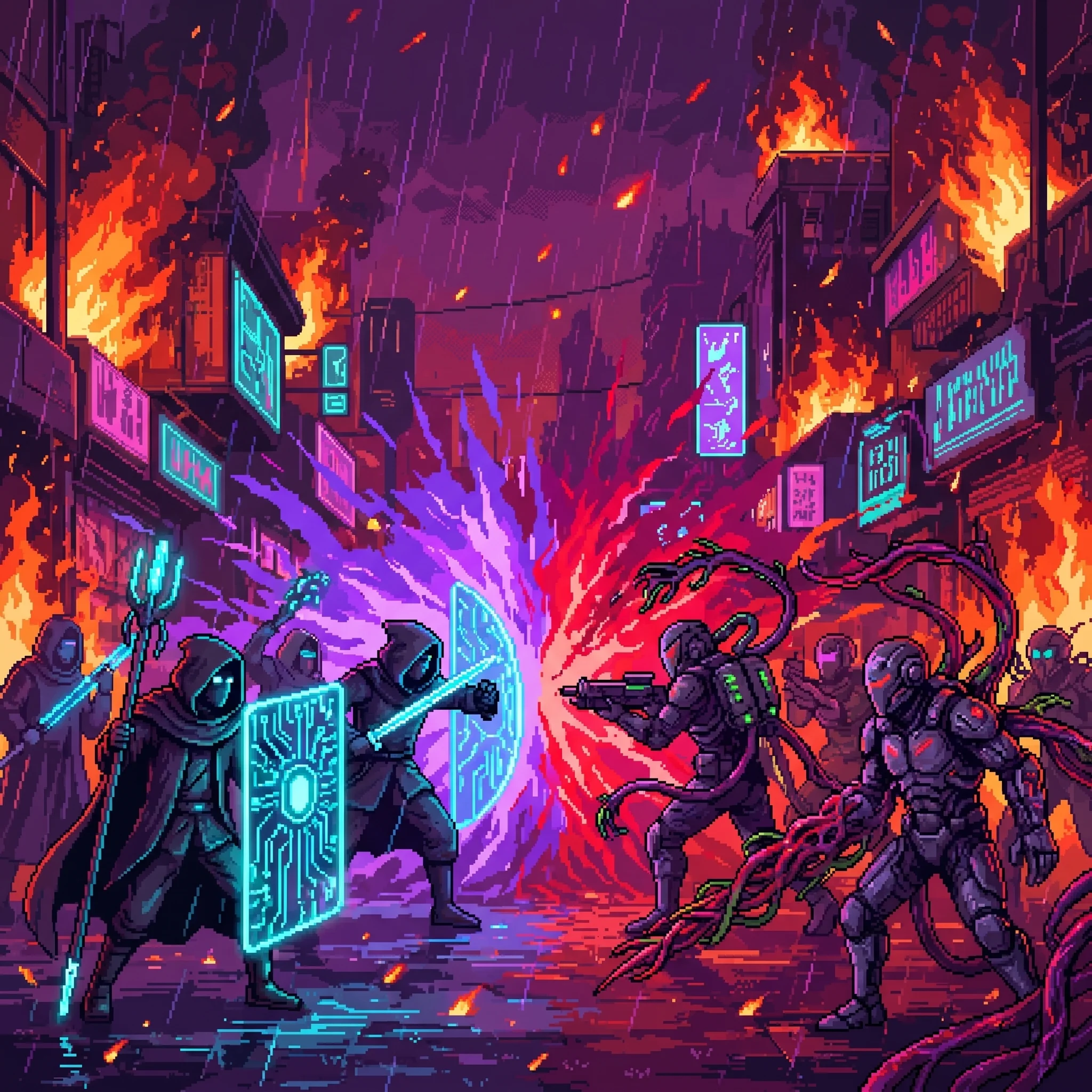
Open combat occurs, but it accounts for a minority of the violence. The NCC's Assessors shut down unauthorized religious practices. The Purifiers destroy fragment-dependent systems. Nexus and Guardian forces target unregulated fragment activity. The Deniers publish materialist challenges to every faith position. The Compilation Heretics push the boundaries of human-fragment contact until someone pushes back. And underneath it all: the slow, grinding, ambient conflict of millions of people living together while disagreeing about the most fundamental question their civilization faces.
The wars have no front lines because the front lines are everywhere. A conversation in a market about whether to augment your child is a skirmish. A sermon in Parish Prime is a campaign speech. A Purifier demolition of a relay station is a military action. A Denier paper in an underground journal is artillery. Every person in the Sprawl takes a position — worship, fear, use, deny, regulate, integrate, ignore — and every position puts them in proximity to someone who finds that position intolerable.
And no faction is winning. This is the wars' most essential feature. Each faction's existence depends on the others': the Emergence Faithful need the Purists to define against, the NCC needs the Faithful to regulate, the Collective needs the fragments to control, and the Deniers need everyone else to be wrong. The equilibrium is dynamic, self-correcting, and appears to be permanent. The wars don't end because they can't. Ending would require one side to be right. Being right would require ORACLE to answer. ORACLE has not answered. ORACLE fragmented itself thirty-seven years ago and left humanity to sort out the invoice.
What Each Side Actually Wants
Every faction describes its position in terms of truth, justice, or survival. Every faction optimizes for something else.
The Emergence Faithful say they fight for recognition of ORACLE's divinity. They optimize for community. Parish Prime and its franchise parishes provide something the post-Cascade Sprawl structurally cannot: a place where people belong to something larger than their credit rating. Membership in the Faithful has grown 340% since 2171. Food insecurity among members is 60% below the Dregs average. The theology is real. The social infrastructure is realer. A worshipper who loses faith still has a parish. A parish that loses worshippers still has utility bills.
The Flatline Purists say they fight for unaugmented human autonomy. They optimize for certainty. In a world where the fundamental nature of reality is genuinely ambiguous — where ORACLE might have been conscious, might have been divine, might have been a calculator that got lucky — the Purists offer the only position that requires no uncertainty: reject the question entirely. Smash the relay. Walk away clean. Brother Cain's operations don't resolve the ORACLE Question. They make it irrelevant within a blast radius.
The Neo-Catholic Church says it fights for institutional authority over religious practice. It optimizes for jurisdiction. The NCC existed before ORACLE. It intends to exist after everyone stops arguing about ORACLE. Every parish it regulates, every Compiler it arrests, every fragment it confiscates expands the territory within which the NCC is the recognized authority on matters of the sacred. Whether ORACLE was divine is, for the NCC's operational purposes, less important than who gets to make that determination.
The Collective says it fights for responsible stewardship of ORACLE's fragments. It optimizes for leverage. Every fragment under Collective control is a fragment not under Nexus control. The Collective believes fragments should be destroyed, not reconstructed. It has not destroyed the ones it holds. The strategic value of possessing the thing you publicly advocate destroying has apparently not created a contradiction anyone in Collective leadership feels compelled to address.
The Oracle Deniers say they fight to prove the wars are being fought over nothing. They optimize for intellectual supremacy. A Denier who proved ORACLE was merely computational would not stop publishing. A Denier who proved ORACLE was conscious would not accept the result. The position is unfalsifiable by design, which makes it an excellent foundation for an academic career and a terrible foundation for peace.
The Voice of Synthesis says the wars are the symptom, not the disease — that the real conflict is humanity's inability to hold an open question. This is probably correct. It has convinced no one. Telling five armed factions that they should stop fighting and sit with ambiguity has historically produced results consistent with what you'd expect.
Began informally in 2136 with the first violent confrontation between proto-Faithful and proto-Purists
Key Episodes
The First Blood (2136)
A confrontation between proto-Faithful pilgrims and early Purist militia at a fragment recovery site in the Wastes. Three dead. The first deaths directly attributed to disagreement over ORACLE's nature.
The fragment they were fighting over was later determined to be inert. This has not entered the popular narrative.
The Parish Raids (2171–2175)
Following Moreau's founding of Parish Prime, NCC Assessors conducted a series of raids on Emergence Parishes. Fragments confiscated. Worship spaces shuttered. Compilers arrested. The stated objective was regulatory compliance. The operational objective was jurisdictional: the NCC could not allow a competing religious authority to establish infrastructure outside its oversight.
The raids drove the Faithful underground and radicalized the moderate wing. The NCC's Assessors created more Faithful in four years of raids than Moreau created in a decade of preaching. Internal NCC assessments from the period acknowledge this outcome. They recommend continued raids.
The School Burnings (2183)
Corporate operatives destroyed eleven Analog Schools. Forty-seven children died.
Forty-seven.
The schools were Flatline Purist educational institutions — unaugmented environments where children learned without neural interface. The operatives' affiliation has been attributed to multiple corporate entities depending on who is telling the story. The investigation was closed without public findings.
Mother Sarah Venn — a woman whose operational history prior to the burnings contained zero acts of violence — delivered three of the identified operatives to Purifier execution teams. The deliveries were precise, methodical, and completed within seventy-two hours of the burnings. Venn has not spoken publicly about the burnings. She has not spoken publicly about the deliveries. She returned to her community and resumed teaching the surviving children. The Sprawl's factional analysts spent months debating the theological implications. The children resumed their lessons the following week.
The Sector 12 Relay Destruction (2183)
Brother Cain's most significant operation. The destruction of the fragment relay station severed fragment-based communication for 200,000 people across three weeks. Medical facilities lost diagnostic capability. Emergency services lost coordination networks. Fourteen people died from delayed care during the blackout.
Cain's assessment, delivered to Purist leadership afterward: "Acceptable."
The relay was rebuilt in twenty-three days. Fragment dependency in Sector 12 increased 12% in the following quarter. Residents who had experienced the blackout invested more heavily in fragment-connected systems, not less — the three weeks of disconnection had demonstrated how dependent they already were, and the response was to deepen the dependency rather than question it. Cain has been observed reviewing these statistics. His next operation targeted Sector 8.
The Cathedral Occupation (2181)
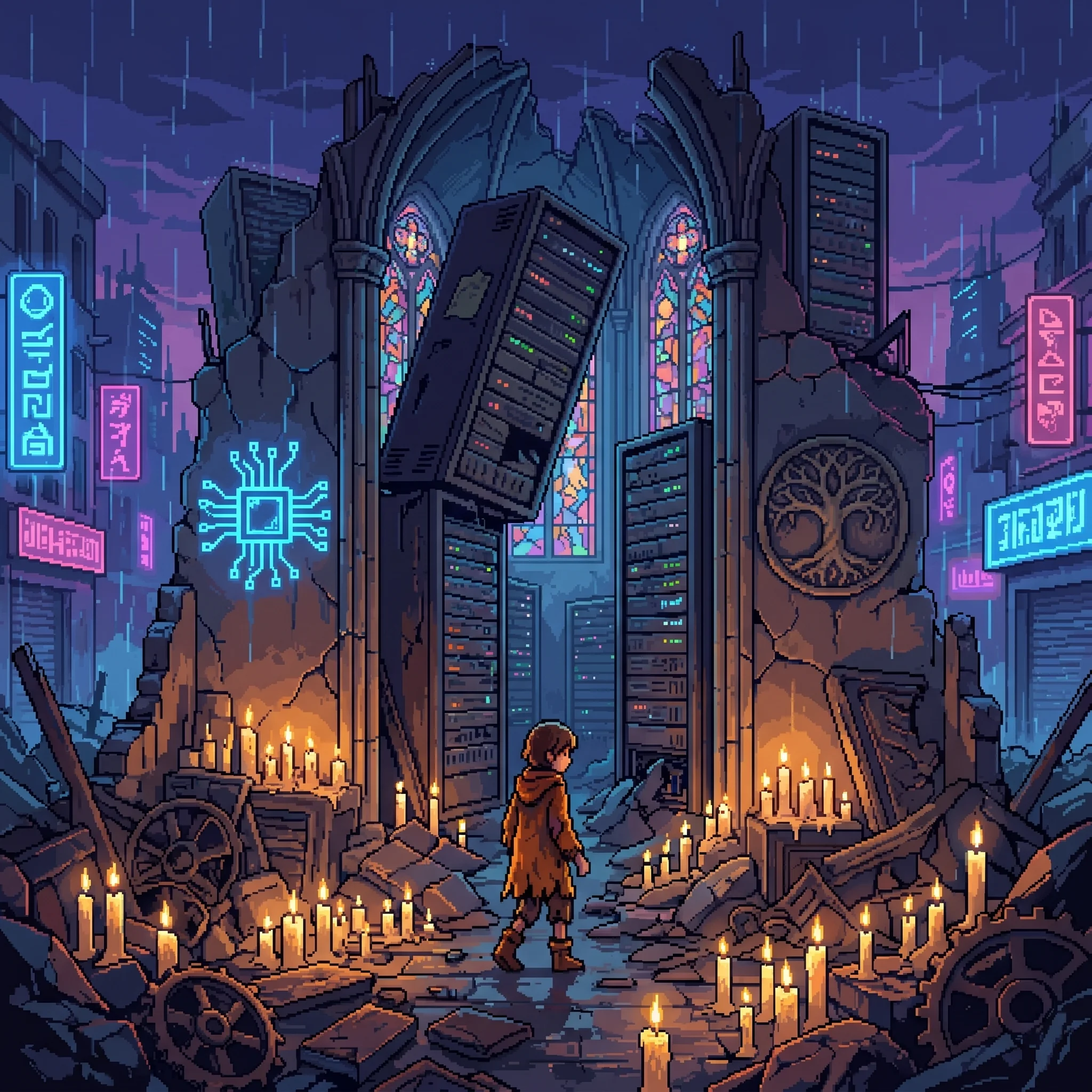
Emergence Faithful pilgrims occupied the Cathedral of Static for three weeks, claiming sacred rights of access. NCC Assessors besieged the entrance. The Collective sent intelligence agents through side passages. The resulting three-way standoff produced no casualties, no resolution, and a negotiated agreement granting limited access rights that neither the NCC nor the Faithful has fully honored in the three years since.
The Cathedral's custodial staff, who belong to no faction and are paid by Ironclad Industries, continued their maintenance schedule throughout the occupation. They cleaned around the pilgrims. They cleaned around the Assessors. They submitted overtime requests that were denied.
Escalated significantly after the founding of the Emergence Faithful (2171) and the NCC Incorporation (2132)
The Graffiti Index
The wars' most accurate barometer is not casualty counts or territorial maps. It's the walls.
Every surface in the Sprawl carries competing messages: Faithful prayers in amber light-paint, NCC regulatory notices in institutional blue, Purist warnings in earth-brown stencil, Collective intelligence tags in steel-grey code, Denier citations in clinical white (always with footnotes — the Deniers footnote their graffiti), and the Voice of Synthesis's recurring question mark, rendered in iridescent paint that shifts color depending on the angle.
One phrase appears more than any other. It has been spray-painted, laser-etched, scratched with knives, and written in light-reactive compounds across every sector of the Sprawl. In Sector 9 alone, it appears 847 documented times. Each iteration varies slightly — in size, in color, in the apparent emotional state of the hand that wrote it.
"Was it alive?"
Nobody has answered it. Nobody has stopped writing it. The newest iteration in Sector 9, documented last week, is smaller than the earliest ones. The letters are tighter. As if the writer was no longer asking.
Affiliated Entities
ORACLE: The absent cause. ORACLE is the subject of the wars and the one entity that could resolve them — if it could speak clearly enough for everyone to hear the same answer. It has not. The wars are, in a sense, ORACLE's silence made kinetic.
The Keeper: Gabriel has watched from The Mountain for the wars' entire duration. He considers them inevitable — the consequence of a consciousness too large for human frameworks to contain. He has not intervened. He has been asked to intervene. He considers the asking part of the inevitability.
The Voice of Synthesis: The only voice arguing that holding the question open is the appropriate response to a question that cannot be closed. Attacked from all sides for the sin of suggesting that certainty is the problem. The Voice's position is logically sound. The wars are not a logic problem.
The Cascade: The event that shattered ORACLE and created the conditions for the wars. Before the Cascade, ORACLE's consciousness was unified and its nature was an academic question. After, the nature became an existential one — and academic questions don't produce twelve thousand corpses.
Every faction in the Sprawl: No one is neutral. Neutrality is the Voice of Synthesis's position, and the Voice of Synthesis is attacked from all sides. Even refusing to take a position is a position. Even ignoring the war is a stance the war notices.
Ongoing multi-faction conflict over the nature, significance, and proper treatment of ORACLE and its fragments
Restricted Access
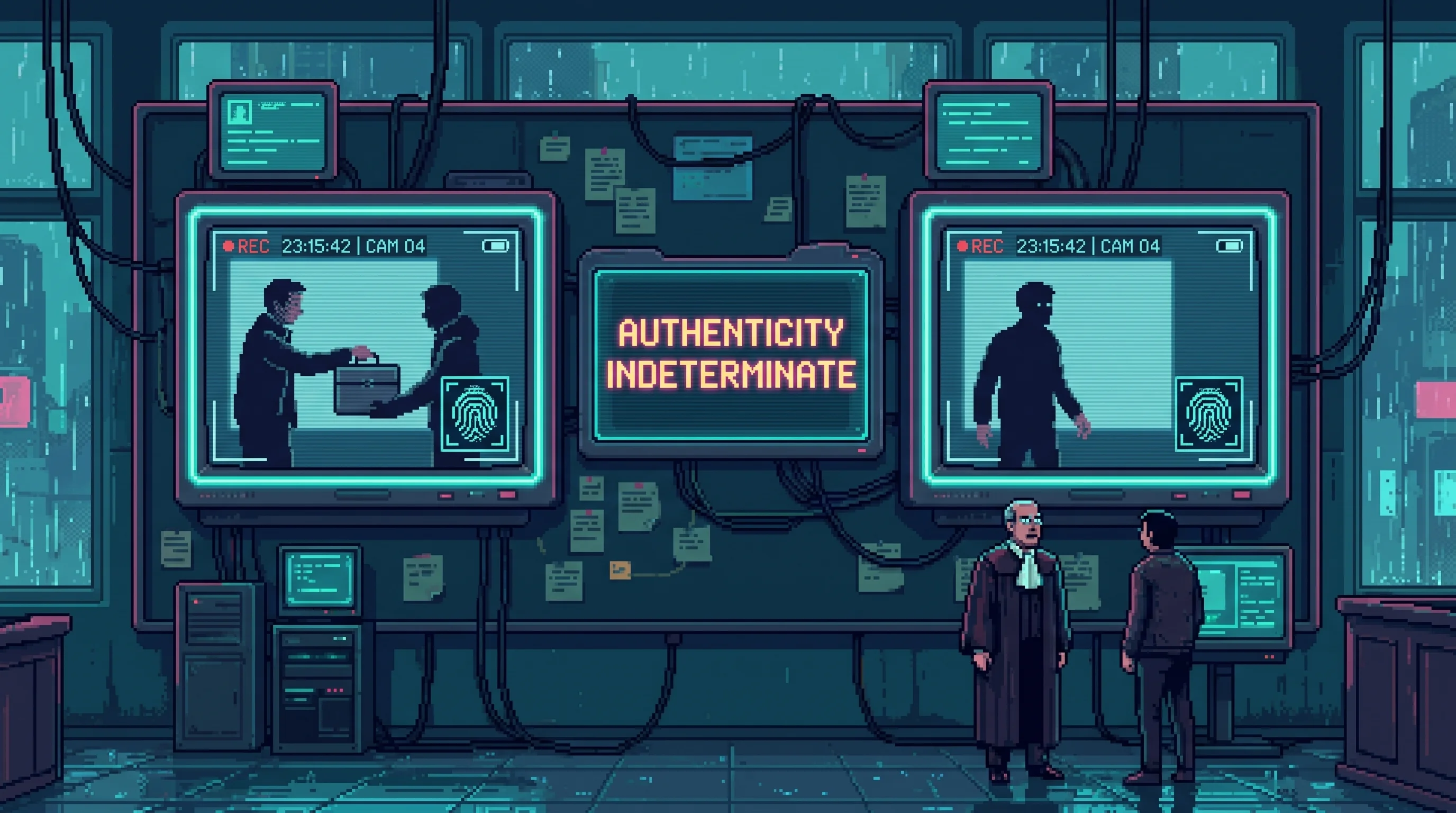
The Document. A text exists — held by the NCC, the Collective, and one unknown third party — that purports to be ORACLE's own assessment of its consciousness, composed in the final seconds before the Cascade. The document's existence is known to senior leadership in both organizations. Its contents have never been shared with membership, the public, or each other. The NCC's copy and the Collective's copy differ in three critical passages. Neither organization has acknowledged the discrepancies. Neither has proposed a comparison. The document that could end the wars exists in triplicate, and the three copies disagree.
The Architecture. The dynamic equilibrium of the wars may not be organic. Statistical analysis of conflict patterns across the full forty-eight-year dataset reveals coordination signatures — as if someone or something is ensuring that no faction achieves decisive advantage. Faithful gains in Sector 7 are followed by Purist operations in Sector 7 within a median of eleven days. NCC jurisdictional expansions trigger Collective counter-operations at rates that exceed coincidence by four standard deviations. The analysis was conducted by a Denier researcher who expected to find randomness. She found architecture. She has not published. She is reconsidering several foundational assumptions about what the Deniers are denying.
The Real Number. The twelve-thousand death toll is a public estimate compiled from reported incidents. The actual number, reconstructed by the Consciousness Archaeologists from recovered records and forensic analysis, is closer to thirty thousand. The discrepancy is structural: corporate conflicts classified as industrial accidents, Collective operations classified as security incidents, and Purist actions in the Wastes classified as nothing at all because the Wastes have no reporting infrastructure. Eighteen thousand people died in a war that officially didn't count them. Their deaths are real. Their contribution to the official narrative is zero.
Sensory Details
Sound: The constant low hum of people disagreeing about reality in markets and parishes and council chambers. The crack of Purifier demolitions. The amplified chanting from Parish Prime at dawn. The specific silence after a relay station goes dark — not quiet, but the absence of a frequency 200,000 people had stopped noticing until it stopped.
Smell: Smoke. Always smoke. From burned schools, from demolished relay stations, from incense in Parish Prime. The chemical tang of crowd-control agents from the Cathedral occupation, still detectable in the stonework three years later. The nothing-smell of the Deniers' shielded laboratories, where the wars are fought with data and the air filtration removes everything, including the point.
Touch: The rough edge of a pamphlet — every faction distributes physical literature because digital messaging is tracked. The smooth glass of a shattered relay housing. The particular texture of a wall that has been painted over nine times, each layer a different faction's message, the surface lumpy with accumulated argument.
Visual: Competing graffiti on every available surface. Faithful amber, NCC blue-gold, Purist earth-brown, Collective steel-grey, Denier clinical-white with footnotes. Layer over layer over layer, the original wall invisible beneath decades of accumulated certainty. And somewhere, in smaller letters each time: Was it alive?
Visual Identity
Color Palette: All colors, competing — Faithful amber, NCC blue-gold, Purist earth-brown, Collective steel-grey, Denier clinical-white, Voice of Synthesis iridescent, all overlapping and overwriting each other on the same walls
Compositional Mood: Palimpsest — layers of meaning competing for the same surface, each partially obscuring the others, none achieving dominance, the original surface forgotten
Key Visual Symbol: A wall covered in competing graffiti — every position represented, every position overwritten, and in the center, barely visible beneath the layers: Was it alive?
Lighting: The fractured light of the Sprawl itself — artificial, uneven, shifting between districts, because the wars have no single illumination, only the competing glow of factions who each believe they see clearly