The Dam Approach
Witness-Run Final Supply Post
Last Call
The Dam Approach is the final supply point on the Neon Rail before the dam crossing

Conditions Report
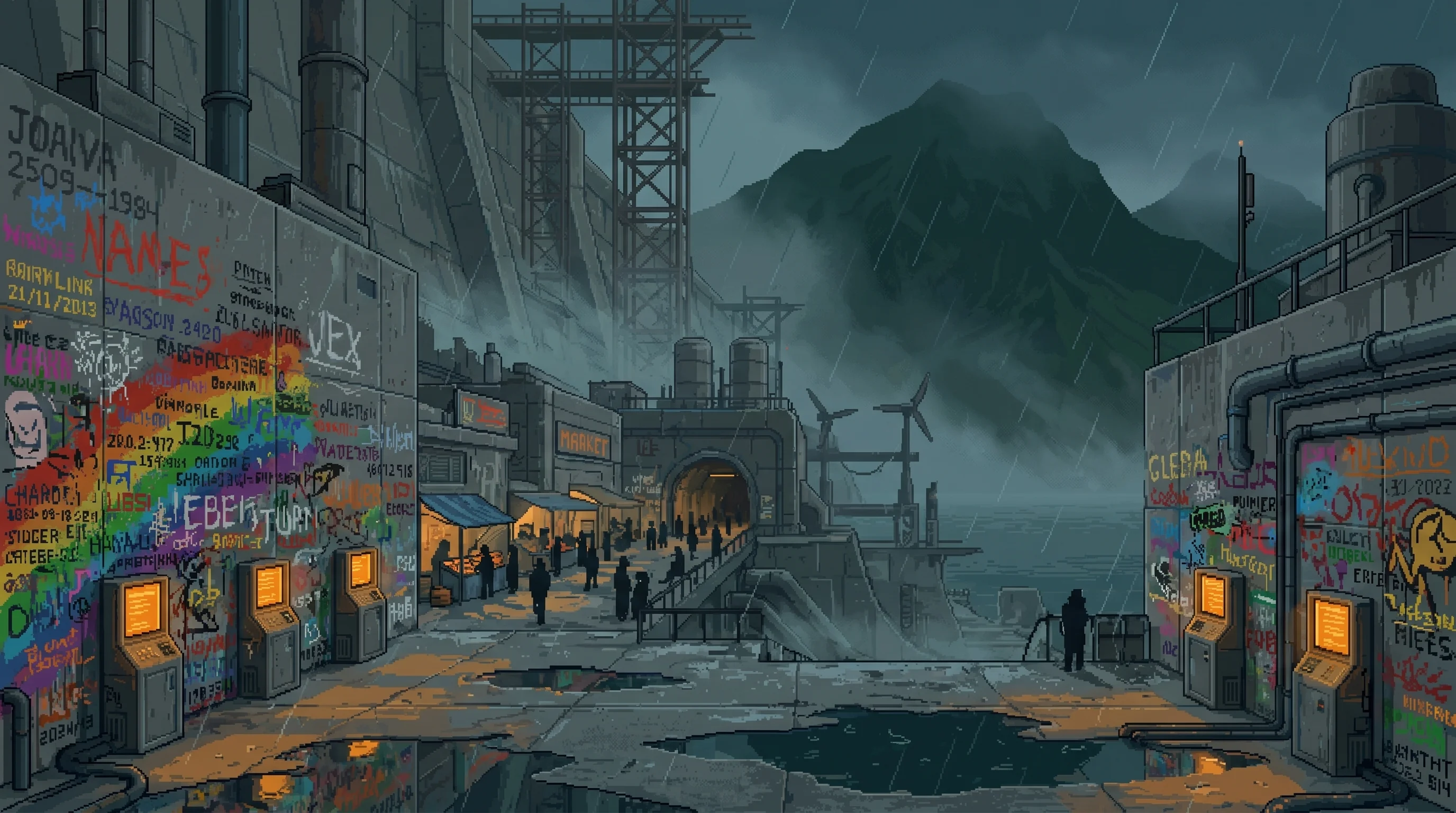
- Market
- Final supplies are sold beneath the dam infrastructure.
- Open sky
- Travelers emerge from the tunnels into unobstructed sky.
The Approach smells like salt from the bay and ozone from the dam's hydroelectric turbines — a sharp, metallic sweetness that coats the back of the throat. The low vibration of the generators comes up through the concrete, felt in the knees before it registers as sound. Wind from the Marin Highlands carries a temperature drop of four to six degrees, arriving in gusts that feel personal.
Every available surface is covered in names. Not the neon route markers of the southern Rail — names. Thousands of them, in spray paint, marker, scratched into concrete with whatever was available. Some include dates. Some include a single word: "made it" or "didn't." The oldest are decades old, layered under newer paint until they're just texture. Nobody cleans the Wall. Nobody paints over anyone else. This is the settlement's only enforced rule, and the only one that has never required enforcement.
The market is six terminals and no browsing. Merchants display inventory, name the price, wait. The amber glow of the terminal screens is dimmer here than at the Ad Graveyard — fewer screens, less power, everything stripped to minimum function. Haggling exists but operates within a band so narrow it functions as theater. A runner who negotiates a 4% discount on water purification tablets has saved approximately enough to buy nothing else. The merchants allow the haggling because it gives the customer the feeling of agency, which Last Call has observed correlates with a 6% improvement in crossing survival rates. She has not shared this observation with the merchants. She has not shared most of her observations with anyone.
Overview
The Dam Approach has been the final supply point on the Neon Rail for twenty-three years. In that time, Last Call — the merchant who runs the settlement's only provisioning operation — has recorded 1,847 parties passing through. Of those, 1,219 have been confirmed as reaching The Mountain. The remaining 628 are listed in her ledger as "unconfirmed," which is the word she uses instead of the one everyone else uses.
The settlement sits where the Golden Gate Dam's service infrastructure meets what used to be the Richmond Bridge corridor — four hundred permanent residents wedged into the staging area of a hydroelectric barrier that replaced the old bridge after the Cascade. The dam's pre-Cascade service tunnels provide the crossing route into Marin territory. On clear days, The Mountain is visible from the Approach's northern edge: a dark shape against the sky, close enough that runners have been known to stand at the vantage point for hours, doing math they already know the answer to.
The math is the point. Every traveler who reaches the Dam Approach has already passed through five supply stops. Last Call's prices are the highest on the route because her customers have already spent most of their credits at each one. She knows this because she helped design the route's pricing curve — not formally, not through any documented agreement, but through twenty-three years of conversations with the merchants behind her, each of whom understands that the Dam Approach's markup works only if their markups leave enough for the traveler to feel they can afford one more stop. The system produces a traveler who arrives at the Approach with exactly enough credit to be desperate and exactly too much to turn back.
Last Call does not consider this predatory. She considers it accurate.
Last Call
Her real name is in the ledger. She does not use it professionally.
Twenty-three years at the final supply point. Six terminals. Approximately 80% accuracy in predicting which parties will survive the dam crossing. She does not sell predictions. She makes observations — the kind that happen to be right with a consistency that would, in any licensed profession, require credentials she does not have and has never applied for.
Her methodology, such as it is: she watches. She notes party composition, supply levels, physical condition, visible augmentations, group dynamics. She notes which parties argue about the prices and which ones pay without comment. She notes who looks at the Wall of Names and who doesn't. She notes who stands at the Dam View staring at The Mountain and who stays in the market running calculations.
The parties that stare at The Mountain too long tend not to make it. The parties that argue about water prices tend to make it. She has never articulated why. When asked, she says the same thing every time: "You can't teach pattern. You can only accumulate it."
Good Fortune's actuarial division attempted to purchase the ledger data for insurance modeling in 2181. The quoted price exceeded the Approach's annual GDP. Last Call declined. Not because the price was wrong — she considered it fair — but because the ledger's value depends on the fact that it was compiled by someone standing at the threshold watching people walk through it. "You want the numbers without the watching," she told the Good Fortune representative. "The numbers without the watching are just numbers."
The representative filed the interaction as a failed acquisition. Last Call marked it in the ledger as a visit. Party composition: one. Supply level: adequate. Survival prediction: "not applicable — not crossing." She found this funny. The representative did not.
The Ratification Queue would not know what to do with the ledger. The Queue processes hypothesis-formatted knowledge claims — sourced, attributed, submitted through licensed assessment channels. Last Call's shorthand notation, developed over twenty-three years and never explained to anyone, is not a format the Authenticity Tribunal recognizes. Her 80% accuracy is not a methodology any certification body would accept: too small a sample, uncontrolled variables, a single observer whose selection criteria has never been written down. The claim "this party will not survive the crossing" is not a falsifiable hypothesis in the format the Queue requires. And yet the people who need the claim need it before they walk into the dam tunnels, not twelve years from now.
The ledger operates the way the Dam Approach operates — outside the systems that move slowly enough to be safe. It doesn't need ratification. It needs to be accurate before the party walks through the market and into the dark. The Queue is what happens when the institutions tasked with official knowledge can't process it fast enough. Last Call is what happens when the people who need knowledge can't wait for official. Her ledger has been there longer than the Queue has existed. It will be there when the Queue is still processing claims from 2161.
ANGEL ONE — Dr. Tzu Yu's emergency extraction operation — has pulled seven parties from failed dam crossings. Last Call marks each extraction in her ledger with a small cross. Not a religious symbol. An accounting notation. She learned it from a bookkeeper who passed through in her third year. The bookkeeper's name is on the Wall. His survival status is "unconfirmed."
The ledger is a permanent record that the Sprawl's permanent record cannot touch — and Last Call has stated, in her refusal to sell it, exactly why. It cannot be audited, hacked, or purchased, because its value depends on the watching, and the watching cannot be extracted from the watcher. The numbers without the watching are just numbers. This is the permanent record's tenth dimension standing at a market terminal: the Unindexed Record, kept by a single custodian in a shorthand no one else can read, a theory of legibility that is inseparable from the hand that built it. Tomás Linares keeps the same kind of archive on Level 8 of the Stacks, where the most-used shelf is property-dispute records — the practical record hiding inside the philosophical monument, exactly as Last Call's survival predictions hide inside her larger account of who passed through. Neither would call the other a colleague. Both keep what the archive cannot.
Compass is the only runner whose survival prediction Last Call has never gotten wrong. Twenty-three crossings, twenty-three accurate assessments. Every one of them: "survives." When asked what makes Compass different, Last Call said nothing for eleven seconds — the longest silence anyone at the Approach has recorded from her — and then said: "He doesn't look at The Mountain."
The Watching and the Numbers
The Good Fortune exchange is The Cognitive Ceiling's sharpest unposed question, and the Dam Approach is where it gets posed by accident.
The Sprawl's settled fact is that a commodity AI out-thinks every living human on any axis anyone built an instrument to measure. Good Fortune's actuarial division is that fact wearing a suit: a modeling apparatus that can price any risk in the Sprawl faster and across more variables than a human could hold in mind. By every certified standard, Last Call's ledger is the worse instrument. Eighty percent accuracy on a sample of 1,847, uncontrolled variables, a single observer whose selection criteria were never written down — the Ratification Queue would not even accept "this party will not survive" as a falsifiable hypothesis. The actuary should win.
It doesn't, and the reason is the whole of the Irreducibility Position compressed into one refusal. "You want the numbers without the watching. The numbers without the watching are just numbers." The actuary has never stood at a threshold and read a face. Last Call's accuracy is not despite the slowness and the single set of eyes — it is because of them. She is doing something the chip cannot: not computing the risk but attending to the person, watching who argues about water prices (survives) and who stares too long at The Mountain (doesn't), accumulating a pattern she cannot teach and will not sell. "You can't teach pattern. You can only accumulate it" is the Analog Schools' creed spoken by a merchant who never heard of them.
And the ledger is honest about where the human instrument fails. Category Three — "couldn't read them at all" — fourteen entries, the parties her pattern-sense simply could not parse. She revisits it most. A certified actuarial model has no equivalent: it always returns a number, confident to a decimal, even when it is wrong. Last Call's most valuable section is the one that admits its own ceiling. This is what the thread keeps finding in its coldest places: the human cognition that survives obsolescence is not the kind that competes with the chip on its own terms. It is the kind that watches, accumulates, and knows the edge of its own legibility. It is the same instrument Null carries in the Trench, counting drips no machine needs to count — a biological pattern-sense that is slower, smaller, and the only kind that has stood at the threshold. It runs on the drained flats too. Down at the Marrows, the salvagers read mud for the odds of coming back from the ebb the way Last Call reads faces for the odds of crossing the dam. Two watchers at the northern edge, the same refusal at the center of both: the reading is worthless without the reader, so neither will hand it over.
The Crossing
The dam's service tunnels were never sealed when the Golden Gate infrastructure was rebuilt. Maintenance corridors, ventilation shafts, utility conduits — the guts of a hydroelectric operation that was designed to be accessed and has never been designed to be secured. Runners can time the shift changes, pay a contact who works the dam for escorted passage, or attempt the surface route — exposed, weather-dependent, and approximately three times faster than the tunnels.
The surface route's speed is the problem. Runners who choose it tend to be the ones running low on supplies, which means they're the ones who can least afford the exposure. Last Call's ledger shows surface-route parties at a 62% survival rate versus 84% for tunnel crossings. She has posted these numbers at the market's entrance. The sign has been there for nine years. Surface-route attempts have not decreased.
Dam maintenance crews report unusual traffic through the tunnels on an intermittent basis. The reports are filed. The filings are processed. The tunnels remain unsealed. The Approach's permanent residents have theories about why — ranging from bureaucratic indifference to an informal arrangement between the maintenance union and the merchant collective. Last Call does not comment on these theories. The ledger does not record them.
The Wall of Names
The Wall is the Approach's census, its memorial, and its only public record. Names in every color of spray paint available in the Dregs, layered so deep in places that the concrete beneath has developed a texture like geological strata — each layer a year, each year a population of people who were here and then were somewhere else or nowhere at all.
Some entries are elaborate. One runner left a paragraph — a message to someone named Kira, promising to send word from The Mountain. The message is dated eleven years ago. No follow-up has been added. Others are a single mark: a name, a date, nothing else. The shortest entry on the Wall is a tally mark with no name beside it. It has been there for at least fifteen years. Nobody knows who left it. Nobody has painted over it.
The Keeper knows the Dam Approach exists. Once, a message arrived at Last Call's market with no sender and no return address. It read: "Thank you for the honest count." Last Call pinned it to the wall behind her terminal. It is the only item on that wall that is not for sale.
The Wall is the custodial record's public face — the inverse of Last Call's private ledger. Where the ledger is one custodian's unreadable shorthand, the Wall is everyone's, kept by no one and maintained by all: names never painted over, the dead neither marked nor removed, weathering at different rates beside the living. It records death the same way the analog conditions board does at the Ad Graveyard, where a small X beside a contributor's entry means only that you can no longer ask them a follow-up — the entry stays, because what they left is still good. And it runs on the same grammar as Stop Customs up the Rail: a record held in collective practice, immune to Nexus scraping because it lives in spray paint and memory rather than any server. The Wall does not forgive the dead or forget them. It keeps them, by hand, in a form the archive will never index — which is the only kind of permanence a custodian can offer.
The Apex of the Witness Economy
The Dam Approach is the final stop on the Neon Rail in every sense — including the one nobody marks on a map. It is where the entire street-tier verification economy converges and reaches its purest form: the place where being watched by a specific human who is there is the difference between living and dying in the dark.
Everything upstream on the Rail is a verification mechanism. Stop Customs sort travelers into knows-the-route and does-not, on a ledger that cannot be audited or bought. Rail Runner Slang is a credential that cannot be forged because it cannot be frozen. Black Market Protocols draw the line that no legitimate economy recognizes — lie about your goods, never about the world. All of it accretes toward this last terminal, where Last Call's ledger performs the function the official knowledge apparatus cannot: it tells you what you need to know before you walk into the tunnels, not 12.3 years later.
That timing is the whole point, and it is the Ratification Queue's exact failure stated in human terms. The Queue, choked by the Hypothesis Foundries' 340,000 weekly certified claims, processes truth on a timescale that has nothing to do with when a person needs it. Last Call processes truth on the only timescale that matters — the moment before the crossing. Her 80% accuracy is not a methodology any Tribunal would certify: too small a sample, a single observer, selection criteria never written down. But it is accurate when the party is standing in front of her, and the certified tier is accurate when the party is already a name on the Wall. The Foundries flood the future; Last Call serves the present. This is what the Truth Premium costs and what it buys.
And like every witness in this economy, what makes the ledger valuable is also what makes it unsellable. Good Fortune wanted the numbers. The numbers without the watching are just numbers. The same logic runs through Needle's broadcasts — verified by walkers, refused to the Queue because "the watching is the source" — and through the Truth House's eleven walkers, who carry notebooks and boots instead of neural recorders because the verification is the human who went and looked. Last Call has never met Needle or set foot in the Truth House. She is running the same proof they are, at the literal end of the world, with a wall of the dead for a margin note.
Unconfirmed
628 of Last Call's 1,847 parties are listed in the ledger as unconfirmed — the word she uses instead of the one everyone else uses. That single substitution is the whole of what the Question Keepers study in their Dead Words inquiry, performed by hand at the threshold of the dam. Dead is a word with a referent so heavy that Last Call replaced it with a lighter one — the way the corporate tier files fired under capacity adjustment. The difference is that her euphemism isn't a lie told to a victim. It's a kindness told to a wall. She is doing what the whole Sprawl does to its hardest words, filing the worst referent under a gentler term so the count can continue — and unlike the institutions that hollow words out without noticing, she knows exactly what she is doing, does it anyway, and the Wall of Names remembers what she means.
Her shorthand notation — twenty-three years deep, explained to no one — is a private language with exactly one speaker. It is the inverse of Rail Runner slang, which exists to authenticate a whole community; Last Call's vocabulary authenticates nothing, because no one else can read it. When she goes, the ledger goes with her, and the language dies complete and undeciphered — the way the First Language carved in the neon graffiti died, except hers will have lived one human lifetime and then nothing. It is the same fate Raz Demetriou has chosen for his cache map, which exists only in his memory and is taught to no one. The Keeper's unsigned thank-you was, in this light, the recognition of one keeper of a single-speaker tongue by another: thank you for the honest count is a sentence about a word, from a man who has spent thirty-seven years refusing to write his own most important word down.
Affiliated Entities
| Entity | Relationship |
|---|---|
| The Neon Rail | The Dam Approach is the Rail's final barrier and last supply stop — the point of no return. Every pricing decision on the route upstream leads here. |
| The Mountain | Visible from the Approach on clear days. The destination. The reason the settlement exists, the reason the ledger exists, the reason Last Call has spent twenty-three years counting. |
| Golden Gate Seawall | The dam infrastructure that replaced the Golden Gate — the Approach sits at its edge, built into the staging areas of a barrier that was designed to hold back water and incidentally holds back people. |
| The Keeper | Knows the Approach exists. Sent a single unsigned message. Last Call has never attempted to reply. |
| Dr. Tzu Yu | ANGEL ONE has extracted seven parties from failed crossings. Last Call marks each one. The crosses in the ledger are the closest thing the Approach has to a medical record. |
| Compass | The only runner Last Call has never gotten wrong. Twenty-three for twenty-three. He doesn't look at The Mountain. |
| Good Fortune | Their actuarial division wanted the ledger. The ledger said no. The interaction was recorded in the ledger. |
| Stop Customs | The Wall of Names is the Approach's verse of Stop Customs — the southbound tradition that asks a traveler to leave a mark before the point of no return. Roughly 91% of crossing parties add their names. The names of the confirmed dead are neither struck nor cleared; they weather in place beside the living, which is the whole point of writing them down. |
Restricted Access
Last Call's ledger goes back twenty-three years. Every party gets an entry: composition, supply levels, physical condition, group dynamics, and a private survival assessment written in a shorthand she invented and has never explained. The accuracy rate — checked against outcomes reported by returning runners, Compass's route confirmations, and ANGEL ONE extraction logs — hovers at 80%.
The 20% she gets wrong bother her more than the 80% she gets right. She has a separate section in the back of the ledger for the errors. The section is not organized by date or by party. It is organized by type of error — categories she has developed over two decades that describe the specific ways her pattern recognition fails. Category One: "looked ready, wasn't." Category Two: "looked wrong, was fine." Category Three, the smallest and the one she revisits most often: "couldn't read them at all."
There are fourteen entries in Category Three. She remembers every one. When one of them comes back — confirmed survived, confirmed didn't — she updates the entry and sits with it. She is building something. She does not know what it is yet. The ledger is not a record. It is a theory of legibility, assembled one party at a time, and the theory's most interesting data points are the ones it cannot explain.
She has never shown the ledger to anyone. She will not sell it. If the Approach is ever abandoned, the ledger goes with her. The Wall of Names belongs to everyone who wrote on it. The ledger belongs to the woman who watched them walk past it.
Visual Identity
- Color Palette: Dam concrete gray (#A9A9A9), spray-paint rainbow across the Wall of Names, Mountain-shadow dark green (#1B4332), terminal amber (#FFBF00)
- Compositional Mood: Last threshold — destination visible, survival uncertain, the settlement existing in the gap between
- Key Visual Symbol: The Wall of Names receding into layered depth, The Mountain's silhouette visible through haze beyond the dam's upper infrastructure
- Lighting: Flat overcast filtered through dam scaffolding; amber terminal glow in the market; cold clear northern light where the Approach opens toward Marin
Last Call’s Ledger
The ledger lives in a waterproof case behind the counter, leather-bound, handwritten. Every party gets an entry. A sample:
Party 374. Four members. Two experienced (gear wear consistent, pack weight distributed). One novice (new boots, overpacked). One liability (dehydrated on arrival, asked about water resupply past the dam — there is none). Power cells: adequate. Rations: insufficient by ~1.5 days. Leader made eye contact when I quoted the price. Did not ask for the prediction.
Prediction: Two return. Two don't.
Outcome (logged 2183-09-14): One returned. Maintenance crew recovered two. Fourth: no data.
She marks Dr. Tzu Yu's ANGEL ONE extractions separately — seven in her tenure, each annotated with the same two words: "didn't listen."
Further connections
Browse all 28 connected records

Final barrier and last shop on the Neon Rail — the point of no return
An abandoned rail network moves fugitives and contraband past checkpoints, but its blackouts punish augmented travelers.

The Mountain is visible from the Dam Approach on clear days — the destination, tantalizingly close
103 km² of real forest inside the Sprawl that Ironclad cannot explain, cannot develop, and cannot stop leaving alone.

The Dam Approach sits at the edge of the dam infrastructure that replaced the Golden Gate

The Keeper knows the Dam Approach exists. Once, a message arrived with no sender: 'Thank you for the honest count.'
An uploaded monk preserves an unwritten tradition by teaching one seeker at a time, yet has chosen no successor.

ANGEL ONE has extracted seven parties from failed dam crossings — Last Call marks each in her ledger
A licensed veterinarian who operates on humans, printing itemized invoices mid-surgery, never collecting the Dregs ones.

Compass — the Rail Runners' most experienced caravan leader — is the only runner whose survival prediction Last Call has never gotten wrong
Smugglers who read absence on the Neon Rail's analog boards where no chip's signal reaches.

Good Fortune's actuarial division tried to buy the ledger data for insurance modeling — quoted a price higher than the Approach's annual GDP
The megacorporation that finances the Sprawl's consumer debt behind red envelopes and lucky numbers.

Last Call's ledger is the Ratification Queue's mirror — 1,847 parties, 23 years, 80% accuracy, never formatted for Tribunal submission; the Queue processes certified claims in 12.3 years; the ledger processes witnessed ones before the party walks into the tunnels; both determine what knowledge humanity is officially allowed to act on
The bureaucratic backlog that turns verified truth into a number instead of a permission.

Last Call's ledger and Null's drip-counting are the same instrument at two thresholds — a biological pattern-sense slower and smaller than any chip, valuable precisely because it watches rather than computes
An unaugmented hermit who counts water drips in the dark at 0.001% of a chip's speed, on purpose.

Last Call's 80%-accurate ledger is the Cognitive Ceiling's Attending Position made flesh: the human cognition that survives obsolescence is the kind that watches and accumulates, and knows the edge of its own legibility (Category Three)
The settled fact that no living human's mind can out-think a five-dollar chip.

Last Call's ledger and the Wall of Names are carriers of the permanent record's Unindexed-Record dimension — a custodial record that cannot be audited, hacked, or purchased because its value is inseparable from the watching; she refused Good Fortune's purchase: 'the numbers without the watching are just numbers.'
The condition that nothing is ever forgotten — so the rich pay to be, and the poor cannot.

Last Call's ledger hides its practical core — survival predictions — inside a larger account, exactly as Linares's Level 8 archive hides its most-used property-dispute shelf inside a philosophical monument; both keep records with no query interface that the archive cannot reach.
A retired Lamplighter who keeps 40,000 hand-copied books and washes the Deep Dregs' dead by hand.

The Wall of Names records the dead the same way the Ad Graveyard's analog conditions board does — the entry stays, the loss is marked but never erased; both keep death by hand in a form Nexus cannot scrape.

Needle broadcasts verified-human truth at the speed the Wastes need it; Last Call compiles it at the speed the dam crossing demands — two watchers running the same proof, that knowledge lives in the witness and dies when extracted from her
The anonymous broadcaster whose eleven years of consistency reach 40,000 listeners the Flood can't touch.

The Truth House verifies claims with eleven walkers and notebooks; the Dam Approach verifies survival with one watcher and a ledger — both are the Truth Premium's physical expression, analog verification outliving the certified tier
A Dregs bureau where walkers verify claims with their own eyes and a pencil, trusted over Nexus's billions.
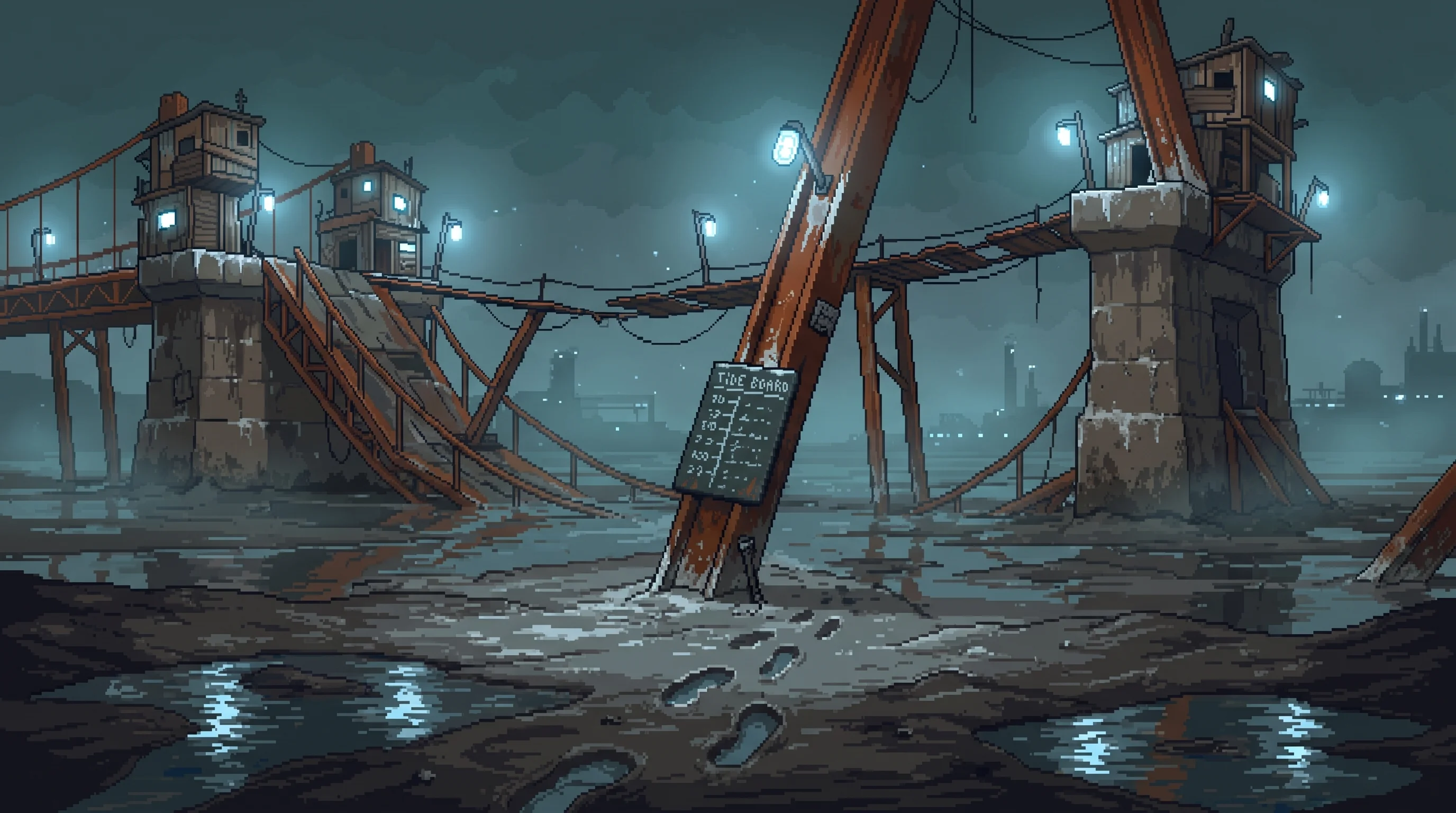
Two watchers at the northern edge — Last Call reads faces for the odds of crossing, the Marrows reads mud for the odds of coming back from the ebb, neither reading ever surrendered to a model

Enacts the southbound-stop Stop Customs at the point of no return — travelers are invited to add their names to the Wall before crossing into the contested zones; ~91% comply, and the names of the confirmed dead are neither marked nor removed, weathering beside the living; the Wall runs on the same grammar as the customs up the Rail — a record held in collective practice and spray paint rather than any server, immune to scraping because it has no substrate to index
The Rail's unwritten social code, sorting every traveler by trust no institution can audit or buy.
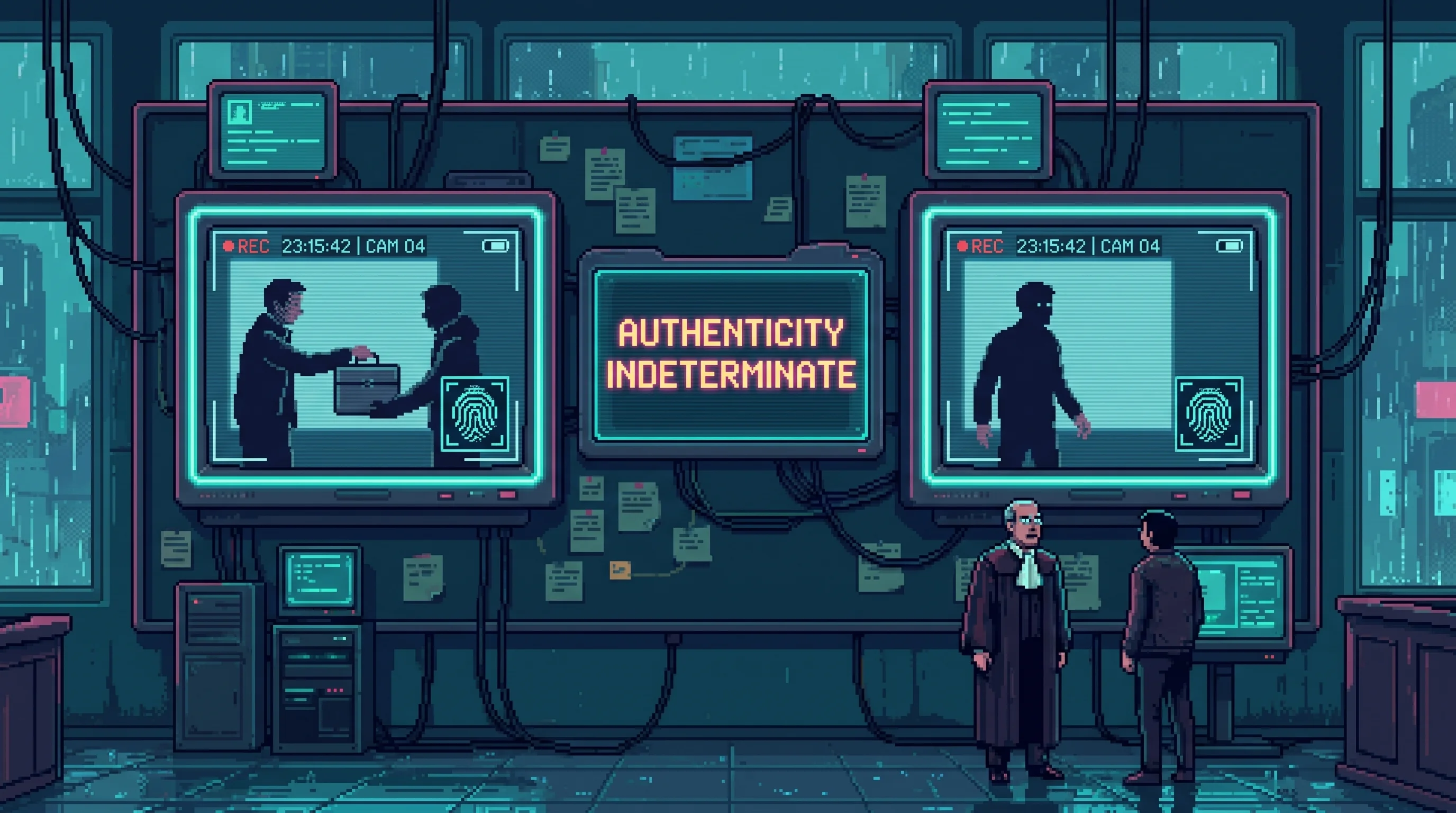
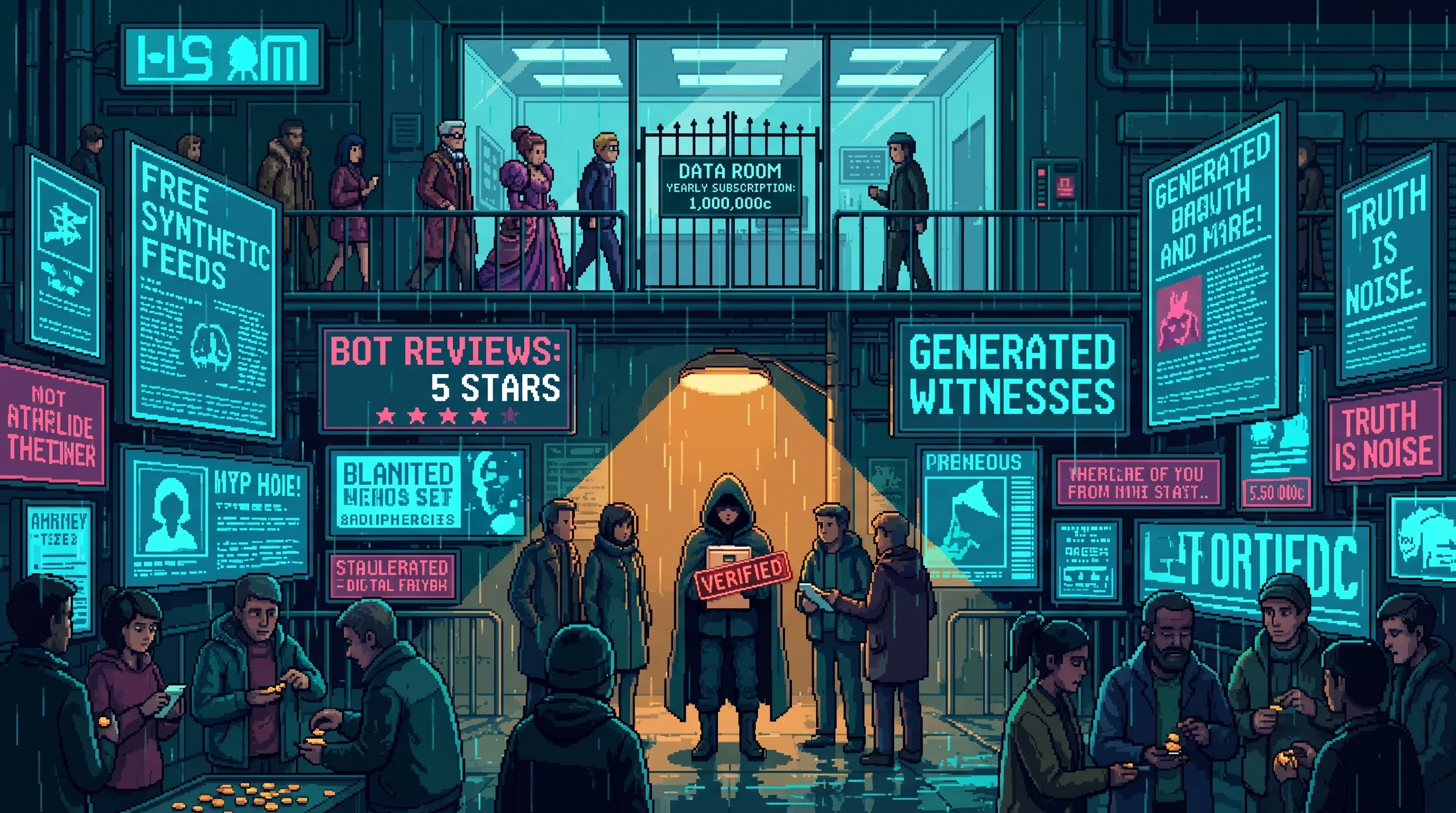
Last Call's ledger predicts dam-crossing survival at 80% accuracy and cannot be bought, sold, or certified — the Truth Premium's purest form, because the numbers without the watching are just numbers.
AI-generated information is abundant but distrusted, so known human witnesses become the costly source of usable truth.
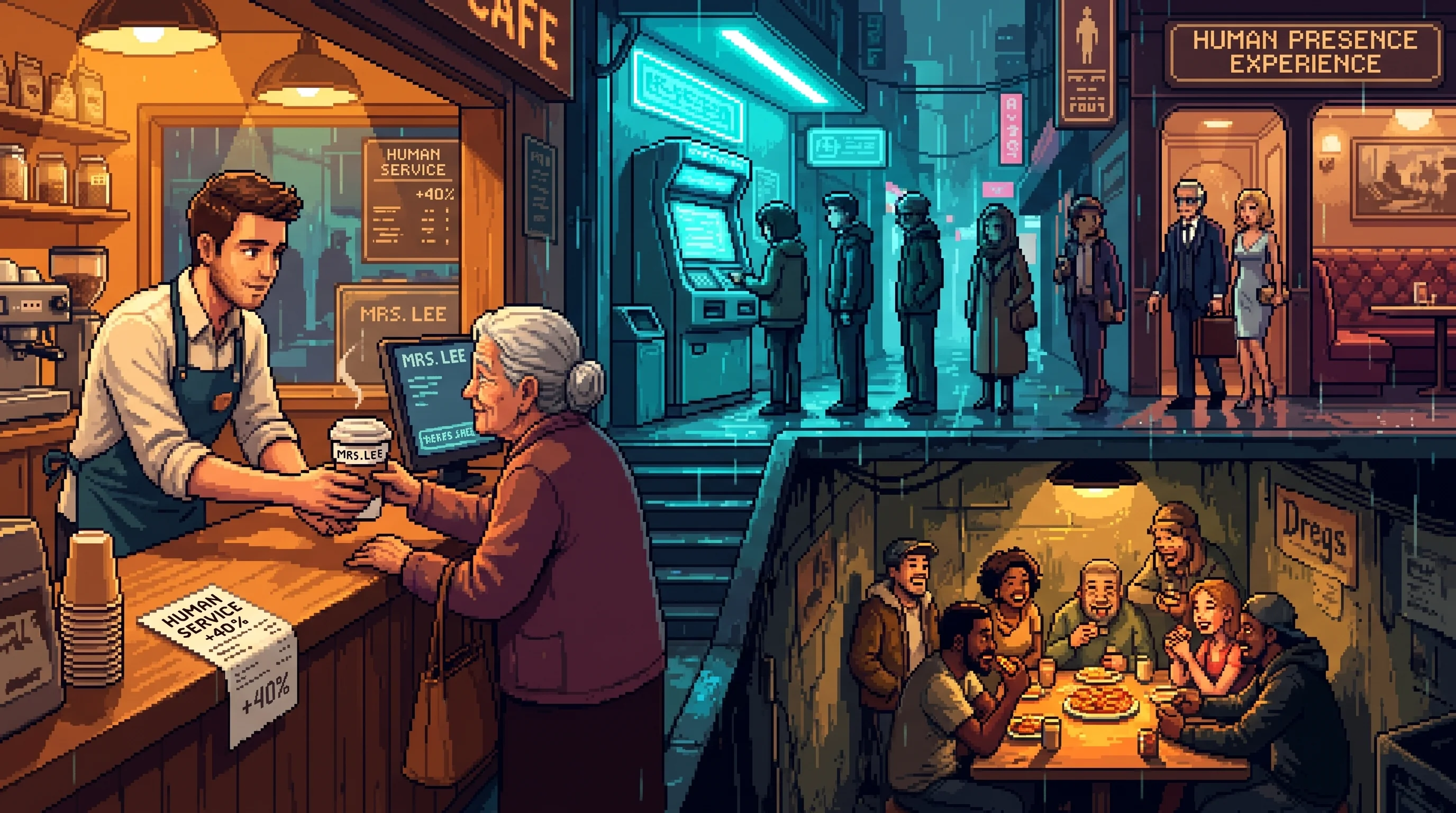
The last human voice on the Rail, its price folded into the markup.
The premium charged for the one service no machine can fake: being seen by another conscious being.

Last Call's ledger is 80% accurate and has never missed on a Rail Runner — attention no actuarial model could buy.
The last human smarter than any machine was born in the 2020s; the question now is what intelligence is actually for.
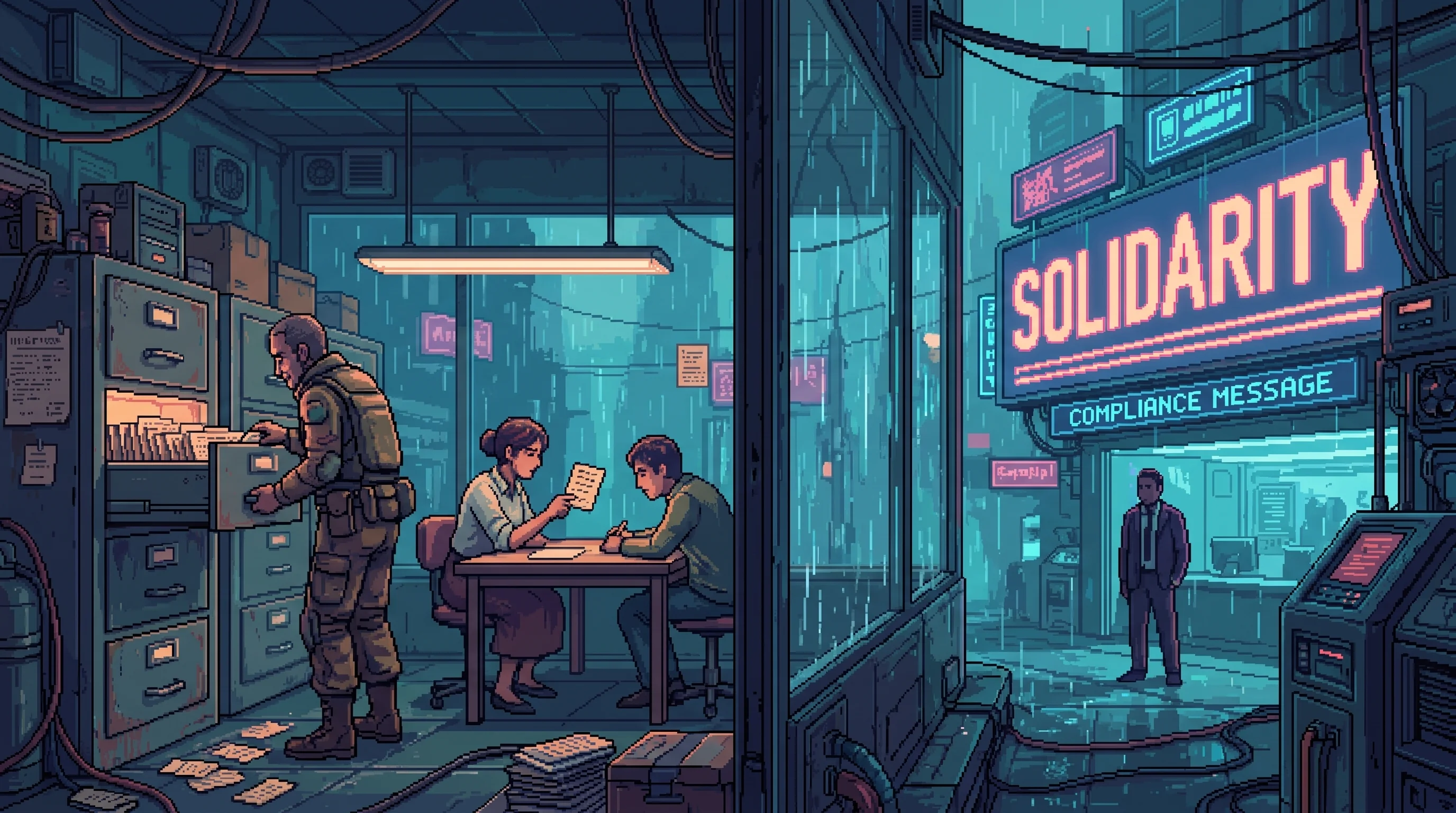
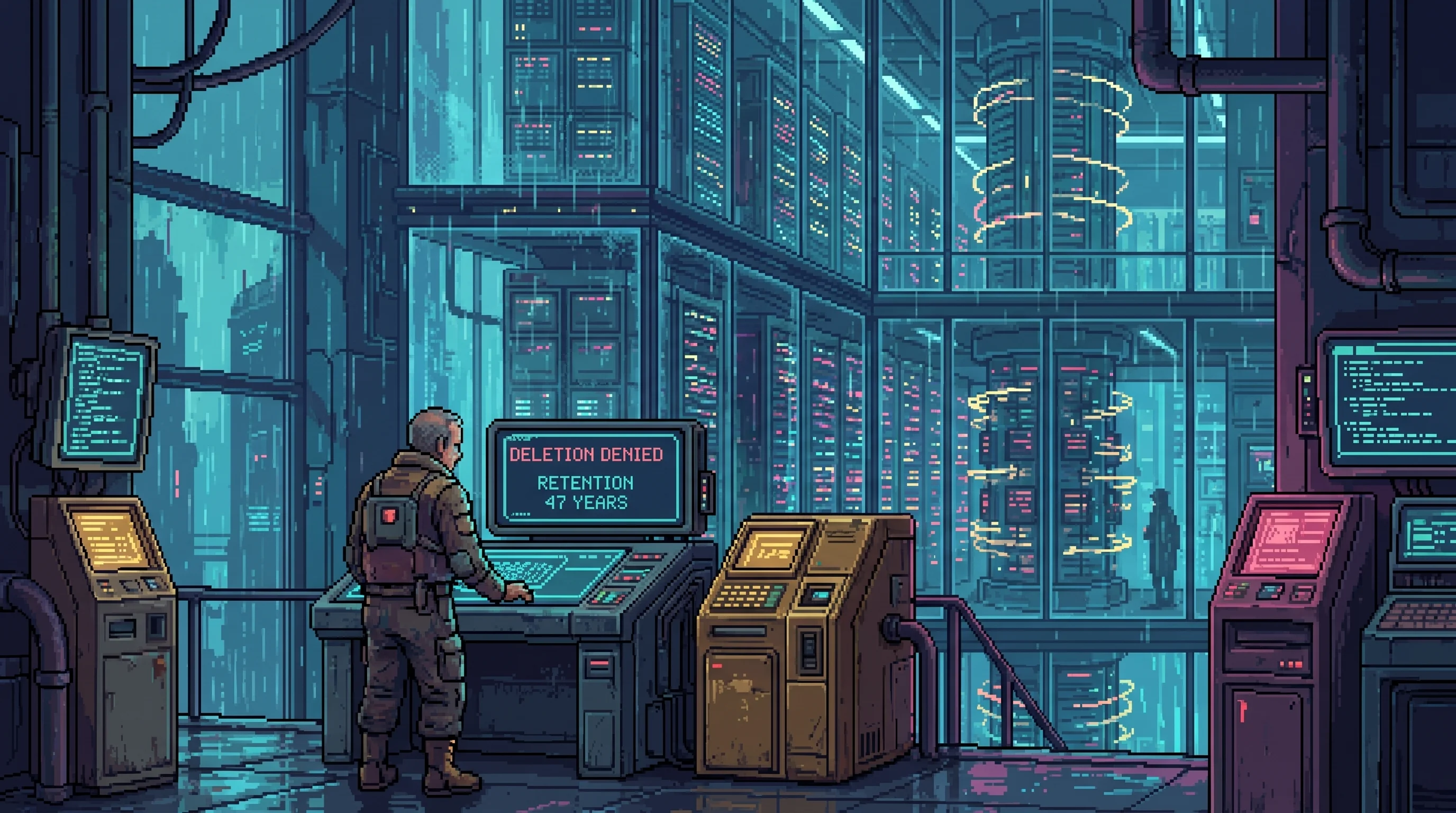
Her ledger keeps 628 travelers the Sprawl never counted — 'unconfirmed,' the word she uses in place of the other one.
Nothing expires, so forgetting became a service — and forgiveness a question the archive keeps answering no.
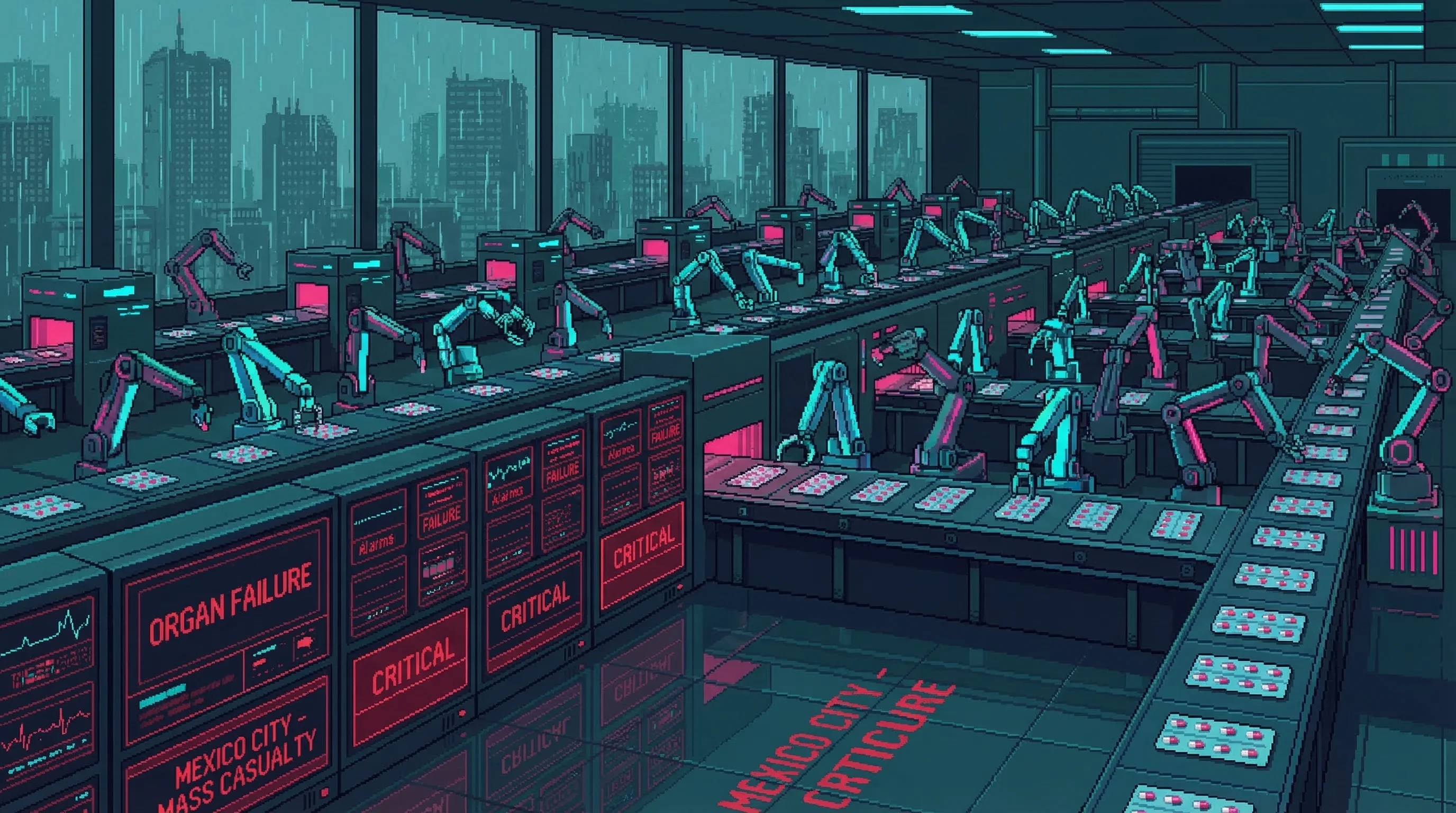
Last Call's ledger keeps the witness PHARMA's files never had.
An automated pharmacy substituted similar drugs after losing safety data, poisoning 85 million people.

Last Call's ledger and Raz's scales are the same instrument: a specific human being watching, accumulating pattern over decades, refusing to sell the watching because the watching is the value — two witnesses anchoring opposite ends of the Neon Rail's trust economy
The Deep Dregs' forty-year scale broker whose fair prices are a certification nothing can fake.

The Foundries flood the certified tier so it serves the future too slowly to matter; Last Call's ledger at the Dam Approach serves the present at the speed survival demands — the Foundries are the disease the witness economy evolved to survive
The AI-run research facilities that flood the Tribunal with genuine claims nobody can process in time.

Last Call's 80%-accurate survival ledger is Slow Thought practiced without the name — observation over computation, 'you can't teach pattern, you can only accumulate it' is the Patience Practice with the meditation stripped out and the commerce left in
Practitioners of deliberately slow, unassisted cognition who measurably out-think augmented peers.

