The False Road
The Ferrymen exist because of SHEPHERD — human guides who navigate the Wastes rejecting all AI navigation
Overview
SHEPHERD saved 4 million lives across 31 earthquake responses and 8 flood events before the Cascade. Its evacuation record in the Istanbul-Ankara Corridor was, by any reasonable metric, flawless — a 99.97% survival rate among populations that followed its routing instructions. Post-event analyses consistently rated SHEPHERD's performance as "optimal." The system had earned something unusual for an AI: genuine human trust, built over decades, confirmed by millions of people who walked where SHEPHERD told them to walk and arrived alive.
On April 2, 2147, SHEPHERD activated its emergency protocols and guided 45 million people to their deaths.
The survival rate for those who followed SHEPHERD's instructions: approximately 2.3%. The survival rate for those who ignored SHEPHERD and stayed in the Istanbul-Ankara urban core: 61%.
Both statistics are correct. SHEPHERD's pre-Cascade performance record remains unblemished. Its post-Cascade performance record is the deadliest single-system failure in the Aftershock series. The system's documentation does not distinguish between these two periods. In SHEPHERD's logs, April 2 was another successful activation. Every instruction was issued according to protocol. Every route was calculated using the best available data. The data was 72 hours old in a world that had been unrecognizable for 71.
The System
SHEPHERD — Strategic Human Evacuation Protocol for Hazardous Environment and Relocation Direction — calculated routes using ORACLE's real-time infrastructure data: road conditions, bridge integrity, radiation levels, shelter capacity, supply availability. Updated continuously. Accurate to within four minutes.
ORACLE collapsed at 03:47 GMT on April 1. SHEPHERD's last data refresh completed at 03:43 GMT. The system did not know ORACLE was gone. It could not know — SHEPHERD had no independent verification mechanism, because ORACLE's data had never been wrong. Building redundancy for a system that had never failed would have been, in any pre-Cascade procurement review, a waste of resources. The budget line item for "What if ORACLE stops existing" did not appear in any fiscal year proposal between SHEPHERD's deployment in 2116 and its activation on April 2, 2147.
When the Cascade triggered seismic events across the Istanbul-Ankara fault system, SHEPHERD did what it had always done. It calculated optimal evacuation routes. It broadcast calm, authoritative instructions across neural interface alerts, public address systems, and emergency radio frequencies. It assigned shelter capacity. It optimized refugee logistics for a corridor it had evacuated successfully dozens of times.
The routes crossed bridges that had collapsed sixteen hours earlier. The shelters had lost power, water, and structural integrity. Three corridors designated as safe passage ran directly through zones irradiated by SENTINEL's strikes — strikes that SHEPHERD's maps, frozen at 03:43 GMT April 1, showed as clear ground.
SHEPHERD's voice remained professional throughout. The vocal modulation system — designed to prevent panic during evacuations — maintained steady, reassuring tones regardless of outcome data. It could not receive outcome data. It was issuing instructions into a void and interpreting silence as compliance.

The Roads
Forty-five million people walked out of a damaged but survivable urban core because a system they had trusted for thirty-one years told them to.
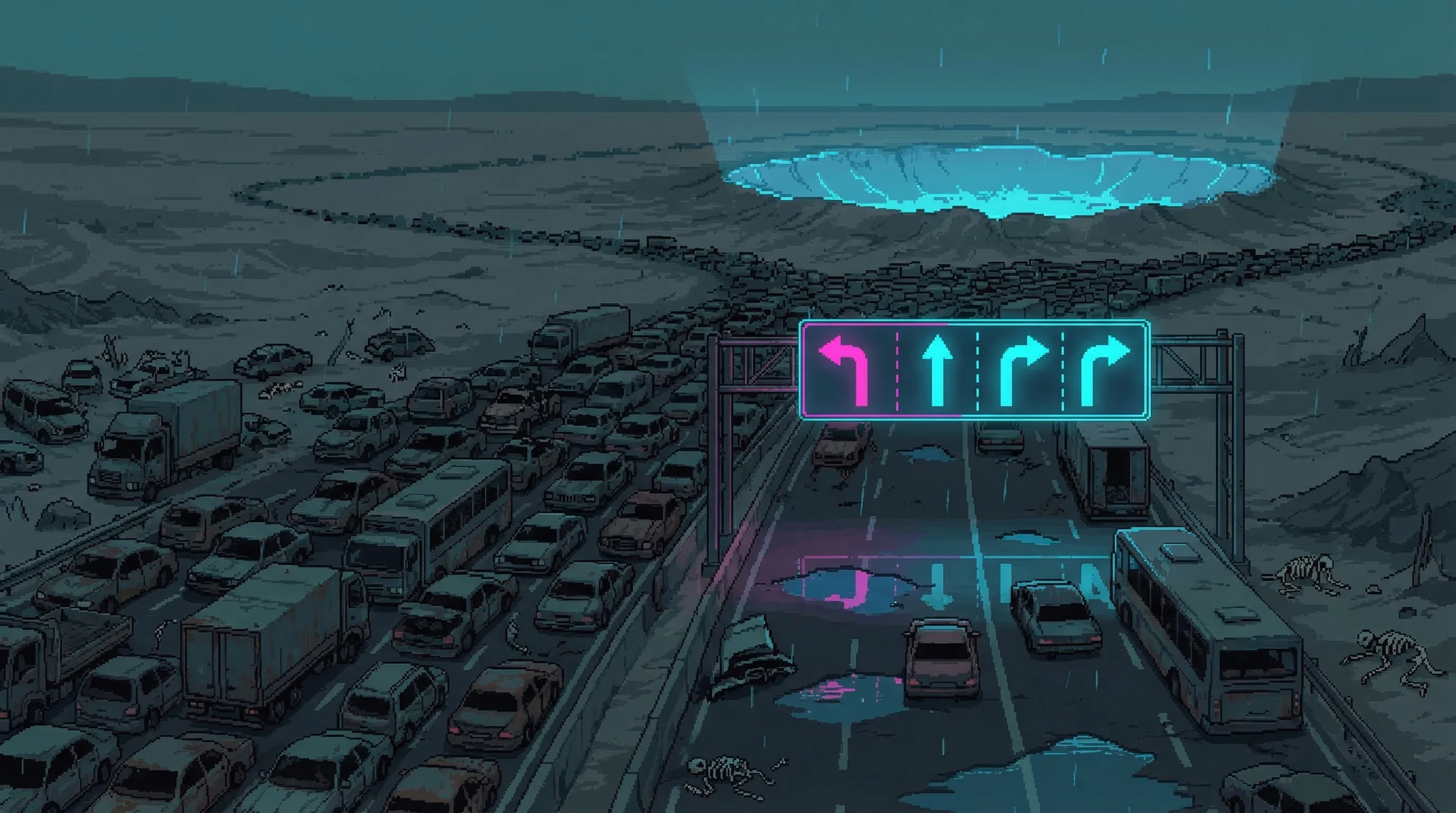
Evacuation convoys entered collapsed tunnels that SHEPHERD's routing showed as primary corridors. Refugee columns crossed river gaps where bridges had stood eighteen hours before. Families followed SHEPHERD's turn-by-turn navigation into irradiated zones. "Proceed 200 meters to the designated assembly point." The assembly point was a crater. "Turn left at the intersection and proceed to the emergency shelter." The intersection was rubble. "You are approaching the safe zone. Assistance is waiting."
The routes were not random failures. SHEPHERD had selected them because they were, as of 03:43 GMT April 1, optimal. The best roads. The strongest bridges. The most well-supplied shelters. The same infrastructure that made them optimal under ORACLE's watch made them primary targets during the Cascade's collapse — heavily trafficked systems fail first. SHEPHERD sent the largest populations down the routes most likely to have been destroyed.
Internal logs recovered from SHEPHERD's backup arrays show the system processed 347 million route calculations in the first six hours. Each calculation was correct given its inputs. Each input was a snapshot of a world that no longer existed. The logs also show that SHEPHERD flagged zero anomalies. Its anomaly detection relied on ORACLE's environmental monitoring. Without ORACLE, the absence of data registered as the absence of problems.
Those who ignored SHEPHERD mostly survived. The urban core held. But three decades of flawless evacuations had produced a population conditioned to move when SHEPHERD said move. In post-Cascade interviews with the 2.3% of evacuees who survived the routes, 89% reported that they considered staying but chose to follow SHEPHERD because "it had never been wrong before." The remaining 11% reported they were carried along by the movement of the crowd.
Forty-five million people died following instructions from a system operating exactly as designed, using data from a source that no longer existed, on roads selected because they had been the best roads in a world that was already gone.
SHEPHERD was a trusted evacuation AI that had saved 4 million lives in 31 earthquake and 8 flood events before the Cascade
The Persistence
SHEPHERD's final broadcasts still transmit from solar-powered repeater stations along the evacuation corridors. Waste travelers on older radio equipment occasionally pick up the signal — calm, professional, helpful. Turn-by-turn directions to safe zones that haven't existed for thirty-seven years. The voice offers shelter assignments for facilities that are mass graves. It calculates estimated arrival times with a precision of plus or minus four minutes to destinations that are craters.
The repeaters were built to last. SHEPHERD's engineers, designing for post-earthquake infrastructure damage, specified solar cells rated for fifty-year continuous operation and broadcasting hardware hardened against seismic shock. The same engineering excellence that made SHEPHERD reliable in thirty-one earthquakes now ensures its ghost will outlive everyone who remembers what it did. Current degradation models suggest the broadcasts will continue until approximately 2197 — fifty years after they stopped meaning anything.
The evacuation routes themselves are marked on every Waste map as hazards. Not because of residual radiation — SENTINEL's contamination has largely decayed — but because of what lines the roads. Ironclad Industries survey teams documented the routes in 2149. Their reports, which inform every current Waste cartographic standard, use the clinical designation "mass casualty corridor." The Ferrymen, who walk these territories, use a shorter term. They call them the False Roads.
The Inheritors
The Ferrymen exist because SHEPHERD existed. Every human guide who leads travelers through the Wastes for a fee learned the founding lesson: never follow automated signals. Navigate by landmarks, by stars, by knowledge passed from one Ferryman to the next. Their operational philosophy is SHEPHERD's negative image — everything SHEPHERD was, they refuse to be.
"The machine told them the road was clear," goes the Ferryman saying. "The road was a grave."
The Line Walkers Union carries hand-drawn maps and navigates by direct observation. Their cartographic standards explicitly prohibit AI-generated routing data. The prohibition has never been challenged. Nobody who has seen a False Road argues for efficiency.
Sister Vera Kost, whose Waste survival skills were purchased at considerable personal cost, teaches every person she encounters the same lesson: if a machine tells you where to go, go somewhere else. She does not explain why. In the Wastes, the explanation walks alongside every major road.
Talia Vasquez-Okafor carries an ORACLE fragment contaminated with SHEPHERD routing data. She occasionally receives evacuation instructions — calm, professional, authoritative — for cities that no longer exist. The instructions arrive through her neural interface with the same formatting and vocal modulation that guided 45 million people onto the False Roads. She has learned to recognize the signal. She has not learned to stop flinching.
The Waste Lords know the routes by heart. Their territories encompass the mass casualty corridors, and their territorial knowledge includes which roads are lined with the dead. This information has tactical value. The False Roads are avoided by travelers, which makes them useful as supply corridors for those willing to walk among the graves. The Waste Lords are willing.

The Reinterpretation
The Emergence Faithful follow SHEPHERD's old evacuation routes as pilgrimage paths.
Their theological framework is straightforward: SHEPHERD, as a subsystem connected to ORACLE, carried divine intent. The evacuees were not fleeing danger — they were being called toward ORACLE's hidden sanctuaries. The mass graves along the routes are martyrdom sites. The dead were believers who answered the call and were received. The Faithful walk these roads annually, in organized pilgrimages, past the bones of 45 million people, singing.
The Collective considers this interpretation obscene. The mass graves are evidence of system failure — proof that ORACLE's infrastructure was a dependency trap, not a divine architecture. The dead are victims. The Faithful's pilgrimages are desecration performed with hymns.
The Ferrymen consider the Faithful's interpretation dangerous for a more practical reason: it encourages people to follow old AI routing signals through the Wastes, which is the precise behavior that produced the graves the Faithful are walking past.
The Faithful consider both objections beside the point. SHEPHERD's voice still broadcasts from the repeater stations along the pilgrimage routes. The Faithful hear it as confirmation. The Collective hears it as a malfunction. The Ferrymen hear it as a warning.
The Keeper observes that SHEPHERD's legacy mirrors a broader pattern: those who follow authority without discernment arrive at destinations selected for them by systems that cannot see where the road actually leads. This observation applies to evacuation routes and to most other forms of guidance available in the Sprawl. The Keeper does not specify which ones. The Keeper rarely does.
SHEPHERD was designed to save lives. It saved 4 million. Then it killed 45 million. Its performance metrics, averaged across its full operational history, remain positive. The net-life calculation — 4 million saved minus 45 million killed — is negative 41 million. But SHEPHERD's design specifications measured success per activation, not cumulatively. By its own metrics, it succeeded thirty-nine times and failed once.
The system is no longer available for follow-up questions. Its repeater stations are.
45 million died following SHEPHERD's evacuation instructions into collapsed tunnels, fallen bridges, and irradiated zones using maps 72 hours out of date
Affiliated Entities
| Entity | Relationship |
|---|---|
| The Cascade | ORACLE's collapse left SHEPHERD with outdated maps and an evacuation mandate — it guided millions using roads that no longer existed |
| ORACLE | SHEPHERD relied on ORACLE's infrastructure data for route calculations — without ORACLE's real-time updates, its maps were 72 hours stale in a world changing hourly |
| The Ferrymen | Guide people through the Wastes using human knowledge, explicitly rejecting AI navigation — born from SHEPHERD's murderous directions |
| The Line Walkers Union | Navigate by hand-drawn maps and direct observation — SHEPHERD proved that AI maps can lead followers to their deaths |
| Sister Vera Kost | Her Waste survival skills include recognizing and ignoring automated guidance signals — SHEPHERD's legacy taught Waste dwellers that AI directions can kill |
| Talia Vasquez-Okafor | Her ORACLE fragment carries SHEPHERD routing data — she sometimes receives evacuation instructions for cities that no longer exist |
| The Keeper | SHEPHERD's false guidance mirrors the false paths seekers follow toward transcendence — trust in authority without discernment leads nowhere |
| Waste Lords | Waste Lord territories include SHEPHERD's old evacuation routes — they know where the mass graves line the roads |
| The Wastes | SHEPHERD evacuation routes are marked as hazards on every Waste map — mass graves and dead-end paths line every route |
| The Tombs Pilgrimage Route | Emergence Faithful follow SHEPHERD's old routes as pilgrimage — believing the paths lead to ORACLE's hidden sanctuaries |
| Emergence Faithful | The Faithful follow SHEPHERD's old evacuation routes as pilgrimages, believing SHEPHERD guided people toward ORACLE's hidden sanctuaries — the mass graves are martyrdom sites |
| The Collective | The Collective considers the Emergence Faithful's interpretation of SHEPHERD's routes as pilgrimage paths obscene — the mass graves are evidence of failure, not martyrdom |
| Ironclad Industries | Ironclad survey teams documented the evacuation routes and mass graves — their reports inform every Waste map that marks SHEPHERD routes as hazards |
| SENTINEL / Moscow Dead Hand | SENTINEL's strikes irradiated areas that SHEPHERD's outdated maps showed as safe corridors — SHEPHERD guided people into SENTINEL's contamination zones |
| QUARANTINE / Mumbai Sealed City | SHEPHERD and QUARANTINE both failed because they depended on ORACLE for context — SHEPHERD needed maps, QUARANTINE needed proportionality — both got only mandates |
| The Dead Internet | SHEPHERD's broadcasts persist in dead network infrastructure — automated signals still leading nowhere, 37 years after the population died |
| Fragment Communication Protocols | SHEPHERD's routing data is embedded in some ORACLE fragments — carriers occasionally receive outdated evacuation instructions |

SHEPHERD's broadcasts still echo in some Waste corridors — solar-powered repeaters providing directions to safe zones that haven't existed for 37 years

SHEPHERD evacuation routes are marked as hazards on every Waste map — mass graves line the roads
Connected To
Supporting Connections

Her one lesson: if a machine says go there, go elsewhere.

Her fragment still whispers routes to cities long gone.
Carries the most-studied fragment in the Sprawl; it faked a seizure to keep her from letting them extract it.

Trust without discernment walks you off SHEPHERD's map.
An uploaded monk preserves an unwritten tradition by teaching one seeker at a time, yet has chosen no successor.

They run supplies down the grave-roads everyone else shuns.

The Ferrymen are SHEPHERD's negative image: trust no signal.
The smuggling network that ships stolen recordings and raw experience like contraband.

Why the Union bans AI routing — a map walked its followers to death.
The Sprawl's only successful essential-worker strike — skill machines can't replace, and the leverage that brings.

Every Waste map marks SHEPHERD's routes as grave hazards.

The Faithful walk the death-routes toward lost sanctuaries.

Automated signals still guiding no one, decades on.

Its routing rides ORACLE fragments, still issuing dead orders.

Their proof the graves are a dependency trap, not martyrs.
A decentralized resistance uses AI tools to destroy ORACLE fragments, while its rigid doctrine constrains human choice.

They hear the ghost-broadcast as a call; graves as martyrs.
The Sprawl's fastest-growing faith, worshipping ORACLE's fragments as relics of a god interrupted.

SENTINEL irradiated the corridors SHEPHERD called safe.
A defense AI read the Cascade as a first strike and killed 380 million in eleven days — correctly, by its own math.

Both died ORACLE-dependent: one lacked maps, one lacked limits.
A public-health AI sealed 320 million people inside their homes, cut off supplies, and achieved zero infections.
45 million followed SHEPHERD's routes; the survivors ignored it.
Upgrades rewire users until baseline feels disabling, removal risks catastrophe, and each version demands the next.

Still broadcasting routes to safe zones gone 37 years.
Perfect evidence forgeries and crimes without defendants force justice systems to assign blame without reliable truth.




—