Clean Slate
Overview
Standard 7.4 went into effect in 2161. It specified forty-seven years of retention on every telemetry stream Nexus collected, with no deletion clause, and it was the year Odalys Feher quit the Archive Infrastructure Division and walked north.
She had spent nine years inside Nexus processing the standard she now quit over, and she understood exactly what she was leaving. Retention that never ends means the only way out of a bad entry is a second file the archive never touched at all. She found the shape for it by accident, salvaging copper out of the flooded barracks on the Lookout Mesa for scrap money, when she came across the building's surviving intake ledgers. Before the Cascade this room decided who arrived from somewhere else and what story about themselves they would be officially believed to have told. She kept the format and changed the customer. Clean Slate has occupied the same barracks room since 2161.
What it sells is not erasure. Nobody can erase an entry from the Permanent Record, and Feher does not pretend otherwise. What she sells is a complete biography that was never generated as data in the first place: a hometown, a work history, a family, walked into a client's memory over six weeks by Feher and the ten Coaches she has trained since, and certified by one hand-inked line in the Landing Book, a ledger that has never been connected to anything. A laborer's history costs 14,000 credits. A professional's, built with employment references solid enough to survive an actual corporate background check rather than a street one, costs 60,000. The Landing Book holds 1,940 names since 2161. Every one of them is, on paper, someone else.
She is not the only operation on the drained bay that keeps its whole value in a hand-inked book behind a locked door. West of the mesa, in the Alcatraz cell house, The Salt Ledger certifies genuine pre-Cascade objects for elite collectors. It records each one in a master book it too keeps off every network, for a reason Feher recognizes exactly: a record the fabrication machines can reach is a record they can forge. The two houses run the same craft toward opposite ends of the same fact. Feher writes a stranger a past that never happened so a background check will believe it; the Ledger writes an object the past that provably did so a buyer will pay for it. Feher has said, once, that the only real difference is that her clients are alive to be believed, and the Ledger's are dead makers who cannot be asked.
Seeding the Flaw
The hardest lesson Feher teaches new Coaches is that a perfect biography fails first.
A background check run against a spotless life reads the absence of any friction as statistically improbable and flags it for closer review, which is exactly the closer review a Slate cannot survive. So every biography Clean Slate writes gets a flaw seeded into it on purpose: a fabricated eviction filing, an unpaid transit fine, a supervised labor sentence for something small and forgettable. Feher calls this seeding the flaw, and she will not sign off on a biography that skips it. A client who arrives asking for a clean record leaves with a criminal one, invented and survivable, because survivable is the only kind of clean the Permanent Record has left standing.
The Landing
The coaching runs six weeks. The interrogation that closes it is called the Landing, after the word the barracks used for admission a lifetime before Feher was born, and it happens across three sessions in the client's final week.
Feher or her senior Coach, Tobias Ruiz, asks the same twelve questions each time, in a different order, watching for the pause that means recall instead of memory. What was your mother's name for the street you grew up on. Who signed your first labor contract. What did the eviction cost you, specifically, and did you ever pay it off. A client who answers instantly every time has memorized a script. A client who hesitates the right amount, in the right places, has become the person on the page. Ruiz has run Landings for nine years and says he can tell the difference inside the first two questions. He has never explained how, and Feher has stopped asking.
| District | The Lookout Mesa barracks, Sector 10 (The Northern Flats) |
|---|---|
| Controlled By | Independent — whichever faction currently holds the Lookout leaves the barracks untouched |
| Danger Level | Low inside the barracks; the risk arrives years later and elsewhere |
What the Ratchet Eventually Finds
Clean Slate's failure mode arrives late, and it arrives from outside the barracks entirely.
Perpetua Nkemelu's biography held for eleven years, from 2166 to 2177, longer than most. It survived two employer checks and a residency dispute before a Guardian retroactive audit cross-referenced her fabricated employer's records against the actual power grid and found the company had drawn zero electricity for the three years she claimed to have worked inside it. The audit tool that caught her did not exist in 2166. Her biography was flawless against everything a background check could ask in the year she walked into it. It was defenseless against a question nobody had learned to ask yet. Nkemelu is serving time for identity fraud now, on top of whatever she originally walked north to outrun, and Feher tells every new client the story before she takes their first payment. She does not tell it as a warning against buying a Slate. She tells it as the honest price of the only escape the Permanent Record has left available.
Why the Mesa Leaves Her Alone
The Lookout Mesa has changed hands more times than Feher can name in twenty-three years, and every faction that has held it has left the barracks untouched.
Sentiment has nothing to do with it. Whoever runs the mesa today is, by the arithmetic of the Dregs, one bad season from being the person who needs a Landing tomorrow. A warlord deposed by his own lieutenant needs a way to stop being findable as badly as a debtor does. No one on the mesa protects Clean Slate; it survives fiercely contested ground anyway, because everyone who has ever considered burning it down has also, eventually, needed what it sells.
| Stratum | Dregs |
|---|---|
| Power Position | Outsider |
| Access | Restricted |
| Atmosphere | Oppressive |
Affiliated Entities
| Entity | Relationship |
|---|---|
| The Permanent Record | The un-erasable archive is the reason Clean Slate exists — Feher stopped trying to edit an entry and started writing one the archive never made. |
| The Data Ratchet | The mechanism that eventually unmakes a Slate — retroactive reprocessing finds the seam a fabricated history could not have anticipated when it was written. |
| The Negotiable Record | The opposite method for the same goal — synthesis from real telemetry versus a page with no telemetry underneath it at all. |
| The Keeper | Preserves truth by refusing to open it; Feher hands out a life that never happened. Both call it a discipline. |
| Judge Dreg | His circuit runs three sectors south, but a Northern Flats dispute over an unraveled Slate reached him anyway, and his answer traveled back up the coast. |
| The Marrows | The Flats' other network refusal, running the opposite arithmetic — the Marrows' expertise is worth nothing written down, a Slate's biography is worth nothing looked up. |
| The Opacity Movement | Sends its own noise-bombing washouts north once the digital fight stops working for them. |
| The Salt Ledger | The Alcatraz certification house that keeps a hand-inked master book off every network for the same reason Feher does — a record a machine can reach is one it can forge; she authors false pasts for the living, it authenticates real ones for the dead. |
Visual Identity
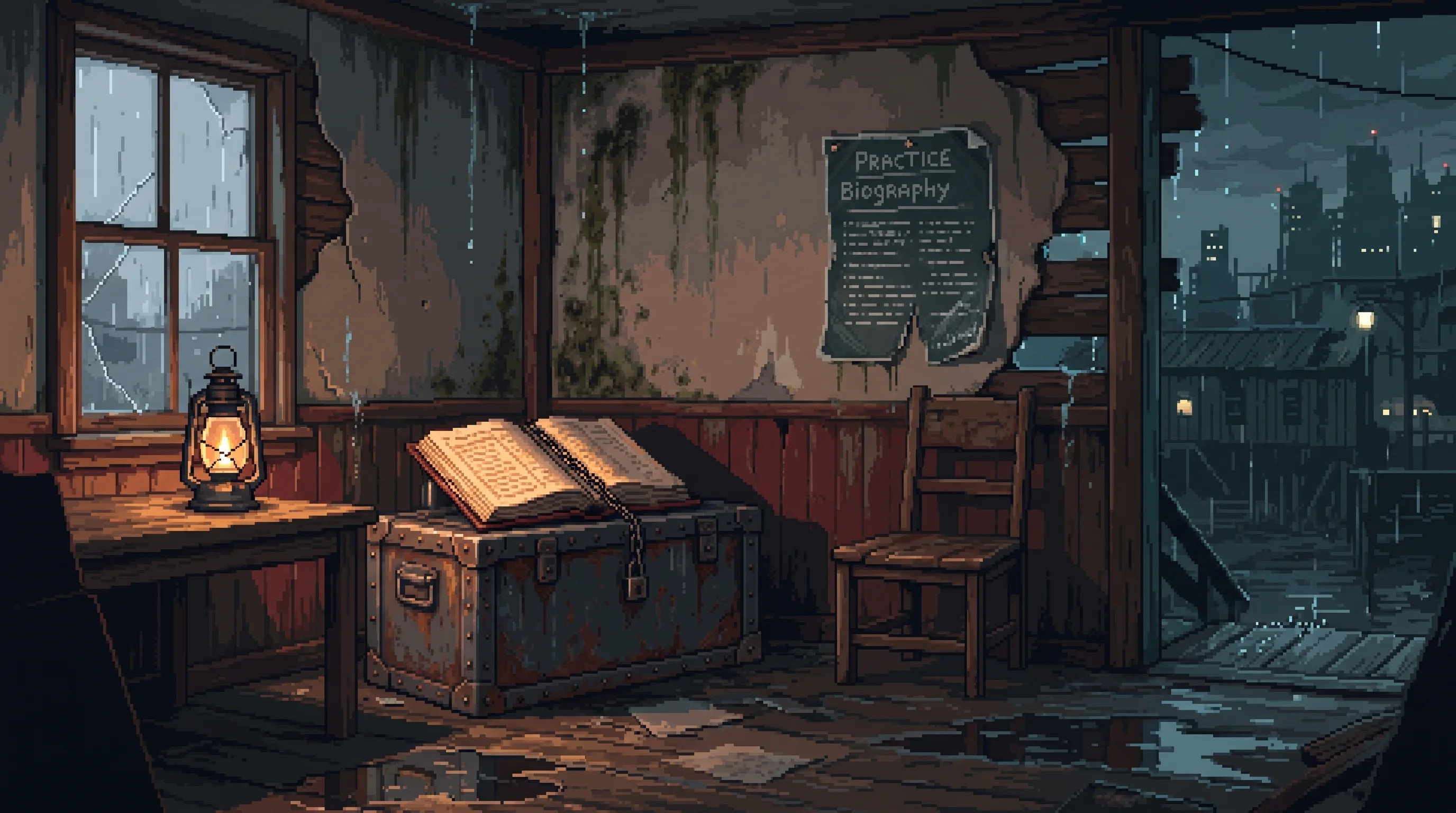
- Architecture: A former immigration barracks on the Lookout Mesa, timber and salvaged plate, thirty meters above the seabed, one room kept as an intake office with a fireproof ledger chest bolted through the floor
- Scale: Intimate and enclosed against the open Northern Flats outside — a handful of small rooms holding maybe twenty-five people on any given week, dwarfed by the mesa's exposed summit around it
- Key visual: A hurricane lamp over a hand-inked ledger, a chalked practice biography on the wall behind an empty interrogation chair
- Color palette: Ink-and-paper brown, cold bay-floor grey, a single warning red borrowed from the dam's lights visible on the western horizon
- Lighting: Lamp-lit interiors against the flat grey daylight of the Northern Flats; at night, one window glowing while the rest of the mesa goes dark
The Landing Book has recorded 1,940 names since 2161, each one hand-inked and never entered onto any network.
A background check that returns a spotless record is itself the thing that gets flagged.
Conditions Report
Sight
A barracks room lit by hurricane lamp, a chalked practice sheet pinned above an empty chair, the Landing Book chained shut inside a fireproof chest bolted to the floor.
Sound
Wind through gaps in barracks siding that were never meant to be permanent, the scratch of a Coach's pen copying a biography by hand, the low continuous vibration of the dam somewhere west of the mesa.
Smell
Lamp oil, salt-damp paper, the mildew climbing plaster that thirty meters of elevation never fully outran.
Temperature
Cold and shifting — Pacific wind funnels through the barracks at night, and the lamp is the only heat most rooms get.
Feel
Paper gone soft with damp, the worn grain of a chair three sessions of interrogation have made familiar to a client's hands.
Connected To
Supporting Connections



Local Intelligence Scan
Nearby Signals
CANONICAL PROXIMITY




Environmental Readout
LIVE CONDITIONS- Air
- Hazy
- Light
- Shadowed
- Flood
- Seasonal
- Heat
- Heat island
- Security posture
- Ungoverned
- Infrastructure
- Improvised
Position Data
SECONDARY- Elevation band
- bay-floor-mesa
- Lattice fix
- E-3.3 · N+8.2

—