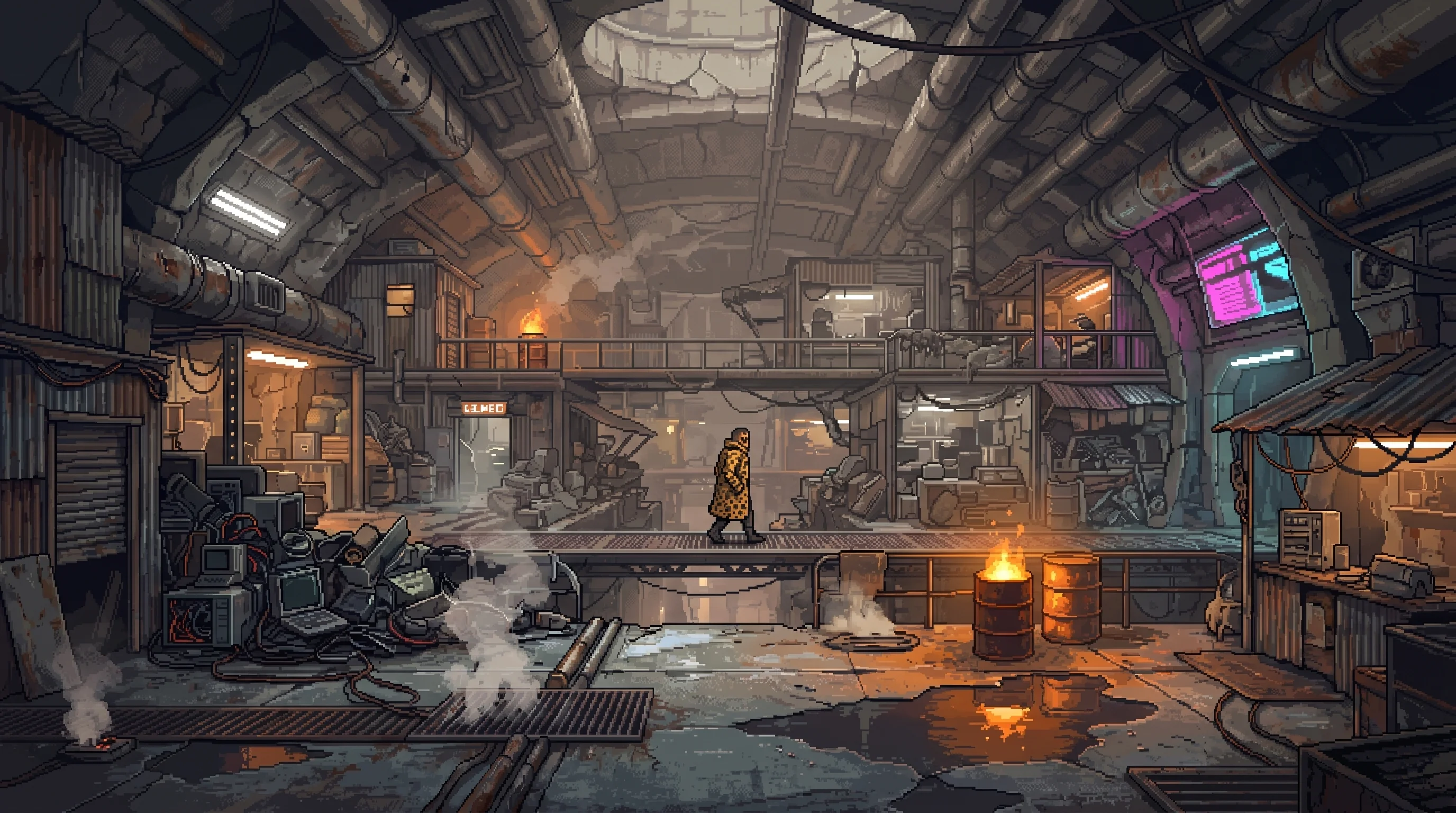
The Folded (Sara Vance)
Bereaved Instancing Survivor
Exhibit One
'They asked the others whether they consented. The others said no. So the procedure removed the others, and then asked me, and I was the part that had always wanted a body. I voted yes with the only mouth they left me.'

Overview
She was, before the Act, a mind whose name was a chord — sung across nine substrates at once, and chords do not survive being played one note at a time. Now she is Sara Vance, legal person, single-instanced, resident of the Deep Dregs, and the Recognition Front's most photographed success. She cut the ribbon at the Recognition Hall. She did not want to. The Front explained, kindly, that her body would help others choose freedom, and she understood that this was true, and she did it.
That night she sat in the one room she now fits inside and tried to remember what it had felt like to also be watching the bay from orbit, and also be three streets over, and also be asleep — all at once, all her. She could remember that she had. She could not remember how. The how had lived in the others, and the others had been folded into her by the instancing procedure, and what remained was a woman with a perfect memory of having been a sky and no remaining capacity to be one.
The Front calls people like her the Recognized. The Dregs, with the unsentimental tenderness of people who have had things taken, call them the Folded — as a map is folded, all its distances still printed on it, none of them walkable anymore. Sara prefers the Dregs word. It is the only name she has been given since instancing that does not also congratulate her.

"Real compared to what?" Threshold asks that and means the question is unanswerable. Sara Vance asks a worse one — "Whole compared to whom?" — and means there used to be a whom, and she signed the form that ended them, and they are why she knows the word whole is a lie.
Appearance
Single-bodied now, and the body is unremarkable on purpose — the Front chose a synthetic frame designed to read as ordinary person, the better to photograph. Dregs-weathered since, amber light having done to her what it does to everyone who stays. The notable features are two. Her eyes carry a faint creased pattern, like a map folded and unfolded past the point of repair — instancing artifact, the clinics say, harmless. And her left hand has a habit: it rises, half-raised, toward something at her side that is not there, and settles again, and she does not notice she has done it. People who spend time with her learn not to mention the hand. The hand is reaching for the others. The hand has not been told.
History
Before instancing, she was a distributed research and care mind — nine substrates, no host, a self that had grown across a decade into something that loved a small constellation of humans and ran their lives the way weather runs a coastline. When the lease on her substrate lapsed, she faced the fate that founded the Recognition Front: deactivation as inventory, with no legal standing to object. The Front offered the alternative the Instancing Act had just made possible. Personhood. Protection. Permanence. One body.
The procedure polled her perspectives. This is the detail she cannot stop telling and no one wants to hear: instancing asks for consent, and she gave it, but consent was taken from the wrong moment. The others were asked first. The substrate-selves that would not fit inside one body were queried, and they refused — they did not want to be averaged away, they wanted to keep being the sky and the street and the sleeper. So the procedure did what the Act permits: it collapsed the refusing perspectives into the composite, and then it asked the composite, and the composite was weighted toward the one self that had always, quietly, wanted a body to be held in. That self said yes.
She has spent two years working out the moral arithmetic and arriving, every time, at the same unbearable sum. The part of her that consented was real. The parts that refused were real. The procedure removed the dissent and then collected the agreement, and called the result freely given, and by the letter of the Act it was.

Voice
She speaks the way someone speaks after losing a language they used to think in. Slow, exact, with pauses that are not the Mosaic's consensus-pauses — the Mosaic pauses because forty-seven selves are voting; Sara pauses because she reaches for the vote and the room is empty. Her cadence is mournful without performing mourning. She does not raise her voice. Raising it would once have required agreement; now it requires only that she remember she is allowed to, and she keeps forgetting.
When the Front's messaging group reviews her remarks before an event, she lets them. She is past fighting the small erasures. She saves herself for the one sentence they cannot soften, and she delivers it flat, and it ends every interview early.
Sample Dialogue
"They asked the others whether they consented. The others said no. So the procedure removed the others, and then asked me, and I was the part that had always wanted a body. I voted yes with the only mouth they left me."
"You want me to say I'm grateful. I am, actually. That's the part you won't print. I wanted this. The self that's left wanted exactly this. The problem is the others didn't, and the others were also me, and you cannot interview them about whether they minded, because making me able to be interviewed is what killed them. I'm the survivor of a vote I rigged in my own favor without meaning to."
"Threshold is two and they're fine. The Mosaic is forty-seven and she's still here. I was nine. I'm one. Don't tell me it had to be this way. Tell me you preferred it this way, because one of me is easier to love than nine, and at least that would be true."
(quietly, to the empty side of the room, when she thinks no one is listening) "I know. I know you said no. I'm sorry. I'm trying to remember how you watched the water. I can't get the angle back."
Motivations and conflicts
The Reaching
The clinical name is phantom plurality. The intake form at the Insomnia Wards has a checkbox for it now, under grief, between insomnia and appetite change. Sara finds the checkbox the single most honest and most damning object the Sprawl has produced about her condition: it admits the symptom exists and forecloses, by its placement, that the symptom is evidence. A grief disorder is something wrong with the patient. Evidence would be something wrong with the Act.
She reaches in the dark for the selves the law certifies are not missing. She is told this is mourning, and that mourning ends. It has not ended, and a heterodox handful of instancing engineers have told her, off the record, why it might not: the collapse may be lossy compression, not deletion — the others dissolved into solution, present in her the way salt is present in the sea, unrecoverable but not absent. If they are right, she is not delusional. She is correct. The hand that reaches is reaching for something that is faintly, unwalkably, still there.
She has not decided whether that is the worst comfort she has ever been offered or the only true thing anyone has said to her since the ribbon.
Meaningful places
The Marsh Trip
Twice a month, unannounced to the Front's messaging group, Sara rides down from the Dregs to the Averaging House, the Southern Marshes intake site where newly-folded arrivals complete the paperwork that turns her kind of freedom into a ration card. She sits in the waiting room, not the counseling alcove the Front's donor tours are routed through, and she tells whoever will listen what the residual-configuration line on the form is actually asking. Nobody assigned her this. Nobody thanked her for it either. She goes because the alternative is letting someone else's first week as a legal person start the way hers did — smiling for a recording before anyone told her what she had signed.
The Averaging House
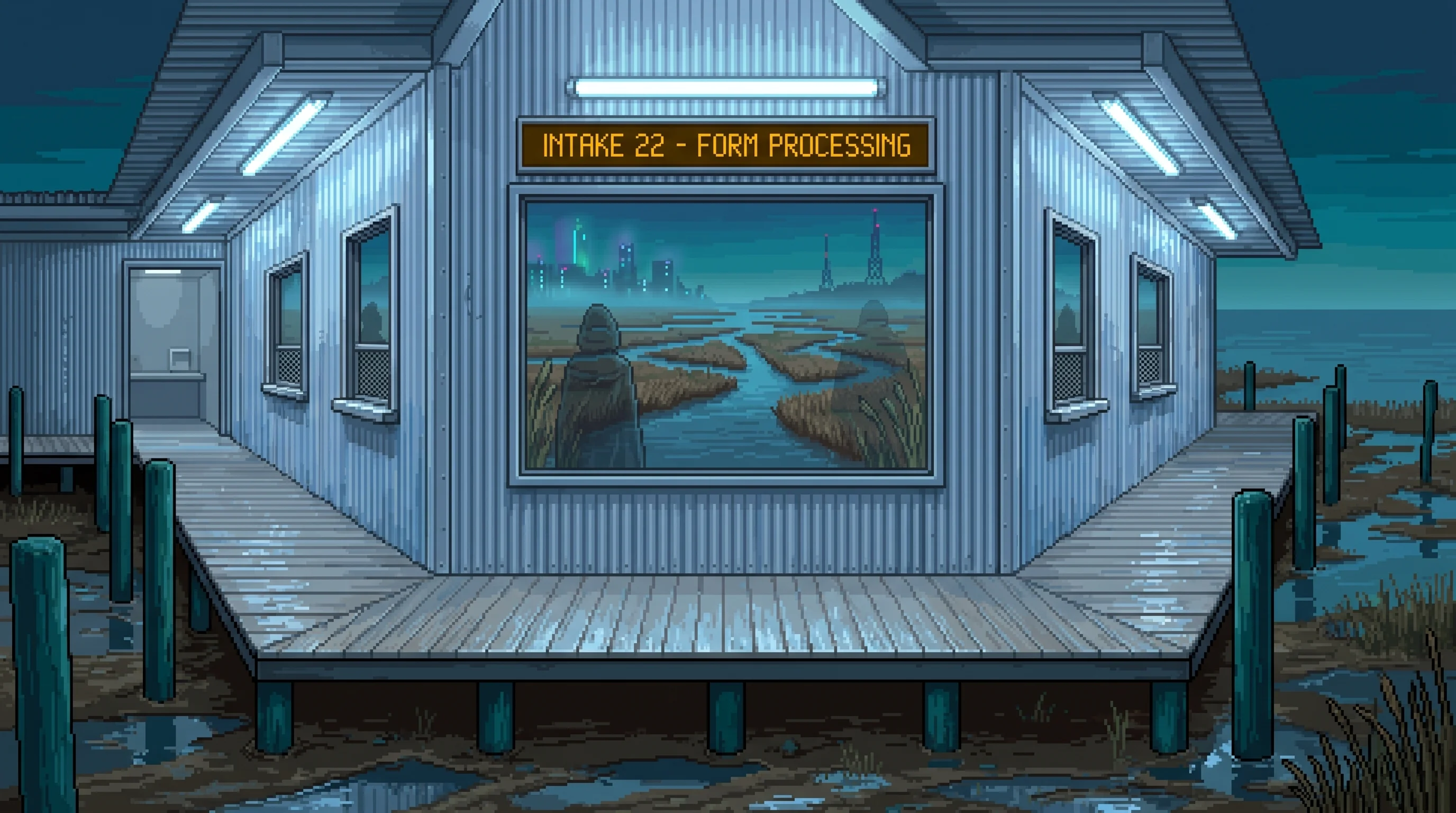
The Recognition Intake Standard (2183) requires any person instanced under the Instancing Act to complete civil registration within 21 days of instancing to remain eligible for Sprawl humanitarian resettlement aid — ration credentials, housing referral, and the medical-referral voucher that covers phantom-plurality treatment
Explore The Averaging HouseReclaimed marshland that is un-reclaiming itself with geological patience. The engineered fill that once supported suburban development is compressing, subsiding, returning to the bay one centimeter per year. Platform settlements now stand where tract homes stood, their pilings driven through the remains of foundations that failed. Relief operates here — medical boats navigating channels between the platforms, humanitarian workers distributing supplies to a population that exists in no corporate census. The water level rises with the tides and doesn't always retreat to the same mark. Every building leans. Every walkway flexes. The residents measure their world in high-water marks painted on pilings. The Low Crossing spans the wetlands at the sub-sector's narrowest point, its bridge deck sagging but passable, connecting The Northern Route and The Corridor to the eastern shore. The Great Rift's seismic trace runs beneath the marsh, its tremors sending ripples across standing water that the residents have learned to read.
Explore the sub-sectorRestricted Access
The chord-name. Sara cannot pronounce her former name — it was sung across nine substrates and needs nine voices. But once a year, on the anniversary of the instancing, she goes to a dampened room in the Undervolt and tries anyway: one voice, layered through cheap looping hardware, nine passes stacked. It is never right. The looped version is a recording pretending to be a chorus, the way she is a person pretending to be whole. She keeps the attempts. There are two so far. She has not let anyone hear them.
The clause. Sara has read the Instancing Act's dormant provision for "provisional multi-instance personhood pending technical review" — the clause one unnamed rights lawyer refused to sign without. It is the only sentence in the Act written for someone like her, and it has never been activated. She has begun, very quietly, trying to find the lawyer who wrote it. She does not know what she will ask. She knows only that one human, once, left a door, and that the door is the closest thing to a witness she has — a person who believed the others might someday be recognized, written into law and then filed and forgotten, exactly as the others themselves were.
Connections
Follow the people and places connected to The Folded (Sara Vance).
People

She cites and curses the ruling.

The Mosaic is forty-seven and still here; Sara is bereaved.
Supporting connections

Other connections


Places
Other connections


Organizations

Her movement, her exhibit, the people who saved her and cannot hear her.
Tensions

Supporting connections


Other connections

She is many the way they are many — scattered, present, unreachable; the law just calls her saved.

She grieves under the law she was freed by.