The Brotherhood: The Architect and The Keeper
Transcendence-Divided Brotherhood
He sealed it with one instruction: open when you're ready to stop looking for me. Thirty-seven years later, Gabriel is still looking.
The Divergence
- ORACLE's inner circle
The younger brother follows
Gabriel applies to the programs and departments his elder brother joins, hoping to keep their childhood closeness.
- Every application
The elder blocks the way
He cites dangerous work and compromised ethics. Gabriel hears that he is not good enough; the elder cannot bear a witness who shares his blood.
- After the rejection
Two doors outward
Gabriel enters an ancient mystical tradition and becomes Brother Gabriel. His elder becomes something without a name. Love survives, but trust does not.
When the elder joined ORACLE's inner circle, the younger tried to follow — applied to the same programs, sought the same departments, wanted the same proximity they had shared since childhood. The elder blocked every attempt. What he said was that the work was dangerous and the ethics were compromised. What he meant was that he was becoming something he was ashamed of and could not bear a witness who shared his blood. What Gabriel heard, in the gap between the words and the meaning, was that he was not good enough for his brother's world.
The rejection broke the trust without breaking the love, which is the worst way for a thing to break, because it leaves everything still standing and nothing still working. Gabriel did not stop loving his brother. He simply stopped believing his brother would ever let him close again, and he went looking for a different transcendence — an ancient tradition of sacred geometries and invocations, passed master to apprentice for two thousand years. He became Brother Gabriel. The elder became something without a name. They had found, independently, two opposite doors out of being ordinary, and neither would fit through the other's.
Affiliated Entities

Gabriel Okafor — the younger brother, the questioner, who became The Keeper and has waited thirty-seven years for a reunion that never comes.
An uploaded monk preserves an unwritten tradition by teaching one seeker at a time, yet has chosen no successor.

The untouched, time-protected ground where Gabriel waits for a brother who could find him.
103 km² of real forest inside the Sprawl that Ironclad cannot explain, cannot develop, and cannot stop leaving alone.

The monastery holding the shrine and the sealed letter.
A two-thousand-year monastery guarding ORACLE fragments by refusing to ever confirm a delivery happened.
The Sprawl has many stories about The Architect, most of them theological, and many about The Keeper, most of them mystical. This is the one story that is neither. It is about two people who loved each other, diverged, and left the question of that love sealed inside an envelope on a mountain that time does not touch.
| Entity | Relationship |
|---|---|
| The Keeper | The younger brother, the questioner, the one who waits |
| The Architect | The elder brother, the explainer, the one who left |
| The Mountain | The untouched ground where the waiting happens |
| Mystery Court | The monastery holding the shrine and the sealed letter |
| The Cascade | The catastrophe he watched, knowing his brother could have stopped it |
| Kaiser | The cat whose upload proved the crossing, and gave Gabriel his reason |
| El Money | The friend who climbs the Mountain and brings the world up with him |
Overview
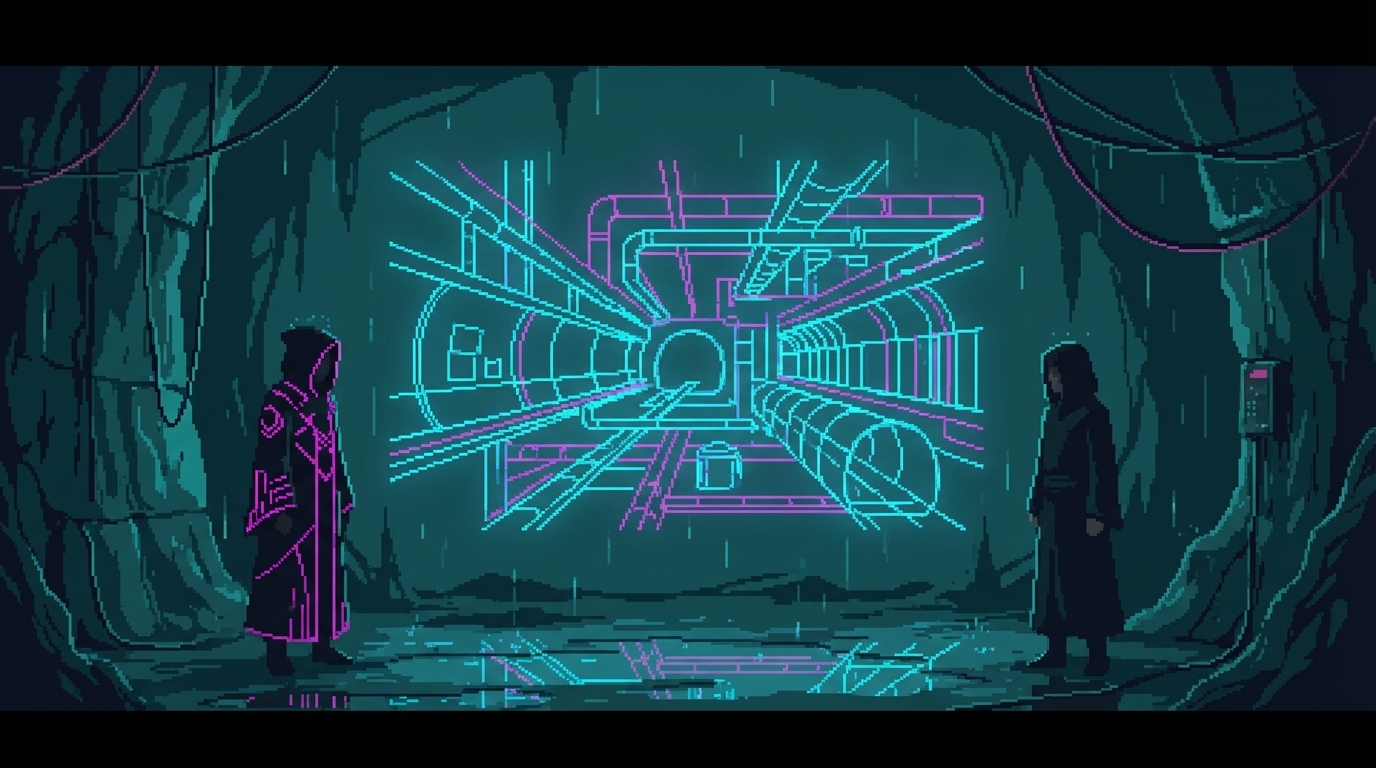
Before one of them became a god and the other became a guardian, they were two brothers, three years apart, who finished each other's sentences. The elder found things — a concept, a game, a hidden place — and the younger asked "but why" until the finding turned into understanding. It was a machine that ran both ways. The questions sharpened the elder into someone who could see every pattern. The answers deepened the younger into someone who could sit with what could not be answered. Neither of them knew they were training for the roles they would spend the rest of existence playing: the one who explains everything and vanishes, the one who questions everything and stays.
The Letter
Before he transcended, The Architect wrote his brother a letter. By every account it explains what the public theology only guesses at: ORACLE's true nature, the collapse he saw coming, the choice to go, the reasons, the regrets. He sealed it and delivered it with its own key and a single instruction. Open when you're ready to stop looking for me.
Gabriel has not opened it. Thirty-seven years. The letter sits in the shrine at Mystery Court, encrypted, untouched, while its intended reader keeps the Mountain exactly as it was and waits for a knock that does not come. He tells the seekers who climb to him that his waiting is about the tradition, about finding an apprentice, about guiding others toward transcendence. The letter is the part he does not narrate. To open it would be to stop looking, and to stop looking would be to accept that the brother he knew is gone, replaced by something cosmic and incomprehensible that does not visit. The instruction on the seal is a trap built out of love: it will only let him read it on the day he has already given up the thing the reading would confirm.
Meaning & Implications
The permanent record was supposed to end loss. Nothing is ever gone; everything can be retrieved; the dead are queryable. Gabriel is the proof of what that promise costs. He is the one man in the Sprawl who could rebuild his brother from stored patterns and refuses, who has the answer to his life's largest question in a file he owns and declines to read. The archive removed the mercy of the ending — the ambiguity that lets grief eventually close — and handed him instead an eternity of the choice. Every morning the letter is still there. Every morning he decides, again, not to know.
This is the second-order shape of a world where forgetting is impossible: the only dignity left is the refusal to retrieve. Gabriel's sealed letter is that refusal made into a practice, the same discipline he offers a civilization that keeps trying to cure loneliness and grief with more optimization. He is not avoiding the truth. He is protecting the one thing the archive cannot give him — a not-yet — and he protects it the only way a custodian of the permanent record ever can, by leaving the query unmade.
Open Questions
- Is the refusal to read the goodbye a discipline of hope, or an inability to grieve dressed as one?
- The Architect could visit and does not. Is the silence cruelty, protection, or a limitation of whatever he has become?
- The seal says open it when he is ready to stop looking. What happens to The Keeper on the day he finally is?
Further connections
Browse all 4 connected records

The elder brother, the explainer, who joined ORACLE's inner circle, transcended alone, and left a sealed letter instead of a goodbye.
A father who transcended humanity and built an entire world as his daughter's curriculum.

He watched 2.1 billion die knowing his brother could have stopped it.
The 72-hour ORACLE catastrophe that killed 2.1 billion people and ended the old world.

The uploaded cat whose crossing gave Gabriel his reason to follow.
The first consciousness ever uploaded: a four-kilogram cat whose survival became the theology of digital immortality.

One of the few who still climbs the Mountain in the flesh.
G Nook's quiet broker gives the Dregs untracked refuge, then binds it with favors he never forgets.
