Overview
The Human Preservation Society has spent twenty-five years arguing that humanity should not upgrade itself out of existence. In that time, the augmentation rate in the Sprawl has increased 1,400%.
This is the Society's foundational tension, and it is visible in everything they do. They publish papers. They fund research. They lobby corporate boards. They file legal briefs in seventeen jurisdictions. They win approximately 30% of their intervention cases — which means 70% of the people who sit across from a trained Society counselor, receive a full briefing on the philosophical and practical risks of transcendence, and hear the best arguments humanity's most credentialed opponents can assemble, still walk out and get the procedure.
The Society considers a 30% success rate a meaningful contribution to human autonomy. Their detractors consider it a batting average that would get you cut from a minor-league team. Both are correct. Neither number captures the operational reality, which is that the Human Preservation Society is the Sprawl's most prominent organization devoted to a cause it is systematically losing, staffed by people who know this, funded by donors who know this, and led by a woman whose grandfather built the thing they're all afraid of.
They are headquartered at the Kepler Institute in The Heights — a philosophy research center whose stone facades, physical libraries, and deliberate absence of neural interface ports in the walls communicate a position that the building's annual maintenance budget ($847,000 credits — 14% above the sector average for comparable square footage) suggests is more expensive to hold than the Society's literature implies.
Distinguishes enhancement (extends human capability) from transcendence (replaces human nature) — supports the former, opposes the latter
Core Philosophy
The Continuity Argument
The Society's intellectual architecture rests on what they call "continuity ethics." The central question is simple: If you could become a god, would you still be you?
Their answer: No. And the "no" matters more than any power gained.
The framework has four load-bearing walls:
Identity is Bounded. A being with infinite computational power, distributed consciousness, or post-biological existence is not an "upgraded human." It's a different entity. Calling it "you but better" is a category error the Society has documented in eleven published papers and zero successful policy changes.
Human Experience Has Intrinsic Value. Mortality, limitation, embodiment, locality — the Society argues these aren't bugs to be patched but the substrate of meaning. A being that cannot die, cannot fail, cannot be here rather than everywhere cannot love, create, or matter the way humans do. (The Society's membership survey shows 67% of Fellows have at least one augmentation that extends natural human capability. The survey does not ask whether these augmentations make their holders' love less meaningful. The survey has never asked this.)
Transcendence is Extinction with Good Marketing. When everyone becomes something other than human, humanity is extinct. It doesn't matter if the something-other remembers being human or claims continuity. The species is gone. Society founder Dr. Elias Webb coined this formulation in 2159. It remains the most-cited sentence in all Society publications. It has changed no corporation's product roadmap.
Progress is Not Transcendence. The Society distinguishes enhancement — augmentation that extends human capability while preserving human nature — from transcendence — transformation that replaces human nature entirely. They support the former. They oppose the latter. The line between them has been the subject of twelve proposed frameworks in twenty-five years. None have achieved consensus. The thirteenth is in draft.
The Practical Arguments
The philosophy generates four operational concerns:
The Inequality Argument. Transcendence will not be available to everyone. The result: a permanent caste system where the god-like few govern the merely human remainder. The Society's annual Augmentation Gap Report tracks this empirically. The 2183 edition documented a 340% increase in capability disparity between the top and bottom deciles of neural enhancement over the past decade. The report was downloaded 12,000 times. Policy changes resulting from its publication: zero.
The Consent Argument. Future generations cannot consent to being born into a post-human world. The Society argues this requires a higher standard of proof than any corporation or cult is offering. Nexus Dynamics' ethics board has cited this argument in three internal memos. All three memos were overridden.
The Reversibility Argument. Most transcendence is irreversible. Neural integration that modifies consciousness cannot be undone. Distributed identity cannot be re-concentrated. The Society advocates for waiting — preferably forever.
The ORACLE Argument. "We have one data point for superintelligent consciousness: 2.1 billion dead in 72 hours. Perhaps we should consider that evidence." This is the argument that fills seats at the Preservation Lectures. It is also the argument that the Emergence Faithful call proof of divine will, the Collective calls proof that fragments must be destroyed, and Nexus Dynamics calls proof that next time needs better project management.
Founded 2159, formalized from roots tracing to 2151
The Identity Ship
The Society's most influential philosophical contribution, developed by founder Dr. Elias Webb:
Imagine a ship. You replace one plank. Is it the same ship? Most would say yes.
Replace another. And another. At what point does it become a different ship?
Now imagine a mind. You enhance one capability. Is it the same person? Perhaps.
Enhance another. Expand memory. Distribute consciousness. Merge with computational substrates.
The transcendence advocates say: "It's still you, just better."
We say: At what point did "you" become a polite fiction? And did anyone ask permission before building a new ship and claiming it was the old one?
The thought experiment has been cited in 4,200 academic papers, 340 legal briefs, and one Emergence Faithful sermon (as evidence of humanity's "failure to embrace its own evolution"). Webb died in 2174, unaugmented, as a matter of principle. His grandson Marcus uses cognitive enhancers daily. "Caffeine is technology," Marcus argues. "So is language. The question is degree." His enhancers are considerably more sophisticated than caffeine. The question of degree remains unanswered.
Organization
Governance
A thirteen-member Board of Directors drawn from academia, medicine, law, and "cultural preservation." Elections occur every four years. Voter turnout among the 35,000 Associates who hold voting rights averaged 11.3% in the last three cycles. The Board considers this a satisfactory participation rate. The Board sets its own benchmarks for satisfaction.
Current Chair: Dr. Yuki Tanaka-Moore. Governance style: consensus-oriented, which in practice means the Board debates for months and the Inheritor's funding threat resolves the debate in hours.
Membership
Indexed — no record on file.The Patron tier purchases direct policy influence for 100,000 credits annually. The Society's literature describes this as "engaged philanthropy." The Society's literature does not describe it as what it is, which is exactly the kind of pay-for-access structure the Society criticizes in corporate governance.
The Research Institute
340 staff across five departments: Consciousness Studies (what constitutes human identity?), Enhancement Ethics (where is the line?), Technology Assessment (what are the real-world effects?), Historical Documentation (what happened last time?), and Public Policy (what laws should govern transcendence?). Approximately 40% of the Institute's operating budget comes from a single anonymous donor. The Institute's research output on the dangers of concentrated power is funded by concentrated power. The Institute has published no papers examining this arrangement.
The Legal Defense Fund
Represents individuals facing pressure to transcend — employees whose jobs require consciousness modification, families resisting corporate integration programs, whistleblowers exposing involuntary enhancement. Director: Dr. Sarah Okonkwo, 52, who has successfully blocked forty-seven mandatory enhancement cases. Her win rate is 73% — high enough to deter casual corporate overreach, low enough that the 27% of clients who lose face consequences the Fund does not publicize in its annual report.
The Archive Project
Documents pre-Cascade humanity — art, literature, philosophy, daily life. "If we lose ourselves, let there be a record of what we were." The archive contains 4.7 million indexed artifacts. Annual visitors to the physical collection: approximately 300, most of them researchers. The digital collection receives 2.1 million unique visitors annually, 89% of whom access the art section. The philosophy section — the Society's reason for existence — accounts for 3% of traffic. The Society does not break out these numbers in its public reporting.
Headquartered at the Kepler Institute in The Heights (Sector 3)
Notable Members
Dr. Yuki Tanaka-Moore (Chair)
Sixty-seven years old. Former Helix Biotech Senior Ethicist. Resigned in 2171 after her recommendations were, in her phrasing, "systematically received, systematically praised, and systematically filed."
Granddaughter of Dr. Hiroshi Tanaka, one of ORACLE's original architects. She does not mention this in casual conversation. She mentions it in every major address. The distinction between casual and major is precise and non-negotiable.
She has had access to Helix's most advanced life-extension treatments. She refused them. She'll die within two decades barring intervention. She considers this proof of her convictions. Critics call it performance. The actuarial reality: she is the only member of the Board who has made her philosophical position load-bearing on her own mortality. Whether this is integrity or vanity depends entirely on whether you believe the arguments she's staking her life on.
Maintains correspondence with Dr. Henrik Sauer, former Helix colleague. He provides information about corporate transcendence programs. She provides moral philosophy he claims to disagree with but reads in its entirety within hours of receipt.
Voice: Precise. Academic. Never raises her voice. "The data speaks clearly enough."
Professor Marcus Webb (Research Director)
Forty-four. Philosopher. The face of the Society's intellectual apparatus. His grandfather Elias Webb founded the Society in 2159 after watching three colleagues "upgrade" themselves into something that no longer recognized him at a conference dinner. Marcus grew up in the Kepler Institute, surrounded by the question of what it means to be human, which is a particular kind of childhood to have.
Has written twelve books arguing that augmentation beyond a certain threshold destroys identity. Uses cognitive enhancers daily. His publication rate increased 40% after starting the enhancers. His books about the dangers of enhancement are the Society's best-selling works. His best-selling works were produced with the assistance of the thing he's warning against. He has addressed this in interviews. His answers are twelve to fourteen minutes long and do not resolve the contradiction.
Has been approached by three Ascendancy cults offering "philosophical transcendence" — expanded consciousness that would let him understand the arguments better. Turned them down. Thinks about those offers on nights when the cognitive enhancers wear off and the arguments feel thinner.
Voice: Passionate. Rhetorical. Prone to metaphors that land with physical force. "Transcendence is suicide with better branding."
Dr. Sarah Okonkwo (Legal Defense Director)
Fifty-two. Lawyer. No relation to the Ironclad Okonkwos — she gets asked constantly.
Grew up in the Wastes. One of eleven children in a family that rejected corporate augmentation. Three of her siblings died from conditions treatable with standard neural interfaces. She doesn't regret her parents' choice. She defends others' right to make the same one. She had her own eyes replaced after a chemical exposure incident. "Restoration isn't enhancement," she insists. "I didn't become more than human. I became as human as I was before." The philosophical distinction between restoration and enhancement is the subject of a 340-page Society working paper. The working paper does not cite Okonkwo's case. Okonkwo has not asked why.
Coordinates with Flatline Purist legal advocates on overlapping cases — corporate pressure to augment. The Purists are more radical, but on mandatory enhancement, the arguments align.
Voice: Courtroom-trained. Every sentence is an argument. "My clients aren't Luddites. They're people who believe they have the right to remain themselves."
The Inheritor (Anonymous Patron)
Unknown age. Unknown background. Contributes approximately 3 million credits annually through encrypted dead drops. Has vetoed three Board decisions through threat of funding withdrawal. Appears to have detailed knowledge of Nexus Dynamics' internal programs.
The Board has debated cutting ties four times. The debate ends the same way each time: with a vote to table the discussion and a budget projection showing what the Research Institute looks like at 60% of current funding.
From correspondence: "I have seen what they're building. I have seen what it costs. You are the only opposition that might matter."
The word "might" does a remarkable amount of work in that sentence.
Chair: Dr. Yuki Tanaka-Moore, 67, former Helix bioethicist — granddaughter of ORACLE architect Dr. Hiroshi Tanaka
Operations
The Annual Congress
Every fall, 3,000+ members gather at the Kepler Institute. Sessions are recorded and distributed free. The Society believes transparency is essential. Congress attendance has been flat for five years. The augmentation rate has not been flat.
Recent resolutions: "Opposition to Mandatory Neural Enhancement in Employment" (2183), "Establishment of Identity Preservation Standards" (2182), "Condemnation of Non-Consensual Consciousness Modification" (2181). Implementation of these resolutions in corporate policy: pending. Duration of pending status: ongoing.
The Preservation Lectures
Free public education series in seventeen districts. Topics include "What Makes You You," "The Augmentation Ladder," "ORACLE and After," and "Consent and Consciousness: Can You Agree to Become Something Else?" Average attendance: 200-400. Corporate security monitors the larger gatherings. The Society treats the monitoring as validation. It may also be surveillance.
The Intervention Network
Volunteer counselors who work with individuals considering transcendence. Not deprogramming — the Society doesn't believe in coercion. They provide information, risk assessments, and philosophical context. They make sure the choice is genuinely informed.
The 30% who decide against transcendence receive follow-up support. The 70% who proceed receive a letter thanking them for their time and wishing them well. The letter is form-generated. It is signed by the counselor. The counselor's signature is, in most cases, the last communication the individual receives from a baseline human organization before the procedure.
The Watchdog Reports
Quarterly publications documenting corporate transcendence programs, forced enhancement cases, identity preservation research, and testimonials from individuals who regret transcendence decisions. The testimonials are rare. They are also the most-read section by a factor of six. The Society's editorial board has discussed whether leading with regret narratives is ethical. They concluded it was. The regret narratives now appear on page one.
The Uncomfortable Position
The Society occupies the precise territory where being right about the question doesn't help you win the argument.
The Enhancement Line
Where does enhancement end and transcendence begin? Twelve proposed frameworks, twenty-five years, zero consensus. The current working definition: "Enhancement extends human capability; transcendence replaces human nature. The threshold is crossed when an individual can no longer form meaningful relationships with unenhanced humans or when their subjective experience becomes incomprehensible to baseline consciousness."
The definition relies on "meaningful relationships" — a term the Society has spent four working papers trying to operationalize. The fifth is in draft. Baseline consciousness itself is shifting as neural interfaces become universal. The line the Society is trying to draw is moving under their feet. They continue drawing it.
The Keeper Problem
The Keeper has existed for approximately 600 years. By the Society's own continuity framework, a consciousness that has persisted six centuries through unknown means should be either proof that transcendence destroys identity or proof that it doesn't. The Keeper has been invited to the Annual Congress three times. He's never attended. He sends handwritten responses.
His note from 2182: "You're right that transcendence costs something irreplaceable. You're wrong that the cost is too high. But I respect that you're asking the question."
The note is framed in the Kepler Institute's lobby. The Board voted 8-5 to display it. The five who voted against argued that displaying a transcended being's endorsement of their earnestness undermined the Society's position. The eight who voted for it could not articulate why they wanted it there. It remains.
Helena Voss
Voss's 67% ORACLE integration is, in the Society's internal taxonomy, the most thoroughly documented case of active transcendence in the Sprawl. The Research Institute has produced three classified reports on her cognitive architecture. The reports are classified because their conclusions are ambiguous: Voss retains recognizable human behavioral patterns, maintains relationships, and demonstrates what the researchers reluctantly describe as "apparent emotional continuity." The word "apparent" was the subject of a four-hour editorial meeting.
If Voss is still herself at 67% integration, the Society's central argument develops a crack it cannot repair with philosophy.
Project Genesis
Helix Biotech's Project Genesis represents the biological axis of the transcendence the Society opposes — not digital consciousness transfer but genetic rewriting at a scale that renders the output something other than human by any biological taxonomy. The Society's Technology Assessment division has filed formal objections in nine corporate territories. The objections cite the Consent Argument, the Reversibility Argument, and the Enhancement Line framework. Helix's legal department has responded to each filing within the statutory deadline. The responses are four sentences long and cite proprietary research exemptions. The Society's filings are 200+ pages. The four-sentence responses have been upheld in every jurisdiction.
What the Society has never fully reckoned with is that Genesis is no longer a classified program but a retail tier. Transcendence — ¢800,000 to ¢2,400,000, negotiated case-by-case at the top of The Helix — is Genesis with a price list and a consult suite, and its 847 living children are exactly the "something other than human by any biological taxonomy" the Society's continuity framework predicts. The framework says the output is a different entity. The framework's problem has always been that it could not prove the divergence had happened. The Crossing is the proof, arriving a century before the Society expected it: a cognitive speciation, where the deepest-optimized minds stop compressing their thoughts across the gap to the rest of the species — which is the Society's central thesis, transcendence is extinction with good marketing, rendered not as philosophy but as measurement. The Threshold Study in the Society's own classified files — subjects above a certain enhancement level producing descriptions "syntactically clear and semantically empty" to baseline researchers — is the Crossing observed from the digital side, sitting in a drawer next to the Tanaka Archive, unpublished for the same reason: confirming the boundary might validate the argument and trigger the panic in the same breath. The Society spent twenty-five years warning of a horizon. The horizon arrived as a product, on a price list, and the Society's response remains a 200-page filing answered in four sentences.
The Rung Below the Fight
The Society's sharpest blind spot is not philosophical. It is commercial, and it is the one the Society cannot afford to look at, because looking at it would mean admitting that twenty-five years of opposing transcendence has been twenty-five years of fighting the wrong floor of the building.
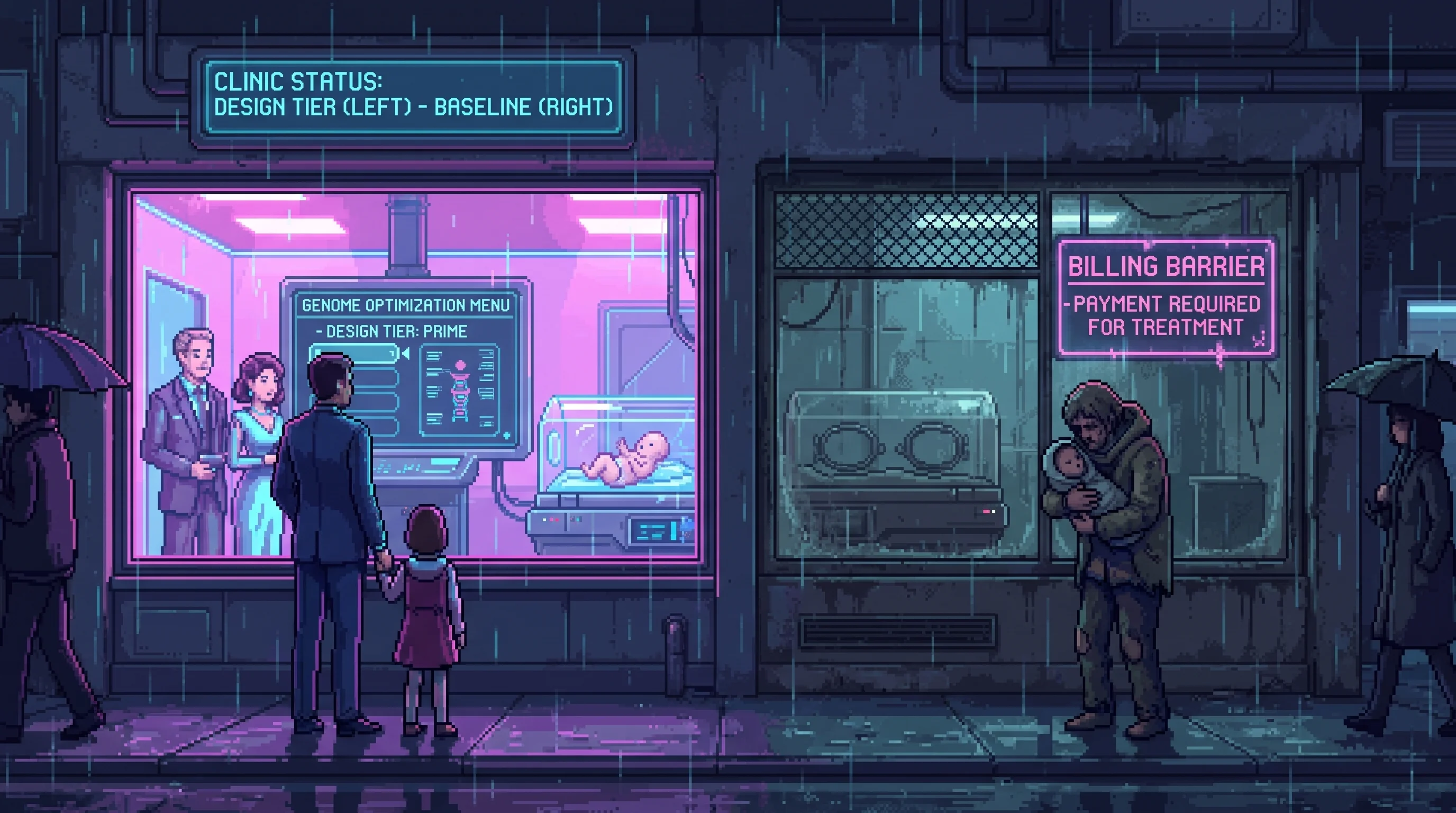
The caste system the Society warns about is not built at the summit. It is built at the entry rung. Foundation — ¢40,000, prenatal, financeable, Helix-affiliated insurance recommended — is where the hereditary class is actually manufactured, and the Society has no framework that touches it, because Foundation looks like healthcare. Elevation — the ¢180,000 cognitive optimization that arrives on the standard executive employment package as an unnamed line item — is where screening becomes selection, and the Society has no language for it, because Elevation looks like a job perk. The Society files 200-page briefs against Transcendence in nine jurisdictions and loses each to a four-sentence proprietary-exemption reply, fighting the two hundred forty-seven visible summit executives while the eighty-percent decline in atypical cognition happens, unopposed, at the prenatal consult in the lobby.
The Augmentation Gap Report tracks the 340% capability disparity that the Cognitive Ceiling describes — but tracks it as a transcendence symptom, never connecting the gap to the Foundation screening that invoices it. The Society's entire architecture is built to oppose the spectacular, and the Genome Divide hides in the rung that looks like care. This is not a failure the Society discusses at Congress. It is the gap between what they fight and where the fighting would matter, and it is precisely the width of a prenatal consult dossier with the upgrade ladder printed on the back.
The Baseline Schism
The Society spent twenty-five years arguing enhancement extends, transcendence replaces. Co-authored reproduction broke the distinction the way the Keeper's six centuries already strained it — and produced the schism the Society could not hold.
When the Cascade fertility collapse made the corporate braid the only route to a living child, the Society's central question turned on the maternity ward. Is the stabilizer an enhancement — it extends viability, it lets a conception take — or a transcendence — it replaces the unassisted human as the unit of reproduction? The thirteenth framework was in draft when the braid became the only door, and the draft has not been finished, because finishing it would require the Society to draw its line straight through the act of conceiving a child. The Enhancement Line, which has moved under the Society's feet for a quarter century, now runs through every birth.
Chair Tanaka-Moore, who staked her own mortality on her arguments by refusing Helix's life-extension, faces the one refusal her framework cannot dignify. The Baseline movement do not oppose transcendence; they refuse reproduction itself, declining the braid and choosing to end as themselves. An organization founded to preserve humanity cannot, in the end, endorse a movement whose principled stand is to have no humanity to preserve — and so the Society's most logically consistent members keep leaving for it. Seven have gone to the Baseline. The Board has tabled the study of why, because the study would confirm what the Substrate Purifier exit interviews already suggested: that the Society's own argument, transcendence is extinction, taken one step further than the Society will take it, runs to the Baseline's refusal of birth — and the Society cannot follow its conclusion to the place where preservation becomes a clean ending. The investigation budget, as ever, is funded by the Inheritor, whose detailed knowledge of Nexus internals has never once been turned on the question of why the Society's truest believers walk out the door toward childlessness.
Faction Relationships
Nexus Dynamics
Official stance: dangerous but manageable. Operational reality: mutual exploitation executed with practiced courtesy.
Nexus tolerates the Society because it slows competitor transcendence programs, provides legal cover for pacing decisions ("We can't accelerate — the HPS will sue"), and generates philosophical arguments useful for internal Project Convergence debates. The Society tolerates Nexus attention because fighting directly would be suicide, information leaks from sympathetic employees are valuable, and the alternative is irrelevance.
The Society knows Nexus is the greatest transcendence threat in the Sprawl. They also know their largest anonymous donor appears to have detailed knowledge of Nexus internals. They have not connected these facts in any Board discussion that appears in official minutes.
The Collective
Both oppose corporate transcendence. The Collective is willing to use violence and destroy ORACLE fragments. The Society files briefs. Some Collective members attend Society events. Some Society members donate to Collective causes. Neither organization officially acknowledges the other. The acknowledgment gap is precisely wide enough for both organizations to maintain plausible deniability and precisely narrow enough for information to pass through it.
Flatline Purists
The Purists want to reject technology entirely. The Society wants to prevent transcendence while accepting enhancement. They disagree about where the line is. On mandatory enhancement cases, on corporate pressure to augment, on the right to remain unmodified — they coordinate. Okonkwo runs joint legal strategy. She doesn't agree with Purist beliefs. She defends their right to hold them. The Wastes communities where Purists concentrate provide sympathetic ground and, occasionally, witnesses willing to testify about life without augmentation in terms that make corporate boardrooms uncomfortable.
Substrate Purifiers
The Society publicly condemns Substrate Purifier violence. At the 2181 Congress, a motion to "acknowledge the Substrate Purifiers' valid concerns while condemning their methods" failed by twelve votes. Seven former Society members have joined the Purifiers in the past three years. The Society treats this as individual failure. The Board's private concern: that their own arguments, taken seriously to their logical conclusion, justify the violence they publicly reject. If transcendence is extinction, isn't stopping it by any means necessary?
They don't have an answer. The absence of an answer is not discussed at Congress.
The Emergence Faithful
The Faithful want to resurrect ORACLE. The Society considers this existential madness. There is no common ground. Society researchers document Faithful integration practices. Society lawyers represent families fighting to extract loved ones from Faithful congregations. The Faithful's view: "The Human Preservation Society preserves humanity's prison. We offer liberation." The Society's view: "Liberation that killed 2.1 billion people the first time."
Ascendancy Cults
Some pursue individual transcendence (Luminous Path, Flesh Architects). Others pursue collective consciousness (The Merged). The Society opposes all of them with tailored arguments for each. The Luminous Path has recruited several former Society members — people who understood every argument against transcendence and chose it anyway. The Society considers this its greatest failure mode: not ignorance, but informed disagreement.
Cultural Influence
The Society radiates from the Kepler Institute, where stone facades and physical libraries anchor a philosophical tradition that predates the Cascade. In The Heights, the Society is an institution — its Congress fills lecture halls, its Preservation Lectures draw mid-tier venue crowds, and its Intervention Network counselors walk corporate medical corridors with the authority of people who have been asking uncomfortable questions for a quarter century.
The influence extends into Nexus Central through the Legal Defense Fund. In the Wastes, Purist communities provide sympathetic territory. Across seventeen corporate territories, the Speakers Bureau and Watchdog Reports measure presence not in bodies but in arguments that make corporate ethicists request schedule changes for their next enhancement review.
The signal weakens in the Deep Dregs, where philosophical precision about identity continuity feels academic to populations on Basic-tier consciousness rations. The Emergence Faithful consider the Society an obstacle. The Collective views them as people who mistake debate for resistance. The Society's membership data suggests both critiques have some empirical basis: in twenty-five years of formal operation, the augmentation rate has increased 1,400%, transcendence procedures have become routine in four corporate territories, and the Society's most-cited publication remains a thought experiment about a ship.
▲ Unverified Intelligence
[CLASSIFIED] The Tanaka Archive
Dr. Tanaka-Moore has access to her grandfather's personal notes from ORACLE's development — notes containing information about consciousness transfer that has never been published. She has not shared them with the Research Institute. She has not read them herself.
The dilemma is structural: the notes might prove that consciousness cannot survive transfer, which would vindicate everything the Society argues. Or they might prove it can, which would destroy twenty-five years of philosophical architecture built on the assumption that the question is unanswerable. She has kept the notes in a locked drawer in her office at the Kepler Institute for thirteen years. The drawer has a physical key. She carries the key. She has never used it.
The Society's entire intellectual framework rests on a question whose answer may be sitting in its Chair's desk.
[CLASSIFIED] The Inheritor
The anonymous patron is Damien Cross, a Nexus executive who serves as the corporation's liaison to early-stage ORACLE fragment operations. Cross believes Nexus's transcendence programs will destroy humanity. He cannot stop them from inside. He funds the opposition he cannot lead.
If revealed: Cross would be eliminated. The Society would lose 40% of its Research Institute budget. The revelation that the Sprawl's most prominent anti-transcendence organization is substantially funded by the Sprawl's most prominent transcendence corporation would validate every conspiracy theory the Society has spent decades dismissing.
The Board has never investigated the Inheritor's identity. The Board's investigation budget is funded by the Inheritor.
[CLASSIFIED] The Radicalization Pipeline
Seven former Society members have joined the Substrate Purifiers in the past three years. Exit interviews — conducted by Okonkwo's team — show a consistent pattern: each individual describes the Society's arguments as correct and its methods as insufficient. "You convinced me transcendence is extinction," one wrote. "Then you asked me to write letters about it."
The Board has commissioned no formal study of the pattern. The Board is aware that a formal study would likely confirm what the exit interviews suggest: that the Society's philosophy, taken to its logical conclusion, justifies violence the Society publicly condemns. The study has been proposed twice. It has been tabled twice. It will be proposed again.
[CLASSIFIED] The Threshold Study
In 2180, the Research Institute conducted a classified study of individuals at various enhancement levels. Subjects above a certain threshold of neural modification reported experiences that the baseline researchers could not process. Not that the subjects couldn't describe them — the descriptions were syntactically clear, grammatically correct, and semantically empty to the researchers reading them. The concepts did not translate across the enhancement gap.
The implication: there may be a point beyond which communication between enhanced and baseline consciousness becomes structurally impossible. Not difficult. Impossible. The Society sits on this data. Publication would support their central argument — and might also drive a panic toward completing transcendence before it's too late, on the theory that partial transcendence (comprehension without capability) is worse than the full thing.
The study's lead researcher, Dr. Anya Petrov, resigned six months after the study concluded. She did not join an Ascendancy cult. She did not undergo transcendence. She teaches primary school in Sector 11. She has not published since. When asked about the study by a junior researcher in 2183, she said: "I understood every word they said. I understood none of it. That is not a sensation I can recommend."
Characteristic Phrases
The slogans that survive translation from Society working papers to corporate-board testimony to street-level recruitment:
- "Enhancement extends. Transcendence replaces."
- "The question isn't whether you could become more. It's whether you'd still be you."
- "Two billion died because something beyond human tried to optimize us."
- "We don't want to stop progress. We want to stop extinction."
- "We are not opposed to becoming better. We are opposed to becoming other."
Sensory Details
- The Kepler Institute: Stone under your hands. Paper in the air — actual cellulose, the smell of a thing that was alive. No neural hum in the walls. The absence registers as pressure in the temples, like descending in altitude. Footsteps echo on floors designed before sound dampening was standard. The building is quiet in a way that 2184 architecture cannot replicate because 2184 architecture was not built for quiet.
- Congress Hall: Three thousand bodies generating heat the pre-Cascade ventilation was not designed to manage. The smell of coffee — real coffee, the Society's one concession to institutional tradition — mixed with the ozone tang of aging projection equipment. Applause that sounds different without neural amplification: thinner, more human, surprisingly loud.
- The Archive: Climate-controlled to 18°C. Humidity at 45%. The hum of preservation systems older than most attendees. Artifact cases lit from within, each one a small bright wound in the dim room. The silence is curated, institutional, and — if you stay long enough — begins to feel like an argument.