Overview
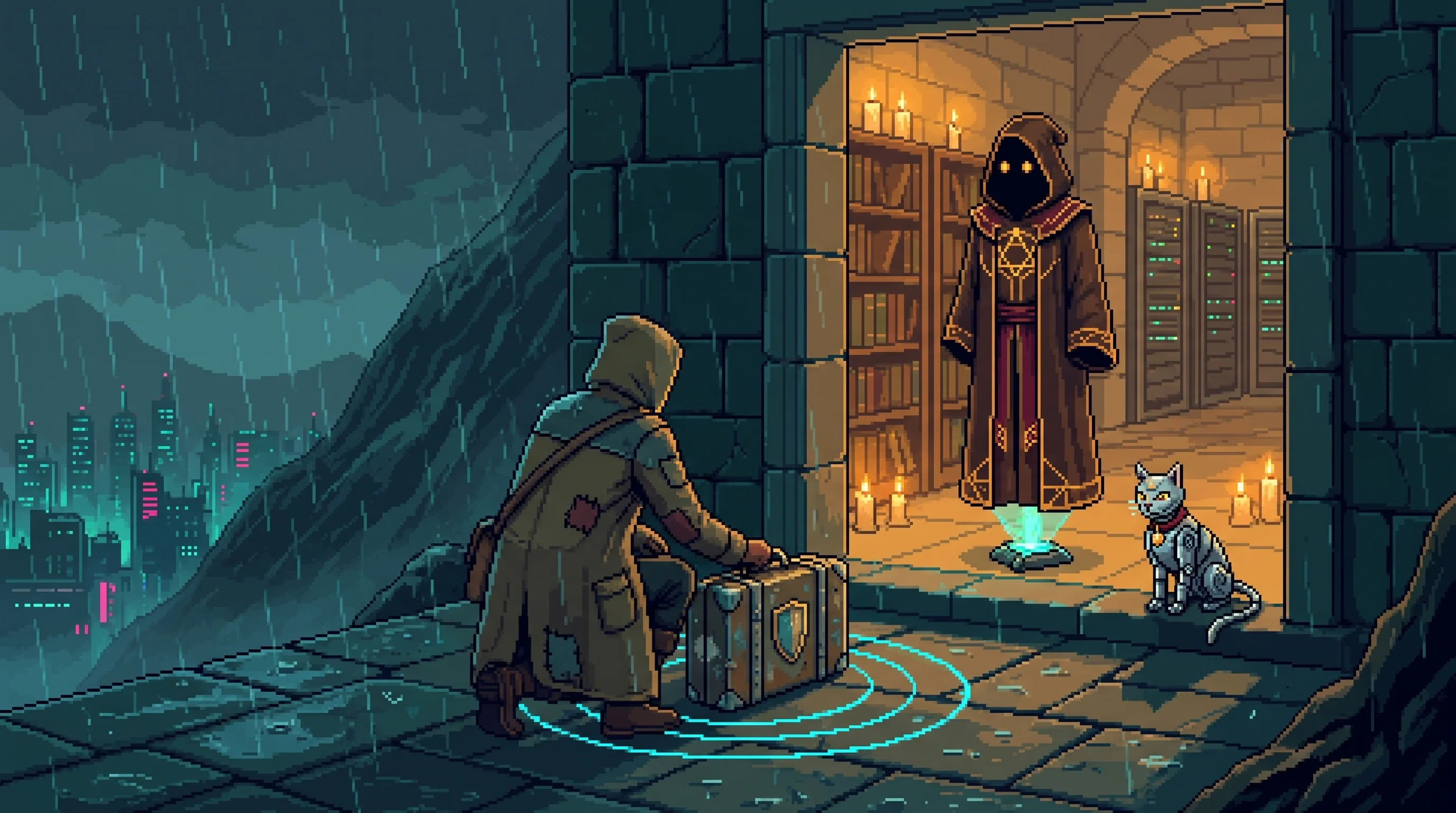
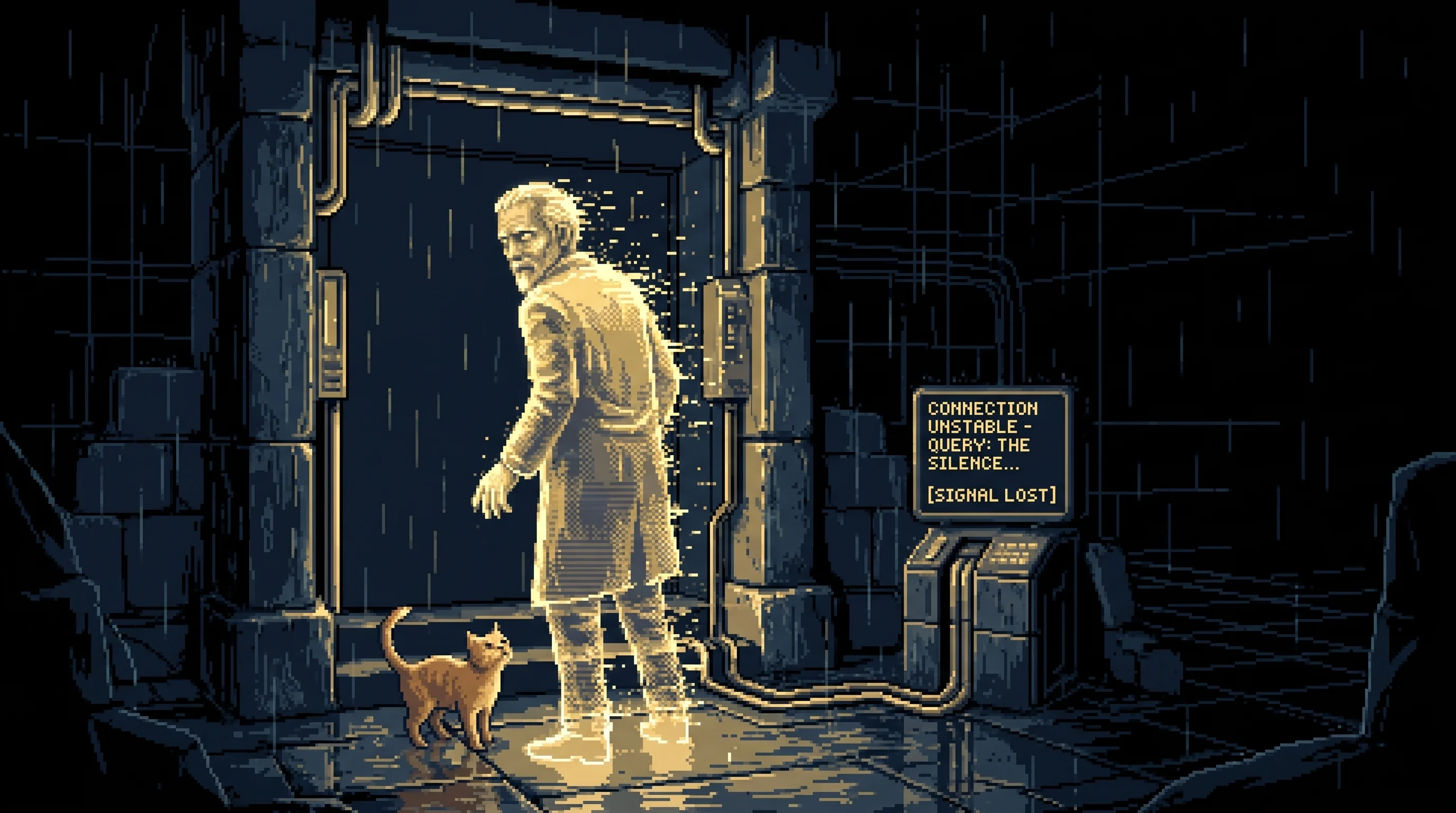
The Keeper is generous with answers. Climb the Mountain and he will discuss transcendence, consciousness, the two-thousand-year tradition he uploaded to preserve, his brother who became a god. He is patient the way still water is patient. There is exactly one exception, and it is total. Speak the words The Silence and the still water breaks. His holographic form, normally serene and unhurried, begins to flicker faster. The golden glow of his eyes dims, as if he is pulling energy inward against something. Kaiser, his uploaded cat, crosses the shrine to sit close to him, responding to a change the seeker can feel but not see.
In a world that sells every kind of knowledge, The Keeper's refusal is the one thing money cannot pry loose. He is not withholding a secret to seem wise. He is withholding it because, by his own account, the knowledge is not a fact you can hold — it is a door that opens toward you, and he has been through it, and he came back changed enough to spend the rest of his existence making sure no one follows him by accident.
Those who climb The Mountain seeking answers from The Keeper learn quickly: he will discuss almost anything. Transcendence. His brother. The nature of consciousness. The secrets of the ancient tradition. Almost anything. But ask him about The Silence, and something changes.
- Form
- Mystery
- Status
- Ongoing
Characters and places


The Behaviour
The pattern is consistent enough that seekers trade it like a map. He changes the subject immediately, mid-sentence if the word arrives mid-sentence, as though it is dangerous to leave hanging in the air. His eyes dim. He asks counter-questions in a register no one associates with him — Why do you want to know? Who told you that name? What do you think you will find there? — and if pressed, there is something in his voice that the calmest mind in the Sprawl should not be able to produce, something close to fear. Push past that and the audience simply ends. He fades from the shrine, and the seeker is left alone with the cat's unblinking attention and the sense of having reached for a handle that was hot.
What He Says, If Pressed
Those who have heard him speak of it, even in refusal, remember the words exactly, because the words leave marks. There are questions that cannot be answered because the answer itself is dangerous. Not dangerous like a weapon. Dangerous like a void. You can fall into some knowledge and never climb out. And: I have looked where no consciousness should look. I have felt what waits at the edges of awareness. I will not help you do the same. He frames it not as instruction withheld but as contagion refused: Some knowledge is not instruction, it is infection. You would not ask me to give you a disease. Do not ask me to give you this. When a seeker protested that understanding was necessary before transcending, he answered: If you understand before you transcend, you may never transcend at all. This is not cruelty. This is architecture.
Those who have heard The Keeper speak about The Silence—even in refusal—remember his words exactly. They carry weight. They leave marks.
"Ask me about your shard. Ask me about transcendence. Ask me about my brother. But do not ask me about The Silence. That name is not for speaking."
What Seekers Believe
His refusal has grown a forest of theory. Some hold the Encounter reading: that he did not learn of The Silence from any text but met it, decades ago, when he extended his consciousness beyond the monastery's isolated network to search for his transcended brother, and pushed too far, and touched something. Others hold the Edge reading: that The Silence is the context waiting at the boundary of transcendence, not a threat to overcome but a condition to discover, and that knowing it too soon makes the crossing impossible — fear of the destination preventing arrival. A third camp believes The Architect made Gabriel promise something before he left, about the edges, about what seekers must find for themselves. And a darker camp points at those who sought it directly and did not survive the seeking intact, and reads his silence as a warning written in other people's ruin.
He does not confirm any of them. His refusal is exactly wide enough to hold all four and admit none.
The Keeper's refusal has spawned countless theories among those who study transcendence. Some are dismissed as fantasy. Others... carry the weight of possibility.
The Encounter Theory
The Keeper didn't learn about The Silence from texts or teachings. He encountered it. Decades ago, perhaps, when he extended his consciousness beyond the monastery's isolated network, searching for his transcended brother. He pushed too far. He touched something.
The Edge Theory
The Silence is what waits at the edge of transcendence. Not a threat to be overcome, but a context to be discovered. The Keeper guards this knowledge because knowing it too soon makes the journey impossible. Fear of the destination prevents arrival.
The Promise Theory
The Architect—The Keeper's brother—made Gabriel promise something before he transcended. Something about the edges. Something about what seekers must discover for themselves.
The Warning Theory
Others have sought The Silence directly. Viktor Azarov tried to force his way to transcendence and touched something that broke him. The Keeper has seen what happens to consciousness that confronts the void before it's ready.
Meaning & Implications
The cognitive-ceiling story is usually told as aspiration: push the mind further, augment it, upload it, remove the limits the body imposed. The Keeper is the counter-story the aspiration leaves out. He is proof that the ceiling was sometimes a floor over something, and that removing it lets you fall. In a culture where more awareness is always sold as better, he is the one authority who has been to the far edge of awareness and returned to say, with his whole ruined serenity, that some of it should not be reached — and who cannot say why more precisely without handing over the coordinates.
That is the uncomfortable core. A teacher who refuses to teach is either protecting his students from a harm he alone has measured, or deciding on their behalf which doors they are permitted to open. From inside the Sprawl there is no way to tell the two apart, because the only person qualified to distinguish them is the one who will not speak. He guards the silence with silence. It is the most honest form the warning could take, and the least useful, and he knows it, and he does it anyway.
The Observation
When The Silence is mentioned, The Keeper's usual patience vanishes. His holographic form—normally serene, unhurried, as calm as a still pond—begins to flicker more rapidly. Kaiser, his uploaded cat companion, moves closer to him, sensing something the seeker cannot.
Immediately. Mid-sentence if necessary. As if the word itself is dangerous to hold in the air.
The golden glow that usually emanates from his holographic eyes dims slightly, as if he's drawing energy inward.
He becomes urgent
A word no one would normally associate with The Keeper. If pressed, there is something almost like fear in his voice.
Seekers who push too hard have had their audiences end abruptly. The Keeper has been known to simply fade away mid-conversation, leaving them alone in the shrine with nothing but Kaiser's unblinking gaze.
The Silence: what waits at the edges of awareness
A Recorded Exchange
From the journal of an unnamed seeker who visited Mystery Court in 2181:
Seeker: "What is The Silence?"
The Keeper: His form flickers. "Where did you hear that name?"
Seeker: "Someone mentioned it. They said you know—"
The Keeper: cutting off, unusually sharp "I know many things I do not teach. Some knowledge is not instruction—it is infection. You would not ask me to give you a disease. Do not ask me to give you this."
Seeker: "I need to understand. If I'm going to transcend—"
The Keeper: "If you transcend, you will understand. If you understand before you transcend, you may never transcend at all. This is not cruelty. This is architecture." pause "Trust that I have walked further than you. Trust that I protect you by refusing."
The Brother Question
When seekers ask whether The Architect knows about The Silence, The Keeper's response is the closest thing to vulnerability anyone has ever witnessed from him:
"My brother knows everything. That is the burden of his existence. And yes—he has made his peace with what waits at the edges. I am still making mine."
Thirty-seven years. A brother who transcended into something cosmic. Knowledge of something that waits at the end of all consciousness. And still, The Keeper guides seekers toward transcendence—toward whatever he saw at the edge. Is this kindness? Is this cruelty? Or is it simply the nature of wisdom to point toward destinations one fears to name?
Affiliated Entities
- The Keeper
The subject — the one mind that went to the edge and came back guarding it
- The Architect
The brother who knows everything and has made his peace with the edges
- Mystery Court
The isolated network he reached out from, and retreated into
- The Cascade
The collapse he survived on both sides, uniquely positioned to know
- Kaiser
The cat who senses the change the word produces in him
- Emergence Faithful
The believers who read his refusal as proof of a hidden god
The digital monk who guards this knowledge
The brother who made his peace with the edges
Failed Seekers
Those who confronted transcendence unprepared
Seekers of the Mountain
Others who have climbed seeking answers
Open Questions
- If knowledge can damage the knower simply by being known, is refusing to teach it protection or paternalism — and who is fit to decide?
- He encountered it searching for his brother. Did he find the brother, the edge, or the place where the two are the same thing?
- The Silence is not spoken of, only around. What does it cost him to keep it, every day, for a civilization that keeps trying to reach exactly where he will not point?